Process Approach to Quality
Management System
[Rashid Mahmood]
Neutro Pharma (Pvt.) Limited
Lahore, Pakistan
Objective
Understanding the concept of
“Process Approach” &
techniques/skills to
implement this approach.
Key Issue
 Exceptionally, If your organization has
struggled to show measurable and
sustainable improvements in performance for
your customers or toward top-priority
management goals, then ISO may be thought
to be in "maintenance mode" within your
organization, rather than a vital tool to
address today's critical business needs.
Key Issue (Continued)
 Common symptoms of the situation are:
– The same corrective actions come up again and
again.
– Audit reports identifying seemingly "petty" issues.
– Management review meetings "going through
the motions" and often poorly attended.
– Improvements made in the past don't show
sustained results today.
– There is a "burn out" factor within your internal
auditor team.
But, WHYdoes this occur?
Key Issue (Continued)
 These indications point to a quality
management system (QMS) that has
generally LOST ITS FOCUS.
Key Issue (Continued)
 Having an effective process management
process may be a "missing link" in your
current QMS and this gap may be a key
reason your system (ISO) has lost its luster.
 To simplify
“Process Approach is missing”
What is a “Process”?
 “Set of interrelated or interacting activities,
which transforms inputs into outputs”
(ISO 9001:2008)
 These activities require allocation of
resources such as people and materials
A Generic Process
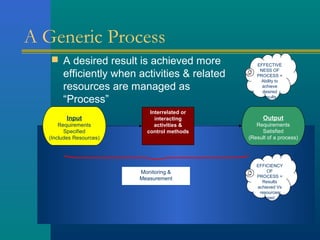
 A desired result is achieved more
efficiently when activities & related
resources are managed as
“Process”
Input
Requirements
Specified
(Includes Resources)
Output
Requirements
Satisfied
(Result of a process)
Interrelated or
interacting
activities &
control methods
EFFECTIVE
NESS OF
PROCESS =
Ability to
achieve
desired
results
EFFICIENCY
OF
PROCESS =
Results
achieved Vs
resources
used
Monitoring &
Measurement
A Generic Process (continued)
 Inputs and intended outputs may be tangible
(equipment, materials or components) or
intangible (energy or information). Outputs
can also be unintended, such as waste or
pollution.
 Each process has customers and other
interested parties (either internal or external
to the organization), with needs and
expectations about the process, who define
the required outputs of the process.
A Generic Process (continued)
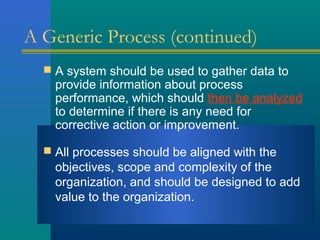
 A system should be used to gather data to
provide information about process
performance, which should then be analyzed
to determine if there is any need for
corrective action or improvement.
 All processes should be aligned with the
objectives, scope and complexity of the
organization, and should be designed to add
value to the organization.
A Generic Process (continued)
 Process effectiveness and efficiency can be
assessed through internal or external review
processes.
What is “Process Approach”?
 “The application of a system of processes
within an organization, together with the
identification and interactions of these
processes, and their management to
produce the desired outcome, can be
referred to as the “process approach“.
(ISO 9001:2008)
Function-based Management
(A Traditional, Prevailing Style)
 Organizations are often structured into
a hierarchy of functional units.
Organizations are usually managed
vertically, with responsibility divided
among functional units.
 The end customer or other interested
party is not always visible to all
involved.
Function-based Management (continued)
(A Traditional, Prevailing Style)
 Consequences are
– A series of “Complex Chains” or interactions
between departments or divisions;
Function-based Management (continued)
(A Traditional, Prevailing Style)
–Unclear relationship between
INPUTS, RESOURCES & Outputs;
Function-based Management (continued)
(A Traditional, Prevailing Style)
–People competing (fighting) for
resources;
Function-based Management (continued)
 Functional……..Complicated Processes
Function-based Management (continued)
(A Traditional, Prevailing Style)
– Non-value adding (inefficiency adding)
activates exist (process interfaces poorly
managed)
– No responsibility for the whole range of the
process (departmental mentality)
– Inspection & firefighting (Not preventive)
– Stability seeking (Doesn’t trigger
improvement)
Function-based Management (continued)
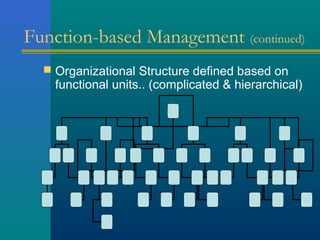
 Organizational Structure defined based on
functional units.. (complicated & hierarchical)
Function-based Management (continued)
 Functional………..
As Marketing Requested It
Function-based Management (continued)
 Functional………..
As Sales ordered it
Function-based Management (continued)
 Functional………..
As Engineering designed it
Function-based Management (continued)
 Functional………..
As Production Manufactured it
Function-based Management (continued)
 Functional………..
As Plant installed it
Function-based Management (continued)
 Functional………..
What the customer wanted
Function-based Management (continued)
What is Wrong………..????
Function-based Management (continued)
 This is the reason:
– Process disconnection across departments in an
organization with functional orientation.
Function-based Management (continued)
(A Traditional, Prevailing Style)
 This leads to “LITTLE” or “NO”
improvement as actions are usually
focused on the functions, rather than
overall benefit of to the organization
Process Approach
 The process approach in the contrary:
–introduces horizontal management,
crossing the barriers between
different functional units and unifying
their focus to the main goals of the
organization.
–It also improves the management of
process interfaces
Process Approach
 A process approach is thus a powerful
way of organizing and managing
activities to create value for the
customer and other interested parties.
Process Approach
 The processes are managed as a
system defined by the network of the
processes and their interactions, thus
creating a better understanding of
added value
Process Approach
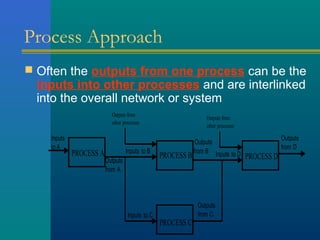
 Often the outputs from one process can be the
inputs into other processes and are interlinked
into the overall network or system
PROCESS A
PROCESS C
PROCESS B PROCESS D
Inputs
to A
Inputs to B
Outputs
from A
Inputs to C
Outputs
from C
Outputs
from B Inputs to D
Outputs
from D
Outputs from
other processes
Outputs from
other processes
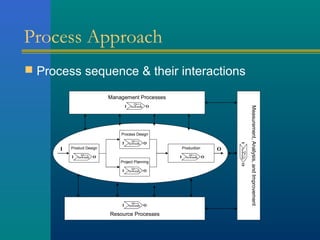
Process Approach
 Process sequence & their interactions
Resource Processes
Product Design
Process Design
Project Planning
Production
Management Processes
Measurement,Analysis,andImprovement
OI
IO
I O
I O
I O
I O
I O
I O
Resource Processes
Product Design
Process Design
Project Planning
Production
Management Processes
Measurement,Analysis,andImprovement
OI
IOIO
I OI O
I OI O
I OI O
I OI O
I OI O
I OI O
Process Approach
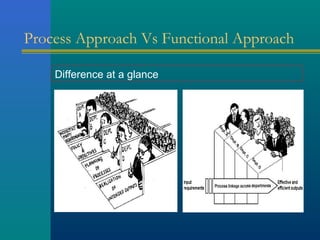
Process linkage across departments in an
organization with process orientation
Process Approach Vs Functional Approach
Difference at a glance
How to implement “Process Approach”
 Identify Processes
 Process Type?
 Process Name?
 Process Owner?
How to implement “Process Approach”
 Identify Processes
 Management Processes
– Planning (Strategic & Operational)
– Resource Management
– Management Review
How to implement “Process Approach”
 Identify Processes
 Product Realization Processes
– Contract Management
– Transportation
– Storage
– Product Design
How to implement “Process Approach”
 Identify Processes
 Resource Provision Processes
– Recruitment
– Training
– Maintenance
– Payment
– Document Control
– Information Management
How to implement “Process Approach”
Identify Processes
 Monitoring & Measurement Processes
– Internal Audit
– Inspection
– Testing
How to implement “Process Approach”
Identify Processes
 Monitoring & Measurement Processes
– Internal Audit
– Inspection
– Testing
How to implement “Process Approach”
Identify Processes
 Name the Process
– Purchase Process
– Order Fulfillment Process
– Training & Development Process
How to implement “Process Approach”
 Identify Processes
 Define the “Process Owner”
– Process owner is one who plays central role
in the process & has the basic responsibility
of implementing the process
– Everyone’s Responsibility is No One’s
Responsibility
How to implement “Process Approach”
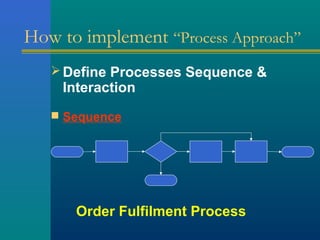
Define Processes Sequence &
Interaction
 Sequence
Order Fulfilment Process
How to implement “Process Approach”
 Define Processes Sequence & Interaction
 Interaction
Monitoring & Measurements
Finance HRPlanning
How to implement “Process Approach”
 Plan the Processes
Define the activities within process
Define monitoring & measurement requirements
Define the resources needed
Verify processes against planned objectives
How to implement “Process Approach”
 Implement & Measure the Processes
 Analyze the Process
 Take Corrective Actions to Improve
Process
Process Mapping
 What is Process Mapping?
–“Process mapping is a
workflow diagram to bring
forth a clearer understanding
of a process or series of
parallel processes.”
Process Mapping
 Process mapping is the first step of
process management. It uses tools
that enable us to:
– Document,
–Analyze
–Improve
–Streamline, &
–Redesign the way we do our works
Process Mapping Techniques
Make your goal to define three
process states:
– “As Is”
–“To Be”
–“Could Be”
Process Mapping Techniques
““As Is”As Is” Process State
– It is how our process/work is
currently being performed.
–In any journey, it is important
to know “where we are”“where we are” before
we head off in a new direction.
Process Mapping Techniques
““As Is”As Is” Process State
– Many re-engineering efforts
fail because
managers/consultants reach
for dramatic breakthroughs
without understanding how (or
why) current processes
operate.
Process Mapping Techniques
 ““To Be”To Be” Process State
– It consists of the optimal
performance level of “as is”“as is” state.
–In other words, if we streamline the
existing process & remove all
reworks, delays, bottlenecks, and
assignable causes of variation, we
will achieve the “To Be”“To Be” state.
Process Mapping Techniques
 ““Could Be”Could Be” Process State
– It is a new level of performance
that can be achieved via process
re-design.
–This state requires “out of the box”“out of the box”
thinking.
–This is the exact process re-
engineering.
Process Mapping Techniques
 Hierarchical Process MappingHierarchical Process Mapping
Macro/organization Level Process Mapping
Micro/activity Level Process Mapping
Middle Process Mapping
Process Mapping Techniques
 Macro/organization Level Process MapMacro/organization Level Process Map
– Mapping process commences fromMapping process commences from
organizational level maps or macroorganizational level maps or macro
level & hierarchically moves to thelevel & hierarchically moves to the
detail or micro level of system.detail or micro level of system.
Process Mapping Techniques
 Middle-Level Process MapMiddle-Level Process Map
– We can map the processes or sub-We can map the processes or sub-
processes for some selected fromprocesses for some selected from
the organizational overviewthe organizational overview
process maps into process levelprocess maps into process level
maps.maps.
– Purchase process map of aPurchase process map of a
company is an example of middle-company is an example of middle-
level process maplevel process map
Process Mapping Techniques
 Activity/Detail Level or Map (Micro-Activity/Detail Level or Map (Micro-
Level Process MapsLevel Process Maps
– Usually, activity or detail levelUsually, activity or detail level
process maps are constructed &process maps are constructed &
analyzed preferably using flowanalyzed preferably using flow
charting method.charting method.
Constructing Process Flow Charts
 Step 1:Step 1: Determine the Process
Boundaries
– Where does a process begin?Where does a process begin?
– Where does a process end?Where does a process end?
– Describe the beginning step in anDescribe the beginning step in an
oval flowchart symboloval flowchart symbol
Start
Constructing Process Flow Charts
 Step 2:Step 2: List the Process Steps
– Ask yourself “what happens next”?Ask yourself “what happens next”?
– List these steps & add each to theList these steps & add each to the
flowchart as rectangleflowchart as rectangle
– Don’t put arrows until laterDon’t put arrows until later
Activity/Sub-process Activity/Sub-process
Constructing Process Flow Charts
 Step 3:Step 3: Sequence the Process Steps
– Determine the sequence of eachDetermine the sequence of each
activity/sub-processactivity/sub-process
– Numbering of boxes is preferableNumbering of boxes is preferable
Activity/Sub-process
(1)
Activity/Sub-process
(2)
Activity/Sub-process
(3)
Activity/Sub-process
(4)
Constructing Process Flow Charts
 Step 4:Step 4: Draw Appropriate Symbols
–OvalOval
It acts asIt acts as “Terminator”“Terminator”
Shows input toShows input to startstart the processthe process
or output at theor output at the endend of theof the
process.process.
Start End
Constructing Process Flow Charts
 Step 4:Step 4: Draw Appropriate Symbols
–Rectangle (“Box”)Rectangle (“Box”)
RepresentsRepresents “Process/Sub-“Process/Sub-
process”process”
ShowShow “Task”“Task” oror “Activity”“Activity”
performed in the processperformed in the process
Activities
Constructing Process Flow Charts
 Step 4:Step 4: Draw Appropriate Symbols
–ArrowArrow
Shows processShows process “Direction”“Direction” ofof
flow.flow.
Process directs fromProcess directs from “Tail”“Tail” to
“Head”“Head”
Activity A Activity B
Constructing Process Flow Charts
 Step 4:Step 4: Draw Appropriate Symbols
–DiamondDiamond
Shows the point in processShows the point in process
wherewhere “YES/NO”“YES/NO” decision isdecision is
required.required.
Pass?
No
Yes
Constructing Process Flow Charts
 Step 4:Step 4: Draw Appropriate Symbols
–DiamondDiamond
If feed back Arrow is used makeIf feed back Arrow is used make
sure it joins the loop some wheresure it joins the loop some where
Pass?
Feed back arrow
No
Yes
Constructing Process Flow Charts
 Step 5:Step 5: Use System Model Approach
– Draw charts usingDraw charts using “System Model“System Model
Approach”Approach”..
InputInput - use information based upon- use information based upon
–PeoplePeople
–MachinesMachines
–MaterialMaterial
–Method andMethod and
–Environment.Environment.
Constructing Process Flow Charts
 Step 5:Step 5: Use System Model Approach
– Draw charts usingDraw charts using “System Model“System Model
Approach”Approach”..
ProcessProcess - use subsets of- use subsets of
processes inprocesses in
–Series orSeries or
–Parallel.Parallel.
Constructing Process Flow Charts
 Step 5:Step 5: Use System Model Approach
– Draw charts usingDraw charts using “System Model“System Model
Approach”Approach”..
OutputOutput use outcomes or desireduse outcomes or desired
results.results.
ControlControl use best in classuse best in class
business rules.business rules.
FeedbackFeedback use information fromuse information from
surveys or feedback.surveys or feedback.
Constructing Process Flow Charts
 Step 6:Step 6: Check for Completeness
– Include pertinent chart informationInclude pertinent chart information
Using title andUsing title and
Date for easy reference.Date for easy reference.
Constructing Process Flow Charts
 Step 7:Step 7: Finalize the Flowchart
– Ask the followingAsk the following “questions”“questions” toto
yourselfyourself
If this process is being runIf this process is being run the way itthe way it
should beshould be??
Are people following theAre people following the process asprocess as
chartedcharted??
Do we have aDo we have a consensusconsensus??
What isWhat is redundantredundant??
– AddAdd what iswhat is missingmissing
Constructing Process Flow Charts
 Sample of Flow ChartSample of Flow Chart
Process Start
Activity
Decision?
Activity Process Start
FeedBackarrow
Keys to Successful Flowcharting
 Start with Big Picture:Start with Big Picture:
– Draw aDraw a “Macro”“Macro” level flowchart firstlevel flowchart first
– Develop other diagrams forDevelop other diagrams for “Detailed”“Detailed”
level process.level process.
 Observe the Current ProcessObserve the Current Process
 Record the Process Steps you observedRecord the Process Steps you observed
 Arrange sequence of steps & DrawArrange sequence of steps & Draw
FlowchartFlowchart
Keys to Successful Flowcharting
 Draw the FlowchartDraw the Flowchart
– Draw aDraw a “Macro”“Macro” level flowchart firstlevel flowchart first
– Develop other diagrams forDevelop other diagrams for “Detailed”“Detailed”
level process.level process.
 Observe the Current ProcessObserve the Current Process
 Record the Process Steps you observedRecord the Process Steps you observed
 Arrange sequence of steps & drawArrange sequence of steps & draw
flowchart.flowchart.
Keys Elements in Process Mapping
 Select PeopleSelect People
 Define ProcessDefine Process
 Gather DataGather Data
 Construct MapsConstruct Maps
 Analyze MapsAnalyze Maps
 Issue RecommendationsIssue Recommendations
Keys Elements in Process Mapping
 Select PeopleSelect People
– Select right people to create map.Select right people to create map.
– Include personnel who can provideInclude personnel who can provide
cross-functional perspectives:cross-functional perspectives:
Knowledgeable about processKnowledgeable about process
Interested in improving processInterested in improving process
Available & motivated to stayAvailable & motivated to stay
with the project until completionwith the project until completion
Keys Elements in Process Mapping
 Define ProcessDefine Process
– Decide which processes to mapDecide which processes to map
first based on:first based on:
Process impact on customer-Process impact on customer-
perceived valueperceived value
Processes that most contributeProcesses that most contribute
to customer-perceived value toto customer-perceived value to
be world-class or at leastbe world-class or at least
competitively superior.competitively superior.
Keys Elements in Process Mapping
 Define ProcessDefine Process
– Processes as part of core competencyProcesses as part of core competency
– Cost reduction ProcessesCost reduction Processes
– Cycle time reductionCycle time reduction
– Defect reductionDefect reduction
– Obsolete or changing technologyObsolete or changing technology
especially,especially,
Information technology.Information technology.
– Competitive ReasonsCompetitive Reasons
Keys Elements in Process Mapping
 Gather DataGather Data
– Three basic methods to collect theThree basic methods to collect the
process information necessary toprocess information necessary to
create a map:create a map:
Self-generateSelf-generate
One-on-one interviewsOne-on-one interviews
Group interviewsGroup interviews
Keys Elements in Process Mapping
 Construct MapsConstruct Maps
– Start with the key elements ofStart with the key elements of
process/the widest possibleprocess/the widest possible
breadth of informationbreadth of information
– Then go back & fine-tune the map,Then go back & fine-tune the map,
adding the required depth.adding the required depth.
Questions/Feedback-Most Welcome
 rashidpharmacist@yahoo.comrashidpharmacist@yahoo.com

Process approach

  • 1.
    Process Approach toQuality Management System [Rashid Mahmood] Neutro Pharma (Pvt.) Limited Lahore, Pakistan
  • 2.
    Objective Understanding the conceptof “Process Approach” & techniques/skills to implement this approach.
  • 3.
    Key Issue  Exceptionally,If your organization has struggled to show measurable and sustainable improvements in performance for your customers or toward top-priority management goals, then ISO may be thought to be in "maintenance mode" within your organization, rather than a vital tool to address today's critical business needs.
  • 4.
    Key Issue (Continued) Common symptoms of the situation are: – The same corrective actions come up again and again. – Audit reports identifying seemingly "petty" issues. – Management review meetings "going through the motions" and often poorly attended. – Improvements made in the past don't show sustained results today. – There is a "burn out" factor within your internal auditor team.
  • 5.
    But, WHYdoes thisoccur? Key Issue (Continued)  These indications point to a quality management system (QMS) that has generally LOST ITS FOCUS.
  • 6.
    Key Issue (Continued) Having an effective process management process may be a "missing link" in your current QMS and this gap may be a key reason your system (ISO) has lost its luster.  To simplify “Process Approach is missing”
  • 7.
    What is a“Process”?  “Set of interrelated or interacting activities, which transforms inputs into outputs” (ISO 9001:2008)  These activities require allocation of resources such as people and materials
  • 8.
    A Generic Process A desired result is achieved more efficiently when activities & related resources are managed as “Process” Input Requirements Specified (Includes Resources) Output Requirements Satisfied (Result of a process) Interrelated or interacting activities & control methods EFFECTIVE NESS OF PROCESS = Ability to achieve desired results EFFICIENCY OF PROCESS = Results achieved Vs resources used Monitoring & Measurement
  • 9.
    A Generic Process(continued)  Inputs and intended outputs may be tangible (equipment, materials or components) or intangible (energy or information). Outputs can also be unintended, such as waste or pollution.  Each process has customers and other interested parties (either internal or external to the organization), with needs and expectations about the process, who define the required outputs of the process.
  • 10.
    A Generic Process(continued)  A system should be used to gather data to provide information about process performance, which should then be analyzed to determine if there is any need for corrective action or improvement.  All processes should be aligned with the objectives, scope and complexity of the organization, and should be designed to add value to the organization.
  • 11.
    A Generic Process(continued)  Process effectiveness and efficiency can be assessed through internal or external review processes.
  • 12.
    What is “ProcessApproach”?  “The application of a system of processes within an organization, together with the identification and interactions of these processes, and their management to produce the desired outcome, can be referred to as the “process approach“. (ISO 9001:2008)
  • 13.
    Function-based Management (A Traditional,Prevailing Style)  Organizations are often structured into a hierarchy of functional units. Organizations are usually managed vertically, with responsibility divided among functional units.  The end customer or other interested party is not always visible to all involved.
  • 14.
    Function-based Management (continued) (ATraditional, Prevailing Style)  Consequences are – A series of “Complex Chains” or interactions between departments or divisions;
  • 15.
    Function-based Management (continued) (ATraditional, Prevailing Style) –Unclear relationship between INPUTS, RESOURCES & Outputs;
  • 16.
    Function-based Management (continued) (ATraditional, Prevailing Style) –People competing (fighting) for resources;
  • 17.
    Function-based Management (continued) Functional……..Complicated Processes
  • 18.
    Function-based Management (continued) (ATraditional, Prevailing Style) – Non-value adding (inefficiency adding) activates exist (process interfaces poorly managed) – No responsibility for the whole range of the process (departmental mentality) – Inspection & firefighting (Not preventive) – Stability seeking (Doesn’t trigger improvement)
  • 19.
    Function-based Management (continued) Organizational Structure defined based on functional units.. (complicated & hierarchical)
  • 20.
    Function-based Management (continued) Functional……….. As Marketing Requested It
  • 21.
    Function-based Management (continued) Functional……….. As Sales ordered it
  • 22.
    Function-based Management (continued) Functional……….. As Engineering designed it
  • 23.
    Function-based Management (continued) Functional……….. As Production Manufactured it
  • 24.
    Function-based Management (continued) Functional……….. As Plant installed it
  • 25.
    Function-based Management (continued) Functional……….. What the customer wanted
  • 26.
  • 27.
    Function-based Management (continued) This is the reason: – Process disconnection across departments in an organization with functional orientation.
  • 28.
    Function-based Management (continued) (ATraditional, Prevailing Style)  This leads to “LITTLE” or “NO” improvement as actions are usually focused on the functions, rather than overall benefit of to the organization
  • 29.
    Process Approach  Theprocess approach in the contrary: –introduces horizontal management, crossing the barriers between different functional units and unifying their focus to the main goals of the organization. –It also improves the management of process interfaces
  • 30.
    Process Approach  Aprocess approach is thus a powerful way of organizing and managing activities to create value for the customer and other interested parties.
  • 31.
    Process Approach  Theprocesses are managed as a system defined by the network of the processes and their interactions, thus creating a better understanding of added value
  • 32.
    Process Approach  Oftenthe outputs from one process can be the inputs into other processes and are interlinked into the overall network or system PROCESS A PROCESS C PROCESS B PROCESS D Inputs to A Inputs to B Outputs from A Inputs to C Outputs from C Outputs from B Inputs to D Outputs from D Outputs from other processes Outputs from other processes
  • 33.
    Process Approach  Processsequence & their interactions Resource Processes Product Design Process Design Project Planning Production Management Processes Measurement,Analysis,andImprovement OI IO I O I O I O I O I O I O Resource Processes Product Design Process Design Project Planning Production Management Processes Measurement,Analysis,andImprovement OI IOIO I OI O I OI O I OI O I OI O I OI O I OI O
  • 34.
    Process Approach Process linkageacross departments in an organization with process orientation
  • 35.
    Process Approach VsFunctional Approach Difference at a glance
  • 36.
    How to implement“Process Approach”  Identify Processes  Process Type?  Process Name?  Process Owner?
  • 37.
    How to implement“Process Approach”  Identify Processes  Management Processes – Planning (Strategic & Operational) – Resource Management – Management Review
  • 38.
    How to implement“Process Approach”  Identify Processes  Product Realization Processes – Contract Management – Transportation – Storage – Product Design
  • 39.
    How to implement“Process Approach”  Identify Processes  Resource Provision Processes – Recruitment – Training – Maintenance – Payment – Document Control – Information Management
  • 40.
    How to implement“Process Approach” Identify Processes  Monitoring & Measurement Processes – Internal Audit – Inspection – Testing
  • 41.
    How to implement“Process Approach” Identify Processes  Monitoring & Measurement Processes – Internal Audit – Inspection – Testing
  • 42.
    How to implement“Process Approach” Identify Processes  Name the Process – Purchase Process – Order Fulfillment Process – Training & Development Process
  • 43.
    How to implement“Process Approach”  Identify Processes  Define the “Process Owner” – Process owner is one who plays central role in the process & has the basic responsibility of implementing the process – Everyone’s Responsibility is No One’s Responsibility
  • 44.
    How to implement“Process Approach” Define Processes Sequence & Interaction  Sequence Order Fulfilment Process
  • 45.
    How to implement“Process Approach”  Define Processes Sequence & Interaction  Interaction Monitoring & Measurements Finance HRPlanning
  • 46.
    How to implement“Process Approach”  Plan the Processes Define the activities within process Define monitoring & measurement requirements Define the resources needed Verify processes against planned objectives
  • 47.
    How to implement“Process Approach”  Implement & Measure the Processes  Analyze the Process  Take Corrective Actions to Improve Process
  • 48.
    Process Mapping  Whatis Process Mapping? –“Process mapping is a workflow diagram to bring forth a clearer understanding of a process or series of parallel processes.”
  • 49.
    Process Mapping  Processmapping is the first step of process management. It uses tools that enable us to: – Document, –Analyze –Improve –Streamline, & –Redesign the way we do our works
  • 50.
    Process Mapping Techniques Makeyour goal to define three process states: – “As Is” –“To Be” –“Could Be”
  • 51.
    Process Mapping Techniques ““AsIs”As Is” Process State – It is how our process/work is currently being performed. –In any journey, it is important to know “where we are”“where we are” before we head off in a new direction.
  • 52.
    Process Mapping Techniques ““AsIs”As Is” Process State – Many re-engineering efforts fail because managers/consultants reach for dramatic breakthroughs without understanding how (or why) current processes operate.
  • 53.
    Process Mapping Techniques ““To Be”To Be” Process State – It consists of the optimal performance level of “as is”“as is” state. –In other words, if we streamline the existing process & remove all reworks, delays, bottlenecks, and assignable causes of variation, we will achieve the “To Be”“To Be” state.
  • 54.
    Process Mapping Techniques ““Could Be”Could Be” Process State – It is a new level of performance that can be achieved via process re-design. –This state requires “out of the box”“out of the box” thinking. –This is the exact process re- engineering.
  • 55.
    Process Mapping Techniques Hierarchical Process MappingHierarchical Process Mapping Macro/organization Level Process Mapping Micro/activity Level Process Mapping Middle Process Mapping
  • 56.
    Process Mapping Techniques Macro/organization Level Process MapMacro/organization Level Process Map – Mapping process commences fromMapping process commences from organizational level maps or macroorganizational level maps or macro level & hierarchically moves to thelevel & hierarchically moves to the detail or micro level of system.detail or micro level of system.
  • 57.
    Process Mapping Techniques Middle-Level Process MapMiddle-Level Process Map – We can map the processes or sub-We can map the processes or sub- processes for some selected fromprocesses for some selected from the organizational overviewthe organizational overview process maps into process levelprocess maps into process level maps.maps. – Purchase process map of aPurchase process map of a company is an example of middle-company is an example of middle- level process maplevel process map
  • 58.
    Process Mapping Techniques Activity/Detail Level or Map (Micro-Activity/Detail Level or Map (Micro- Level Process MapsLevel Process Maps – Usually, activity or detail levelUsually, activity or detail level process maps are constructed &process maps are constructed & analyzed preferably using flowanalyzed preferably using flow charting method.charting method.
  • 59.
    Constructing Process FlowCharts  Step 1:Step 1: Determine the Process Boundaries – Where does a process begin?Where does a process begin? – Where does a process end?Where does a process end? – Describe the beginning step in anDescribe the beginning step in an oval flowchart symboloval flowchart symbol Start
  • 60.
    Constructing Process FlowCharts  Step 2:Step 2: List the Process Steps – Ask yourself “what happens next”?Ask yourself “what happens next”? – List these steps & add each to theList these steps & add each to the flowchart as rectangleflowchart as rectangle – Don’t put arrows until laterDon’t put arrows until later Activity/Sub-process Activity/Sub-process Activity/Sub-process Activity/Sub-process
  • 61.
    Constructing Process FlowCharts  Step 3:Step 3: Sequence the Process Steps – Determine the sequence of eachDetermine the sequence of each activity/sub-processactivity/sub-process – Numbering of boxes is preferableNumbering of boxes is preferable Activity/Sub-process (1) Activity/Sub-process (2) Activity/Sub-process (3) Activity/Sub-process (4)
  • 62.
    Constructing Process FlowCharts  Step 4:Step 4: Draw Appropriate Symbols –OvalOval It acts asIt acts as “Terminator”“Terminator” Shows input toShows input to startstart the processthe process or output at theor output at the endend of theof the process.process. Start End
  • 63.
    Constructing Process FlowCharts  Step 4:Step 4: Draw Appropriate Symbols –Rectangle (“Box”)Rectangle (“Box”) RepresentsRepresents “Process/Sub-“Process/Sub- process”process” ShowShow “Task”“Task” oror “Activity”“Activity” performed in the processperformed in the process Activities
  • 64.
    Constructing Process FlowCharts  Step 4:Step 4: Draw Appropriate Symbols –ArrowArrow Shows processShows process “Direction”“Direction” ofof flow.flow. Process directs fromProcess directs from “Tail”“Tail” to “Head”“Head” Activity A Activity B
  • 65.
    Constructing Process FlowCharts  Step 4:Step 4: Draw Appropriate Symbols –DiamondDiamond Shows the point in processShows the point in process wherewhere “YES/NO”“YES/NO” decision isdecision is required.required. Pass? No Yes
  • 66.
    Constructing Process FlowCharts  Step 4:Step 4: Draw Appropriate Symbols –DiamondDiamond If feed back Arrow is used makeIf feed back Arrow is used make sure it joins the loop some wheresure it joins the loop some where Pass? Feed back arrow No Yes
  • 67.
    Constructing Process FlowCharts  Step 5:Step 5: Use System Model Approach – Draw charts usingDraw charts using “System Model“System Model Approach”Approach”.. InputInput - use information based upon- use information based upon –PeoplePeople –MachinesMachines –MaterialMaterial –Method andMethod and –Environment.Environment.
  • 68.
    Constructing Process FlowCharts  Step 5:Step 5: Use System Model Approach – Draw charts usingDraw charts using “System Model“System Model Approach”Approach”.. ProcessProcess - use subsets of- use subsets of processes inprocesses in –Series orSeries or –Parallel.Parallel.
  • 69.
    Constructing Process FlowCharts  Step 5:Step 5: Use System Model Approach – Draw charts usingDraw charts using “System Model“System Model Approach”Approach”.. OutputOutput use outcomes or desireduse outcomes or desired results.results. ControlControl use best in classuse best in class business rules.business rules. FeedbackFeedback use information fromuse information from surveys or feedback.surveys or feedback.
  • 70.
    Constructing Process FlowCharts  Step 6:Step 6: Check for Completeness – Include pertinent chart informationInclude pertinent chart information Using title andUsing title and Date for easy reference.Date for easy reference.
  • 71.
    Constructing Process FlowCharts  Step 7:Step 7: Finalize the Flowchart – Ask the followingAsk the following “questions”“questions” toto yourselfyourself If this process is being runIf this process is being run the way itthe way it should beshould be?? Are people following theAre people following the process asprocess as chartedcharted?? Do we have aDo we have a consensusconsensus?? What isWhat is redundantredundant?? – AddAdd what iswhat is missingmissing
  • 72.
    Constructing Process FlowCharts  Sample of Flow ChartSample of Flow Chart Process Start Activity Decision? Activity Process Start FeedBackarrow
  • 73.
    Keys to SuccessfulFlowcharting  Start with Big Picture:Start with Big Picture: – Draw aDraw a “Macro”“Macro” level flowchart firstlevel flowchart first – Develop other diagrams forDevelop other diagrams for “Detailed”“Detailed” level process.level process.  Observe the Current ProcessObserve the Current Process  Record the Process Steps you observedRecord the Process Steps you observed  Arrange sequence of steps & DrawArrange sequence of steps & Draw FlowchartFlowchart
  • 74.
    Keys to SuccessfulFlowcharting  Draw the FlowchartDraw the Flowchart – Draw aDraw a “Macro”“Macro” level flowchart firstlevel flowchart first – Develop other diagrams forDevelop other diagrams for “Detailed”“Detailed” level process.level process.  Observe the Current ProcessObserve the Current Process  Record the Process Steps you observedRecord the Process Steps you observed  Arrange sequence of steps & drawArrange sequence of steps & draw flowchart.flowchart.
  • 75.
    Keys Elements inProcess Mapping  Select PeopleSelect People  Define ProcessDefine Process  Gather DataGather Data  Construct MapsConstruct Maps  Analyze MapsAnalyze Maps  Issue RecommendationsIssue Recommendations
  • 76.
    Keys Elements inProcess Mapping  Select PeopleSelect People – Select right people to create map.Select right people to create map. – Include personnel who can provideInclude personnel who can provide cross-functional perspectives:cross-functional perspectives: Knowledgeable about processKnowledgeable about process Interested in improving processInterested in improving process Available & motivated to stayAvailable & motivated to stay with the project until completionwith the project until completion
  • 77.
    Keys Elements inProcess Mapping  Define ProcessDefine Process – Decide which processes to mapDecide which processes to map first based on:first based on: Process impact on customer-Process impact on customer- perceived valueperceived value Processes that most contributeProcesses that most contribute to customer-perceived value toto customer-perceived value to be world-class or at leastbe world-class or at least competitively superior.competitively superior.
  • 78.
    Keys Elements inProcess Mapping  Define ProcessDefine Process – Processes as part of core competencyProcesses as part of core competency – Cost reduction ProcessesCost reduction Processes – Cycle time reductionCycle time reduction – Defect reductionDefect reduction – Obsolete or changing technologyObsolete or changing technology especially,especially, Information technology.Information technology. – Competitive ReasonsCompetitive Reasons
  • 79.
    Keys Elements inProcess Mapping  Gather DataGather Data – Three basic methods to collect theThree basic methods to collect the process information necessary toprocess information necessary to create a map:create a map: Self-generateSelf-generate One-on-one interviewsOne-on-one interviews Group interviewsGroup interviews
  • 80.
    Keys Elements inProcess Mapping  Construct MapsConstruct Maps – Start with the key elements ofStart with the key elements of process/the widest possibleprocess/the widest possible breadth of informationbreadth of information – Then go back & fine-tune the map,Then go back & fine-tune the map, adding the required depth.adding the required depth.
  • 81.