3.6 Procedures
In Chapter 1 we defined a procedure as a description of a process. Scheme
provides a way to define procedures that take inputs, carry out a sequence of actions,
and produce an output.
Section 3.4.1 introduced some of Scheme’s primitive procedures. To construct complex
programs, however, we need to be able to create our own procedures.
Procedures are similar to mathematical functions in that they provide a mapping
between inputs and outputs, but they differ from mathematical functions in two
important ways:
State. In addition to producing an output, a procedure may access and modify
state. This means that even when the same procedure is applied to the same inputs, the
output produced may vary.
Because mathematical functions do not have external state, when the same function is
applied to the same inputs it always produces the same result. State makes procedures
much harder to reason about.
We will ignore this issue until Chapter 9, and focus until then only on procedures that
do not involve any state.
Resources. Unlike an ideal mathematical function, which provides an
instantaneous and free mapping between inputs and outputs, a procedure requires
resources to execute before the output is produced.
The most important resources are space (memory) and time. A procedure may
need space to keep track of intermediate results while it is executing.
Each step of a procedure requires some time to execute. Predicting how long a
procedure will take to execute and finding the fastest procedure possible for
solving some problem are core problems in computer science
3.6.1 Making procedures
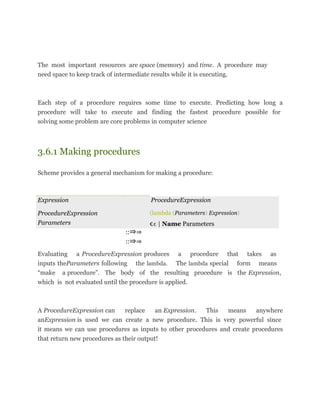
Scheme provides a general mechanism for making a procedure:
Evaluating a ProcedureExpression produces a procedure that takes as
inputs theParameters following the lambda. The lambda special form means
“make a procedure”. The body of the resulting procedure is the Expression,
which is not evaluated until the procedure is applied.
A ProcedureExpression can replace an Expression. This means anywhere
anExpression is used we can create a new procedure. This is very powerful since
it means we can use procedures as inputs to other procedures and create procedures
that return new procedures as their output!
Expression
::⇒⇒
ProcedureExpression
ProcedureExpression
::⇒⇒
(lambda (Parameters) Expression)
Parameters
::⇒⇒
ϵϵ | Name Parameters
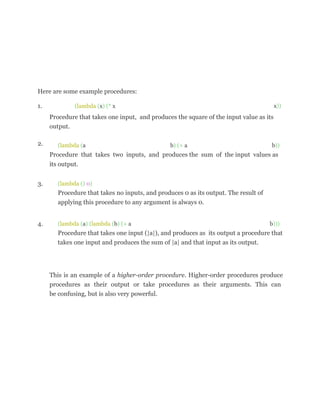
Here are some example procedures:
1. (lambda (x) (* x x))
Procedure that takes one input, and produces the square of the input value as its
output.
2. (lambda (a b) (+ a b))
Procedure that takes two inputs, and produces the sum of the input values as
its output.
3. (lambda () 0)
Procedure that takes no inputs, and produces 0 as its output. The result of
applying this procedure to any argument is always 0.
4. (lambda (a) (lambda (b) (+ a b)))
Procedure that takes one input (|a|), and produces as its output a procedure that
takes one input and produces the sum of |a| and that input as its output.
This is an example of a higher-order procedure. Higher-order procedures produce
procedures as their output or take procedures as their arguments. This can
be confusing, but is also very powerful.
3.6.2 Substitution model of evaluation
For a procedure to be useful, we need to apply it. In Section 3.4.2, we saw the syntax and
evaluation rule for an ApplicationExpression when the procedure to be applied is a primitive
procedure.
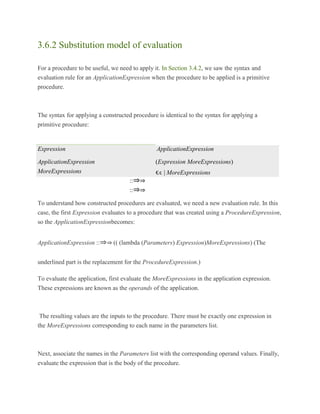
The syntax for applying a constructed procedure is identical to the syntax for applying a
primitive procedure:
To understand how constructed procedures are evaluated, we need a new evaluation rule. In this
case, the first Expression evaluates to a procedure that was created using a ProcedureExpression,
so the ApplicationExpressionbecomes:
ApplicationExpression ::⇒⇒ (( (lambda (Parameters) Expression)MoreExpressions) (The
underlined part is the replacement for the ProcedureExpression.)
To evaluate the application, first evaluate the MoreExpressions in the application expression.
These expressions are known as the operands of the application.
The resulting values are the inputs to the procedure. There must be exactly one expression in
the MoreExpressions corresponding to each name in the parameters list.
Next, associate the names in the Parameters list with the corresponding operand values. Finally,
evaluate the expression that is the body of the procedure.
Expression
::⇒⇒
ApplicationExpression
::⇒⇒
(Expression MoreExpressions)
MoreExpressions
::⇒⇒
ϵ |ϵ MoreExpressions
Whenever any parameter name is used inside the body expression, the name evaluates to the
value of the corresponding input that is associated with that name.
Whenever any parameter name is used inside the body expression, the name evaluates to the
value of the corresponding input that is associated with that name.

procedures

  • 1.
    3.6 Procedures In Chapter1 we defined a procedure as a description of a process. Scheme provides a way to define procedures that take inputs, carry out a sequence of actions, and produce an output. Section 3.4.1 introduced some of Scheme’s primitive procedures. To construct complex programs, however, we need to be able to create our own procedures. Procedures are similar to mathematical functions in that they provide a mapping between inputs and outputs, but they differ from mathematical functions in two important ways: State. In addition to producing an output, a procedure may access and modify state. This means that even when the same procedure is applied to the same inputs, the output produced may vary. Because mathematical functions do not have external state, when the same function is applied to the same inputs it always produces the same result. State makes procedures much harder to reason about. We will ignore this issue until Chapter 9, and focus until then only on procedures that do not involve any state. Resources. Unlike an ideal mathematical function, which provides an instantaneous and free mapping between inputs and outputs, a procedure requires resources to execute before the output is produced.
  • 2.
    The most importantresources are space (memory) and time. A procedure may need space to keep track of intermediate results while it is executing. Each step of a procedure requires some time to execute. Predicting how long a procedure will take to execute and finding the fastest procedure possible for solving some problem are core problems in computer science 3.6.1 Making procedures Scheme provides a general mechanism for making a procedure: Evaluating a ProcedureExpression produces a procedure that takes as inputs theParameters following the lambda. The lambda special form means “make a procedure”. The body of the resulting procedure is the Expression, which is not evaluated until the procedure is applied. A ProcedureExpression can replace an Expression. This means anywhere anExpression is used we can create a new procedure. This is very powerful since it means we can use procedures as inputs to other procedures and create procedures that return new procedures as their output! Expression ::⇒⇒ ProcedureExpression ProcedureExpression ::⇒⇒ (lambda (Parameters) Expression) Parameters ::⇒⇒ ϵϵ | Name Parameters
  • 3.
    Here are someexample procedures: 1. (lambda (x) (* x x)) Procedure that takes one input, and produces the square of the input value as its output. 2. (lambda (a b) (+ a b)) Procedure that takes two inputs, and produces the sum of the input values as its output. 3. (lambda () 0) Procedure that takes no inputs, and produces 0 as its output. The result of applying this procedure to any argument is always 0. 4. (lambda (a) (lambda (b) (+ a b))) Procedure that takes one input (|a|), and produces as its output a procedure that takes one input and produces the sum of |a| and that input as its output. This is an example of a higher-order procedure. Higher-order procedures produce procedures as their output or take procedures as their arguments. This can be confusing, but is also very powerful.
  • 4.
    3.6.2 Substitution modelof evaluation For a procedure to be useful, we need to apply it. In Section 3.4.2, we saw the syntax and evaluation rule for an ApplicationExpression when the procedure to be applied is a primitive procedure. The syntax for applying a constructed procedure is identical to the syntax for applying a primitive procedure: To understand how constructed procedures are evaluated, we need a new evaluation rule. In this case, the first Expression evaluates to a procedure that was created using a ProcedureExpression, so the ApplicationExpressionbecomes: ApplicationExpression ::⇒⇒ (( (lambda (Parameters) Expression)MoreExpressions) (The underlined part is the replacement for the ProcedureExpression.) To evaluate the application, first evaluate the MoreExpressions in the application expression. These expressions are known as the operands of the application. The resulting values are the inputs to the procedure. There must be exactly one expression in the MoreExpressions corresponding to each name in the parameters list. Next, associate the names in the Parameters list with the corresponding operand values. Finally, evaluate the expression that is the body of the procedure. Expression ::⇒⇒ ApplicationExpression ApplicationExpression ::⇒⇒ (Expression MoreExpressions) MoreExpressions ::⇒⇒ ϵ |ϵ MoreExpressions
  • 5.
    Whenever any parametername is used inside the body expression, the name evaluates to the value of the corresponding input that is associated with that name.
  • 6.
    Whenever any parametername is used inside the body expression, the name evaluates to the value of the corresponding input that is associated with that name.