Principles of
Programming Languages
Introduction
• We will study Modeling and Programming Computational Processes
• Design Principles
– Modularity, abstraction, contracts…
• Programming languages features
– Functional Programming
• E.g. Scheme, ML
• Functions are first-class objects
– Logic Programming
• E.g. Prolog
• “Declarative Programming”
– Imperative Programming
• E.g. C,Java, Pascal
• Focuses on change of state
– Not always a crisp distinction – for instance scheme can be used for imperative
programming.
3
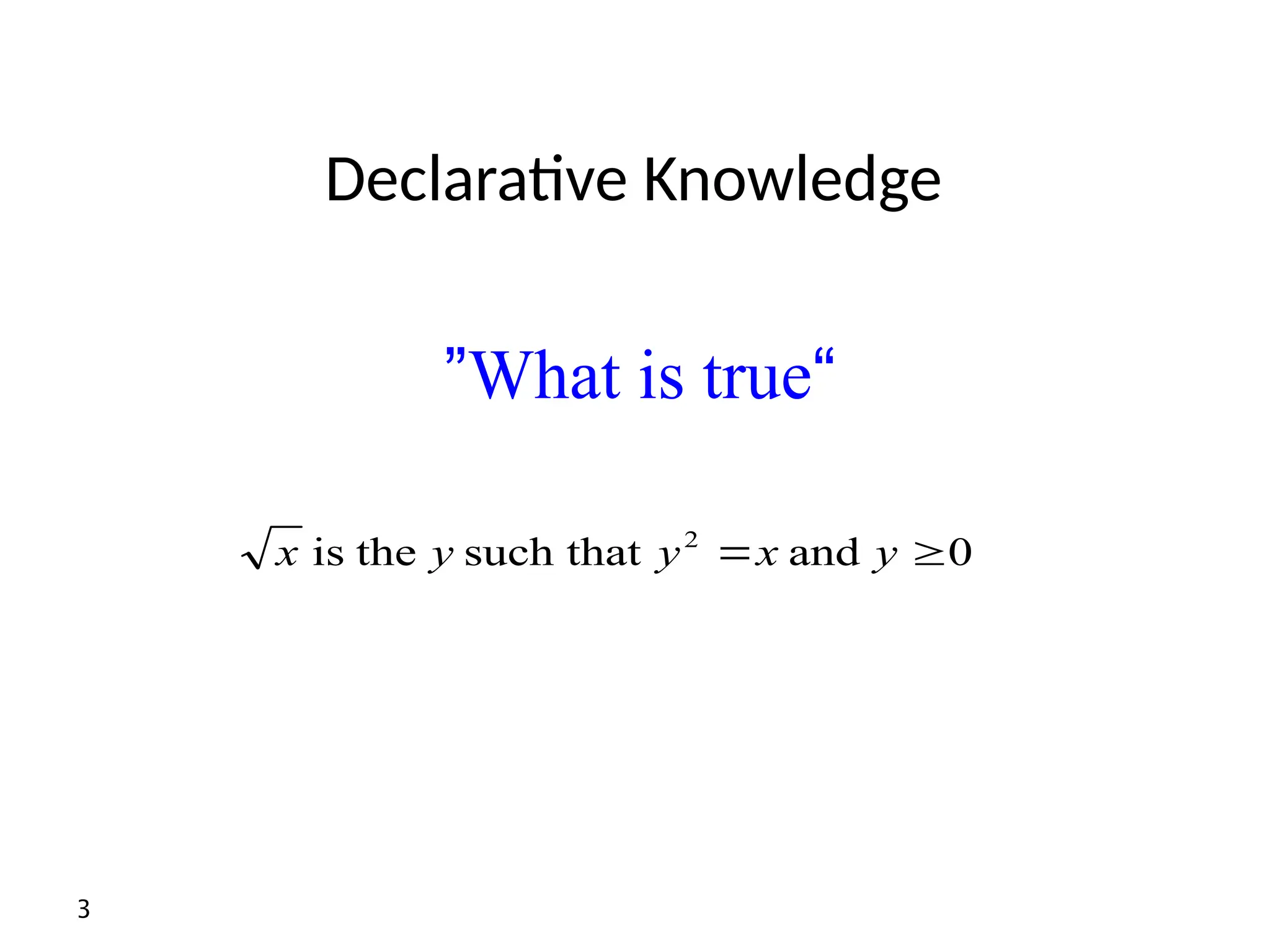
Declarative Knowledge
0
and
such that
the
is 2

 y
x
y
y
x
“
What is true
”
4
To find an approximation of x:
• Make a guess G
• Improve the guess by averaging G and x/G
• Keep improving the guess until it is good enough
Imperative and Functional
Knowledge
“
How to
”
An algorithm due to
:
[
Heron of Alexandria
]
More topics
• Types
– Type Inference and Type Checking
– Static and Dynamic Typing
• Different Semantics (e.g. Operational)
• Interpreters vs. Compilers
– Lazy and applicative evaluation
Languages that will be studied
• Scheme
– Dynamically Typed
– Functions are first-class citizens
– Simple (though lots of parenthesis  )
and allows to show different programming styles
• ML
– Statically typed language
– Polymorphic types
• Prolog
– Declarative, Logic programming language
• Languages are important, but we will focus on the principles
Administrative Issues
• Web-site
• Exercises
• Mid-term
• Exam
• Grade
Use of Slides
• Slides are teaching-aids, i.e. by nature
incomplete
• Compulsory material include everything
taught in class, practical sessions as well as
compulsory reading if mentioned
Today
• Scheme basics
– Syntax and Semantics
– The interpreter
– Expressions, values, types..
10
Scheme
• LISP = LISt Processing
– Invented in 1959 by John McCarthy
– Scheme is a dialect of LISP – invented by Gerry
Sussman and Guy Steele
11
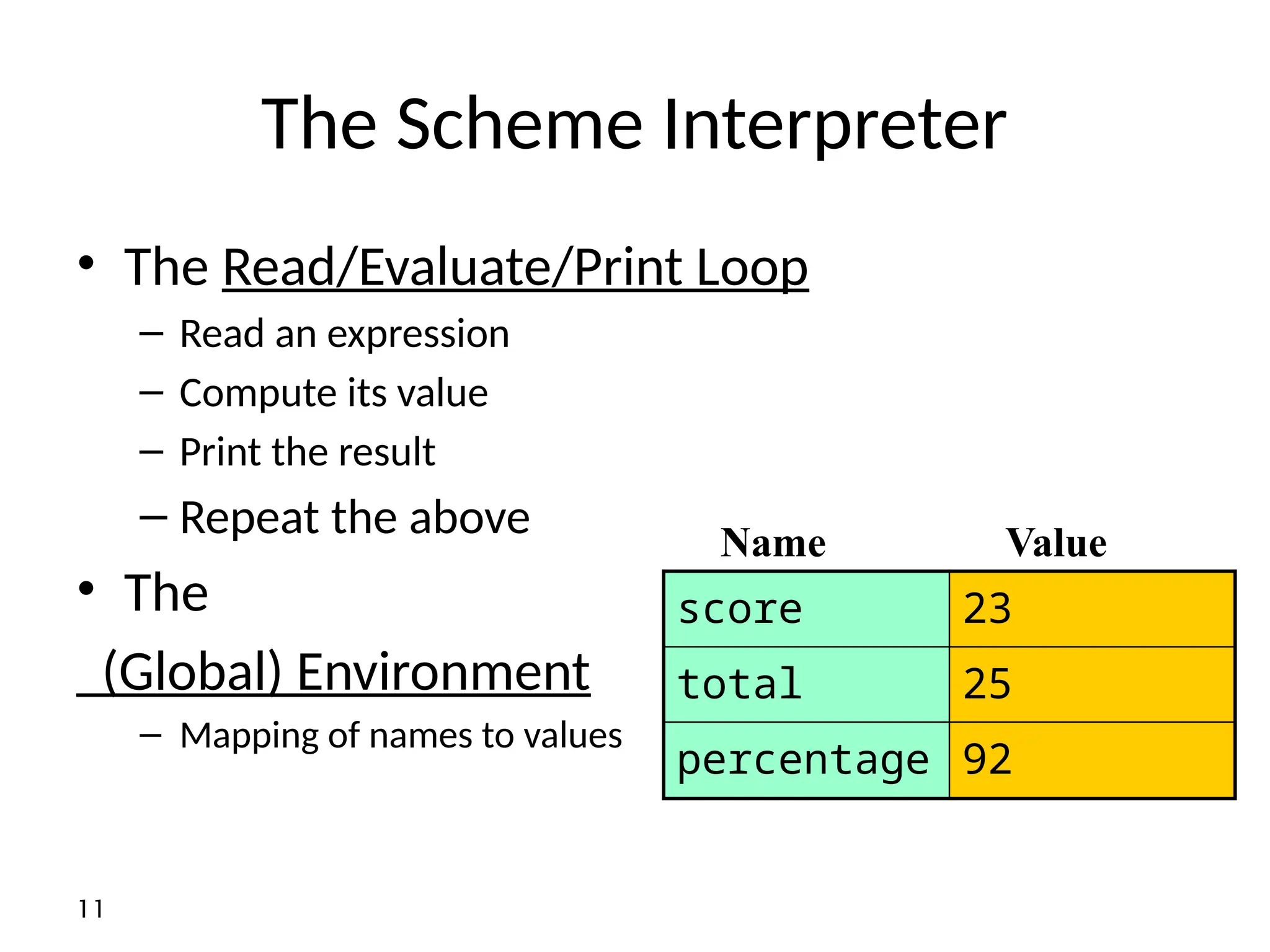
The Scheme Interpreter
• The Read/Evaluate/Print Loop
– Read an expression
– Compute its value
– Print the result
– Repeat the above
• The
(Global) Environment
– Mapping of names to values
score 23
total 25
percentage 92
Name Value
12
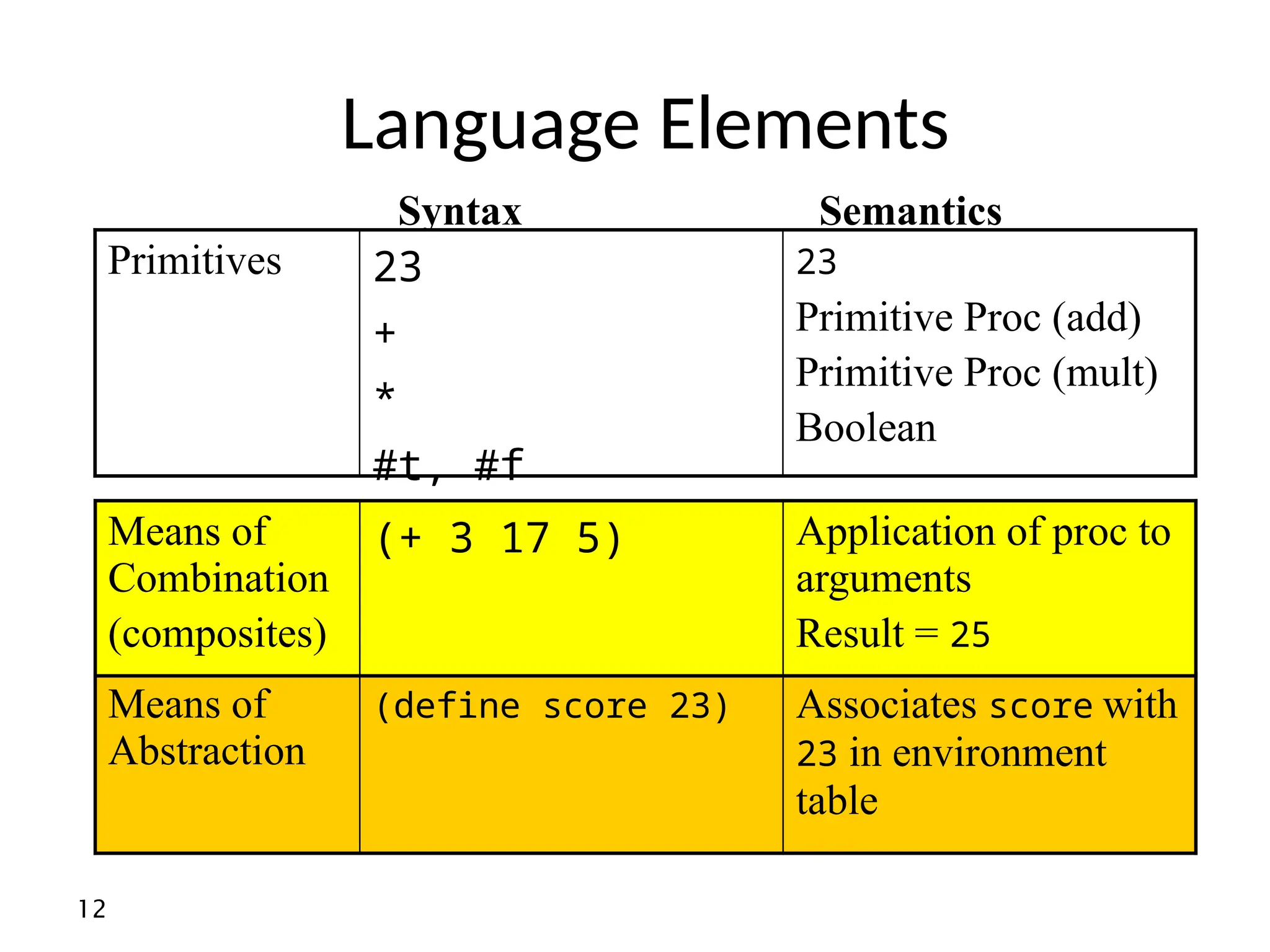
Language Elements
Means of
Abstraction
(define score 23) Associates score with
23 in environment
table
Syntax Semantics
Means of
Combination
(composites)
(+ 3 17 5) Application of proc to
arguments
Result = 25
Primitives 23
+
*
#t, #f
23
Primitive Proc (add)
Primitive Proc (mult)
Boolean
13
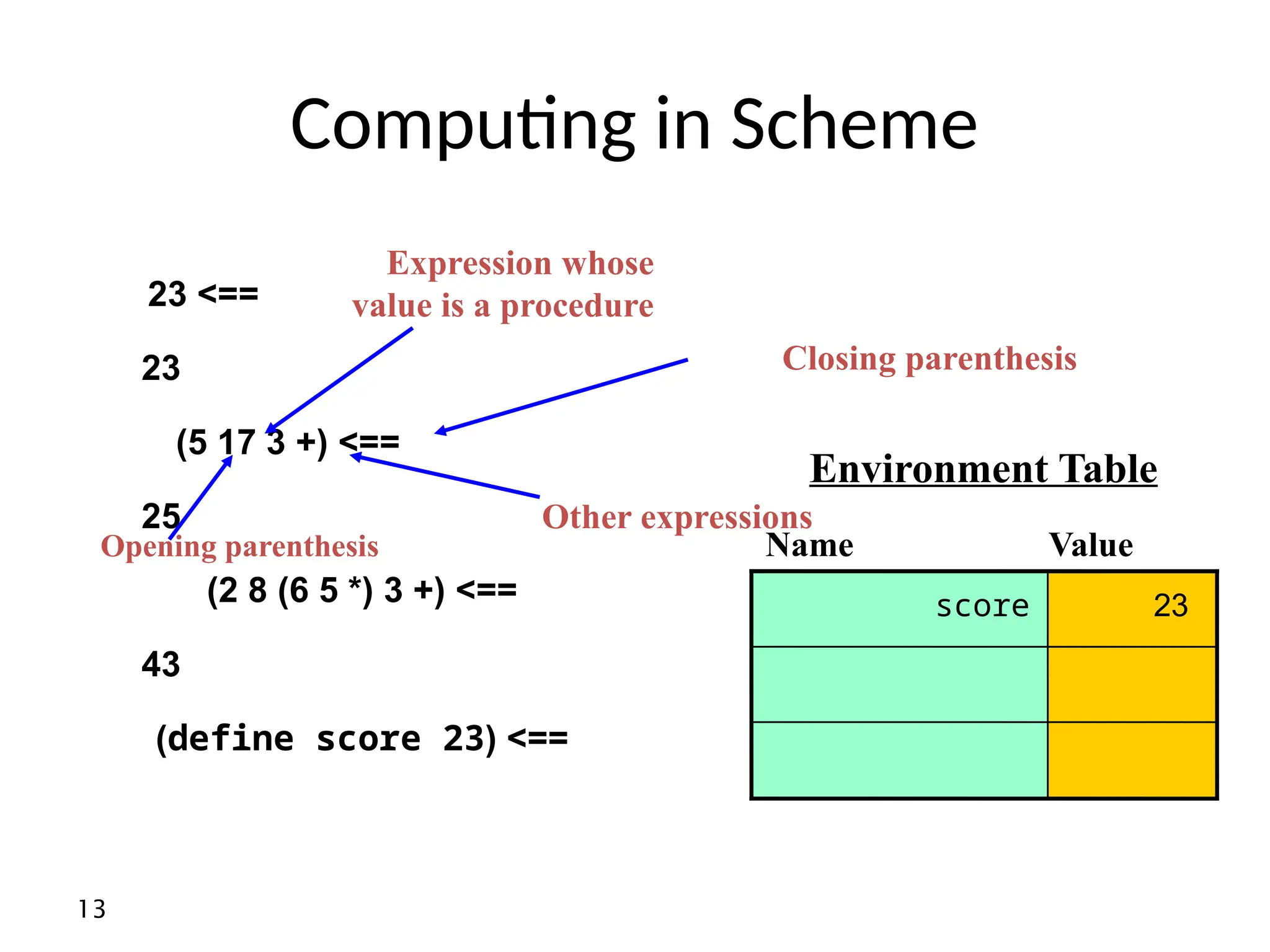
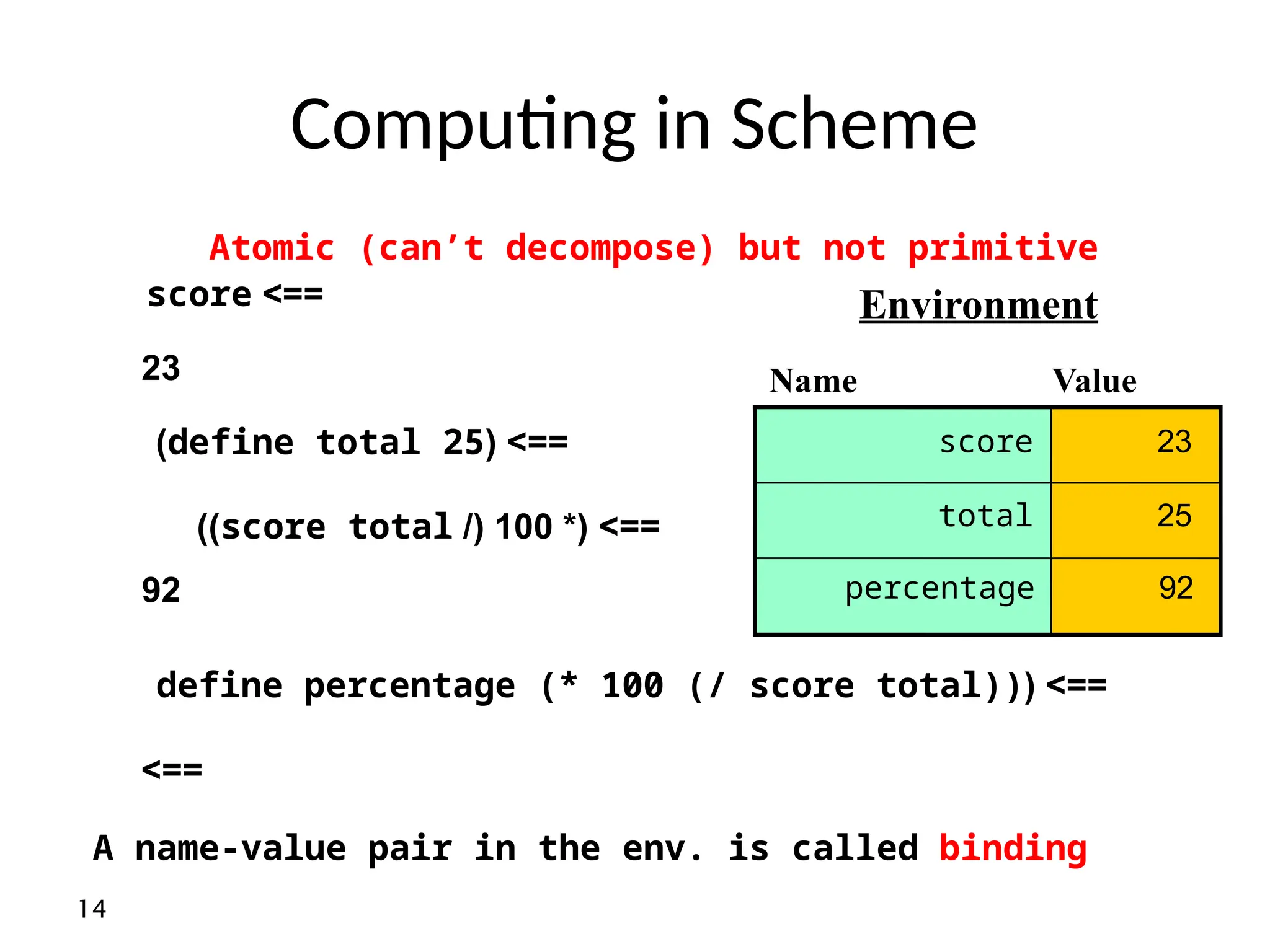
Computing in Scheme
>==
23
23
+( >==
3
17
5
)
25
+( >==
3
*(
5
6
)
8
2
)
43
( >==
define score 23
)
Name Value
Environment Table
23
score
Opening parenthesis
Expression whose
value is a procedure
Other expressions
Closing parenthesis
14
Computing in Scheme
>==
score
23
( >==
define total 25
)
*( >==
100
/(
score total
))
92
( >==
define percentage (* 100 (/ score total))
Name Value
Environment
23
score
25
total
92
percentage
>==
Atomic (can’t decompose) but not primitive
A name-value pair in the env. is called binding
15
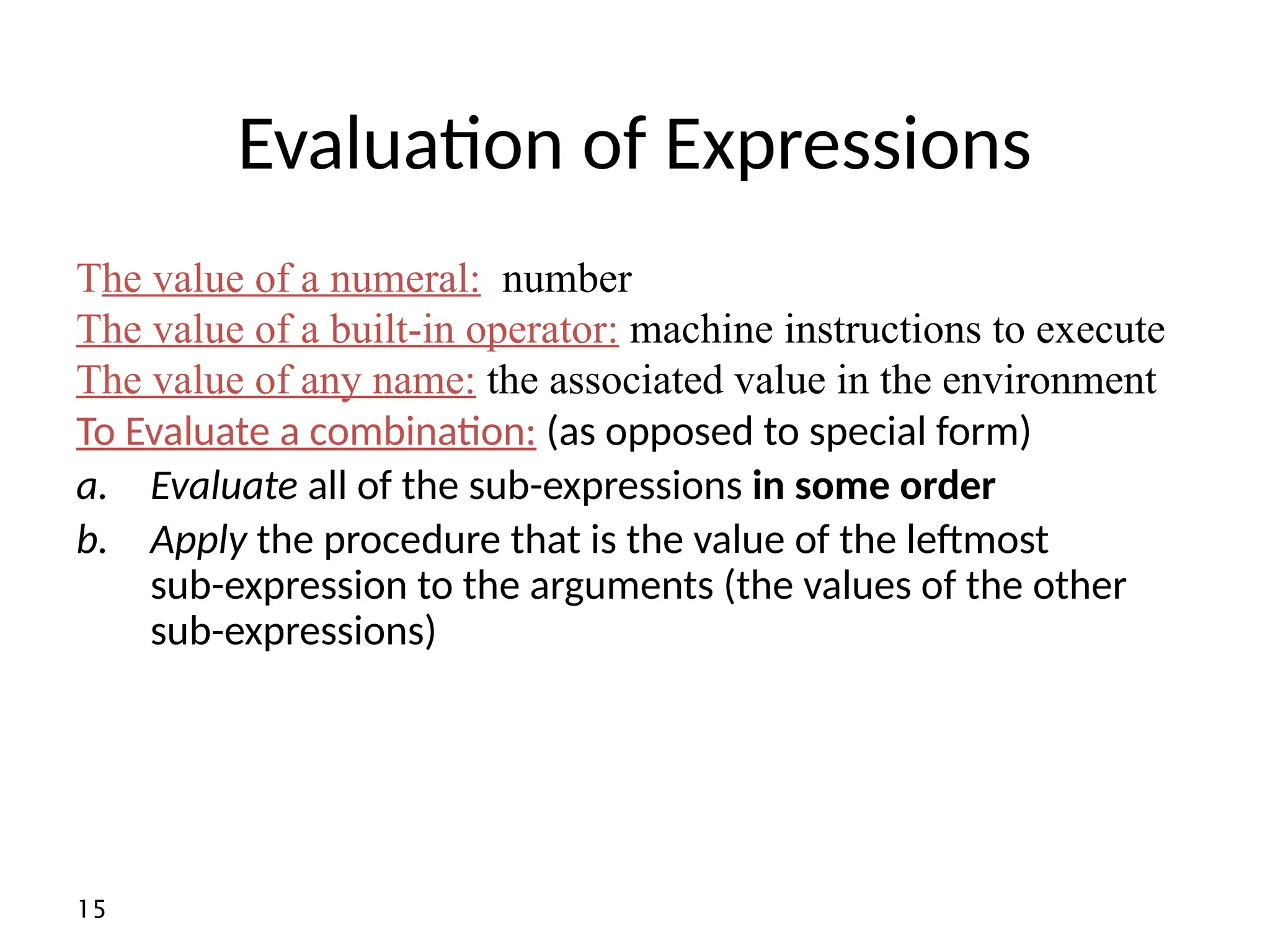
Evaluation of Expressions
To Evaluate a combination: (as opposed to special form)
a. Evaluate all of the sub-expressions in some order
b. Apply the procedure that is the value of the leftmost
sub-expression to the arguments (the values of the other
sub-expressions)
The value of a numeral: number
The value of a built-in operator: machine instructions to execute
The value of any name: the associated value in the environment
16
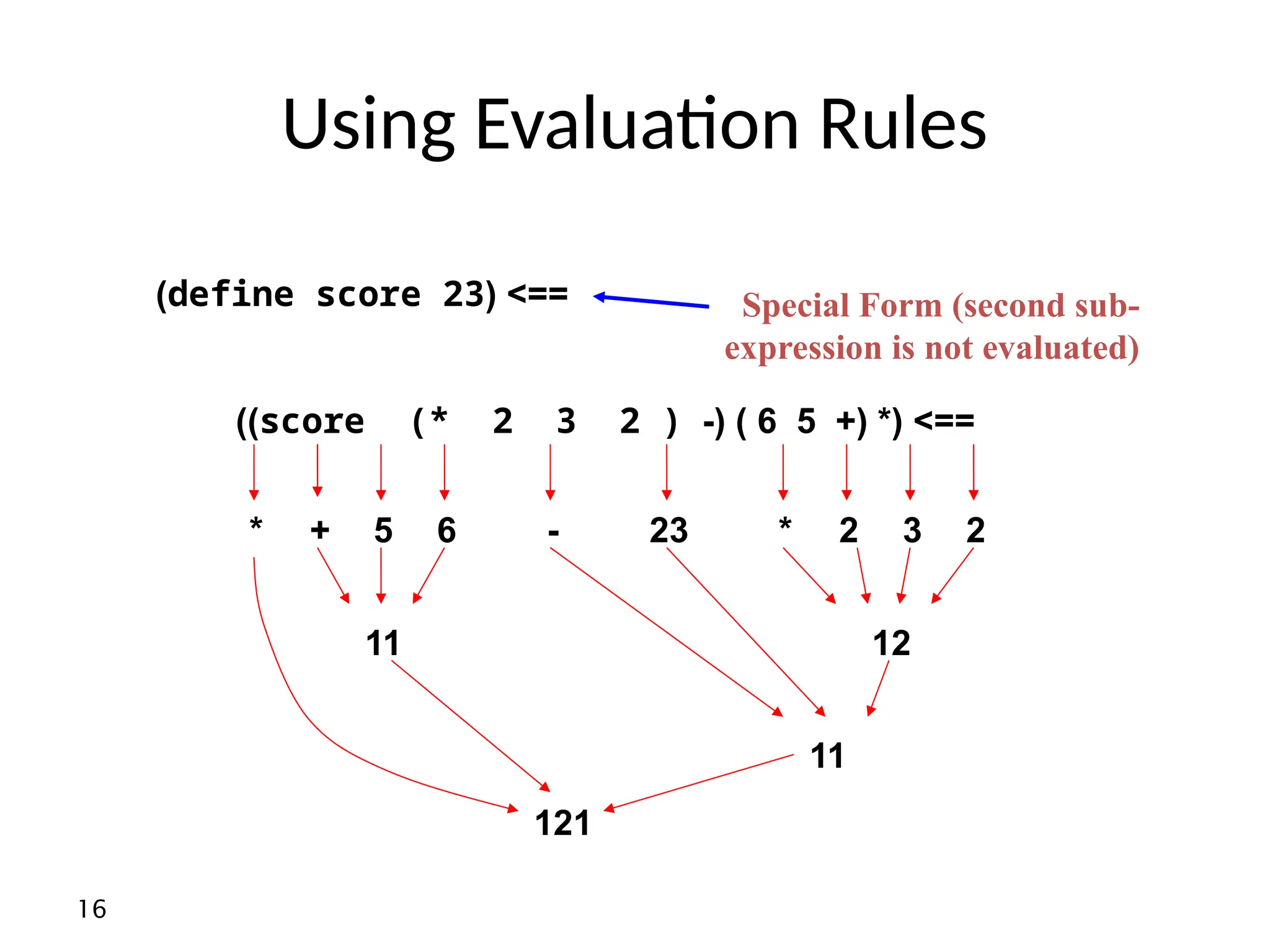
Using Evaluation Rules
( >==
define score 23
)
+( *( >==
5
6
-( )
score (* 2 3 2 )
))
Special Form (second sub-
expression is not evaluated)
* + 5 6
11
- 23 * 3 2
2
12
11
121
17
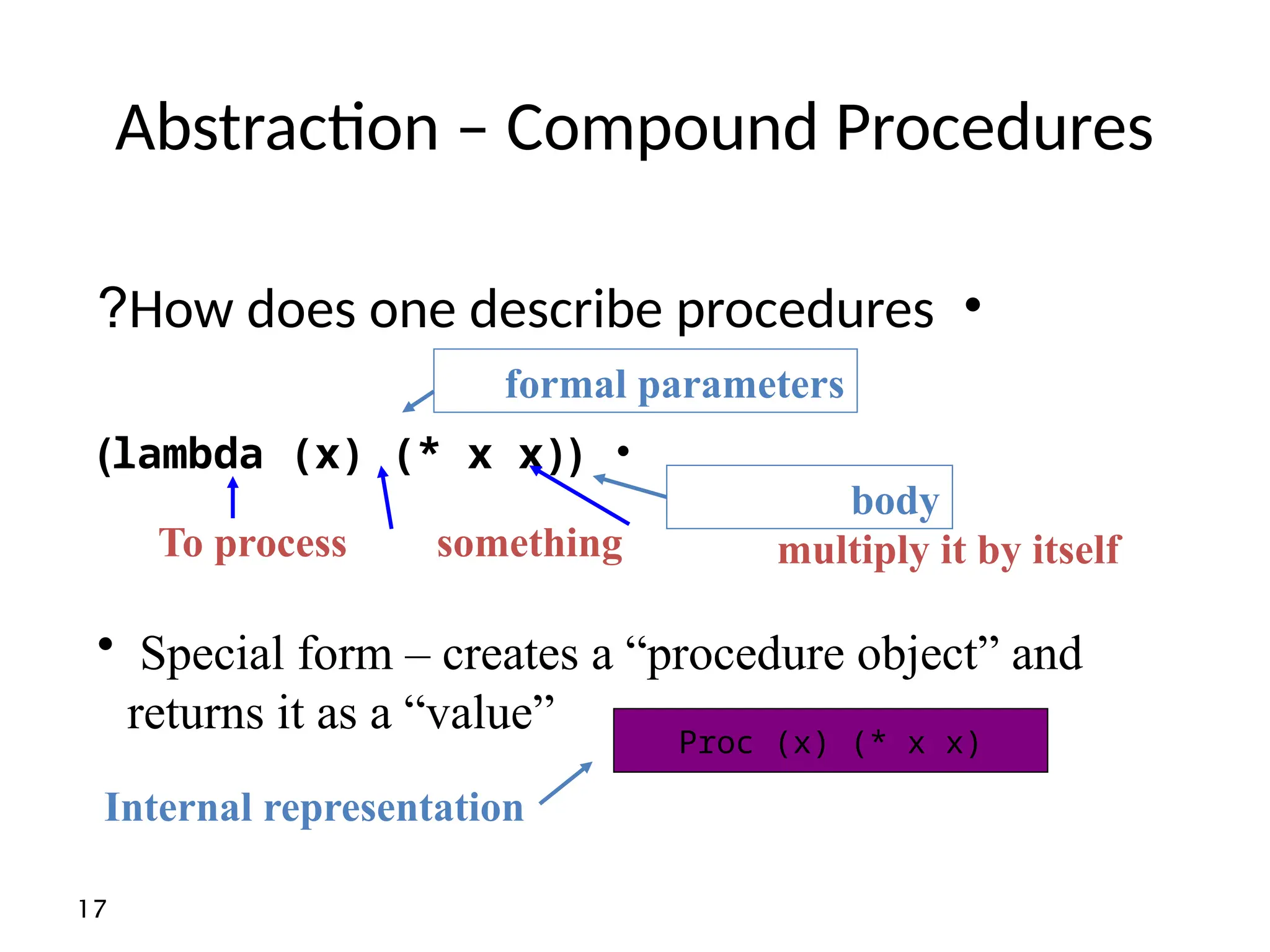
Abstraction – Compound Procedures
•
How does one describe procedures
?
•
(
lambda (x) (* x x)
)
To process something multiply it by itself
formal parameters
body
Internal representation
• Special form – creates a “procedure object” and
returns it as a “value”
Proc (x) (* x x)
18
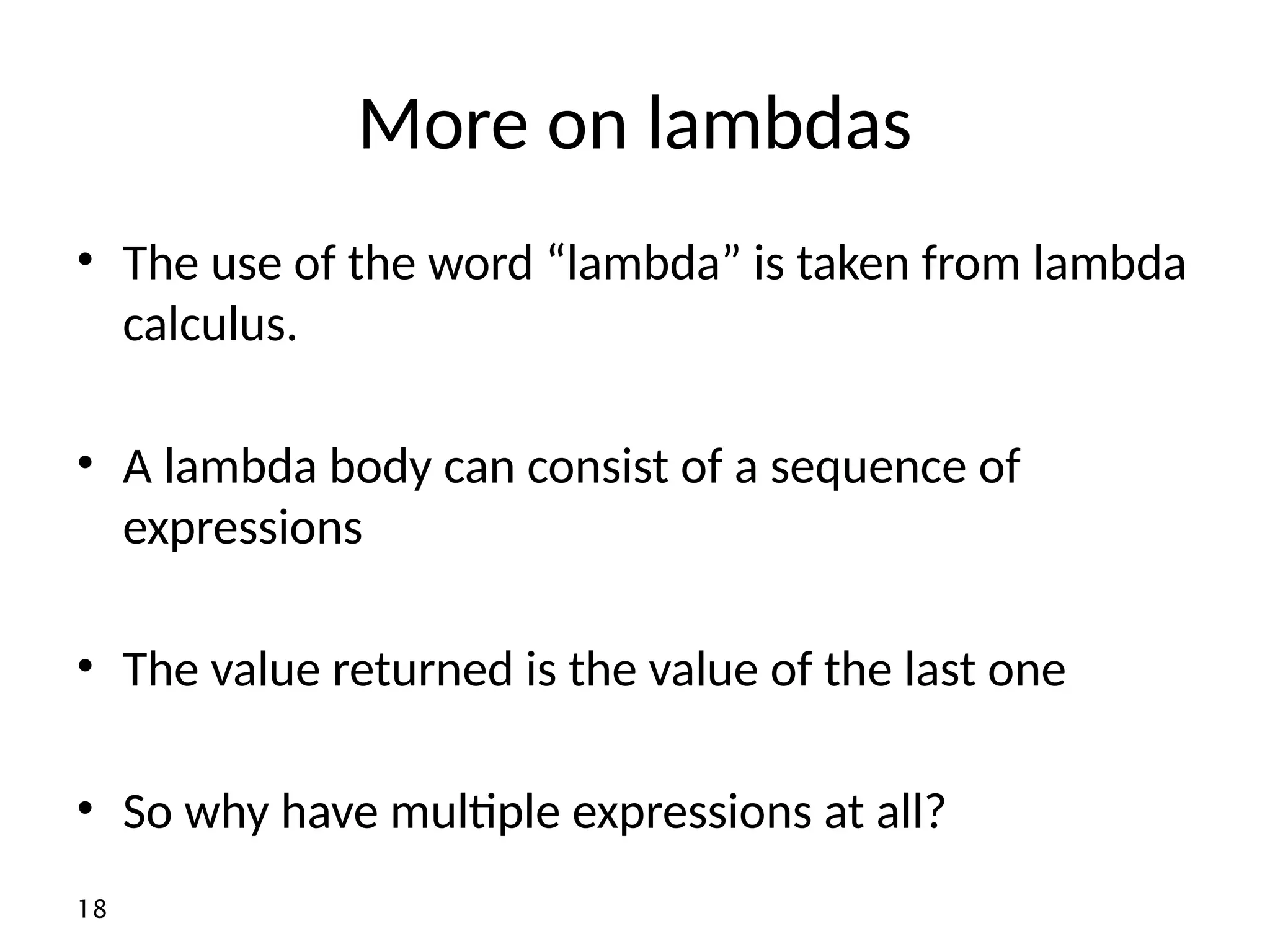
More on lambdas
• The use of the word “lambda” is taken from lambda
calculus.
• A lambda body can consist of a sequence of
expressions
• The value returned is the value of the last one
• So why have multiple expressions at all?
19
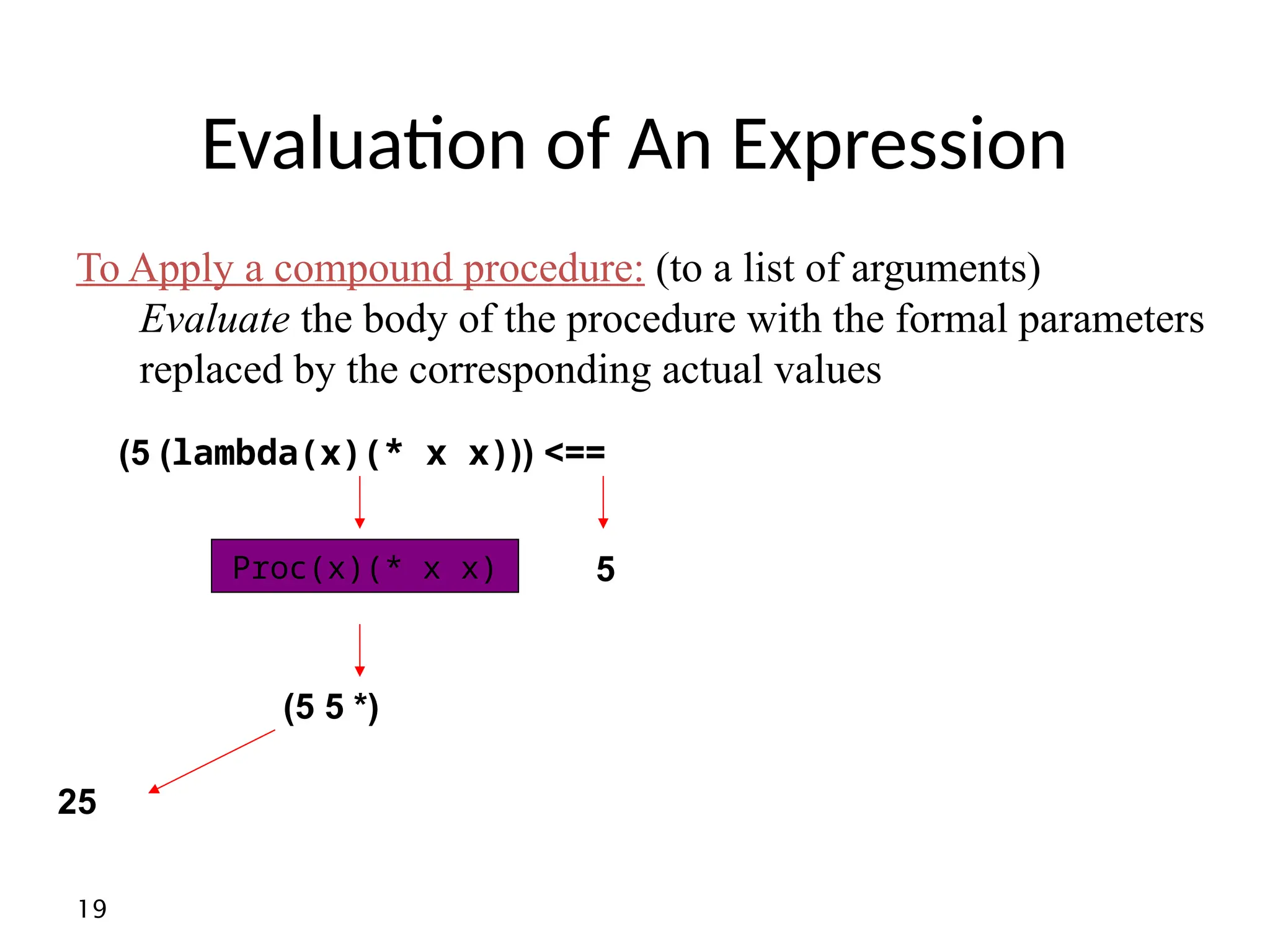
Evaluation of An Expression
To Apply a compound procedure: (to a list of arguments)
Evaluate the body of the procedure with the formal parameters
replaced by the corresponding actual values
(( >==
lambda(x)(* x x)
)
5
)
Proc(x)(* x x) 5
*(
5
5
)
25
20
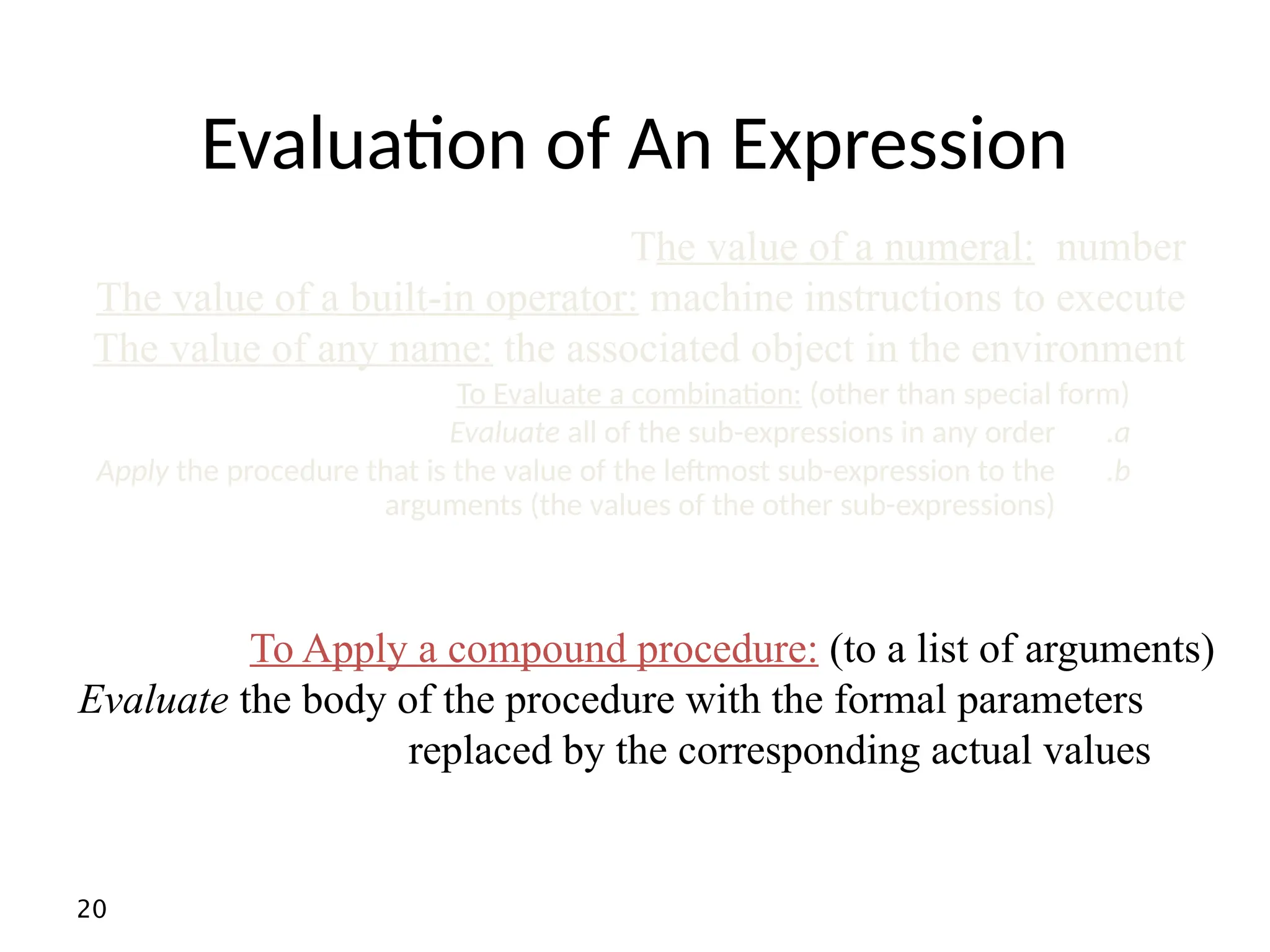
Evaluation of An Expression
To Apply a compound procedure: (to a list of arguments)
Evaluate the body of the procedure with the formal parameters
replaced by the corresponding actual values
To Evaluate a combination: (other than special form)
.a
Evaluate all of the sub-expressions in any order
.b
Apply the procedure that is the value of the leftmost sub-expression to the
arguments (the values of the other sub-expressions)
The value of a numeral: number
The value of a built-in operator: machine instructions to execute
The value of any name: the associated object in the environment
21
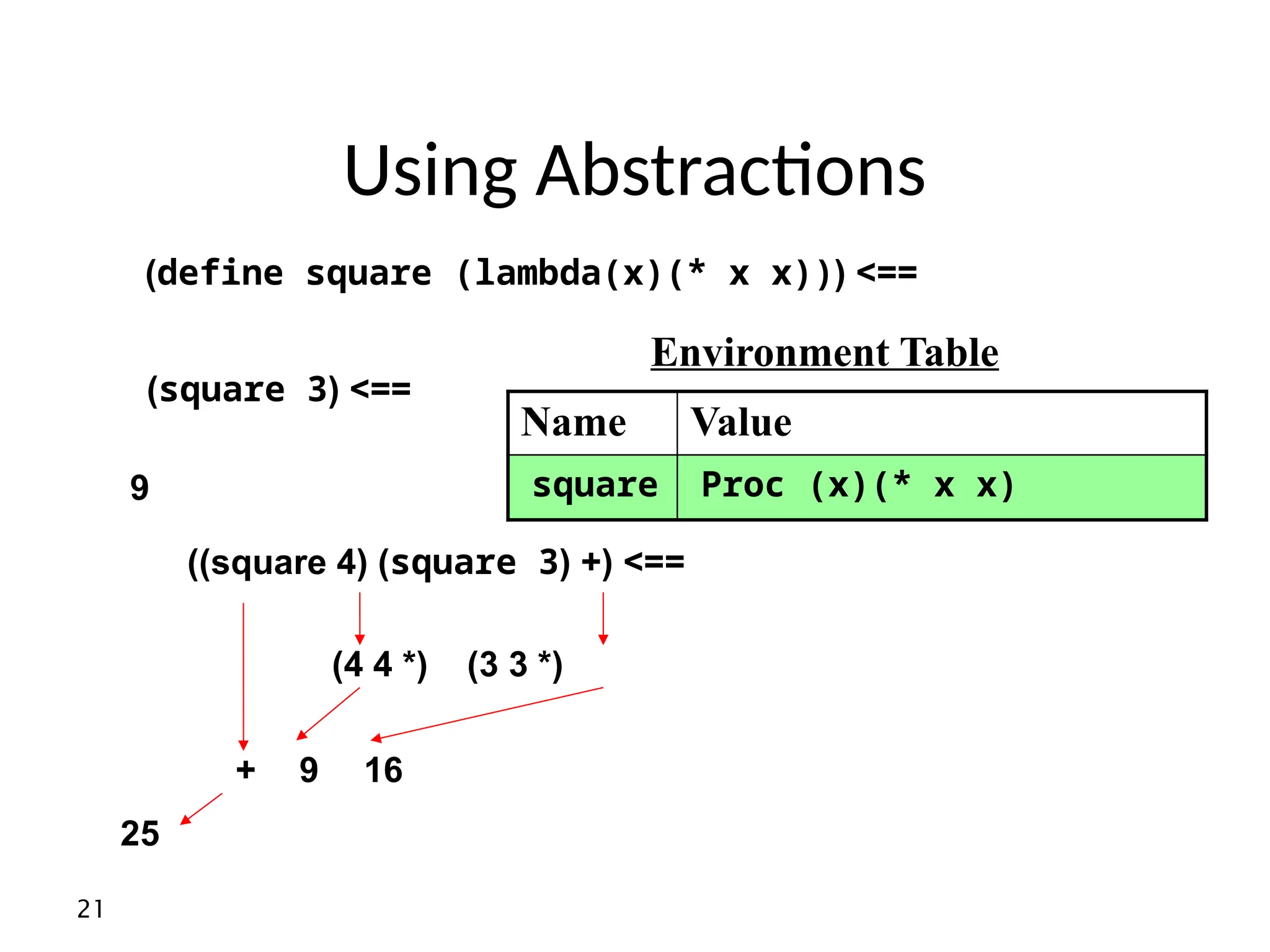
Using Abstractions
( >==
square 3
)
9
( +( >==
square 3
( )
square 4
))
( >==
define square (lambda(x)(* x x))
)
*(
3
3
*( )
4
4
)
9 16
+
25
Environment Table
Name Value
square Proc (x)(* x x)
22
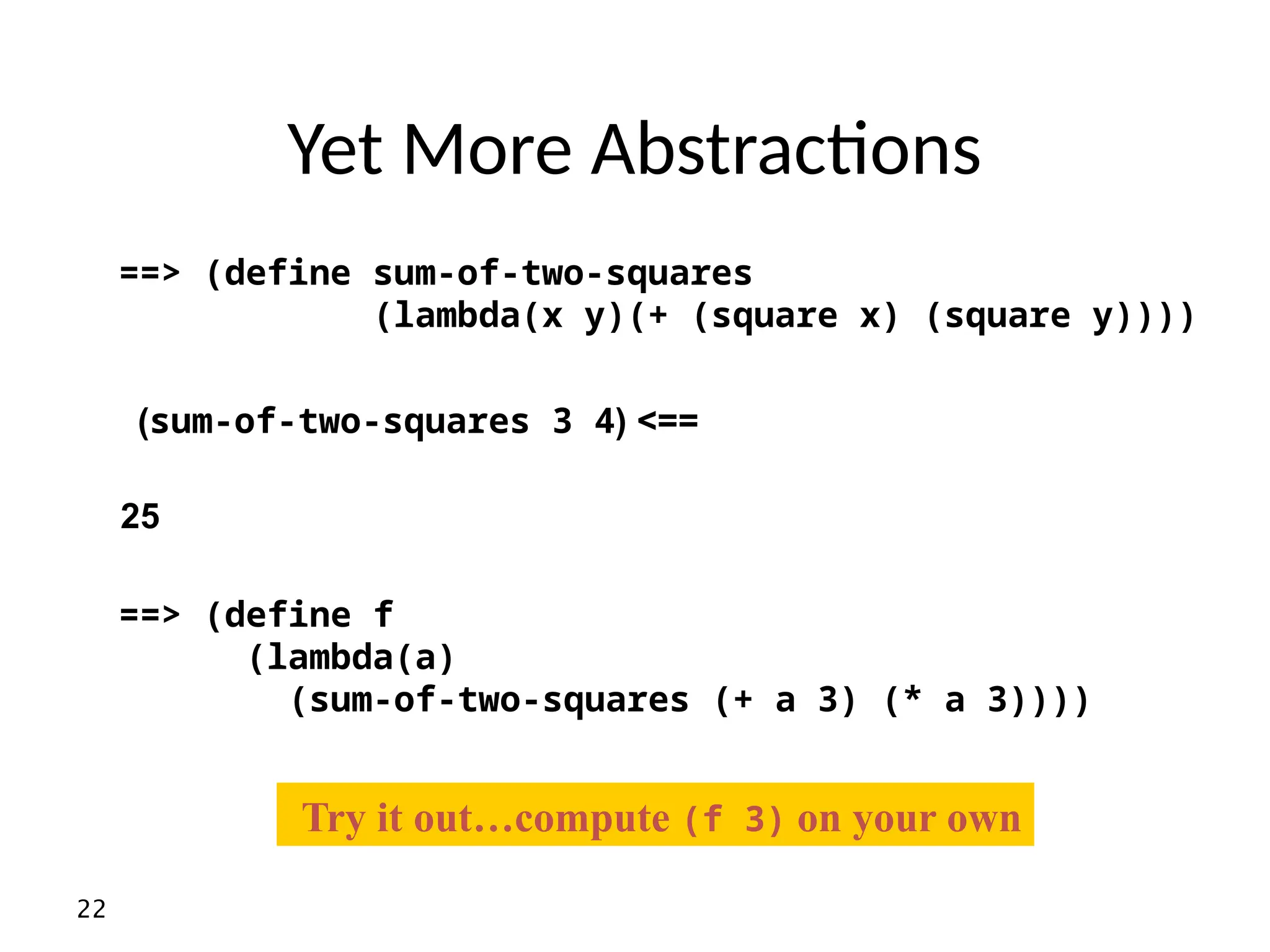
Yet More Abstractions
==> (define f
(lambda(a)
(sum-of-two-squares (+ a 3) (* a 3))))
( >==
sum-of-two-squares 3 4
)
25
==> (define sum-of-two-squares
(lambda(x y)(+ (square x) (square y))))
Try it out…compute (f 3) on your own
23
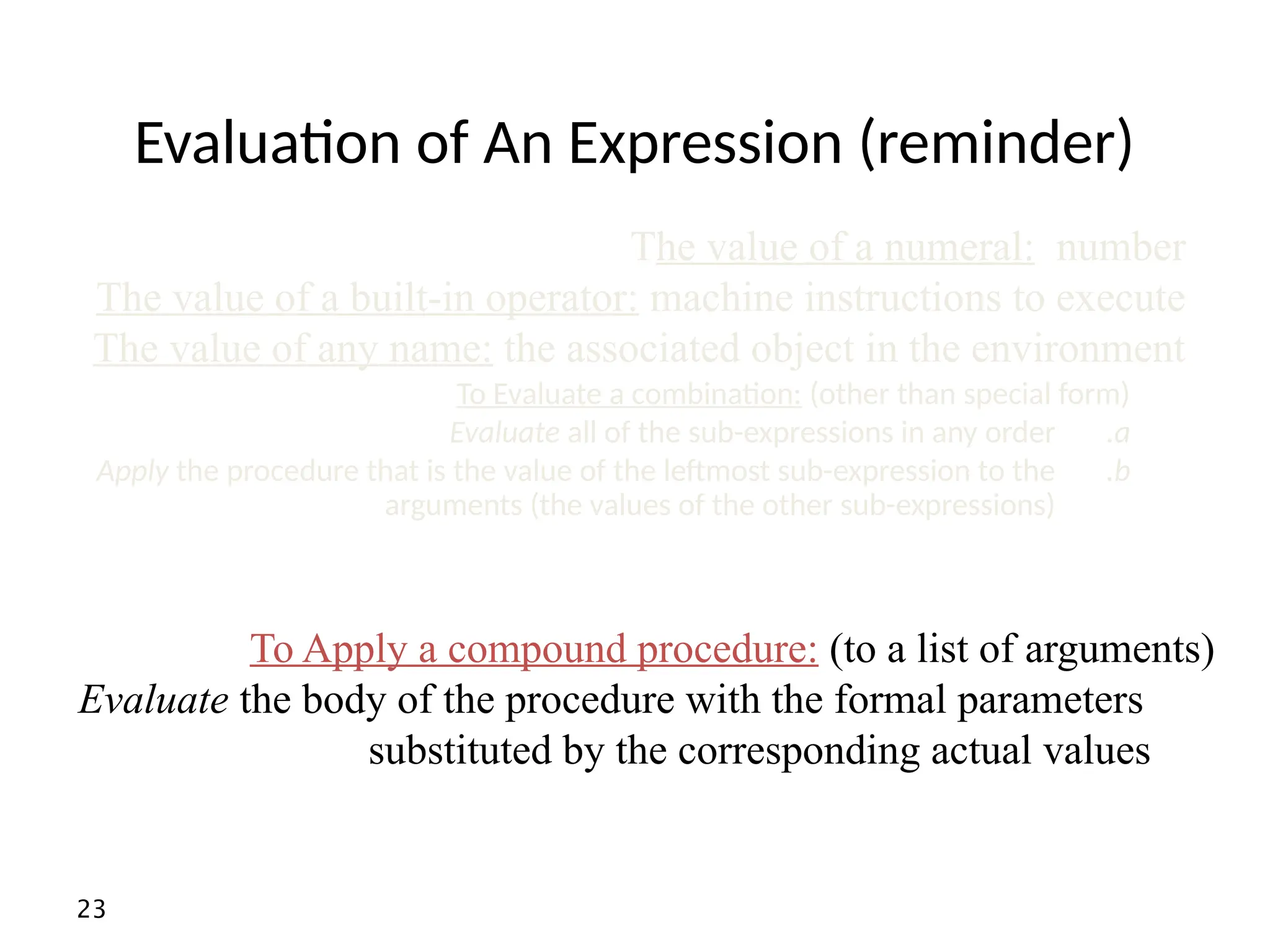
Evaluation of An Expression (reminder)
To Apply a compound procedure: (to a list of arguments)
Evaluate the body of the procedure with the formal parameters
substituted by the corresponding actual values
To Evaluate a combination: (other than special form)
.a
Evaluate all of the sub-expressions in any order
.b
Apply the procedure that is the value of the leftmost sub-expression to the
arguments (the values of the other sub-expressions)
The value of a numeral: number
The value of a built-in operator: machine instructions to execute
The value of any name: the associated object in the environment
24
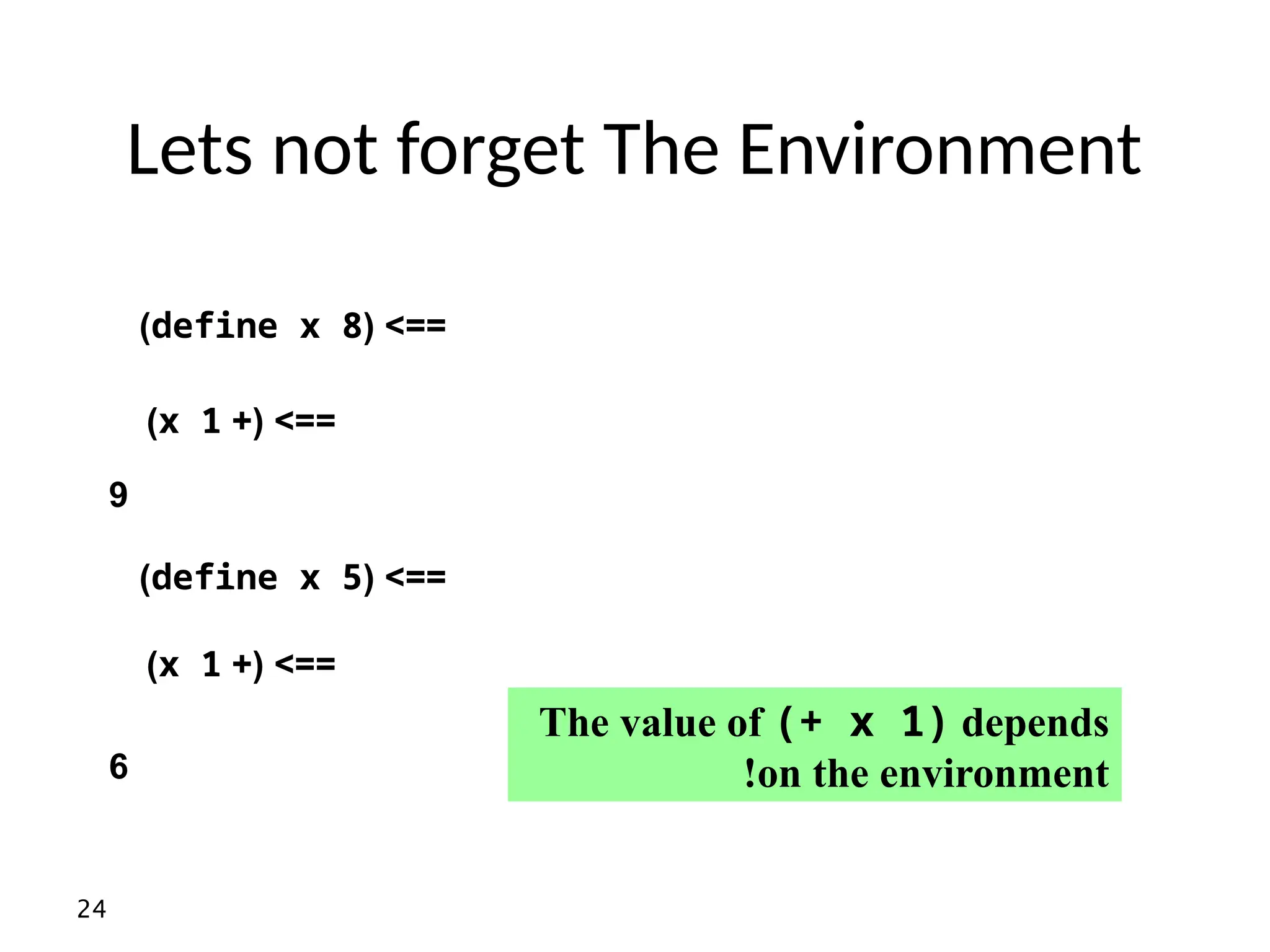
Lets not forget The Environment
( >==
define x 8
)
+( >==
x 1
)
9
( >==
define x 5
)
+( >==
x 1
)
6
The value of (+ x 1) depends
on the environment
!
25
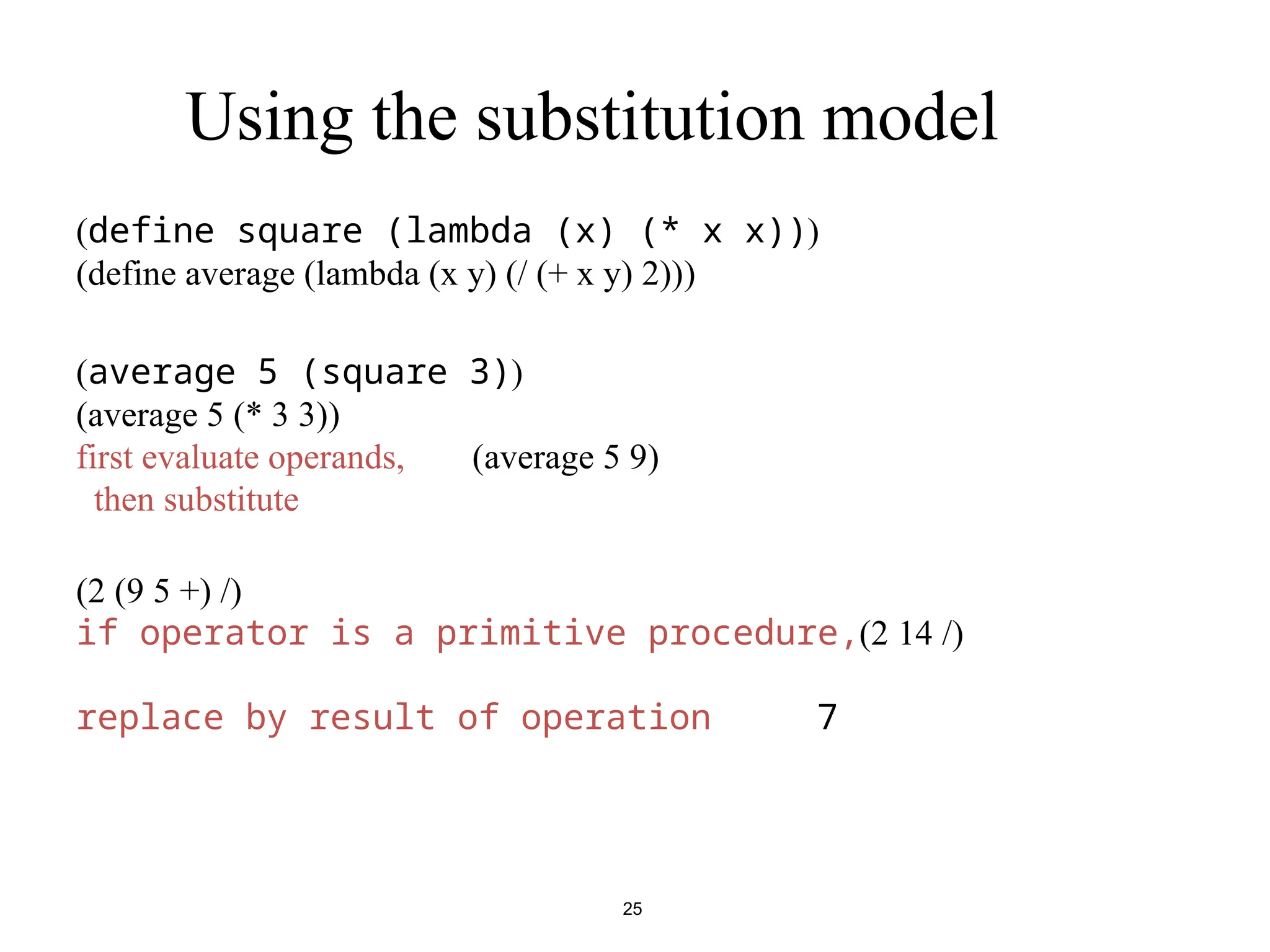
Using the substitution model
(
define square (lambda (x) (* x x))
)
(
define average (lambda (x y) (/ (+ x y) 2))
)
(
average 5 (square 3)
)
(
average 5 (* 3 3)
)
(
average 5 9
)
first evaluate operands,
then substitute
+( /(
5
9
)
2
)
/(
14
2
)
if operator is a primitive procedure,
7
replace by result of operation
26
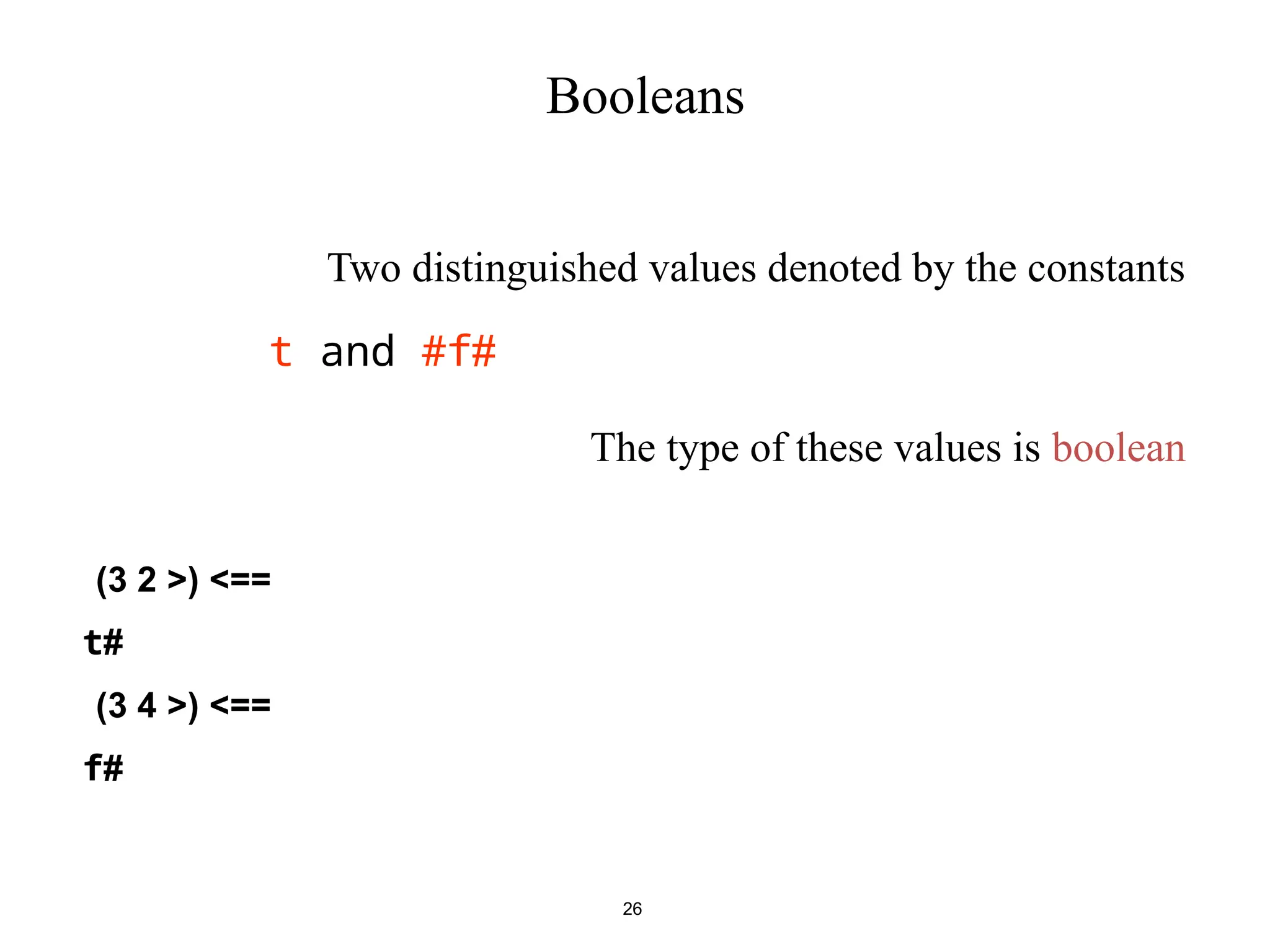
Booleans
Two distinguished values denoted by the constants
#
t and #f
The type of these values is boolean
<( >==
2
3
)
#
t
<( >==
4
3
)
#
f
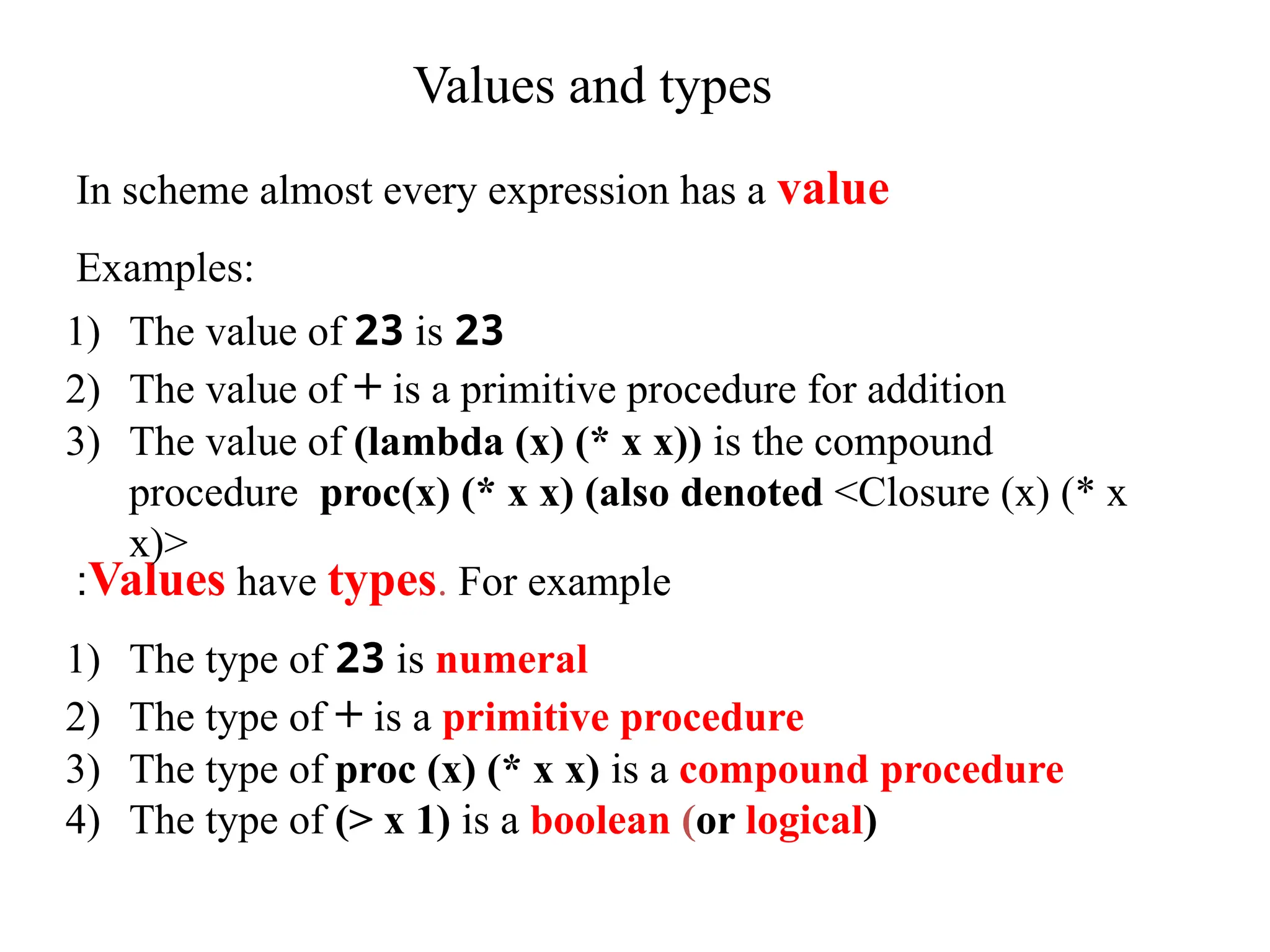
Values and types
Values have types. For example
:
In scheme almost every expression has a value
Examples:
1) The value of 23 is 23
2) The value of + is a primitive procedure for addition
3) The value of (lambda (x) (* x x)) is the compound
procedure proc(x) (* x x) (also denoted <Closure (x) (* x
x)>
1) The type of 23 is numeral
2) The type of + is a primitive procedure
3) The type of proc (x) (* x x) is a compound procedure
4) The type of (> x 1) is a boolean (or logical)
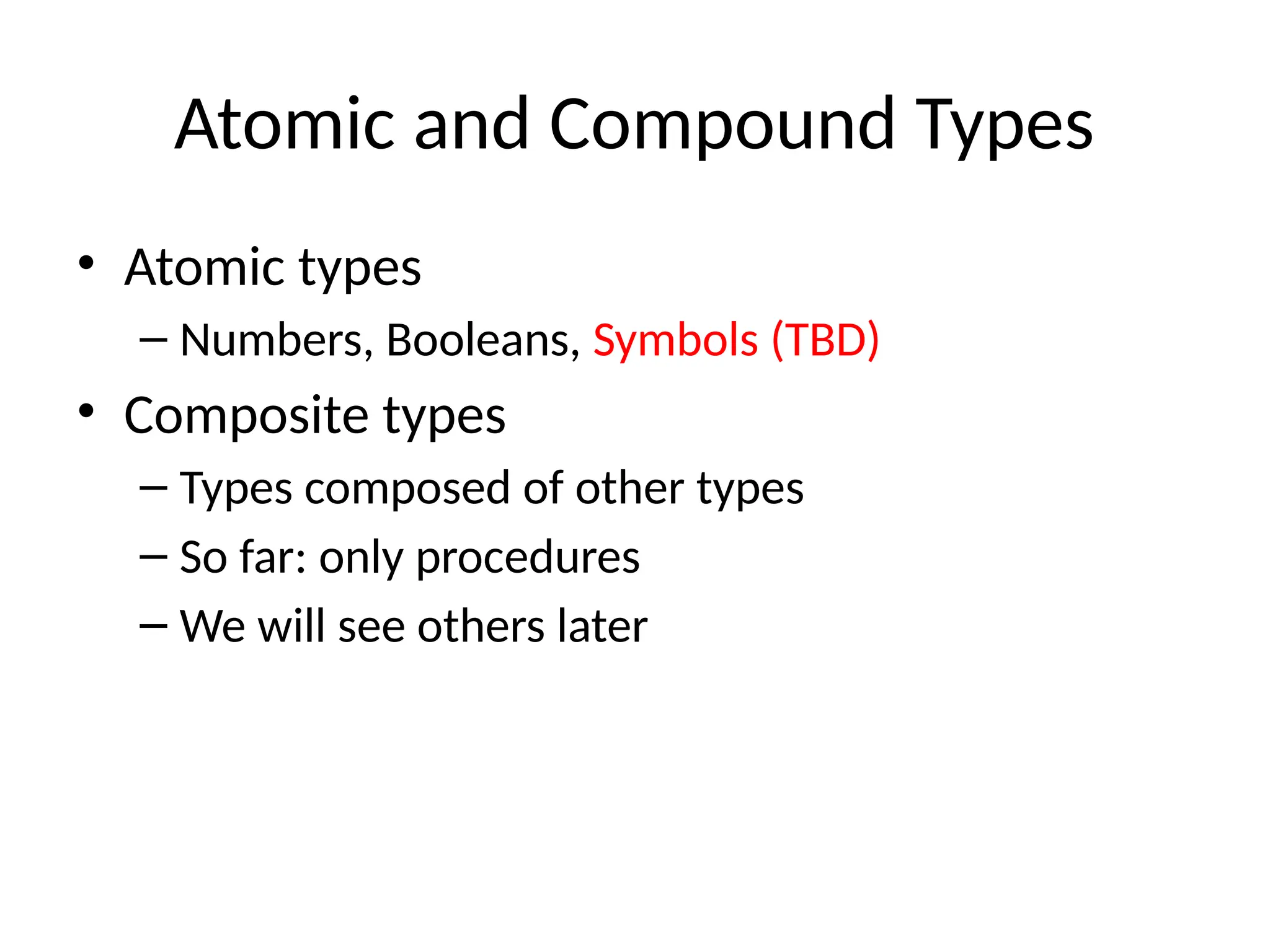
Atomic and Compound Types
• Atomic types
– Numbers, Booleans, Symbols (TBD)
• Composite types
– Types composed of other types
– So far: only procedures
– We will see others later
29
No Value
?
• In scheme most expressions have values
• Not all! Those that don’t usually have side effects
Example : what is the value of the expression
(define x 8)
And of
(display x)
[display is a primitive func., prints the value of its
argument to the screen]
• In scheme, the value of a define, display expression is
“undefined” . This means “implementation-dependent”
• Never write code that relies on such value!
Dynamic Typing
• Note that we never specify explicitly types of
variables
• However primitive functions expect values of a
certain type!
– E.g. “+” expects numeral values
• So will our procedures (To be discussed soon)
• The Scheme interpreter checks type correctness
at run-time: dynamic typing
– [As opposed to static typing verified by a compiler ]
31
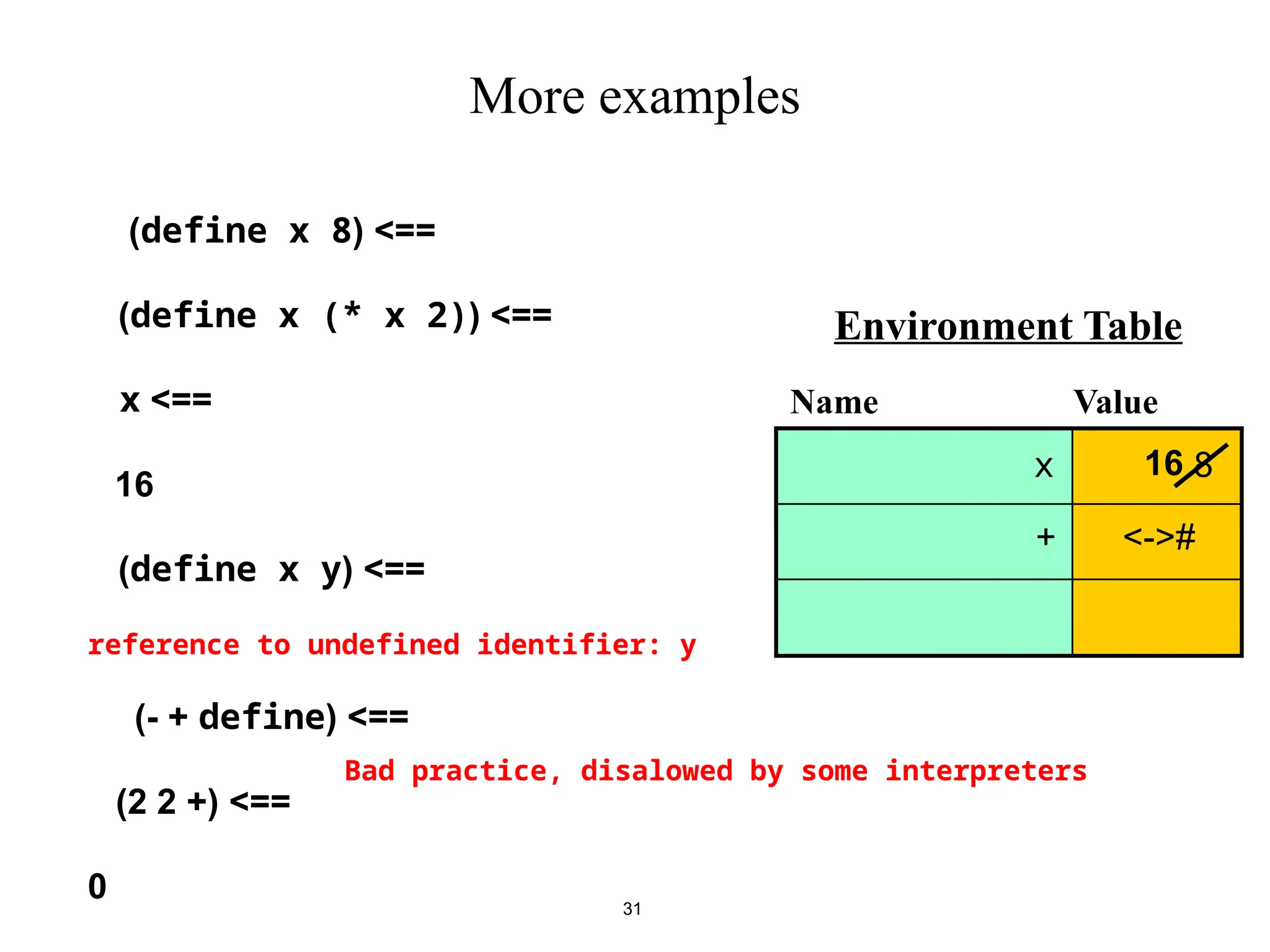
More examples
( >==
define x 8
)
Name Value
Environment Table
8
x
( >==
define x (* x 2)
)
>==
x
16
16
( >==
define x y
)
reference to undefined identifier: y
( >==
define
)- +
>-<#
+
+( >==
2
2
)
0
Bad practice, disalowed by some interpreters
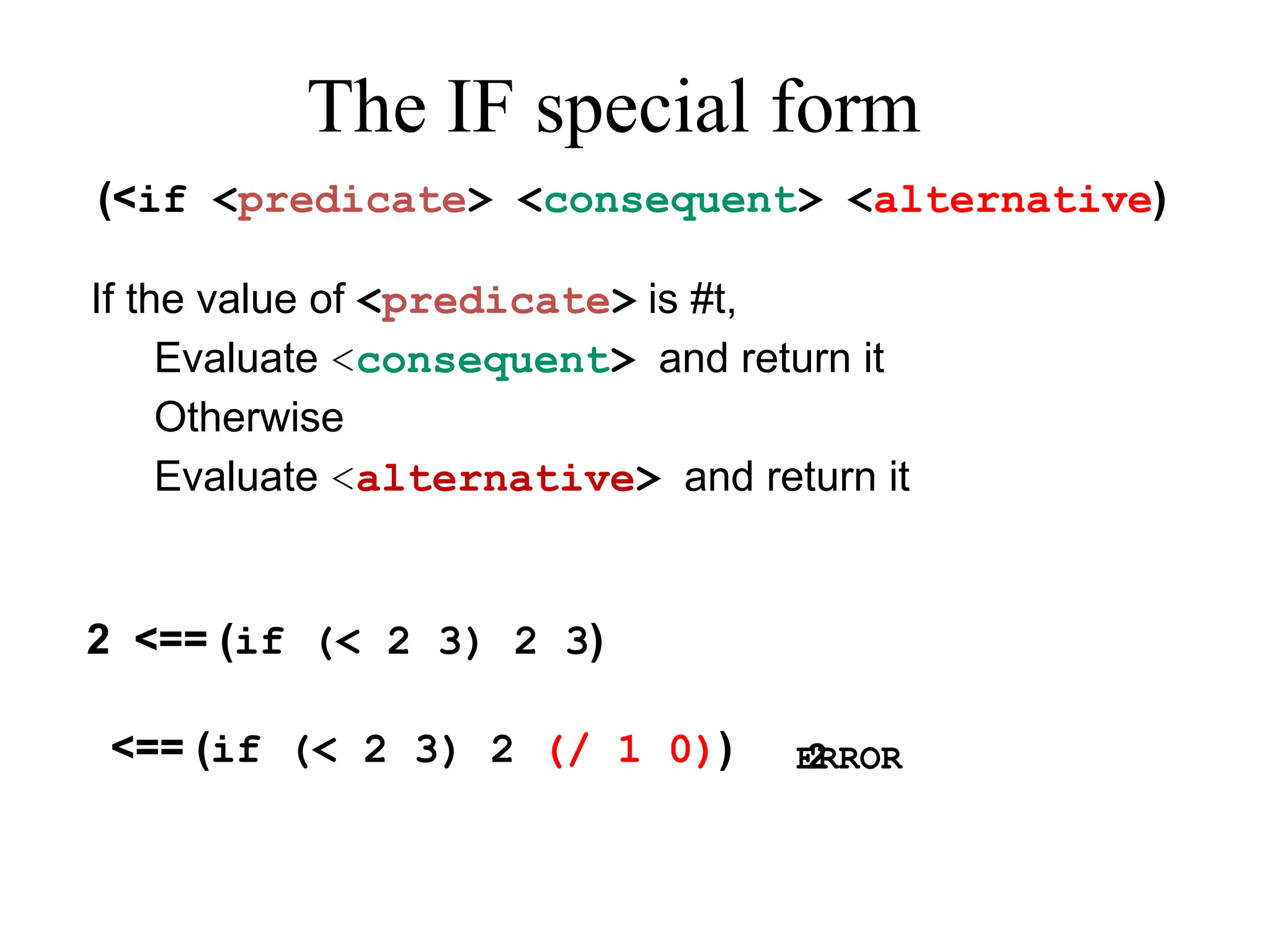
The IF special form
ERROR
2
(
if <predicate> <consequent> <alternative
)>
If the value of <predicate> is #t,
Evaluate <consequent> and return it
Otherwise
Evaluate <alternative> and return it
(
if (< 2 3) 2 3
>== )
2
(
if (< 2 3) 2 (/ 1 0)
>== )
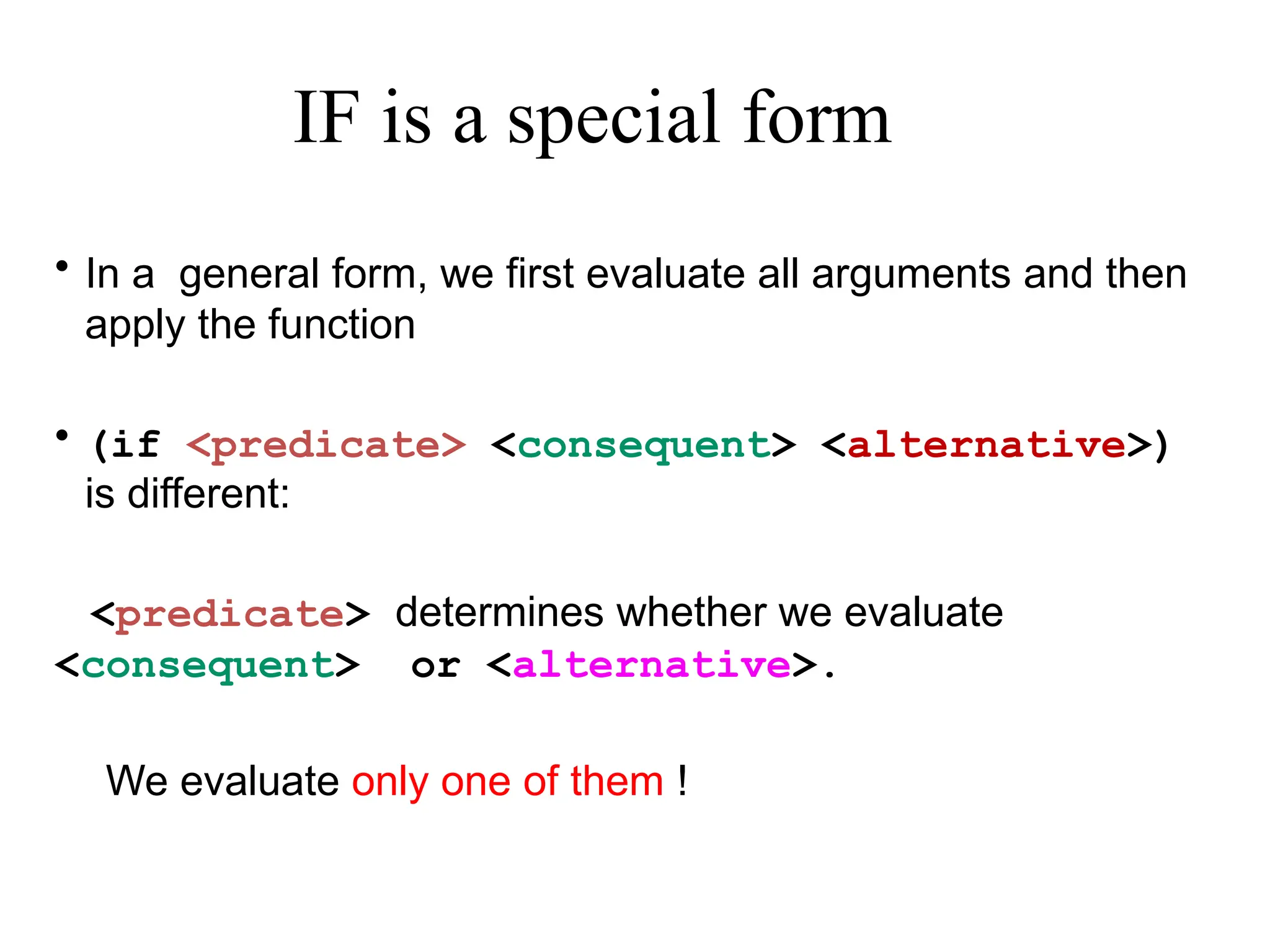
IF is a special form
• In a general form, we first evaluate all arguments and then
apply the function
• (if <predicate> <consequent> <alternative>)
is different:
<predicate> determines whether we evaluate
<consequent> or <alternative>.
We evaluate only one of them !
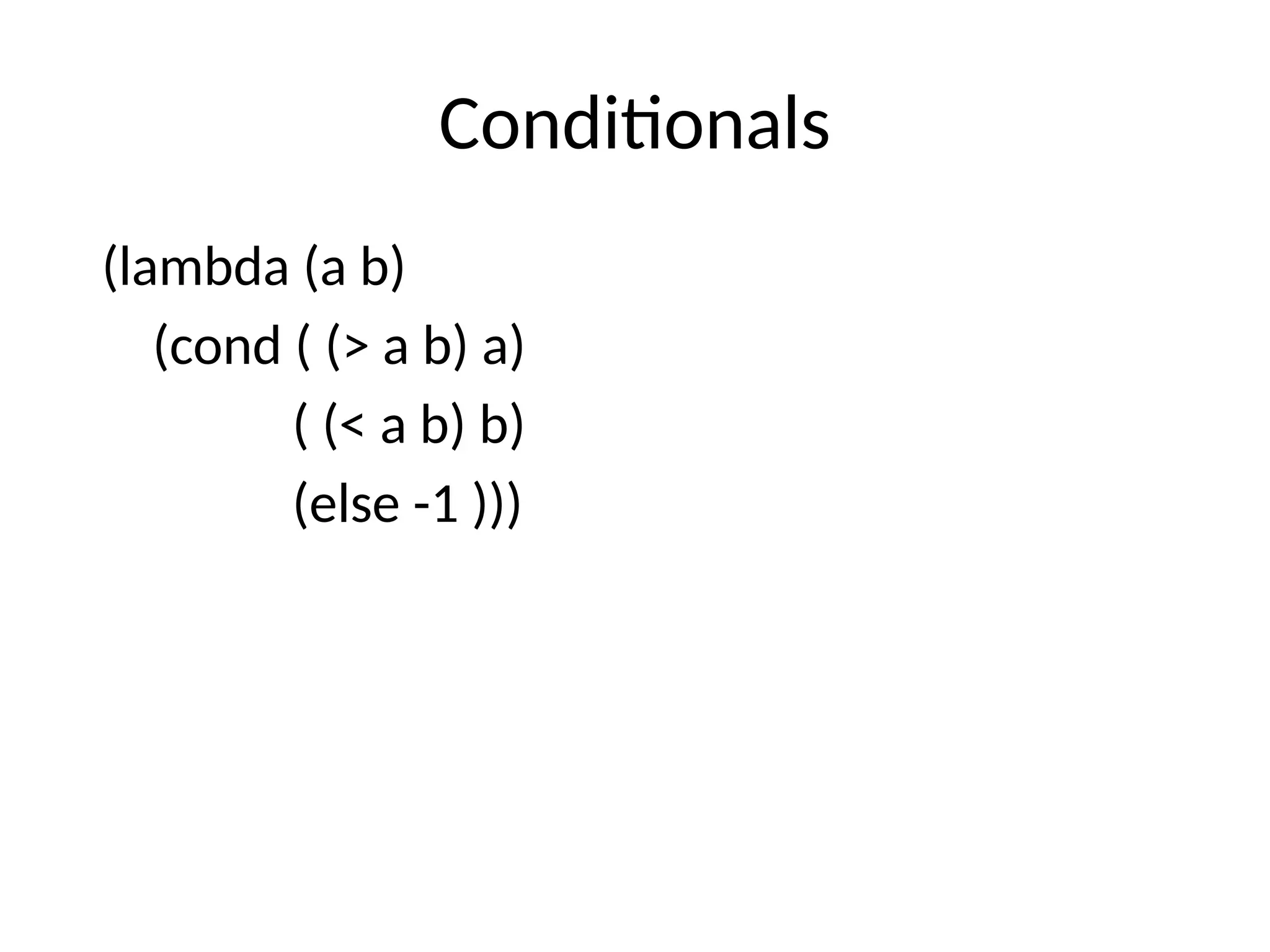
Conditionals
(lambda (a b)
(cond ( (> a b) a)
( (< a b) b)
(else -1 )))
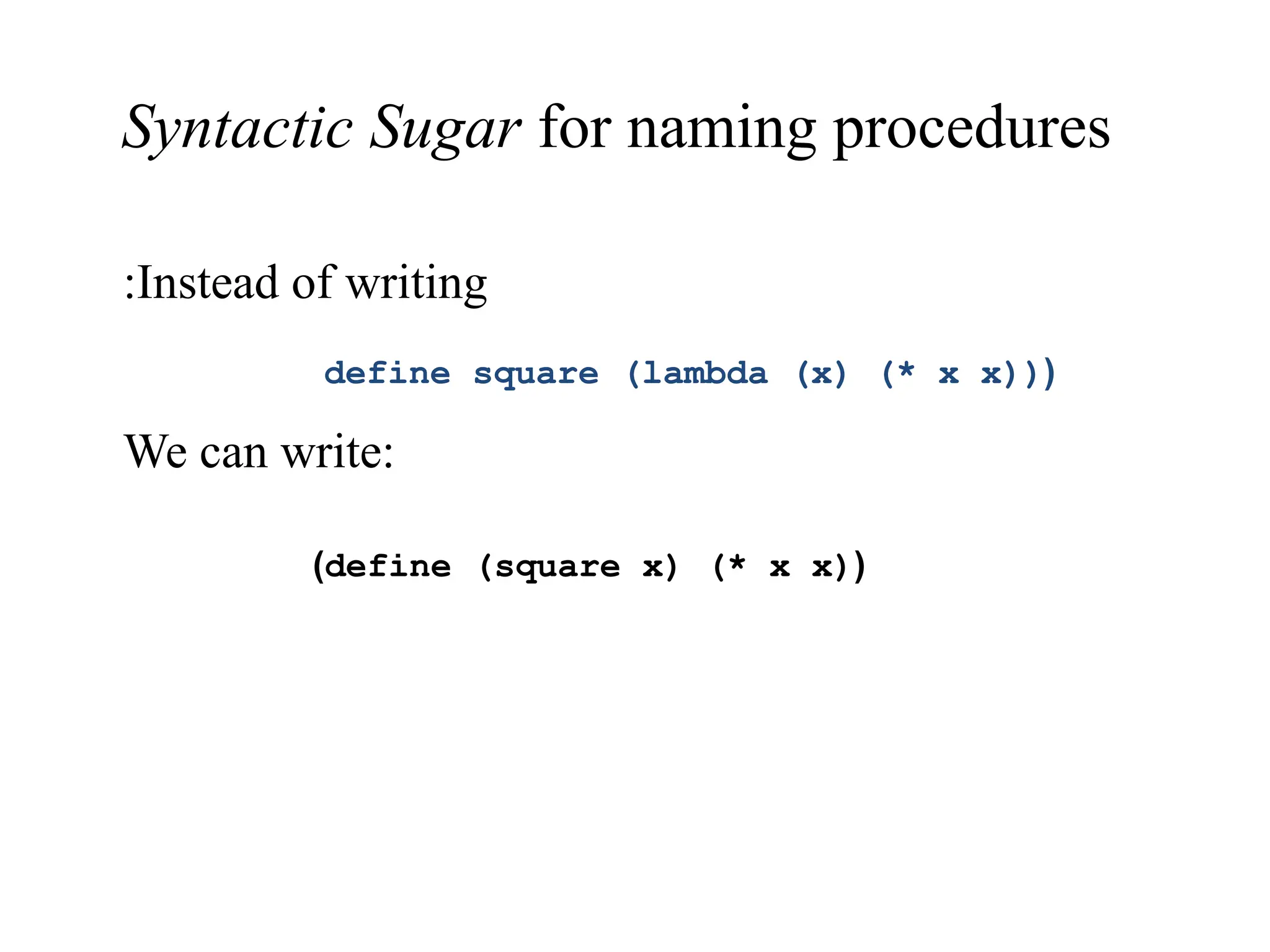
Syntactic Sugar for naming procedures
(
define square (lambda (x) (* x x))
(
define (square x) (* x x)
)
Instead of writing
:
We can write:
(
define second
)
(
second 2 15 3
>== )
15
(
second 34 -5 16
- >== )
5
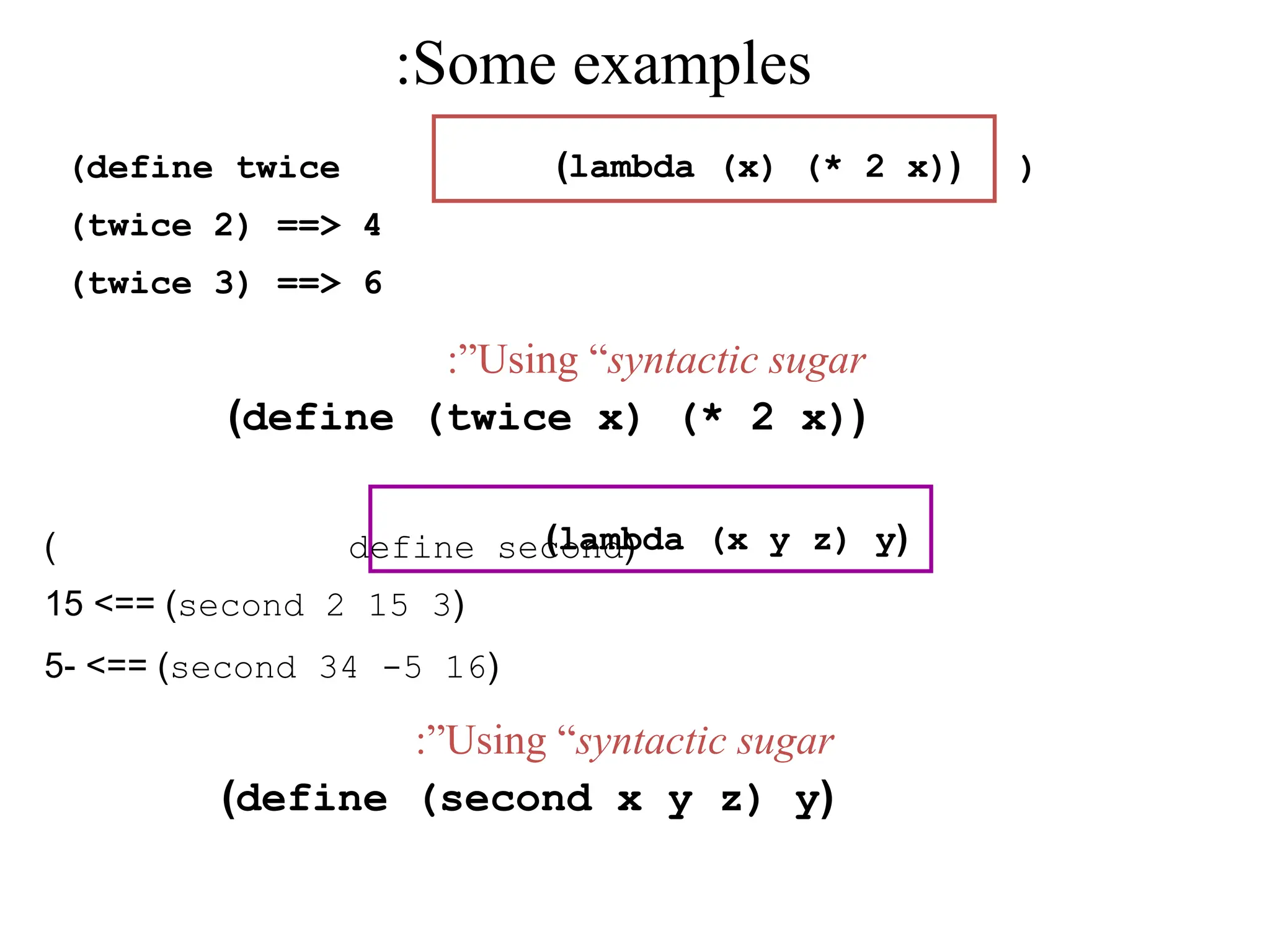
Some examples
:
(
lambda (x) (* 2 x)
)
(
lambda (x y z) y
)
Using “syntactic sugar
:”
(
define (twice x) (* 2 x)
)
Using “syntactic sugar
:”
(
define (second x y z) y
)
(define twice )
(twice 2) ==> 4
(twice 3) ==> 6
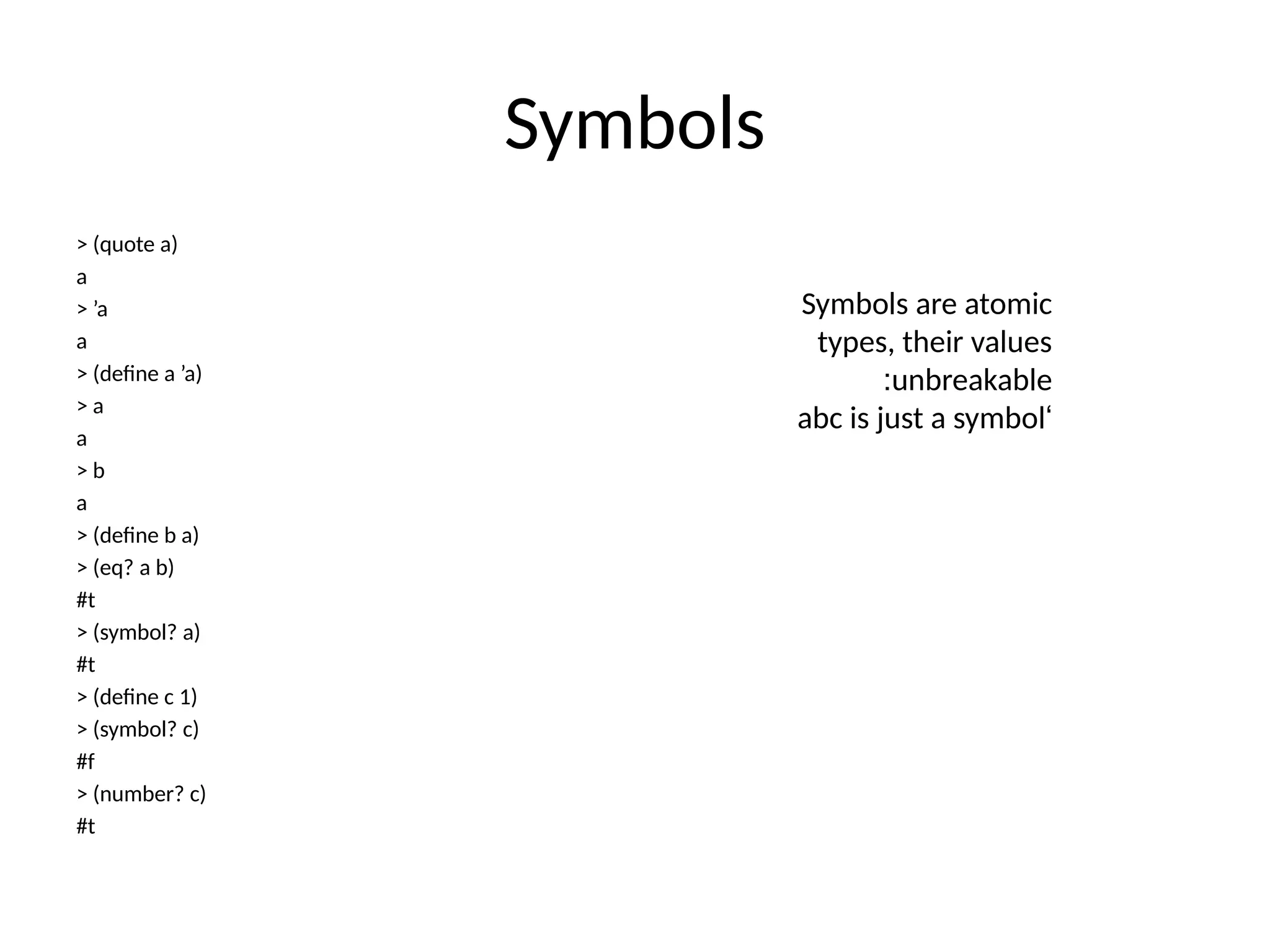
Symbols
> (quote a)
a
> ’a
a
> (define a ’a)
> a
a
> b
a
> (define b a)
> (eq? a b)
#t
> (symbol? a)
#t
> (define c 1)
> (symbol? c)
#f
> (number? c)
#t
Symbols are atomic
types, their values
unbreakable
:
‘
abc is just a symbol
More on Types
• A procedure type is a composite type, as it is
composed of the types of its inputs (domain)
and output (range)
• In fact, the procedure type can be instantiated
with any type for domain and range, resulting
in a different type for the procedure (=data)
• Such types are called polymorphic
– Another polymorphic type: arrays of values of type
X (e.g. STL vectors in C++)
Type constructor
• Defines a composite type out of other types
• The type constructor for functions is denoted “->”
• Example: [Number X Number –> Number] is the type of all procedures
that get as input two numbers, and return a number
• If all types are allowed we use a type variable:
– [T –> T] is the type of all procs. That return the same type as they get as input
• Note: there is nothing in the syntax for defining types! This is a
convention we manually enforce (for now..).
Scheme Type Grammar
Type --> ’Unit’ | Non-Unit [Unit=Void]
Non-unit -> Atomic | Composite | Type-variable
Atomic --> ’Number’ | ’Boolean’ | ’Symbol’
Composite --> Procedure | Union
Procedure --> ’Unit ’->’ Type | ’[’ (Non-Unit ’*’)* Non-
Unit ’->’ Type ’]’
Union --> Type ’union’ Type
Type-variable -> A symbol starting with an upper case
letter
Value constructor
• Means of defining an instance of a particular
type.
• The value constructors for procedures is
lambda
– Each lambda expression generates a new
procedure

Principles of programming language intro

  • 1.
  • 2.
    Introduction • We willstudy Modeling and Programming Computational Processes • Design Principles – Modularity, abstraction, contracts… • Programming languages features – Functional Programming • E.g. Scheme, ML • Functions are first-class objects – Logic Programming • E.g. Prolog • “Declarative Programming” – Imperative Programming • E.g. C,Java, Pascal • Focuses on change of state – Not always a crisp distinction – for instance scheme can be used for imperative programming.
  • 3.
    3 Declarative Knowledge 0 and such that the is2   y x y y x “ What is true ”
  • 4.
    4 To find anapproximation of x: • Make a guess G • Improve the guess by averaging G and x/G • Keep improving the guess until it is good enough Imperative and Functional Knowledge “ How to ” An algorithm due to : [ Heron of Alexandria ]
  • 5.
    More topics • Types –Type Inference and Type Checking – Static and Dynamic Typing • Different Semantics (e.g. Operational) • Interpreters vs. Compilers – Lazy and applicative evaluation
  • 6.
    Languages that willbe studied • Scheme – Dynamically Typed – Functions are first-class citizens – Simple (though lots of parenthesis  ) and allows to show different programming styles • ML – Statically typed language – Polymorphic types • Prolog – Declarative, Logic programming language • Languages are important, but we will focus on the principles
  • 7.
    Administrative Issues • Web-site •Exercises • Mid-term • Exam • Grade
  • 8.
    Use of Slides •Slides are teaching-aids, i.e. by nature incomplete • Compulsory material include everything taught in class, practical sessions as well as compulsory reading if mentioned
  • 9.
    Today • Scheme basics –Syntax and Semantics – The interpreter – Expressions, values, types..
  • 10.
    10 Scheme • LISP =LISt Processing – Invented in 1959 by John McCarthy – Scheme is a dialect of LISP – invented by Gerry Sussman and Guy Steele
  • 11.
    11 The Scheme Interpreter •The Read/Evaluate/Print Loop – Read an expression – Compute its value – Print the result – Repeat the above • The (Global) Environment – Mapping of names to values score 23 total 25 percentage 92 Name Value
  • 12.
    12 Language Elements Means of Abstraction (definescore 23) Associates score with 23 in environment table Syntax Semantics Means of Combination (composites) (+ 3 17 5) Application of proc to arguments Result = 25 Primitives 23 + * #t, #f 23 Primitive Proc (add) Primitive Proc (mult) Boolean
  • 13.
    13 Computing in Scheme >== 23 23 +(>== 3 17 5 ) 25 +( >== 3 *( 5 6 ) 8 2 ) 43 ( >== define score 23 ) Name Value Environment Table 23 score Opening parenthesis Expression whose value is a procedure Other expressions Closing parenthesis
  • 14.
    14 Computing in Scheme >== score 23 (>== define total 25 ) *( >== 100 /( score total )) 92 ( >== define percentage (* 100 (/ score total)) Name Value Environment 23 score 25 total 92 percentage >== Atomic (can’t decompose) but not primitive A name-value pair in the env. is called binding
  • 15.
    15 Evaluation of Expressions ToEvaluate a combination: (as opposed to special form) a. Evaluate all of the sub-expressions in some order b. Apply the procedure that is the value of the leftmost sub-expression to the arguments (the values of the other sub-expressions) The value of a numeral: number The value of a built-in operator: machine instructions to execute The value of any name: the associated value in the environment
  • 16.
    16 Using Evaluation Rules (>== define score 23 ) +( *( >== 5 6 -( ) score (* 2 3 2 ) )) Special Form (second sub- expression is not evaluated) * + 5 6 11 - 23 * 3 2 2 12 11 121
  • 17.
    17 Abstraction – CompoundProcedures • How does one describe procedures ? • ( lambda (x) (* x x) ) To process something multiply it by itself formal parameters body Internal representation • Special form – creates a “procedure object” and returns it as a “value” Proc (x) (* x x)
  • 18.
    18 More on lambdas •The use of the word “lambda” is taken from lambda calculus. • A lambda body can consist of a sequence of expressions • The value returned is the value of the last one • So why have multiple expressions at all?
  • 19.
    19 Evaluation of AnExpression To Apply a compound procedure: (to a list of arguments) Evaluate the body of the procedure with the formal parameters replaced by the corresponding actual values (( >== lambda(x)(* x x) ) 5 ) Proc(x)(* x x) 5 *( 5 5 ) 25
  • 20.
    20 Evaluation of AnExpression To Apply a compound procedure: (to a list of arguments) Evaluate the body of the procedure with the formal parameters replaced by the corresponding actual values To Evaluate a combination: (other than special form) .a Evaluate all of the sub-expressions in any order .b Apply the procedure that is the value of the leftmost sub-expression to the arguments (the values of the other sub-expressions) The value of a numeral: number The value of a built-in operator: machine instructions to execute The value of any name: the associated object in the environment
  • 21.
    21 Using Abstractions ( >== square3 ) 9 ( +( >== square 3 ( ) square 4 )) ( >== define square (lambda(x)(* x x)) ) *( 3 3 *( ) 4 4 ) 9 16 + 25 Environment Table Name Value square Proc (x)(* x x)
  • 22.
    22 Yet More Abstractions ==>(define f (lambda(a) (sum-of-two-squares (+ a 3) (* a 3)))) ( >== sum-of-two-squares 3 4 ) 25 ==> (define sum-of-two-squares (lambda(x y)(+ (square x) (square y)))) Try it out…compute (f 3) on your own
  • 23.
    23 Evaluation of AnExpression (reminder) To Apply a compound procedure: (to a list of arguments) Evaluate the body of the procedure with the formal parameters substituted by the corresponding actual values To Evaluate a combination: (other than special form) .a Evaluate all of the sub-expressions in any order .b Apply the procedure that is the value of the leftmost sub-expression to the arguments (the values of the other sub-expressions) The value of a numeral: number The value of a built-in operator: machine instructions to execute The value of any name: the associated object in the environment
  • 24.
    24 Lets not forgetThe Environment ( >== define x 8 ) +( >== x 1 ) 9 ( >== define x 5 ) +( >== x 1 ) 6 The value of (+ x 1) depends on the environment !
  • 25.
    25 Using the substitutionmodel ( define square (lambda (x) (* x x)) ) ( define average (lambda (x y) (/ (+ x y) 2)) ) ( average 5 (square 3) ) ( average 5 (* 3 3) ) ( average 5 9 ) first evaluate operands, then substitute +( /( 5 9 ) 2 ) /( 14 2 ) if operator is a primitive procedure, 7 replace by result of operation
  • 26.
    26 Booleans Two distinguished valuesdenoted by the constants # t and #f The type of these values is boolean <( >== 2 3 ) # t <( >== 4 3 ) # f
  • 27.
    Values and types Valueshave types. For example : In scheme almost every expression has a value Examples: 1) The value of 23 is 23 2) The value of + is a primitive procedure for addition 3) The value of (lambda (x) (* x x)) is the compound procedure proc(x) (* x x) (also denoted <Closure (x) (* x x)> 1) The type of 23 is numeral 2) The type of + is a primitive procedure 3) The type of proc (x) (* x x) is a compound procedure 4) The type of (> x 1) is a boolean (or logical)
  • 28.
    Atomic and CompoundTypes • Atomic types – Numbers, Booleans, Symbols (TBD) • Composite types – Types composed of other types – So far: only procedures – We will see others later
  • 29.
    29 No Value ? • Inscheme most expressions have values • Not all! Those that don’t usually have side effects Example : what is the value of the expression (define x 8) And of (display x) [display is a primitive func., prints the value of its argument to the screen] • In scheme, the value of a define, display expression is “undefined” . This means “implementation-dependent” • Never write code that relies on such value!
  • 30.
    Dynamic Typing • Notethat we never specify explicitly types of variables • However primitive functions expect values of a certain type! – E.g. “+” expects numeral values • So will our procedures (To be discussed soon) • The Scheme interpreter checks type correctness at run-time: dynamic typing – [As opposed to static typing verified by a compiler ]
  • 31.
    31 More examples ( >== definex 8 ) Name Value Environment Table 8 x ( >== define x (* x 2) ) >== x 16 16 ( >== define x y ) reference to undefined identifier: y ( >== define )- + >-<# + +( >== 2 2 ) 0 Bad practice, disalowed by some interpreters
  • 32.
    The IF specialform ERROR 2 ( if <predicate> <consequent> <alternative )> If the value of <predicate> is #t, Evaluate <consequent> and return it Otherwise Evaluate <alternative> and return it ( if (< 2 3) 2 3 >== ) 2 ( if (< 2 3) 2 (/ 1 0) >== )
  • 33.
    IF is aspecial form • In a general form, we first evaluate all arguments and then apply the function • (if <predicate> <consequent> <alternative>) is different: <predicate> determines whether we evaluate <consequent> or <alternative>. We evaluate only one of them !
  • 34.
    Conditionals (lambda (a b) (cond( (> a b) a) ( (< a b) b) (else -1 )))
  • 35.
    Syntactic Sugar fornaming procedures ( define square (lambda (x) (* x x)) ( define (square x) (* x x) ) Instead of writing : We can write:
  • 36.
    ( define second ) ( second 215 3 >== ) 15 ( second 34 -5 16 - >== ) 5 Some examples : ( lambda (x) (* 2 x) ) ( lambda (x y z) y ) Using “syntactic sugar :” ( define (twice x) (* 2 x) ) Using “syntactic sugar :” ( define (second x y z) y ) (define twice ) (twice 2) ==> 4 (twice 3) ==> 6
  • 37.
    Symbols > (quote a) a >’a a > (define a ’a) > a a > b a > (define b a) > (eq? a b) #t > (symbol? a) #t > (define c 1) > (symbol? c) #f > (number? c) #t Symbols are atomic types, their values unbreakable : ‘ abc is just a symbol
  • 38.
    More on Types •A procedure type is a composite type, as it is composed of the types of its inputs (domain) and output (range) • In fact, the procedure type can be instantiated with any type for domain and range, resulting in a different type for the procedure (=data) • Such types are called polymorphic – Another polymorphic type: arrays of values of type X (e.g. STL vectors in C++)
  • 39.
    Type constructor • Definesa composite type out of other types • The type constructor for functions is denoted “->” • Example: [Number X Number –> Number] is the type of all procedures that get as input two numbers, and return a number • If all types are allowed we use a type variable: – [T –> T] is the type of all procs. That return the same type as they get as input • Note: there is nothing in the syntax for defining types! This is a convention we manually enforce (for now..).
  • 40.
    Scheme Type Grammar Type--> ’Unit’ | Non-Unit [Unit=Void] Non-unit -> Atomic | Composite | Type-variable Atomic --> ’Number’ | ’Boolean’ | ’Symbol’ Composite --> Procedure | Union Procedure --> ’Unit ’->’ Type | ’[’ (Non-Unit ’*’)* Non- Unit ’->’ Type ’]’ Union --> Type ’union’ Type Type-variable -> A symbol starting with an upper case letter
  • 41.
    Value constructor • Meansof defining an instance of a particular type. • The value constructors for procedures is lambda – Each lambda expression generates a new procedure

Editor's Notes

  • #3 Lets see an example.
  • #33 (If (attack Russians) (send bomb) (do nothing)) (If (= I 1) (set I 2) (set I 3)) If + recursion