A D V I S E R ’ S G U I D E
T O E S TA B L I S H I N G P O L I C Y
R A C H E L E K A N I G E L
S A N F R A N C I S C O S TA T E U N I V E R S I T Y
B R A D L E Y W I L S O N , P H . D
M I D W E S T E R N S TA T E U N I V E R S I T Y
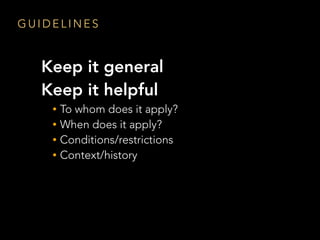
G U I D E L I N E S
Keep it general
Keep it helpful
• To whom does it apply?
• When does it apply?
• Conditions/restrictions
• Context/history
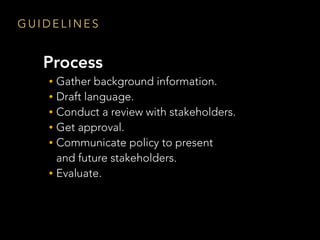
G U I D E L I N E S
Process
• Gather background information.
• Draft language.
• Conduct a review with stakeholders.
• Get approval.
• Communicate policy to present 

and future stakeholders.
• Evaluate.
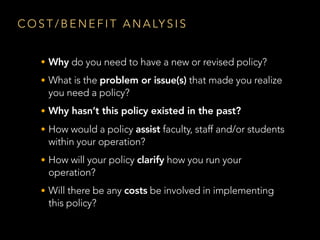
C O S T / B E N E F I T A N A LY S I S
• Why do you need to have a new or revised policy?
• What is the problem or issue(s) that made you realize
you need a policy?
• Why hasn’t this policy existed in the past?
• How would a policy assist faculty, staff and/or students
within your operation?
• How will your policy clarify how you run your
operation?
• Will there be any costs be involved in implementing
this policy?
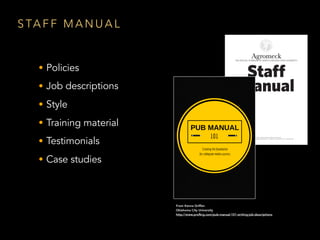
S TA F F M A N U A L
• Policies
• Job descriptions
• Style
• Training material
• Testimonials
• Case studies
From Kenna Griffen
Oklahoma City University
http://www.profkrg.com/pub-manual-101-writing-job-descriptions
PART OF THE STUDENT MEDIA FAMILY INCLUDING
AGROMECK • AMERICANA • NUBIAN MESSAGE • TECHNICIAN • WKNC 88.1FM • WINDHOVER
AgromeckTHE OFFICIAL YEARBOOK OF NORTH CAROLINA STATE UNIVERSITY
Staff
Manual
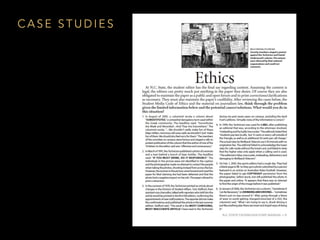
C A S E S T U D I E S
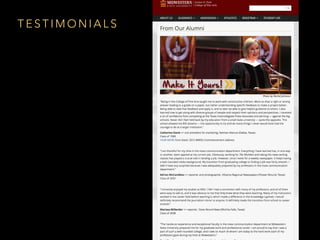
T E S T I M O N I A L S
“To this day, I still can’t tell you what did it.
“I can’t elaborate on what drew me, an awkward
engineering freshman, over to that corner in the
ballroom, where a former editor stood waiting.
“…Whatever the reason, I did wander over there.
He did give me that pitch. I did write my first
article.
“And I’ve never been the same.”
–TYLER DUKES, TESTIMONIAL
T E S T I M O N I A L S
“To this day, I still can’t tell you what did it.
“I can’t elaborate on what drew me, an awkward
engineering freshman, over to that corner in the
ballroom, where a former editor stood waiting.
“…Whatever the reason, I did wander over there.
He did give me that pitch. I did write my first
article.
“And I’ve never been the same.”
–TYLER DUKES, TESTIMONIAL
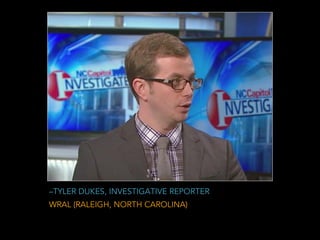
–TYLER DUKES, INVESTIGATIVE REPORTER
WRAL (RALEIGH, NORTH CAROLINA)
T E S T I M O N I A L S
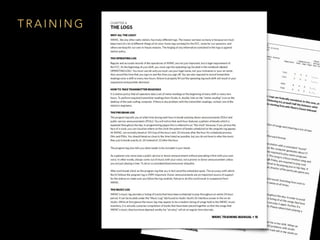
T R A I N I N G
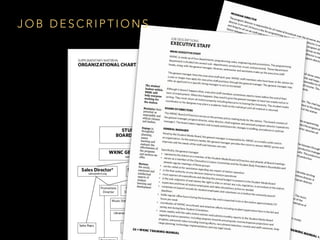
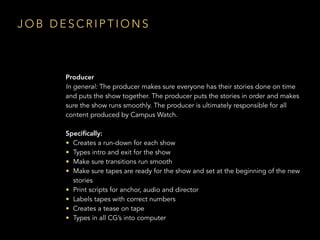
J O B D E S C R I P T I O N S
Producer
In general: The producer makes sure everyone has their stories done on time
and puts the show together. The producer puts the stories in order and makes
sure the show runs smoothly. The producer is ultimately responsible for all
content produced by Campus Watch.
Specifically:
• Creates a run-down for each show
• Types intro and exit for the show
• Make sure transitions run smooth
• Make sure tapes are ready for the show and set at the beginning of the new
stories
• Print scripts for anchor, audio and director
• Labels tapes with correct numbers
• Creates a tease on tape
• Types in all CG’s into computer
J O B D E S C R I P T I O N S
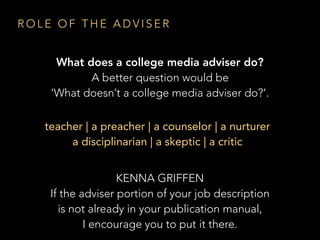
R O L E O F T H E A D V I S E R
What does a college media adviser do?
A better question would be
‘What doesn’t a college media adviser do?’.
teacher | a preacher | a counselor | a nurturer
a disciplinarian | a skeptic | a critic
KENNA GRIFFEN
If the adviser portion of your job description
is not already in your publication manual,
I encourage you to put it there.
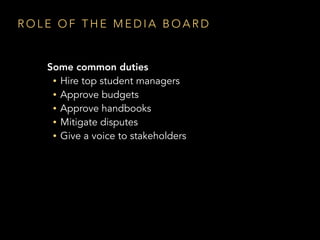
R O L E O F T H E M E D I A B O A R D
Some common duties
• Hire top student managers
• Approve budgets
• Approve handbooks
• Mitigate disputes
• Give a voice to stakeholders
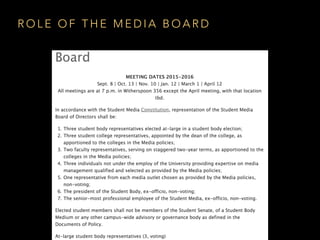
R O L E O F T H E M E D I A B O A R D
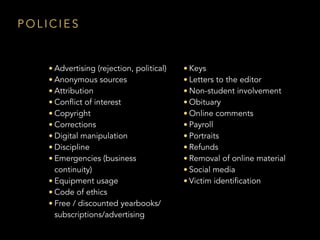
P O L I C I E S
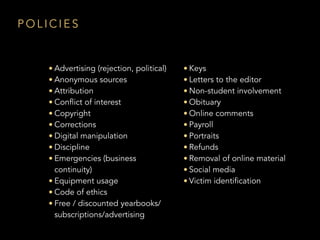
• Advertising (rejection, political)
• Anonymous sources
• Attribution
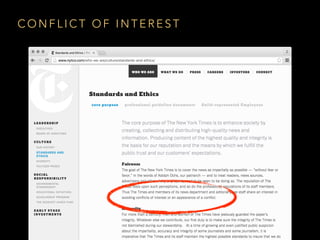
• Conflict of interest
• Copyright
• Corrections
• Digital manipulation
• Discipline
• Emergencies (business
continuity)
• Equipment usage
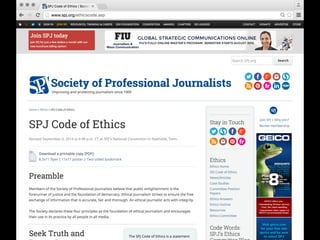
• Code of ethics
• Free / discounted yearbooks/
subscriptions/advertising
• Keys
• Letters to the editor
• Non-student involvement
• Obituary
• Online comments
• Payroll
• Portraits
• Refunds
• Removal of online material
• Social media
• Victim identification
C O N F L I C T O F I N T E R E S T
GUIDELINE

Students have to have at least two degrees of separation
from their sources. So they can't interview a roommate or a
cousin but they can interview their roommate's cousin (as
long as that person isn't a friend of theirs).
OTHER QUESTIONS
Then there are questions about can reporters interview their
professors? Can they write about campus housing if they
live on campus? Can they cover sports if they play on a
team (or if their sister is one of the coaches)?
C O N F L I C T O F I N T E R E S T
OVERVIEW
All Student Media are
obligated to correct any
error they make as soon
as possible, no matter
the level of consequence
for the error. The
corrections should be in
a fixed, consistent
location in the
publication. The absence
of such corrections calls
into question a medium’s
ability to call itself a
public forum.
PROCEDURE
• Document the error
with the source, the
reporter(s) and editor(s)
involved.
• Determine whether a
clarification or
correction is warranted.
• Publish a clarification or
correction as soon as
possible, usually the
next day.
• Follow up with a phone
call and written
communication from
the editor to the
source(s) in question.
RESPONSIBILITY
The editor is responsible
• for publishing written
correction of all errors;
and
• for publishing a
summary of errors in
the monthly report to
the board.
C O R R E C T I O N S
FORM
Although the specifics may vary depending on the circumstances, in general, a
correction will take the form: “In ‘<headline>’ (p. <#>, <date>), the <name of
publication> <correction without restating the error when possible>. <Name of
publication> regrets the error.”
When a source believes he or she has been misquoted or otherwise attributed to
misstatements, but he editor, after consultation with the reporter, believes the published
statement were correct, a clarification may take the general form: “In ‘<headline>’ (p.
<#>, <date>), <name of publication> <what we said.> In subsequent interviews with
<sources>, they state <what they now state>. The <name of publication> stands behind
the original publication.
When a correction or clarification is made online to a story that appeared in print, the
publication will note that in an editor’s note to appear at the top of the online version of
the articles. “Information in this article, originally published <date> has been corrected.
State correction without restating error when possible.”
C O R R E C T I O N S
C O P Y R I G H T
OWNERSHIP OF IMAGES
In accordance with Student Media policy and the work-for-hire clauses of the United
States Copyright Law, Student Media owns all images taken on assignment for the
Student Media.
This does NOT prevent a student photographer from taking pictures on their own,
using their own equipment, for profit. It does NOT prevent a student photographer
from publishing photos they have taken on their own Web site for portfolio or contest
purposes or otherwise displaying them for portfolio or contest purposes.
It DOES prevent a photographer from releasing any photos taken while on assignment
from Student Media – as indicated above – before they are published (or refused
publication) in the Student Media.
The Student Media retains exclusive rights to publish in any form photographs taken
while on assignment or published in a student media for a period of 18 months. After
that, the photographer and Student Media share copyright and both may publish as
desired.
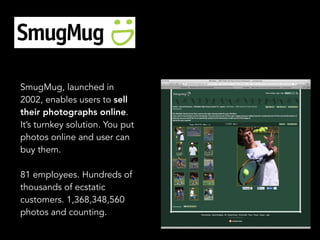
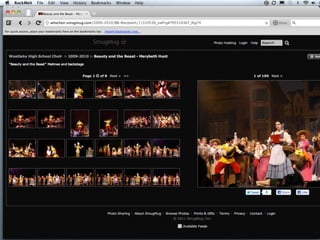
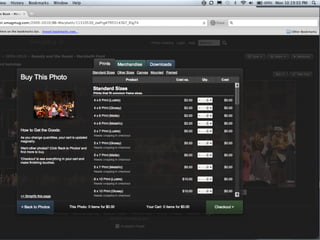
SmugMug, launched in
2002, enables users to sell
their photographs online.
It’s turnkey solution. You put
photos online and user can
buy them.
81 employees. Hundreds of
thousands of ecstatic
customers. 1,368,348,560
photos and counting.
P H O T O C R E D I T S
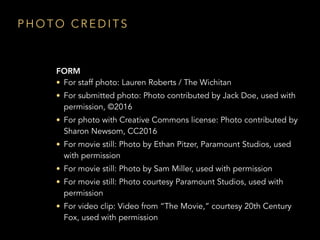
FORM
• For staff photo: Lauren Roberts / The Wichitan
• For submitted photo: Photo contributed by Jack Doe, used with
permission, ©2016
• For photo with Creative Commons license: Photo contributed by
Sharon Newsom, CC2016
• For movie still: Photo by Ethan Pitzer, Paramount Studios, used
with permission
• For movie still: Photo by Sam Miller, used with permission
• For movie still: Photo courtesy Paramount Studios, used with
permission
• For video clip: Video from “The Movie,” courtesy 20th Century
Fox, used with permission
Q U E S T I O N S ?
C O M M E N T S ?
R A C H E L E K A N I G E L
S A N F R A N C I S C O S TAT E U N I V E R S I T Y
R K A N I G E L @ G M A I L . C O M
@ J O U R P R O F
B R A D L E Y W I L S O N , P H . D
M I D W E S T E R N S TAT E U N I V E R S I T Y
B R A D L E Y W I L S O N 0 8 @ G M A I L . C O M
@ B R A D L E Y W I L S O N 0 9
P O L I C I E S
• Advertising (rejection, political)
• Anonymous sources
• Attribution
• Conflict of interest
• Copyright
• Corrections
• Digital manipulation
• Discipline
• Emergencies (business
continuity)
• Equipment usage
• Code of ethics
• Free / discounted yearbooks/
subscriptions/advertising
• Keys
• Letters to the editor
• Non-student involvement
• Obituary
• Online comments
• Payroll
• Portraits
• Refunds
• Removal of online material
• Social media
• Victim identification

Establishing policy

  • 1.
    A D VI S E R ’ S G U I D E T O E S TA B L I S H I N G P O L I C Y R A C H E L E K A N I G E L S A N F R A N C I S C O S TA T E U N I V E R S I T Y B R A D L E Y W I L S O N , P H . D M I D W E S T E R N S TA T E U N I V E R S I T Y
  • 2.
    G U ID E L I N E S Keep it general Keep it helpful • To whom does it apply? • When does it apply? • Conditions/restrictions • Context/history
  • 3.
    G U ID E L I N E S Process • Gather background information. • Draft language. • Conduct a review with stakeholders. • Get approval. • Communicate policy to present 
 and future stakeholders. • Evaluate.
  • 4.
    C O ST / B E N E F I T A N A LY S I S • Why do you need to have a new or revised policy? • What is the problem or issue(s) that made you realize you need a policy? • Why hasn’t this policy existed in the past? • How would a policy assist faculty, staff and/or students within your operation? • How will your policy clarify how you run your operation? • Will there be any costs be involved in implementing this policy?
  • 5.
    S TA FF M A N U A L • Policies • Job descriptions • Style • Training material • Testimonials • Case studies From Kenna Griffen Oklahoma City University http://www.profkrg.com/pub-manual-101-writing-job-descriptions PART OF THE STUDENT MEDIA FAMILY INCLUDING AGROMECK • AMERICANA • NUBIAN MESSAGE • TECHNICIAN • WKNC 88.1FM • WINDHOVER AgromeckTHE OFFICIAL YEARBOOK OF NORTH CAROLINA STATE UNIVERSITY Staff Manual
  • 6.
    C A SE S T U D I E S
  • 7.
    T E ST I M O N I A L S “To this day, I still can’t tell you what did it. “I can’t elaborate on what drew me, an awkward engineering freshman, over to that corner in the ballroom, where a former editor stood waiting. “…Whatever the reason, I did wander over there. He did give me that pitch. I did write my first article. “And I’ve never been the same.” –TYLER DUKES, TESTIMONIAL
  • 8.
    T E ST I M O N I A L S “To this day, I still can’t tell you what did it. “I can’t elaborate on what drew me, an awkward engineering freshman, over to that corner in the ballroom, where a former editor stood waiting. “…Whatever the reason, I did wander over there. He did give me that pitch. I did write my first article. “And I’ve never been the same.” –TYLER DUKES, TESTIMONIAL
  • 9.
    –TYLER DUKES, INVESTIGATIVEREPORTER WRAL (RALEIGH, NORTH CAROLINA)
  • 10.
    T E ST I M O N I A L S
  • 11.
    T R AI N I N G
  • 12.
    J O BD E S C R I P T I O N S
  • 13.
    J O BD E S C R I P T I O N S
  • 14.
    Producer In general: Theproducer makes sure everyone has their stories done on time and puts the show together. The producer puts the stories in order and makes sure the show runs smoothly. The producer is ultimately responsible for all content produced by Campus Watch. Specifically: • Creates a run-down for each show • Types intro and exit for the show • Make sure transitions run smooth • Make sure tapes are ready for the show and set at the beginning of the new stories • Print scripts for anchor, audio and director • Labels tapes with correct numbers • Creates a tease on tape • Types in all CG’s into computer J O B D E S C R I P T I O N S
  • 15.
    R O LE O F T H E A D V I S E R What does a college media adviser do? A better question would be ‘What doesn’t a college media adviser do?’. teacher | a preacher | a counselor | a nurturer a disciplinarian | a skeptic | a critic KENNA GRIFFEN If the adviser portion of your job description is not already in your publication manual, I encourage you to put it there.
  • 16.
    R O LE O F T H E M E D I A B O A R D Some common duties • Hire top student managers • Approve budgets • Approve handbooks • Mitigate disputes • Give a voice to stakeholders
  • 17.
    R O LE O F T H E M E D I A B O A R D
  • 18.
    P O LI C I E S • Advertising (rejection, political) • Anonymous sources • Attribution • Conflict of interest • Copyright • Corrections • Digital manipulation • Discipline • Emergencies (business continuity) • Equipment usage • Code of ethics • Free / discounted yearbooks/ subscriptions/advertising • Keys • Letters to the editor • Non-student involvement • Obituary • Online comments • Payroll • Portraits • Refunds • Removal of online material • Social media • Victim identification
  • 20.
    C O NF L I C T O F I N T E R E S T
  • 21.
    GUIDELINE
 Students have tohave at least two degrees of separation from their sources. So they can't interview a roommate or a cousin but they can interview their roommate's cousin (as long as that person isn't a friend of theirs). OTHER QUESTIONS Then there are questions about can reporters interview their professors? Can they write about campus housing if they live on campus? Can they cover sports if they play on a team (or if their sister is one of the coaches)? C O N F L I C T O F I N T E R E S T
  • 22.
    OVERVIEW All Student Mediaare obligated to correct any error they make as soon as possible, no matter the level of consequence for the error. The corrections should be in a fixed, consistent location in the publication. The absence of such corrections calls into question a medium’s ability to call itself a public forum. PROCEDURE • Document the error with the source, the reporter(s) and editor(s) involved. • Determine whether a clarification or correction is warranted. • Publish a clarification or correction as soon as possible, usually the next day. • Follow up with a phone call and written communication from the editor to the source(s) in question. RESPONSIBILITY The editor is responsible • for publishing written correction of all errors; and • for publishing a summary of errors in the monthly report to the board. C O R R E C T I O N S
  • 23.
    FORM Although the specificsmay vary depending on the circumstances, in general, a correction will take the form: “In ‘<headline>’ (p. <#>, <date>), the <name of publication> <correction without restating the error when possible>. <Name of publication> regrets the error.” When a source believes he or she has been misquoted or otherwise attributed to misstatements, but he editor, after consultation with the reporter, believes the published statement were correct, a clarification may take the general form: “In ‘<headline>’ (p. <#>, <date>), <name of publication> <what we said.> In subsequent interviews with <sources>, they state <what they now state>. The <name of publication> stands behind the original publication. When a correction or clarification is made online to a story that appeared in print, the publication will note that in an editor’s note to appear at the top of the online version of the articles. “Information in this article, originally published <date> has been corrected. State correction without restating error when possible.” C O R R E C T I O N S
  • 24.
    C O PY R I G H T OWNERSHIP OF IMAGES In accordance with Student Media policy and the work-for-hire clauses of the United States Copyright Law, Student Media owns all images taken on assignment for the Student Media. This does NOT prevent a student photographer from taking pictures on their own, using their own equipment, for profit. It does NOT prevent a student photographer from publishing photos they have taken on their own Web site for portfolio or contest purposes or otherwise displaying them for portfolio or contest purposes. It DOES prevent a photographer from releasing any photos taken while on assignment from Student Media – as indicated above – before they are published (or refused publication) in the Student Media. The Student Media retains exclusive rights to publish in any form photographs taken while on assignment or published in a student media for a period of 18 months. After that, the photographer and Student Media share copyright and both may publish as desired.
  • 25.
    SmugMug, launched in 2002,enables users to sell their photographs online. It’s turnkey solution. You put photos online and user can buy them. 81 employees. Hundreds of thousands of ecstatic customers. 1,368,348,560 photos and counting.
  • 28.
    P H OT O C R E D I T S FORM • For staff photo: Lauren Roberts / The Wichitan • For submitted photo: Photo contributed by Jack Doe, used with permission, ©2016 • For photo with Creative Commons license: Photo contributed by Sharon Newsom, CC2016 • For movie still: Photo by Ethan Pitzer, Paramount Studios, used with permission • For movie still: Photo by Sam Miller, used with permission • For movie still: Photo courtesy Paramount Studios, used with permission • For video clip: Video from “The Movie,” courtesy 20th Century Fox, used with permission
  • 29.
    Q U ES T I O N S ? C O M M E N T S ?
  • 30.
    R A CH E L E K A N I G E L S A N F R A N C I S C O S TAT E U N I V E R S I T Y R K A N I G E L @ G M A I L . C O M @ J O U R P R O F B R A D L E Y W I L S O N , P H . D M I D W E S T E R N S TAT E U N I V E R S I T Y B R A D L E Y W I L S O N 0 8 @ G M A I L . C O M @ B R A D L E Y W I L S O N 0 9
  • 31.
    P O LI C I E S • Advertising (rejection, political) • Anonymous sources • Attribution • Conflict of interest • Copyright • Corrections • Digital manipulation • Discipline • Emergencies (business continuity) • Equipment usage • Code of ethics • Free / discounted yearbooks/ subscriptions/advertising • Keys • Letters to the editor • Non-student involvement • Obituary • Online comments • Payroll • Portraits • Refunds • Removal of online material • Social media • Victim identification