A presentation for

SWECJMC
Southwest Education Council for Journalism & Mass Communication

2018 | Denver, Colorado

by Bradley Wilson, Ph.D.

Associate Professor

Midwestern State University

Wichita Falls,Texas
It’s About More
Than Money.Adviser qualifications, racial makeup of staff 

and school location predict scholastic media success
Respondents in a 2017 Gallup poll said they have little condence in the public schools
today with only 36 percent having a “great deal” or “quite a lot” of confidence in the
schools. While the rising tide of mediocrity so often mentioned in educational research
pushes for more funding— smaller class sizes and higher teacher salaries, this research
and that of others shows money may not be the leading factor in success in a
scholastic media environment. When 310 of the most successful scholastic broadcast,
yearbook, newspaper and online programs were examined, the qualications of the
teachers, the location of the school and the racial diversity of the school were more
likely to predict success than per pupil revenues or low student/teacher ratios.
Abstract
Introduction
“The educational foundations of our society
are presently being eroded by a rising tide of
mediocrity that threatens our very future as
a Nation and a people.”
A Nation at Risk, 1983
Introduction
Education is not a fundamental right.
San Antonio ISD v. Rodriguez, 411 U.S. 1 (1973)
Texan’s are still ‘broadly negative’ on the
state’s handling of public education.
University of Texas / Texas Tribune Poll, 2018
Work environment
Teachers quit for several reasons, but the one
you’d expect to be at the top of the list —
salary — typically isn’t.
National Center for Education Statistics, 2017
administrative support
workplace conditions
lack of influence within the school system
classroom intrusion
inadequate time
It’s not the money
There is a lack of consistent evidence on
whether education expenditures are related
to achievement.
Lips, Watkins, Fleming, 2008
Is white privilege 

a real thing?
In virtually every aspect of life — from the risk of
racist violence, to getting a job, to nd a place to
live, to the simple act of hailing a cab the black
person will face struggles and threats that the white
person will not.
Jensen, 2005
Why study awards?
“[T]he motivation of students themselves is critical
to the educational process.”
Hanushek, 1994
“[P]eople tend to over invest resources whenever
‘winning against others’ is involved because winning
confers status.”
Huberman, Loch and Önçüler, 2005
• H1 Schools with award-winning scholastic media programs will not
be significantly different from schools with JEA certified
teachers.
• H2 Schools with award-winning scholastic media programs will be
more affluent.
• H3 Schools with award-winning scholastic media programs will have
lower student/teacher ratios.
• H4 Schools with award-winning scholastic media programs will have
more white students and be less racially diverse than average.
• H5 More urban schools will have award-winning scholastic media
programs than rural schools.
Hypotheses
Methodology
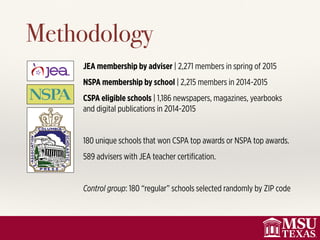
JEA membership by adviser | 2,271 members in spring of 2015
NSPA membership by school | 2,215 members in 2014-2015
CSPA eligible schools | 1,186 newspapers, magazines, yearbooks
and digital publications in 2014-2015
180 unique schools that won CSPA top awards or NSPA top awards.
589 advisers with JEA teacher certication.
Control group: 180 “regular” schools selected randomly by ZIP code
The control group
180 “regular” schools
Randomly selected by ZIP code
Special education schools, juvenile
detention schools, hospital and
homebound schools and alternative
schools were not included in the control
group
Findings
Award-winning
group
Control group
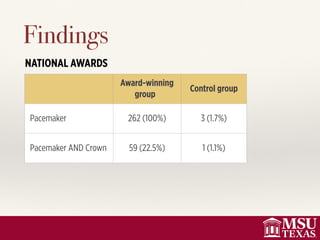
Pacemaker 262 (100%) 3 (1.7%)
Pacemaker AND Crown 59 (22.5%) 1 (1.1%)
NATIONAL AWARDS
Findings
JEA CERTIFICATION
Award-winning group Control group Sig. of difference
None 83 174
CJE 32 4
MJE 25 2
Certied 57 (40.7 %) 6 (3.3 %) p<0.001
Total 140 unique advisers 180 advisers
Findings
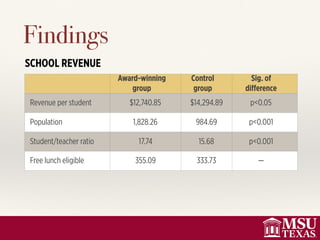
SCHOOL REVENUE
Award-winning
group
Control
group
Sig. of
difference
Revenue per student $12,740.85 $14,294.89 p<0.05
Population 1,828.26 984.69 p<0.001
Student/teacher ratio 17.74 15.68 p<0.001
Free lunch eligible 355.09 333.73 —
Findings
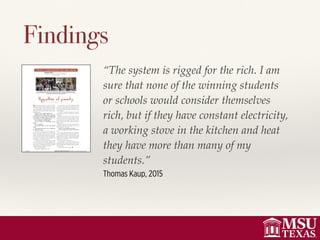
“The system is rigged for the rich. I am
sure that none of the winning students
or schools would consider themselves
rich, but if they have constant electricity,
a working stove in the kitchen and heat
they have more than many of my
students.”
Thomas Kaup, 2015
Findings
RACE
Award-winning group Control group
White 1,073.3 526.9
Non-white 630.2 439.5
Sig. of difference p<0.001
Publications in award-winning programs tend to be less diverse
than schools in the control group. Specically, back students were
under-represented and Asian students were over-represented.
Findings
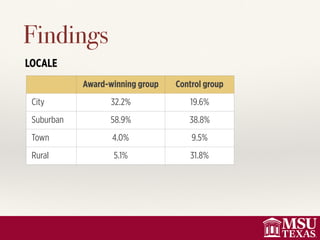
Award-winning group Control group
City 32.2% 19.6%
Suburban 58.9% 38.8%
Town 4.0% 9.5%
Rural 5.1% 31.8%
LOCALE
• H1 Schools with award-winning scholastic media programs will not be significantly
different from schools with JEA certified teachers. NOT PROVEN
• H2 Schools with award-winning scholastic media programs will be more affluent.
NOT PROVEN
• H3 Schools with award-winning scholastic media programs will have lower student/
teacher ratios. NOT PROVEN
• H4 Schools with award-winning scholastic media programs will have more white
students and be less racially diverse than average. PROVEN
• H5 More urban schools will have award-winning scholastic media programs than
rural schools. PROVEN
Hypotheses
When 310 of the most successful scholastic
broadcast, yearbook, newspaper and online
programs were examined, the qualications of the
teachers, the location of the school and the racial
diversity of the school were more likely to predict
success than per pupil revenues or low student/
teacher ratios.
In one sentence
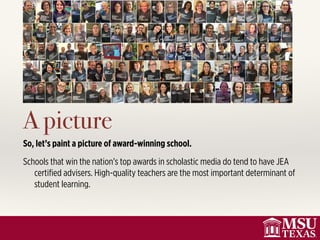
A picture
So, let’s paint a picture of award-winning school.
Schools that win the nation’s top awards in scholastic media do tend to have JEA
certied advisers. High-quality teachers are the most important determinant of
student learning.
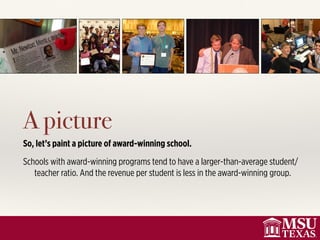
A picture
So, let’s paint a picture of award-winning school.
Schools with award-winning programs tend to have a larger-than-average student/
teacher ratio. And the revenue per student is less in the award-winning group.
A picture
So, let’s paint a picture of award-winning school.
Award-winning scholastic media programs tend to be less diverse than the control
group — predominately white — and exist in large, suburban schools.
Areas for future research
• Why did award-winning programs have a larger-than-
average student-teacher ratio? Maybe this gave them
access to more students to produce content.
• Do more successful programs make use of large, outside
forms of revenue from advertising to donations?
• Advisers tend to remain on the job 3-5 years. Is adviser
tenure associated with award-winning programs?
Areas for future research
• “If our schools aren’t teaching youth how to sniff out the truth 

when so many today seem determined to give us anything but, 

who will?”
Preston Tolliver, 2018
High school journalism / media programs
provide students with at least the
opportunity to develop all the desirable,
marketable skills and ethical standards.
Jack Kennedy, 2012
By Bradley Wilson, Ph.D.
Department of Mass Communication
bradley.wilson@msutexas.edu
bradleywilson08@gmail.com
@bradleywilson09

It's about more than money

  • 1.
    A presentation for SWECJMC SouthwestEducation Council for Journalism & Mass Communication 2018 | Denver, Colorado by Bradley Wilson, Ph.D. Associate Professor Midwestern State University Wichita Falls,Texas It’s About More Than Money.Adviser qualifications, racial makeup of staff 
 and school location predict scholastic media success
  • 2.
    Respondents in a2017 Gallup poll said they have little confidence in the public schools today with only 36 percent having a “great deal” or “quite a lot” of confidence in the schools. While the rising tide of mediocrity so often mentioned in educational research pushes for more funding— smaller class sizes and higher teacher salaries, this research and that of others shows money may not be the leading factor in success in a scholastic media environment. When 310 of the most successful scholastic broadcast, yearbook, newspaper and online programs were examined, the qualifications of the teachers, the location of the school and the racial diversity of the school were more likely to predict success than per pupil revenues or low student/teacher ratios. Abstract
  • 3.
    Introduction “The educational foundationsof our society are presently being eroded by a rising tide of mediocrity that threatens our very future as a Nation and a people.” A Nation at Risk, 1983
  • 4.
    Introduction Education is nota fundamental right. San Antonio ISD v. Rodriguez, 411 U.S. 1 (1973) Texan’s are still ‘broadly negative’ on the state’s handling of public education. University of Texas / Texas Tribune Poll, 2018
  • 5.
    Work environment Teachers quitfor several reasons, but the one you’d expect to be at the top of the list — salary — typically isn’t. National Center for Education Statistics, 2017 administrative support workplace conditions lack of influence within the school system classroom intrusion inadequate time
  • 6.
    It’s not themoney There is a lack of consistent evidence on whether education expenditures are related to achievement. Lips, Watkins, Fleming, 2008
  • 7.
    Is white privilege
 a real thing? In virtually every aspect of life — from the risk of racist violence, to getting a job, to find a place to live, to the simple act of hailing a cab the black person will face struggles and threats that the white person will not. Jensen, 2005
  • 8.
    Why study awards? “[T]hemotivation of students themselves is critical to the educational process.” Hanushek, 1994 “[P]eople tend to over invest resources whenever ‘winning against others’ is involved because winning confers status.” Huberman, Loch and Önçüler, 2005
  • 9.
    • H1 Schoolswith award-winning scholastic media programs will not be significantly different from schools with JEA certified teachers. • H2 Schools with award-winning scholastic media programs will be more affluent. • H3 Schools with award-winning scholastic media programs will have lower student/teacher ratios. • H4 Schools with award-winning scholastic media programs will have more white students and be less racially diverse than average. • H5 More urban schools will have award-winning scholastic media programs than rural schools. Hypotheses
  • 10.
    Methodology JEA membership byadviser | 2,271 members in spring of 2015 NSPA membership by school | 2,215 members in 2014-2015 CSPA eligible schools | 1,186 newspapers, magazines, yearbooks and digital publications in 2014-2015 180 unique schools that won CSPA top awards or NSPA top awards. 589 advisers with JEA teacher certification. Control group: 180 “regular” schools selected randomly by ZIP code
  • 11.
    The control group 180“regular” schools Randomly selected by ZIP code Special education schools, juvenile detention schools, hospital and homebound schools and alternative schools were not included in the control group
  • 12.
    Findings Award-winning group Control group Pacemaker 262(100%) 3 (1.7%) Pacemaker AND Crown 59 (22.5%) 1 (1.1%) NATIONAL AWARDS
  • 13.
    Findings JEA CERTIFICATION Award-winning groupControl group Sig. of difference None 83 174 CJE 32 4 MJE 25 2 Certified 57 (40.7 %) 6 (3.3 %) p<0.001 Total 140 unique advisers 180 advisers
  • 14.
    Findings SCHOOL REVENUE Award-winning group Control group Sig. of difference Revenueper student $12,740.85 $14,294.89 p<0.05 Population 1,828.26 984.69 p<0.001 Student/teacher ratio 17.74 15.68 p<0.001 Free lunch eligible 355.09 333.73 —
  • 15.
    Findings “The system isrigged for the rich. I am sure that none of the winning students or schools would consider themselves rich, but if they have constant electricity, a working stove in the kitchen and heat they have more than many of my students.” Thomas Kaup, 2015
  • 16.
    Findings RACE Award-winning group Controlgroup White 1,073.3 526.9 Non-white 630.2 439.5 Sig. of difference p<0.001 Publications in award-winning programs tend to be less diverse than schools in the control group. Specifically, back students were under-represented and Asian students were over-represented.
  • 17.
    Findings Award-winning group Controlgroup City 32.2% 19.6% Suburban 58.9% 38.8% Town 4.0% 9.5% Rural 5.1% 31.8% LOCALE
  • 18.
    • H1 Schoolswith award-winning scholastic media programs will not be significantly different from schools with JEA certified teachers. NOT PROVEN • H2 Schools with award-winning scholastic media programs will be more affluent. NOT PROVEN • H3 Schools with award-winning scholastic media programs will have lower student/ teacher ratios. NOT PROVEN • H4 Schools with award-winning scholastic media programs will have more white students and be less racially diverse than average. PROVEN • H5 More urban schools will have award-winning scholastic media programs than rural schools. PROVEN Hypotheses
  • 19.
    When 310 ofthe most successful scholastic broadcast, yearbook, newspaper and online programs were examined, the qualications of the teachers, the location of the school and the racial diversity of the school were more likely to predict success than per pupil revenues or low student/ teacher ratios. In one sentence
  • 20.
    A picture So, let’spaint a picture of award-winning school. Schools that win the nation’s top awards in scholastic media do tend to have JEA certified advisers. High-quality teachers are the most important determinant of student learning.
  • 21.
    A picture So, let’spaint a picture of award-winning school. Schools with award-winning programs tend to have a larger-than-average student/ teacher ratio. And the revenue per student is less in the award-winning group.
  • 22.
    A picture So, let’spaint a picture of award-winning school. Award-winning scholastic media programs tend to be less diverse than the control group — predominately white — and exist in large, suburban schools.
  • 23.
    Areas for futureresearch • Why did award-winning programs have a larger-than- average student-teacher ratio? Maybe this gave them access to more students to produce content. • Do more successful programs make use of large, outside forms of revenue from advertising to donations? • Advisers tend to remain on the job 3-5 years. Is adviser tenure associated with award-winning programs?
  • 24.
    Areas for futureresearch • “If our schools aren’t teaching youth how to sniff out the truth 
 when so many today seem determined to give us anything but, 
 who will?” Preston Tolliver, 2018 High school journalism / media programs provide students with at least the opportunity to develop all the desirable, marketable skills and ethical standards. Jack Kennedy, 2012
  • 25.
    By Bradley Wilson,Ph.D. Department of Mass Communication bradley.wilson@msutexas.edu bradleywilson08@gmail.com @bradleywilson09