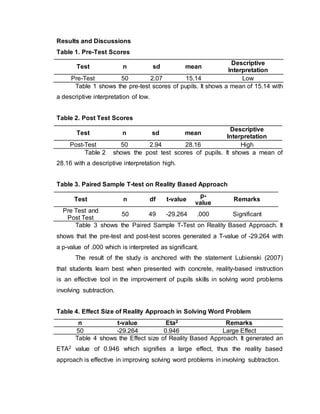
REALITY – BASED INSTRUCTION AND SOLVING WORD PROBLEMS
INVOLVING SUBTRACTION
WENEFREDO S. HIFARVA JR.
Abstract
This study was conducted to determine the effect of reality based on the
solving word problems involving subtraction. Descriptive-Comparative research
design using paired sample T-test was used to utilized in the study. The study
was carried out in Tibungol Elementary School to Fifty student of Grade Three
section 1. Results revealed that there was a significant difference on the pretest
and post test scores of pupils in reality based approach. Further, the reality
based approach is effective in improving the performance of student.
Introduction
In teaching through problem solving, learning takes place during the
process of attempting to solve problems in which relevant mathematics concepts
and skills are embedded (Lester & Charles, 2003). Modifying teaching strategies
can be one simple way to implement an intervention for a student. Taking
aspects of reality into account in modelling the situations described in word
problems is a potentially powerful way to connect pupils’ mathematics problem
solving to the real world, and to modify the belief and feeling of many children
that mathematics is irrelevant in relation to their everyday experiences. In this
approach, students able to relate in real situation that they may encounter in their
daily life.
The theoretical underpinnings of the study is anchored on the idea of
Bottge et al, 2004 which stated that the use of contextualized problem solving to
provide concrete, reality-based instruction has provided positive results in
student math achievement. These strategies provide students with the
opportunity to use prior knowledge to solve meaningful problems. Kurz and
Batarelo (2005) stated that, “The primary goal of anchored instruction is to create
shared environments that permit examination by students and teachers and
enable them to understand the kinds of problems and opportunities that can be
found in real life” (p. 422). On the other, to teach math not only allows students to
learn through discovery by drawing on their past knowledge, but also helps
provide students the confidence they need to solve sophisticated math problems.
Traditional university teachings are often not capable of providing students
with all the skill sets and knowledge necessary to solve the real-world problems
encountered in construction industry (AbouRizk and Sawhney, 1994). It has been
found that the most widely adopted pedagogical approach used for conveying
knowledge in majority of the construction programs is the traditional teaching
methods that includes lectures, seminars, and tutorials to expose the students to
applied science courses (Sawhney, et al., 2001). Sometimes the knowledge is
also conveyed in fragments using a series of courses with limited or no
opportunities for students to interact with construction professionals to gain
practical experiences of a real life situation (Fruchter, 1996, Fruchter, 1997).
In other countries, contextualized instruction has been supported through
research by Hoffman and Brahier (2008).Through meaningful contextualized
instruction, “students become confident in their ability to tackle difficult problems,
eager to figure things out own their own, flexible in exploring mathematical ideas
and trying alternative paths, and willing to persevere” (National Council for
Teachers of Mathematics, 2000, p. 21). Teachers do not have to sacrifice great
teaching pedagogy to achieve on highs takes tests (Williamson et al., 2009).
“Students can learn sophisticated concepts when instructional methods and
materials are motivating and appropriate” (Bottge et al., 2006, p. 405). Research
has provided evidence that contextualized problem solving can be a teaching
strategy that is successful for increasing student achievement and motivation.
Using problem-based learning as a teaching strategy can be useful as a Tier
intervention; however, one intervention may not be the answer for all students.
The study aimed to answer the following questions; 1. What is the pre test
scores of pupils in solving word problems involving subtraction? 2. What is the
post test scores of pupils in solving word problems involving subtraction? 3. Is
there a significant difference in the pre-test and post-test scores of pupils? 4.
What is the effect size of reality based instruction to the solving word problems
involving subtraction?
Reality Based Approach – is an approach using situation, experiences use as
an example of problem solving. The teacher construct a problem by asking the
pupils about their experiences, problems and any situation might involve friends
and families.
Problem solving is a skill may be used to accomplish the instructional goals of
learning basic facts, concepts, and procedures, as well as goals for problem
solving within problem contexts.
Method
This study utilized Descriptive-Comparative research design using paired
samples T-test. The respondents of this study were the 50 pupils of Grade III
section 1. The researcher made use of purposive sampling technique as
respondents of the proposed study. The study was conducted at Tibungol
Elementary School, Paquibato District. The researcher made use of secondary
data, specifically the scores in pre-test and post-test. The statistical tools use
were Descriptive Statistics (mean & SD), paired-sample T-test and ETA2. In this
study, the reality based approach will be examined. The data were collated and
analyzed using SPSS IBM statistics.
Results and Discussions
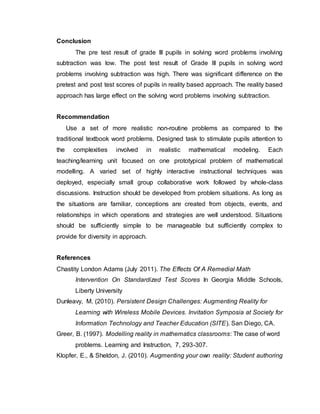
Table 1. Pre-Test Scores
Test n sd mean
Descriptive
Interpretation
Pre-Test 50 2.07 15.14 Low
Table 1 shows the pre-test scores of pupils. It shows a mean of 15.14 with
a descriptive interpretation of low.
Table 2. Post Test Scores
Test n sd mean
Descriptive
Interpretation
Post-Test 50 2.94 28.16 High
Table 2 shows the post test scores of pupils. It shows a mean of
28.16 with a descriptive interpretation high.
Table 3. Paired Sample T-test on Reality Based Approach
Test n df t-value
p-
value
Remarks
Pre Test and
Post Test
50 49 -29.264 .000 Significant
Table 3 shows the Paired Sample T-Test on Reality Based Approach. It
shows that the pre-test and post-test scores generated a T-value of -29.264 with
a p-value of .000 which is interpreted as significant.
The result of the study is anchored with the statement Lubienski (2007)
that students learn best when presented with concrete, reality-based instruction
is an effective tool in the improvement of pupils skills in solving word problems
involving subtraction.
Table 4. Effect Size of Reality Approach in Solving Word Problem
n t-value Eta2 Remarks
50 -29.264 0.946 Large Effect
Table 4 shows the Effect size of Reality Based Approach. It generated an
ETA2 value of 0.946 which signifies a large effect, thus the reality based
approach is effective in improving solving word problems in involving subtraction.
Conclusion
The pre test result of grade III pupils in solving word problems involving
subtraction was low. The post test result of Grade III pupils in solving word
problems involving subtraction was high. There was significant difference on the
pretest and post test scores of pupils in reality based approach. The reality based
approach has large effect on the solving word problems involving subtraction.
Recommendation
Use a set of more realistic non-routine problems as compared to the
traditional textbook word problems. Designed task to stimulate pupils attention to
the complexities involved in realistic mathematical modeling. Each
teaching/learning unit focused on one prototypical problem of mathematical
modelling. A varied set of highly interactive instructional techniques was
deployed, especially small group collaborative work followed by whole-class
discussions. Instruction should be developed from problem situations. As long as
the situations are familiar, conceptions are created from objects, events, and
relationships in which operations and strategies are well understood. Situations
should be sufficiently simple to be manageable but sufficiently complex to
provide for diversity in approach.
References
Chastity London Adams (July 2011). The Effects Of A Remedial Math
Intervention On Standardized Test Scores In Georgia Middle Schools,
Liberty University
Dunleavy, M. (2010). Persistent Design Challenges: Augmenting Reality for
Learning with Wireless Mobile Devices. Invitation Symposia at Society for
Information Technology and Teacher Education (SITE). San Diego, CA.
Greer, B. (1997). Modelling reality in mathematics classrooms: The case of word
problems. Learning and Instruction, 7, 293-307.
Klopfer, E., & Sheldon, J. (2010). Augmenting your own reality: Student authoring
of science-based augmented reality games. New Directions for Youth
Development, 128 (Winter), 85–94.
Lehrer, R., & Schauble, L. (in press). Modeling in mathematics and science. In R.
Glaser (Ed.), Advances in instructional psychology (Vol. 5). Mahwah, NJ:
Lawrence Erlbaum Associates
Reusser, K., & Stebler, R. (1997b, August). Realistic mathematical modelling
through the solving of performance tasks. Paper presented at the Seventh
European Conference on Learning and Instruction, Athens, Greece.
Suchismita Somik Ghosh, Phd, Usefulness of Role-Playing Teaching in
Construction Education: A Systematic Review University Muncie, IN,
Bradley University Peoria
Verschaffel, L., & De Corte, E. (1997b). Teaching realistic mathematical
modeling and problem solving in the elementary school. A teaching
experiment with fifth graders. Journal for Research in Mathematics
Education, 28, 577-601.
Yoshida, H., Verschaffel, L., & De Corte, E. (1997). Realistic considerations in
solving problematic word problems: Do Japanese and Belgian children
have the same difficulties? Learning and Instruction, 7, 329-338.

REALITY – BASED INSTRUCTION AND SOLVING WORD PROBLEMS INVOLVING SUBTRACTION

  • 1.
    REALITY – BASEDINSTRUCTION AND SOLVING WORD PROBLEMS INVOLVING SUBTRACTION WENEFREDO S. HIFARVA JR. Abstract This study was conducted to determine the effect of reality based on the solving word problems involving subtraction. Descriptive-Comparative research design using paired sample T-test was used to utilized in the study. The study was carried out in Tibungol Elementary School to Fifty student of Grade Three section 1. Results revealed that there was a significant difference on the pretest and post test scores of pupils in reality based approach. Further, the reality based approach is effective in improving the performance of student. Introduction In teaching through problem solving, learning takes place during the process of attempting to solve problems in which relevant mathematics concepts and skills are embedded (Lester & Charles, 2003). Modifying teaching strategies can be one simple way to implement an intervention for a student. Taking aspects of reality into account in modelling the situations described in word problems is a potentially powerful way to connect pupils’ mathematics problem solving to the real world, and to modify the belief and feeling of many children that mathematics is irrelevant in relation to their everyday experiences. In this approach, students able to relate in real situation that they may encounter in their daily life.
  • 2.
    The theoretical underpinningsof the study is anchored on the idea of Bottge et al, 2004 which stated that the use of contextualized problem solving to provide concrete, reality-based instruction has provided positive results in student math achievement. These strategies provide students with the opportunity to use prior knowledge to solve meaningful problems. Kurz and Batarelo (2005) stated that, “The primary goal of anchored instruction is to create shared environments that permit examination by students and teachers and enable them to understand the kinds of problems and opportunities that can be found in real life” (p. 422). On the other, to teach math not only allows students to learn through discovery by drawing on their past knowledge, but also helps provide students the confidence they need to solve sophisticated math problems. Traditional university teachings are often not capable of providing students with all the skill sets and knowledge necessary to solve the real-world problems encountered in construction industry (AbouRizk and Sawhney, 1994). It has been found that the most widely adopted pedagogical approach used for conveying knowledge in majority of the construction programs is the traditional teaching methods that includes lectures, seminars, and tutorials to expose the students to applied science courses (Sawhney, et al., 2001). Sometimes the knowledge is also conveyed in fragments using a series of courses with limited or no opportunities for students to interact with construction professionals to gain practical experiences of a real life situation (Fruchter, 1996, Fruchter, 1997). In other countries, contextualized instruction has been supported through research by Hoffman and Brahier (2008).Through meaningful contextualized instruction, “students become confident in their ability to tackle difficult problems, eager to figure things out own their own, flexible in exploring mathematical ideas and trying alternative paths, and willing to persevere” (National Council for Teachers of Mathematics, 2000, p. 21). Teachers do not have to sacrifice great teaching pedagogy to achieve on highs takes tests (Williamson et al., 2009). “Students can learn sophisticated concepts when instructional methods and materials are motivating and appropriate” (Bottge et al., 2006, p. 405). Research has provided evidence that contextualized problem solving can be a teaching
  • 3.
    strategy that issuccessful for increasing student achievement and motivation. Using problem-based learning as a teaching strategy can be useful as a Tier intervention; however, one intervention may not be the answer for all students. The study aimed to answer the following questions; 1. What is the pre test scores of pupils in solving word problems involving subtraction? 2. What is the post test scores of pupils in solving word problems involving subtraction? 3. Is there a significant difference in the pre-test and post-test scores of pupils? 4. What is the effect size of reality based instruction to the solving word problems involving subtraction? Reality Based Approach – is an approach using situation, experiences use as an example of problem solving. The teacher construct a problem by asking the pupils about their experiences, problems and any situation might involve friends and families. Problem solving is a skill may be used to accomplish the instructional goals of learning basic facts, concepts, and procedures, as well as goals for problem solving within problem contexts. Method This study utilized Descriptive-Comparative research design using paired samples T-test. The respondents of this study were the 50 pupils of Grade III section 1. The researcher made use of purposive sampling technique as respondents of the proposed study. The study was conducted at Tibungol Elementary School, Paquibato District. The researcher made use of secondary data, specifically the scores in pre-test and post-test. The statistical tools use were Descriptive Statistics (mean & SD), paired-sample T-test and ETA2. In this study, the reality based approach will be examined. The data were collated and analyzed using SPSS IBM statistics.
  • 4.
    Results and Discussions Table1. Pre-Test Scores Test n sd mean Descriptive Interpretation Pre-Test 50 2.07 15.14 Low Table 1 shows the pre-test scores of pupils. It shows a mean of 15.14 with a descriptive interpretation of low. Table 2. Post Test Scores Test n sd mean Descriptive Interpretation Post-Test 50 2.94 28.16 High Table 2 shows the post test scores of pupils. It shows a mean of 28.16 with a descriptive interpretation high. Table 3. Paired Sample T-test on Reality Based Approach Test n df t-value p- value Remarks Pre Test and Post Test 50 49 -29.264 .000 Significant Table 3 shows the Paired Sample T-Test on Reality Based Approach. It shows that the pre-test and post-test scores generated a T-value of -29.264 with a p-value of .000 which is interpreted as significant. The result of the study is anchored with the statement Lubienski (2007) that students learn best when presented with concrete, reality-based instruction is an effective tool in the improvement of pupils skills in solving word problems involving subtraction. Table 4. Effect Size of Reality Approach in Solving Word Problem n t-value Eta2 Remarks 50 -29.264 0.946 Large Effect Table 4 shows the Effect size of Reality Based Approach. It generated an ETA2 value of 0.946 which signifies a large effect, thus the reality based approach is effective in improving solving word problems in involving subtraction.
  • 5.
    Conclusion The pre testresult of grade III pupils in solving word problems involving subtraction was low. The post test result of Grade III pupils in solving word problems involving subtraction was high. There was significant difference on the pretest and post test scores of pupils in reality based approach. The reality based approach has large effect on the solving word problems involving subtraction. Recommendation Use a set of more realistic non-routine problems as compared to the traditional textbook word problems. Designed task to stimulate pupils attention to the complexities involved in realistic mathematical modeling. Each teaching/learning unit focused on one prototypical problem of mathematical modelling. A varied set of highly interactive instructional techniques was deployed, especially small group collaborative work followed by whole-class discussions. Instruction should be developed from problem situations. As long as the situations are familiar, conceptions are created from objects, events, and relationships in which operations and strategies are well understood. Situations should be sufficiently simple to be manageable but sufficiently complex to provide for diversity in approach. References Chastity London Adams (July 2011). The Effects Of A Remedial Math Intervention On Standardized Test Scores In Georgia Middle Schools, Liberty University Dunleavy, M. (2010). Persistent Design Challenges: Augmenting Reality for Learning with Wireless Mobile Devices. Invitation Symposia at Society for Information Technology and Teacher Education (SITE). San Diego, CA. Greer, B. (1997). Modelling reality in mathematics classrooms: The case of word problems. Learning and Instruction, 7, 293-307. Klopfer, E., & Sheldon, J. (2010). Augmenting your own reality: Student authoring
  • 6.
    of science-based augmentedreality games. New Directions for Youth Development, 128 (Winter), 85–94. Lehrer, R., & Schauble, L. (in press). Modeling in mathematics and science. In R. Glaser (Ed.), Advances in instructional psychology (Vol. 5). Mahwah, NJ: Lawrence Erlbaum Associates Reusser, K., & Stebler, R. (1997b, August). Realistic mathematical modelling through the solving of performance tasks. Paper presented at the Seventh European Conference on Learning and Instruction, Athens, Greece. Suchismita Somik Ghosh, Phd, Usefulness of Role-Playing Teaching in Construction Education: A Systematic Review University Muncie, IN, Bradley University Peoria Verschaffel, L., & De Corte, E. (1997b). Teaching realistic mathematical modeling and problem solving in the elementary school. A teaching experiment with fifth graders. Journal for Research in Mathematics Education, 28, 577-601. Yoshida, H., Verschaffel, L., & De Corte, E. (1997). Realistic considerations in solving problematic word problems: Do Japanese and Belgian children have the same difficulties? Learning and Instruction, 7, 329-338.