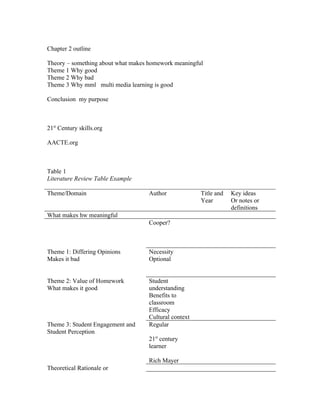
Chapter 2 outline

Theory – something about what makes homework meaningful
Theme 1 Why good
Theme 2 Why bad
Theme 3 Why mml multi media learning is good

Conclusion my purpose


21st Century skills.org

AACTE.org


Table 1
Literature Review Table Example

Theme/Domain                       Author             Title and   Key ideas
                                                      Year        Or notes or
                                                                  definitions
What makes hw meaningful
                                   Cooper?


Theme 1: Differing Opinions        Necessity
Makes it bad                       Optional


Theme 2: Value of Homework         Student
What makes it good                 understanding
                                   Benefits to
                                   classroom
                                   Efficacy
                                   Cultural context
Theme 3: Student Engagement and    Regular
Student Perception
                                   21st century
                                   learner

                                   Rich Mayer
Theoretical Rationale or
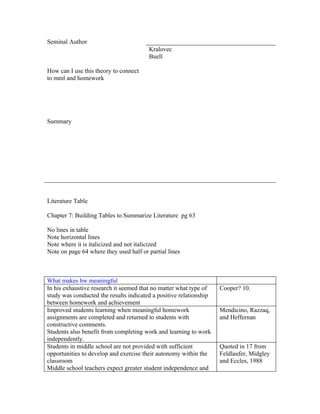
Seminal Author
                                        Kralovec
                                        Buell

How can I use this theory to connect
to mml and homework


Summary


Literature Table

Chapter 7: Building Tables to Summarize Literature pg 63

No lines in table
Note horizontal lines
Note where it is italicized and not italicized
Note on page 64 where they used half or partial lines


What makes hw meaningful
In his exhaustive research it seemed that no matter what type of    Cooper? 10.
study was conducted the results indicated a positive relationship
between homework and achievement
Improved students learning when meaningful homework                 Mendicino, Razzaq,
assignments are completed and returned to students with             and Heffernan
constructive comments.
Students also benefit from completing work and learning to work
independently.
Students in middle school are not provided with sufficient          Quoted in 17 from
opportunities to develop and exercise their autonomy within the     Feldlaufer, Midgley
classroom                                                           and Eccles, 1988
Middle school teachers expect greater student independence and
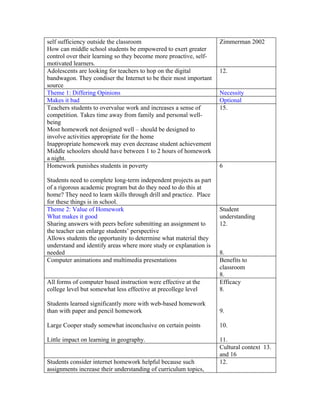
self sufficiency outside the classroom                              Zimmerman 2002
How can middle school students be empowered to exert greater
control over their learning so they become more proactive, self-
motivated learners.
Adolescents are looking for teachers to hop on the digital          12.
bandwagon. They condiser the Internet to be their most important
source
Theme 1: Differing Opinions                                         Necessity
Makes it bad                                                        Optional
Teachers students to overvalue work and increases a sense of        15.
competition. Takes time away from family and personal well-
being
Most homework not designed well – should be designed to
involve activities appropriate for the home
Inappropriate homework may even decrease student achievement
Middle schoolers should have between 1 to 2 hours of homework
a night.
Homework punishes students in poverty                               6

Students need to complete long-term independent projects as part
of a rigorous academic program but do they need to do this at
home? They need to learn skills through drill and practice. Place
for these things is in school.
Theme 2: Value of Homework                                          Student
What makes it good                                                  understanding
Sharing answers with peers before submitting an assignment to       12.
the teacher can enlarge students’ perspective
Allows students the opportunity to determine what material they
understand and identify areas where more study or explanation is
needed                                                              8.
Computer animations and multimedia presentations                    Benefits to
                                                                    classroom
                                                                    8.
All forms of computer based instruction were effective at the       Efficacy
college level but somewhat less effective at precollege level       8.

Students learned significantly more with web-based homework
than with paper and pencil homework                                 9.

Large Cooper study somewhat inconclusive on certain points          10.

Little impact on learning in geography.                             11.
                                                                    Cultural context 13.
                                                                    and 16
Students consider internet homework helpful because such            12.
assignments increase their understanding of curriculum topics,
facilitate independent learning and allow practice with research
skills
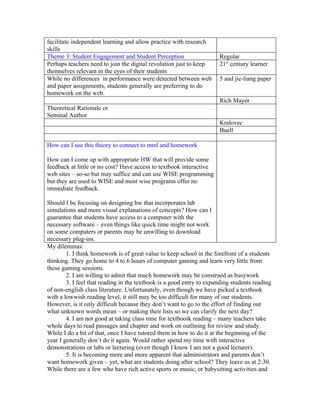
Theme 3: Student Engagement and Student Perception                    Regular
Perhaps teachers need to join the digital revolution just to keep     21st century learner
themselves relevant in the eyes of their students
While no differences in performance were detected between web         5 and jie-liang paper
and paper assignments, students generally are preferring to do
homework on the web.
                                                                      Rich Mayer
Theoretical Rationale or
Seminal Author
                                                                      Kralovec
                                                                      Buell

How can I use this theory to connect to mml and homework

How can I come up with appropriate HW that will provide some
feedback at little or no cost? Have access to textbook interactive
web sites – so-so but may suffice and can use WISE programming
but they are used to WISE and most wise programs offer no
immediate feedback.

Should I be focusing on designing hw that incorporates lab
simulations and more visual explanations of concepts? How can I
guarantee that students have access to a computer with the
necessary software – even things like quick time might not work
on some computers or parents may be unwilling to download
necessary plug-ins.
My dilemmas:
        1. I think homework is of great value to keep school in the forefront of a students
thinking. They go home to 4 to 6 hours of computer gaming and learn very little from
these gaming sessions.
        2. I am willing to admit that much homework may be construed as busywork
        3. I feel that reading in the textbook is a good entry to expanding students reading
of non-english class literature. Unfortunately, even though we have picked a textbook
with a lowwish reading level, it still may be too difficult for many of our students.
However, is it only difficult because they don’t want to go to the effort of finding out
what unknown words mean – or making their lists so we can clarify the next day?
        4. I am not good at taking class time for textbooik reading – many teachers take
whole days to read passages and chapter and work on outlining for review and study.
While I do a bit of that, once I have tutored them in how to do it at the beginning of the
year I generally don’t do it again. Would rather spend my time with interactive
demonstrations or labs or lecturing (even though I know I am not a good lecturer).
        5. It is becoming more and more apparent that administrators and parents don’t
want homework given – yet, what are students doing after school? They leave us at 2:30.
While there are a few who have rich active sports or music, or babysitting activities and
chores, most of our students spend their out of school time on their cell phones or
computers.
        6. How do we make the homework the teacher feels is essential more relevant and
deemed important to those administrators and parents? Will creating lessons and hw on
the web and internet give validation to the assignment and encourage a higher completion
rate?
        7. Once we improve the completion rate for hw will that translate into higher test
scores? Will these higher test scores become because we can devote more in class time to
experiments and work at a lab station? Even though other studies have shown that the
same learning can be effected with computer simulations I am seeking a way to get
students more interested and involved in the classroom during the day. Lack of interest in
all educational topics is dragging us down. A higher percentage of students attach little
importance to what is happening in the classroom. Will providing more computer time
and/or more lab time rather than “seat” time make their science education more relevant
to them?

1. Roth, Ivanchenko, Record, ScienceDirect Computers and Education, 2008: Evaluating
students response to WeBWorK, a web-based homework delivery and grading system

2. Pritchard, Morote, World Conference on E-learning in Corporate, Government,
HealthCare, and Higher Education, E-Learn 2002: Reliable Assessment with Cybertutor,
a Web-Based Homework Tutor

3. Melis, Andrews, Budenbender, etc. 2001, ActiveMath: A Generic and Adaptive Web-
Based Learning Environment

4. Salend, Duhaney, Anderson, Gottschalk, Teaching Exceptional Children, 2004: Using
the Internet to Improve Homework Communication and Completion

5. Bonham, Beichner, Deardorff, The Physics Teacher 2001: Online Homework: Does it
Make a Difference?

6. Kralovec, Buell, 2001? Association for Supervision and Curriculum Development:
End Homework Now

7. Bonham, Deardorff, Beichner: North Carolina State University? 2002-3??: A
comparison of student performance using web and paper-based homework in college-
level physics

8. Cole, Todd, Journal of Chemical Educationa, November 2003: Effects of Web-Based
Multimedia Homework with Immediate Rich Feedback on Student Learning in General
Chemistry

9.Mendicino, Razzaq, Heffernan, Journal of Research on Technology in Education, 2009
41(3): A Comparison of Traditional Homework to Computer-Supported Homework
10. Cooper, Robinson, Patall, Review of Educational Research, 2006, Does Homework
Improve Academic Achievemenet? A Synthesis of Research, 1987-2003

11. Schuster, University of Wisconsin-LaCrosse, 2009: The Impact of Homework and
Homework Preferences in Ninth Grade Geography

12. Strom, Strom, Wing, Beckert, National Assoc. Of sSecondary School Principals,
NASSP Bulletijn, June 2009: Adolescent Learning nad the Internet

13. Xu, The School Community Journal, 2009: School Location, Student Achievement
and Homework Management Reported By Middle School Students

14. Patvarczki, Politz, Heffernan, Worcester Polytechnic Institute, 2009?

15. Marzano, Pickering, Educational Leadership, March 2007: The Case for and Against
Homework

16. Brock, Lapp, Flood, Fisher, Tao Han, Urban Education, 2007: Does Homework
Matter? An Investigation of Teacher Perceptions about Homework Practices for Children
From non-dominant Backgrounds.

17. Cleary, Zimmerman, Psychology in the Schools, 2004: Self-Regulation
Empowerment Program: A School Based Program to Enhance Self-Regulated and Self
Motivated Cycles of Student Learning.

18. Mayer, Educational Psychologist, 1997: Multimedia Learning: Are we asking the
right questions?

19. Whipp, Journal of Teacher Education, 2003: Scaffolding Critical Reflection in Online
Discussions

Literature table june 26

  • 1.
    Chapter 2 outline Theory– something about what makes homework meaningful Theme 1 Why good Theme 2 Why bad Theme 3 Why mml multi media learning is good Conclusion my purpose 21st Century skills.org AACTE.org Table 1 Literature Review Table Example Theme/Domain Author Title and Key ideas Year Or notes or definitions What makes hw meaningful Cooper? Theme 1: Differing Opinions Necessity Makes it bad Optional Theme 2: Value of Homework Student What makes it good understanding Benefits to classroom Efficacy Cultural context Theme 3: Student Engagement and Regular Student Perception 21st century learner Rich Mayer Theoretical Rationale or
  • 2.
    Seminal Author Kralovec Buell How can I use this theory to connect to mml and homework Summary Literature Table Chapter 7: Building Tables to Summarize Literature pg 63 No lines in table Note horizontal lines Note where it is italicized and not italicized Note on page 64 where they used half or partial lines What makes hw meaningful In his exhaustive research it seemed that no matter what type of Cooper? 10. study was conducted the results indicated a positive relationship between homework and achievement Improved students learning when meaningful homework Mendicino, Razzaq, assignments are completed and returned to students with and Heffernan constructive comments. Students also benefit from completing work and learning to work independently. Students in middle school are not provided with sufficient Quoted in 17 from opportunities to develop and exercise their autonomy within the Feldlaufer, Midgley classroom and Eccles, 1988 Middle school teachers expect greater student independence and
  • 3.
    self sufficiency outsidethe classroom Zimmerman 2002 How can middle school students be empowered to exert greater control over their learning so they become more proactive, self- motivated learners. Adolescents are looking for teachers to hop on the digital 12. bandwagon. They condiser the Internet to be their most important source Theme 1: Differing Opinions Necessity Makes it bad Optional Teachers students to overvalue work and increases a sense of 15. competition. Takes time away from family and personal well- being Most homework not designed well – should be designed to involve activities appropriate for the home Inappropriate homework may even decrease student achievement Middle schoolers should have between 1 to 2 hours of homework a night. Homework punishes students in poverty 6 Students need to complete long-term independent projects as part of a rigorous academic program but do they need to do this at home? They need to learn skills through drill and practice. Place for these things is in school. Theme 2: Value of Homework Student What makes it good understanding Sharing answers with peers before submitting an assignment to 12. the teacher can enlarge students’ perspective Allows students the opportunity to determine what material they understand and identify areas where more study or explanation is needed 8. Computer animations and multimedia presentations Benefits to classroom 8. All forms of computer based instruction were effective at the Efficacy college level but somewhat less effective at precollege level 8. Students learned significantly more with web-based homework than with paper and pencil homework 9. Large Cooper study somewhat inconclusive on certain points 10. Little impact on learning in geography. 11. Cultural context 13. and 16 Students consider internet homework helpful because such 12. assignments increase their understanding of curriculum topics,
  • 4.
    facilitate independent learningand allow practice with research skills Theme 3: Student Engagement and Student Perception Regular Perhaps teachers need to join the digital revolution just to keep 21st century learner themselves relevant in the eyes of their students While no differences in performance were detected between web 5 and jie-liang paper and paper assignments, students generally are preferring to do homework on the web. Rich Mayer Theoretical Rationale or Seminal Author Kralovec Buell How can I use this theory to connect to mml and homework How can I come up with appropriate HW that will provide some feedback at little or no cost? Have access to textbook interactive web sites – so-so but may suffice and can use WISE programming but they are used to WISE and most wise programs offer no immediate feedback. Should I be focusing on designing hw that incorporates lab simulations and more visual explanations of concepts? How can I guarantee that students have access to a computer with the necessary software – even things like quick time might not work on some computers or parents may be unwilling to download necessary plug-ins. My dilemmas: 1. I think homework is of great value to keep school in the forefront of a students thinking. They go home to 4 to 6 hours of computer gaming and learn very little from these gaming sessions. 2. I am willing to admit that much homework may be construed as busywork 3. I feel that reading in the textbook is a good entry to expanding students reading of non-english class literature. Unfortunately, even though we have picked a textbook with a lowwish reading level, it still may be too difficult for many of our students. However, is it only difficult because they don’t want to go to the effort of finding out what unknown words mean – or making their lists so we can clarify the next day? 4. I am not good at taking class time for textbooik reading – many teachers take whole days to read passages and chapter and work on outlining for review and study. While I do a bit of that, once I have tutored them in how to do it at the beginning of the year I generally don’t do it again. Would rather spend my time with interactive demonstrations or labs or lecturing (even though I know I am not a good lecturer). 5. It is becoming more and more apparent that administrators and parents don’t want homework given – yet, what are students doing after school? They leave us at 2:30. While there are a few who have rich active sports or music, or babysitting activities and
  • 5.
    chores, most ofour students spend their out of school time on their cell phones or computers. 6. How do we make the homework the teacher feels is essential more relevant and deemed important to those administrators and parents? Will creating lessons and hw on the web and internet give validation to the assignment and encourage a higher completion rate? 7. Once we improve the completion rate for hw will that translate into higher test scores? Will these higher test scores become because we can devote more in class time to experiments and work at a lab station? Even though other studies have shown that the same learning can be effected with computer simulations I am seeking a way to get students more interested and involved in the classroom during the day. Lack of interest in all educational topics is dragging us down. A higher percentage of students attach little importance to what is happening in the classroom. Will providing more computer time and/or more lab time rather than “seat” time make their science education more relevant to them? 1. Roth, Ivanchenko, Record, ScienceDirect Computers and Education, 2008: Evaluating students response to WeBWorK, a web-based homework delivery and grading system 2. Pritchard, Morote, World Conference on E-learning in Corporate, Government, HealthCare, and Higher Education, E-Learn 2002: Reliable Assessment with Cybertutor, a Web-Based Homework Tutor 3. Melis, Andrews, Budenbender, etc. 2001, ActiveMath: A Generic and Adaptive Web- Based Learning Environment 4. Salend, Duhaney, Anderson, Gottschalk, Teaching Exceptional Children, 2004: Using the Internet to Improve Homework Communication and Completion 5. Bonham, Beichner, Deardorff, The Physics Teacher 2001: Online Homework: Does it Make a Difference? 6. Kralovec, Buell, 2001? Association for Supervision and Curriculum Development: End Homework Now 7. Bonham, Deardorff, Beichner: North Carolina State University? 2002-3??: A comparison of student performance using web and paper-based homework in college- level physics 8. Cole, Todd, Journal of Chemical Educationa, November 2003: Effects of Web-Based Multimedia Homework with Immediate Rich Feedback on Student Learning in General Chemistry 9.Mendicino, Razzaq, Heffernan, Journal of Research on Technology in Education, 2009 41(3): A Comparison of Traditional Homework to Computer-Supported Homework
  • 6.
    10. Cooper, Robinson,Patall, Review of Educational Research, 2006, Does Homework Improve Academic Achievemenet? A Synthesis of Research, 1987-2003 11. Schuster, University of Wisconsin-LaCrosse, 2009: The Impact of Homework and Homework Preferences in Ninth Grade Geography 12. Strom, Strom, Wing, Beckert, National Assoc. Of sSecondary School Principals, NASSP Bulletijn, June 2009: Adolescent Learning nad the Internet 13. Xu, The School Community Journal, 2009: School Location, Student Achievement and Homework Management Reported By Middle School Students 14. Patvarczki, Politz, Heffernan, Worcester Polytechnic Institute, 2009? 15. Marzano, Pickering, Educational Leadership, March 2007: The Case for and Against Homework 16. Brock, Lapp, Flood, Fisher, Tao Han, Urban Education, 2007: Does Homework Matter? An Investigation of Teacher Perceptions about Homework Practices for Children From non-dominant Backgrounds. 17. Cleary, Zimmerman, Psychology in the Schools, 2004: Self-Regulation Empowerment Program: A School Based Program to Enhance Self-Regulated and Self Motivated Cycles of Student Learning. 18. Mayer, Educational Psychologist, 1997: Multimedia Learning: Are we asking the right questions? 19. Whipp, Journal of Teacher Education, 2003: Scaffolding Critical Reflection in Online Discussions