STUDENT WEBINAR TRAINING
STRATEGIES FOR ANSWERING
MULTIPLE CHOICE QUESTIONS
(MCQs)
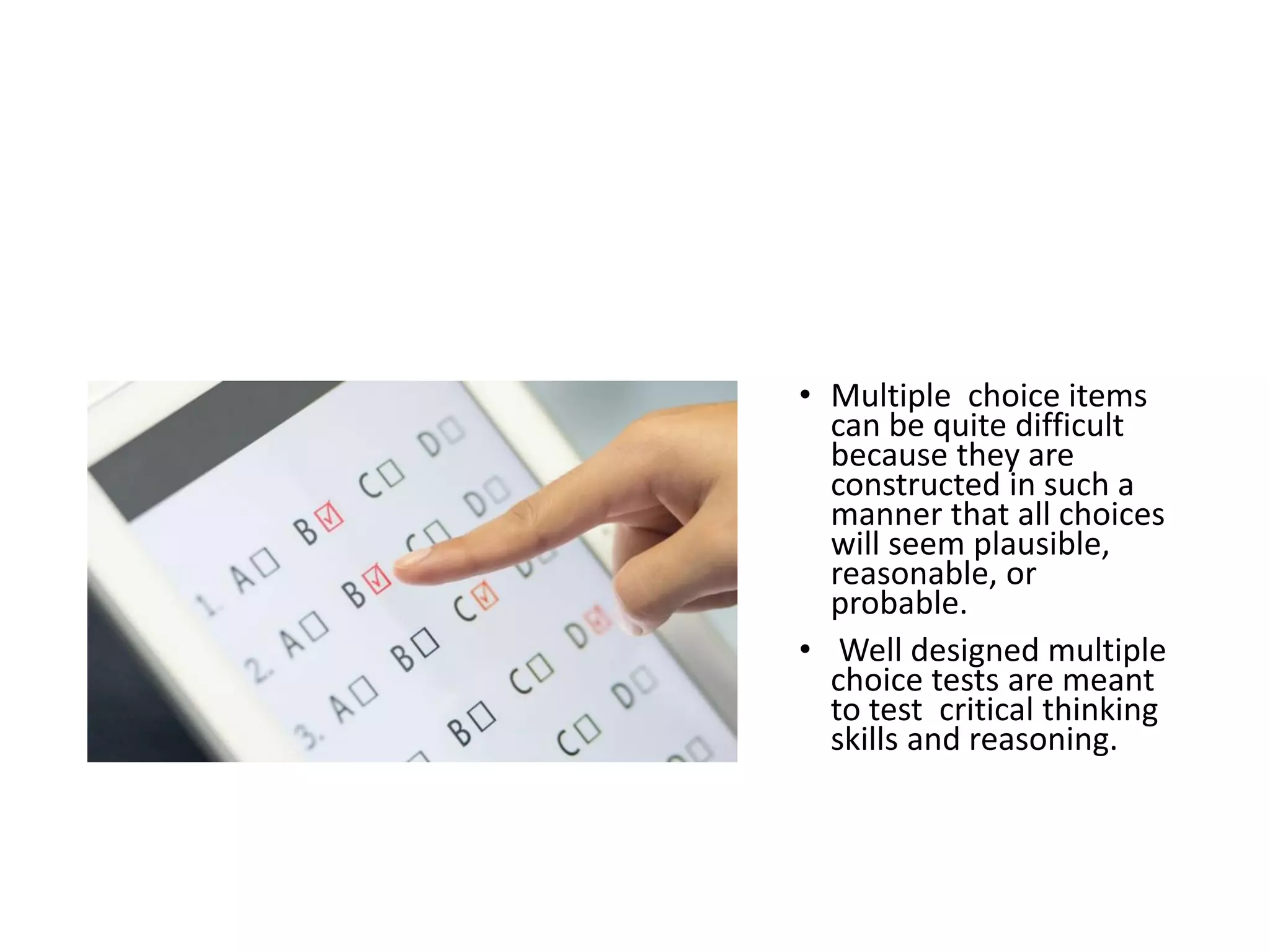
• Multiple choice items
can be quite difficult
because they are
constructed in such a
manner that all choices
will seem plausible,
reasonable, or
probable.
• Well designed multiple
choice tests are meant
to test critical thinking
skills and reasoning.
MULTIPLE
CHOICE TEST
DESIGN
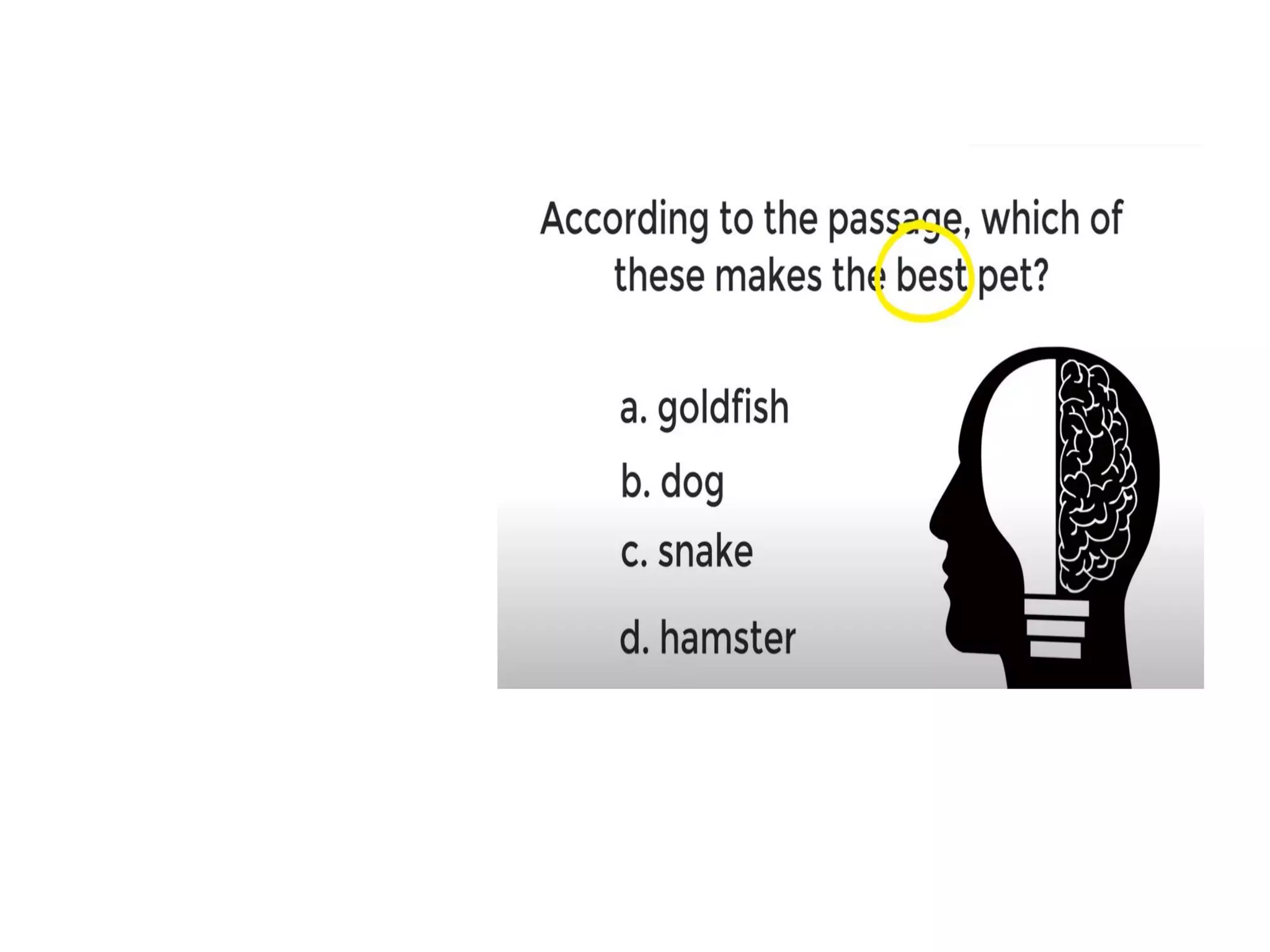
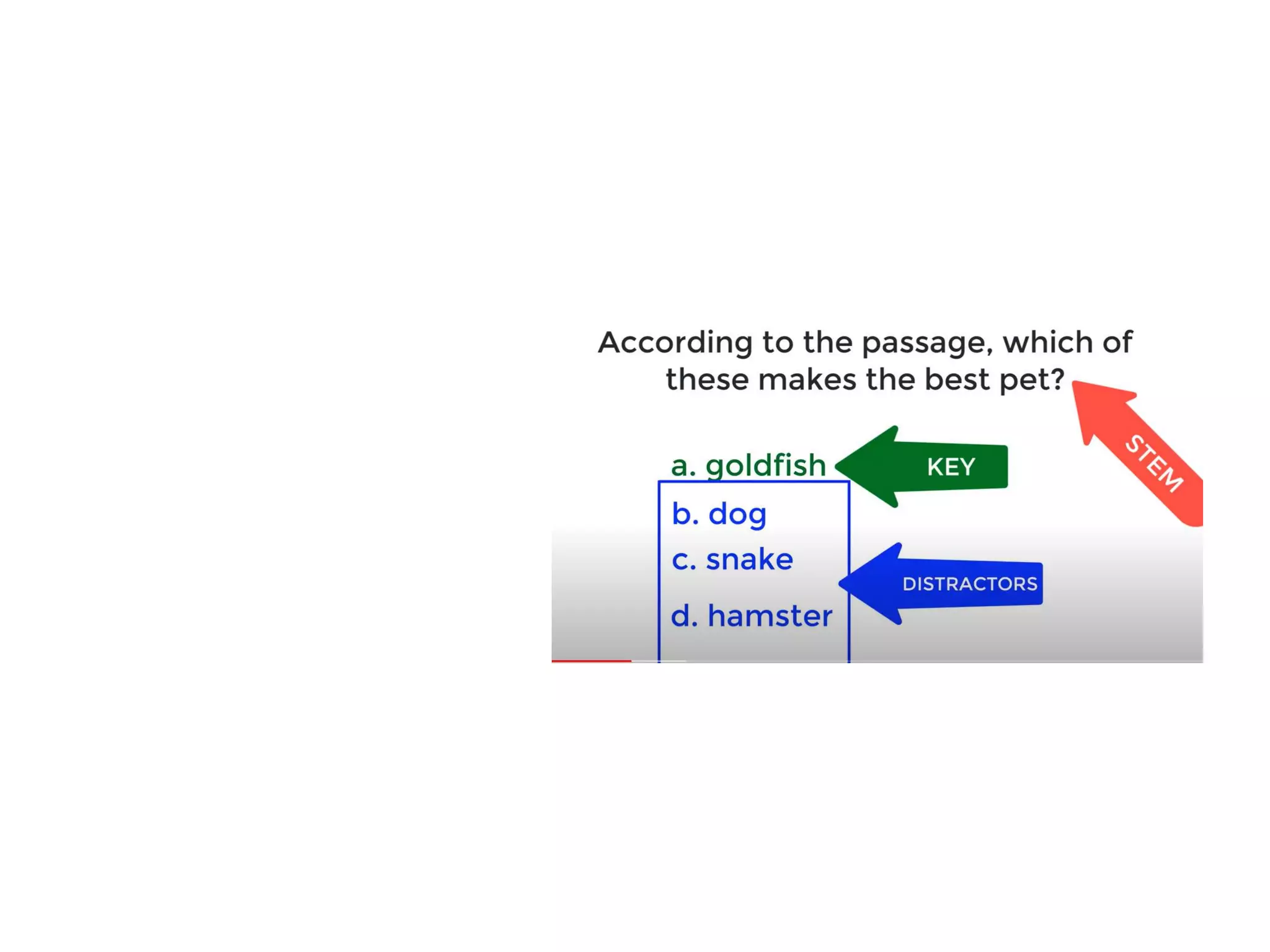
• Stem: the part of the
question that asks the
question/ poses a problem
• Distractors: Incorrect but
feasible choices
• Key: The correct answer
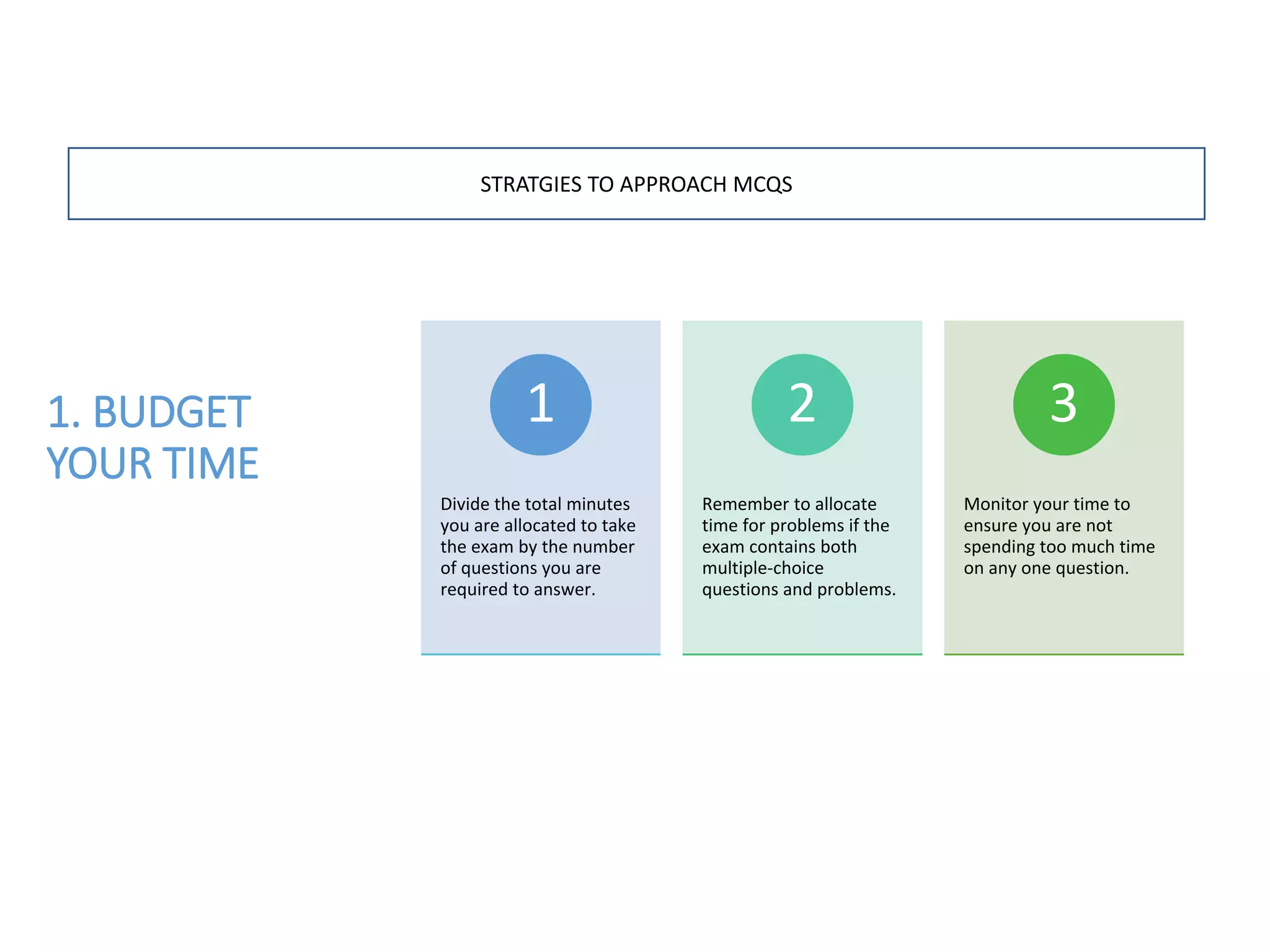
1. BUDGET
YOUR TIME
Divide the total minutes
you are allocated to take
the exam by the number
of questions you are
required to answer.
1
Remember to allocate
time for problems if the
exam contains both
multiple-choice
questions and problems.
2
Monitor your time to
ensure you are not
spending too much time
on any one question.
3
STRATGIES TO APPROACH MCQS
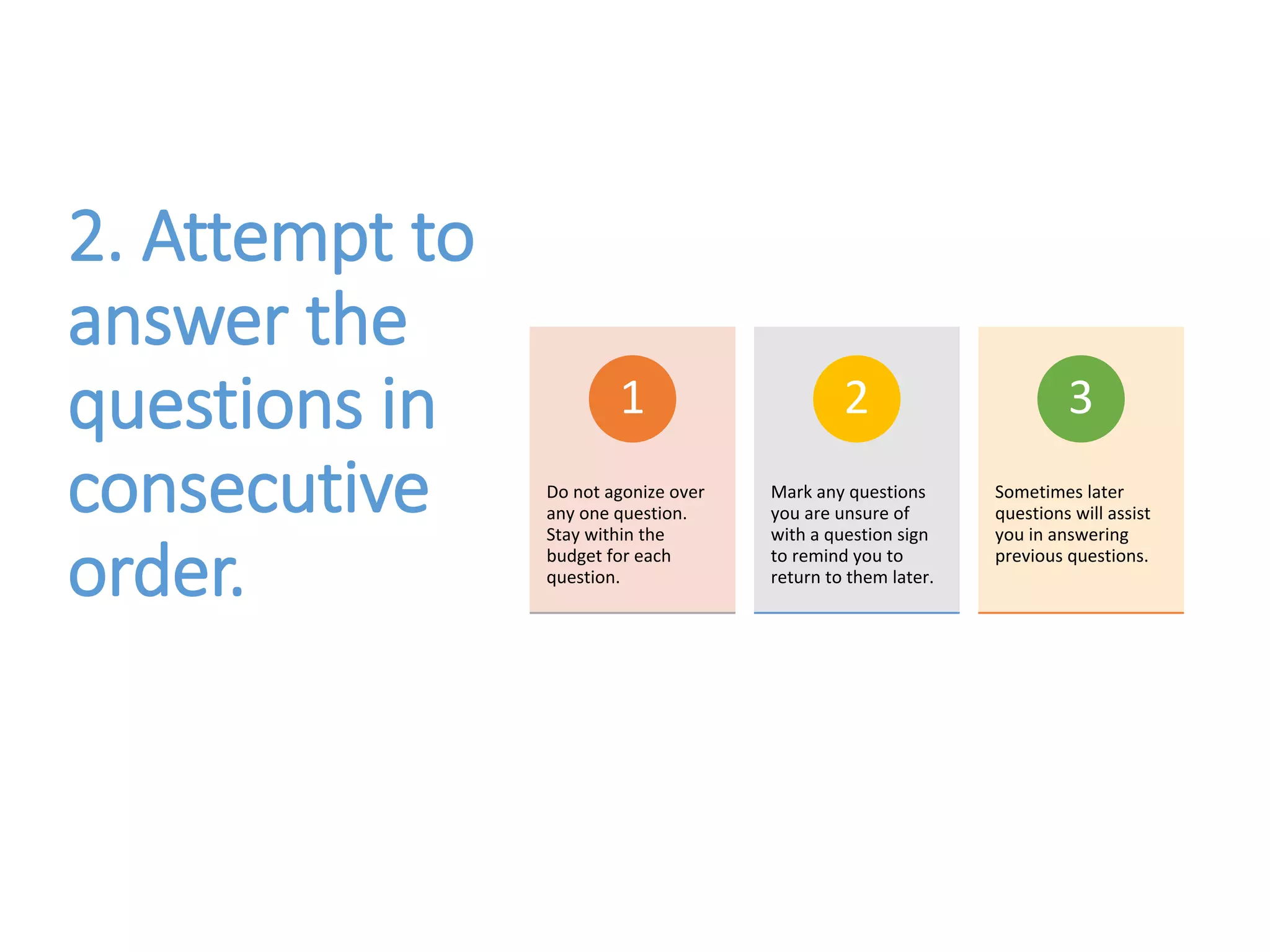
2. Attempt to
answer the
questions in
consecutive
order.
Do not agonize over
any one question.
Stay within the
budget for each
question.
1
Mark any questions
you are unsure of
with a question sign
to remind you to
return to them later.
2
Sometimes later
questions will assist
you in answering
previous questions.
3
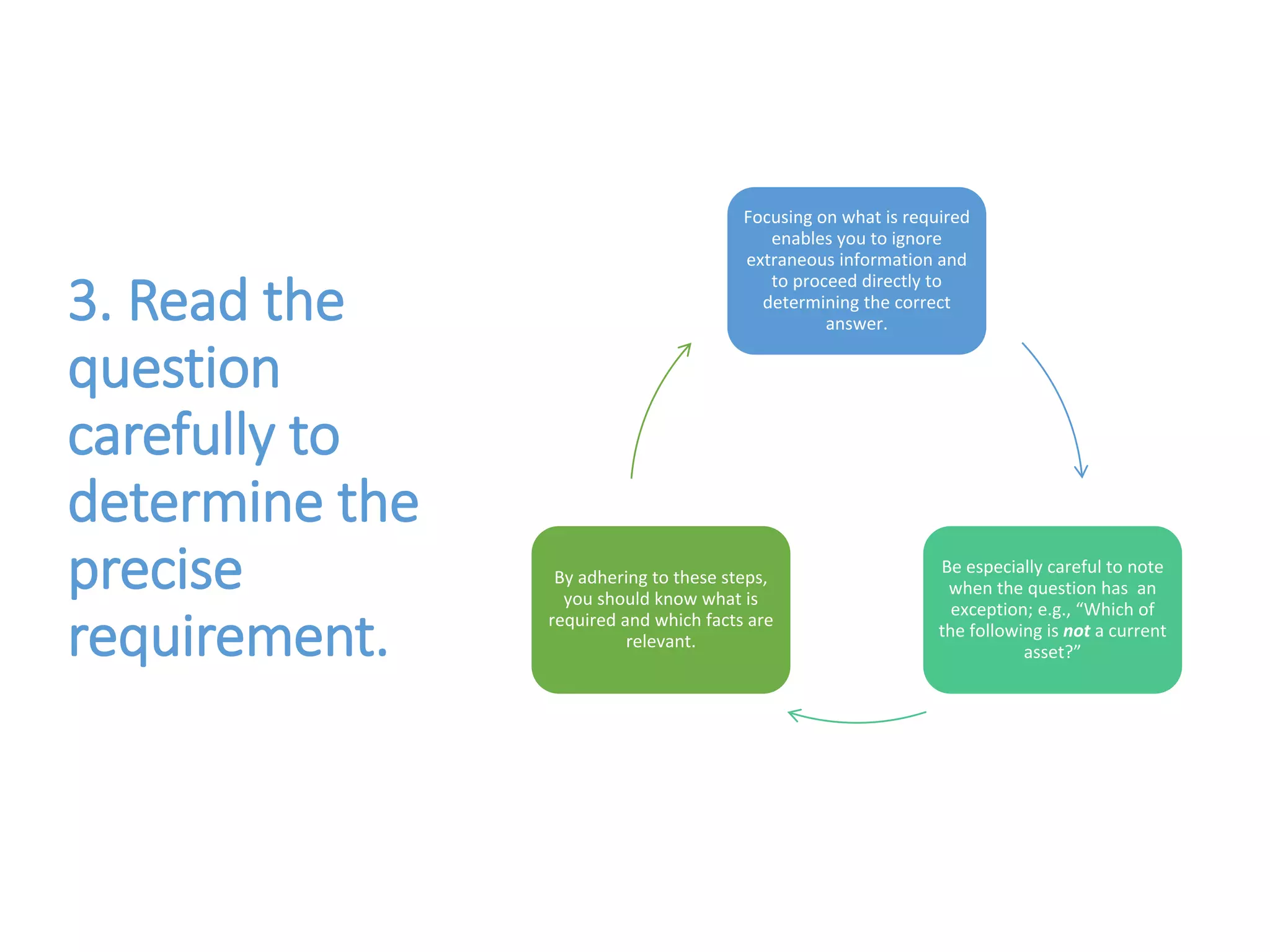
3. Read the
question
carefully to
determine the
precise
requirement.
Focusing on what is required
enables you to ignore
extraneous information and
to proceed directly to
determining the correct
answer.
Be especially careful to note
when the question has an
exception; e.g., “Which of
the following is not a current
asset?”
By adhering to these steps,
you should know what is
required and which facts are
relevant.
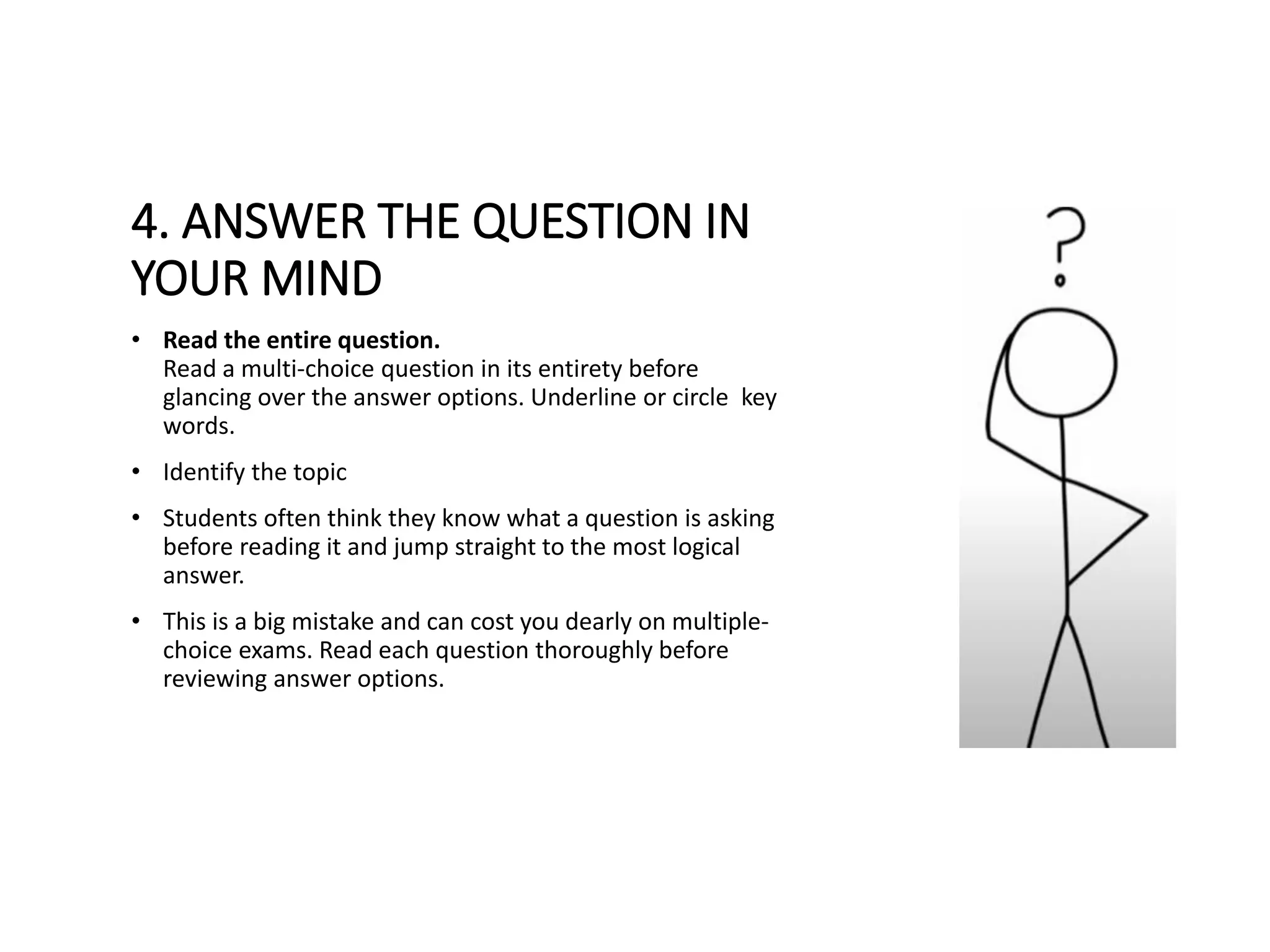
4. ANSWER THE QUESTION IN
YOUR MIND
• Read the entire question.
Read a multi-choice question in its entirety before
glancing over the answer options. Underline or circle key
words.
• Identify the topic
• Students often think they know what a question is asking
before reading it and jump straight to the most logical
answer.
• This is a big mistake and can cost you dearly on multiple-
choice exams. Read each question thoroughly before
reviewing answer options.
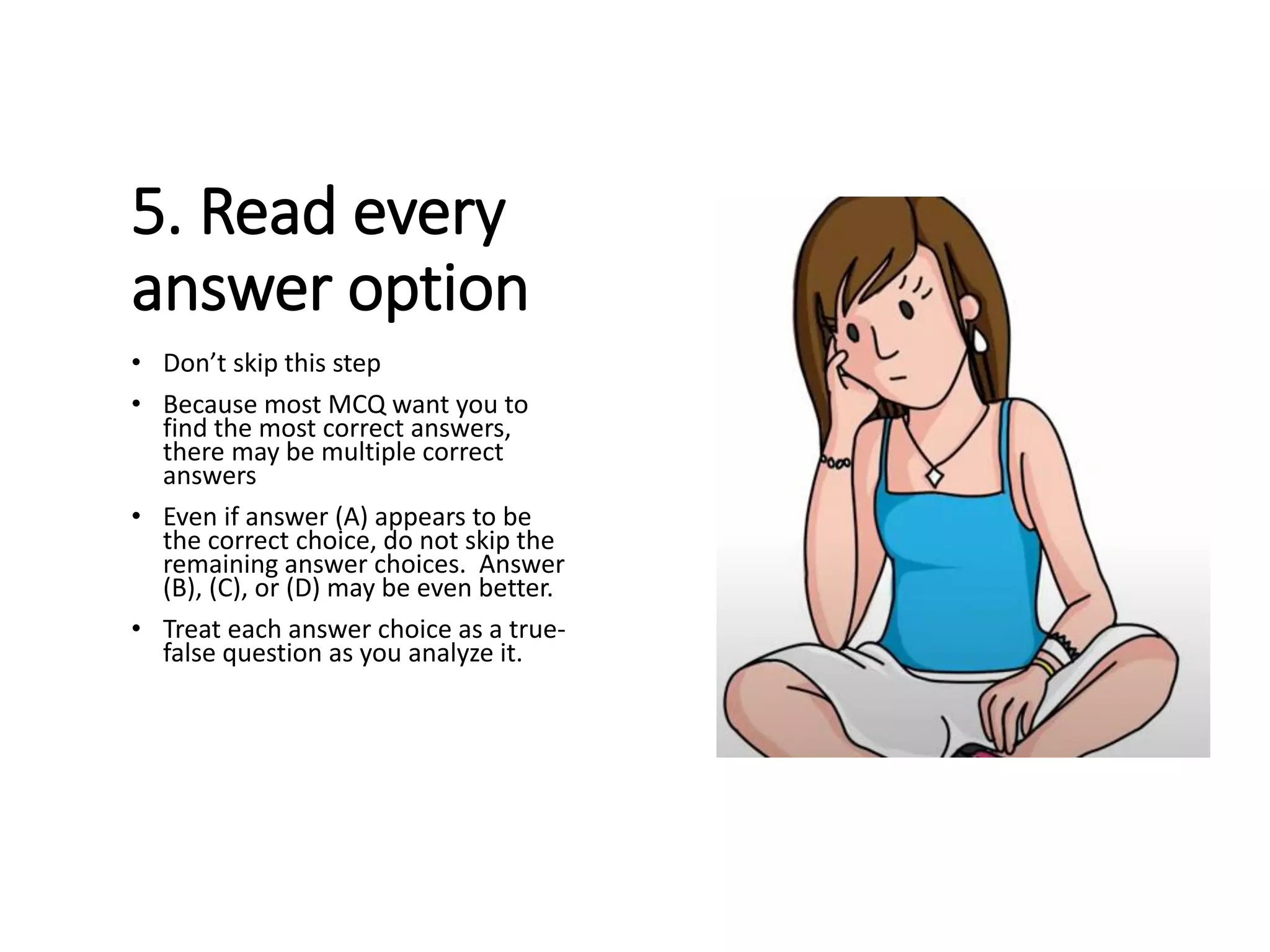
5. Read every
answer option
• Don’t skip this step
• Because most MCQ want you to
find the most correct answers,
there may be multiple correct
answers
• Even if answer (A) appears to be
the correct choice, do not skip the
remaining answer choices. Answer
(B), (C), or (D) may be even better.
• Treat each answer choice as a true-
false question as you analyze it.
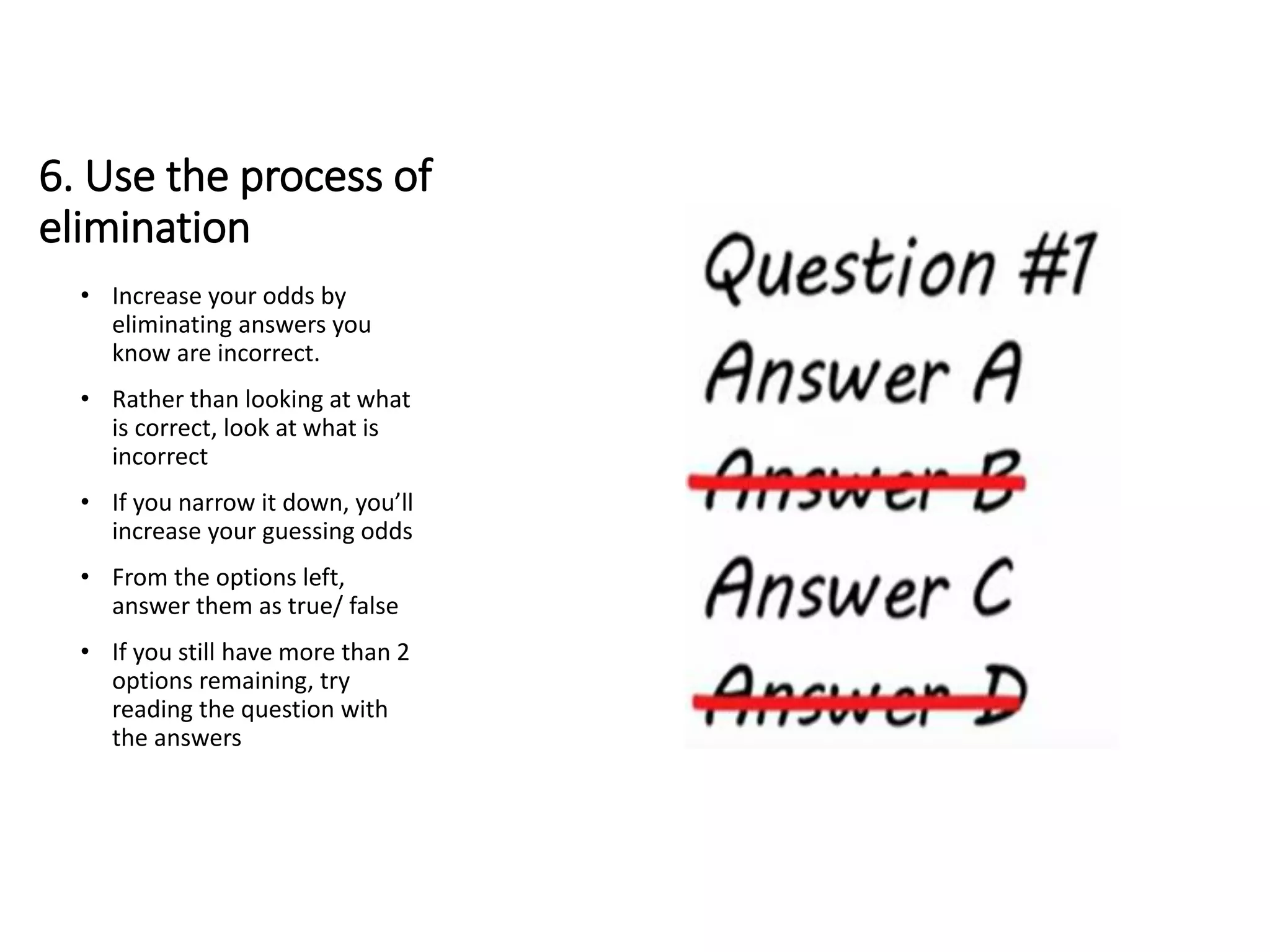
6. Use the process of
elimination
• Increase your odds by
eliminating answers you
know are incorrect.
• Rather than looking at what
is correct, look at what is
incorrect
• If you narrow it down, you’ll
increase your guessing odds
• From the options left,
answer them as true/ false
• If you still have more than 2
options remaining, try
reading the question with
the answers
7. Make an
educated
guess
• Make an educated guess.
If it will not count against your score, make an educated guess for any question
you're unsure about. (Note: On some standardized tests incorrect answers are
penalized. For example, a correct answer may be worth 2 points, an unanswered
question 0 points, and an incorrect answer -1 points. On these tests, you can still
make an educated guess, but only when you're able to eliminate at least one or
two incorrect answers.)
• Pay attention to these words...
Pay particularly close attention to the words not, sometimes, always, and never. An
answer that includes always must be irrefutable. If you can find a single
counterexample, then the answer is not correct. The same holds true for the
word never. If an answer option includes never a single counterexample will
indicate the answer is not the correct.
• It's usually best to stick with your first choice--but not always.
However, this doesn't mean your first answer choice is necessarily the correct
answer choice. While multiple choice tests aren't usually intentionally designed to
trick or confuse students, they are designed test students' knowledge and ability.
• To this end, the answer options provided will often include the most common
wrong answer among the choices or answers that seem logical but are ultimately
incorrect, or the best answer.
Presenter
Dr Salosh
Govender
Unisa

ADOVH Student support Strategies for MCQs.pdf

  • 2.
  • 3.
    STRATEGIES FOR ANSWERING MULTIPLECHOICE QUESTIONS (MCQs) • Multiple choice items can be quite difficult because they are constructed in such a manner that all choices will seem plausible, reasonable, or probable. • Well designed multiple choice tests are meant to test critical thinking skills and reasoning.
  • 4.
  • 5.
    • Stem: thepart of the question that asks the question/ poses a problem • Distractors: Incorrect but feasible choices • Key: The correct answer
  • 6.
    1. BUDGET YOUR TIME Dividethe total minutes you are allocated to take the exam by the number of questions you are required to answer. 1 Remember to allocate time for problems if the exam contains both multiple-choice questions and problems. 2 Monitor your time to ensure you are not spending too much time on any one question. 3 STRATGIES TO APPROACH MCQS
  • 7.
    2. Attempt to answerthe questions in consecutive order. Do not agonize over any one question. Stay within the budget for each question. 1 Mark any questions you are unsure of with a question sign to remind you to return to them later. 2 Sometimes later questions will assist you in answering previous questions. 3
  • 8.
    3. Read the question carefullyto determine the precise requirement. Focusing on what is required enables you to ignore extraneous information and to proceed directly to determining the correct answer. Be especially careful to note when the question has an exception; e.g., “Which of the following is not a current asset?” By adhering to these steps, you should know what is required and which facts are relevant.
  • 9.
    4. ANSWER THEQUESTION IN YOUR MIND • Read the entire question. Read a multi-choice question in its entirety before glancing over the answer options. Underline or circle key words. • Identify the topic • Students often think they know what a question is asking before reading it and jump straight to the most logical answer. • This is a big mistake and can cost you dearly on multiple- choice exams. Read each question thoroughly before reviewing answer options.
  • 10.
    5. Read every answeroption • Don’t skip this step • Because most MCQ want you to find the most correct answers, there may be multiple correct answers • Even if answer (A) appears to be the correct choice, do not skip the remaining answer choices. Answer (B), (C), or (D) may be even better. • Treat each answer choice as a true- false question as you analyze it.
  • 11.
    6. Use theprocess of elimination • Increase your odds by eliminating answers you know are incorrect. • Rather than looking at what is correct, look at what is incorrect • If you narrow it down, you’ll increase your guessing odds • From the options left, answer them as true/ false • If you still have more than 2 options remaining, try reading the question with the answers
  • 12.
    7. Make an educated guess •Make an educated guess. If it will not count against your score, make an educated guess for any question you're unsure about. (Note: On some standardized tests incorrect answers are penalized. For example, a correct answer may be worth 2 points, an unanswered question 0 points, and an incorrect answer -1 points. On these tests, you can still make an educated guess, but only when you're able to eliminate at least one or two incorrect answers.) • Pay attention to these words... Pay particularly close attention to the words not, sometimes, always, and never. An answer that includes always must be irrefutable. If you can find a single counterexample, then the answer is not correct. The same holds true for the word never. If an answer option includes never a single counterexample will indicate the answer is not the correct. • It's usually best to stick with your first choice--but not always. However, this doesn't mean your first answer choice is necessarily the correct answer choice. While multiple choice tests aren't usually intentionally designed to trick or confuse students, they are designed test students' knowledge and ability. • To this end, the answer options provided will often include the most common wrong answer among the choices or answers that seem logical but are ultimately incorrect, or the best answer.
  • 13.