eae
Pitch Perfect and
The Design Box
Roger Altizer & Jose Zagal
University of Utah
eae
You are here
eae
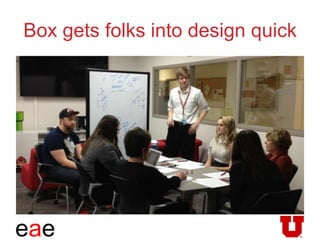
Box gets folks into design quick
eae
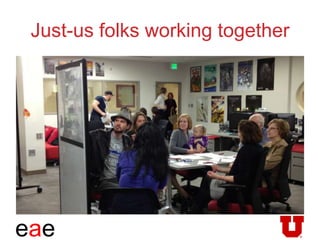
Just-us folks working together
eae
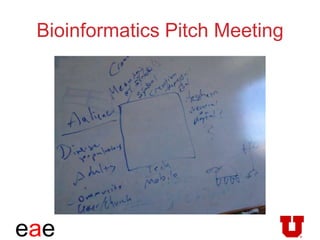
Bioinformatics Pitch Meeting
eae
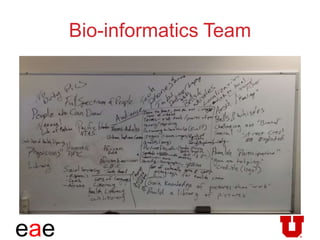
Bio-informatics Team
eae
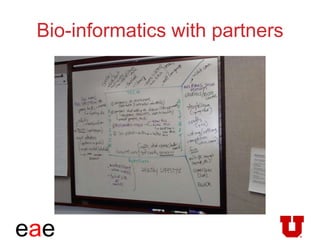
Bio-informatics with partners
eae
Easy as pie (still confusing)
• Falling in love is easy
• Pitching from the cuff is easy (ish)
• Ignoring the details is easy
• Pitching derivative ideas is easy
• Ending endless brainstorming is easy
• Avoiding competing ideas is easy
• Finding relief in a pitch is easy
eae
Life is hard
• Ideation is hard
• Designing with teams is hard
• Buy-in is hard
• Breaking a problem down is hard
• Thinking inductively is hard
eae
Assuming Assumptions
• Good design solves a problem
• Constraint breeds creativity
• Qualitative/inductive approach to design
• Iteration helps with ideation
• Coding-like process may bring new ideas or
problems up that are missed at first glance
• Brining clients and audience “in” allows for
design research, vetting, and just inclusion
eae
Punny Beginnings
eae
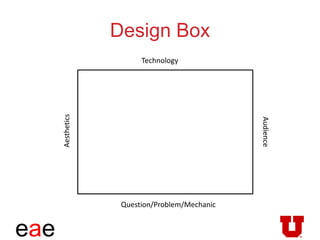
Design Box
Aesthetics
Technology
Audience
Question/Problem/Mechanic
eae
Technology
• What is the tech the project is required?
• What tech is available to the team?
• What tech is the team good at?
• Does the tech have any key advantages?
• What limitations does the tech impose?
eae
Audience
• Who is the end user?
• Who will be buying the game?
• Who will be distributing the game?
• Are there any other key stakeholders?
• Can we narrow down the audience?
• Is there anything about the audience we need
to pay special attention to?
eae
Aesthetic
• Is there required content?
• Is there a required style?
• What would you like the audience to feel?
• What limitations do we have on content?
• Is there a particular theme we want to
embrace?
• Is there any taboo content?
eae
Question/Problem/Mechanic
• What problem does this game need to solve?
• Does this game need to promote a certain
kind of play?
• What question is this game exploring?
• What is it we want to say as a team?
• Is there a particular mechanic we want or
need to explore?
• What does this thing need to really do?
eae
Step 2: All pitches welcome
• Moderator writes pitches inside of the box
• No pitch may be written in the box unless it
accounts for all four sides.
• Any member of the team present may pitch.
• Any member may riff off another’s idea.
• Repeat until ‘theoretical saturation’ occurs –
the ideas start to sound the same
• Cross talk about the walls but not the pitches
is allowed.
eae
Be cool with the box
eae
Step 3: Refine the walls
• What assumptions are being made in the
pitches that aren’t on the walls?
• Refine the walls to account for common
threads in the pitches.
• Refine the walls based upon the cross talk
from the previous step.
• Allow for drastic changes to the walls.
eae
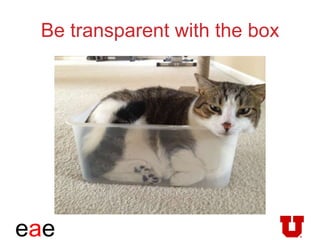
Be transparent with the box
eae
Step 4: Rinse and repeat
• Take a photo of the pitches then erase them
and start over.
• Team members may not pitch the same ideas
as previous rounds.
• Team members may modify earlier pitches.
• Again, all pitches must work with all walls.
• Moderator may ask questions to help the
pitch evolve.
eae
Team should press on the box
eae
Step 5: The pitch
• Teams may repeat the steps as many times as
needed
• In the end the walls get “heavier” and the box
gets “smaller”
• The smaller the box, the fewer the pitches
that fit
• The last pitches should look like answers the
team came up with or agreed with
eae
Great big idea, tiny little box
eae
Your thoughts here
Roger Altizer
roger.altizer@utah.edu
@real_rahjur
Jose Zagal
jose.zagal@utah.edu
@JoseZagal
You’re on a boat!

Design Box Working Paper FDG 2014

  • 1.
    eae Pitch Perfect and TheDesign Box Roger Altizer & Jose Zagal University of Utah
  • 2.
  • 3.
    eae Box gets folksinto design quick
  • 4.
  • 5.
  • 6.
  • 7.
  • 8.
    eae Easy as pie(still confusing) • Falling in love is easy • Pitching from the cuff is easy (ish) • Ignoring the details is easy • Pitching derivative ideas is easy • Ending endless brainstorming is easy • Avoiding competing ideas is easy • Finding relief in a pitch is easy
  • 9.
    eae Life is hard •Ideation is hard • Designing with teams is hard • Buy-in is hard • Breaking a problem down is hard • Thinking inductively is hard
  • 10.
    eae Assuming Assumptions • Gooddesign solves a problem • Constraint breeds creativity • Qualitative/inductive approach to design • Iteration helps with ideation • Coding-like process may bring new ideas or problems up that are missed at first glance • Brining clients and audience “in” allows for design research, vetting, and just inclusion
  • 11.
  • 12.
  • 13.
    eae Technology • What isthe tech the project is required? • What tech is available to the team? • What tech is the team good at? • Does the tech have any key advantages? • What limitations does the tech impose?
  • 14.
    eae Audience • Who isthe end user? • Who will be buying the game? • Who will be distributing the game? • Are there any other key stakeholders? • Can we narrow down the audience? • Is there anything about the audience we need to pay special attention to?
  • 15.
    eae Aesthetic • Is thererequired content? • Is there a required style? • What would you like the audience to feel? • What limitations do we have on content? • Is there a particular theme we want to embrace? • Is there any taboo content?
  • 16.
    eae Question/Problem/Mechanic • What problemdoes this game need to solve? • Does this game need to promote a certain kind of play? • What question is this game exploring? • What is it we want to say as a team? • Is there a particular mechanic we want or need to explore? • What does this thing need to really do?
  • 17.
    eae Step 2: Allpitches welcome • Moderator writes pitches inside of the box • No pitch may be written in the box unless it accounts for all four sides. • Any member of the team present may pitch. • Any member may riff off another’s idea. • Repeat until ‘theoretical saturation’ occurs – the ideas start to sound the same • Cross talk about the walls but not the pitches is allowed.
  • 18.
  • 19.
    eae Step 3: Refinethe walls • What assumptions are being made in the pitches that aren’t on the walls? • Refine the walls to account for common threads in the pitches. • Refine the walls based upon the cross talk from the previous step. • Allow for drastic changes to the walls.
  • 20.
  • 21.
    eae Step 4: Rinseand repeat • Take a photo of the pitches then erase them and start over. • Team members may not pitch the same ideas as previous rounds. • Team members may modify earlier pitches. • Again, all pitches must work with all walls. • Moderator may ask questions to help the pitch evolve.
  • 22.
  • 23.
    eae Step 5: Thepitch • Teams may repeat the steps as many times as needed • In the end the walls get “heavier” and the box gets “smaller” • The smaller the box, the fewer the pitches that fit • The last pitches should look like answers the team came up with or agreed with
  • 24.
    eae Great big idea,tiny little box
  • 25.
    eae Your thoughts here RogerAltizer roger.altizer@utah.edu @real_rahjur Jose Zagal jose.zagal@utah.edu @JoseZagal You’re on a boat!

Editor's Notes

  • #8 ENACUCAIRDiabetesEdCatmull
  • #9 Pie seems to rank right up there with cake in the US lexicon of ease and pleasantry
  • #12 Design Box