PROBLEMATIC SOILS
(SALT-AFFECTED SOILS AND ACIDIC SOILS)
Name – Shubhashree Sahu
ID – 21401
Subject – Forest Soil Management
SALT AFFECTED SOILS
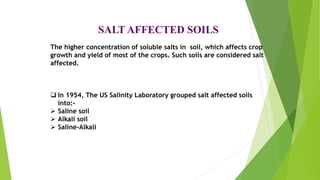
The higher concentration of soluble salts in soil, which affects crop
growth and yield of most of the crops. Such soils are considered salt
affected.
 In 1954, The US Salinity Laboratory grouped salt affected soils
into:-
 Saline soil
 Alkali soil
 Saline-Alkali
Salt Affected Soil
- Occur when rainfall is not sufficient for adequate leaching of salts
- Common in arid condition
- Can ruin soils for agriculture
Common salt ions :-
Chlorides and sulphates of Na+, Ca2+ ,Mg2+
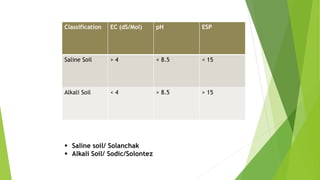
Classification EC (dS/Mol) pH ESP
Saline Soil > 4 < 8.5 < 15
Alkali Soil < 4 > 8.5 > 15
 Saline soil/ Solanchak
 Alkali Soil/ Sodic/Solontez
Salt affected soils in India
The salt affected soils account for 6.727 Mha
equivalent to 2.1% of the geographical area of
the country.
Out of total 6.727 Mha of salt-affected soils,
 2.956 Mha are saline
 3.771 Mha are sodic
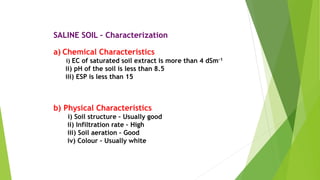
SALINE SOIL – Characterization
a) Chemical Characteristics
i) EC of saturated soil extract is more than 4 dSm-1
ii) pH of the soil is less than 8.5
iii) ESP is less than 15
b) Physical Characteristics
i) Soil structure – Usually good
ii) Infiltration rate – High
iii) Soil aeration – Good
iv) Colour – Usually white
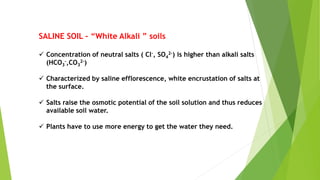
SALINE SOIL – “White Alkali ” soils
 Concentration of neutral salts ( Cl-, SO4
2-) is higher than alkali salts
(HCO3
-,CO3
2-)
 Characterized by saline efflorescence, white encrustation of salts at
the surface.
 Salts raise the osmotic potential of the soil solution and thus reduces
available soil water.
 Plants have to use more energy to get the water they need.
Saline Soil – Formation
 The process by which saline soil is formed is called Salinization.
 Saline soils occur mostly in arid or semi-arid regions.
 In arid regions – Due to less rainfall and high evaporation rate the soluble
salts tends to move to surface in dissolved state and then accumulates
on soil surface.
Effects of saline soil on plants
 Stunted growth
 Wilting
 Blueish-green colour
 Necrosis of leaf tips
 Drought stress symptoms
 Specific toxicity
 Plant species vary in salt tolerance
 Salt injury – High salt levels when high rates of fertilizers or manures applied.
Alkali Soil – Characterization
a) Chemical Characteristics
i) EC of the saturation soil extract is less than 4dSm-1.
ii) pH of the soil is more than 8.5
iii) ESP is higher than 15
b) Physical Characteristics
i) Soil Structure – Very poor ( Soil in dispersed/ deflocculated state)
ii) Infiltration rate – Very low
iii) Soil aeration – Very poor
iv) Colour – Usually black
Alkali Soil – “Black Alkali Soils”
 Concentration of alkali salts(HCO3-, CO32- ) is higher than neutral
salts(Cl-,SO42-).
 Major problem is the effect of sodium on flocculation and aggregation of
soil particles.
 Sodium causes soil particles to disperse
No aggregation of soil particles
Individual soil particles clog soil pores
Poor soil physical properties
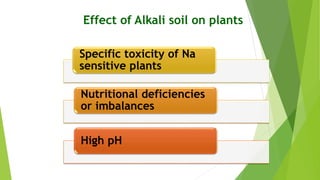
Specific toxicity of Na
sensitive plants
Nutritional deficiencies
or imbalances
High pH
Effect of Alkali soil on plants
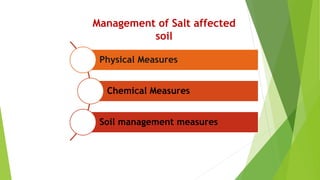
Physical Measures
Chemical Measures
Soil management measures
Management of Salt affected
soil
Physical Measures
1. Leaching
When soil elements after dissolving with water go down from
upper parts to the lower level, it is called leaching.
In this method saline elements of the soil are transferred to lower
levels after dissolving with water.
This water, along with the supply of water to crops, takes away
salts after dissolving them. That is why more water is required in this
method.
2.Scratching
 Many times salts are collected in large quantity and it looks like
heap.
 Then it has to be scratched out from the field to reduce salinity
of the soil.
 This method is not practicable on large scale.
3.Drainage
 With drainage of additional water, concentration of salts does
not take place.
 Drains may be constructed in the field so that excess water
keeps on discharging
Chemical Measures
 Reclamation of alkali/ sodic soils requires neutralization of
alkalinity and replacement of the most of the sodium ions from the
soil – exchange complex by the more favourable calcium ions.
1. Solvent calcium Salt : Gypsum and Phospho Gypsum
2. Little Soluble Calcium Salt : Lime Stone
3. Acid and Acid Producing : Sulphur, Acid of Sulphur, Pyrites
Gypsum is the most commonly used chemical amendment.
Soil management measures
 Preparation of the Field
 Fields should be kept leveled.
 Water distribution during irrigation is balanced in leveled field which prevents
concentration of salts.
 Preparation of Basin and Sowing
 Sowing of crop should be done on the slope following furrow and basin method.
 In basin irrigation, the salt collects near the basin, the adverse effect of which
is visible on plants.
 Special attention should be given to irrigation.
 Reduction in Evaporation
 Growing of Crops bearing Salts and Alkali condition.
ACIDIC SOILS
 Soil having pH < 7.0 is called acidic soil.
 They contains excessive amount of dissolved ions
of Al, Fe, Mn and Cu.
 Acidic soils are deficient in Ca and Mg.
 Acid sulphate soils are rich in pyrite which on
oxidation forms sulphuric acid. These soils have
pH < 3.5.
 Crops on these soils suffer mainly due to Al, Fe
and other micronutrients( except Mo) toxicity.
Reclamation of Acidic soils
 Liming
 Application of lime is recommended for reclaiming acidic soils.
 Burnt lime – CaO, Hydrated lime – Ca(OH)2, Basic slag – CaSiO2, Limestone –
CaCO3, Dolomite – CaCO3.MgCO3.
 It improves the base saturation, inactivates iron, manganese and
aluminium in soil solutions.
 Lime should be applied once in five years depending on soil pH.
Presentation on Salt-Affected soils and Acidic soils

Presentation on Salt-Affected soils and Acidic soils

  • 1.
    PROBLEMATIC SOILS (SALT-AFFECTED SOILSAND ACIDIC SOILS) Name – Shubhashree Sahu ID – 21401 Subject – Forest Soil Management
  • 2.
    SALT AFFECTED SOILS Thehigher concentration of soluble salts in soil, which affects crop growth and yield of most of the crops. Such soils are considered salt affected.  In 1954, The US Salinity Laboratory grouped salt affected soils into:-  Saline soil  Alkali soil  Saline-Alkali
  • 3.
    Salt Affected Soil -Occur when rainfall is not sufficient for adequate leaching of salts - Common in arid condition - Can ruin soils for agriculture Common salt ions :- Chlorides and sulphates of Na+, Ca2+ ,Mg2+
  • 4.
    Classification EC (dS/Mol)pH ESP Saline Soil > 4 < 8.5 < 15 Alkali Soil < 4 > 8.5 > 15  Saline soil/ Solanchak  Alkali Soil/ Sodic/Solontez
  • 5.
    Salt affected soilsin India The salt affected soils account for 6.727 Mha equivalent to 2.1% of the geographical area of the country. Out of total 6.727 Mha of salt-affected soils,  2.956 Mha are saline  3.771 Mha are sodic
  • 6.
    SALINE SOIL –Characterization a) Chemical Characteristics i) EC of saturated soil extract is more than 4 dSm-1 ii) pH of the soil is less than 8.5 iii) ESP is less than 15 b) Physical Characteristics i) Soil structure – Usually good ii) Infiltration rate – High iii) Soil aeration – Good iv) Colour – Usually white
  • 7.
    SALINE SOIL –“White Alkali ” soils  Concentration of neutral salts ( Cl-, SO4 2-) is higher than alkali salts (HCO3 -,CO3 2-)  Characterized by saline efflorescence, white encrustation of salts at the surface.  Salts raise the osmotic potential of the soil solution and thus reduces available soil water.  Plants have to use more energy to get the water they need.
  • 8.
    Saline Soil –Formation  The process by which saline soil is formed is called Salinization.  Saline soils occur mostly in arid or semi-arid regions.  In arid regions – Due to less rainfall and high evaporation rate the soluble salts tends to move to surface in dissolved state and then accumulates on soil surface.
  • 9.
    Effects of salinesoil on plants  Stunted growth  Wilting  Blueish-green colour  Necrosis of leaf tips  Drought stress symptoms  Specific toxicity  Plant species vary in salt tolerance  Salt injury – High salt levels when high rates of fertilizers or manures applied.
  • 10.
    Alkali Soil –Characterization a) Chemical Characteristics i) EC of the saturation soil extract is less than 4dSm-1. ii) pH of the soil is more than 8.5 iii) ESP is higher than 15 b) Physical Characteristics i) Soil Structure – Very poor ( Soil in dispersed/ deflocculated state) ii) Infiltration rate – Very low iii) Soil aeration – Very poor iv) Colour – Usually black
  • 11.
    Alkali Soil –“Black Alkali Soils”  Concentration of alkali salts(HCO3-, CO32- ) is higher than neutral salts(Cl-,SO42-).  Major problem is the effect of sodium on flocculation and aggregation of soil particles.  Sodium causes soil particles to disperse No aggregation of soil particles Individual soil particles clog soil pores Poor soil physical properties
  • 12.
    Specific toxicity ofNa sensitive plants Nutritional deficiencies or imbalances High pH Effect of Alkali soil on plants
  • 13.
    Physical Measures Chemical Measures Soilmanagement measures Management of Salt affected soil
  • 14.
    Physical Measures 1. Leaching Whensoil elements after dissolving with water go down from upper parts to the lower level, it is called leaching. In this method saline elements of the soil are transferred to lower levels after dissolving with water. This water, along with the supply of water to crops, takes away salts after dissolving them. That is why more water is required in this method.
  • 15.
    2.Scratching  Many timessalts are collected in large quantity and it looks like heap.  Then it has to be scratched out from the field to reduce salinity of the soil.  This method is not practicable on large scale. 3.Drainage  With drainage of additional water, concentration of salts does not take place.  Drains may be constructed in the field so that excess water keeps on discharging
  • 16.
    Chemical Measures  Reclamationof alkali/ sodic soils requires neutralization of alkalinity and replacement of the most of the sodium ions from the soil – exchange complex by the more favourable calcium ions. 1. Solvent calcium Salt : Gypsum and Phospho Gypsum 2. Little Soluble Calcium Salt : Lime Stone 3. Acid and Acid Producing : Sulphur, Acid of Sulphur, Pyrites Gypsum is the most commonly used chemical amendment.
  • 17.
    Soil management measures Preparation of the Field  Fields should be kept leveled.  Water distribution during irrigation is balanced in leveled field which prevents concentration of salts.  Preparation of Basin and Sowing  Sowing of crop should be done on the slope following furrow and basin method.  In basin irrigation, the salt collects near the basin, the adverse effect of which is visible on plants.  Special attention should be given to irrigation.  Reduction in Evaporation  Growing of Crops bearing Salts and Alkali condition.
  • 18.
    ACIDIC SOILS  Soilhaving pH < 7.0 is called acidic soil.  They contains excessive amount of dissolved ions of Al, Fe, Mn and Cu.  Acidic soils are deficient in Ca and Mg.  Acid sulphate soils are rich in pyrite which on oxidation forms sulphuric acid. These soils have pH < 3.5.  Crops on these soils suffer mainly due to Al, Fe and other micronutrients( except Mo) toxicity.
  • 19.
    Reclamation of Acidicsoils  Liming  Application of lime is recommended for reclaiming acidic soils.  Burnt lime – CaO, Hydrated lime – Ca(OH)2, Basic slag – CaSiO2, Limestone – CaCO3, Dolomite – CaCO3.MgCO3.  It improves the base saturation, inactivates iron, manganese and aluminium in soil solutions.  Lime should be applied once in five years depending on soil pH.