Problem-based Learning
What is PBL?
 A learning strategy characterized by self-
directed active learning starting with an “ill-
structured problem” before any instruction
 Learners probe deeply into issues searching
for connections, grappling with complexity
and using knowledge to fashion solutions
 An excellent instructional method that can
cultivate students’ critical thinking, develop
their abilities to analyze and solve problems
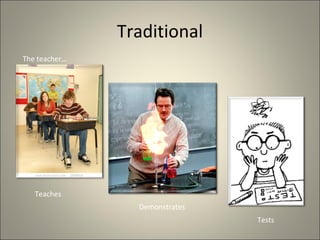
Traditional
Teaches
Demonstrates
Tests
The teacher…
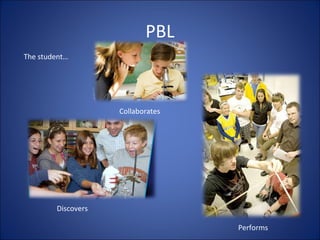
PBL
Collaborates
Discovers
Performs
The student…
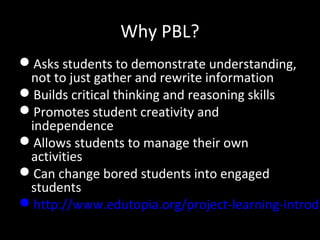
Why PBL?
Asks students to demonstrate understanding,
not to just gather and rewrite information
Builds critical thinking and reasoning skills
Promotes student creativity and
independence
Allows students to manage their own
activities
Can change bored students into engaged
students
http://www.edutopia.org/project-learning-introdu
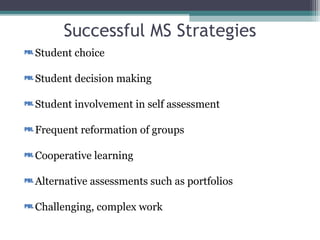
Successful MS Strategies
Student choice
Student decision making
Student involvement in self assessment
Frequent reformation of groups
Cooperative learning
Alternative assessments such as portfolios
Challenging, complex work
Anderman, Lynley Hicks, Midgley, Carol . "Motivation and Middle School Students." ERIC Digest 1997.
6/30/10 <http://www.ericdigests.org/1999-1/motivation.html>.
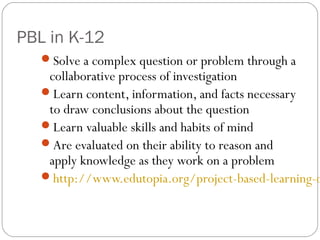
PBL in K-12
Solve a complex question or problem through a
collaborative process of investigation
Learn content, information, and facts necessary
to draw conclusions about the question
Learn valuable skills and habits of mind
Are evaluated on their ability to reason and
apply knowledge as they work on a problem
http://www.edutopia.org/project-based-learning-o
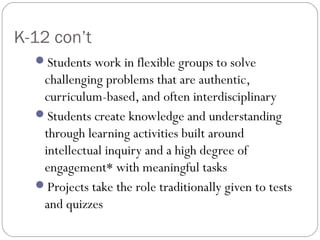
K-12 con’t
Students work in flexible groups to solve
challenging problems that are authentic,
curriculum-based, and often interdisciplinary
Students create knowledge and understanding
through learning activities built around
intellectual inquiry and a high degree of
engagement* with meaningful tasks
Projects take the role traditionally given to tests
and quizzes
What does PBL require of
teachers?
Costa and Kallick articulate 3 "curriculum mind shifts"
educators must undergo in the areas of goals & outcomes,
instruction and assessment as we position ourselves to lead
learning in the 21st century:
Mind shift #1: From knowing the right answers to knowing how
to behave when answers are not readily apparent.
Mind shift #2: From transmitting meaning to constructing
meaning.
Mind shift #3: From external evaluation to self-assessment.
 Retrieved from
http://www.ascd.org/publications/books/109008/chapters/It-Takes-Some-Getting-Used-To@-Reth

Problem based learning

  • 1.
    Problem-based Learning What isPBL?  A learning strategy characterized by self- directed active learning starting with an “ill- structured problem” before any instruction  Learners probe deeply into issues searching for connections, grappling with complexity and using knowledge to fashion solutions  An excellent instructional method that can cultivate students’ critical thinking, develop their abilities to analyze and solve problems
  • 2.
  • 3.
  • 4.
    Why PBL? Asks studentsto demonstrate understanding, not to just gather and rewrite information Builds critical thinking and reasoning skills Promotes student creativity and independence Allows students to manage their own activities Can change bored students into engaged students http://www.edutopia.org/project-learning-introdu
  • 5.
    Successful MS Strategies Studentchoice Student decision making Student involvement in self assessment Frequent reformation of groups Cooperative learning Alternative assessments such as portfolios Challenging, complex work Anderman, Lynley Hicks, Midgley, Carol . "Motivation and Middle School Students." ERIC Digest 1997. 6/30/10 <http://www.ericdigests.org/1999-1/motivation.html>.
  • 6.
    PBL in K-12 Solvea complex question or problem through a collaborative process of investigation Learn content, information, and facts necessary to draw conclusions about the question Learn valuable skills and habits of mind Are evaluated on their ability to reason and apply knowledge as they work on a problem http://www.edutopia.org/project-based-learning-o
  • 7.
    K-12 con’t Students workin flexible groups to solve challenging problems that are authentic, curriculum-based, and often interdisciplinary Students create knowledge and understanding through learning activities built around intellectual inquiry and a high degree of engagement* with meaningful tasks Projects take the role traditionally given to tests and quizzes
  • 8.
    What does PBLrequire of teachers? Costa and Kallick articulate 3 "curriculum mind shifts" educators must undergo in the areas of goals & outcomes, instruction and assessment as we position ourselves to lead learning in the 21st century: Mind shift #1: From knowing the right answers to knowing how to behave when answers are not readily apparent. Mind shift #2: From transmitting meaning to constructing meaning. Mind shift #3: From external evaluation to self-assessment.  Retrieved from http://www.ascd.org/publications/books/109008/chapters/It-Takes-Some-Getting-Used-To@-Reth

Editor's Notes

  • #2 . Ill-structured problems, on the other hand, are messy like the problems that are faced in everyday life and in professional practice Students may need to draw from multiple disciplines
  • #3 Teacher has already taught the material that will be covered on the test It’s all about the teacher
  • #4 Students learn the material as they need it working through the problem It’s all about the student
  • #6 Research shows that the most successful middle school teaching model uses these strategies which also happen to be strategies employed in PBL
  • #7 PROJECT BASES LEARNING and PROBLEM based learning are similar, and the terms are sometimes used interchangeably. Both are based on a method inquiry into an authentic problem or question. Problem based learning is a term more commonly used in colleges and universities, while Project Based Learning is a term used in K -12 education in the United States. Outside the United States, problem based learning or ‘project work’ is the more common term for PBL. Project learning is often initiated with a Driving Questions whereas Problem-based learning begins with a problem, not just a question Seymour Papert is an MIT mathematician, computer scientist, and educator. He is one of the pioneers of artificial intelligence, as well as an inventor of the Logo programming language.
  • #8 * Problems are deliberately written to engage stu interest.PROJECT BASEd LEARNING and PROBLEM based learning are similar, and the terms are sometimes used interchangeably. Both are based on a method inquiry into an authentic problem or question. Problem based learning is a term more commonly used in colleges and universities, while Project Based Learning is a term used in K -12 education in the United States. Outside the United States, problem based learning or ‘project work’ is the more common term for PBL. Seymour Papert is an MIT mathematician, computer scientist, and educator. He is one of the pioneers of artificial intelligence, as well as an inventor of the Logo programming language.