Chapter 1
Unpacking Thinking
Summary and My Take-a-ways
Making it visible to ourselves
We ask/tell our students to "think", but what does
that mean?
What do we want them to do?
What does "thinking" mean to me?
- - - - - hmmmmmm……- - - -
If we are going to make thinking visible in our
classrooms, FIRST step will be for us as a teacher to
make the various forms, dimensions, and process of
thinking visible to ourselves
BEYOND BLOOM
➔ Bloom's taxonomy suggests that thinking is a linear progression,
but it's not. Why is "understanding" toward the bottom of the
revised Bloom's?
➔ “…understanding is not a precursor to application, analysis,
evaluating, and creating but a result of it.”
➔ Is understanding a type of thinking or an outcome of thinking?
➔ Classrooms tend to be places of "tell & practice", not much (if any)
thinking.
BEYOND MEMORIZATION, WORK AND ACTIVITY
➔ Understanding is the chief goal of thinking!
➔ Retention of information through rote practice isn't learning, it is training!
➔ Playing a review game or doing other activities may be fun, but still not likely to
develop understanding. Hands on does not mean minds on.
➔ Work & activity not synonymous with learning
➔ To develop understanding of a subject, you need to have authentic intellectual
activity.
➔ “In most school settings, educators have focused more on the completion of work
and assignments than on a true development of understanding.”
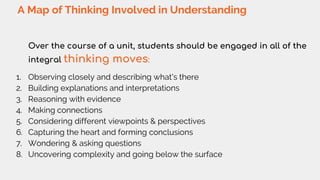
Over the course of a unit, students should be engaged in all of the
integral thinking moves:
1. Observing closely and describing what's there
2. Building explanations and interpretations
3. Reasoning with evidence
4. Making connections
5. Considering different viewpoints & perspectives
6. Capturing the heart and forming conclusions
7. Wondering & asking questions
8. Uncovering complexity and going below the surface
A Map of Thinking Involved in Understanding
Structured
reflection
Analysis
Connection
Perspective
Reflection that goes beyond
voicing one’s opinion or
feelings - involves describing
the object of reflection and
noticing its key features,
connecting what is new to
what one already knows and
examination of the event or
object of reflection through
various lenses or frames
which is perspective taking
(Coby et al)
Activity idea (pg 16)
Create a concept map on 'What is
thinking?' However, don't stress if student
answers aren't great - most students
haven't been taught to think about
thinking.
OTHER KINDS OF
THINKING
1. Identifying patterns and making
generalizations
2. Generating possibilities and
alternatives
3. Evaluating evidence, arguments
and actions
4. Formulating plans and monitoring
actions
5. Identifying claims, assumptions and
bias
6. Clarifying priorities, conditions, and
what is known
Uncovering Students’ Thinking About
Thinking
➔ To be properly metacognitive, then, students have to be
realistically aware of their own cognitive resources in
relation to the task demands and then to plan, monitor and
control those resources - Biggs
➔ Awareness of one’s own learning process and one’s control
over them (meta-learning) or
➔ Knowledge about the strategies one has at one’s disposal
to facilitate and direct one’s own learning (meta-strategic
knowledge)
The Cultures of Thinking Research
Students responses might be grouped into:
1. Memory and knowledge-based strategies
2. General and nonspecific strategies
3. Self-regulation and motivation strategies
4. Specific thinking and strategies and process
My Take-a-ways
● Deepen my own understanding about the types of thinking beyond
surface learning
● What types of thinking I want my students to do?
● Do the activities I have planned provide opportunities to develop
understanding through the thinking I intend?
● How can I develop the culture of thinking research with my students?
● As an educator, what can I do to develop the metacognition of my
students?

Making Thinking Visible Chapter 1

  • 1.
  • 2.
    Making it visibleto ourselves We ask/tell our students to "think", but what does that mean? What do we want them to do? What does "thinking" mean to me? - - - - - hmmmmmm……- - - - If we are going to make thinking visible in our classrooms, FIRST step will be for us as a teacher to make the various forms, dimensions, and process of thinking visible to ourselves
  • 3.
    BEYOND BLOOM ➔ Bloom'staxonomy suggests that thinking is a linear progression, but it's not. Why is "understanding" toward the bottom of the revised Bloom's? ➔ “…understanding is not a precursor to application, analysis, evaluating, and creating but a result of it.” ➔ Is understanding a type of thinking or an outcome of thinking? ➔ Classrooms tend to be places of "tell & practice", not much (if any) thinking.
  • 4.
    BEYOND MEMORIZATION, WORKAND ACTIVITY ➔ Understanding is the chief goal of thinking! ➔ Retention of information through rote practice isn't learning, it is training! ➔ Playing a review game or doing other activities may be fun, but still not likely to develop understanding. Hands on does not mean minds on. ➔ Work & activity not synonymous with learning ➔ To develop understanding of a subject, you need to have authentic intellectual activity. ➔ “In most school settings, educators have focused more on the completion of work and assignments than on a true development of understanding.”
  • 5.
    Over the courseof a unit, students should be engaged in all of the integral thinking moves: 1. Observing closely and describing what's there 2. Building explanations and interpretations 3. Reasoning with evidence 4. Making connections 5. Considering different viewpoints & perspectives 6. Capturing the heart and forming conclusions 7. Wondering & asking questions 8. Uncovering complexity and going below the surface A Map of Thinking Involved in Understanding
  • 6.
    Structured reflection Analysis Connection Perspective Reflection that goesbeyond voicing one’s opinion or feelings - involves describing the object of reflection and noticing its key features, connecting what is new to what one already knows and examination of the event or object of reflection through various lenses or frames which is perspective taking (Coby et al)
  • 7.
    Activity idea (pg16) Create a concept map on 'What is thinking?' However, don't stress if student answers aren't great - most students haven't been taught to think about thinking.
  • 8.
    OTHER KINDS OF THINKING 1.Identifying patterns and making generalizations 2. Generating possibilities and alternatives 3. Evaluating evidence, arguments and actions 4. Formulating plans and monitoring actions 5. Identifying claims, assumptions and bias 6. Clarifying priorities, conditions, and what is known
  • 9.
    Uncovering Students’ ThinkingAbout Thinking ➔ To be properly metacognitive, then, students have to be realistically aware of their own cognitive resources in relation to the task demands and then to plan, monitor and control those resources - Biggs ➔ Awareness of one’s own learning process and one’s control over them (meta-learning) or ➔ Knowledge about the strategies one has at one’s disposal to facilitate and direct one’s own learning (meta-strategic knowledge)
  • 10.
    The Cultures ofThinking Research Students responses might be grouped into: 1. Memory and knowledge-based strategies 2. General and nonspecific strategies 3. Self-regulation and motivation strategies 4. Specific thinking and strategies and process
  • 11.
    My Take-a-ways ● Deepenmy own understanding about the types of thinking beyond surface learning ● What types of thinking I want my students to do? ● Do the activities I have planned provide opportunities to develop understanding through the thinking I intend? ● How can I develop the culture of thinking research with my students? ● As an educator, what can I do to develop the metacognition of my students?

Editor's Notes

  • #4 What is understanding? In my opinion, I consider it as an outcome, because thinking is a process... when you understand, it means your processing information , concepts, details etc. Classroom as a tell and practice - I am guity specially when its crunch time for deadlines, assessments etc
  • #5 Rote practice - Guilty! Specially when they need to remember their tricky words and plus the pressure of covering the entire curriculum Hands on does not mean minds on - Balance between activities and the understanding of concepts is immportant Work + activity =/ learning - Use the 3 questions to identify the possible discrepancy between students actvities and teaching strategies that leads with understanding. P10 Authentic intellectual activity - Need to provide the students more opportunity to use the target language in real life situations (role playing for instance) But how would you help your students to think like a scientist/mathenatician if they havent acquired the language yet?
  • #10 How do we do this?What are the different ways we can do to do this in our class? How can we develop our learners’ netacognition? Meta-learning- I think it is connected with learning styles
  • #11 I am wondering what are the different strategies I can implement in my class to foster cultures of thinking research