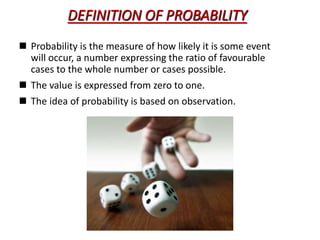
 Probability is the measure of how likely it is some event
will occur, a number expressing the ratio of favourable
cases to the whole number or cases possible.
 The value is expressed from zero to one.
 The idea of probability is based on observation.
BASICS FORMULA OF PROBABILITY
Probability of event to happen P(E) = Number of
favourable outcomes/Total Number of outcomes
[Where E is event.]
TYPES OF PROBABILITY
Theoratical Probability
Experimental Probability
Axiomatic Probability
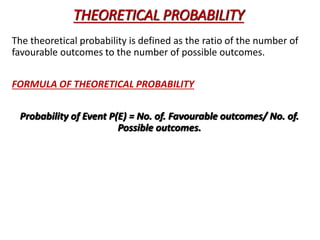
THEORETICAL PROBABILITY
The theoretical probability is defined as the ratio of the number of
favourable outcomes to the number of possible outcomes.
FORMULA OF THEORETICAL PROBABILITY
Probability of Event P(E) = No. of. Favourable outcomes/ No. of.
Possible outcomes.
Example of Theoratical Probability
Find the probability of rolling a 5 on a fair die
Solution:
To find the probability of getting 5 while rolling a die, an
experiment is not needed. We know that there are 6 possible
outcomes when rolling a die. They are 1, 2, 3, 4, 5, 6.
Therefore, the probability is,
Probability of Event P(E) = No. of. Favourable outcomes/ No.
of. Possible outcomes.
P(E) = 1/6.
Hence, the probability of getting 5 while rolling a fair die is
1/6.
EXPERIMENTAL PROBABILITY
Experimental probability, also known as Empirical probability, is
based on actual experiments and adequate recordings of the
happening of events. To determine the occurrence of any event, a
series of actual experiments are conducted.
FORMULA OF EXPERIMENTAL PROBABILITY
Probability of an Event P(E) = Number of times an event occurs /
Total number of trials.
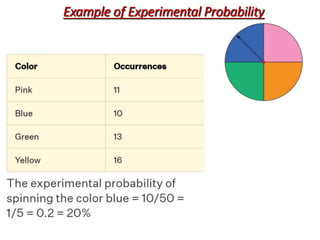
Example of Experimental Probability
AXIOMATIC PROBABILITY
Axiomatic probability is a unifying probability theory. It sets
down a set of axioms (rules) that apply to all of types of
probability, including frequentist probability and classical
probability. These rules, based on Kolmogorov’s Three Axioms,
set starting points for mathematical probability.
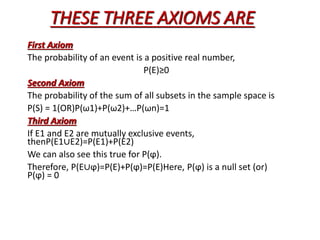
THESE THREE AXIOMS ARE
First Axiom
The probability of an event is a positive real number,
P(E)≥0
Second Axiom
The probability of the sum of all subsets in the sample space is
P(S) = 1(OR)P(ω1)+P(ω2)+…P(ωn)=1
Third Axiom
If E1 and E2 are mutually exclusive events,
thenP(E1∪E2)=P(E1)+P(E2)
We can also see this true for P(ϕ).
Therefore, P(E∪ϕ)=P(E)+P(ϕ)=P(E)Here, P(ϕ) is a null set (or)
P(ϕ) = 0
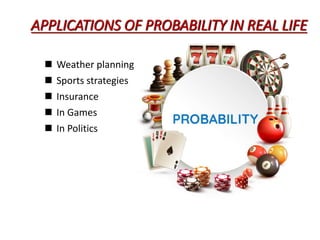
APPLICATIONS OF PROBABILITY IN REAL LIFE
 Weather planning
 Sports strategies
 Insurance
 In Games
 In Politics

Classification of Probability.pptx

  • 2.
     Probability isthe measure of how likely it is some event will occur, a number expressing the ratio of favourable cases to the whole number or cases possible.  The value is expressed from zero to one.  The idea of probability is based on observation.
  • 3.
    BASICS FORMULA OFPROBABILITY Probability of event to happen P(E) = Number of favourable outcomes/Total Number of outcomes [Where E is event.]
  • 4.
    TYPES OF PROBABILITY TheoraticalProbability Experimental Probability Axiomatic Probability
  • 5.
    THEORETICAL PROBABILITY The theoreticalprobability is defined as the ratio of the number of favourable outcomes to the number of possible outcomes. FORMULA OF THEORETICAL PROBABILITY Probability of Event P(E) = No. of. Favourable outcomes/ No. of. Possible outcomes.
  • 6.
    Example of TheoraticalProbability Find the probability of rolling a 5 on a fair die Solution: To find the probability of getting 5 while rolling a die, an experiment is not needed. We know that there are 6 possible outcomes when rolling a die. They are 1, 2, 3, 4, 5, 6. Therefore, the probability is, Probability of Event P(E) = No. of. Favourable outcomes/ No. of. Possible outcomes. P(E) = 1/6. Hence, the probability of getting 5 while rolling a fair die is 1/6.
  • 7.
    EXPERIMENTAL PROBABILITY Experimental probability,also known as Empirical probability, is based on actual experiments and adequate recordings of the happening of events. To determine the occurrence of any event, a series of actual experiments are conducted. FORMULA OF EXPERIMENTAL PROBABILITY Probability of an Event P(E) = Number of times an event occurs / Total number of trials.
  • 8.
  • 9.
    AXIOMATIC PROBABILITY Axiomatic probabilityis a unifying probability theory. It sets down a set of axioms (rules) that apply to all of types of probability, including frequentist probability and classical probability. These rules, based on Kolmogorov’s Three Axioms, set starting points for mathematical probability.
  • 10.
    THESE THREE AXIOMSARE First Axiom The probability of an event is a positive real number, P(E)≥0 Second Axiom The probability of the sum of all subsets in the sample space is P(S) = 1(OR)P(ω1)+P(ω2)+…P(ωn)=1 Third Axiom If E1 and E2 are mutually exclusive events, thenP(E1∪E2)=P(E1)+P(E2) We can also see this true for P(ϕ). Therefore, P(E∪ϕ)=P(E)+P(ϕ)=P(E)Here, P(ϕ) is a null set (or) P(ϕ) = 0
  • 11.
    APPLICATIONS OF PROBABILITYIN REAL LIFE  Weather planning  Sports strategies  Insurance  In Games  In Politics