Probability The MEnTe Program Math Enrichment through Technology Title V  East Los Angeles College ©2003 East Los Angeles College.  All rights reserved.   EXIT NEXT Click one of the buttons below  or press the enter key BACK TOPICS
Topics Introduction Empirical Probability Theoretical Probability Compound Events Addition Rule Multiplication Rule   for Independent Events Multiplication Rule   for Dependent Events Counting Principles Odds Permutations Combinations Permutations of    Repeated  Objects
Probability Introduction When we speak of the probability of something happening, we are referring to the likelihood—or chances—of it happening.  Do we have a better chance of it occurring or do we have a better chance of it  not  occurring?
Generally, we talk about this probability as a fraction, a decimal, or even a percent— the probability that if two dice are tossed the spots will total to seven is 1/6 the probability that a baseball player will get a hit is .273 the probability that it will rain is 20%
Empirical Probability Some probabilities are determined from repeated experimentation and observation, recording results, and then using these results to predict expected probability.  This kind of probability is referred to as  empirical probability .
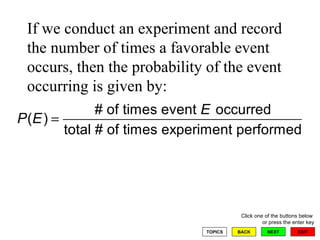
If we conduct an experiment and record the number of times a favorable event occurs, then the probability of the event occurring is given by:
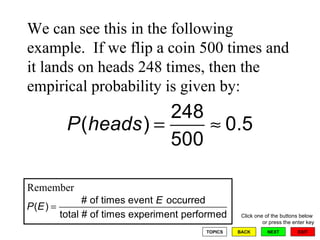
We can see this in the following example.  If we flip a coin 500 times and it lands on heads 248 times, then the empirical probability is given by: Remember
Theoretical Probability Other probabilities are determined using mathematical computations based on possible results, or outcomes.  This kind of probability is referred to as  theoretical probability .
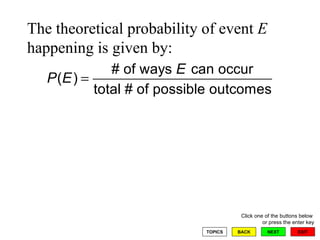
The theoretical probability of event  E  happening is given by:
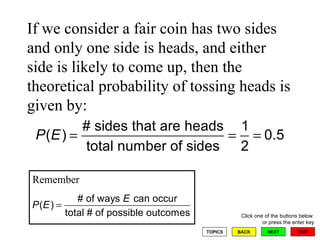
If we consider a fair coin has two sides and only one side is heads, and either side is likely to come up, then the theoretical probability of tossing heads is given by:  Remember
While in both cases illustrated for tossing a heads the probability comes out to be 0.5, it should be noted that empirical probability falls under the  Law of Large Numbers  which basically says that an experiment must be conducted a large number of times in order to determine the probability with any certainty.
You can flip a coin ten times and have heads come up seven times, but this does not mean that the probability is 0.7.  The more times a coin is flipped, the more certainty we have to determine the probability of coming up heads.
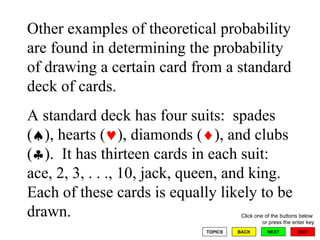
Other examples of theoretical probability are found in determining the probability of drawing a certain card from a standard deck of cards.  A standard deck has four suits:  spades (  ), hearts (  ), diamonds (  ), and clubs (  ).  It has thirteen cards in each suit:  ace, 2, 3, . . ., 10, jack, queen, and king.  Each of these cards is equally likely to be drawn.
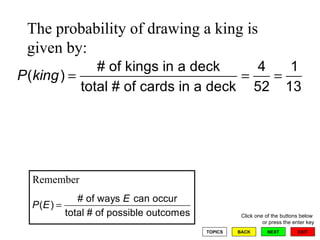
The probability of drawing a king is given by:  Remember
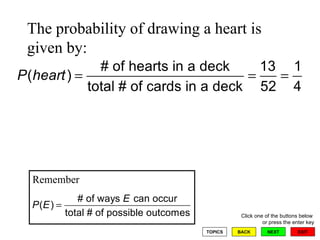
The probability of drawing a heart is given by:  Remember
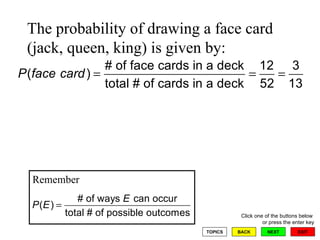
The probability of drawing a face card (jack, queen, king) is given by:  Remember
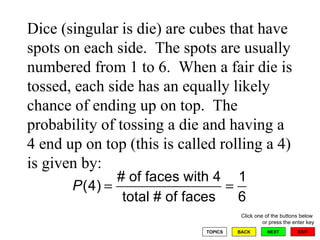
Dice (singular is die) are cubes that have spots on each side.  The spots are usually numbered from 1 to 6.  When a fair die is tossed, each side has an equally likely chance of ending up on top.  The probability of tossing a die and having a 4 end up on top (this is called rolling a 4) is given by:
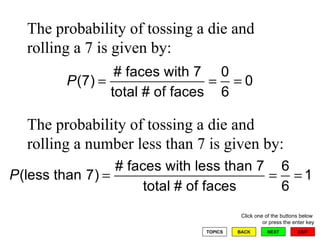
The probability of tossing a die and rolling a 7 is given by: The probability of tossing a die and rolling a number less than 7 is given by:
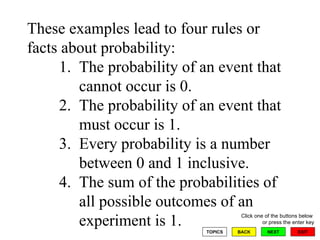
These examples lead to four rules or facts about probability: 1.  The probability of an event that    cannot occur is 0. 2.  The probability of an event that    must occur is 1. 3.  Every probability is a number    between 0 and 1 inclusive. 4.  The sum of the probabilities of    all possible outcomes of an    experiment is 1.
The complement of an event is all outcomes where the desired event does  not  occur.  We can say the complement of  E  is  not   E  (sometimes written as  Ē  or  E  ).
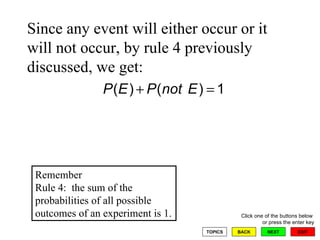
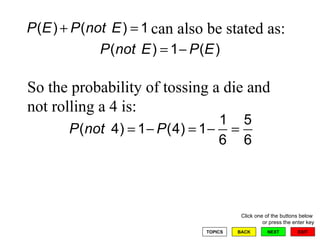
Since any event will either occur or it will not occur, by rule 4 previously discussed, we get: Remember Rule 4:  the sum of the probabilities of all possible outcomes of an experiment is 1.
can also be stated as: So the probability of tossing a die and not rolling a 4 is:
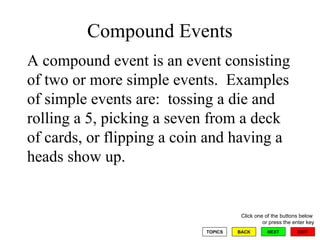
Compound Events A compound event is an event consisting of two or more simple events.  Examples of simple events are:  tossing a die and rolling a 5, picking a seven from a deck of cards, or flipping a coin and having a heads show up.
An example of a compound event is tossing a die and rolling a 5  or  an even number.  The notation for this kind of compound event is given by  .  This is the probability that event  A  or event  B  (or both) will occur.
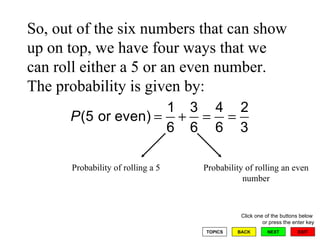
In the case of rolling either a 5 or an even number on a die, the probability is arrived at by using the fact that there is only one way to roll a 5 and there are three ways to roll an even number.
So, out of the six numbers that can show up on top, we have four ways that we can roll either a 5 or an even number.  The probability is given by: Probability of rolling a 5 Probability of rolling an even number
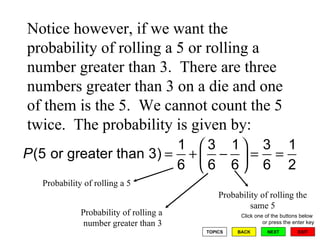
Notice however, if we want the probability of rolling a 5 or rolling a number greater than 3.  There are three numbers greater than 3 on a die and one of them is the 5.  We cannot count the 5 twice.  The probability is given by: Probability of rolling a 5 Probability of rolling a  number greater than 3 Probability of rolling the same 5
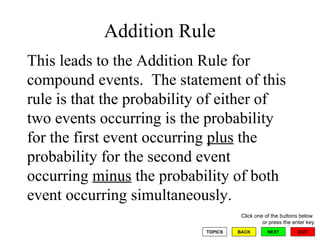
Addition Rule This leads to the Addition Rule for compound events.  The statement of this rule is that the probability of either of two events occurring is the probability for the first event occurring  plus  the probability for the second event occurring  minus  the probability of both event occurring simultaneously.
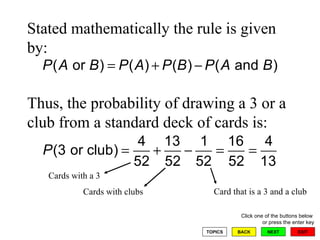
Stated mathematically the rule is given by: Thus, the probability of drawing a 3 or a club from a standard deck of cards is: Cards with a 3 Cards with clubs Card that is a 3 and a club
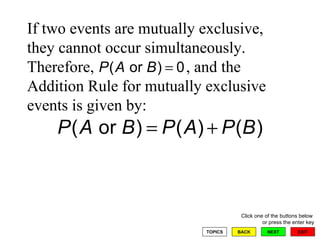
If two events are mutually exclusive, they cannot occur simultaneously.  Therefore,  , and the Addition Rule for mutually exclusive events is given by:
Multiplication Rule for Independent Events Independent events are events in which the occurrence of the events will not affect the probability of the occurrence of any of the other events.
When we conduct two independent events we can determine the probability of a given outcome in the first event followed by another given outcome in the second event.
An example of this is picking a color from a set of crayons, then tossing a die.  Separately, each of these events is a simple event and the selection of a color does not affect the tossing of a die.
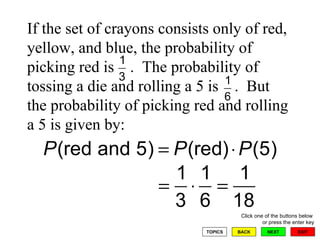
If the set of crayons consists only of red, yellow, and blue, the probability of picking red is  .  The probability of  tossing a die and rolling a 5 is  .  But the probability of picking red and rolling a 5 is given by:
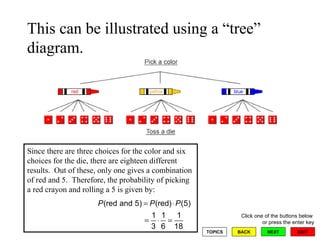
This can be illustrated using a “tree” diagram. Since there are three choices for the color and six choices for the die, there are eighteen different results.  Out of these, only one gives a combination of red and 5.  Therefore, the probability of picking a red crayon and rolling a 5 is given by:
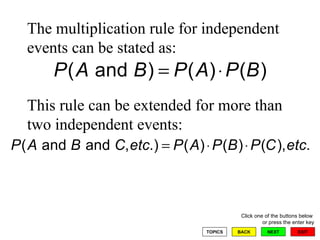
The multiplication rule for independent events can be stated as: This rule can be extended for more than two independent events:
Multiplication Rule for Dependent Events Dependent events are events that are not independent.  The occurrence of one event affects the probability of the occurrence of other events.  An example of dependent events is picking a card from a standard deck then picking another card from the remaining cards in the deck.
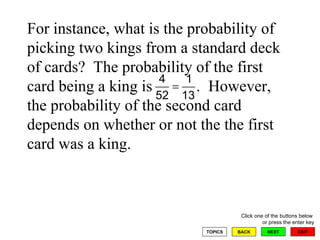
For instance, what is the probability of picking two kings from a standard deck of cards?  The probability of the first card being a king is  .  However, the probability of the second card depends on whether or not the the first card was a king.
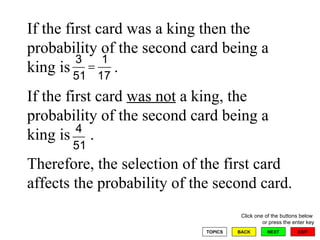
If the first card was a king then the probability of the second card being a king is  .  If the first card  was not  a king, the probability of the second card being a king is  .  Therefore, the selection of the first card affects the probability of the second card.
When we are looking at probability for two dependent events we need to have notation to express the probability for an event to occur given that another event has already occurred.
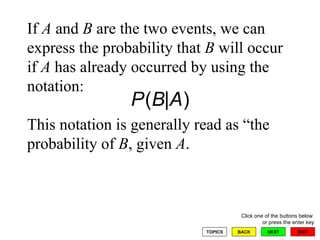
If  A  and  B  are the two events, we can express the probability that  B  will occur if  A  has already occurred by using the notation:  This notation is generally read as “the probability of  B , given  A .
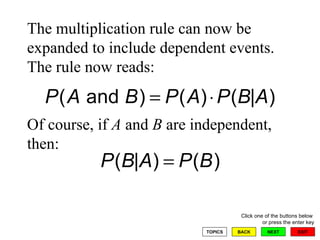
The multiplication rule can now be expanded to include dependent events.  The rule now reads: Of course, if  A  and  B  are independent, then:
As an example, in a group of 25 people 16 of them are married and 9 are single.  What is the probability that if two people are randomly selected from the group, they are both married?
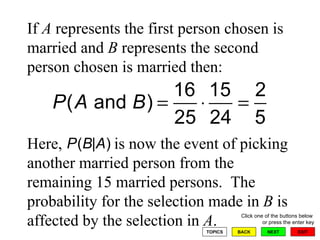
If  A  represents the first person chosen is married and  B  represents the second person chosen is married then: Here,  is now the event of picking another married person from the remaining 15 married persons.  The probability for the selection made in  B  is affected by the selection in  A .
Counting Principles Sometimes determining probability depends on being able to count the number of possible events that can occur, for instance, suppose that a person at a dinner can choose from two different salads, five entrees, three drinks, and three desserts.  How many different choices does this person have for choosing a complete dinner?
The Multiplication Principal for counting (which is similar to the Multiplication Principle for Probability) says that if an event consists of a sequence of choices, then the total number of choices is equal to the product of the numbers for each individual choice.
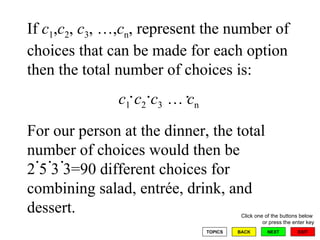
If  c 1 , c 2 ,  c 3 , …, c n , represent the number of choices that can be made for each option then the total number of choices is: c 1   c 2  c 3  …  c n  For our person at the dinner, the total number of choices would then be  2 5 3 3=90 different choices for combining salad, entrée, drink, and dessert.
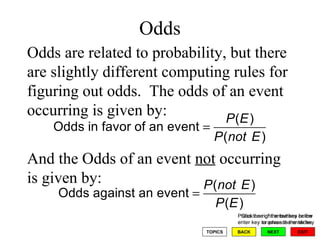
Odds Press the right arrow key or the enter key to advance the slides Odds are related to probability, but there are slightly different computing rules for figuring out odds.  The odds of an event occurring is given by: And the Odds of an event  not  occurring is given by:
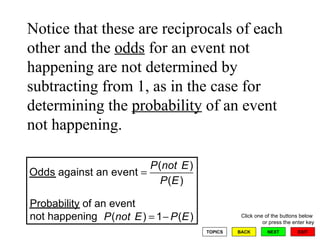
Probability of an event not happening Notice that these are reciprocals of each other and the  odds  for an event not happening are not determined by subtracting from 1, as in the case for determining the  probability  of an event not happening.
Permutations  A permutation is an arrangement of objects where order is important.  For instance the digits 1,2, and 3 can be arranged in six different orders --- 123, 132, 213, 231, 312, and 321. Hence, there are six permutations of the three digits.  In fact there are six permutations of any three objects when all three objects are used.
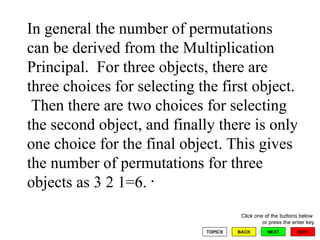
In general the number of permutations can be derived from the Multiplication Principal.  For three objects, there are three choices for selecting the first object.  Then there are two choices for selecting the second object, and finally there is only one choice for the final object. This gives the number of permutations for three objects as 3 2 1=6.
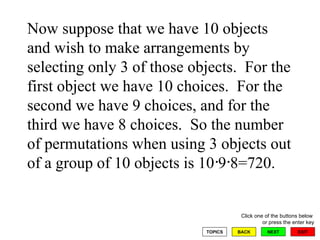
Now suppose that we have 10 objects and wish to make arrangements by selecting only 3 of those objects.  For the first object we have 10 choices.  For the second we have 9 choices, and for the third we have 8 choices.  So the number of permutations when using 3 objects out of a group of 10 objects is 10 9 8=720.
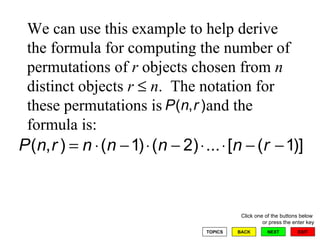
We can use this example to help derive the formula for computing the number of permutations of  r  objects chosen from  n  distinct objects  r      n .  The notation for these permutations is  and the formula is:
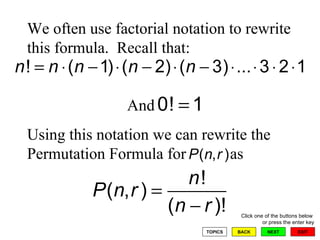
We often use factorial notation to rewrite this formula.  Recall that:   And Using this notation we can rewrite the Permutation Formula for  as
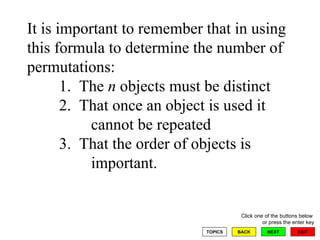
It is important to remember that in using this formula to determine the number of permutations: 1.  The  n  objects must be distinct 2.  That once an object is used it  cannot be repeated  3.  That the order of objects is  important.
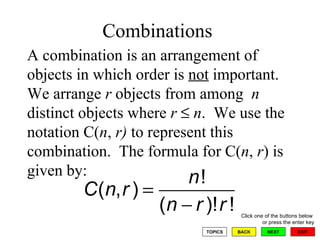
Combinations  A combination is an arrangement of objects in which order is  not  important.  We arrange  r  objects from among  n  distinct objects where  r      n .  We use the notation C( n ,  r)  to represent this combination.  The formula for C( n ,  r ) is given by:
The Combination Formula is derived from the Permutation Formula in that for a permutation every different order of the objects is counted even when the same objects are involved.  This means that for  r  objects, there will be  r ! different order arrangements.
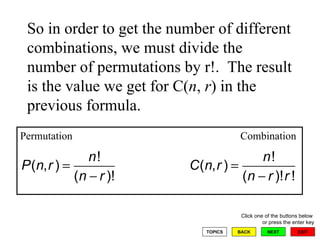
Permutation  Combination So in order to get the number of different combinations, we must divide the number of permutations by r!.  The result is the value we get for C( n ,  r ) in the previous formula.
Permutations of Repeated Objects It is possible that in a group of objects some of the objects may be the same.  In taking the permutation of this group of objects, different orders of the objects that are the same will not be different  from one another.
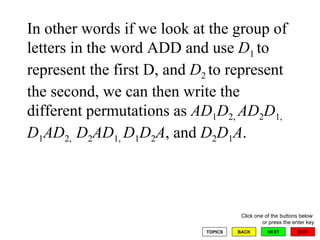
In other words if we look at the group of letters in the word ADD and use  D 1  to represent the first D, and  D 2  to represent the second, we can then write the different permutations as  AD 1 D 2,  AD 2 D 1,  D 1 AD 2,  D 2 AD 1,  D 1 D 2 A , and  D 2 D 1 A .
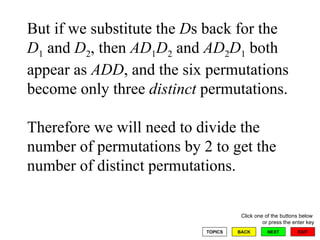
But if we substitute the  D s back for the  D 1  and  D 2 , then  AD 1 D 2  and  AD 2 D 1  both appear as  ADD , and the six permutations become only three  distinct  permutations.  Therefore we will need to divide the number of permutations by 2 to get the number of distinct permutations.
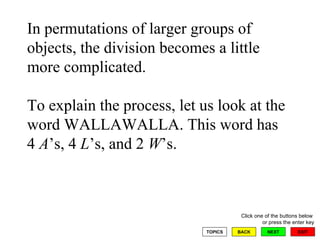
In permutations of larger groups of objects, the division becomes a little more complicated.  To explain the process, let us look at the word WALLAWALLA. This word has  4  A ’s, 4  L ’s, and 2  W ’s.
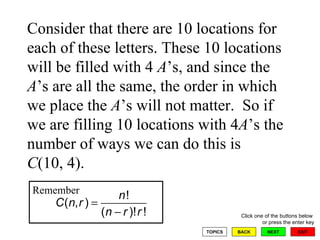
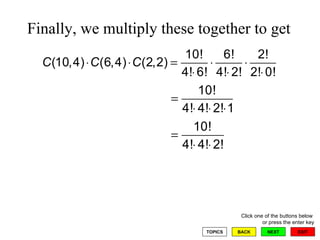
Consider that there are 10 locations for each of these letters. These 10 locations will be filled with 4  A ’s, and since the  A ’s are all the same, the order in which we place the  A ’s will not matter.  So if we are filling 10 locations with 4 A ’s the number of ways we can do this is  C (10, 4). Remember
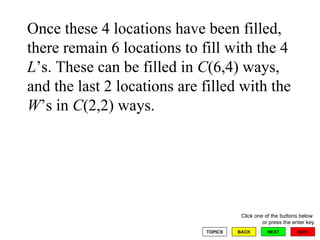
Once these 4 locations have been filled, there remain 6 locations to fill with the 4  L ’s. These can be filled in  C (6,4) ways, and the last 2 locations are filled with the  W ’s in  C (2,2) ways.
Finally, we multiply these together to get
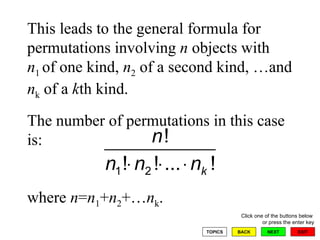
This leads to the general formula for permutations involving  n  objects with  n 1  of one kind,  n 2  of a second kind, …and  n k  of a  k th kind.  The number of permutations in this case is:  where  n = n 1 + n 2 +… n k .
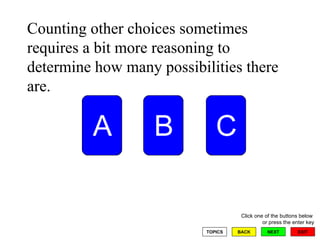
Counting other choices sometimes requires a bit more reasoning to determine how many possibilities there are.
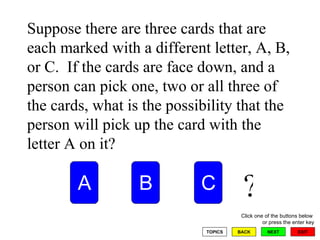
Suppose there are three cards that are each marked with a different letter, A, B, or C.  If the cards are face down, and a person can pick one, two or all three of the cards, what is the possibility that the person will pick up the card with the letter A on it?  ?
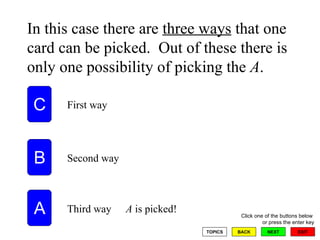
In this case there are  three ways  that one card can be picked.  Out of these there is only one possibility of picking the  A .  First way Second way Third way A  is picked!
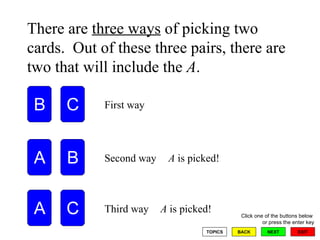
There are  three ways  of picking two cards.  Out of these three pairs, there are two that will include the  A . First way Second way Third way A  is picked! A  is picked!
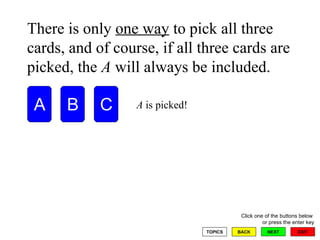
There is only  one way  to pick all three cards, and of course, if all three cards are picked, the  A  will always be included. A  is picked!
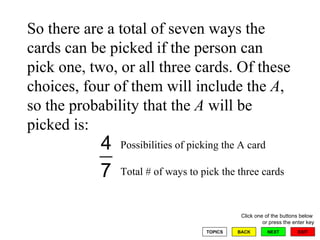
So there are a total of seven ways the cards can be picked if the person can pick one, two, or all three cards. Of these choices, four of them will include the  A , so the probability that the  A  will be picked is:  Total # of ways to pick the three cards Possibilities of picking the A card
Contact Us At: The MEnTe Program / Title V  East Los Angeles College 1301 Avenida Cesar Chavez Monterey Park, CA  91754 Phone: (323) 265-8784 Fax: (323) 415-4109 Email Us At: [email_address] Our Websites: http://www.matematicamente.org http://www.mente.elac.org

Probability 2

  • 1.
    Probability The MEnTeProgram Math Enrichment through Technology Title V East Los Angeles College ©2003 East Los Angeles College. All rights reserved. EXIT NEXT Click one of the buttons below or press the enter key BACK TOPICS
  • 2.
    Topics Introduction EmpiricalProbability Theoretical Probability Compound Events Addition Rule Multiplication Rule for Independent Events Multiplication Rule for Dependent Events Counting Principles Odds Permutations Combinations Permutations of Repeated Objects
  • 3.
    Probability Introduction Whenwe speak of the probability of something happening, we are referring to the likelihood—or chances—of it happening. Do we have a better chance of it occurring or do we have a better chance of it not occurring?
  • 4.
    Generally, we talkabout this probability as a fraction, a decimal, or even a percent— the probability that if two dice are tossed the spots will total to seven is 1/6 the probability that a baseball player will get a hit is .273 the probability that it will rain is 20%
  • 5.
    Empirical Probability Someprobabilities are determined from repeated experimentation and observation, recording results, and then using these results to predict expected probability. This kind of probability is referred to as empirical probability .
  • 6.
    If we conductan experiment and record the number of times a favorable event occurs, then the probability of the event occurring is given by:
  • 7.
    We can seethis in the following example. If we flip a coin 500 times and it lands on heads 248 times, then the empirical probability is given by: Remember
  • 8.
    Theoretical Probability Otherprobabilities are determined using mathematical computations based on possible results, or outcomes. This kind of probability is referred to as theoretical probability .
  • 9.
    The theoretical probabilityof event E happening is given by:
  • 10.
    If we considera fair coin has two sides and only one side is heads, and either side is likely to come up, then the theoretical probability of tossing heads is given by: Remember
  • 11.
    While in bothcases illustrated for tossing a heads the probability comes out to be 0.5, it should be noted that empirical probability falls under the Law of Large Numbers which basically says that an experiment must be conducted a large number of times in order to determine the probability with any certainty.
  • 12.
    You can flipa coin ten times and have heads come up seven times, but this does not mean that the probability is 0.7. The more times a coin is flipped, the more certainty we have to determine the probability of coming up heads.
  • 13.
    Other examples oftheoretical probability are found in determining the probability of drawing a certain card from a standard deck of cards. A standard deck has four suits: spades (  ), hearts (  ), diamonds (  ), and clubs (  ). It has thirteen cards in each suit: ace, 2, 3, . . ., 10, jack, queen, and king. Each of these cards is equally likely to be drawn.
  • 14.
    The probability ofdrawing a king is given by: Remember
  • 15.
    The probability ofdrawing a heart is given by: Remember
  • 16.
    The probability ofdrawing a face card (jack, queen, king) is given by: Remember
  • 17.
    Dice (singular isdie) are cubes that have spots on each side. The spots are usually numbered from 1 to 6. When a fair die is tossed, each side has an equally likely chance of ending up on top. The probability of tossing a die and having a 4 end up on top (this is called rolling a 4) is given by:
  • 18.
    The probability oftossing a die and rolling a 7 is given by: The probability of tossing a die and rolling a number less than 7 is given by:
  • 19.
    These examples leadto four rules or facts about probability: 1. The probability of an event that cannot occur is 0. 2. The probability of an event that must occur is 1. 3. Every probability is a number between 0 and 1 inclusive. 4. The sum of the probabilities of all possible outcomes of an experiment is 1.
  • 20.
    The complement ofan event is all outcomes where the desired event does not occur. We can say the complement of E is not E (sometimes written as Ē or E ).
  • 21.
    Since any eventwill either occur or it will not occur, by rule 4 previously discussed, we get: Remember Rule 4: the sum of the probabilities of all possible outcomes of an experiment is 1.
  • 22.
    can also bestated as: So the probability of tossing a die and not rolling a 4 is:
  • 23.
    Compound Events Acompound event is an event consisting of two or more simple events. Examples of simple events are: tossing a die and rolling a 5, picking a seven from a deck of cards, or flipping a coin and having a heads show up.
  • 24.
    An example ofa compound event is tossing a die and rolling a 5 or an even number. The notation for this kind of compound event is given by . This is the probability that event A or event B (or both) will occur.
  • 25.
    In the caseof rolling either a 5 or an even number on a die, the probability is arrived at by using the fact that there is only one way to roll a 5 and there are three ways to roll an even number.
  • 26.
    So, out ofthe six numbers that can show up on top, we have four ways that we can roll either a 5 or an even number. The probability is given by: Probability of rolling a 5 Probability of rolling an even number
  • 27.
    Notice however, ifwe want the probability of rolling a 5 or rolling a number greater than 3. There are three numbers greater than 3 on a die and one of them is the 5. We cannot count the 5 twice. The probability is given by: Probability of rolling a 5 Probability of rolling a number greater than 3 Probability of rolling the same 5
  • 28.
    Addition Rule Thisleads to the Addition Rule for compound events. The statement of this rule is that the probability of either of two events occurring is the probability for the first event occurring plus the probability for the second event occurring minus the probability of both event occurring simultaneously.
  • 29.
    Stated mathematically therule is given by: Thus, the probability of drawing a 3 or a club from a standard deck of cards is: Cards with a 3 Cards with clubs Card that is a 3 and a club
  • 30.
    If two eventsare mutually exclusive, they cannot occur simultaneously. Therefore, , and the Addition Rule for mutually exclusive events is given by:
  • 31.
    Multiplication Rule forIndependent Events Independent events are events in which the occurrence of the events will not affect the probability of the occurrence of any of the other events.
  • 32.
    When we conducttwo independent events we can determine the probability of a given outcome in the first event followed by another given outcome in the second event.
  • 33.
    An example ofthis is picking a color from a set of crayons, then tossing a die. Separately, each of these events is a simple event and the selection of a color does not affect the tossing of a die.
  • 34.
    If the setof crayons consists only of red, yellow, and blue, the probability of picking red is . The probability of tossing a die and rolling a 5 is . But the probability of picking red and rolling a 5 is given by:
  • 35.
    This can beillustrated using a “tree” diagram. Since there are three choices for the color and six choices for the die, there are eighteen different results. Out of these, only one gives a combination of red and 5. Therefore, the probability of picking a red crayon and rolling a 5 is given by:
  • 36.
    The multiplication rulefor independent events can be stated as: This rule can be extended for more than two independent events:
  • 37.
    Multiplication Rule forDependent Events Dependent events are events that are not independent. The occurrence of one event affects the probability of the occurrence of other events. An example of dependent events is picking a card from a standard deck then picking another card from the remaining cards in the deck.
  • 38.
    For instance, whatis the probability of picking two kings from a standard deck of cards? The probability of the first card being a king is . However, the probability of the second card depends on whether or not the the first card was a king.
  • 39.
    If the firstcard was a king then the probability of the second card being a king is . If the first card was not a king, the probability of the second card being a king is . Therefore, the selection of the first card affects the probability of the second card.
  • 40.
    When we arelooking at probability for two dependent events we need to have notation to express the probability for an event to occur given that another event has already occurred.
  • 41.
    If A and B are the two events, we can express the probability that B will occur if A has already occurred by using the notation: This notation is generally read as “the probability of B , given A .
  • 42.
    The multiplication rulecan now be expanded to include dependent events. The rule now reads: Of course, if A and B are independent, then:
  • 43.
    As an example,in a group of 25 people 16 of them are married and 9 are single. What is the probability that if two people are randomly selected from the group, they are both married?
  • 44.
    If A represents the first person chosen is married and B represents the second person chosen is married then: Here, is now the event of picking another married person from the remaining 15 married persons. The probability for the selection made in B is affected by the selection in A .
  • 45.
    Counting Principles Sometimesdetermining probability depends on being able to count the number of possible events that can occur, for instance, suppose that a person at a dinner can choose from two different salads, five entrees, three drinks, and three desserts. How many different choices does this person have for choosing a complete dinner?
  • 46.
    The Multiplication Principalfor counting (which is similar to the Multiplication Principle for Probability) says that if an event consists of a sequence of choices, then the total number of choices is equal to the product of the numbers for each individual choice.
  • 47.
    If c1 , c 2 , c 3 , …, c n , represent the number of choices that can be made for each option then the total number of choices is: c 1 c 2 c 3 … c n For our person at the dinner, the total number of choices would then be 2 5 3 3=90 different choices for combining salad, entrée, drink, and dessert.
  • 48.
    Odds Press theright arrow key or the enter key to advance the slides Odds are related to probability, but there are slightly different computing rules for figuring out odds. The odds of an event occurring is given by: And the Odds of an event not occurring is given by:
  • 49.
    Probability of anevent not happening Notice that these are reciprocals of each other and the odds for an event not happening are not determined by subtracting from 1, as in the case for determining the probability of an event not happening.
  • 50.
    Permutations Apermutation is an arrangement of objects where order is important. For instance the digits 1,2, and 3 can be arranged in six different orders --- 123, 132, 213, 231, 312, and 321. Hence, there are six permutations of the three digits. In fact there are six permutations of any three objects when all three objects are used.
  • 51.
    In general thenumber of permutations can be derived from the Multiplication Principal. For three objects, there are three choices for selecting the first object. Then there are two choices for selecting the second object, and finally there is only one choice for the final object. This gives the number of permutations for three objects as 3 2 1=6.
  • 52.
    Now suppose thatwe have 10 objects and wish to make arrangements by selecting only 3 of those objects. For the first object we have 10 choices. For the second we have 9 choices, and for the third we have 8 choices. So the number of permutations when using 3 objects out of a group of 10 objects is 10 9 8=720.
  • 53.
    We can usethis example to help derive the formula for computing the number of permutations of r objects chosen from n distinct objects r  n . The notation for these permutations is and the formula is:
  • 54.
    We often usefactorial notation to rewrite this formula. Recall that: And Using this notation we can rewrite the Permutation Formula for as
  • 55.
    It is importantto remember that in using this formula to determine the number of permutations: 1. The n objects must be distinct 2. That once an object is used it cannot be repeated 3. That the order of objects is important.
  • 56.
    Combinations Acombination is an arrangement of objects in which order is not important. We arrange r objects from among n distinct objects where r  n . We use the notation C( n , r) to represent this combination. The formula for C( n , r ) is given by:
  • 57.
    The Combination Formulais derived from the Permutation Formula in that for a permutation every different order of the objects is counted even when the same objects are involved. This means that for r objects, there will be r ! different order arrangements.
  • 58.
    Permutation CombinationSo in order to get the number of different combinations, we must divide the number of permutations by r!. The result is the value we get for C( n , r ) in the previous formula.
  • 59.
    Permutations of RepeatedObjects It is possible that in a group of objects some of the objects may be the same. In taking the permutation of this group of objects, different orders of the objects that are the same will not be different from one another.
  • 60.
    In other wordsif we look at the group of letters in the word ADD and use D 1 to represent the first D, and D 2 to represent the second, we can then write the different permutations as AD 1 D 2, AD 2 D 1, D 1 AD 2, D 2 AD 1, D 1 D 2 A , and D 2 D 1 A .
  • 61.
    But if wesubstitute the D s back for the D 1 and D 2 , then AD 1 D 2 and AD 2 D 1 both appear as ADD , and the six permutations become only three distinct permutations. Therefore we will need to divide the number of permutations by 2 to get the number of distinct permutations.
  • 62.
    In permutations oflarger groups of objects, the division becomes a little more complicated. To explain the process, let us look at the word WALLAWALLA. This word has 4 A ’s, 4 L ’s, and 2 W ’s.
  • 63.
    Consider that thereare 10 locations for each of these letters. These 10 locations will be filled with 4 A ’s, and since the A ’s are all the same, the order in which we place the A ’s will not matter. So if we are filling 10 locations with 4 A ’s the number of ways we can do this is C (10, 4). Remember
  • 64.
    Once these 4locations have been filled, there remain 6 locations to fill with the 4 L ’s. These can be filled in C (6,4) ways, and the last 2 locations are filled with the W ’s in C (2,2) ways.
  • 65.
    Finally, we multiplythese together to get
  • 66.
    This leads tothe general formula for permutations involving n objects with n 1 of one kind, n 2 of a second kind, …and n k of a k th kind. The number of permutations in this case is: where n = n 1 + n 2 +… n k .
  • 67.
    Counting other choicessometimes requires a bit more reasoning to determine how many possibilities there are.
  • 68.
    Suppose there arethree cards that are each marked with a different letter, A, B, or C. If the cards are face down, and a person can pick one, two or all three of the cards, what is the possibility that the person will pick up the card with the letter A on it? ?
  • 69.
    In this casethere are three ways that one card can be picked. Out of these there is only one possibility of picking the A . First way Second way Third way A is picked!
  • 70.
    There are three ways of picking two cards. Out of these three pairs, there are two that will include the A . First way Second way Third way A is picked! A is picked!
  • 71.
    There is only one way to pick all three cards, and of course, if all three cards are picked, the A will always be included. A is picked!
  • 72.
    So there area total of seven ways the cards can be picked if the person can pick one, two, or all three cards. Of these choices, four of them will include the A , so the probability that the A will be picked is: Total # of ways to pick the three cards Possibilities of picking the A card
  • 73.
    Contact Us At:The MEnTe Program / Title V East Los Angeles College 1301 Avenida Cesar Chavez Monterey Park, CA 91754 Phone: (323) 265-8784 Fax: (323) 415-4109 Email Us At: [email_address] Our Websites: http://www.matematicamente.org http://www.mente.elac.org