Section Summary
 What is Probability?
 Basic Counting Rule
Experiment and Its Sample Space
 An experiment (a real experiment or a thought experiment) is any
process that generates well-defined outcomes
 The set of all possible outcomes is called sample space usually
denoted by 𝑆.
 An experimental outcome is also called a sample point.
 A subset of sample space is called an event
 Examples:
 Flip a coin
 Weather in Naryn KG on February 14, 2035
 Toss a die or a pair of dice
 Choose a card from a standard deck of cards
 Temperature in Gulakain Khorog at 5 pm today
Example
 Tossing a die.
 The sample space is
 S = {1, 2, 3, 4, 5, 6}.
 Give an example of an event in this experiment.
 E = {2, 4, 6} is an event, which can be described in
words as ”the number is even”
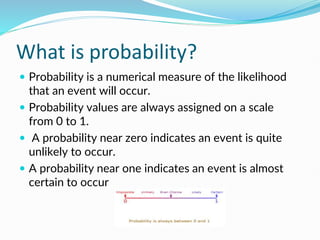
What is probability?
 Probability is a numerical measure of the likelihood
that an event will occur.
 Probability values are always assigned on a scale
from 0 to 1.
 A probability near zero indicates an event is quite
unlikely to occur.
 A probability near one indicates an event is almost
certain to occur
Example
If I have 3 red marbles and 5 blue marbles in
a bag, what is the probability (or chance, or
likelihood) that it is red if I pull out one
marble without looking in the bag?
Dice Problem
P (red) = -------
Probability of
the event of pulling
out
a red marble
3
8
Number of red marbles
- or number of
outcomes that result in
the event
Total number of
marbles - or total
number of possible
outcomes
This entire thought process is what we call in probability
a ‘thought experiment’, or just an ‘experiment’
Dice Problem
Try: For the experiment of rolling a single six-
sided die, find the probability of rolling:
i) 5
ii) 7
iii) a positive integer
Eg., If 47% of students in the UCA are female,
and I randomly select a student from all the UCA
students, what is the probability that the student is
male?
Try: A question on a multiple-choice test has five
possible answers, only one of which is correct. If
you guess on the question, what is the probability
of guessing an incorrect answer?
Try: An experiment consists of tossing a coin
three times in a row.
a) List all possible outcomes (sample
space).
b) What is the probability of getting
one head?
c) What is Probability of getting two
heads?
d) What is Probability of getting three
heads?
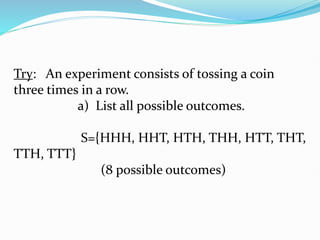
Try: An experiment consists of tossing a coin
three times in a row.
a) List all possible outcomes.
S={HHH, HHT, HTH, THH, HTT, THT,
TTH, TTT}
(8 possible outcomes)
How many outcomes are there for the experiment of flipping a
coin and throwing a regular die?
H1 H2 H3 H4 H5 H6 T1 T2 T3 T4 T5 T6
So, 12 possible outcomes.
There are ‘2 possible ways the first task can be completed’ (ie.,
either H or T)
There are ‘6 possible ways the second task can be completed’
(ie., 1, 2, 3, 4, 5 or 6)
How does the 12 relate to the 2 and 6?
Basic Counting Law
2 x 6 =12
Case 1
Try: For lunch you have 5 choices of salad and 7 choices for an
entree. How many different lunch possibilities are there?
5 x 7 = 35
We can extend the Basic Counting Law to more than two tasks.
Case 2
Try: For lunch you have 5 choices of salad, 7 choices for an
entree and 3 choices for dessert. How many different lunch
possibilities are there now?
5 x 7 x 3 = 105
Basic Counting Law
Case 3
Try: A die is rolled four times in a row. How many outcomes
are possible?
6 x 6 x 6 x 6 = 1296 (there are four tasks here)
Basic Counting Law
Example
Suppose you own 5 shirts and 3 pants. How many ways
are there for you to get dressed in the morning?
In general…
Basic Counting Law:
If there are m possible ways a task can be performed and, after
the first task is complete, there are n possible ways for a second
task to be performed, then there are m • n possible ways for the
two tasks to be performed in order.
Basic Counting Law
On using the Basic Counting Law
Players’ shirts have two digit numbers.
Ten possible digits: 0,1,2,3,4,5,6,7,8,9
You want to choose a two digit number for your
shirt. How many possible two digit numbers can
you choose from?
10 × 10 = 100
If you can not repeat the same digit, how many
choices you have?
10 × 9 = 90
Player jersey Numbers
License plates
Example
How many different license plates can be made if each
plate contains a sequence of three uppercase English
letters followed by three digits?
Solution
Example: How many different license plates can be
made if each plate contains a sequence of three
uppercase English letters followed by three digits?
Solution: By the product rule,
there are 26 ∙ 26 ∙ 26 ∙ 10 ∙ 10 ∙ 10 = 17,576,000
different possible license plates.
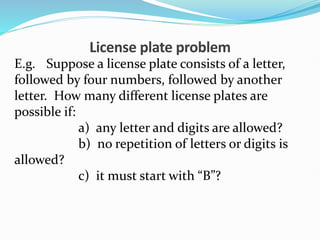
E.g. Suppose a license plate consists of a letter,
followed by four numbers, followed by another
letter. How many different license plates are
possible if:
a) any letter and digits are allowed?
b) no repetition of letters or digits is
allowed?
c) it must start with “B”?
License plate problem
How many different license plates are possible if:
a) any letter and digits are allowed?
26 x 10 x 10 x 10 x 10 x 26 = 6 760 000
(there are 6 tasks in these questions)
b) no repetition of letters or digits is
allowed?
26 x 10 x 9 x 8 x 7 x 25 = 3 276 000
c) it must start with “B”?
1 x 10 x 10 x 10 x 10 x 26 = 260 000
Solution
Exercise
What is the number of total outcomes if a 6-
sided die is rolled,
a. 2 times
b. 3 times
c. 4 times
d. 𝑘 times

Basic Counting Law Discrete Math Power Point Presentaton

  • 2.
    Section Summary  Whatis Probability?  Basic Counting Rule
  • 3.
    Experiment and ItsSample Space  An experiment (a real experiment or a thought experiment) is any process that generates well-defined outcomes  The set of all possible outcomes is called sample space usually denoted by 𝑆.  An experimental outcome is also called a sample point.  A subset of sample space is called an event  Examples:  Flip a coin  Weather in Naryn KG on February 14, 2035  Toss a die or a pair of dice  Choose a card from a standard deck of cards  Temperature in Gulakain Khorog at 5 pm today
  • 4.
    Example  Tossing adie.  The sample space is  S = {1, 2, 3, 4, 5, 6}.  Give an example of an event in this experiment.  E = {2, 4, 6} is an event, which can be described in words as ”the number is even”
  • 5.
    What is probability? Probability is a numerical measure of the likelihood that an event will occur.  Probability values are always assigned on a scale from 0 to 1.  A probability near zero indicates an event is quite unlikely to occur.  A probability near one indicates an event is almost certain to occur
  • 6.
    Example If I have3 red marbles and 5 blue marbles in a bag, what is the probability (or chance, or likelihood) that it is red if I pull out one marble without looking in the bag?
  • 7.
    Dice Problem P (red)= ------- Probability of the event of pulling out a red marble 3 8 Number of red marbles - or number of outcomes that result in the event Total number of marbles - or total number of possible outcomes This entire thought process is what we call in probability a ‘thought experiment’, or just an ‘experiment’
  • 8.
    Dice Problem Try: Forthe experiment of rolling a single six- sided die, find the probability of rolling: i) 5 ii) 7 iii) a positive integer
  • 9.
    Eg., If 47%of students in the UCA are female, and I randomly select a student from all the UCA students, what is the probability that the student is male?
  • 10.
    Try: A questionon a multiple-choice test has five possible answers, only one of which is correct. If you guess on the question, what is the probability of guessing an incorrect answer?
  • 11.
    Try: An experimentconsists of tossing a coin three times in a row. a) List all possible outcomes (sample space). b) What is the probability of getting one head? c) What is Probability of getting two heads? d) What is Probability of getting three heads?
  • 12.
    Try: An experimentconsists of tossing a coin three times in a row. a) List all possible outcomes. S={HHH, HHT, HTH, THH, HTT, THT, TTH, TTT} (8 possible outcomes)
  • 13.
    How many outcomesare there for the experiment of flipping a coin and throwing a regular die? H1 H2 H3 H4 H5 H6 T1 T2 T3 T4 T5 T6 So, 12 possible outcomes. There are ‘2 possible ways the first task can be completed’ (ie., either H or T) There are ‘6 possible ways the second task can be completed’ (ie., 1, 2, 3, 4, 5 or 6) How does the 12 relate to the 2 and 6? Basic Counting Law 2 x 6 =12
  • 14.
    Case 1 Try: Forlunch you have 5 choices of salad and 7 choices for an entree. How many different lunch possibilities are there? 5 x 7 = 35 We can extend the Basic Counting Law to more than two tasks. Case 2 Try: For lunch you have 5 choices of salad, 7 choices for an entree and 3 choices for dessert. How many different lunch possibilities are there now? 5 x 7 x 3 = 105 Basic Counting Law
  • 15.
    Case 3 Try: Adie is rolled four times in a row. How many outcomes are possible? 6 x 6 x 6 x 6 = 1296 (there are four tasks here) Basic Counting Law
  • 16.
    Example Suppose you own5 shirts and 3 pants. How many ways are there for you to get dressed in the morning?
  • 17.
    In general… Basic CountingLaw: If there are m possible ways a task can be performed and, after the first task is complete, there are n possible ways for a second task to be performed, then there are m • n possible ways for the two tasks to be performed in order. Basic Counting Law
  • 18.
    On using theBasic Counting Law
  • 19.
    Players’ shirts havetwo digit numbers. Ten possible digits: 0,1,2,3,4,5,6,7,8,9 You want to choose a two digit number for your shirt. How many possible two digit numbers can you choose from? 10 × 10 = 100 If you can not repeat the same digit, how many choices you have? 10 × 9 = 90 Player jersey Numbers
  • 20.
  • 21.
    Example How many differentlicense plates can be made if each plate contains a sequence of three uppercase English letters followed by three digits?
  • 22.
    Solution Example: How manydifferent license plates can be made if each plate contains a sequence of three uppercase English letters followed by three digits? Solution: By the product rule, there are 26 ∙ 26 ∙ 26 ∙ 10 ∙ 10 ∙ 10 = 17,576,000 different possible license plates.
  • 23.
    E.g. Suppose alicense plate consists of a letter, followed by four numbers, followed by another letter. How many different license plates are possible if: a) any letter and digits are allowed? b) no repetition of letters or digits is allowed? c) it must start with “B”? License plate problem
  • 24.
    How many differentlicense plates are possible if: a) any letter and digits are allowed? 26 x 10 x 10 x 10 x 10 x 26 = 6 760 000 (there are 6 tasks in these questions) b) no repetition of letters or digits is allowed? 26 x 10 x 9 x 8 x 7 x 25 = 3 276 000 c) it must start with “B”? 1 x 10 x 10 x 10 x 10 x 26 = 260 000 Solution
  • 25.
    Exercise What is thenumber of total outcomes if a 6- sided die is rolled, a. 2 times b. 3 times c. 4 times d. 𝑘 times