Planning your private cloud
Learning from the lessons of others
CloudStack Collaboration Conference Europe 2013

Tim Mackey – XenServer Community Evangelist
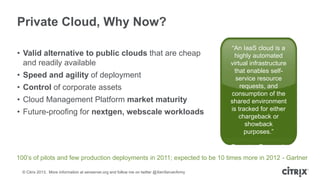
Private Cloud, Why Now?
• Valid alternative to public clouds that are cheap
and readily available
• Speed and agility of deployment

• Control of corporate assets
• Cloud Management Platform market maturity
• Future-proofing for nextgen, webscale workloads

“An IaaS cloud is a
highly automated
virtual infrastructure
that enables selfservice resource
requests, and
consumption of the
shared environment
is tracked for either
chargeback or
showback
purposes.”
Forrester Research

100’s of pilots and few production deployments in 2011; expected to be 10 times more in 2012 - Gartner
© Citrix 2013. More information at xenserver.org and follow me on twitter @XenServerArmy
Capital Leverage

Workforce Leverage

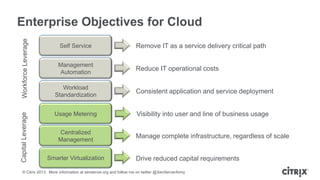
Enterprise Objectives for Cloud
Self Service

Remove IT as a service delivery critical path

Management
Automation

Reduce IT operational costs

Workload
Standardization

Consistent application and service deployment

Usage Metering

Visibility into user and line of business usage

Centralized
Management
Smarter Virtualization

Manage complete infrastructure, regardless of scale
Drive reduced capital requirements

© Citrix 2013. More information at xenserver.org and follow me on twitter @XenServerArmy
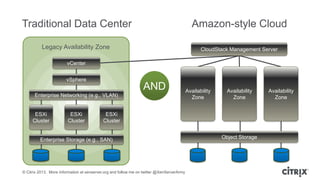
Traditional Data Center

Amazon-style Cloud

Legacy Availability Zone

CloudStack Management Server

vCenter

vSphere

AND
OR

Enterprise Networking (e.g., VLAN)

ESXi
Cluster

ESXi
Cluster

Availability
Zone

Availability
Zone

ESXi
Cluster

Enterprise Storage (e.g., SAN)

© Citrix 2013. More information at xenserver.org and follow me on twitter @XenServerArmy

Object Storage

Availability
Zone
Best practices aren’t always
Density in the cloud
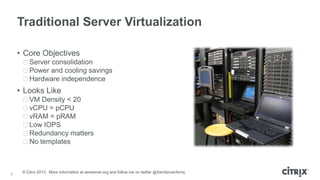
Traditional Server Virtualization
• Core Objectives
ᵒServer consolidation
ᵒPower and cooling savings
ᵒHardware independence

• Looks Like
ᵒVM Density < 20
ᵒvCPU = pCPU
ᵒvRAM = pRAM
ᵒLow IOPS
ᵒRedundancy matters
ᵒNo templates

7

© Citrix 2013. More information at xenserver.org and follow me on twitter @XenServerArmy
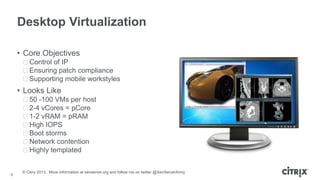
Desktop Virtualization
• Core Objectives
ᵒControl of IP
ᵒEnsuring patch compliance
ᵒSupporting mobile workstyles

• Looks Like
ᵒ50 -100 VMs per host
ᵒ2-4 vCores = pCore
ᵒ1-2 vRAM = pRAM
ᵒHigh IOPS
ᵒBoot storms
ᵒNetwork contention
ᵒHighly templated

8

© Citrix 2013. More information at xenserver.org and follow me on twitter @XenServerArmy
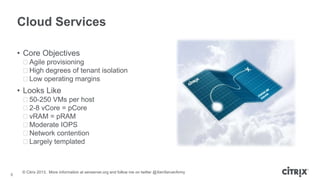
Cloud Services
• Core Objectives
ᵒAgile provisioning
ᵒHigh degrees of tenant isolation
ᵒLow operating margins

• Looks Like
ᵒ50-250 VMs per host
ᵒ2-8 vCore = pCore
ᵒvRAM = pRAM
ᵒModerate IOPS
ᵒNetwork contention
ᵒLargely templated

9

© Citrix 2013. More information at xenserver.org and follow me on twitter @XenServerArmy
Planning the network
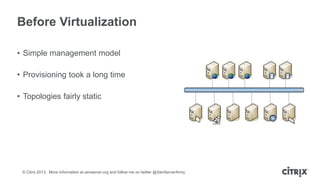
Before Virtualization
• Simple management model
• Provisioning took a long time

• Topologies fairly static

© Citrix 2013. More information at xenserver.org and follow me on twitter @XenServerArmy
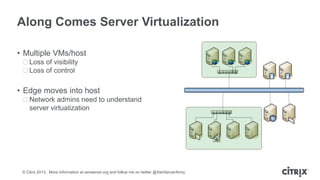
Along Comes Server Virtualization
• Multiple VMs/host
ᵒLoss of visibility
ᵒLoss of control

• Edge moves into host
ᵒNetwork admins need to understand
server virtualization

© Citrix 2013. More information at xenserver.org and follow me on twitter @XenServerArmy
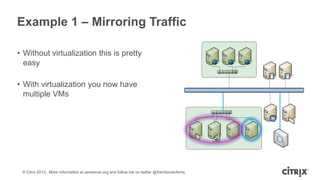
Example 1 – Mirroring Traffic
• Without virtualization this is pretty
easy
• With virtualization you now have
multiple VMs

© Citrix 2013. More information at xenserver.org and follow me on twitter @XenServerArmy
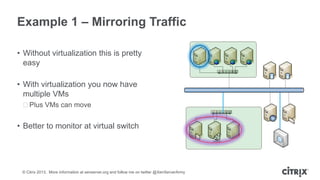
Example 1 – Mirroring Traffic
• Without virtualization this is pretty
easy
• With virtualization you now have
multiple VMs
ᵒPlus VMs can move

• Better to monitor at virtual switch

© Citrix 2013. More information at xenserver.org and follow me on twitter @XenServerArmy
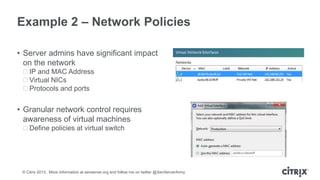
Example 2 – Network Policies
• Server admins have significant impact
on the network
ᵒIP and MAC Address
ᵒVirtual NICs
ᵒProtocols and ports

• Granular network control requires
awareness of virtual machines
ᵒDefine policies at virtual switch

© Citrix 2013. More information at xenserver.org and follow me on twitter @XenServerArmy
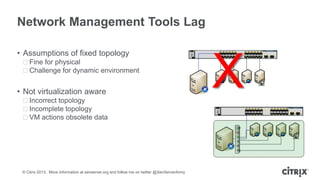
Network Management Tools Lag
• Assumptions of fixed topology
ᵒFine for physical
ᵒChallenge for dynamic environment

• Not virtualization aware
ᵒIncorrect topology
ᵒIncomplete topology
ᵒVM actions obsolete data

© Citrix 2013. More information at xenserver.org and follow me on twitter @XenServerArmy

X
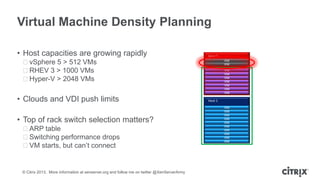
Virtual Machine Density Planning
• Host capacities are growing rapidly
ᵒvSphere 5 > 512 VMs
ᵒRHEV 3 > 1000 VMs
ᵒHyper-V > 2048 VMs

• Clouds and VDI push limits
• Top of rack switch selection matters?
ᵒARP table
ᵒSwitching performance drops
ᵒVM starts, but can’t connect

© Citrix 2013. More information at xenserver.org and follow me on twitter @XenServerArmy

Host 2
VM
VM
VM
VM
VM
VM
VM
VM
VM
Host 1
VM
VM
VM
VM
VM
VM
VM
VM
VM
VM
Storage choice is critical
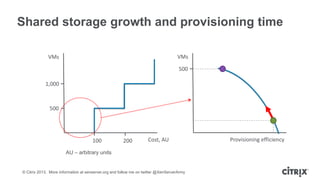
Shared storage growth and provisioning time
VMs

VMs

500
1,000

500

100

200

Cost, AU

AU – arbitrary units

© Citrix 2013. More information at xenserver.org and follow me on twitter @XenServerArmy

Provisioning efficiency
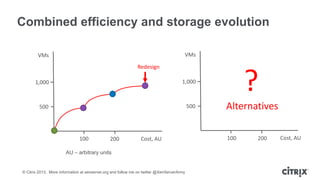
Combined efficiency and storage evolution
VMs

VMs
Redesign

1,000

500

500

?

1,000

100

200

Cost, AU

AU – arbitrary units

© Citrix 2013. More information at xenserver.org and follow me on twitter @XenServerArmy

Alternatives
100

200

Cost, AU
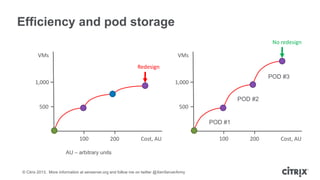
Efficiency and pod storage
No redesign
VMs

VMs
Redesign

1,000

POD #3

1,000
POD #2

500

500
POD #1

100

200

Cost, AU

AU – arbitrary units

© Citrix 2013. More information at xenserver.org and follow me on twitter @XenServerArmy

100

200

Cost, AU
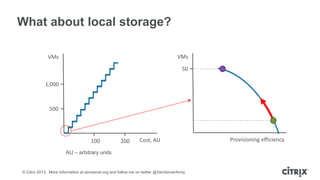
What about local storage?
VMs

VMs

50
1,000

500

100

200

Cost, AU

AU – arbitrary units

© Citrix 2013. More information at xenserver.org and follow me on twitter @XenServerArmy

Provisioning efficiency
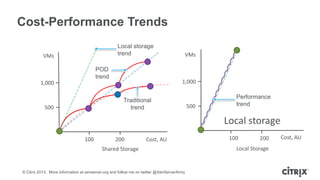
Cost-Performance Trends
Local storage
trend

VMs
POD
trend

VMs

1,000

1,000

Traditional
trend

500

500

Performance
trend

Local storage
100

200

Cost, AU

Shared Storage

© Citrix 2013. More information at xenserver.org and follow me on twitter @XenServerArmy

100

200

Local Storage

Cost, AU
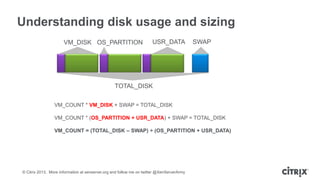
Understanding disk usage and sizing
VM_DISK OS_PARTITION

USR_DATA

SWAP

TOTAL_DISK
VM_COUNT * VM_DISK + SWAP = TOTAL_DISK
VM_COUNT * (OS_PARTITION + USR_DATA) + SWAP = TOTAL_DISK
VM_COUNT = (TOTAL_DISK – SWAP) ÷ (OS_PARTITION + USR_DATA)

© Citrix 2013. More information at xenserver.org and follow me on twitter @XenServerArmy
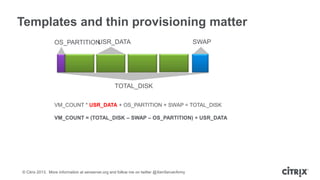
Templates and thin provisioning matter
USR_DATA
OS_PARTITION

SWAP

TOTAL_DISK
VM_COUNT * USR_DATA + OS_PARTITION + SWAP = TOTAL_DISK
VM_COUNT = (TOTAL_DISK – SWAP – OS_PARTITION) ÷ USR_DATA

© Citrix 2013. More information at xenserver.org and follow me on twitter @XenServerArmy
Storage performance
IO per Disk

Write Penalties
RAID

PENALTY

VM Utilization

RPM

IOPS

ITEM

~VALUE

SSD

5,000+

0

1

IOPS per VM

20

SAS 15,000

175

1

2

Size, KB

4-8

SAS 10,000

125

5

4

Writes, %

80

SAS 7,200

75

6

6

Reads, %

20

10

2

50

4

IOPS = [IOPS per DISK]*[Disk Count]*([% of Reads]+[% of Writes] ÷ [RAID Write Penalty])
VM_COUNT = IOPS ÷ [IOPS per VM]
© Citrix 2013. More information at xenserver.org and follow me on twitter @XenServerArmy
Blueprint for success ….
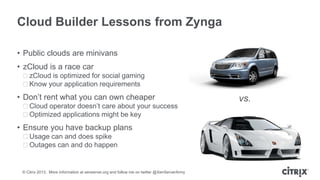
Cloud Builder Lessons from Zynga
• Public clouds are minivans
• zCloud is a race car
ᵒzCloud is optimized for social gaming
ᵒKnow your application requirements

• Don’t rent what you can own cheaper
ᵒCloud operator doesn’t care about your success
ᵒOptimized applications might be key

• Ensure you have backup plans
ᵒUsage can and does spike
ᵒOutages can and do happen

© Citrix 2013. More information at xenserver.org and follow me on twitter @XenServerArmy

vs.
Cloud Builder Lessons From Telcos
• Utility computing fits business model
ᵒTraditionally operate a low margin business model
ᵒUnderstand tiered service offerings
ᵒHave a history with instant provisioning

• Tiered service demands infrastructure flexibility
ᵒ“Cost per instance” is paramount
ᵒCharge extra for premium features
ᵒInstance doesn’t imply virtualization
ᵒBe prepared to change vendors if better model appears

• Provisioning agility expected
ᵒCustomers expect instant self service access and detailed billing

© Citrix 2013. More information at xenserver.org and follow me on twitter @XenServerArmy
Service Offerings
• Clearly define what you want to offer
ᵒWhat types of applications
ᵒWho has access, and who owns them
ᵒWhat type of access

• Define how templates need to be managed
ᵒOperating system support
ᵒPatching requirements

• Define expectations around compliance and availability
ᵒWho owns backup and monitoring

© Citrix 2013. More information at xenserver.org and follow me on twitter @XenServerArmy
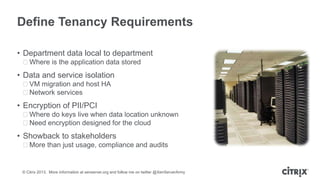
Define Tenancy Requirements
• Department data local to department
ᵒWhere is the application data stored

• Data and service isolation
ᵒVM migration and host HA
ᵒNetwork services

• Encryption of PII/PCI
ᵒWhere do keys live when data location unknown
ᵒNeed encryption designed for the cloud

• Showback to stakeholders
ᵒMore than just usage, compliance and audits

© Citrix 2013. More information at xenserver.org and follow me on twitter @XenServerArmy
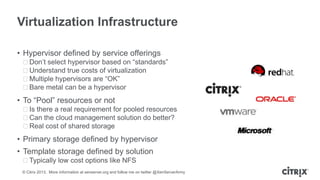
Virtualization Infrastructure
• Hypervisor defined by service offerings
ᵒDon’t select hypervisor based on “standards”
ᵒUnderstand true costs of virtualization
ᵒMultiple hypervisors are “OK”
ᵒBare metal can be a hypervisor

• To “Pool” resources or not
ᵒIs there a real requirement for pooled resources
ᵒCan the cloud management solution do better?
ᵒReal cost of shared storage

• Primary storage defined by hypervisor
• Template storage defined by solution
ᵒTypically low cost options like NFS
© Citrix 2013. More information at xenserver.org and follow me on twitter @XenServerArmy
Cloud Operations
• Design for maintainability
• Monitor critical components
ᵒManagement servers and system support VMs
ᵒHypervisor hosts, and critical infrastructure
ᵒEnd user deployment environments

If your cloud has maintenance windows, you’re doing it wrong.
- Allan Leinwand Former CTO Zynga

© Citrix 2013. More information at xenserver.org and follow me on twitter @XenServerArmy
Work better. Live better.

Planning a successful private cloud - CloudStack Collaboration Europe 2013

  • 1.
    Planning your privatecloud Learning from the lessons of others CloudStack Collaboration Conference Europe 2013 Tim Mackey – XenServer Community Evangelist
  • 2.
    Private Cloud, WhyNow? • Valid alternative to public clouds that are cheap and readily available • Speed and agility of deployment • Control of corporate assets • Cloud Management Platform market maturity • Future-proofing for nextgen, webscale workloads “An IaaS cloud is a highly automated virtual infrastructure that enables selfservice resource requests, and consumption of the shared environment is tracked for either chargeback or showback purposes.” Forrester Research 100’s of pilots and few production deployments in 2011; expected to be 10 times more in 2012 - Gartner © Citrix 2013. More information at xenserver.org and follow me on twitter @XenServerArmy
  • 3.
    Capital Leverage Workforce Leverage EnterpriseObjectives for Cloud Self Service Remove IT as a service delivery critical path Management Automation Reduce IT operational costs Workload Standardization Consistent application and service deployment Usage Metering Visibility into user and line of business usage Centralized Management Smarter Virtualization Manage complete infrastructure, regardless of scale Drive reduced capital requirements © Citrix 2013. More information at xenserver.org and follow me on twitter @XenServerArmy
  • 4.
    Traditional Data Center Amazon-styleCloud Legacy Availability Zone CloudStack Management Server vCenter vSphere AND OR Enterprise Networking (e.g., VLAN) ESXi Cluster ESXi Cluster Availability Zone Availability Zone ESXi Cluster Enterprise Storage (e.g., SAN) © Citrix 2013. More information at xenserver.org and follow me on twitter @XenServerArmy Object Storage Availability Zone
  • 5.
  • 6.
  • 7.
    Traditional Server Virtualization •Core Objectives ᵒServer consolidation ᵒPower and cooling savings ᵒHardware independence • Looks Like ᵒVM Density < 20 ᵒvCPU = pCPU ᵒvRAM = pRAM ᵒLow IOPS ᵒRedundancy matters ᵒNo templates 7 © Citrix 2013. More information at xenserver.org and follow me on twitter @XenServerArmy
  • 8.
    Desktop Virtualization • CoreObjectives ᵒControl of IP ᵒEnsuring patch compliance ᵒSupporting mobile workstyles • Looks Like ᵒ50 -100 VMs per host ᵒ2-4 vCores = pCore ᵒ1-2 vRAM = pRAM ᵒHigh IOPS ᵒBoot storms ᵒNetwork contention ᵒHighly templated 8 © Citrix 2013. More information at xenserver.org and follow me on twitter @XenServerArmy
  • 9.
    Cloud Services • CoreObjectives ᵒAgile provisioning ᵒHigh degrees of tenant isolation ᵒLow operating margins • Looks Like ᵒ50-250 VMs per host ᵒ2-8 vCore = pCore ᵒvRAM = pRAM ᵒModerate IOPS ᵒNetwork contention ᵒLargely templated 9 © Citrix 2013. More information at xenserver.org and follow me on twitter @XenServerArmy
  • 10.
  • 11.
    Before Virtualization • Simplemanagement model • Provisioning took a long time • Topologies fairly static © Citrix 2013. More information at xenserver.org and follow me on twitter @XenServerArmy
  • 12.
    Along Comes ServerVirtualization • Multiple VMs/host ᵒLoss of visibility ᵒLoss of control • Edge moves into host ᵒNetwork admins need to understand server virtualization © Citrix 2013. More information at xenserver.org and follow me on twitter @XenServerArmy
  • 13.
    Example 1 –Mirroring Traffic • Without virtualization this is pretty easy • With virtualization you now have multiple VMs © Citrix 2013. More information at xenserver.org and follow me on twitter @XenServerArmy
  • 14.
    Example 1 –Mirroring Traffic • Without virtualization this is pretty easy • With virtualization you now have multiple VMs ᵒPlus VMs can move • Better to monitor at virtual switch © Citrix 2013. More information at xenserver.org and follow me on twitter @XenServerArmy
  • 15.
    Example 2 –Network Policies • Server admins have significant impact on the network ᵒIP and MAC Address ᵒVirtual NICs ᵒProtocols and ports • Granular network control requires awareness of virtual machines ᵒDefine policies at virtual switch © Citrix 2013. More information at xenserver.org and follow me on twitter @XenServerArmy
  • 16.
    Network Management ToolsLag • Assumptions of fixed topology ᵒFine for physical ᵒChallenge for dynamic environment • Not virtualization aware ᵒIncorrect topology ᵒIncomplete topology ᵒVM actions obsolete data © Citrix 2013. More information at xenserver.org and follow me on twitter @XenServerArmy X
  • 17.
    Virtual Machine DensityPlanning • Host capacities are growing rapidly ᵒvSphere 5 > 512 VMs ᵒRHEV 3 > 1000 VMs ᵒHyper-V > 2048 VMs • Clouds and VDI push limits • Top of rack switch selection matters? ᵒARP table ᵒSwitching performance drops ᵒVM starts, but can’t connect © Citrix 2013. More information at xenserver.org and follow me on twitter @XenServerArmy Host 2 VM VM VM VM VM VM VM VM VM Host 1 VM VM VM VM VM VM VM VM VM VM
  • 18.
  • 19.
    Shared storage growthand provisioning time VMs VMs 500 1,000 500 100 200 Cost, AU AU – arbitrary units © Citrix 2013. More information at xenserver.org and follow me on twitter @XenServerArmy Provisioning efficiency
  • 20.
    Combined efficiency andstorage evolution VMs VMs Redesign 1,000 500 500 ? 1,000 100 200 Cost, AU AU – arbitrary units © Citrix 2013. More information at xenserver.org and follow me on twitter @XenServerArmy Alternatives 100 200 Cost, AU
  • 21.
    Efficiency and podstorage No redesign VMs VMs Redesign 1,000 POD #3 1,000 POD #2 500 500 POD #1 100 200 Cost, AU AU – arbitrary units © Citrix 2013. More information at xenserver.org and follow me on twitter @XenServerArmy 100 200 Cost, AU
  • 22.
    What about localstorage? VMs VMs 50 1,000 500 100 200 Cost, AU AU – arbitrary units © Citrix 2013. More information at xenserver.org and follow me on twitter @XenServerArmy Provisioning efficiency
  • 23.
    Cost-Performance Trends Local storage trend VMs POD trend VMs 1,000 1,000 Traditional trend 500 500 Performance trend Localstorage 100 200 Cost, AU Shared Storage © Citrix 2013. More information at xenserver.org and follow me on twitter @XenServerArmy 100 200 Local Storage Cost, AU
  • 24.
    Understanding disk usageand sizing VM_DISK OS_PARTITION USR_DATA SWAP TOTAL_DISK VM_COUNT * VM_DISK + SWAP = TOTAL_DISK VM_COUNT * (OS_PARTITION + USR_DATA) + SWAP = TOTAL_DISK VM_COUNT = (TOTAL_DISK – SWAP) ÷ (OS_PARTITION + USR_DATA) © Citrix 2013. More information at xenserver.org and follow me on twitter @XenServerArmy
  • 25.
    Templates and thinprovisioning matter USR_DATA OS_PARTITION SWAP TOTAL_DISK VM_COUNT * USR_DATA + OS_PARTITION + SWAP = TOTAL_DISK VM_COUNT = (TOTAL_DISK – SWAP – OS_PARTITION) ÷ USR_DATA © Citrix 2013. More information at xenserver.org and follow me on twitter @XenServerArmy
  • 26.
    Storage performance IO perDisk Write Penalties RAID PENALTY VM Utilization RPM IOPS ITEM ~VALUE SSD 5,000+ 0 1 IOPS per VM 20 SAS 15,000 175 1 2 Size, KB 4-8 SAS 10,000 125 5 4 Writes, % 80 SAS 7,200 75 6 6 Reads, % 20 10 2 50 4 IOPS = [IOPS per DISK]*[Disk Count]*([% of Reads]+[% of Writes] ÷ [RAID Write Penalty]) VM_COUNT = IOPS ÷ [IOPS per VM] © Citrix 2013. More information at xenserver.org and follow me on twitter @XenServerArmy
  • 27.
  • 28.
    Cloud Builder Lessonsfrom Zynga • Public clouds are minivans • zCloud is a race car ᵒzCloud is optimized for social gaming ᵒKnow your application requirements • Don’t rent what you can own cheaper ᵒCloud operator doesn’t care about your success ᵒOptimized applications might be key • Ensure you have backup plans ᵒUsage can and does spike ᵒOutages can and do happen © Citrix 2013. More information at xenserver.org and follow me on twitter @XenServerArmy vs.
  • 29.
    Cloud Builder LessonsFrom Telcos • Utility computing fits business model ᵒTraditionally operate a low margin business model ᵒUnderstand tiered service offerings ᵒHave a history with instant provisioning • Tiered service demands infrastructure flexibility ᵒ“Cost per instance” is paramount ᵒCharge extra for premium features ᵒInstance doesn’t imply virtualization ᵒBe prepared to change vendors if better model appears • Provisioning agility expected ᵒCustomers expect instant self service access and detailed billing © Citrix 2013. More information at xenserver.org and follow me on twitter @XenServerArmy
  • 30.
    Service Offerings • Clearlydefine what you want to offer ᵒWhat types of applications ᵒWho has access, and who owns them ᵒWhat type of access • Define how templates need to be managed ᵒOperating system support ᵒPatching requirements • Define expectations around compliance and availability ᵒWho owns backup and monitoring © Citrix 2013. More information at xenserver.org and follow me on twitter @XenServerArmy
  • 31.
    Define Tenancy Requirements •Department data local to department ᵒWhere is the application data stored • Data and service isolation ᵒVM migration and host HA ᵒNetwork services • Encryption of PII/PCI ᵒWhere do keys live when data location unknown ᵒNeed encryption designed for the cloud • Showback to stakeholders ᵒMore than just usage, compliance and audits © Citrix 2013. More information at xenserver.org and follow me on twitter @XenServerArmy
  • 32.
    Virtualization Infrastructure • Hypervisordefined by service offerings ᵒDon’t select hypervisor based on “standards” ᵒUnderstand true costs of virtualization ᵒMultiple hypervisors are “OK” ᵒBare metal can be a hypervisor • To “Pool” resources or not ᵒIs there a real requirement for pooled resources ᵒCan the cloud management solution do better? ᵒReal cost of shared storage • Primary storage defined by hypervisor • Template storage defined by solution ᵒTypically low cost options like NFS © Citrix 2013. More information at xenserver.org and follow me on twitter @XenServerArmy
  • 33.
    Cloud Operations • Designfor maintainability • Monitor critical components ᵒManagement servers and system support VMs ᵒHypervisor hosts, and critical infrastructure ᵒEnd user deployment environments If your cloud has maintenance windows, you’re doing it wrong. - Allan Leinwand Former CTO Zynga © Citrix 2013. More information at xenserver.org and follow me on twitter @XenServerArmy
  • 34.