"We used to leak kilobytes,
then megs, then even gigs.
                        Cloud Computing
Now, we leak EC2 instances.
Someday, we'll leak
entire datacenters."
                - @Dymaxion
        
            This term means absolutely nothing.
        
            $variable + vague generic term
OpenStack
                   Security Brief


ShmooCon 2013
http://www.secstack.org/shmoocon2013.ppt
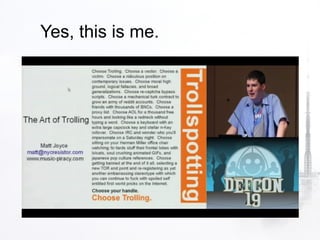
Yes, this is me.
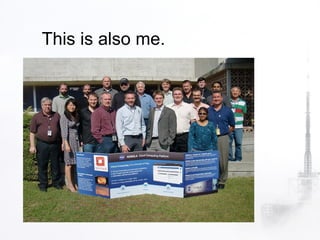
This is also me.
Part I – OpenStack Structure
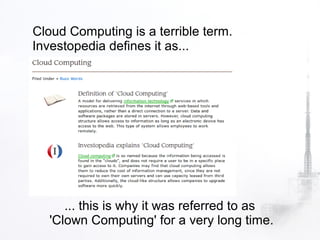
Cloud Computing is a terrible term.
Investopedia defines it as...


     ... this is why it was referred to as
  'Clown Computing' for a very long time.
A Better Term :
              Elastic Design

Scale horizontally rather than vertically


    Distributed services

    Standard Orchestration APIs

    All States are Ephemeral
So.. it's an Open Stack?


    Elastic Cloud

    Open Source ( Apache License )

    Open Standards ( Foundation )

    Written in Python

    REST APIs

    Shared Nothing, Message Oriented
Gaming the Foundation
   A fun tangent


https://www.music-piracy.com/?p=750
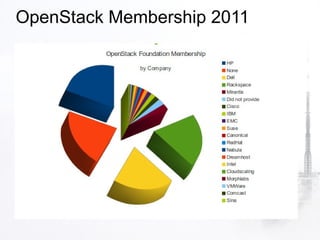
OpenStack Membership 2011
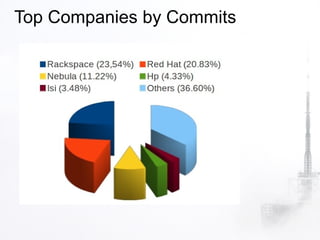
Top Companies by Commits
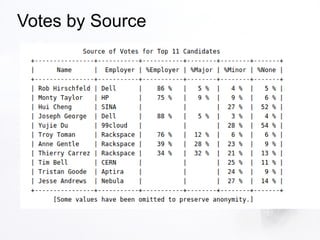
Votes by Source
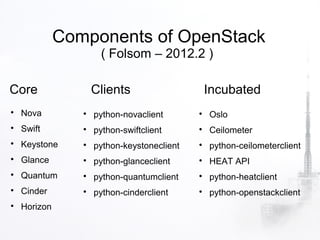
Components of OpenStack
                      ( Folsom – 2012.2 )

Core                 Clients                     Incubated

    Nova         
                     python-novaclient       
                                                 Oslo

    Swift        
                     python-swiftclient      
                                                 Ceilometer

    Keystone     
                     python-keystoneclient   
                                                 python-ceilometerclient

    Glance       
                     python-glanceclient     
                                                 HEAT API

    Quantum      
                     python-quantumclient    
                                                 python-heatclient

    Cinder       
                     python-cinderclient     
                                                 python-openstackclient

    Horizon
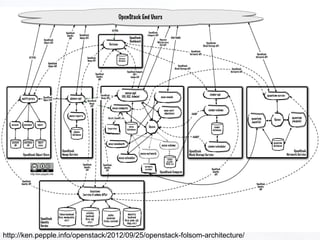
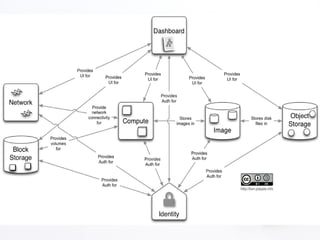
Good Reading


Ken Pepple's Folsom Architecture Post
http://ken.pepple.info/openstack/2012/09/25/openstack-folsom-architecture/
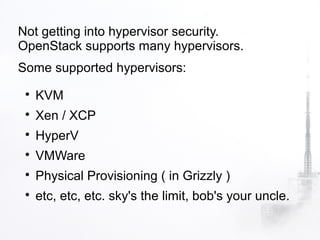
Not getting into hypervisor security.
OpenStack supports many hypervisors.
Some supported hypervisors:
 
     KVM
 
     Xen / XCP
 
     HyperV
 
     VMWare
 
     Physical Provisioning ( in Grizzly )
 
     etc, etc, etc. sky's the limit, bob's your uncle.
Keystone – Identity Manager

    REST API, Admin API

    Service Catalog

    Backend to sqlite by default

    Supports MySQL, LDAP, Active Directory
    ( with patches ).

    Token generation and shared
    authentication endpoint in OpenStack
    software.
Nova – Elastic Compute ( EC2 )

    REST API, Metadata API, EC2 API

    Integrates with many hypervisors

    Defaults to libvirt

    Integrated volume and network
    orchestration in Folsom ( deprecated )

    Security Groups, Quotas, Zones, Flavors..

    Config Drive

    Ugliest, oldest, most complex code in
    project.
Glance – Image Store


    REST API

    Backed my MySQL

    Stores to local volumes

    Optionally stores to object storage
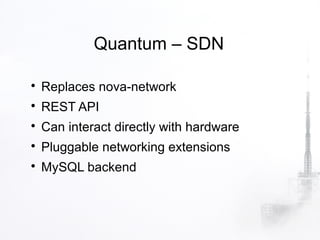
Quantum – SDN


    Replaces nova-network

    REST API

    Can interact directly with hardware

    Pluggable networking extensions

    MySQL backend
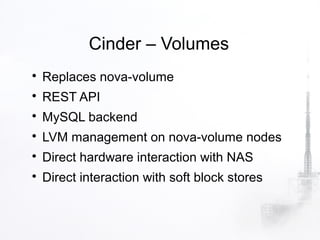
Cinder – Volumes

    Replaces nova-volume

    REST API

    MySQL backend

    LVM management on nova-volume nodes

    Direct hardware interaction with NAS

    Direct interaction with soft block stores
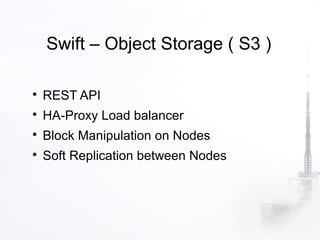
Swift – Object Storage ( S3 )


    REST API

    HA-Proxy Load balancer

    Block Manipulation on Nodes

    Soft Replication between Nodes
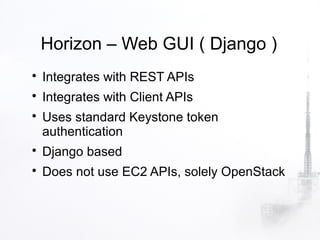
Horizon – Web GUI ( Django )

    Integrates with REST APIs

    Integrates with Client APIs

    Uses standard Keystone token
    authentication

    Django based

    Does not use EC2 APIs, solely OpenStack
Message Buses



    RabbitMQ

    ZeroMQ
Development Workflows

    Continuous Integration

    Gerrit

    Jenkins

    Launchpad

    GitHub

    Packaging
Packaging

    Core packages are built from release
    tarballs

    Client packages are built from pypi tarballs

    Git releases are PGP signed

    Efforts are being made to ensure all
    dependencies are PGP signed properly

    Ubuntu / RedHat / SuSE among many
    vendors with signed releases
Good Reading


China GitHub and Man in the Middle
https://en.greatfire.org/blog/2013/jan/china-github-and-man-middle
Part II – Targetting OpenStack
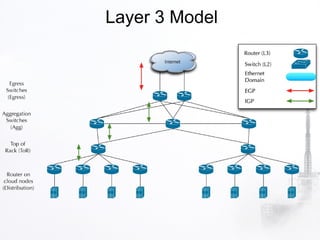
Layer 3 Model
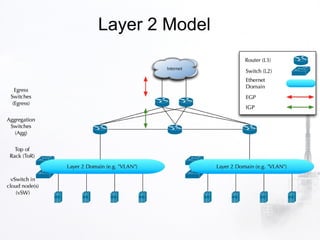
Layer 2 Model
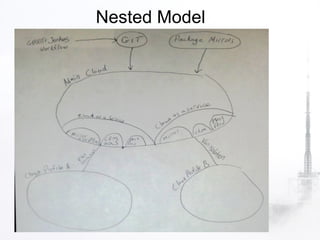
Nested Model
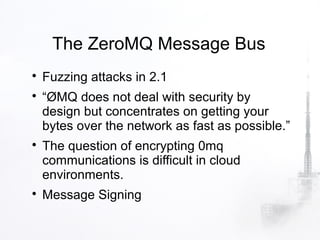
The ZeroMQ Message Bus

    Fuzzing attacks in 2.1

    “ØMQ does not deal with security by
    design but concentrates on getting your
    bytes over the network as fast as possible.”

    The question of encrypting 0mq
    communications is difficult in cloud
    environments.

    Message Signing
Good Reading


Status of Secure Messaging
http://lists.openstack.org/pipermail/openstack-dev/2013-
   February/005614.html
The RabbitMQ Message Bus

    Supports SSL

    Supports Authentication ( SASL )

    Public / Private Queues

    No encryption at rest ( who cares? )


    Not as horizontally scalable
The REST APIs and other HTTP Targets


    Backend ( wsgi )

    Admin ( wsgi )

    Client ( requests )

    SDKs ( there are many )

    Horizon ( django )
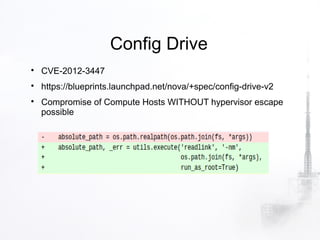
Config Drive

    CVE-2012-3447

    https://blueprints.launchpad.net/nova/+spec/config-drive-v2

    Compromise of Compute Hosts WITHOUT hypervisor escape
    possible
Volumes, Block Storage, and Memory


    Volume zeroing is a recurring vulnerability

    Volume encryption coming

    Shared Memory space presents the
    possibility for attackers to sniff memory
    allocated to other virtual hosts

    DMA access is a continual source of
    hypervisor escape attacks
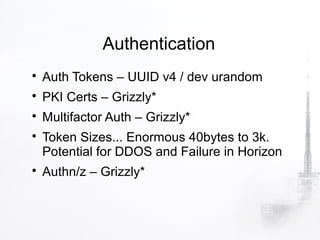
Authentication

    Auth Tokens – UUID v4 / dev urandom

    PKI Certs – Grizzly*

    Multifactor Auth – Grizzly*

    Token Sizes... Enormous 40bytes to 3k.
    Potential for DDOS and Failure in Horizon

    Authn/z – Grizzly*
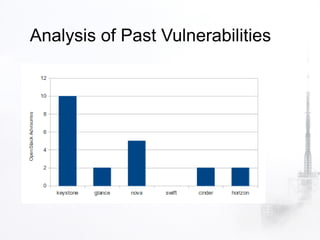
Analysis of Past Vulnerabilities
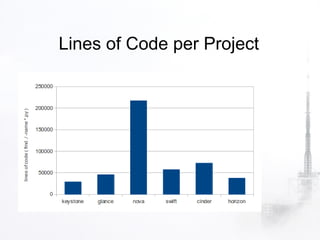
Lines of Code per Project
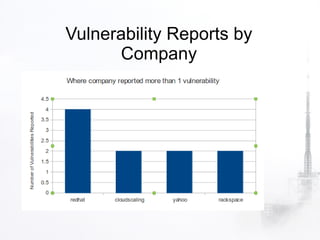
Vulnerability Reports by
      Company
Part III – Defense against the
            Dark Arts
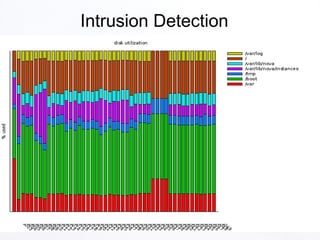
Intrusion Detection
Intrusion Detection

    Security APIs ( ceilometer, marconi? ) -
    event logging

    Precursor Indicators – Homogeneity makes
    anomalies easy to spot. Standard methods
    as well.

    External Reporting

    Security Services ( SaaS )

    Infrastructure Knowledge ( This Preso )
Intrusion Response
You guys know this better than I

    Have a plan.

    Consumers must have a workflow that is
    known and supported for response.

    Disclosure of breach and other issues
    should be planned for ahead of time.

    Don't Panic.
Forensics ( Chain of Custody )
 
     Ephemeral Design means interruption is
     usually expected as part of SLA
 
     OpenStack has no mechanism for
     migrating instances between tenants.
 
     You may want to provide SOC teams
     tenant access to monitor compromised
     instances.
 
     Instances can be snapshotted and
     exported for controlled testing in sandbox.
 
     Logs should be isolated in one way DMZ
Reporting to OpenStack
    
        Open a bug in Launchpad and mark it as a
        'security bug'. This will make the bug
        Private and only accessible to the
        Vulnerability Management Team.
    
        If the issue is extremely sensitive, please
        send an encrypted email to one of the
        Team’s members. Their GPG keys can be
        found below, and are also available from
        popular public GPG key servers.

http://www.openstack.org/projects/openstack-security/
Good Reads on Inc Response


Handling Compromised Components in an IaaS Cloud Installation
Aryan TaheriMonfared (aryan@uninett.no)
Martin G Jaatun (Martin.G.Jaatun@sintef.no)


http://www.journalofcloudcomputing.com/content/1/1/16/abstract
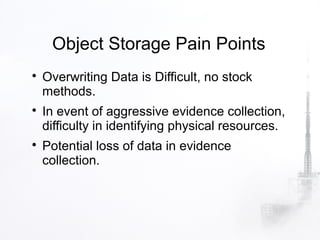
Object Storage Pain Points

    Overwriting Data is Difficult, no stock
    methods.

    In event of aggressive evidence collection,
    difficulty in identifying physical resources.

    Potential loss of data in evidence
    collection.
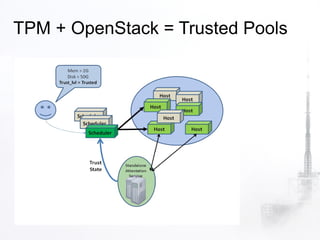
TPM + OpenStack = Trusted Pools
Zoned by Exposed Surface Area



    SaaS is most secure

    PaaS less so

    IaaS least secure


Duh
Good Reading

Trusted Computing Pools
http://wiki.openstack.org/TrustedComputingPools


Putting Trust in OpenStack
http://www.openstack.org/summit/san-diego-2012/openstack-summit-
   sessions/presentation/putting-trust-in-openstack
Parting thought
Consider public cloud vendors as you would
 a Chinese fabrication supply chain.


    They are cheap.

    They are untrusted.

    They are probably going to be around for
    the foreseeable future.
Good Reading


A multi-level security model for partitioning
  workflows over federated clouds
http://www.journalofcloudcomputing.com/content/1/1/15

Shmoocon 2013 - OpenStack Security Brief

  • 1.
    "We used toleak kilobytes, then megs, then even gigs. Cloud Computing Now, we leak EC2 instances. Someday, we'll leak entire datacenters." - @Dymaxion  This term means absolutely nothing.  $variable + vague generic term
  • 2.
    OpenStack Security Brief ShmooCon 2013 http://www.secstack.org/shmoocon2013.ppt
  • 3.
  • 4.
  • 5.
    Part I –OpenStack Structure
  • 6.
    Cloud Computing isa terrible term. Investopedia defines it as... ... this is why it was referred to as 'Clown Computing' for a very long time.
  • 7.
    A Better Term: Elastic Design Scale horizontally rather than vertically  Distributed services  Standard Orchestration APIs  All States are Ephemeral
  • 8.
    So.. it's anOpen Stack?  Elastic Cloud  Open Source ( Apache License )  Open Standards ( Foundation )  Written in Python  REST APIs  Shared Nothing, Message Oriented
  • 9.
    Gaming the Foundation A fun tangent https://www.music-piracy.com/?p=750
  • 10.
  • 11.
  • 12.
  • 13.
    Components of OpenStack ( Folsom – 2012.2 ) Core Clients Incubated  Nova  python-novaclient  Oslo  Swift  python-swiftclient  Ceilometer  Keystone  python-keystoneclient  python-ceilometerclient  Glance  python-glanceclient  HEAT API  Quantum  python-quantumclient  python-heatclient  Cinder  python-cinderclient  python-openstackclient  Horizon
  • 14.
    Good Reading Ken Pepple'sFolsom Architecture Post http://ken.pepple.info/openstack/2012/09/25/openstack-folsom-architecture/
  • 15.
  • 16.
    Not getting intohypervisor security. OpenStack supports many hypervisors. Some supported hypervisors:  KVM  Xen / XCP  HyperV  VMWare  Physical Provisioning ( in Grizzly )  etc, etc, etc. sky's the limit, bob's your uncle.
  • 18.
    Keystone – IdentityManager  REST API, Admin API  Service Catalog  Backend to sqlite by default  Supports MySQL, LDAP, Active Directory ( with patches ).  Token generation and shared authentication endpoint in OpenStack software.
  • 19.
    Nova – ElasticCompute ( EC2 )  REST API, Metadata API, EC2 API  Integrates with many hypervisors  Defaults to libvirt  Integrated volume and network orchestration in Folsom ( deprecated )  Security Groups, Quotas, Zones, Flavors..  Config Drive  Ugliest, oldest, most complex code in project.
  • 20.
    Glance – ImageStore  REST API  Backed my MySQL  Stores to local volumes  Optionally stores to object storage
  • 21.
    Quantum – SDN  Replaces nova-network  REST API  Can interact directly with hardware  Pluggable networking extensions  MySQL backend
  • 22.
    Cinder – Volumes  Replaces nova-volume  REST API  MySQL backend  LVM management on nova-volume nodes  Direct hardware interaction with NAS  Direct interaction with soft block stores
  • 23.
    Swift – ObjectStorage ( S3 )  REST API  HA-Proxy Load balancer  Block Manipulation on Nodes  Soft Replication between Nodes
  • 24.
    Horizon – WebGUI ( Django )  Integrates with REST APIs  Integrates with Client APIs  Uses standard Keystone token authentication  Django based  Does not use EC2 APIs, solely OpenStack
  • 25.
    Message Buses  RabbitMQ  ZeroMQ
  • 26.
    Development Workflows  Continuous Integration  Gerrit  Jenkins  Launchpad  GitHub  Packaging
  • 27.
    Packaging  Core packages are built from release tarballs  Client packages are built from pypi tarballs  Git releases are PGP signed  Efforts are being made to ensure all dependencies are PGP signed properly  Ubuntu / RedHat / SuSE among many vendors with signed releases
  • 28.
    Good Reading China GitHuband Man in the Middle https://en.greatfire.org/blog/2013/jan/china-github-and-man-middle
  • 29.
    Part II –Targetting OpenStack
  • 30.
  • 31.
  • 32.
  • 33.
    The ZeroMQ MessageBus  Fuzzing attacks in 2.1  “ØMQ does not deal with security by design but concentrates on getting your bytes over the network as fast as possible.”  The question of encrypting 0mq communications is difficult in cloud environments.  Message Signing
  • 34.
    Good Reading Status ofSecure Messaging http://lists.openstack.org/pipermail/openstack-dev/2013- February/005614.html
  • 35.
    The RabbitMQ MessageBus  Supports SSL  Supports Authentication ( SASL )  Public / Private Queues  No encryption at rest ( who cares? )  Not as horizontally scalable
  • 36.
    The REST APIsand other HTTP Targets  Backend ( wsgi )  Admin ( wsgi )  Client ( requests )  SDKs ( there are many )  Horizon ( django )
  • 37.
    Config Drive  CVE-2012-3447  https://blueprints.launchpad.net/nova/+spec/config-drive-v2  Compromise of Compute Hosts WITHOUT hypervisor escape possible
  • 38.
    Volumes, Block Storage,and Memory  Volume zeroing is a recurring vulnerability  Volume encryption coming  Shared Memory space presents the possibility for attackers to sniff memory allocated to other virtual hosts  DMA access is a continual source of hypervisor escape attacks
  • 39.
    Authentication  Auth Tokens – UUID v4 / dev urandom  PKI Certs – Grizzly*  Multifactor Auth – Grizzly*  Token Sizes... Enormous 40bytes to 3k. Potential for DDOS and Failure in Horizon  Authn/z – Grizzly*
  • 40.
    Analysis of PastVulnerabilities
  • 41.
    Lines of Codeper Project
  • 42.
  • 43.
    Part III –Defense against the Dark Arts
  • 44.
  • 45.
    Intrusion Detection  Security APIs ( ceilometer, marconi? ) - event logging  Precursor Indicators – Homogeneity makes anomalies easy to spot. Standard methods as well.  External Reporting  Security Services ( SaaS )  Infrastructure Knowledge ( This Preso )
  • 46.
    Intrusion Response You guysknow this better than I  Have a plan.  Consumers must have a workflow that is known and supported for response.  Disclosure of breach and other issues should be planned for ahead of time.  Don't Panic.
  • 47.
    Forensics ( Chainof Custody )  Ephemeral Design means interruption is usually expected as part of SLA  OpenStack has no mechanism for migrating instances between tenants.  You may want to provide SOC teams tenant access to monitor compromised instances.  Instances can be snapshotted and exported for controlled testing in sandbox.  Logs should be isolated in one way DMZ
  • 48.
    Reporting to OpenStack  Open a bug in Launchpad and mark it as a 'security bug'. This will make the bug Private and only accessible to the Vulnerability Management Team.  If the issue is extremely sensitive, please send an encrypted email to one of the Team’s members. Their GPG keys can be found below, and are also available from popular public GPG key servers. http://www.openstack.org/projects/openstack-security/
  • 49.
    Good Reads onInc Response Handling Compromised Components in an IaaS Cloud Installation Aryan TaheriMonfared (aryan@uninett.no) Martin G Jaatun (Martin.G.Jaatun@sintef.no) http://www.journalofcloudcomputing.com/content/1/1/16/abstract
  • 50.
    Object Storage PainPoints  Overwriting Data is Difficult, no stock methods.  In event of aggressive evidence collection, difficulty in identifying physical resources.  Potential loss of data in evidence collection.
  • 51.
    TPM + OpenStack= Trusted Pools
  • 52.
    Zoned by ExposedSurface Area  SaaS is most secure  PaaS less so  IaaS least secure Duh
  • 53.
    Good Reading Trusted ComputingPools http://wiki.openstack.org/TrustedComputingPools Putting Trust in OpenStack http://www.openstack.org/summit/san-diego-2012/openstack-summit- sessions/presentation/putting-trust-in-openstack
  • 54.
    Parting thought Consider publiccloud vendors as you would a Chinese fabrication supply chain.  They are cheap.  They are untrusted.  They are probably going to be around for the foreseeable future.
  • 55.
    Good Reading A multi-levelsecurity model for partitioning workflows over federated clouds http://www.journalofcloudcomputing.com/content/1/1/15