1
Communication Technology
Learn the different Printing Processes
2
Intaglio
– Gravure
Relief Printing
– Letterpress
– Flexography
Offset Lithography
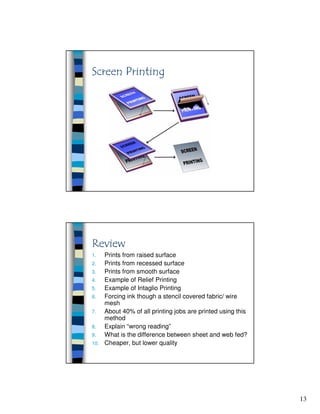
Screen Printing
Method of printing from a sunken
surface
Image carrier is usually handcrafted,
using an engraving or etching technique
Lines are used instead of ink cells
3
Paper Money
Postage stamps
Stock certificates
Fancy stationery
Example of intaglio printing
Depressed or sunken surface
Image carrier is a cylinder
20% of all printing sales
4
Cylinder has tiny cells that hold ink for printing
Prints from
recessed area
Long runs
High quality printing
Very expensive
Millions of copies
5
Packaging
Publications
– Magazines
• National Geographic
Speciality
– Money, Stamps, Wall paper
Smooth surface
Thin metal plate
Lithograph presses = thousands copies
per hour
Based on principle that water and oil
don’t mix
6
Offset lithography is the most widely
used print process.
About 40% of all print jobs are produced
with offset printing.
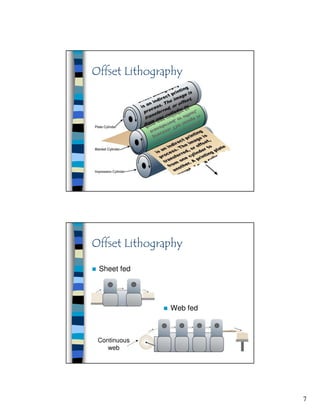
It is an indirect printing process which
means that an image is transferred, or
offset, from one surface to another
Right read, wrong read, right read
7
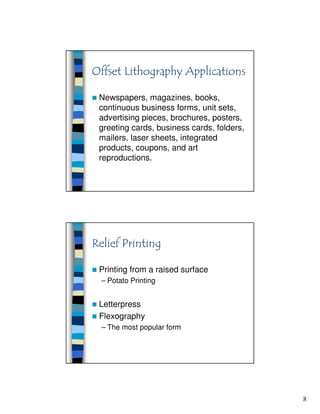
Sheet fed
Web fed
Continuous
web
8
Newspapers, magazines, books,
continuous business forms, unit sets,
advertising pieces, brochures, posters,
greeting cards, business cards, folders,
mailers, laser sheets, integrated
products, coupons, and art
reproductions.
Printing from a raised surface
– Potato Printing
Letterpress
Flexography
– The most popular form
9
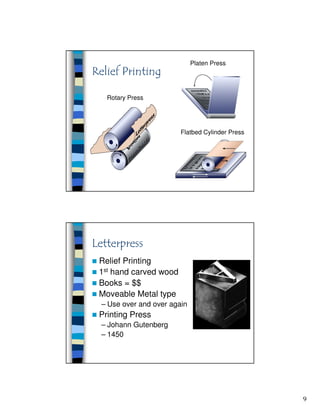
Platen Press
Rotary Press
Flatbed Cylinder Press
Relief Printing
1st hand carved wood
Books = $$
Moveable Metal type
– Use over and over again
Printing Press
– Johann Gutenberg
– 1450
10
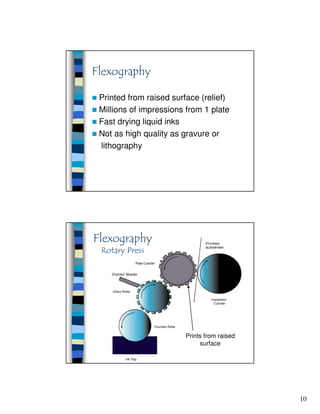
Printed from raised surface (relief)
Millions of impressions from 1 plate
Fast drying liquid inks
Not as high quality as gravure or
lithography
Prints from raised
surface
11
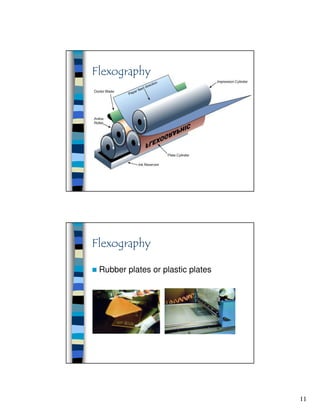
Rubber plates or plastic plates
12
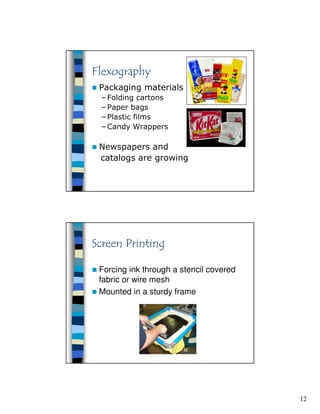
Forcing ink through a stencil covered
fabric or wire mesh
Mounted in a sturdy frame
13
1. Prints from raised surface
2. Prints from recessed surface
3. Prints from smooth surface
4. Example of Relief Printing
5. Example of Intaglio Printing
6. Forcing ink though a stencil covered fabric/ wire
mesh
7. About 40% of all printing jobs are printed using this
method
8. Explain “wrong reading”
9. What is the difference between sheet and web fed?
10. Cheaper, but lower quality
14
1. Prints from raised surface: Relief Printing
2. Prints from recessed surface: Intaglio
3. Prints from smooth surface: Lithography
4. Example of Relief Printing: Letterpress or
Flexography
5. Example of Intaglio Printing: Gravure
6. Forcing ink though a stencil covered fabric/
wire mesh: Screen Printing
7. About 40% of all printing jobs are printed
using this method: Lithography
8. Explain “wrong reading”
9. What is the difference between sheet and
web fed?
7. Cheaper, but lower quality: Flexography
15
http://glossary.ippaper.com/default.asp?req=knowledge/category/24&catitemid=24

Printing processes of d&g

  • 1.
    1 Communication Technology Learn thedifferent Printing Processes
  • 2.
    2 Intaglio – Gravure Relief Printing –Letterpress – Flexography Offset Lithography Screen Printing Method of printing from a sunken surface Image carrier is usually handcrafted, using an engraving or etching technique Lines are used instead of ink cells
  • 3.
    3 Paper Money Postage stamps Stockcertificates Fancy stationery Example of intaglio printing Depressed or sunken surface Image carrier is a cylinder 20% of all printing sales
  • 4.
    4 Cylinder has tinycells that hold ink for printing Prints from recessed area Long runs High quality printing Very expensive Millions of copies
  • 5.
    5 Packaging Publications – Magazines • NationalGeographic Speciality – Money, Stamps, Wall paper Smooth surface Thin metal plate Lithograph presses = thousands copies per hour Based on principle that water and oil don’t mix
  • 6.
    6 Offset lithography isthe most widely used print process. About 40% of all print jobs are produced with offset printing. It is an indirect printing process which means that an image is transferred, or offset, from one surface to another Right read, wrong read, right read
  • 7.
  • 8.
    8 Newspapers, magazines, books, continuousbusiness forms, unit sets, advertising pieces, brochures, posters, greeting cards, business cards, folders, mailers, laser sheets, integrated products, coupons, and art reproductions. Printing from a raised surface – Potato Printing Letterpress Flexography – The most popular form
  • 9.
    9 Platen Press Rotary Press FlatbedCylinder Press Relief Printing 1st hand carved wood Books = $$ Moveable Metal type – Use over and over again Printing Press – Johann Gutenberg – 1450
  • 10.
    10 Printed from raisedsurface (relief) Millions of impressions from 1 plate Fast drying liquid inks Not as high quality as gravure or lithography Prints from raised surface
  • 11.
    11 Rubber plates orplastic plates
  • 12.
    12 Forcing ink througha stencil covered fabric or wire mesh Mounted in a sturdy frame
  • 13.
    13 1. Prints fromraised surface 2. Prints from recessed surface 3. Prints from smooth surface 4. Example of Relief Printing 5. Example of Intaglio Printing 6. Forcing ink though a stencil covered fabric/ wire mesh 7. About 40% of all printing jobs are printed using this method 8. Explain “wrong reading” 9. What is the difference between sheet and web fed? 10. Cheaper, but lower quality
  • 14.
    14 1. Prints fromraised surface: Relief Printing 2. Prints from recessed surface: Intaglio 3. Prints from smooth surface: Lithography 4. Example of Relief Printing: Letterpress or Flexography 5. Example of Intaglio Printing: Gravure 6. Forcing ink though a stencil covered fabric/ wire mesh: Screen Printing 7. About 40% of all printing jobs are printed using this method: Lithography 8. Explain “wrong reading” 9. What is the difference between sheet and web fed? 7. Cheaper, but lower quality: Flexography
  • 15.