The Comparison of European
Countries on the Base Human
Development Index
Zlata Sojková, Zlata Kropková
Slovak University of Agriculture, Nitra, Slovak Republic
The human development index is one of the important
indicators of country development level, including another
aspect concerning the quality of life unlike gross domestic
product.
The countries are categorized to three categories by The
United Nations Organization Development Program (UNDP)
according to the Human development index: low level of human
development to 0.499, middle level from 0.500 to 0.799, and
high level from 0.8 to 1.
This classification serves as a comparison of the countries of
the world with evident marked disproportions between
developed and developing countries.
European countries are classified on the basis of this
classification into two groups: the countries with high level of
Human Development Index and those of middle level.
The aims of the analyses are:
to realize detailed classification of European countries to the
groups on the basis of Education Index, Gross Domestic
Product Index, and Life Expectancy Index;
to characterize and compare groups of the countries from the
point of view of partial indicators creating the Human
Development Index;
to specify disparities between countries from the point of view
of the partial components of the Human Development Index;
to compare the results of the grouping according to the
multidimensional classification with the results of the ranking
based on the Human Development Index.
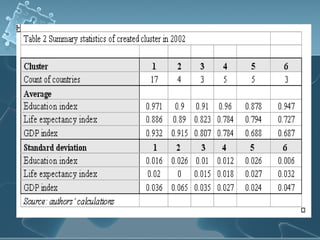
The comparative analysis is realized on the basis of the data
from the World Bank in 2002. The following information of 37
European countries was excerpted from these data:
Human Development Index (HDi)
Life Expectancy Index (iLE)
Education Index (iED)
Gross Domestic Product Index (iGDP)
The applied methodological means of multidimensional
classification of such countries from the point of view of three
components of the HDI is the cluster analysis and the
discriminant analysis.
The multidimensional classification of 37 European countries is
realized according to the three above mentioned components
of the Human Development Index simultaneously:
Gross Domestic Product Index (x1),
Life Expectancy Index (x2)
and Education Index (x3).
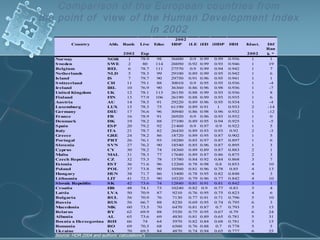
Comparison of the European countries from
the point of view of the Human Development Index
in 2002
Country Abb. Rank Live Educ HDP iLE iED iHDP HDI Klast. Dif
2002 Exp 2002
Ran
k *
Norway NOR 1 78.9 98 36600 0.9 0.99 0.99 0.956 1 1
Sweden SWE 2 80 114 26050 0.92 0.99 0.93 0.946 1 19
Belgium BEL 6 78.7 111 27570 0.9 0.99 0.94 0.942 1 7
Netherlands NLD 5 78.3 99 29100 0.89 0.99 0.95 0.942 1 6
Island IS 7 79.7 90 29750 0.91 0.96 0.95 0.941 1 1
Switzerland CH 11 79.1 88 30010 0.9 0.95 0.95 0.936 1 -4
Ireland IRL 10 76.9 90 36360 0.86 0.96 0.98 0.936 1 -7
United Kingdom UK 12 78.1 113 26150 0.88 0.99 0.93 0.936 1 8
Finland FIN 13 77.9 106 26190 0.88 0.99 0.93 0.935 1 6
Austria AU 14 78.5 91 29220 0.89 0.96 0.95 0.934 1 -4
Luxemburg LUX 15 78.3 75 61190 0.89 0.91 1 0.933 2 -14
Germany DEU 17 76.6 96 30940 0.86 0.98 0.96 0.932 1 -12
France FR 16 78.9 91 26920 0.9 0.96 0.93 0.932 1 0
Denmark DK 19 78.2 88 27100 0.89 0.95 0.94 0.925 1 -5
Spain ESP 20 79.2 92 21460 0.9 0.97 0.9 0.922 1 5
Italy ITA 21 78.7 82 26430 0.89 0.93 0.93 0.92 2 -3
Greece GRE 24 78.2 86 18720 0.89 0.95 0.87 0.902 1 5
Portugal PRT 26 76.1 93 18280 0.85 0.97 0.87 0.897 1 6
Slovenia SVN 27 76.2 90 18540 0.85 0.96 0.87 0.895 1 3
Cyprus CY 30 78.2 74 18360 0.89 0.89 0.87 0.883 2 1
Malta MAL 31 78.3 77 17640 0.89 0.87 0.86 0.875 2 3
Czech Republic CZ 32 75.3 78 15780 0.84 0.92 0.84 0.868 3 7
Estonia EST 36 71.6 96 12260 0.78 0.98 0.8 0.853 4 10
Poland POL 37 73.8 90 10560 0.81 0.96 0.78 0.85 4 13
Hungary HUN 38 71.7 86 13400 0.78 0.95 0.82 0.848 4 3
Lithuania LIT 41 72.5 90 10320 0.79 0.96 0.77 0.842 4 10
Slovak Republic SK 42 73.6 74 12840 0.81 0.91 0.81 0.842 3 1
Croatia HR 48 74.1 73 10240 0.82 0.9 0.77 0.83 3 4
Latvia LVA 50 70.9 87 9210 0.76 0.95 0.75 0.823 4 6
Bulgaria BUL 56 70.9 76 7130 0.77 0.91 0.71 0.796 5 10
Russia RUS 56 66.7 88 8230 0.69 0.95 0.74 0.795 6 3
Macedonia MK 60 73.5 70 6470 0.81 0.87 0.7 0.793 5 15
Belarus BY 62 69.9 88 5520 0.75 0.95 0.67 0.79 6 24
Albania AL 65 73.6 69 4830 0.81 0.89 0.65 0.781 5 31
Bosnia a Herzegovina BiH 66 74 64 5970 0.82 0.84 0.68 0.781 5 15
Romania RO 69 70.5 68 6560 0.76 0.88 0.7 0.778 5 5
Ukraine UA 70 69.5 84 4870 0.74 0.94 0.65 0.777 6 25
2002
Source: HDR 2004 and authors’ calculations*)
Multidimensional classification of European
countries in 2002
The multidimensional classification of countries is realized on
the basis of three partial indices (iLE, iED, iGDP).
The countries are grouped to mutual similar six cluster from
according to the three indices mentioned above, so that the
classified countries were the most similar and there were the
significant differences between the clusters.
The Further Neighbour Method is applied in the procedure of
agglomeration.
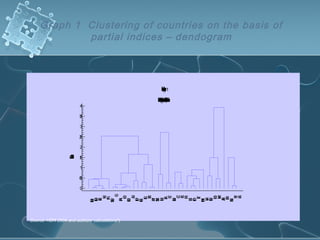
The procedure of classification is presented in dendogram
Graph 1. The results of the grouping of European countries are
six clusters - groups.
The efficiency of the classification was verified by discriminant
analysis and it was confirmed.
The rearrangement within the clusters was not necessary.
Dendrogram
FurthestNeighborMethod,SquaredEuclidean
Distance
0
0,5
1
1,5
2
2,5
3
3,5
4
NOR
SWE
NLD
BEL
IS
IRL
CH
UK
FIN
AU
LUX
FRA
DK
DEU
ESP
ITA
GRE
PRT
SVN
CY
MAL
CZ
EST
POL
HUN
LIT
SK
HR
LVA
BUL
RUS
MK
BY
ALB
BiH
RO
UA
Source: HDR 2004 and authors’ calculations*)
Graph 1 Clustering of countries on the basis of
partial indices – dendogram
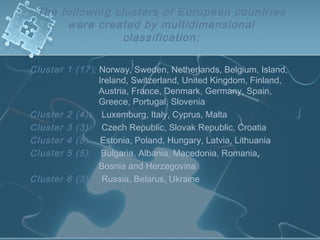
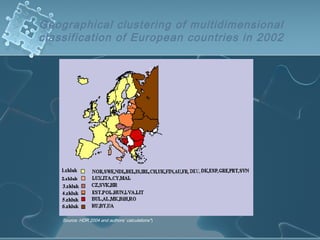
Cluster 1 (17): Norway, Sweden, Netherlands, Belgium, Island,
Ireland, Switzerland, United Kingdom, Finland,
Austria, France, Denmark, Germany, Spain,
Greece, Portugal, Slovenia
Cluster 2 (4): Luxemburg, Italy, Cyprus, Malta
Cluster 3 (3): Czech Republic, Slovak Republic, Croatia
Cluster 4 (5): Estonia, Poland, Hungary, Latvia, Lithuania
Cluster 5 (5): Bulgaria, Albania, Macedonia, Romania,
Bosnia and Herzegovina
Cluster 6 (3): Russia, Belarus, Ukraine
The following clusters of European countries
were created by multidimensional
classification:
Geographical clustering of multidimensional
classification of European countries in 2002
Source: HDR 2004 and authors’ calculations*)
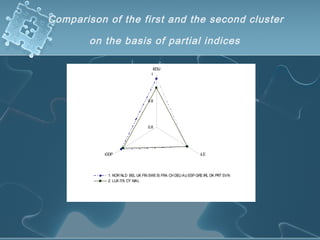
Comparison of the first and the second cluster
on the basis of partial indices
0,6
0,8
1
iEDU
iLEiGDP
1: NOR NLD BEL UK FIN SWE IS FRA CH DEU AU ESP GREIRL DK PRT SVN
2: LUX ITA CY MAL
0,6
0,8
1
iEDU
iLEiGDP
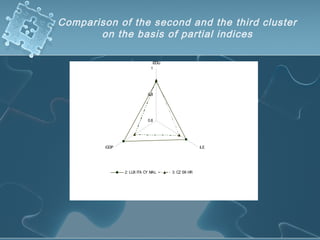
2: LUX ITA CY MAL 3: CZ SK HR
Comparison of the second and the third cluster
on the basis of partial indices
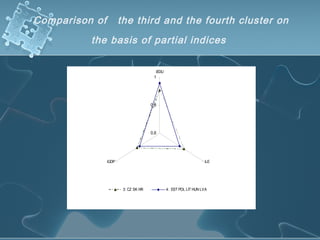
Comparison of the third and the fourth cluster on
the basis of partial indices
0,6
0,8
1
iEDU
iLEiGDP
3: CZ SK HR 4: EST POL LIT HUN LVA
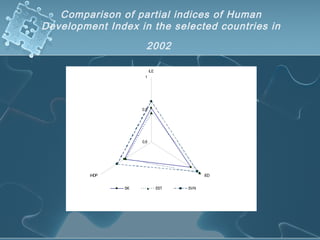
Comparison of partial indices of Human
Development Index in the selected countries in
2002
0,6
0,8
1
iLE
iEDiHDP
SK EST SVN
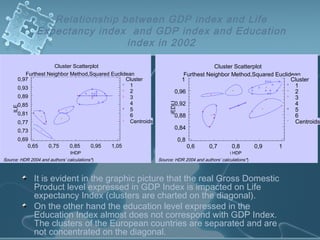
Relationship between GDP index and Life
Expectancy index and GDP index and Education
index in 2002
Cluster Scatterplot
Furthest Neighbor Method,Squared Euclidean
IHDP
ILE
Cluster
1
2
3
4
5
6
Centroids
0,65 0,75 0,85 0,95 1,05
0,69
0,73
0,77
0,81
0,85
0,89
0,93
0,97
Cluster Scatterplot
Furthest Neighbor Method,Squared Euclidean
i HDP
iEDU
Cluster
1
2
3
4
5
6
Centroids
0,6 0,7 0,8 0,9 1
0,8
0,84
0,88
0,92
0,96
1
It is evident in the graphic picture that the real Gross Domestic
Product level expressed in GDP Index is impacted on Life
expectancy Index (clusters are charted on the diagonal).
On the other hand the education level expressed in the
Education Index almost does not correspond with GDP Index.
The clusters of the European countries are separated and are
not concentrated on the diagonal.
Source: HDR 2004 and authors’ calculations*) Source: HDR 2004 and authors’ calculations*)
It could be submitted, that a real Gross Domestic Product is not
significantly determinate for Education level.
This fact is typical for Estonia, Latvia, Lithuania, and the other
countries, too. The relatively higher Education Index is attained
in spite of low real Gross Domestic Product.
CONCLUSION
The reason of the application of the multidimensional
classification is the fact, that the disparities in partial indices of
three indicators composing HDI are averaged by the Human
Development Index.
To simplify: Two countries close or identical from the point of
view of the total HDI can be less or more evidently different
from the point of view of partial indices. From the point of view
of the components, the disproportions between countries are
covered by the Human Development Index.
Regional disparities within European countries are and will be
the next problem of globalization. They might be observed not
only in the original European Union, but also particularly in the
new Member States.
The investigation of convergence and divergence tendencies
and the disparities on the NUTS2 and NUT3 level is just the
topic high on the list of our scientific research.
Thank you for your
attention

Hdi (1)

  • 1.
    The Comparison ofEuropean Countries on the Base Human Development Index Zlata Sojková, Zlata Kropková Slovak University of Agriculture, Nitra, Slovak Republic
  • 2.
    The human developmentindex is one of the important indicators of country development level, including another aspect concerning the quality of life unlike gross domestic product. The countries are categorized to three categories by The United Nations Organization Development Program (UNDP) according to the Human development index: low level of human development to 0.499, middle level from 0.500 to 0.799, and high level from 0.8 to 1. This classification serves as a comparison of the countries of the world with evident marked disproportions between developed and developing countries. European countries are classified on the basis of this classification into two groups: the countries with high level of Human Development Index and those of middle level.
  • 3.
    The aims ofthe analyses are: to realize detailed classification of European countries to the groups on the basis of Education Index, Gross Domestic Product Index, and Life Expectancy Index; to characterize and compare groups of the countries from the point of view of partial indicators creating the Human Development Index; to specify disparities between countries from the point of view of the partial components of the Human Development Index; to compare the results of the grouping according to the multidimensional classification with the results of the ranking based on the Human Development Index.
  • 4.
    The comparative analysisis realized on the basis of the data from the World Bank in 2002. The following information of 37 European countries was excerpted from these data: Human Development Index (HDi) Life Expectancy Index (iLE) Education Index (iED) Gross Domestic Product Index (iGDP) The applied methodological means of multidimensional classification of such countries from the point of view of three components of the HDI is the cluster analysis and the discriminant analysis.
  • 5.
    The multidimensional classificationof 37 European countries is realized according to the three above mentioned components of the Human Development Index simultaneously: Gross Domestic Product Index (x1), Life Expectancy Index (x2) and Education Index (x3).
  • 6.
    Comparison of theEuropean countries from the point of view of the Human Development Index in 2002 Country Abb. Rank Live Educ HDP iLE iED iHDP HDI Klast. Dif 2002 Exp 2002 Ran k * Norway NOR 1 78.9 98 36600 0.9 0.99 0.99 0.956 1 1 Sweden SWE 2 80 114 26050 0.92 0.99 0.93 0.946 1 19 Belgium BEL 6 78.7 111 27570 0.9 0.99 0.94 0.942 1 7 Netherlands NLD 5 78.3 99 29100 0.89 0.99 0.95 0.942 1 6 Island IS 7 79.7 90 29750 0.91 0.96 0.95 0.941 1 1 Switzerland CH 11 79.1 88 30010 0.9 0.95 0.95 0.936 1 -4 Ireland IRL 10 76.9 90 36360 0.86 0.96 0.98 0.936 1 -7 United Kingdom UK 12 78.1 113 26150 0.88 0.99 0.93 0.936 1 8 Finland FIN 13 77.9 106 26190 0.88 0.99 0.93 0.935 1 6 Austria AU 14 78.5 91 29220 0.89 0.96 0.95 0.934 1 -4 Luxemburg LUX 15 78.3 75 61190 0.89 0.91 1 0.933 2 -14 Germany DEU 17 76.6 96 30940 0.86 0.98 0.96 0.932 1 -12 France FR 16 78.9 91 26920 0.9 0.96 0.93 0.932 1 0 Denmark DK 19 78.2 88 27100 0.89 0.95 0.94 0.925 1 -5 Spain ESP 20 79.2 92 21460 0.9 0.97 0.9 0.922 1 5 Italy ITA 21 78.7 82 26430 0.89 0.93 0.93 0.92 2 -3 Greece GRE 24 78.2 86 18720 0.89 0.95 0.87 0.902 1 5 Portugal PRT 26 76.1 93 18280 0.85 0.97 0.87 0.897 1 6 Slovenia SVN 27 76.2 90 18540 0.85 0.96 0.87 0.895 1 3 Cyprus CY 30 78.2 74 18360 0.89 0.89 0.87 0.883 2 1 Malta MAL 31 78.3 77 17640 0.89 0.87 0.86 0.875 2 3 Czech Republic CZ 32 75.3 78 15780 0.84 0.92 0.84 0.868 3 7 Estonia EST 36 71.6 96 12260 0.78 0.98 0.8 0.853 4 10 Poland POL 37 73.8 90 10560 0.81 0.96 0.78 0.85 4 13 Hungary HUN 38 71.7 86 13400 0.78 0.95 0.82 0.848 4 3 Lithuania LIT 41 72.5 90 10320 0.79 0.96 0.77 0.842 4 10 Slovak Republic SK 42 73.6 74 12840 0.81 0.91 0.81 0.842 3 1 Croatia HR 48 74.1 73 10240 0.82 0.9 0.77 0.83 3 4 Latvia LVA 50 70.9 87 9210 0.76 0.95 0.75 0.823 4 6 Bulgaria BUL 56 70.9 76 7130 0.77 0.91 0.71 0.796 5 10 Russia RUS 56 66.7 88 8230 0.69 0.95 0.74 0.795 6 3 Macedonia MK 60 73.5 70 6470 0.81 0.87 0.7 0.793 5 15 Belarus BY 62 69.9 88 5520 0.75 0.95 0.67 0.79 6 24 Albania AL 65 73.6 69 4830 0.81 0.89 0.65 0.781 5 31 Bosnia a Herzegovina BiH 66 74 64 5970 0.82 0.84 0.68 0.781 5 15 Romania RO 69 70.5 68 6560 0.76 0.88 0.7 0.778 5 5 Ukraine UA 70 69.5 84 4870 0.74 0.94 0.65 0.777 6 25 2002 Source: HDR 2004 and authors’ calculations*)
  • 7.
    Multidimensional classification ofEuropean countries in 2002 The multidimensional classification of countries is realized on the basis of three partial indices (iLE, iED, iGDP). The countries are grouped to mutual similar six cluster from according to the three indices mentioned above, so that the classified countries were the most similar and there were the significant differences between the clusters. The Further Neighbour Method is applied in the procedure of agglomeration. The procedure of classification is presented in dendogram Graph 1. The results of the grouping of European countries are six clusters - groups. The efficiency of the classification was verified by discriminant analysis and it was confirmed. The rearrangement within the clusters was not necessary.
  • 8.
  • 9.
    Cluster 1 (17):Norway, Sweden, Netherlands, Belgium, Island, Ireland, Switzerland, United Kingdom, Finland, Austria, France, Denmark, Germany, Spain, Greece, Portugal, Slovenia Cluster 2 (4): Luxemburg, Italy, Cyprus, Malta Cluster 3 (3): Czech Republic, Slovak Republic, Croatia Cluster 4 (5): Estonia, Poland, Hungary, Latvia, Lithuania Cluster 5 (5): Bulgaria, Albania, Macedonia, Romania, Bosnia and Herzegovina Cluster 6 (3): Russia, Belarus, Ukraine The following clusters of European countries were created by multidimensional classification:
  • 10.
    Geographical clustering ofmultidimensional classification of European countries in 2002 Source: HDR 2004 and authors’ calculations*)
  • 12.
    Comparison of thefirst and the second cluster on the basis of partial indices 0,6 0,8 1 iEDU iLEiGDP 1: NOR NLD BEL UK FIN SWE IS FRA CH DEU AU ESP GREIRL DK PRT SVN 2: LUX ITA CY MAL
  • 13.
    0,6 0,8 1 iEDU iLEiGDP 2: LUX ITACY MAL 3: CZ SK HR Comparison of the second and the third cluster on the basis of partial indices
  • 14.
    Comparison of thethird and the fourth cluster on the basis of partial indices 0,6 0,8 1 iEDU iLEiGDP 3: CZ SK HR 4: EST POL LIT HUN LVA
  • 15.
    Comparison of partialindices of Human Development Index in the selected countries in 2002 0,6 0,8 1 iLE iEDiHDP SK EST SVN
  • 16.
    Relationship between GDPindex and Life Expectancy index and GDP index and Education index in 2002 Cluster Scatterplot Furthest Neighbor Method,Squared Euclidean IHDP ILE Cluster 1 2 3 4 5 6 Centroids 0,65 0,75 0,85 0,95 1,05 0,69 0,73 0,77 0,81 0,85 0,89 0,93 0,97 Cluster Scatterplot Furthest Neighbor Method,Squared Euclidean i HDP iEDU Cluster 1 2 3 4 5 6 Centroids 0,6 0,7 0,8 0,9 1 0,8 0,84 0,88 0,92 0,96 1 It is evident in the graphic picture that the real Gross Domestic Product level expressed in GDP Index is impacted on Life expectancy Index (clusters are charted on the diagonal). On the other hand the education level expressed in the Education Index almost does not correspond with GDP Index. The clusters of the European countries are separated and are not concentrated on the diagonal. Source: HDR 2004 and authors’ calculations*) Source: HDR 2004 and authors’ calculations*)
  • 17.
    It could besubmitted, that a real Gross Domestic Product is not significantly determinate for Education level. This fact is typical for Estonia, Latvia, Lithuania, and the other countries, too. The relatively higher Education Index is attained in spite of low real Gross Domestic Product.
  • 18.
    CONCLUSION The reason ofthe application of the multidimensional classification is the fact, that the disparities in partial indices of three indicators composing HDI are averaged by the Human Development Index. To simplify: Two countries close or identical from the point of view of the total HDI can be less or more evidently different from the point of view of partial indices. From the point of view of the components, the disproportions between countries are covered by the Human Development Index. Regional disparities within European countries are and will be the next problem of globalization. They might be observed not only in the original European Union, but also particularly in the new Member States.
  • 19.
    The investigation ofconvergence and divergence tendencies and the disparities on the NUTS2 and NUT3 level is just the topic high on the list of our scientific research.
  • 20.
    Thank you foryour attention