PRINCIPLES OF SAFE
SURGERY
Primum Non Nocere
Five facts about surgical safety
1. Complications after inpatient operations occur in up to 25% of patients.
2. The reported crude mortality rate after major surgery is 0.5–5%.
3. In industrialized countries nearly half of all adverse events in hospitalized
patients are related to surgical care.
4. At least half of the cases in which surgery led to harm are considered to be
preventable.
5. Known principles of surgical safety are inconsistently applied even in the most
sophisticated settings.
Patient safety
is the absence
of preventable
harm to a
patient during
the process of
health care.
SURGICAL SAFETY IS BROADLY INCLUDED IN THREE PHASES:
1. PRE-OPERATIVE:
- History & physical examination
- Investigation
- Risk stratification
2. INTRA-OPERATIVE
- Antibiotic prophylaxis (Surgical site infection prevention)
- Machine & equipment check
- Patient Positioning
3. POST-OPERATIVE (upto discharge)
System-wide approach to improved surgical safety
• No single remedy
• Requires reliable completion of a sequence of necessary steps in care,
by a team of health-care professionals working together within a
supportive health system for the benefit of the patient.
Safe Surgery Saves Lives
Safe Surgery Saves Lives - multifaceted, participatory initiative to
reduce patient harm through safer surgical care.
Includes:
10 essential objectives for safe surgery
5 surgical ‘vital statistics’ to measure progress
1 Surgical Safety Checklist for each surgical procedure.
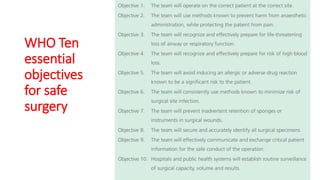
WHO Ten
essential
objectives
for safe
surgery
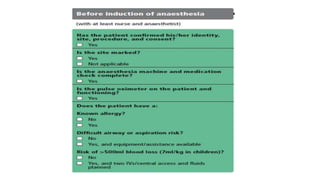
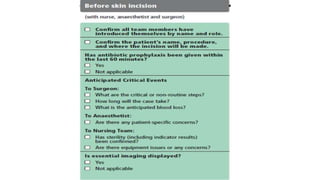
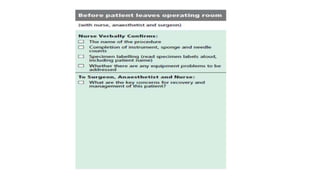
SURGICAL SAFETY CHECKLIST
• 2008 – WHO introduced a surgical safety checklist applicable to all surgical
teams to be used for every patient undergoing a surgical procedure.
AIM:
• To encourage the use of routine safety checks to minimize harm to patients.
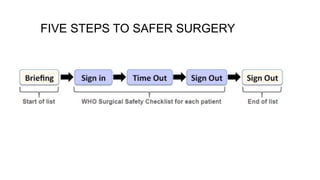
FIVE STEPS TO SAFER SURGERY
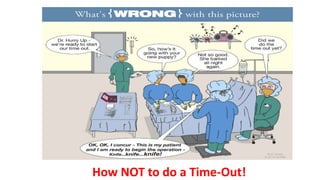
How NOT to do a Time-Out!
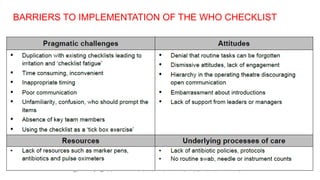
BARRIERS TO IMPLEMENTATION OF THE WHO CHECKLIST
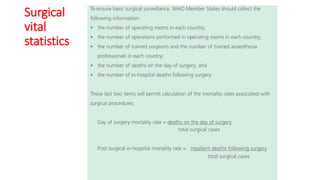
Surgical
vital
statistics

PRINCIPLES OF SAFE SURGERY.pptx

  • 1.
  • 2.
  • 3.
    Five facts aboutsurgical safety 1. Complications after inpatient operations occur in up to 25% of patients. 2. The reported crude mortality rate after major surgery is 0.5–5%. 3. In industrialized countries nearly half of all adverse events in hospitalized patients are related to surgical care. 4. At least half of the cases in which surgery led to harm are considered to be preventable. 5. Known principles of surgical safety are inconsistently applied even in the most sophisticated settings.
  • 4.
    Patient safety is theabsence of preventable harm to a patient during the process of health care.
  • 5.
    SURGICAL SAFETY ISBROADLY INCLUDED IN THREE PHASES: 1. PRE-OPERATIVE: - History & physical examination - Investigation - Risk stratification 2. INTRA-OPERATIVE - Antibiotic prophylaxis (Surgical site infection prevention) - Machine & equipment check - Patient Positioning 3. POST-OPERATIVE (upto discharge)
  • 6.
    System-wide approach toimproved surgical safety • No single remedy • Requires reliable completion of a sequence of necessary steps in care, by a team of health-care professionals working together within a supportive health system for the benefit of the patient.
  • 7.
    Safe Surgery SavesLives Safe Surgery Saves Lives - multifaceted, participatory initiative to reduce patient harm through safer surgical care. Includes: 10 essential objectives for safe surgery 5 surgical ‘vital statistics’ to measure progress 1 Surgical Safety Checklist for each surgical procedure.
  • 8.
  • 9.
    SURGICAL SAFETY CHECKLIST •2008 – WHO introduced a surgical safety checklist applicable to all surgical teams to be used for every patient undergoing a surgical procedure. AIM: • To encourage the use of routine safety checks to minimize harm to patients.
  • 10.
    FIVE STEPS TOSAFER SURGERY
  • 14.
    How NOT todo a Time-Out!
  • 15.
    BARRIERS TO IMPLEMENTATIONOF THE WHO CHECKLIST
  • 17.