City University London
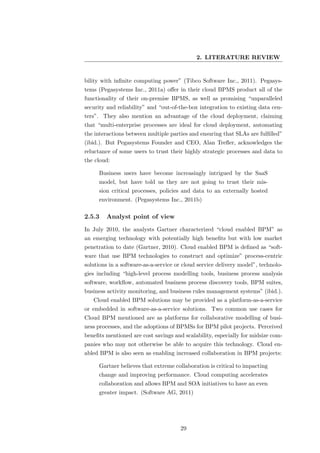
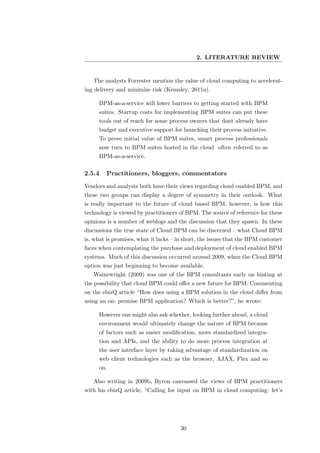
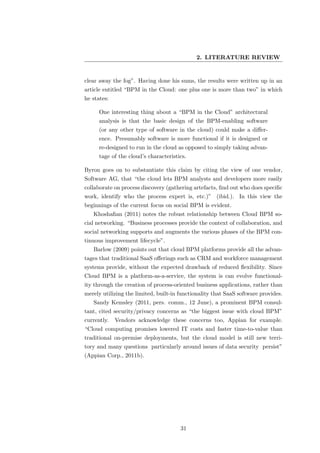
   MSc in Business Systems Analysis and Design
                 Project Report
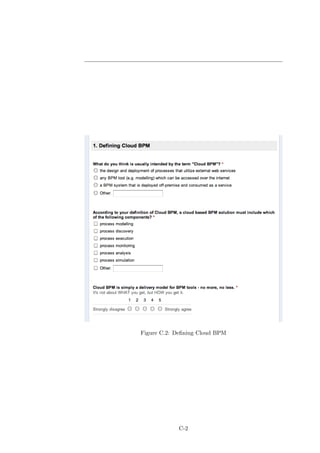
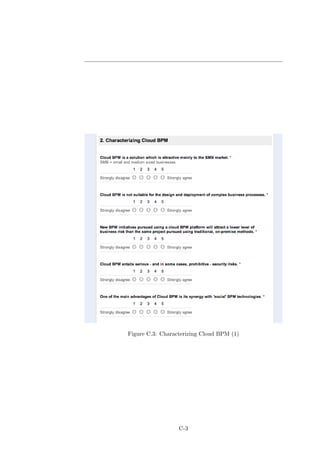
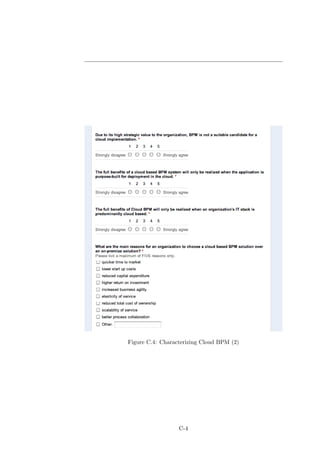
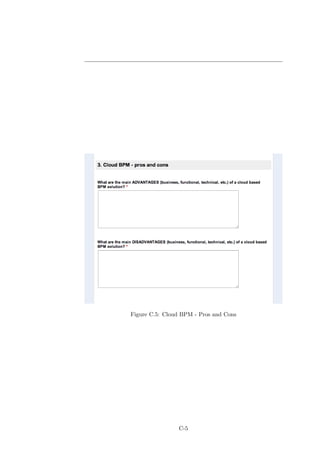
                      2011


Cloud Based Business Process
    Management Systems


                  Ja’far Railton
                   Supervised by
                  Bill Karakostas


                 23 September 2011
By submitting this work, I declare that this work is entirely my own
except those parts duly identified and referenced in my submission.
It complies with any specified word limits and the requirements and
regulations detailed in the coursework instructions and any other
relevant programme and module documentation. In submitting
this work I acknowledge that I have read and understood the reg-
ulations and code regarding academic misconduct, including that
relating to plagiarism, as specified in the Programme Handbook.
I also acknowledge that this work will be subject to a variety of
checks for academic misconduct.


Signed:
Acknowledgements


 In the Name of Allah, the Most Beneficent, the Most Merciful

   All praise and thanks are due to Allah and may peace and
              blessings be upon the Messenger of Allah


To proceed:


I would like to thank my family for their patience and support – so
sorely needed by this incorrigible student, Jack of many Masters.


I would also like to thank my supervisor, Bill Karakostas, for his
guidance and support throughout, which greatly assisted in the
success of this endeavour.
Abstract


Although both business process management (BPM) and cloud
computing are relatively well-defined in the literature, their recent
amalgamation – in the form of Cloud BPM – is not. This research
contributes to the literature on Cloud BPM, firstly by defining its
terms, and then by considering its application and merits. The
methods employed are an exhaustive literature survey of the sub-
ject domain, followed by the generation of a hypothesis regarding
the definition of Cloud BPM. An online survey questionnaire is
used to test the hypothesis by collecting data from a target group
of BPM practitioners. The findings will be of interest to potential
consumers of cloud based BPM systems, as well as to vendors of
BPM systems, and analysts seeking to advise on the potential on
this emerging technology and how it might help customers realize
their business goals.
Keywords: cloud computing, business process management, cloud
based BPM, BPMS
Contents

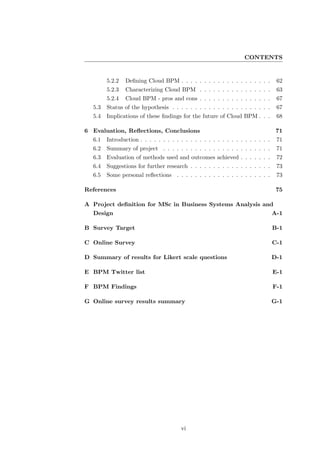
Contents                                                                          iv

List of Figures                                                                   vii

List of Tables                                                                    ix

1 Introduction and project objectives                                              1
   1.1   Introduction . . . . . . . . . . . . . . . . . . . . . . . . . . . . .    1
   1.2   Problem statement . . . . . . . . . . . . . . . . . . . . . . . . .       1
   1.3   Important note on terminology . . . . . . . . . . . . . . . . . .         2
   1.4   Aims and objectives . . . . . . . . . . . . . . . . . . . . . . . .       2
   1.5   Applicable methodologies . . . . . . . . . . . . . . . . . . . . .        3
   1.6   Project contribution and supposed beneficiaries . . . . . . . . .          4
   1.7   Organization of this project report . . . . . . . . . . . . . . . .       4

2 Literature survey                                                                6
   2.1   Introduction . . . . . . . . . . . . . . . . . . . . . . . . . . . . .    6
   2.2   Cloud BPM from the linguistic point of view . . . . . . . . . .           6
   2.3   Business process management . . . . . . . . . . . . . . . . . . .         7
         2.3.1   Defining BPM . . . . . . . . . . . . . . . . . . . . . . .         7
         2.3.2   The BPM lifecycle . . . . . . . . . . . . . . . . . . . . .       8
         2.3.3   The BPM discipline . . . . . . . . . . . . . . . . . . . .        9
         2.3.4   BPM technology: the BPM suite . . . . . . . . . . . . .           9
         2.3.5   BPM and service oriented architecture . . . . . . . . . .        12
         2.3.6   BPM adoption and potential obstacles to be overcome .            14
   2.4   Cloud computing . . . . . . . . . . . . . . . . . . . . . . . . . .      16
         2.4.1   Defining cloud computing . . . . . . . . . . . . . . . . .        17
         2.4.2   Characteristics of cloud computing . . . . . . . . . . . .       19


                                        iv
CONTENTS


  2.5   Cloud BPM . . . . . . . . . . . . . . . . . . . . . . . . . . . . .      21
        2.5.1   History . . . . . . . . . . . . . . . . . . . . . . . . . . .    21
        2.5.2   Vendor offerings . . . . . . . . . . . . . . . . . . . . . .      22
        2.5.3   Analyst point of view . . . . . . . . . . . . . . . . . . .      29
        2.5.4   Practitioners, bloggers, commentators . . . . . . . . . .        30
  2.6   Summary . . . . . . . . . . . . . . . . . . . . . . . . . . . . . .      32

3 Methods                                                                        33
  3.1   Introduction . . . . . . . . . . . . . . . . . . . . . . . . . . . . .   33
  3.2   Literature survey . . . . . . . . . . . . . . . . . . . . . . . . . .    34
        3.2.1   Literature search . . . . . . . . . . . . . . . . . . . . . .    34
        3.2.2   Literature review . . . . . . . . . . . . . . . . . . . . . .    35
  3.3   Online survey . . . . . . . . . . . . . . . . . . . . . . . . . . . .    35
        3.3.1   Survey design . . . . . . . . . . . . . . . . . . . . . . . .    36
        3.3.2   General considerations . . . . . . . . . . . . . . . . . . .     36
        3.3.3   Survey target . . . . . . . . . . . . . . . . . . . . . . . .    38
        3.3.4   Motivation of questions . . . . . . . . . . . . . . . . . .      38
  3.4   Proposed definition . . . . . . . . . . . . . . . . . . . . . . . . .     45
  3.5   Evaluation of proposed definition . . . . . . . . . . . . . . . . .       45
  3.6   Summary . . . . . . . . . . . . . . . . . . . . . . . . . . . . . .      45

4 Results                                                                        46
  4.1   Introduction . . . . . . . . . . . . . . . . . . . . . . . . . . . . .   46
  4.2   Literature analysis . . . . . . . . . . . . . . . . . . . . . . . . .    46
        4.2.1   Description of Cloud BPM . . . . . . . . . . . . . . . .         46
        4.2.2   Hypothesis statement . . . . . . . . . . . . . . . . . . .       48
  4.3   Survey questionnaire results . . . . . . . . . . . . . . . . . . . .     49
        4.3.1   Respondent-specific information       . . . . . . . . . . . . .   49
        4.3.2   Defining Cloud BPM . . . . . . . . . . . . . . . . . . . .        51
        4.3.3   Characterizing Cloud BPM . . . . . . . . . . . . . . . .         54
        4.3.4   Cloud BPM - pros and cons . . . . . . . . . . . . . . . .        58
  4.4   Summary . . . . . . . . . . . . . . . . . . . . . . . . . . . . . .      59

5 Discussion                                                                     61
  5.1   Introduction . . . . . . . . . . . . . . . . . . . . . . . . . . . . .   61
  5.2   Discussion of online survey results . . . . . . . . . . . . . . . .      61
        5.2.1   Respondents . . . . . . . . . . . . . . . . . . . . . . . .      61


                                        v
CONTENTS


        5.2.2   Defining Cloud BPM . . . . . . . . . . . . . . . . . . . .         62
        5.2.3   Characterizing Cloud BPM . . . . . . . . . . . . . . . .          63
        5.2.4   Cloud BPM - pros and cons . . . . . . . . . . . . . . . .         67
  5.3   Status of the hypothesis . . . . . . . . . . . . . . . . . . . . . .      67
  5.4   Implications of these findings for the future of Cloud BPM . . .           68

6 Evaluation, Reflections, Conclusions                                             71
  6.1   Introduction . . . . . . . . . . . . . . . . . . . . . . . . . . . . .    71
  6.2   Summary of project . . . . . . . . . . . . . . . . . . . . . . . .        71
  6.3   Evaluation of methods used and outcomes achieved . . . . . . .            72
  6.4   Suggestions for further research . . . . . . . . . . . . . . . . . .      73
  6.5   Some personal reflections . . . . . . . . . . . . . . . . . . . . .        73

References                                                                        75

A Project definition for MSc in Business Systems Analysis and
  Design                                                                         A-1

B Survey Target                                                                  B-1

C Online Survey                                                                  C-1

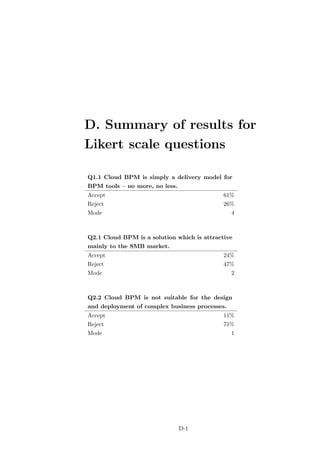
D Summary of results for Likert scale questions                                  D-1

E BPM Twitter list                                                               E-1

F BPM Findings                                                                   F-1

G Online survey results summary                                                  G-1


                                       vi
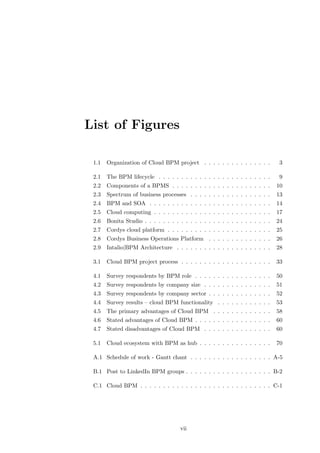
List of Figures

 1.1   Organization of Cloud BPM project . . . . . . . . . . . . . . .          3

 2.1   The BPM lifecycle . . . . . . . . . . . . . . . . . . . . . . . . .      9
 2.2   Components of a BPMS . . . . . . . . . . . . . . . . . . . . . .        10
 2.3   Spectrum of business processes . . . . . . . . . . . . . . . . . .      13
 2.4   BPM and SOA . . . . . . . . . . . . . . . . . . . . . . . . . . .       14
 2.5   Cloud computing . . . . . . . . . . . . . . . . . . . . . . . . . .     17
 2.6   Bonita Studio . . . . . . . . . . . . . . . . . . . . . . . . . . . .   24
 2.7   Cordys cloud platform . . . . . . . . . . . . . . . . . . . . . . .     25
 2.8   Cordys Business Operations Platform . . . . . . . . . . . . . .         26
 2.9   Intalio|BPM Architecture . . . . . . . . . . . . . . . . . . . . .      28

 3.1   Cloud BPM project process . . . . . . . . . . . . . . . . . . . .       33

 4.1   Survey respondents by BPM role . . . . . . . . . . . . . . . . .        50
 4.2   Survey respondents by company size . . . . . . . . . . . . . . .        51
 4.3   Survey respondents by company sector . . . . . . . . . . . . . .        52
 4.4   Survey results – cloud BPM functionality . . . . . . . . . . . .        53
 4.5   The primary advantages of Cloud BPM . . . . . . . . . . . . .           58
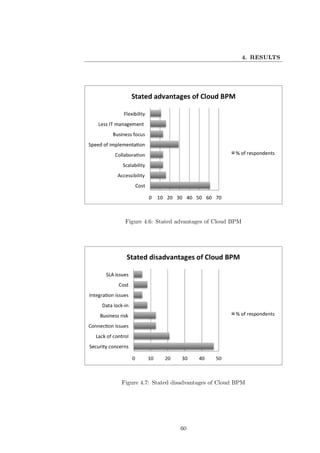
 4.6   Stated advantages of Cloud BPM . . . . . . . . . . . . . . . . .        60
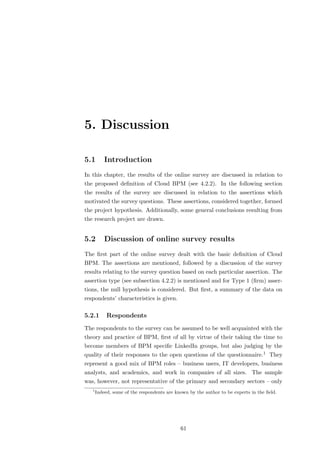
 4.7   Stated disadvantages of Cloud BPM . . . . . . . . . . . . . . .         60

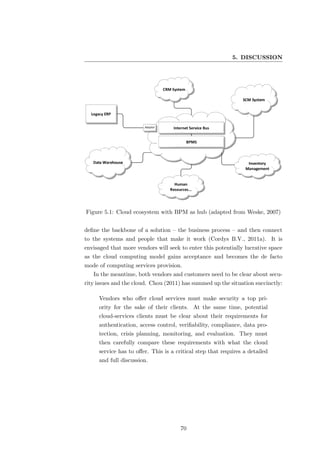
 5.1   Cloud ecosystem with BPM as hub . . . . . . . . . . . . . . . .         70

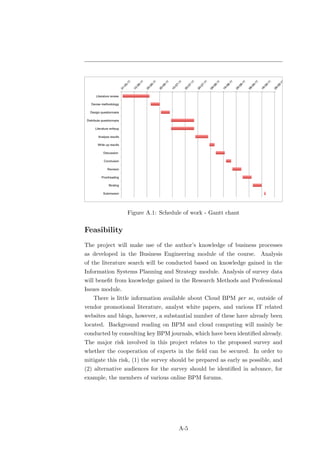
 A.1 Schedule of work - Gantt chant . . . . . . . . . . . . . . . . . . A-5

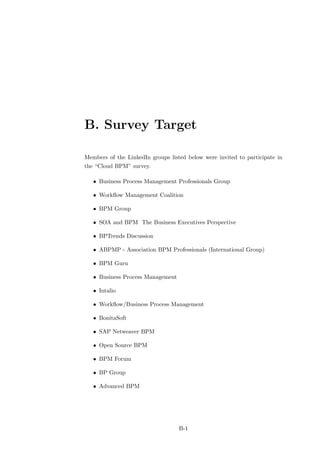
 B.1 Post to LinkedIn BPM groups . . . . . . . . . . . . . . . . . . . B-2

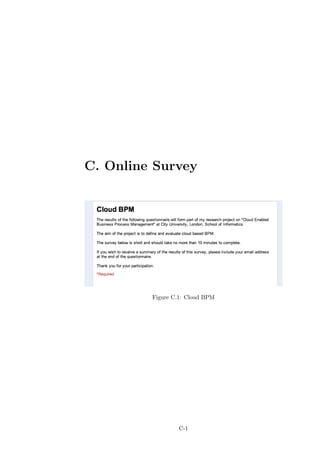
 C.1 Cloud BPM . . . . . . . . . . . . . . . . . . . . . . . . . . . . . C-1


                                      vii
LIST OF FIGURES


C.2 Defining Cloud BPM . . . . . . . . . . . . . . . . . . . . . . . . C-2
C.3 Characterizing Cloud BPM (1) . . . . . . . . . . . . . . . . . . C-3
C.4 Characterizing Cloud BPM (2) . . . . . . . . . . . . . . . . . . C-4
C.5 Cloud BPM - Pros and Cons . . . . . . . . . . . . . . . . . . . C-5
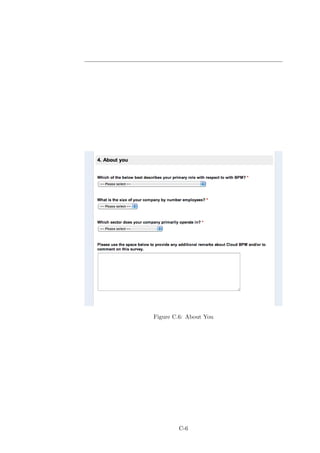
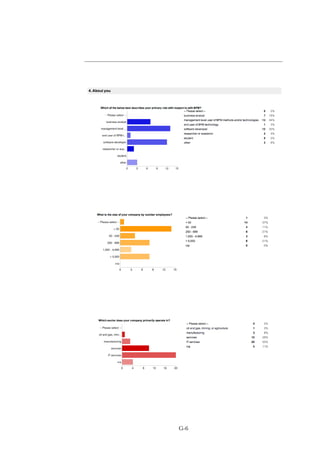
C.6 About You . . . . . . . . . . . . . . . . . . . . . . . . . . . . . C-6
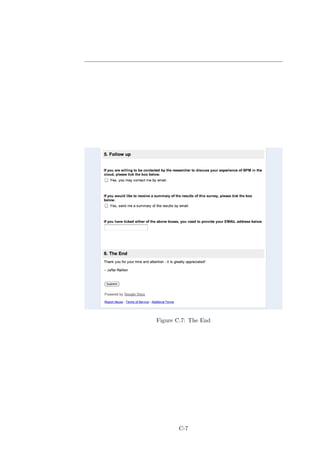
C.7 The End . . . . . . . . . . . . . . . . . . . . . . . . . . . . . . . C-7


                                   viii
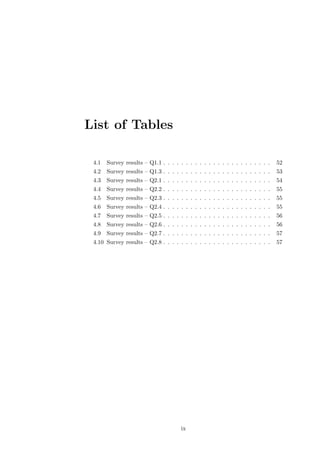
List of Tables

 4.1   Survey results – Q1.1 . . . . . . . . . . . . . . . . . . . . . . . .   52
 4.2   Survey results – Q1.3 . . . . . . . . . . . . . . . . . . . . . . . .   53
 4.3   Survey results – Q2.1 . . . . . . . . . . . . . . . . . . . . . . . .   54
 4.4   Survey results – Q2.2 . . . . . . . . . . . . . . . . . . . . . . . .   55
 4.5   Survey results – Q2.3 . . . . . . . . . . . . . . . . . . . . . . . .   55
 4.6   Survey results – Q2.4 . . . . . . . . . . . . . . . . . . . . . . . .   55
 4.7   Survey results – Q2.5 . . . . . . . . . . . . . . . . . . . . . . . .   56
 4.8   Survey results – Q2.6 . . . . . . . . . . . . . . . . . . . . . . . .   56
 4.9   Survey results – Q2.7 . . . . . . . . . . . . . . . . . . . . . . . .   57
 4.10 Survey results – Q2.8 . . . . . . . . . . . . . . . . . . . . . . . .    57


                                      ix
1. Introduction and project
objectives

1.1    Introduction
Business process management (BPM) is a mature business discipline that has
spawned a number of technologies to support it. Businesses now put “pro-
cess first” (Ould, 2005, p2), and BPM technologies have evolved to support
a business user centred approach to BPM. These days, organizations depend
on BPM to enable them to adapt to rapidly changing business conditions by
enabling the design and execution of business processes that can span the en-
tire enterprise, as well as connect with systems external to it. Today it is the
agile who survive – those organizations who are able to adapt to change, to
innovate as well as continuously improve, and to continuously monitor and
analyze the results of these adaptations.
   In the current web enabled business environment, processes in many cases
depend on the discovery and recognition of components that exist as web
services (Datamonitor, 2009) and BPM systems must facilitate this. Fur-
thermore, the current trend is towards increased emphasis on mobility and
collaboration as essential elements to support the agility and currency of busi-
ness processes. This means that BPM vendors are increasingly seeking to
augment their BPM packages by incorporating greater Web 2.0 type function-
ality. Cloud based BPM is one response to these new demands.


1.2    Problem statement
Although cloud based BPM is already a reality, it is an emerging technology
and still evolving; thus, it is not entirely clear what it is that BPM vendors


                                       1
1. INTRODUCTION


are offering in the cloud, and how cloud based BPM can be evaluated as a
value-adding business proposition.


1.3     Important note on terminology
As will be seen later in the discussion, the concept of the provision of BPM
tools and systems using cloud computing technologies is referred to in vari-
ous terms, such as “cloud based BPM”, “cloud enabled BPM”, “BPM in the
cloud”, “BPM as a service”, “BPM on demand”, etc. This project proposes to
investigate the commonality of these terms under the umbrella concept ‘Cloud
BPM’.


1.4     Aims and objectives
The objective of the project is to propose a definition of the concept ‘Cloud
BPM’. The validity of the proposed definition will rest upon an evaluation of
its utility in further clarifying the key issues of the problem domain.
   In order to arrive at such a definition, the project first presents a review
of the literature surrounding Cloud BPM, and analyses what vendors and
analysts intend through references to “cloud based BPM”, “cloud enabled
BPM”, “BPM in the cloud”, “BPM as a service”, “BPM on demand”, and
so on. This analysis focuses on two key aspects of Cloud BPM technology:
functionality and architecture.
   Further objectives of this project are to identify: (1) any differentiating
features of Cloud BPM over on-premise BPM, (2) the advantages and disad-
vantages of Cloud BPM, and (3) future trends relating to Cloud BPM. Some
other questions that inform the research are:

   • What types of BPM software are available on the cloud?

   • Does BPM on the cloud offer any particular advantages above and be-
      yond the advantages of SaaS considered generically?

   • Are there any technical barriers to entry that apply to cloud based BPM
      which are not applicable to other types of SaaS offerings, e.g. CRM?

   • Does BPM have any characteristics that make it particularly well-suited
      to being deployed in the cloud?


                                        2
1. INTRODUCTION


In support of the above aims, the project also presents relevant background
information on BPM and cloud computing in general, as well as ancillary
technologies such as service oriented architecture (SOA).


1.5      Applicable methodologies
The research follows a sequential process (as described by Dawson (2009,
p20)):

  1. Review the field;

  2. Build a theory;

  3. Test the theory;

  4. Reflect and integrate.

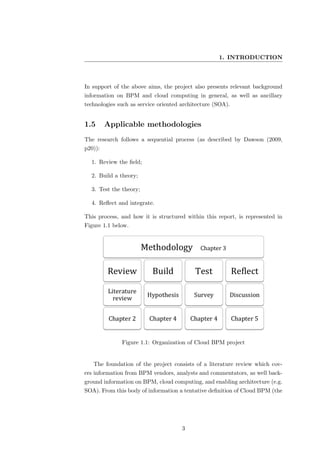
This process, and how it is structured within this report, is represented in
Figure 1.1 below.


              Figure 1.1: Organization of Cloud BPM project


   The foundation of the project consists of a literature review which cov-
ers information from BPM vendors, analysts and commentators, as well back-
ground information on BPM, cloud computing, and enabling architecture (e.g.
SOA). From this body of information a tentative definition of Cloud BPM (the


                                      3
1. INTRODUCTION


hypothesis) is proposed. The proposed definition of Cloud BPM is then tested
against the opinion of experts in the field, who were asked to complete a ques-
tionnaire about BPM and its application in the cloud, designed specifically for
that purpose.


1.6     Project contribution and supposed beneficiaries
Although BPM is a mature discipline supported by similarly mature tech-
nologies, the debate surrounding the definition of cloud computing continues
apace. As for Cloud BPM, the amalgam of BPM and cloud computing, it is
very much an emerging technology, with many vendors currently just begin-
ning to enter the market while others remain on the sidelines still. Such being
the case, Cloud BPM is not yet well-defined; consequently, the discussion re-
garding the merits of its application lack rigour. This project will address this
lack and thereby attempt to stimulate and further the discussion by proposing
a research based definition of this important, emerging technology, which has
the potential to disrupt the current BPM market certainly, and perhaps, the
enterprise systems market in general as well.
   This research will therefore be of benefit to businesses who are considering
implementing BPM and considering buying BPM as a software or platform as
a service. The research will also interest independent analysts and commen-
tators, as well as other researchers in the field of IT strategy.


1.7     Organization of this project report
This project report is divided into five chapters. This initial chapter chapter
has introduced the project aims and objectives, and touched upon the meth-
ods to be employed in meeting them. The next chapter (Chapter 2) consists
of a literature survey covering the key issues relating to the project domain.
Chapter 3 goes on to describe the methods used to investigate the research
topic, methods which included a literature review and a survey questionnaire.
The results of these investigations are presented in Chapter 4 and a hypothesis
– a tentative definition of Cloud BPM – is proposed. The project hypothe-
sis is evaluated and further issues arising from the research are discussed in
Chapter 5. Finally, Chapter 6 concludes the project with a reflection upon
the choice of project methods and their execution, followed by an evaluation


                                       4
1. INTRODUCTION


of project outcomes. A personal view of the project’s benefits – and lessons
learned – is also offered.


                                    5
2. Literature survey

2.1     Introduction
This literature review presents an examination of the key concepts to be con-
sidered as a precursor to a tentative definition of ‘Cloud BPM’ (see 1.3). After
a short linguistic prelude, business process management (BPM) as a discipline
is discussed, followed by a brief look at how BPM is put into practice using
BPM software tools. Then, cloud computing is considered in its generic as-
pect. Finally, consideration is given to how Cloud BPM is viewed by analysts,
software vendors, and BPM commentators and practitioners. It is through the
synthesis of this information that a definition of Cloud BPM is then formu-
lated, as presented in Chapter 4.


2.2     Cloud BPM from the linguistic point of view
“Cloud BPM” is a compound noun comprising two elements: “cloud”, which
refers to the notion of ‘cloud computing’, and “BPM”, which in this case refers
to the software tools used in support of the management discipline known
as business process management. While business process management is a
mature, well-defined concept, cloud computing is less so. Although its origins
can be traced back to computing concepts espoused in the 1960s (Hugos and
Hulitzky, 2010; Wardley, 2009), cloud computing is a rapidly evolving concept,
as it incorporates the rapid advances of the technologies that support it, not
to mention the cultural shift that signals its ever wider adoption. Therefore, if
“Cloud BPM” is a term which is in need of a definition, it is so largely because
of the imprecision involved in the component term “cloud”.
   Nevertheless, the term “BPM” also has some ambiguities attached. It is
important to distinguish two different usages of the term. On the one hand,


                                       6
2. LITERATURE SURVEY


there is BPM – the management discipline; on the other, there is BPM –
the technology, the means by which BPM is implemented in the organization
(Viaene et al., 2010).
   It is clear that “cloud (computing)” denotes a type of technology, so when
“cloud”is combined with the term “BPM” to yield “Cloud BPM”, it is under-
stood that “BPM” in this case refers to the technology by way of which BPM
is implemented, and that the technology in question is cloud based.
   Notwithstanding the particular case of the term “Cloud BPM”, whenever
the technology of BPM is intended (and not the discipline), the term “business
process management system” (BPMS) is commonly used, and that is the usage
that is employed in what follows here. The analysts Gartner have in the past
used the term “business process management technology” (BPMT) to refer
to the software element of BPM, but now generally use the term “business
process management suite” (BPMS), which implies a comprehensive BPM
software package that provides a standard range of functionality (modelling,
deployment, execution, etc.) (McCoy, 2011). For the purposes of this project,
these two meanings of “BPMS” – business process management system and
business process management suite – can be considered synonymous.


2.3     Business process management
BPM as a management discipline has its origins in previous management dis-
ciplines such as business process reengineering (BPR), as developed in the
seminal works of Hammer and Champy in the 1990s (Ko, 2009), and Total
Quality Management (TQM) (Viaene et al., 2010). Ko (2009) also cites Dav-
enport’s seminal contribution in emphasizing the crucial role of information
technology in the implementation of BPR in particular.

2.3.1    Defining BPM
In order to understand what BPM is, it is fitting to begin with an appre-
ciation of what is meant by a business process. Weske (2007, p5) defines a
business process as a set of activities that are performed in coordination in an
organizational and technical environment in order to realize a business goal.
According to Weske’s definition of the term, “each business process is enacted
by a single organization [emphasis added], but it may interact with business
processes performed by other organizations” (loc. cit.).


                                       7
2. LITERATURE SURVEY


   Bearing in mind this definition of a business processes, business process
management can now be defined as:
     supporting business processes using methods, techniques and soft-
     ware to design, enact, control and analyze operational processes in-
     volving humans, organizations, applications, documents and other
     sources of information (van der Aalst et al., 2003).
So, BPM is a management discipline which may include the use of software
systems to support its aims.
   In most organizations today, the management of business processes involves
the use of a software platform to orchestrate a combination of both automated
and human tasks. Such business processes are referred to as executable business
processes (Crusson, 2006). The generic software systems which use explicit
process representations to coordinate the enactment of business processes are
termed business process management systems (Weske, 2007, p6).

2.3.2   The BPM lifecycle
In order to understand both BPM and the technologies which support it, an
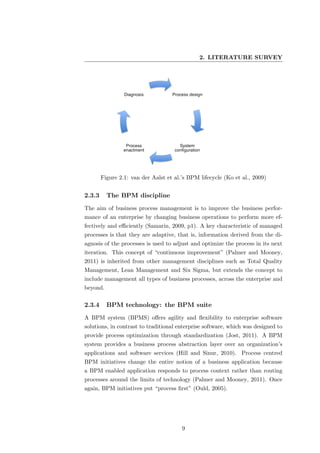
understanding of the BPM lifecycle is necessary. van der Aalst (2004) identifies
a BPM lifecycle comprised of four stages (see Figure 2.1), as summarized here
by Ko et al. (2009):
   • Process design. As-is business processes are modelled in the BPMS.

   • System configuration. The BPMS and the underlying system infrastruc-
     ture is configured.

   • Process enactment. Electronically modelled business processes are de-
     ployed in BPMS process engines.

   • Diagnosis. Using analysis and monitoring tools, flow times, process bot-
     tlenecks, utilization, etc. can be identified and improvements suggested.
   The BPM lifecycle may be preceded by other steps, for example, before the
process design phase there is the necessary step of process discovery, which
can involve the collaboration of many different stakeholders in defining the
processes to be modelled. However, once the lifecycle is initiated, the analysis
phase normally will lead back into the design phase in which process improve-
ments suggested in the diagnosis phase can be implemented.


                                       8
2. LITERATURE SURVEY


        Figure 2.1: van der Aalst et al.’s BPM lifecycle (Ko et al., 2009)


2.3.3     The BPM discipline
The aim of business process management is to improve the business perfor-
mance of an enterprise by changing business operations to perform more ef-
fectively and efficiently (Samarin, 2009, p1). A key characteristic of managed
processes is that they are adaptive, that is, information derived from the di-
agnosis of the processes is used to adjust and optimize the process in its next
iteration. This concept of “continuous improvement” (Palmer and Mooney,
2011) is inherited from other management disciplines such as Total Quality
Management, Lean Management and Six Sigma, but extends the concept to
include management all types of business processes, across the enterprise and
beyond.

2.3.4     BPM technology: the BPM suite
A BPM system (BPMS) offers agility and flexibility to enterprise software
solutions, in contrast to traditional enterprise software, which was designed to
provide process optimization through standardization (Jost, 2011). A BPM
system provides a business process abstraction layer over an organization’s
applications and software services (Hill and Sinur, 2010). Process centred
BPM initiatives change the entire notion of a business application because
a BPM enabled application responds to process context rather than routing
processes around the limits of technology (Palmer and Mooney, 2011). Once
again, BPM initiatives put “process first” (Ould, 2005).


                                        9
2. LITERATURE SURVEY


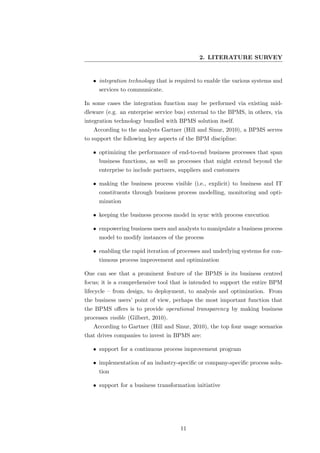
   A BPMS can support the entire lifecycle of business process development –
discovery, modelling, execution, monitoring, optimization – from design-time
to run-time (Kemsley, 2011c) (see Figure 2.2 below). BPMSs provide a com-
position environment and process modelling tools to graphically reassemble
existing functionality outside the suite (usually in the form of services made
available through the implementation of a service oriented architecture) to
create a process application. A registry and repository are required to locate

                      What is a BPMS?
these reusable assets in the form of services (ibid.) (see 2.3.5).


   Performance
   Management
   - Dashboards                                                                       Integration
   - Analytics                                                                         adapters
   - BAM                                                 Performance
                                                             Data                       Business
                                                                                        Systems

                                                                                           ERP


                                                                       Integration
                                                                       Framework
                             Process Design
                                                                                           CRM
   Process Modeling
                             -   Flow
   -   Flow                  -   Resources                 Process                         EJB
   -   Resources/costs       -   Data                      Engine
   -   KPIs                  -   Business rules
                                                                       Business

                                                                                          Legacy
   -   Simulation analysis   -   Forms
                                                                        Rules


                             -   Integration


           Business                 IT                                                Human
                                                  User   User   User        User     workflow


                  Figure 2.2: Components of a BPMS (Silver, 2006)

   According to Linthicum (2009, p129), the other components of a BPM
technology solution are:

   • a business process engine that controls the execution of a process and
        maintains the state of each of the process instances,

   • a business process monitoring interface [performance management] for
        the monitoring and optimization of processes,

   • a business process engine interface that allows the other applications to
        access the business process engine, and


                                                  10
2. LITERATURE SURVEY


   • integration technology that is required to enable the various systems and
     services to communicate.

In some cases the integration function may be performed via existing mid-
dleware (e.g. an enterprise service bus) external to the BPMS, in others, via
integration technology bundled with BPMS solution itself.
   According to the analysts Gartner (Hill and Sinur, 2010), a BPMS serves
to support the following key aspects of the BPM discipline:

   • optimizing the performance of end-to-end business processes that span
     business functions, as well as processes that might extend beyond the
     enterprise to include partners, suppliers and customers

   • making the business process visible (i.e., explicit) to business and IT
     constituents through business process modelling, monitoring and opti-
     mization

   • keeping the business process model in sync with process execution

   • empowering business users and analysts to manipulate a business process
     model to modify instances of the process

   • enabling the rapid iteration of processes and underlying systems for con-
     tinuous process improvement and optimization

One can see that a prominent feature of the BPMS is its business centred
focus; it is a comprehensive tool that is intended to support the entire BPM
lifecycle – from design, to deployment, to analysis and optimization. From
the business users’ point of view, perhaps the most important function that
the BPMS offers is to provide operational transparency by making business
processes visible (Gilbert, 2010).
   According to Gartner (Hill and Sinur, 2010), the top four usage scenarios
that drives companies to invest in BPMS are:

   • support for a continuous process improvement program

   • implementation of an industry-specific or company-specific process solu-
     tion

   • support for a business transformation initiative


                                     11
2. LITERATURE SURVEY


   • support for a process-based, service-oriented-architecture (SOA) redesign

In order to support these various use cases, BPMSs must provide comprehen-
sive functionality and the ability to integrate with the rest of the technology
stack.
   In terms of processes, a BPMS must be capable of handling all of the
following (Kemsley, 2011c):

   • straight through processes (fully automated)

   • long running with human input

   • dynamically changing process flows

   • collaboration within processes

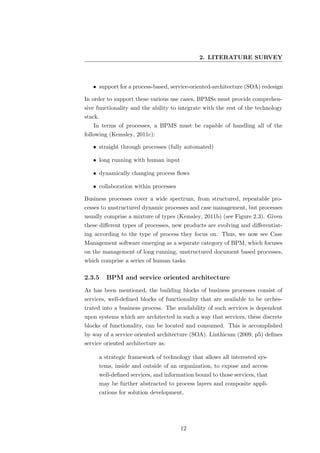
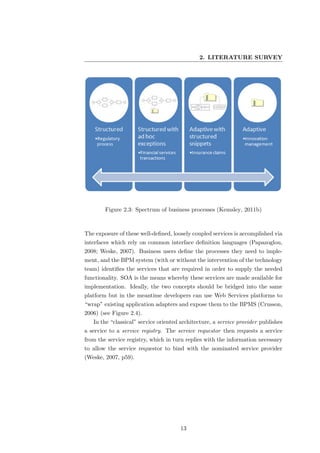
Business processes cover a wide spectrum, from structured, repeatable pro-
cesses to unstructured dynamic processes and case management, but processes
usually comprise a mixture of types (Kemsley, 2011b) (see Figure 2.3). Given
these different types of processes, new products are evolving and differentiat-
ing according to the type of process they focus on. Thus, we now see Case
Management software emerging as a separate category of BPM, which focuses
on the management of long running, unstructured document based processes,
which comprise a series of human tasks.

2.3.5    BPM and service oriented architecture
As has been mentioned, the building blocks of business processes consist of
services, well-defined blocks of functionality that are available to be orches-
trated into a business process. The availability of such services is dependent
upon systems which are architected in such a way that services, these discrete
blocks of functionality, can be located and consumed. This is accomplished
by way of a service oriented architecture (SOA). Linthicum (2009, p5) defines
service oriented architecture as:

     a strategic framework of technology that allows all interested sys-
     tems, inside and outside of an organization, to expose and access
     well-defined services, and information bound to those services, that
     may be further abstracted to process layers and composite appli-
     cations for solution development.


                                      12
2. LITERATURE SURVEY


        Figure 2.3: Spectrum of business processes (Kemsley, 2011b)


The exposure of these well-defined, loosely coupled services is accomplished via
interfaces which rely on common interface definition languages (Papazoglou,
2008; Weske, 2007). Business users define the processes they need to imple-
ment, and the BPM system (with or without the intervention of the technology
team) identifies the services that are required in order to supply the needed
functionality. SOA is the means whereby these services are made available for
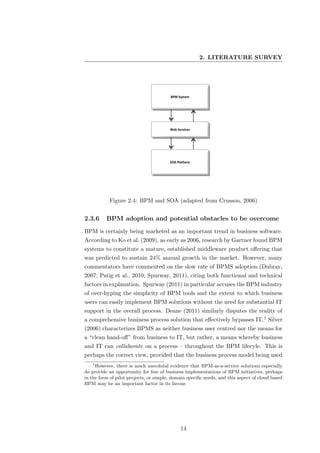
implementation. Ideally, the two concepts should be bridged into the same
platform but in the meantime developers can use Web Services platforms to
“wrap” existing application adapters and expose them to the BPMS (Crusson,
2006) (see Figure 2.4).
   In the “classical” service oriented architecture, a service provider publishes
a service to a service registry. The service requestor then requests a service
from the service registry, which in turn replies with the information necessary
to allow the service requestor to bind with the nominated service provider
(Weske, 2007, p59).


                                      13
2. LITERATURE SURVEY


           Figure 2.4: BPM and SOA (adapted from Crusson, 2006)


2.3.6     BPM adoption and potential obstacles to be overcome
BPM is certainly being marketed as an important trend in business software.
According to Ko et al. (2009), as early as 2006, research by Gartner found BPM
systems to constitute a mature, established middleware product offering that
was predicted to sustain 24% annual growth in the market. However, many
commentators have commented on the slow rate of BPMS adoption (Dubray,
2007; Patig et al., 2010; Spurway, 2011), citing both functional and technical
factors in explanation. Spurway (2011) in particular accuses the BPM industry
of over-hyping the simplicity of BPM tools and the extent to which business
users can easily implement BPM solutions without the need for substantial IT
support in the overall process. Deane (2011) similarly disputes the reality of
a comprehensive business process solution that effectively bypasses IT.1 Silver
(2006) characterizes BPMS as neither business user centred nor the means for
a “clean hand-off” from business to IT, but rather, a means whereby business
and IT can collaborate on a process – throughout the BPM lifecyle. This is
perhaps the correct view, provided that the business process model being used
   1
     However, there is much anecdotal evidence that BPM-as-a-service solutions especially
do provide an opportunity for line of business implementations of BPM initiatives, perhaps
in the form of pilot projects, or simple, domain specific needs, and this aspect of cloud based
BPM may be an important factor in its favour.


                                             14
2. LITERATURE SURVEY


can be easily shared and understood by both parties.1
   The current standard for BPM modelling is BPMN 2.0 (Business Process
Modelling Notation). The goal of BPMN is

        to provide a business process modeling notation that is readily us-
        able by business analysts, technical developers and business peo-
        ple that manage and monitor these processes. One of the goal of
        BPMN is also to be able to generate execution definitions (BPEL4WS)
        that will be used to implement the business processes. As such,
        BPMN positions itself as a bridge between modeling and execu-
        tion and between people that run the business and implementers
        of systems that support the business. (Dubray, 2004)

Many commentators have questioned the degree to which BPMN 2.0 is actually
accessible to average business users (rather than specialists, such as business
analysts), and its ultimate suitability for the modelling of executable processes
of any degree of complexity (ebizQ, 2011).
   Another obstacle in the path of BPM adoption using BPMN is the “round-
tripping problem”, as described by Silver (2007):

        A process model created in BPMN or comparable flowcharting
        notation could not be easily kept in sync with the executable BPEL
        design throughout the implementation lifecycle. Essentially, you
        couldn’t update the process model from the BPEL.. . . So the model
        was not a continuous business view of the implementation. In fact,
        it was still what it had always been – initial business requirements.

Some vendors tried to bypass this problem by focusing on human-centric pro-
cesses, leading to a new style of BPMS

        in which executable design is layered directly on top of the process
        model, in the form of implementation properties of BPMN activ-
        ities. The new style does not create a handoff between different
        tools (with different flow models, data models, and programming
        models), but leverages a single tool shared by business and IT,
        with business focused on the activity flow and IT focused on mak-
        ing those activities executable. (Silver, 2007)
   1
       This “round-tripping problem” is discussed below.


                                             15
2. LITERATURE REVIEW


However, this solution was a partial one at best. Dubray (2007) suggested
that (as of 2007) no vendor could claim that “a general purpose engine that
business analysts can use (even with minimal intervention from IT) to create
a solution from process models” had been delivered. Agreeing with Silver,
he claimed that the limited success that vendors had achieved was the result
of the focus on human-centric processes, “which for the most part fit well
the centralized view of a business process engine developed by these vendors,
especially when limited customization of and integration with existing systems
is needed (ibid.).”
   In summary, problems with the complexity of the BPMN modelling no-
tation, coupled with the difficulties relating to the translation of models into
executable code (using BPEL) meant that vendors were faced with an under-
standable resistance to widespread adoption of BPMSs.
   Indeed, based on the responses of over 130 Forbes 2000 Global companies,
a recent study by Patig et al. (2010) showed BPM adoption to be at a lower
level than what might be expected. The authors found that BPM maturity
in most companies was at a low to intermediate level, and cited the lack of
BPM in a SaaS format as being one possible factor contributing to the lack
of adoption, with the over-complexity of bundled BPM modelling tools being
suggested as another.
   Although the adoption of BPM products continues to advance, the extent
to which business processes are utilizing cloud based services is still quite low;
a Gartner survey conducted in 2010 found that only 40% of companies with
BPM systems had even a small proportion (10%) of their processes utilizing
services based in private or public clouds (Gartner, 2011).


2.4     Cloud computing
It is difficult to agree on a comprehensive definition of cloud computing, as
it is a technology which supports a wide variety of use cases. As a general-
ization, Wardley (2009) characterizes cloud computing as “a disruptive shift
of the computer stack to online services”, allowing on-demand access to soft-
ware applications, development and deployment environments, and computing
infrastructure, on a pay-per-usage basis.


                                       16
2. LITERATURE REVIEW


2.4.1    Defining cloud computing
A more comprehensive definition has been proposed by the National Institute
for Standards and Technology (NIST, 2011):

     Cloud computing allows computer users to conveniently rent ac-
     cess to fully featured applications, to software development and
     deployment environments, and to computing infrastructure assets
     such as network-accessible data storage and processing.

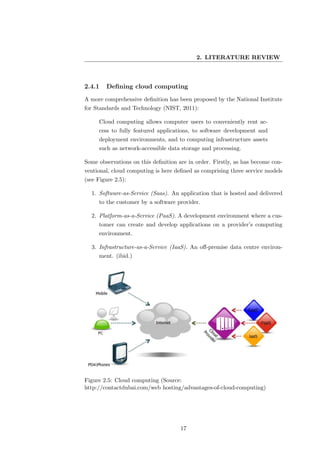
Some observations on this definition are in order. Firstly, as has become con-
ventional, cloud computing is here defined as comprising three service models
(see Figure 2.5):

  1. Software-as-Service (Saas). An application that is hosted and delivered
     to the customer by a software provider.

  2. Platform-as-a-Service (PaaS). A development environment where a cus-
     tomer can create and develop applications on a provider’s computing
     environment.

  3. Infrastructure-as-a-Service (IaaS). An off-premise data centre environ-
     ment. (ibid.)


Figure 2.5: Cloud computing (Source:
http://contactdubai.com/web hosting/advantages-of-cloud-computing)


                                     17
2. LITERATURE REVIEW


Secondly, cloud computing services are “rented”, that is, the service is provided
and charged for on the basis of usage, either based on a subscription model,
or on actual usage, such as compute cycles consumed or data stored. Thirdly,
the services can be “conveniently accessed”, which effectively means by way
of any standard web browser.
   NIST (2011) go on to caution that a comprehensive definition of cloud
computing is not possible, due to the fact that “cloud computing is not a
single kind of system, but instead spans a spectrum of underlying technologies,
configuration possibilities, service models, and deployment models”. However,
the following five characteristics are identified:

  1. On-demand self-service. The service can be accessed by the user, as and
     when required.

  2. Broad network access. The service can be accessed from a variety of
     devices, using standard network protocols.

  3. Resource pooling. The service uses a multi-tenant model, using a combi-
     nation of physical and virtual machines, assigning resources dynamically
     according to user demand.

  4. Rapid elasticity. From the customer’s point of view the service can be
     scaled up or down on demand, as needed.

  5. Measured service.     Resource usage is monitored for the purposes of
     billing, as well as for service quality purposes. (ibid.)

   Finally, four deployment models are identified:

  1. Private cloud. The cloud infrastructure is for the sole use of the organi-
     zation, although it may be managed by a third party and may be located
     off-premise.

  2. Community cloud. As above but with the infrastructure being shared
     by a number of organizations with shared concerns.

  3. Public cloud. The infrastructure is owned and operated by a provider
     and made available to the public.

  4. Hybrid cloud. A combination of two or more of the above types of
     clouds which remain distinct, yet are bound together by standardized


                                       18
2. LITERATURE REVIEW


      or proprietary technology that enables data and application portability
      (e.g. “cloud bursting” for load balancing between clouds). (ibid.)

   In what may be seen as an indication of the rapid evolution and maturation
of the cloud computing paradigm, Linthicum (2009) proposes the to catego-
rization of cloud computing with increased granularity, thereby identifying 11
major categories:

   1. Storage-as-a-service

   2. Database-as-a-service

   3. Information-as-a-service

   4. Process-as-a-service

   5. Application-as-a-service

   6. Platform-as-a-service

   7. Integration-as-a-service

   8. Security-as-a-service

   9. Management-as-a-service

 10. Testing-as-a-service

 11. Infrastructure-as-a-service

It should be noted that process-as-service here refers to ready to use processes,
that is, a set of orchestrated services that can be consumed as a component to
be further orchestrated into a larger process; it does not refer to a platform for
the the construction and management of business processes (a BPMS). Most
BPM cloud offerings are classified as Software-as-a-service or Platform-as-a-
service.

2.4.2      Characteristics of cloud computing
Architecture.       Insofar as the cloud is preeminently designed to provide ser-
vices, the cloud shares with SOA a common foundation (see 2.3.5). According
to Rosen (2011), “the same service design principles that make a good SOA
service need to be applied to a cloud service: well defined interfaces, loose
coupling, proper decomposition, common semantics, etc.”


                                        19
2. LITERATURE REVIEW


Use cases. Armbrust et al. (2010) identify three main use cases for cloud
computing: (1) when demand for a service varies with time, (2) when demand
is unknown in advance, and (3) for batch data analytics requiring short bursts
of high resource usage.

Advantages.     The primary economic advantage of cloud computing is a re-
sult of the elasticity of the service: because the service is made available on
demand, there is no need to over-provision resources to meet peak demand;
similarly, there is no risk of under-provisioning and the resulting loss of rev-
enues due to the inability to meet demand (ibid.). Elasticity refers to the
ability of the service to expand or contract resources in the very short term –
almost instantaneously – according to load. Consumers pay for the resources
they are using, unlike on-premise resources which need to always maintain the
capacity to cope with peak demand levels.
   Another advantage of the cloud model is scalability. With reference to
cloud services, scalability is often used synonymously with elasticity, however,
scalability may also refer to the ability of a cloud based service to facilitate
an expansion of business operations, not in the moment, but rather, over
time. Whereas elasticity refers to the responsiveness of resource allocation
to workload, and is characteristic of shared pools of resources, scalability is
a feature of the underlying infrastructure and software platforms (Gartner,
2009).

Concerns.     Cloud computing necessarily involves trusting ones data to a
third party, so in addition to there being the normal concerns about data
security that are applicable in any context, there are also concerns about to
what degree the provider is capable of guaranteeing security, especially when
their arrangements may involve other third parties, for example, the utilization
of storage provision from other cloud providers.
   Cloud customers also need to be aware of where their data might be stored,
as that has implications for data privacy, which is dependent upon the laws
of the country under whose jurisdiction the stored data falls. According to
Kemsley (2011, pers. comm., 12 June), “many companies are reluctant to
put their processes in the cloud because of the potential for not only security
breaches, but also government intervention in the data.”
   Finally, cloud computing admits of all of the security concerns inherent


                                      20
2. LITERATURE REVIEW


to large-scale systems, especially those that depend on “virtualization tech-
nologies that are still not well understood” (Chorafas, 2010, p206). Of course,
much of the cloud computing model is heavily dependent upon virtualization
technology.


2.5     Cloud BPM
In the preceding sections the two constituents of Cloud BPM were considered
is some detail. In the following section the focus returns to Cloud BPM proper,
beginning with a brief glimpse into its the origins.

2.5.1   History
According to Weske (2007, p25), “business process management mainly deals
with information systems in the context of enterprise systems architectures.”
Today, the nature of this architecture is changing as the needs of business,
and the nature of the business processes that support business, are changing.
The latest development in this evolution of enterprise systems architecture
is the growing adoption of cloud computing technologies, as described above
(Section 2.4). Cloud BPM, the marriage of BPM and cloud computing tech-
nologies, is the logical outcome of the need to manage business processes in
this new context of cloud computing. The more processes move off-premise,
the more compelling the argument for cloud based BPM becomes (Cordys
B.V., 2011a).
   In earlier times, although in a free market economy services should be
most economically provided externally, for corporations operating at scale,
most services could be provided more efficiently in-house, saving the additional
expenses that would be incurred in locating, contracting, coordinating and
paying for such services from external sources (Hugos and Hulitzky, 2010, p1).
Today, however, because of the technological advances that afford increased
connectivity through web services and the like, it is increasingly the case that
services can be procured more economically outside the enterprise. Thus,
the modern enterprise itself has metamorphosed into a new incarnation, that
of the “virtual enterprise” (Hugos and Hulitzky, 2010). These developments
initially led to the outsourcing of complete business processes, but today, as
the services on offer become increasingly granular and accessible, more control
can be gained by orchestrating these services to compose business processes in


                                      21
2. LITERATURE REVIEW


the form of custom composite applications that are flexible, agile and adaptive
(see Dubray, 2008).
   The first glimmerings of Cloud BPM emerged around 2006 or so, when
vendors began to offer modelling tools that would run in a browser and be
accessible on the internet, announcing these as “BPM platforms offered as
a service”. However, these were not considered as tools fit for any serious
BPM purpose (Ghalimi, 2007). Writing in 2006, Khan stated that a “True
BPM”-as-SaaS offering should be capable of “managing and executing com-
plex, personalized, fully-integrated, mission-critical processes and have the
ability to adapt the processes on the fly to meet changing business condi-
tions”. In stark contrast, he noted that the BPM-as-SaaS offered at that time
was restricted to providing partial functionality, such as modules providing
modelling or documentation, templates offering simple pre-defined processes,
or simple hosting. Both authors were implying that SaaS BPM should include
the ability to execute processes. He also identified a lack of flexibility as being
one of the limiting features of SaaS in general and puts this forward as being
a challenge for vendors wishing to provide a BPM-as-SaaS.
   By 2009, bloggers were beginning to ask what BPM in the cloud was,
and what it might be good for, writing articles with titles such as “BPM and
cloud computing” (Silver, 2009) and “BPM in the Cloud: one plus one is
more than two” (Byron, 2009a). Some of these articles are discussed below,
in Section 2.5.4.
   By 2010, ten of the top 15 BPMS vendors (based on worldwide total BPMS
software revenue in 2009) were offering cloud-enabled BPMS platforms (Gart-
ner, 2010), with a much larger number of smaller vendors adding to the mix
of options available. Some of these offerings are discussed in the following
section.

2.5.2      Vendor offerings
In this section, overviews of a small sample of Cloud BPM products are given.
The products mentioned are from the vendors Appian, BonitaSoft, Cordys,
and Intalio.


                                       22
2. LITERATURE REVIEW


2.5.2.1    Appian

Appian is one of the top vendors of BPM offering a cloud enabled BPMS.
A web search on “Cloud BPM” consistently has Appian Cloud BPM as the
first result, and this has been the case for the duration of this project (June –
September 2011). Their choice of the generic-sounding “Cloud BPM” as the
name of their offering appears to have been a good choice in search engine
optimization terms. Appian’s Cloud BPM webpage mentions decreased costs
as the principal benefit of this deployment method, and goes on to tout Ap-
pian’s security and reliability features. Clearly, Appian think that customers
are looking for cost savings (as well as rapid deployment timeframes), and are
most concerned about the security and reliability of cloud deployment.
    Appian offers a cloud deployment that affords “the same functionality as
traditional on-premise BPM software deployments” (Appian Corp., n.d.), in-
cluding easy SOA integration using “packaged connectors for common system
interfaces and native support for SOA frameworks” (Appian Corp., 2011a).
Appian’s BPM products include SaaS and PaaS offerings, with PaaS being
the more popular option with customers, according to Samir Gulati, vice pres-
ident of marketing for Appian (All, 2011). In many cases, customers choose
the cloud deployment as a way of expediting the BPM implementation, and
switch over to an on-premise solution once the pilot project is working well
(ibid.).

2.5.2.2    BonitaSoft

Bonita Open Solution is a BPM system using open source technology to pro-
vide a fully featured BPM product including a BPMN modelling tool, a BPM
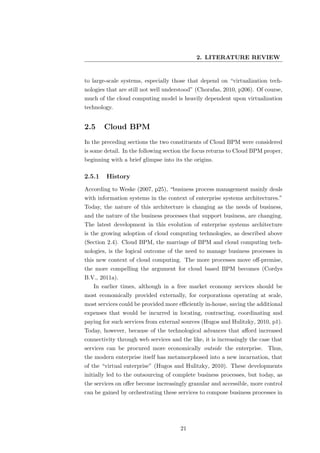
and workflow process engine, and an advanced, clean user interface (see Fig-
ure 2.6) (BonitaSoft, 2011). The Bonita Studio modeller allows users to choose
between a simple or advanced palette, thus determining which subset of BPMN
2.0 features are made available to the user. The modelling component includes
over 100 built-in connectors to build processes that include services derived
from a number of commonly used commercial and open-source databases,
ERPs, CRMs, etc., and also includes process simulation. The monitoring
component features custom dashboards and reports using custom-defined key
performance indicators (KPIs), as well as real-time activity monitoring.


                                      23
2. LITERATURE REVIEW


          Figure 2.6: Bonita Studio (taken from BonitaSoft (2011))


2.5.2.3   Cordys

Cloud based BPM represents only one aspect of Cordys’ grander vision of
creating a comprehensive, cloud based enterprise software platform, utilizing
state-of-the-art technologies to enable enterprise systems that deliver the fea-
tures and performance that the enterprises of today require. The cloud based
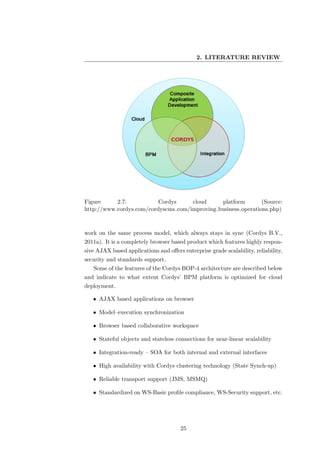
platform comprises three main functions: integration, BPM, and composite
application development (see Figure 2.7).
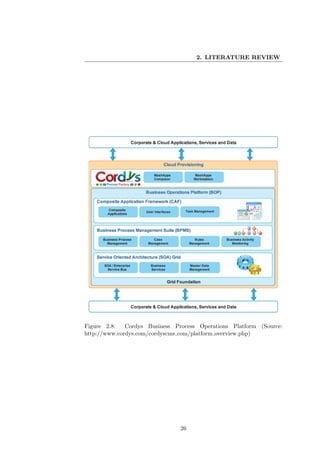
   The Cordys Business Process Management Suite forms one of the main
components of a comprehensive BPM platform called Cordys Business Op-
erations Platform (BOP-4) (see Figure 2.8), which allows for the design, ex-
ecution, monitoring and continuous optimization of business processes, and
includes components such as Business Activity Monitoring (BAM), Master
Data Management (MDM), Composite Application Framework (CAF), and
SOA Grid (ESB). Cordys also offers a more lightweight platform, the Cordys
Process Factory, which allows SMB or departmental users to build and run
process-centric mashup applications on the Web.
   The Cordys BPMS appears to have solved the round-tripping problem
mentioned above; Cordys claims that the platform allows business and IT to


                                      24
2. LITERATURE REVIEW


Figure     2.7:           Cordys     cloud     platform        (Source:
http://www.cordys.com/cordyscms com/improving business operations.php)


work on the same process model, which always stays in sync (Cordys B.V.,
2011a). It is a completely browser based product which features highly respon-
sive AJAX based applications and offers enterprise grade scalability, reliability,
security and standards support.
   Some of the features of the Cordys BOP-4 architecture are described below
and indicate to what extent Cordys’ BPM platform is optimized for cloud
deployment.

   • AJAX based applications on browser

   • Model–execution synchronization

   • Browser based collaborative workspace

   • Stateful objects and stateless connections for near-linear scalability

   • Integration-ready – SOA for both internal and external interfaces

   • High availability with Cordys clustering technology (State Synch-up)

   • Reliable transport support (JMS, MSMQ)

   • Standardized on WS-Basic profile compliance, WS-Security support, etc.


                                       25
2. LITERATURE REVIEW


Figure 2.8:   Cordys Business Process Operations Platform (Source:
http://www.cordys.com/cordyscms com/platform overview.php)


                                26
2. LITERATURE REVIEW


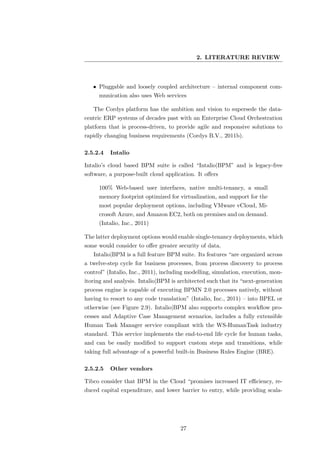
   • Pluggable and loosely coupled architecture – internal component com-
     munication also uses Web services

   The Cordys platform has the ambition and vision to supersede the data-
centric ERP systems of decades past with an Enterprise Cloud Orchestration
platform that is process-driven, to provide agile and responsive solutions to
rapidly changing business requirements (Cordys B.V., 2011b).

2.5.2.4   Intalio

Intalio’s cloud based BPM suite is called “Intalio|BPM” and is legacy-free
software, a purpose-built cloud application. It offers

     100% Web-based user interfaces, native multi-tenancy, a small
     memory footprint optimized for virtualization, and support for the
     most popular deployment options, including VMware vCloud, Mi-
     crosoft Azure, and Amazon EC2, both on premises and on demand.
     (Intalio, Inc., 2011)

The latter deployment options would enable single-tenancy deployments, which
some would consider to offer greater security of data.
   Intalio|BPM is a full feature BPM suite. Its features “are organized across
a twelve-step cycle for business processes, from process discovery to process
control” (Intalio, Inc., 2011), including modelling, simulation, execution, mon-
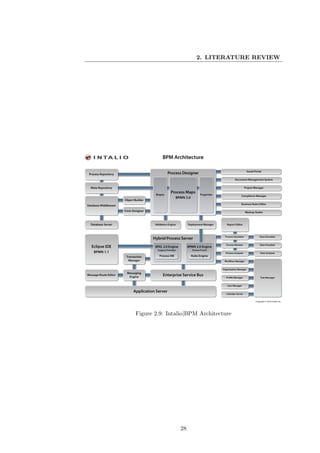
itoring and analysis. Intalio|BPM is architected such that its “next-generation
process engine is capable of executing BPMN 2.0 processes natively, without
having to resort to any code translation” (Intalio, Inc., 2011) – into BPEL or
otherwise (see Figure 2.9). Intalio|BPM also supports complex workflow pro-
cesses and Adaptive Case Management scenarios, includes a fully extensible
Human Task Manager service compliant with the WS-HumanTask industry
standard. This service implements the end-to-end life cycle for human tasks,
and can be easily modified to support custom steps and transitions, while
taking full advantage of a powerful built-in Business Rules Engine (BRE).

2.5.2.5   Other vendors

Tibco consider that BPM in the Cloud “promises increased IT efficiency, re-
duced capital expenditure, and lower barrier to entry, while providing scala-


                                      27
2. LITERATURE REVIEW


Figure 2.9: Intalio|BPM Architecture


                28
2. LITERATURE REVIEW


bility with infinite computing power” (Tibco Software Inc., 2011). Pegasys-
tems (Pegasystems Inc., 2011a) offer in their cloud BPMS product all of the
functionality of their on-premise BPMS, as well as promising “unparalleled
security and reliability” and “out-of-the-box integration to existing data cen-
ters”. They also mention an advantage of the cloud deployment, claiming
that “multi-enterprise processes are ideal for cloud deployment, automating
the interactions between multiple parties and ensuring that SLAs are fulfilled”
(ibid.). But Pegasystems Founder and CEO, Alan Trefler, acknowledges the
reluctance of some users to trust their highly strategic processes and data to
the cloud:

     Business users have become increasingly intrigued by the SaaS
     model, but have told us they are not going to trust their mis-
     sion critical processes, policies and data to an externally hosted
     environment. (Pegasystems Inc., 2011b)

2.5.3   Analyst point of view
In July 2010, the analysts Gartner characterized “cloud enabled BPM” as
an emerging technology with potentially high benefits but with low market
penetration to date (Gartner, 2010). Cloud enabled BPM is defined as “soft-
ware that use BPM technologies to construct and optimize” process-centric
solutions in a software-as-a-service or cloud service delivery model”, technolo-
gies including “high-level process modelling tools, business process analysis
software, workflow, automated business process discovery tools, BPM suites,
business activity monitoring, and business rules management systems” (ibid.).
   Cloud enabled BPM solutions may be provided as a platform-as-a-service
or embedded in software-as-a-service solutions. Two common use cases for
Cloud BPM mentioned are as platforms for collaborative modelling of busi-
ness processes, and the adoptions of BPMSs for BPM pilot projects. Perceived
benefits mentioned are cost savings and scalability, especially for midsize com-
panies who may not otherwise be able to acquire this technology. Cloud en-
abled BPM is also seen as enabling increased collaboration in BPM projects:

     Gartner believes that extreme collaboration is critical to impacting
     change and improving performance. Cloud computing accelerates
     collaboration and allows BPM and SOA initiatives to have an even
     greater impact. (Software AG, 2011)


                                      29
2. LITERATURE REVIEW


   The analysts Forrester mention the value of cloud computing to accelerat-
ing delivery and minimize risk (Kemsley, 2011a).

     BPM-as-a-service will lower barriers to getting started with BPM
     suites. Startup costs for implementing BPM suites can put these
     tools out of reach for some process owners that dont already have
     budget and executive support for launching their process initiative.
     To prove initial value of BPM suites, smart process professionals
     now turn to BPM suites hosted in the cloud often referred to as
     BPM-as-a-service.

2.5.4   Practitioners, bloggers, commentators
Vendors and analysts both have their views regarding cloud enabled BPM, and
these two groups can display a degree of symmetry in their outlook. What
is really important to the future of cloud based BPM, however, is how this
technology is viewed by practitioners of BPM. The source of reference for these
opinions is a number of weblogs and the discussion that they spawn. In these
discussions the true state of Cloud BPM can be discerned – what Cloud BPM
is, what is promises, what it lacks – in short, the issues that the BPM customer
faces when contemplating the purchase and deployment of cloud enabled BPM
systems. Much of this discussion occurred around 2009, when the Cloud BPM
option was just beginning to become available.
   Wainewright (2009) was one of the BPM consultants early on hinting at
the possibility that cloud BPM could offer a new future for BPM. Commenting
on the ebizQ article “How does using a BPM solution in the cloud differ from
using an on- premise BPM application? Which is better?”, he wrote:

     However one might also ask whether, looking further ahead, a cloud
     environment would ultimately change the nature of BPM because
     of factors such as easier modification, more standardized integra-
     tion and APIs, and the ability to do more process integration at
     the user interface layer by taking advantage of standardization on
     web client technologies such as the browser, AJAX, Flex and so
     on.

   Also writing in 2009b, Byron canvassed the views of BPM practitioners
with his ebizQ article, “Calling for input on BPM in cloud computing: let’s


                                      30
2. LITERATURE REVIEW


clear away the fog”. Having done his sums, the results were written up in an
article entitled “BPM in the Cloud: one plus one is more than two” in which
he states:

      One interesting thing about a “BPM in the Cloud” architectural
      analysis is that the basic design of the BPM-enabling software
      (or any other type of software in the cloud) could make a differ-
      ence. Presumably software is more functional if it is designed or
      re-designed to run in the cloud as opposed to simply taking advan-
      tage of the cloud’s characteristics.

Byron goes on to substantiate this claim by citing the view of one vendor,
Software AG, that “the cloud lets BPM analysts and developers more easily
collaborate on process discovery (gathering artefacts, find out who does specific
work, identify who the process expert is, etc.)” (ibid.). In this view the
beginnings of the current focus on social BPM is evident.
   Khoshafian (2011) notes the robust relationship between Cloud BPM so-
cial networking. “Business processes provide the context of collaboration, and
social networking supports and augments the various phases of the BPM con-
tinuous improvement lifecycle”.
   Barlow (2009) points out that cloud BPM platforms provide all the advan-
tages that traditional SaaS offerings such as CRM and workforce management
systems provide, without the expected drawback of reduced flexibility. Since
Cloud BPM is a platform-as-a-service, the system is can evolve functional-
ity through the creation of process-oriented business applications, rather than
merely utilizing the limited, built-in functionality that SaaS software provides.
   Sandy Kemsley (2011, pers. comm., 12 June), a prominent BPM consul-
tant, cited security/privacy concerns as “the biggest issue with cloud BPM”
currently.   Vendors acknowledge these concerns too, Appian for example.
“Cloud computing promises lowered IT costs and faster time-to-value than
traditional on-premise deployments, but the cloud model is still new terri-
tory and many questions particularly around issues of data security persist”
(Appian Corp., 2011b).


                                       31
2. LITERATURE REVIEW


2.6      Summary
In this chapter, the literature surrounding the concept ‘Cloud BPM’ has been
reviewed.1 This began with a discussion of each of the two elements of the
Cloud–BPM marriage – cloud computing and business process management.
Thereafter, Cloud BPM, as it has developed since around 2006 until the
present, and as evidenced by the views of vendors, analysts and BPM practi-
tioners writing on the internet, was discussed. Certain themes have emerged,
and these will inform the tentative definition of Cloud BPM that is proposed,
and then tested, in the chapters following.


   1
     For the sake of completeness, one other manifestation of ‘Cloud BPM’ should be men-
tioned. Linthicum (2009, p127 ff.) discusses the relocation of “information, service and
processes [emphasis added]” to the cloud, rather than the relocation of a BPMS to the
cloud, and is therefore invoking the concept of ‘BPM-as-a-service’, mentioned above in Sec-
tion 2.4.1.


                                            32
3. Methods

3.1    Introduction
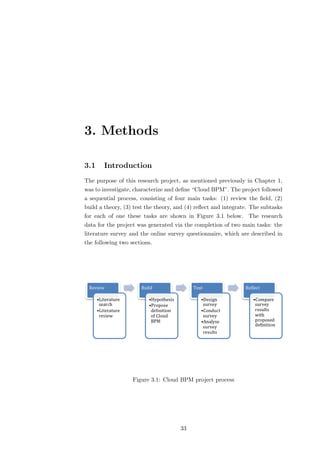
The purpose of this research project, as mentioned previously in Chapter 1,
was to investigate, characterize and define “Cloud BPM”. The project followed
a sequential process, consisting of four main tasks: (1) review the field, (2)
build a theory, (3) test the theory, and (4) reflect and integrate. The subtasks
for each of one these tasks are shown in Figure 3.1 below. The research
data for the project was generated via the completion of two main tasks: the
literature survey and the online survey questionnaire, which are described in
the following two sections.


                   Figure 3.1: Cloud BPM project process


                                      33
3. METHODS


3.2      Literature survey
The first phase of the project (the Review phase) was to conduct a compre-
hensive literature survey of the project domain. The results of the literature
survey have been presented in the the previous chapter (Chapter 2). The
purpose of the literature survey was twofold: (1) to gain familiarity with the
project domain, its issues and defining features, and (2) to gain an under-
standing of the key aspects of the domain, namely, the theory and practice of
business process management and cloud computing, all as a precursor to the
project’s aim of defining “Cloud BPM”. This understanding would provide
the foundation upon which a proposed definition of “Cloud BPM” would be
built.

3.2.1    Literature search
The first aspect of the literature search involved an intensification of the meth-
ods that the author had already employed in developing an interest in the
domain of the project in the first place; thus, the information provided by
industry analysts and bloggers on the Internet was reviewed, and references
to further articles were investigated. Twitter1 provided an important source
of information from both vendors and commentators. The author followed
on Twitter a number of prominent BPM and technology commentators and
analysts, as well as vendors, in order to be alerted of current discussions, up-
coming webinars or new products or features. A partial list of these is provided
in Appendix E. The websites of a number of providers of BPM technologies
were consulted, and many of them provided links to relevant whitepapers, as
well as slide presentations and previously recorded webinars.
   Background research about BPM and cloud computing in general was con-
ducted by way of library searches, using the City University library website2 ,
and the British Library website3 , where a number of books and journals were
located and consulted.
   1
     http://twitter/com/
   2
     http://www.city.ac.uk/library
   3
     http://www.bl.uk


                                      34
3. METHODS


3.2.2      Literature review
Once the main sources for the literature survey had been identified and gath-
ered, the literature review was begun in earnest. The background topics were
researched and written up, and the central topic of Cloud BPM was investi-
gated and presented. The findings of the literature review formed the basis
for the proposed definition and characterization of Cloud BPM (the Build
phase), which was then transformed into a hypothesis (as presented in Chap-
ter 4). The hypothesis was then compared with the results of the online survey
questionnaire (the Reflect phase). The online survey is described in detail in
the next section.


3.3       Online survey
An online survey questionnaire was the method chosen to test the hypothe-
sis (the Test phase) of the definition and characterization of Cloud BPM, as
suggested by the results of the literature review just mentioned. Survey ques-
tions were devised to canvass the opinions of BPM practitioners regarding the
topic domain. The target of the survey consisted of the members of BPM re-
lated groups on LinkedIn1 as listed and described in Appendix B. The survey
received 38 responses.
   Because the survey elicited such a good response, and achieved a sample
size which could be considered significant for the purposes of a qualitative
survey, it was decided that the project would focus on an interpretation of
the data from the survey and dispense with the original idea of canvassing
the opinions of a small number of BPM experts, with the online survey being
a backup plan to gather data if an insufficient number of BPM experts were
available to cooperate in project. The survey provided a broad view of practi-
tioners’ perspective on Cloud BPM, which was what was wanted. The idea of
conducting interviews with a few specific individuals would not have furthered
this goal. The option of follow up was pursued, however, in two cases where
survey responses required further clarification.
   1
       http://www.linkedin.com


                                      35
3. METHODS


3.3.1    Survey design
The survey was entitled “Cloud BPM - a survey” and was administered on-
line. It consisted of 13 closed questions – nine statements to be answered
using the Likert scale, two tick box questions, and two multiple choice ques-
tions – and three open questions. For the sake of clarity, and ease of response,
questions were grouped according to question type. Additionally, a section at
the end of the survey had questions to gather a minimum of personal infor-
mation about the respondents. A survey invitation was sent to a total of 16
different LinkedIn BPM Groups, whose members were invited to complete the
questionnaire. Respondents were advised that a summary of the results of the
survey would be made available to them at a later date, should they wish to
receive this information.

3.3.2    General considerations
The intention of the survey was to gather data about the perceptions of BPM
practitioners about Cloud BPM – what it is and what advantages or dis-
advantages it might have. The survey was intended as (in the words of one
respondent) “a lightweight overview of current practitioners’ views of the topic
domain”.

Scope. The first consideration was to produce a survey which covered the
topics that the literature review had suggested as salient.

Delivery.     The next consideration was to produce a questionnaire that would
be fairly easy to complete and would encourage a high level of participation
from the target group.The online approach was deemed most appropriate as
it would reach a large number of potential respondents. At the same time,
targeting BPM related groups on LinkedIn would mean that respondents could
be assumed to be knowledgeable about, and experienced with, BPM tools and
methods.1 Google Docs was selected as the vehicle for the online survey due
to the author’s previous familiarity with it, as well as its simplicity of use and
clean presentation. A Google spreadsheet is easily transformed into an online
form suitable for a questionnaire.
   1
     Indeed, the level of insight revealed in many of the comments collected indicate the
validity of this assumption.


                                           36
3. METHODS


Style.    In order to make the results capable of easy analysis, a large number
of closed questions were used, with Likert scale type questions used where pos-
sible and forming the majority of the questions to encourage a high completion
rate. The closed questions were actually in the form of statements to which
respondents would respond on a Likert-type scale, ranging from “Strongly dis-
agree” (1) to “Strongly disagree” (5), with a (3) assumed to indicate a neutral
or undecided position – a valid response in the case of these questions and so
not to be excluded by choosing an even number of terms for the scale.
    The assertions were mixed, some being positive statements, others being
negative statements, in order convey a degree of objectivity.Three open ques-
tions were also set, mainly to give respondents a chance to personalize their
responses. This was for two reasons: firstly, to draw out new insights that the
other questions may not have adequately addressed, and secondly, to give the
respondents the satisfaction of contributing a more personal view.

Respondent information. It was considered appropriate to obtain data
on three aspects of the respondents: (1) their relationship or role with respect
to BPM, (2) the size of the company they represented (if applicable), and (3)
the industrial sector that their company falls under.1 The motivation behind
these questions was as follows.
    It was considered desirable to determine what role the respondents had
to BPM, and where they might fall within the business–IT spectrum, that is,
whether they were business users (management, end users), software devel-
opers (either working for customers or vendors), or working on the interface
between business and IT (e.g. business analysts), or any other role (e.g. aca-
demic). It has become a convention to talk about the gap between business
and IT and it was thought important to assess where respondents stood in
relation to this dividing line.
    Especially in the case of respondents being end users, it was of interest
what sector the company operated in, as well as the company size, in order
to gauge what types of companies were interested in Cloud BPM, and what
types of processes Cloud BPM would be enacting.2 With regard to industrial
   1
      It was not considered that respondents’ age or gender was of any significance, nor their
country of residence or activity, nor their number of years of involvement in the problem
domain, and so these types of information were not sought, and this served to streamline
the process.
    2
      Business size rankings were based on the European Union definition (see


                                             37
3. METHODS


sector, in addition to the using the traditional categories of primary, secondary
and tertiary sectors (corresponding to oil and gas, manufacturing, and services
respectively), a fourth category – “IT services” – was added, to allow a finer
grained picture to emerge.
   All of the above questions were also intended to determine the degree of
variety in the sample, in order to gauge whether the results could be considered
representative of the target population.

3.3.3    Survey target
Members of LinkedIn BPM groups were chosen as the target of the survey
for the following reasons. LinkedIn is a social networking site that is focused
on the needs of professional business users. LinkedIn provides users with a
professional online presence, and allows members to connect with each other
(becoming “connections”) and follow their activities and discussions. Members
may also join groups. LinkedIn Groups allow LinkedIn members to follow and
participate in discussions around topics of interest specific to the group. Such
groups can usually be joined by membership only and for this reason anyone
reading and responding to posts in the group can be assumed to have a genuine
interest and some level of expertise in the subject domain of the group.

3.3.4    Motivation of questions
This section describes the the rationale and motivations behind each of the
survey questions, which were grouped into four sections.

SECTION 1.         The first three survey questions, grouped under the heading
“Defining Cloud BPM”, were intended to derive a general sense of how respon-
dents perceived the term “Cloud BPM” as it is used currently. The literature
review had identified three main usages of the term and in the first question
these were suggested as possible responses. A fourth option of “Other” was
given, with a blank field provided for the respondent to supply their own
preferred definition.

   Q1.1 What do you think is usually intended by the term “Cloud
BPM”?
http://en.wikipedia.org/wiki/Small and medium businesses).


                                          38
3. METHODS


    • the design and deployment of processes that utilize external web services

    • any BPM tool (e.g. modelling) which can be accessed over the internet

    • a BPM system that is deployed off-premise and consumed as a service

    The third option is the most specific and relates to a comprehensive BPM
solution or “suite”, functionally equivalent to existing on-premise BPM suites.
The second definition is more general and refers to any type of BPM tool (typ-
ically, a modelling tool) that is accessible online through a browser. The first
definition refers to a completely different notion, that of constructing busi-
ness processes which incorporate externally sourced cloud services or services
combined as processes, that is, BPM using cloud services rather than a BPM
software system that runs in the cloud.

    Q1.2 According to your definition of Cloud BPM, a cloud based
BPM solution must include which of the following components?

    • process modelling

    • process discovery

    • process execution

    • process monitoring

    • process analysis

    • process simulation

    • Other:

    The next question was intended to follow on from the assumption that
Cloud BPM did in fact refer to a comprehensive BPM solution consumed as a
service, and to determine what components such a solution would comprise.1
In other words, what sort of functionality would the respondents require from
a Cloud BPM solution? The three core components of BPM were included
– process modelling, process execution, process analysis – as well as optional
components such as process monitoring and process simulation. Other options,
   1
     It should be noted that of the three definitions proposed in the previous question, the
author judged the first to be the most prevalent in the literature, and the results of the
survey conducted substantiated this view.


                                            39
3. METHODS


such as a process repository or process marketplace were not included for fear
of including too many tick boxes, but an “Other” box was included to cater
for respondents who felt that other options were essential.

       Q1.3 Cloud BPM is simply a delivery model for BPM tools - no
more, no less. (It’s not about WHAT you get, but HOW you get
it.)     [Likert scale]
       The final question in this section was intended to test the hypothesis that
Cloud BPM is no different from on-premise BPM, only the method of delivery
is different. The contrary of this would be that the nature of the cloud platform
for delivery of BPM solutions either (a) enhances or (b) detracts from the end
product, functionally of technically. Most of the respondents agreed with
the proposition that Cloud BPM is simply a model of delivery, having no
implications on the nature of the product in itself.

SECTION 2. The next section of the survey was headed “Characterizing
Cloud BPM” and was intended to tease out some of the issues that surround
cloud based BPM solutions.

       Q2.1 Cloud BPM is a solution which is attractive mainly to the
SMB market.           [Likert scale]
       The first question of this section related to whether Cloud BPM was pre-
dominantly a solution that appealed to small and medium-sized businesses
rather than large enterprises. The hypothesis here is that many of the bene-
fits of cloud based BPM are related to the minimization of capital expenditure
and initial outlay required, lowering the barrier of entry to BPM solutions.

       Q2.2 Cloud BPM is not suitable for the design and deployment
of complex business processes.           [Likert scale]
       The next question sought to gauge the respondents’ perception of the ca-
pabilities of cloud based BPM solutions by proposing that Cloud BPM is not
suitable for the deployment of complex business process. The implication is
that Cloud BPM solutions are more geared towards the creation of mashups,1
or the design and implementation of comparatively lightweight processes that
   1
     Web applications that combine data and/or functionality from more than one source
(http://en.wikipedia.org/wiki/Mashup)


                                         40
3. METHODS


can make use of existing templates and built-in connectors to the required
services.

   Q2.3 New BPM initiatives pursued using a cloud BPM platform
will attract a lower level of business risk than the same project
pursued using traditional, on-premise methods. [Likert scale]
   This question was meant to gauge the respondents’ perception of whether
cloud based BPM is better suited for developing new BPM initiatives eas-
ily, without requiring the mobilization of a large amount of IT department
resources in order to implement pilot projects, in other words, attracting a
lower level of business risk for the project.

   Q2.4 Cloud BPM entails serious - and in some cases, prohibitive
- security risks.    [Likert scale]
   Question 2.4 sought to gauge respondents’ perception of the level of se-
curity risk associated with a cloud based BPM system. The question was
worded to find out if respondents felt that security risks were considered to
be of such a degree that they might seriously impact any decision to be made
about deploying BPM in the cloud.

   Q2.5 One of the main advantages of Cloud BPM is its synergy
with ‘social’ BPM technologies.          [Likert scale]
   Question 2.5 sought to gauge respondents’ perception of the link between
cloud based BPM and social technologies that enable users to more easily col-
laborate in the design processes, as well as monitor processes that are running.
The hypothesis is that a cloud based BPM system is better suited architec-
turally for the provision of such functionality.

   Q2.6 Due to its high strategic value to the organization, BPM is
not a suitable candidate for a cloud implementation. [Likert scale]
   Question 2.6 aimed to test the hypothesis that since the business processes
that a company runs are of high strategic importance, due to the security con-
cerns associated with hosting the process information in a cloud environment,
a cloud environment is not suitable for the implementation of a BPM system.


                                       41
3. METHODS


   Q2.7 The full benefits of a cloud based BPM system will only
be realized when the application is purpose-built for deployment in
the cloud.    [Likert scale]
   Question 2.7 sought to gauge the respondents’ perception of the utility of
Cloud BPM towards introducing BPM initiatives easily and quickly, perhaps
on an experimental or pilot basis. The hypothesis here is that cloud based
BPM solutions can be introduced and trialled at a very low cost, without the
need to purchase new hardware or software, and without relying on the IT
department to mobilize for this change. In other words, Cloud BPM ban put
a BPM solution into the hands of the business users and allow them to pursue
pilot projects for a quick win, in order to demonstrate the efficacy of BPM
solutions in general.

   Q2.8 The full benefits of a cloud based BPM system will only
be realized when an organization’s IT stack is predominantly cloud
based.   [Likert scale]
   Question 2.8 was intended to gauge respondents’ perception of whether
cloud based BPM was more suited to the management of business processes
when the rest of the IT stack was cloud based. The hypothesis here is that
cloud based BPM makes the most sense when the systems that it is interacting
with are architected specifically to operate in a cloud environment.

   Q2.9 What are the main reasons for an organization to choose
a cloud based BPM solution over an on-premise solution? (Please
tick a maximum of FIVE reasons only.)

   • quicker time to market

   • lower start up costs

   • reduced capital expenditure

   • higher return on investment

   • increased business agility

   • elasticity of service

   • reduced total cost of ownership


                                       42
3. METHODS


   • scalability of service

   • better process collaboration

   • Other

The last question in this section suggested some of the possible advantages
associated with cloud based BPM, and requests that the respondent choose
up to five main reasons. This question sought to identify the features of cloud
based BPM that respondents considered to be the most important.

SECTION 3. This section consisted of two open questions and was in-
tended to give respondents a chance to express their own views about Cloud
BPM’s advantages and disadvantages. It was expected that many respondents
would merely seek to emphasize certain points already covered in the survey
in previous questions, but it was hoped as well that some respondents might
provide new insights which the author had possibly missed. The questions
were worded as follows.

   Q3.1 What are the main ADVANTAGES (business, functional,
technical, etc.) of a cloud based BPM solution?          [Text box]

   Q3.2 What are the main DISADVANTAGES (business, func-
tional, technical, etc.) of a cloud based BPM solution? [Text box]

SECTION 4.       The final section of the survey was entitled ‘About you’ and
was intended to gather relevant personal data relating to the respondents, as
well as allow them to comment on the survey.

   Q4.1 Which of the below best describes your primary role with
respect to with BPM?

   • business analyst

   • management level user of BPM methods and/or technologies

   • end user of BPM technology

   • software developer


                                     43
3. METHODS


   • researcher or academic

   • researcher or academic

   • student

   • other

   Q4.2 What is the size of your company by number employees?

   • < 50

   • 50–249

   • 250–999

   • 1000–4,999

   • > 5,000

   • n/a

   Q4.3 Which sector does your company primarily operate in?

   • oil and gas, mining, or agriculture

   • manufacturing

   • services

   • IT services

   • n/a

   Q4.4 Please use the space below to provide any additional re-
marks about Cloud BPM and/or to comment on this survey. [Text
box]
   The final question was intended to elicit comments from the respondents
about the form and content of the survey, but also to give respondents a chance
to bring to light any important issues that may have been omitted from the
survey.


                                      44
3. METHODS


3.4    Proposed definition
The Review (literature review) and Test (online survey) phases of the project
were described in the above two sections. However, in terms of the research
process, prior to the Test phase the Build phase had to be completed. This
entailed the process of distilling the results of the literature review into a
proposed definition of “Cloud BPM” and the formulation of the project hy-
pothesis. The results of this phase, that is, the proposed definition of Cloud
BPM, are presented in Chapter 4.


3.5    Evaluation of proposed definition
The final phase of the project, the Reflect phase, focused on the comparison
of the proposed definition of Cloud BPM with the results of the online survey.
This is discussed in Chapter 5.


3.6    Summary
In this chapter the various phases, tasks and research methods used during
this project have been detailed. The research method followed a sequential
process – survey, build, test, reflect – and comprised a literature review and
an online expert survey as its pillars, with the proposed definition of Cloud
BPM and its evaluation representing their respective fruits.
   In the next chapter, the results of the literature review and the online
survey are presented. Based on the literature survey, a tentative definition of
“Cloud BPM” is proposed, and the results of the online survey are presented
in a summarized form.


                                     45
4. Results

4.1     Introduction
This chapter presents the results of the research conducted with the objec-
tive of defining “Cloud BPM”. First, the definition of “Cloud BPM” that was
formulated and distilled from the comprehensive literature review (see Chap-
ter 2) is presented. Following that are presented the results of the online expert
survey, which was devised to test the validity of the proposed definition by
comparing it with the views of experts in the field, as far as these could be
inferred from their responses to the survey questions.


4.2     Literature analysis
Having completed the literature review, the next phase of the project was to
to summarize the key findings of the literature survey, in anticipation of the
formulation of a definition of “Cloud BPM”. The key findings were listed (see
Appendix F) and working from these points, a series of assertions regarding
Cloud BPM was developed.
   In the next section, a descriptive definition and characterization of Cloud
BPM is proposed. Following this, the definition is presented as the hypothe-
sis, clarified and expressed as a series of assertions that will encapsulate the
definition and characteristics of Cloud BPM. It is this series of assertions en-
capsulating the hypothesis regarding Cloud BPM that the online survey was
intended to test.

4.2.1    Description of Cloud BPM
Definition.     Although BPM is both a methodology and a set of tools, Cloud
BPM clearly falls into the category of a technology: Cloud BPM is a specific


                                       46
4. RESULTS


type of technology which fully supports the practice of BPM, that is, it is a
BPMS, the key characteristics of which are its on-demand availability and its
pay-per-use pricing model.

Market.     Research indicates that Cloud BPM is of primary interest to small
and medium size enterprises, as well as for localized pilot BPM projects within
large enterprises. In the case of SMBs, the low startup costs associated with
Cloud BPM platforms mean that there is a lower barrier to entry to this tech-
nology. As for large enterprises, low startup costs mean that new departmental
BPM initiatives can be trialled, and in many cases implemented, without the
need to involve the IT department and its cumbersome procurement proce-
dures.

Functionality. Cloud BPM functionality should support all of the primary
phases of the business process lifecycle (design, configure, enact, diagnose)
and be capable of supporting both structured and unstructured processes,
and both human task centred and automated processes, or a combination of
these.

Delivery.     A Cloud BPM system should be a SaaS or PaaS offering, with a
multi-tenant architecture that allows frequent and instant system upgrades.
A significant number of established vendors provide BPMS offerings that are
deployable either in the cloud or on-premise, with identical functionality, ac-
cording to customer needs.

Advantages.      The main advantage of Cloud BPM is the lower startup costs
and the flexibility afforded by a system that is available as a service. A further
important benefit is the elasticity of the service provided, with the associated
cost benefits.

Disadvantages.      The main disadvantages associated with Cloud BPM are
the security concerns that arise from the hosting of valuable business data
off-premise.

   Future trends.      Although there is no clear link between added function-
ality and cloud architecture at this moment, current trends point towards the


                                      47
4. RESULTS


growing importance of the cloud platform (PaaS) sector of cloud provision,
and BPM as a practice and technology is perfectly suited to this development.
A BPM platform in the cloud will provide the flexibility and agility that is
key to successful business process management, allowing all of the advantages
of a SaaS offering, without its restrictions in terms of functionality and cus-
tomizability.

4.2.2    Hypothesis statement
Based on the above findings of the literature review, a hypothesis is proposed
below. The hypothesis statement consists of a series of assertions, the asser-
tions being of two types. The first type are firm assertions (Type 1) which
can be tested by a consideration of the null hypothesis, that is, the negation
of the assertion. The second type of assertions are tentative (Type 2), that
is, the assertion is made merely for the purpose of gathering further research
data in the form of respondents’ views on a particular aspect of the domain,
with a view to deciding the validity of the assertion.

   Type 1:

   • Cloud BPM is a BPM system that is deployed off-premise and consumed
     as a service.

   • A cloud BPM system should be capable of executing the core activi-
     ties that support business process management, i.e. process modelling,
     process execution, process monitoring, and process analysis.

   • Cloud BPM is essentially a reference to a delivery model for BPM tools
     and technology, rather than to a new type of functionality.

   • Cloud BPM is a solution which is attractive mainly to the SMB market.

   • New BPM initiatives pursued using a Cloud BPM solution will attract
     a lower level of business risk over traditional methods, and this charac-
     teristic is a driver for the adoption of Cloud BPM.

   • Cloud BPM entails significant security risks.

   • The full benefits of Cloud BPM will be more fully realized when the
     application is purpose built for cloud.


                                      48
4. RESULTS


   • The primary advantages of Cloud BPM relate to cost benefits and quicker
        startup times, and elasticity of service.

   Type 2:

   • Cloud BPM is suitable for complex processes.

   • The benefits of Cloud BPM are not dependent on the full IT stack being
        cloud based.

   • Notwithstanding its high strategic value to the organization, BPM is
        suitable for a cloud implementation.

   • Cloud BPM may have some advantages with respect to its integration
        with social technologies.

   Taken together, these assertions constitute the hypothesis, that is, these
assertions are considered to be an encapsulation of the term “Cloud BPM” as
is is currently employed by BPM vendors, analysts and practitioners. These
assertions will be tested by way of an online survey, which will present the
assertions in the form of a variety of questions.
   The structure of the online survey has been mentioned previously, in Sec-
tion 3.3. The following section provides a summary of the survey results. A
discussion of the results and their implications for the proposed hypothesis
follows in Chapter 5.


4.3        Survey questionnaire results
As discussed in the previous chapter (Chapter 3), the online survey question-
naire “Cloud BPM – a survey” was posted to 16 different BPM groups on
LinkedIn and over a period of two weeks received 38 responses. The results of
the survey are summarized in the sections below.1

4.3.1       Respondent-specific information
The survey included three personal questions relating to the respondents –
their role in relation to BPM, the size of the company they are associated
with (if any), and the industrial sector of the company.
   1
       The summary of responses generated by the online survey is shown in Appendix G.


                                            49
4. RESULTS


    The results of these three questions are given below in Figures 4.1, 4.2 and
4.3 and are summarized as follows.

BPM role. There was a good mix of respondents with respect to BPM
role. The largest number of respondents to the survey were management level
users of BPM methodologies and/or technologies (34%), followed by software
developers (32%) and business analysts (18%).


                    Figure 4.1: Survey respondents by BPM role


Company size.          Most respondents to the survey (50%) worked in large busi-
nesses1 ,   while 37% worked in small businesses2 . Respondents working in mid-
size businesses constituted 11% of respondents. Again, the sample represented
a good cross section of enterprises by size.

Sector.      With respect to enterprise sector, the sample weighed heavily to-
wards the service sector, with 79% of respondents representing the services
   1
       defined as having more than 250 employees
   2
       defined as having less than 50 employees


                                           50
4. RESULTS


    Figure 4.2: Survey respondents by company size (no. of employees)


and IT services sectors combined, with 53% working in IT services. Only 11%
of respondents worked in companies in the primary or secondary sectors.

4.3.2   Defining Cloud BPM
The first question of the survey asked respondents to choose between three
definitions of Cloud BPM. Of these three definitions, the author judged the
first to be the most prevalent and the research conducted substantiated this
view: an overwhelming 84% of respondents considered that what is meant by
the term “Cloud BPM” is “a BPM system that is deployed off-premise and
consumed as a service” (see Table 4.2). Clearly, to most practitioners, Cloud
BPM implies a BPM system (or suite) rather than a standalone BPM tool
(e.g. modelling only).
   As for the functionality that respondents considered to be essential in
a BPM suite, the results were as shown in Figure 4.4. Respondents chose
process modelling, execution, analysis, and monitoring as the “must have”


                                     51
4. RESULTS


       Figure 4.3: Survey respondents by company sector


                Table 4.1: Survey results – Q1.1

What do you think is usually intended by the term “Cloud
BPM”?
- the design and deployment of processes that utilize external
                                                                5%
web services
- any BPM tool (e.g. modelling) which can be accessed over
                                                                8%
the internet
- a BPM system that is deployed off-premise and consumed
                                                               84%
as a service
- Other                                                         3%


                               52
4. RESULTS


           Figure 4.4: Survey results – cloud BPM functionality


components.
   The last question in this section asked respondents to register their agree-
ment or disagreement (on a Likert scale) regarding Cloud BPM being a means
of delivery of a recognized functionality – no more, no less. The majority of
respondents agreed with this statement as shown in Table 4.2, with the modal
response being 4 (Agree).

                      Table 4.2: Survey results – Q1.3

         Cloud BPM is simply a delivery model for
         BPM tools – no more, no less
         Accept                                                 61%
         Reject                                                 26%
         Mode                                                     4


                                     53
4. RESULTS


4.3.3    Characterizing Cloud BPM
All of the questions in this section, except the last, were statements to be rated
on a Likert scale, with 1 being “strongly disagree” and 5 being “strongly
agree”. A summary of responses to all Likert scale questions is shown in
Appendix D.
   The first question in this section (Q2.1) asked respondents to assess the
statement that Cloud BPM is a solution that is mainly attractive to the SMB
market. Contrary to the expectations of the author, nearly half of the re-
spondents rejected this assertion – 47% of respondents disagreed with this
statement while only 24% agreed with it. This response may suggest a grow-
ing acceptance of the cloud model of deployment, and a rejection of the notion
that it is only of value to SMBs. Or, it may be that respondents were aware
that larger enterprises might be using Cloud BPM for exploratory purposes,
such as in pilot projects. Given that 50% of respondents work in large busi-
nesses, the result of this question can be said to be significant.

                         Table 4.3: Survey results – Q2.1
          Cloud      BPM is a solution which is attractive
          mainly     to the SMB market.
          Accept                                          24%
          Reject                                          47%
          Mode                                              2


   In question Q2.2 the assertion that Cloud BPM is unsuitable for the man-
agement of complex business processes was firmly rejected by respondents.
An overwhelming 71% of respondents rejected this assertion with 42% of re-
spondents strongly disagreeing and another 29% disagreeing. Clearly, the
BPM solutions currently on offer in the cloud are perceived to be fully func-
tional solutions that can cope with real business needs, and are not considered
lightweight tools.
   Question Q2.3 dealt with the level of business risk for new BPM ini-
tiatives pursued using a Cloud BPM platform versus a traditional, on-premise
approach. Although there were more respondents accepting this assertion than
those rejecting it (39% and 29% respectively), the most popular response was
a neutral – 32% of respondents chose this response. Perhaps the question


                                       54
4. RESULTS


                    Table 4.4: Survey results – Q2.2
          Cloud BPM is not suitable for the design and de-
          ployment of complex business processes.
          Accept                                       11%
          Reject                                       71%
          Mode                                            1


was not sufficiently well-worded to afford a more decisive result – the question
statement was fairly complicated – but on balance it appears that a sizeable
proportion of the respondents understood the question scenario and agreed
with the assertion.

                    Table 4.5: Survey results – Q2.3
          New BPM initiatives pursued using a cloud BPM
          platform will attract a lower level of business risk
          than the same project pursued using traditional,
          on-premise methods.
          Accept                                           39%
          Reject                                           29%
          Mode                                                3


   Q2.4 referred to the perceived risks associated with Cloud BPM and as-
serted that Cloud BPM entails serious security risks. Almost half of the
respondents (47%) agreed with this assertion while less than one third dis-
agreed (29%). Clearly, security is a well-known concern with regard to cloud
computing in general; the significance of this finding though is that nearly
one-half of respondents considered the level of risk to be “serious – and in
some cases, prohibitive”.

                     Table 4.6: Survey results – Q2.4
          Cloud BPM entails serious - and in some cases,
          prohibitive - security risks.
          Accept                                      47%
          Reject                                      29%
          Mode                                          4


                                     55
4. RESULTS


   In Q2.5 respondents were decidedly non-committal about the assertion
suggesting Cloud BPM’s synergy with social BPM technologies – 50% of re-
spondents chose a neutral response. Nevertheless, 37% of respondents agreed
with this assertion and only 13% rejected it. It may be tentatively concluded
that for those respondents who were familiar with the trend towards empha-
sizing the social, collaborative capabilities of Cloud BPM, the assertion was a
valid one, while the others remain unconvinced.

                    Table 4.7: Survey results – Q2.5
          One of the main advantages of Cloud BPM is its
          synergy with ‘social’ BPM technologies.
          Accept                                     37%
          Reject                                     13%
          Mode                                          3


   In Q2.6 respondents clearly rejected the assertion that due to its high
strategic value to the organization BPM is unsuitable for a cloud implementa-
tion – 87% of respondents disagreed with this assertion. This response suggests
that even though it is a relatively new technology, Cloud BPM is now perceived
as a mature technology and suggests that greater adoption of this technology
is imminent.

                    Table 4.8: Survey results – Q2.6
          Due to its high strategic value to the organiza-
          tion, BPM is not a suitable candidate for a cloud
          implementation.
          Accept                                          8%
          Reject                                         87%
          Mode                                             2


   Perhaps one of the few things holding back the adoption of Cloud BPM
is the perception that if Cloud BPM is to be really effective, it needs to
be purpose-built for a cloud deployment, rather than being a dual-purpose
software that can be deployed on-premise or in the cloud. In Q2.7, well over
one-half of the respondents (63%) agreed with this assertion that the full
benefits of Cloud BPM will only be realized when the application is purpose-


                                      56
4. RESULTS


built for deployment in the cloud.

                     Table 4.9: Survey results – Q2.7
          The full benefits of a cloud based BPM sys-
          tem will only be realized when the application
          is purpose-built for deployment in the cloud.
          Accept                                        63%
          Reject                                        29%
          Mode                                            4


   As for the full benefits of Cloud BPM being dependent upon the rest of the
IT stack being cloud based, in Q2.8 most respondents (57%) disagreed with
this assertion. This response indicates that respondents were convinced of
Cloud BPM’s capabilities vis-`-vis integration with on-premise applications.
                             a

                    Table 4.10: Survey results – Q2.8
          The full benefits of Cloud BPM will only be real-
          ized when an organization’s IT stack is predomi-
          nantly cloud based.
          Accept                                       24%
          Reject                                       58%
          Mode                                            2


   The last question of this section was of a different format to the above
questions. Respondents were asked to select from a list the five main advan-
tages of Cloud BPM. Figure 4.5 shows the percentage of respondents selecting
a particular advantage and all of the advantages shown were ticked by at least
50% of the respondents. The top advantage was lower startup costs and three
of the five advantages selected were cost related. The other advantages were
generic advantages associated with cloud service provision – scalability and
elasticity of service, and both of these features of cloud service provision have
cost advantages associated with them as well. Clearly, the results indicate
that it is advantages relating to cost savings that are the primary attraction
of Cloud BPM to the BPM practitioners responding to this survey.


                                       57
4. RESULTS


              Figure 4.5: The primary advantages of Cloud BPM


4.3.4     Cloud BPM - pros and cons
This section of the survey consisted of two open questions to allow respondents
to give an indication of their own views on the advantages and disadvantages
of Cloud BPM. Their responses are summarized below.

4.3.4.1    Stated advantages

Cost.     The main advantage of Cloud BPM according to the responses to this
section is the cost; 61% of respondents mentioned cost – mainly startup costs,
but also total cost of ownership, or other costs – as one of the main advantages.

Speed of implementation. The next advantage most frequently cited was
speed of implementation – 29% of respondents mentioned speed of implemen-
tation as one of the main advantages.
   One other advantage mentioned, and of note, is that of sharing information
with other organizations, e.g. cross-organizational process mining (collabora-
tion).

4.3.4.2    Stated disadvantages


                                       58
4. RESULTS


Security.     As for the stated disadvantages of Cloud BPM, these are shown
in Figure 4.7. Again security concerns were to the fore – 47% of respondents
cited security concerns as one of Cloud BPM’s main disadvantages.

Control.      The issue of next greatest concern was the perceived lack of control
over the software. This lack of control could be manifested in a variety of ways,
for example, a lack of configurability or customization features. Twenty-one
percent of respondents expressed a concern on this front.

Connection reliability. Given that the cloud service model usually entails
delivery of the service over the internet, it is not surprising that 13% of re-
spondents expressed concerns about the quality or reliability of the network
connections that support the service. It is of concern that an essential business
function is dependent on a network infrastructure which is external to the or-
ganization. These concerns might be addressed by looking into the possibility
of a fallback network in case of connection failure, but also in the negotiation
of suitable service level agreements (SLAs) that will guarantee an acceptable
level of service, both from the BPM system provider, as well as the network
infrastructure provider.1


4.4      Summary
This chapter has presented the results of the research conducted with the
objective of defining “Cloud BPM”. It began with a presentation of the results
of the literature review and their encapsulation in a series of assertions to
form the hypothesis about “Cloud BPM” and its definition. Then followed
the results of the online expert survey, which was devised to test the validity
of the proposed definition by comparing it with the views of experts in the
field. These sum of these findings and their relationship are discussed in the
next chapter.


   1
     Indeed, the complications involved with the negotiation and management of SLAs was
one of the stated concerns, but this was a concern mentioned by only 2 of the 38 respondents.


                                             59
4. RESULTS


 Figure 4.6: Stated advantages of Cloud BPM


Figure 4.7: Stated disadvantages of Cloud BPM


                     60
5. Discussion

5.1        Introduction
In this chapter, the results of the online survey are discussed in relation to
the proposed definition of Cloud BPM (see 4.2.2). In the following section
the results of the survey are discussed in relation to the assertions which
motivated the survey questions. These assertions, considered together, formed
the project hypothesis. Additionally, some general conclusions resulting from
the research project are drawn.


5.2        Discussion of online survey results
The first part of the online survey dealt with the basic definition of Cloud
BPM. The assertions are mentioned, followed by a discussion of the survey
results relating to the survey question based on each particular assertion. The
assertion type (see subsection 4.2.2) is mentioned and for Type 1 (firm) asser-
tions, the null hypothesis is considered. But first, a summary of the data on
respondents’ characteristics is given.

5.2.1       Respondents
The respondents to the survey can be assumed to be well acquainted with the
theory and practice of BPM, first of all by virtue of their taking the time to
become members of BPM specific LinkedIn groups, but also judging by the
quality of their responses to the open questions of the questionnaire.1 They
represent a good mix of BPM roles – business users, IT developers, business
analysts, and academics, and work in companies of all sizes. The sample
was, however, not representative of the primary and secondary sectors – only
   1
       Indeed, some of the respondents are known by the author to be experts in the field.


                                             61
5. DISCUSSION


11% of respondents work in these sectors. However, this imbalance may be
mitigated to some degree by the views of the business analysts (18% of the
respondents), many of whom can be assumed to have had experience of BPM
in these sectors, while representing the service sector in their response to this
question.

5.2.2    Defining Cloud BPM
⇒ Cloud BPM is a BPM system that is deployed off-premise and
consumed as a service.          Although a number of possible definitions of
Cloud BPM were identified in the literature review, the above definition was
found to be the most pervasive, and was therefore chosen as the proposed
definition for this project. The survey validated this definition, i.e. that Cloud
BPM is to be understood to refer to a BPMS that is available as a service to
be consumed, as a clear majority of respondents chose this definition.
Assertion type: 1
Null hypothesis status: Rejected

⇒ A Cloud BPM system should be capable of the modelling, exe-
cution, monitoring and analysis of business processes.             According to
the results of the survey, this is the minimum set of functionality that users
require from a cloud based BPMS; in other words, users require that the BPM
solution should be one which supports the complete business process lifecycle.
It has been shown that the intent behind the implementation of a BPMS is to
make processes more visible and more agile, as well as more efficient, and these
aims cannot be realized except by combining all of these functions. Modelling
and execution are not enough.
   It is considered worthy of note that the component of BPM considered
most essential by respondents was process monitoring. This result bears out
Gilbert’s (2010) view that business process management is really about change
and visibility, and not so much about process execution per se.
Assertion type: 1
Null hypothesis status: Rejected

⇒ Cloud BPM is essentially a reference to a delivery model for
BPM tools and technology.          With the few exceptions noted earlier, nei-
ther vendors nor commentators profess that Cloud BPM represents innovation


                                       62
5. DISCUSSION


in functionality; rather Cloud BPM is in the vast majority of cases pitched
as a solution whose benefits are mostly the result of the mode of delivery
of the technology. In Wardley’s (2009) terms, Cloud BPM would represent
the “commoditization” of BPM rather than an innovation. Its promise is,
therefore, in its ability to offer BPM tools to more types of businesses (the so-
called “democratization” of BPM) – SMBs specifically – and to business users
themselves, in their various roles. A common theme of those who claim that
Cloud BPM offers advantages over on-premise solutions is that Cloud BPM
can enhance communication between stakeholders, both intra-company and
cross-company (see (Jost, 2011)). The development of Cloud BPM to realize
these potential benefits is an emerging trend and one to be watched.
Assertion type: 1
Null hypothesis status: Rejected

5.2.3    Characterizing Cloud BPM
⇒ Cloud BPM is attractive mainly to the SMB market. Many ven-
dors and commentators mentioned the attractiveness of the cloud delivery
model for SMBs, and this is what was proposed in the project definition of
Cloud BPM, however, the survey results show that BPM practitioners envisage
an important role for Cloud BPM in large enterprises as well. It is not pos-
sible to determine what type of role this would be; perhaps, as some vendors
suggest, it could be in the form of pilot projects supporting new initiatives, or
perhaps the view is that Cloud BPM has developed to such an extent that in
many cases it is as a technology mature enough for the use cases seen by large
enterprises.
Assertion type: 1
Null hypothesis status: Accepted

⇒ Cloud BPM is suitable for complex processes. The literature review
had raised questions about the maturity of Cloud BPM in some cases and its
ability to support complex business processes well, however, the results of the
survey again pointed to user confidence in the capabilities of Cloud BPM in
this regard. Further research would need to be carried out to assess the actual
performance and capabilities of Cloud BPM products in practice, but is clear
that users are expecting Cloud BPM to deliver this level of functionality.
Assertion type: 2


                                       63
5. DISCUSSION


Null hypothesis status: Not tested

⇒ New BPM initiatives may attract a lower level of business risk
using Cloud BPM over traditional methods. Lower business risk for
new BPM initiatives was seen as one of the use cases for Cloud BPM but the
survey results were inconclusive on this question. There were more respondents
agreeing with this point than those who disagreed, but a significant number of
respondents gave a neutral response. It may be that the question was worded
in such a way that its intent was not made sufficiently clear1 , as it contained
some possibly ambiguous terms – “business risk”, “new BPM initiatives” –
as well as requiring a comparison to on-premise solutions, and without it
being clear whether these on-premise systems were already deployed, or to be
deployed as an alternative to the cloud deployment. All things considered,
this assertion has not been proved.
Assertion type: 1
Null hypothesis status: Accepted

⇒ Cloud BPM entails significant security risks.                    Concerns about secu-
rity represent the most commonly held reservation with respect to the adoption
of cloud technologies in general, and this issue was proposed as one of the key
concerns with regard to Cloud BPM. The survey question posited that such
concerns were “serious and in some cases prohibitive” and this assertion was
accepted by a large majority of respondents. The issue of security and the
cloud is one which both vendors and buyers need to become more active in
confronting, and it is not clear to what extent the concerns about security in
the cloud are a case of a fear of the unknown. Cloud technology and SaaS
offerings have gained wide acceptance in some spheres of business operations,
yet in areas of high strategic importance there is a reluctance to give up the
sense of control that comes with keeping key processes and data in on-premise
systems.
Assertion type: 1
Null hypothesis status: Rejected
    1
      The question was: “New BPM initiatives pursued using a cloud BPM platform will
attract a lower level of business risk than the same project pursued using traditional, on-
premise methods.”


                                            64
5. DISCUSSION


⇒ Notwithstanding its high strategic value to the organization,
BPM is suitable for a cloud implementation. Almost all respondents
accepted this assertion and this finding requires some analysis as it appears
to contradict the previous finding, namely the serious – “in some cases pro-
hibitive” – risks that respondents associated with cloud based BPM. This
question was intended further clarify respondents’ attitudes towards the secu-
rity issue.
    The framing of the actual question1 may have lacked clarity insofar as the
question assumes that the respondent indeed considers BPM to be of high
strategic importance. The question was meant to imply that because business
processes are of high strategic value to an organization, running these in the
cloud might pose an unnecessary level of risk, but respondents rejected such a
view. There is the possibility that some respondents did not consider BPM to
be of high strategic value, and answered on that basis. Alternatively, it may
be possible to harmonize the two assertions (high risk/suitability for cloud)
by concluding that although security risks are considered significant, BPM
is still considered suitable for implementation in the cloud. In some cases
these risks may be lessened through a hybrid solution (see Han et al., 2010),
where, for example, sensitive data may persist on-premise while the BPMS
is cloud based. However, in actuality, the question was intended to posit
business process definitions themselves as being of high strategic value, and if
respondents responded on this basis, it may be concluded that this strategic
information is suitable for a cloud implementation.
Assertion type: 2
Null hypothesis status: Not tested

⇒ Cloud BPM may have some advantages with respect to its affinity
with social technologies. This question was intended to gauge respondents
views on the importance of this much vaunted technology with respect to cloud
enabled BPM. Although many see social BPM as just the latest hype, others
see the collaborative possibilities that Cloud BPM might afford as the focal
point for future developments in Cloud BPM and the key to its value-adding
potential (see Jost, 2011; Software AG, 2011). If the key to the BPM of
the future is the agile and instantaneous response to changes in the process
   1
     “Due to its high strategic value to the organization, BPM is not a suitable candidate
for a cloud implementation.”


                                           65
5. DISCUSSION


environment, “extreme collaboration” may be one of the key means by which
process feedback is provided.
Assertion type: 2
Null hypothesis status: Not tested

⇒ The benefits of Cloud BPM will be more fully realized when
the application is purpose-built for cloud.       The majority of respondents
agreed with this assertion indicating that vendors will have to develop a cloud
based BPM solution that is optimized for cloud deployment. The implication
is that respondents see much potential in Cloud BPM and the business case
for purpose built, comprehensive cloud based BPM platforms needs to be
considered by vendors urgently.
Assertion type: 2
Null hypothesis status: Not tested

⇒ The benefits of Cloud BPM are not dependent on the full IT stack
being cloud based. Most respondents agreed with this assertion, indicating
that in their view Cloud BPM has an immediate role to play and is capable
of integrating both cloud based and on-premise services into comprehensive
business processes.
Assertion type: 2
Null hypothesis status: Not tested

⇒ The major benefits of Cloud BPM are:

   • lower startup costs

   • scalability of service

   • reduced capital expenditure

   • elasticity of service

   • increased business agility

Respondents for the most part supported this assertion, choosing lower startup
costs as the main advantage of Cloud BPM, along with reduced capital ex-
penditure, and two of the generic benefits associated with cloud computing –


                                      66
5. DISCUSSION


scalability and elasticity. The only asserted advantage not selected by a ma-
jority of respondents was increased business agility, but this may have been
only because other factors took precedence.
Assertion Type: 1
Null hypothesis: Rejected

5.2.4    Cloud BPM - pros and cons
This section of the survey consisted of open questions and so are only indirectly
relevant to the hypothesis.
   The most commonly mentioned advantages of Cloud BPM relate to re-
duced costs (startup costs and capital expenditure). The emphasis that re-
spondents put on the cost related advantages of Cloud BPM further supports
the assertion just mentioned above regarding the major benefits of Cloud
BPM.
   The most commonly stated disadvantages of Cloud BPM related to secu-
rity concerns and the lack of control over Cloud BPM systems. While the
former disadvantage further supports the assertion above regarding the seri-
ous security concerns relating to Cloud BPM, the latter disadvantage – lack
of control – is new information and was not covered in any of the survey
questions.
   A significant number of respondents mentioned concerns such as lack of
customizability or functionality, loose methodology, etc. A discussion with
one of the respondents who consented to follow-up contact centred around
the “loose methodology” exhibited by some Cloud BPMS offerings. This was
further clarified to mean that in many cases there was insufficient functionality
for the validation and verification of the business process models that could
be created in the system, leading to unnecessary runtime errors.


5.3     Status of the hypothesis
Overall, as has been shown above, the definition of Cloud BPM proposed was
validated by the results of the online survey questionnaire, that is, the results
were in line with the author’s expectations, with a few exceptions, as noted
above. To some extent, the author was relying on the open questions in the
survey as a means for respondents to register any disagreement or reservations
held about the importance of issues implied in the questions, however, none of


                                       67
5. DISCUSSION


the respondents commented in this way, and in fact, some respondents were
commented positively regarding the suitability of the survey content.
   The null hypothesis, that is, a negation of each of the assertions presented
in the hypothesis, is therefore considered to be rejected. Of the seven Type 1
assertions made, only two admit the possibility of the null hypothesis based on
the results of the survey questionnaire. Therefore, the hypothesis in the main
is considered proved, and the proposed definition and description of Cloud
BPM validated.
   The aim of the survey was not restricted, however, to an attempt to vali-
date a definitive hypothesis for the characterization and definition of “Cloud
BPM”. Rather, much of the survey questionnaire consisted of tentative asser-
tions embodied in closed questions intended to elicit the views of the respon-
dents on certain aspects of the project domain, as well there being three open
questions intended similarly.


5.4    Implications of these findings for the future of
       Cloud BPM
Respondents were generally very positive about Cloud BPM, especially in
relation to the potential cost benefits that could be derived from choosing this
method of deployment, as this indicates that cloud based BPM can be expected
to increase market traction. Vendors must also take note of the concerns that
respondents have and address the desire for secure data storage and transfer.
Having solved these issues, they will need to educate their customers in order
to allay their fears. This will also need to be a key area of focus for business
analysts and consultants working in the BPM space.
   Whereas BPM in the cloud previously implied specific tools that capital-
ized on the collaborative potential of Web 2.0 enabled solutions, the results of
this survey indicate that BPM practitioners are now expecting a Cloud BPM
solution that is comprehensive and full-featured. Cloud BPM is no longer in
the hype phase, rather as the adoption of cloud technology matures, Cloud
BPM will enable more and more businesses to adopt a BPM methodology,
heralding the age of BPM “democratization” as different vendors have termed
it. Writing in 2009, Silver predicted that a “second wave” of cloud based
BPM in the form of BPMS platform-as-a-service on private clouds would en-
sue, once cloud infrastructure and middleware technologies had matured. It


                                      68
5. DISCUSSION


appears that that wave has landed, and vendors and customers alike need to
reckon with it.
   However, if BPM vendors are to capitalize on the potential for Cloud
BPM to take the central role in future enterprise systems, they must develop
purpose-built BPM systems that focus on the orchestration of services that
are increasingly to be found available in the cloud.
   All signs point to a future where cloud computing becomes the norm in
terms of the mode of delivery of enterprise systems through the development
and implementation of a new “enterprise cloud computing paradigm” (Ellahi
et al., 2011). In this future, BPM will form the heart of the enterprise system,
orchestrating services chosen from a variety of service providers to create a
complete enterprise solution. The current claim that enterprise systems need
to be on-premise so that that they can be easily customized will no longer
hold sway; because of the wide variety of services that will be available, BPM
systems will facilitate the composition of systems which will be closer to the
bespoke systems of yesteryear, by combining commoditized chunks of func-
tionality in the form of services, and creatively orchestrating these to create a
novel solution that perfectly matches business needs. Information technology
will become truly in the service of business, and more than ever process will
be first. Perhaps then IT will matter again (cf. Carr, 2003).
   These systems of the future, because of their inherently composite and
distributed nature, will exhibit hyper-connectivity, that is, integration will be
simplified because the components that they consist of will all share common
interface definitions and common data exchange protocols, based on agreed
upon standards. Such a model has been described as “clouds connecting with
clouds”. Once the BPM hub is centred in the cloud, a wealth of information
will be made more easily available, moving closer to the goal of creating intelli-
gent processes which are “capable of sensing and responding to market changes
and demands, and using the technology infrastructure to reflect the changes in
the executable processes” (Mitra, 2008). Barlow (2009) envisions the forma-
tion of cloud “ecosystems” where cloud enabled business process management
systems become the de facto “operating systems” of cloud computing (see
Figure 5.1).
   Of all of the solutions reviewed, Cordys BPMS is the most closely aligned
with this “middle-out” design paradigm, where business and IT collaboratively


                                       69
5. DISCUSSION


Figure 5.1: Cloud ecosystem with BPM as hub (adapted from Weske, 2007)


define the backbone of a solution – the business process – and then connect
to the systems and people that make it work (Cordys B.V., 2011a). It is
envisaged that more vendors will seek to enter this potentially lucrative space
as the cloud computing model gains acceptance and becomes the de facto
mode of computing services provision.
   In the meantime, both vendors and customers need to be clear about secu-
rity issues and the cloud. Chou (2011) has summed up the situation succinctly:

     Vendors who offer cloud services must make security a top pri-
     ority for the sake of their clients. At the same time, potential
     cloud-services clients must be clear about their requirements for
     authentication, access control, verifiability, compliance, data pro-
     tection, crisis planning, monitoring, and evaluation. They must
     then carefully compare these requirements with what the cloud
     service has to offer. This is a critical step that requires a detailed
     and full discussion.


                                      70
6. Evaluation, Reflections,
Conclusions

6.1    Introduction
In this final chapter, the aims, methods and findings of this research project are
summarized, followed by an evaluation of the methods used and the outcomes
achieved. Some suggestions for further research are offered, and finally, a
reflection on the personal benefits of the project is presented.


6.2    Summary of project
The objective of this project was to propose a definition of the concept ‘Cloud
BPM’. The validity of the proposed definition was to rest upon an evaluation
of its utility in further clarifying the key issues of the problem domain. The
method chosen to pursue this objective was to conduct a literature survey of
the subject domain – books, journal articles, white papers, vendor websites,
analyst websites, discussion groups, social media sites, etc. From this body
of information a tentative definition of Cloud BPM (the hypothesis) was pro-
posed. The proposed definition of Cloud BPM was then tested against the
opinions of experts in the field, who were asked to complete a questionnaire
about cloud based BPM, designed specifically for that purpose. The results of
the survey indicated that the proposed definition was a valid one, and served
to clarify the key issues of the problem domain.


                                      71
6. CONCLUSION


6.3     Evaluation of methods used and outcomes achieved
The literature survey provided a broad foundation for the project and ac-
quainted the author with the key issues in the subject domain, as well as
providing the basis for the research conducted.
   The project allowed the author the opportunity to enter into the world of
BPM practitioners and engage in dialogue with some them. The results of the
online survey will be made available to those respondents who requested them
and it is hoped that respondents will find this information useful, as well as
going some way in justifying the investment of their time in the research.
   The author, upon reflection, considers that the project may have some
weaknesses. The first is the possibly superficial treatment of the architec-
ture that Cloud BPM depends upon, especially considering that one of the
objectives of the project was to characterize Cloud BPM in terms of its func-
tionality and architecture. However, systems and service oriented architecture
is a complex subject and somewhat beyond the present competencies of the
author. Nevertheless, the author is interested in deepening his knowledge of
this subject, as this knowledge is crucial to the correct understanding of the
potential of BPM; Cloud BPM is, after all, an application of known techniques
in the new context of cloud computing, a development that is to some extent
a cultural shift, but nevertheless is dependent on the integration of BPM into
a new architectural environment.
   Another possible weakness is with respect to the research conducted and
the degree to which the results depended upon responses of practitioners of
BPM working in the services sector. It is therefore unclear how businesses in
in the manufacturing or primary sectors view Cloud BPM. The results may
be generalizable to include this group within the total population of BPM
practitioners, but this needs to be tested.
   The extent to which the literature survey depended on online sources is
not considered to be a weakness in the case of this project. The topic of Cloud
BPM, being current, and not a topic of academic study (with a few exceptions),
relies on information from vendors, analysts, and bloggers/commentators on
the subject. This entailed using information made available on the internet.
In the case of bloggers and commentators, care was taken to ensure that these
sources were authoritative and respected by the online BPM community.


                                      72
6. CONCLUSION


6.4     Suggestions for further research
This research project has highlighted the degree to which BPM stakeholders
have concerns about the security of cloud based BPM systems and it appears
that there is a need for a thorough and specific investigation of these issues,
followed by a concise presentation of the findings. Such research will be useful
for the education of potential consumers of this technology. Perhaps a study
of customer concerns correlated with current industry practice in relation to
those issues is advisable.
   The security of networked systems over the internet is a complex topic,
but research presenting a summarized risk assessment of this technology is
needed. It is also important for analysts and consultants working in this field
to be fully informed about the wide range of security issues that impede the
adoption of cloud technologies, which customers appear to be keen to adopt
otherwise.
   Another topic for research suggested by this project is that of the future
of Cloud BPM, as raised towards the end of Discussion chapter of this project
(see 5.4). In this regard, the author has become very interested in the BPM
aspects of the Cordys Business Operations Platform and hopes to investigate
this platform, and the possibilities it affords, in greater detail.


6.5     Some personal reflections
At the beginning of the project the author had some reservations about the
acceptability of the project objectives due to their generality and the high level
approach taken to the domain. However, it appears that the methods chosen
have lent a degree of rigour to project, and the results are felt to be valid and
useful to the supposed beneficiaries. A more detailed project incorporating a
more specific, provable hypothesis may have been a better option in terms of
the project requirements set out by the University, however.
   The author gained a great deal of personal benefit from the project, enjoy-
ing the opportunity to engage more deeply with a topic which is at the heart
of current business/IT concerns. BPM continues to develop in importance as
a management strategy while the adoption of BPM technology lags behind. If
vendors can offer BPM solutions that facilitate the implementation of BPM
programmes, the business benefits are there for the taking. Cloud BPM, if


                                       73
6. CONCLUSION


it is developed in the proper manner, has the potential to provide the agility
and adaptability that businesses need to compete successfully, given current
market conditions. Cloud BPM may actually provide innovation in the real
sense of the term, as it permits the development of processes that respond in
real time to changes in the business environment.
   The current phenomenon of cloud computing represents a strategic inflec-
tion point for information technology, and cloud computing is well-positioned
to become the de facto technology supporting computing in general and en-
terprise information systems in particular. The opportunity to learn about
this important technology was very welcome, especially as the Business Sys-
tems Analysis and Design course did not touch on this topic to any significant
degree.
   The project required the development of good time management skills
and the use of a work schedule proved helpful in gauging one’s progress and
facilitating the project’s completion on time. Enough time was budgeted for
the individual tasks, and there was enough slack in the scheduling to allow the
author to attend to unplanned commitments arising during the course of the
project. Most of all, an appreciation of the benefits of sustained and consistent
effort over time was developed.
   Finally, one of the skills learned while working on this project was the use
of the L TEX document markup language and document preparation system1 .
       A

A certain amount of research was required in order to find a suitable thesis
template to use, as well as to learn the basic markup language itself but this
was well worth the time investment as the benefits of a self-formatting doc-
ument are greatly appreciated once the writing is completed. Using L TEX
                                                                     A

also aids in the organization of the document, as separate documents com-
prising the the master document can be worked on separately, and the master
document then viewed as a whole automatically. The impression of quality
created by a well-formatted document will not be lost on the reader. Used
in conjunction with the text editor TextMate2 , which incorporates advanced
L TEX functionality, the writing of the document was made a highly enjoyable
A

experience.


   1
       see http://en.wikipedia.org/wiki/LaTeX
   2
       http://macromates.com


                                            74
References

All,     A.     (2011).               Companies         showing     interest     in
  cloud-based     BPM.               [Online].               URL     http://www.
  itbusinessedge.com/cm/community/features/interviews/blog/
  companies-showing-interest-in-cloud-based-bpm/?cs=47722.
  [11 July 2011]. 23

Appian Corp. (2011a).            Appian BPM suite:           SOA & integration.
  [Online]. URL http://www.appian.com/bpm-software/bpm-components/
  bpm-soa.jsp. [16 September 2010]. 23

Appian Corp. (2011b). BPM just got better. [Online]. URL http://www.
  appian.com/bpm-resources/whitepapers.jsp. [16 September 2010]. 31

Appian Corp. (n.d.). Appian Cloud BPM. [Online]. URL http://www.
  appian.com/bpm-software/cloudbpm.jsp. [01 July 2011]. 23

Armbrust, M., Fox, A., Griffith, R., Joseph, A., Katz, R., Konwinski, A., Lee,
  G., Patterson, D., Rabkin, A., Stoica, I., et al. (2010). A view of cloud
  computing. Communications of the ACM, 53(4), pp. 50–58. 20

Barlow, G.M. (2009). Business process management and cloud computing.
  [Online].     URL http://www.bpminstitute.org/articles/article/
  article/business-process-management-and-cloud-computing.html.
  [14 July 2011]. 31, 69

BonitaSoft    (2011).       Bonita    Open       Solution,   open   source     BPM.
  [Online].                URL       http://www.bonitasoft.com/products/
  bonita-open-solution-open-source-bpm.                 [20 August 2011].        23,
  24


                                       75
REFERENCES


Byron, D. (2009a).        BPM in the Cloud: One Plus One Is More Than
  Two.    [Online].    URL http://www.ebizq.net/topics/bpm/features/
  11336.html. [25 June 2011]. 22

Byron, D. (2009b). Calling for Input on BPM in Cloud Computing: Let’s
  Clear Away the Fog.         [Online].   URL http://www.ebizq.net/blogs/
  bpminaction/2009/04/calling_for_input_on_bpm_in_cl.php. [06 June
  2011]. 30

Carr, N. (2003). IT doesn’t matter. Educause Review, 38, pp. 24–38. 69

Chorafas, D. (2010). Cloud computing strategies. Boca Raton, Florida: CRC
  Press. 21

Chou,    T. (2011).         Be a student of cloud computing.           [Online].
  URL         http://de.sap-spectrum.com/wp-content/uploads/2011/06/
  SAP-Spectrum_2011-no02_E_lets_talk_business_timothy_chou.pdf.
  [12 September 2011]. 70

Cordys B.V. (2011a). BPMS - Business Process Management Suite. [Online].
  URL http://www.cordys.com/cordyscms_com/bpms.php.                    [17 Au-
  gust 2011]. 21, 25, 70

Cordys B.V. (2011b).            Enterprise Cloud Orchestration.        [Online].
  URL          http://www.cordys.com/cordyscms_com/enterprise_cloud_
  orchestration.php. [19 September 2011]. 27

Crusson, T. (2006). Business process management essentials. [Online]. URL
  http://www.glintech.com/downloads/BPM%20Essentials%20with%
  20Open%20Source.pdf. [01 August 2011]. 8, 13, 14

Datamonitor (2009).          SaaS BPM: silencing the skeptics.         [Online].
  URL http://www.cordys.com/cordyscms_com/saas_bpm_datamonitor_
  report.php. [23 May 2011]. 1, A-1

Dawson, C. (2009). Projects on computing and information systems: a stu-
  dent’s guide. 2nd ed. Harlow: Pearson Education. 3, A-4

Deane,    A.    (2011).         BPM:      business   users   and   programmers.
  [Online].           URL    http://adamdeane.wordpress.com/2011/08/09/
  bpm-business-users-programmers/. [25 August 2011]. 14


                                          76
REFERENCES


Dubray, J.J. (2004). Business process modelling notation (BPMN). [Online].
  URL http://www.ebpml.org/bpmn.htm. [23 August 2011]. 15

Dubray, J.J. (2007). The seven fallacies of business process execution. [Online].
  URL         http://www.infoq.com/articles/seven-fallacies-of-bpm.
  [09 July 2011]. 14, 16

Dubray, J.J. (2008). Composite software construction. [Online]. URL http:
  //www.infoq.com/minibooks/composite-software-construction.
  [09 June 2011]. 22

ebizQ (2011).     Is BPMN 2.0 being adopted by business?                [Online].
  URL                  http://www.ebizq.net/blogs/ebizq_forum/2011/03/
  is-bpmn-20-being-adopted-by-business.php.                [23 August 2011].
  15

Ellahi, T., Hudzia, B., Li, H., Lidner, M., Robinson, P. (2011). The enterprise
  cloud computing paradigm. In: R. Buyya, J. Broberg, A. Goscinski, eds.,
  Cloud Computing: principles and paradigms, chap. 4. Wiley. 69

Gartner (2009). Gartner highlights five attributes of cloud computing. [Online].
  URL http://www.gartner.com/it/page.jsp?id=1035013. [15 Septem-
  ber 2010]. 20

Gartner (2010). Hype cycle for cloud computing. [Online]. URL http://img2.
  insight.com/graphics/se/general/gartner-122010.pdf. [13 Septem-
  ber 2010]. 22, 29

Gartner (2011). Gartner survey shows 40 percent of respondents with BPM
  initiatives use cloud computing to support at least 10 percent of BPM busi-
  ness processes. [Online]. URL http://www.gartner.com/it/page.jsp?
  id=1550514. [09 July 2011]. 16

Ghalimi, I. (2007).        Who needs BPM as a service?                  [Online].
  URL http://itredux.com/2007/02/23/who-needs-bpm-as-a-service/.
  [06 July 2011]. 22

Gilbert, P. (2010). The next decade of BPM. [Online]. URL http://vimeo.
  com/user4922460. [24 June 2011]. 11, 62


                                       77
REFERENCES


Han, Y., Sun, J., Wang, G., Li, H. (2010).                      A cloud-based BPM archi-
  tecture with user-end distribution of non-compute-intensive activities and
  sensitive data.         [Online].    URL http://www.springerlink.com/index/
  8606556182452001.pdf. 65

Hill, J., Sinur, J. (2010). Magic quadrant for business process management
  suites. [Online]. URL http://www.gartner.com/DisplayDocument?doc_
  cd=205212. [23 May 2011]. 9, 11

Hugos, M., Hulitzky, D. (2010). Business in the cloud: what every business
  needs to know about cloud computing. Hoboken, New Jersey: Wiley. 6, 21

Intalio, Inc. (2011). Business process management. [Online]. URL http:
  //www.intalio.com/bpm. [16 August 2011]. 27

Jost, W. (2011). Hidden in the cloud – the process platform for enterprise soft-
  ware. URL http://soa.sys-con.com/node/1801463. [23 August 2011]. 9,
  63, 65

Kemsley, S. (2011a).           Forrester keynote at Appian World: realizing the
  promise of BPM.            [Online].    URL http://www.column2.com/2011/04/
  forrester-keynote-at-appian-world-realizing-the-promise-of-bpm/.
  [20 June 2011]. 30

Kemsley,       S.        (2011b).             It’s     not     about     BPM        vs.    ACM,
  it’s     about     a     spectrum      of      process      functionality.              Column
  2.       [Online].                   URL           http://www.column2.com/2011/03/
  its-not-about-bpm-vs-acm-its-about-a-spectrum-of-process-functionality/.
  [16 August 2011]. 12, 13

Kemsley, S. (2011c). Selecting a BPMS. [Online]. URL http://www.column2.
  com/2011/04/selecting-a-bpms/. [23 August 2011]. 10, 12

Khan, R. (2006).            BPM: a global view.              [Online].   URL http://www.
  bptrends.com/deliver_file.cfm?fileType=publication&fileName=
  10-06-COL-BPMAGlobalView-Khan.pdf. [09 June 2011]. 22

Khoshafian,          S.    (2011).        Ten         technology    trends      in   ten    years.
  [Online].                URL        http://www.pega.com/community/pega-blog/
  ten-technology-trends-in-ten-years-for-bpm-part-i-of-ii.
  [01 August 2011]. 31


                                                78
REFERENCES


Ko, R. (2009). A computer scientist’s introductory guide to business pro-
  cess management (BPM). Crossroads, 15(4). URL http://xrds.acm.org/
  article.cfm?aid=1558901. [24 May 2010]. 7

Ko, R., Lee, S., Lee, E. (2009). Business process management (BPM) stan-
  dards: a survey. Business Process Management Journal, 15(5), pp. 744–791.
  8, 9, 14

Linthicum, D. (2009). Cloud computing and SOA convergence in your enter-
  prise: a step-by-step guide. Boston: Addison-Wesley Professional. 10, 12,
  19, 32

McCoy,       D.   (2011).      A   personal   history   of    “BPM,    the     term”.
  [Online].        URL      http://blogs.gartner.com/dave_mccoy/2009/07/
  06/a-personal-history-of-bpm/. [21 August 2011]. 7

Mitra,     T. (2008).        Architecture in practice,       part 6:    why busi-
  ness process management (BPM) is important to an enterprise.
  [Online].       URL http://www.ibm.com/developerworks/webservices/
  library/ar-arprac6/index.html. [02 June 2011]. 69

NIST (2011).      Cloud computing synopsis and recommendations.              [Online].
  URL                http://csrc.nist.gov/publications/drafts/800-146/
  Draft-NIST-SP800-146.pdf. [12 June 2011]. 17, 18

Ould, M. (2005). Business process management: a rigorous approach. Swin-
  don: The British Computing Society. 1, 9, A-1

Palmer, N., Mooney, L. (2011). Building a business case for BPM – a fast path
  to real results. [Online]. URL http://www.metastorm.com/solutions/
  solution_sheets/Metastorm_Whitepaper_Building_A_Business_Case_
  for_BPM_2009.pdf. [14 September 2011]. 9

Papazoglou, M. (2008). Web services: principles and technology. Addison-
  Wesley. 13

Patig, S., Casanova-Brito, V., V¨geli, B. (2010). IT requirements of business
                                o
  process management in practice – an empirical study. Business Process
  Management, pp. 13–28. 14, 16


                                        79
REFERENCES


Pegasystems Inc. (2011a). Pega Business Process Cloud. [Online]. URL http:
  //www.pega.com/solutions/cloud/business-process-management.
  [14 September 2011]. 29

Pegasystems Inc. (2011b).         Pegasystems announces cloud-enabled busi-
  ness process management platform-as-a-service (PaaS).                        [Online].
  URL        http://www.pega.com/about-us/news-room/press-releases/
  pegasystems-announces-cloud-enabled-business-process-management-pl.
  [21 September 2011]. 29

Rosen, M. (2011). SOA and the cloud. [Online]. URL http://goo.gl/9zjwd.
  19

Samarin, A. (2009). Improving enterprise business process management sys-
  tems. Bloomington, Indiana: Trafford. 9

Silver, B. (2009). BPM and cloud computing. [Online]. URL http://www.
  brsilver.com/bpm-and-cloud-computing-white-paper/.                    [11 Septem-
  ber 2011]. 22, 68

Silver,   B. (2006).        What is a BPMS?               [Online].     URL http:
  //www.omg.org/news/meetings/ThinkTank/past-events/2006/
  presentations/E-07_Silver.pdf. [06 July 2011]. 10, 14

Silver, B. (2007).     Roundtripping revisited.     [Online].    URL http://www.
  brsilver.com/2007/11/28/roundtripping-revisited/. [06 July 2011].
  15

Software AG (2011). CEBIT 2011 - Software AG announces next step in cloud
  strategy. [Online]. URL http://www.softwareag.com/corporate/Press/
  pressreleases/20110228_CeBIT_2011CloudComputing_page.asp.
  [24 May 2010]. 29, 65, A-4

Spurway,     K.   (2011).       The    state   of    BPM:       perspectives    of   an
  industry    insider.         [Online].            URL      http://www.bpm.com/
  the-state-of-bpm-perspectives-of-an-industry-insider.html.
  [09 June 2011]. 14

Tibco Software Inc. (2011). BPM in the cloud. [Online]. URL http://www.
  tibco.com/products/bpm/bpm-cloud/default.jsp. [14 September 2011].
  29


                                       80
REFERENCES


van der Aalst, W., ter Hofstede, A., Weske, M. (2003). Business process
  management: A survey. Business Process Management, pp. 1019–1019. 8

van der Aalst, W. (2004). Business process management demystified: a tutorial
  on models, systems and standards for workflow management. Lectures on
  Concurrency and Petri Nets, pp. 21–58. 8

Viaene, S., Van den Bergh, J., Schr¨der-Pander, F., Mertens, W. (2010).
                                   o
  BPM quo vadis. [Online]. URL https://lirias.kuleuven.be/bitstream/
  123456789/270506/1/Vlerick_Quovadis_online.pdf. [13 June 2011]. 7

Wainewright, P. (2009). How does using a BPM solution in the cloud differ
  from using an on-premise BPM application? Which is better?           [Online].
  URL http://goo.gl/ZVVRF. [24 May 2010]. 30, A-3

Wardley,      S.   (2009).       Cloud      computing   –   why   it   matters.
  [Online].            URL     http://www.slideshare.net/CloudCampFRA/
  simon-wardley-cloud-computing-why-it-matters.              [25 June 2011].
  6, 16, 63

Weske, M. (2007). Business process management: concepts, languages, archi-
  tecturres. Berlin: Springer. 7, 8, 13, 21, 70


                                       81
A. Project definition for MSc
in Business Systems Analysis
and Design


 Name:                      Ja’far Railton
 Email address:             jafar.railton.1@city.ac.uk
 Contact phone number:      0785 7985 426
 Project title:             BPM on the Cloud
 Supervisor:                Bill Karakostas

The Problem
Business process management (BPM) is a mature business discipline that has
spawned a number of technologies to support it. Businesses now put “pro-
cess first” (Ould, 2005, p2), and BPM technologies have evolved to support
a business user centred approach to BPM. These days, organizations depend
on BPM to enable them to adapt to rapidly changing business conditions by
enabling the design and execution of business processes that can span the en-
tire enterprise, as well as connecting with systems external to it. Today it is
the agile who survive – those organizations who are able to adapt to change,
to innovate as well as continuously improve, and to continuously monitor and
analyse the results of these adaptations.
   In the current web-enabled business environment, processes in many cases
depend on the discovery and recognition of components that exist as web
services (Datamonitor, 2009) and BPM systems must facilitate this. Further-


                                     A-1
more, the current trend is towards increased emphasis on mobility and collab-
oration as essential elements to support the agility and currency of business
processes. This means that BPM vendors are increasingly seeking to augment
their BPM packages by incorporating greater Web 2.0 type functionality.
   Although BPM on the cloud is already a reality, it is not entirely clear what
it is that BPM vendors are offering, and how Cloud BPM can be evaluated as
a value adding business proposition.


Aims and Objectives
This project will propose a definition of ‘Cloud BPM’. The justification for the
proposed definition will rest on an evaluation of its utility in further clarifying
the key issues of the problem domain.
   In order to arrive at such a definition, the project will first present a review
of the literature around Cloud BPM, and analyse what vendors and analysts
intend by terms such as “cloud based BPM”, “BPM on the cloud”, “BPM as a
service”, “BPM on demand”, etc. This analysis will focus on two key aspects
of cloud BPM technology: functionality and architecture. Further objectives
will be to identify: (1) any differentiating features of Cloud BPM over on-
premise BPM, (2) the advantages and disadvantages of Cloud BPM, and (3)
future trends relating to Cloud BPM. Some other questions that may inform
the research are:

   • What types of BPM software are available on the cloud?

   • Does BPM on the cloud offer any particular advantages above and be-
      yond the advantages of SaaS considered generically?

   • Are there any technical barriers to entry that apply to cloud based BPM
      which are not applicable to other types of SaaS offerings, e.g. CRM?

   • Does BPM have any characteristics that make it particularly well-suited
      to being deployed in the cloud?

In support of the above objectives, the project will also present relevant back-
ground information on BPM and cloud computing in general, as well as ancil-
lary technologies such as service oriented architecture (SOA).


                                       A-2
Novelty
Although BPM is a mature discipline supported by similarly mature tech-
nologies, the debate surrounding the definition of cloud computing continues
apace. As for Cloud BPM, it is very much an emerging technology, with many
vendors currently just beginning to enter the market, while others remain on
the sidelines still. Such being the case, Cloud BPM is yet to be defined and
the debate regarding its application has so far been muted. This project will
attempt to stimulate and further the discussion by proposing a research based
definition of this important, emerging technology.


Beneficiaries
This research will be of benefit to businesses who are considering implementing
BPM and considering BPM as a software as a service. It will also interest
independent analysts and commentators, as well as other researchers in the
field of IT strategy.


Areas of theory underpinning the project
The following two key quotes will give an indication of the issues involved, and
the theoretical questions that must be addressed by the project.
   Phil Wainewright, independent blogger, analyst and consultant:

     However one might also ask whether, looking further ahead, a cloud
     environment would ultimately change the nature of BPM because
     of factors such as easier modification, more standardized integra-
     tion and APIs, and the ability to do more process integration at
     the user interface layer by taking advantage of standardization on
     web client technologies such as the browser, AJAX, Flex and so
     on. (Wainewright, 2009)

   Daryl Plummer, Managing VP and Gartner Fellow:

     SOA and Business Process Management initiatives aim to improve
     business and process performance. But Gartner believes that ex-
     treme collaboration is critical to impacting change and improving


                                      A-3
performance. Cloud computing accelerates collaboration and al-
      lows BPM and SOA initiatives to have an even greater impact.
      (Software AG, 2011)


Applicable methodologies
The research will follow a sequential process (as described by Dawson (2009,
p20)): (1) review the field, (2) build a theory, (3) test the theory, and (4) reflect
and integrate. The foundation for the project will consist of a literature review
which will cover information from BPM vendors, analysts and commentators,
as well background information on BPM, cloud computing, and architecture
(e.g. SOA). From this body of information a tentative definition of Cloud
BPM will be proposed. This proposed definition will then be tested against
the opinion of experts in the field through the use of a survey, the results of
which will be analysed and compared against the proposed model.


Methods and tools
Methods employed will be a literature review, and an expert survey.


Means envisaged for evaluating the results
The proposed definition of Cloud BPM will be tested against the opinion of
experts in the field, who will be asked to complete a questionnaire about BPM
and its application in the cloud, designed specifically for that purpose. The
survey will also seek to elicit follow-up contact with participants in order to
gain a richer set of qualitative data through the use of an interview.


Work Plan
The proposed general work plan is shown in Figure A.1 and a more detailed
work breakdown structure will be devised later, after the literature review, as
part of the “devise methodology” phase.


                                       A-4
Figure A.1: Schedule of work - Gantt chant


Feasibility
The project will make use of the author’s knowledge of business processes
as developed in the Business Engineering module of the course. Analysis
of the literature search will be conducted based on knowledge gained in the
Information Systems Planning and Strategy module. Analysis of survey data
will benefit from knowledge gained in the Research Methods and Professional
Issues module.
   There is little information available about Cloud BPM per se, outside of
vendor promotional literature, analyst white papers, and various IT related
websites and blogs, however, a substantial number of these have already been
located. Background reading on BPM and cloud computing will mainly be
conducted by consulting key BPM journals, which have been identified already.
The major risk involved in this project relates to the proposed survey and
whether the cooperation of experts in the field can be secured. In order to
mitigate this risk, (1) the survey should be prepared as early as possible, and
(2) alternative audiences for the survey should be identified in advance, for
example, the members of various online BPM forums.


                                     A-5
References
Datamonitor (2009).   SaaS BPM: silencing the skeptics.   [Online].   URL
http://www.cordys.com/cordyscms com/saas bpm datamonitor report.php.
[23 May 2011].


Dawson, C. (2009). Projects on computing and information systems: a stu-
dents guide. 2nd ed. Harlow: Pearson Education.


Ould, M. (2005). Business Process Management: a rigorous approach. Swin-
don: The British Computing Society.


Software AG (2011). Cebit 2011: Software AG announces next step in cloud
strategy. [Online] URL http://www.softwareag.com/corporate/Press/
pressreleases/20110223 CloudComputing page.asp [24 May 2011].


Wainewright, P. (2011). How does using a BPM solution in the cloud differ
from using an on-premise BPM application? Which is better? [Online]. URL
http://www.ebizq.net/blogs/ebizq forum/2009/03/
how-does-using-a-bpm-solution-in-the-cloud-differ-from-using
-an-on--premise-bpm-application-which-is.php [24 May 2010].


                                  A-6
Supervisor’s Endorsement


I have read the preceding Project Definition Document and agree to ensure
fulfilment of all supervisory responsibilities pertaining to the project.


                                                            (Signature / Date)
   Bill Karakostas
   Department of Computing


                                      A-7
B. Survey Target

Members of the LinkedIn groups listed below were invited to participate in
the “Cloud BPM” survey.

   • Business Process Management Professionals Group

   • Workflow Management Coalition

   • BPM Group

   • SOA and BPM The Business Executives Perspective

   • BPTrends Discussion

   • ABPMP - Association BPM Professionals (International Group)

   • BPM Guru

   • Business Process Management

   • Intalio

   • Workflow/Business Process Management

   • BonitaSoft

   • SAP Netweaver BPM

   • Open Source BPM

   • BPM Forum

   • BP Group

   • Advanced BPM


                                   B-1
All of the groups require membership in order to post and generally consist of
discussions of BPM related topics. The post sent to each groups was worded
as follows.


                     screen capture Cloud BPM - a survey
              Please spare a moment and bring your expertise to bear
                           on this short research survey.
                            Cloud BPM [link to survey]


Here is a screen capture of one of online posts:


                    Figure B.1: Post to LinkedIn BPM groups


                                       B-2
C. Online Survey


         Figure C.1: Cloud BPM


                 C-1
Figure C.2: Defining Cloud BPM


            C-2
Figure C.3: Characterizing Cloud BPM (1)


                  C-3
Figure C.4: Characterizing Cloud BPM (2)


                  C-4
Figure C.5: Cloud BPM - Pros and Cons


                C-5
Figure C.6: About You


        C-6
Figure C.7: The End


       C-7
D. Summary of results for
Likert scale questions

Q1.1 Cloud BPM is simply a delivery model for
BPM tools – no more, no less.
Accept                                       61%
Reject                                       26%
Mode                                            4


Q2.1 Cloud BPM is a solution which is attractive
mainly to the SMB market.
Accept                                       24%
Reject                                       47%
Mode                                            2


Q2.2 Cloud BPM is not suitable for the design
and deployment of complex business processes.
Accept                                       11%
Reject                                       71%
Mode                                            1


                                D-1
Q2.3 New BPM initiatives pursued using a cloud
BPM platform will attract a lower level of busi-
ness risk than the same project pursued using tra-
ditional, on-premise methods.
Accept                                           39%
Reject                                           29%
Mode                                               3


Q2.4 Cloud BPM entails serious - and in some
cases, prohibitive - security risks.
Accept                                           47%
Reject                                           29%
Mode                                               4


Q2.5 One of the main advantages of Cloud BPM
is its synergy with ‘social’ BPM technologies.
Accept                                           37%
Reject                                           13%
Mode                                               3


Q2.6 Due to its high strategic value to the orga-
nization, BPM is not a suitable candidate for a
cloud implementation.
Accept                                           8%
Reject                                           87%
Mode                                               2


Q2.7 The full benefits of a cloud based BPM sys-
tem will only be realized when the application is
purpose-built for deployment in the cloud.
Accept                                           63%
Reject                                           29%
Mode                                               4


                                 D-2
Q2.8 The full benefits of Cloud BPM will only be
realized when an organization’s IT stack is pre-
dominantly cloud based.
Accept                                       24%
Reject                                       58%
Mode                                           2


                              D-3
E. BPM Twitter list

The first word of each entry is the Twitter username. The relevant Twitter
account is then accessible from http://twitter.com/username/.

   • bonitasoft BonitaSoft
     The Open Source BPM Company

   • iangotts ian gotts
     Tech CEO, author, speaker and entrepreneur - powered by Duracell

   • JoeBaguley JoeBaguley, Chief Cloud Technologist, EMEA VMware
     Virtualization, Cloud, IAM, Datacenters, BCS, Energy, Science, Pho-
     tography, Shooting, Fireworks, Cars & Gadgets

   • SuryaatOvum Surya Mukherjee
     Ovum’s Business Intelligence Man. Avid follower of world financial mar-
     kets, Asia Pacific IT, cloud computing, Big Data, and spicy food.

   • forr biz proc FORR Biz Process
     Welcome to Forresters Twitter resource for Business Process Profession-
     als.

   • BlueworksUpdate BlueworksLive Update
     Updates and news from the IBM Blueworks Live product team.

   • philgilbertsr Phil Gilbert
     Vice President, BPM Products — IBM Corporation — Austin, Texas

   • BPMcloud BPM Cloud
     Business Process Management (BPM) cloud computing news and infor-
     mation, software vendor products and services.


                                   E-1
E. BPM TWITTER LIST


• Ultimus BPM Ultimus BPM
  The world leader in Business Process Management Software

• rpasschier Ricardo Passchier
  Manager Business Development @ IDS Scheer - BPM Evangelist, Advo-
  cate of Process Intelligence & Performance Management

• BPMlaunchpad BPMlaunchpad
  We are dedicated to helping IT leaders get their BPM projects off the
  ground. Powered by Software AG. #process #bpms #bpmn #bpel #en-
  terpriseIT

• Epicor Epicor
  Epicor delivers business software solutions to the manufacturing, distri-
  bution, retail and services industries. Follow @Epicor DIST & @Epi-
  cor Retail #EnSw #ERP

• passion4process Clay Richardson
  Senior Analyst with Forrester Research, serving business process pros.
  My passion is helping teams get started and scale their BPM initiatives.

• samarin Alexander Samarin
  BPM, SOA, EA

• bpmswatch Bruce Silver
  The BPMN guy - author, trainer, pundit, consultant, trouble-maker.
  Also BPMS product technology, independent industry analyst.

• theprocessninja theprocessninja
  BPM Blogger, Consultant, Certified Process Master

• JimSinur Jim Sinur
  Business Process Management

• swensonkeith Keith Swenson
  VP of R&D Fujitsu America, WfMC Vice Chairman

• EliseOlding Elise Olding
  Street smart agent of change


                                 E-2
E. BPM TWITTER LIST


• rmyp RunMyProcess
  RunMyProcess is a cloud platform for creating workflow apps that inte-
  grate SaaS and on-premise apps( SalesForce, Google...) Watch the video
  http //bit.ly/ewOa0Y

• ghalimi Ismael Ghalimi
  Passionate entrepreneur, private pilot, scuba diver.

• anatoly mt Anatoly Belychook
  #BPM professional & blogger

• Gartner inc Gartner
  Gartner is the leading global provider of independent and objective tech-
  nology related research and advice.

• maxjpucher Max J. Pucher
  Chief Architect ISIS Papyrus Software - ADAPTIVE customer/process/content
  platform.

• ebizq ebizQ
  Online community dedicated to BPM,SOA,BI & Events Processing.

• BPIncubator BP Incubator
  Free %100 compliant BPMN 2.0 Modeler for Visio *Converts BPM mod-
  els from standard to standard *Converts any MS Visio process diagram
  to BPMN

• pegasystems Pegasystems
  Helping organizations build for change with the industry’s leading BPM
  solution

• BPMintheCloud BPM in the Cloud

• adam deane Adam Deane
  Head of BPM, Casewise

• DavidLinthicum DavidLinthicum
  Cloud computing and SOA expert, CTO, blogger, speaker, thought
  leader, and founder of Blue Mountain Labs.

• the philrussell Phil Russell


                                 E-3
E. BPM TWITTER LIST


• Appian Appian Corporation
  Appian is the global innovator in BPM - on the desktop and mobile
  devices, in the cloud and on-premise.

• CloudAve CloudAve
  Cloud Computing, Software-as-a-Service, Business, Entrepreneurship,
  by @zolierdos, @krishnan and many others

• Cordys Cordys
  Cordys is a leading provider of software for business process improvement
  — BPM — Cloud

• Mendix Mendix CEO - Derek
  No Code Just Glory

• metapgmr Jean-Jacques Dubray
  Metaprogrammer at heart

• jamiepride Jamie Pride
  I lead Deloitte Online in Sydney, am passionate about Leadership, Tech-
  nology, Innovation.

• BPMBlueWorks BPM BlueWorks
  Pack Your Bags! @BPMBlueWorks is moving to @BlueworksLive Novem-
  ber 20th. Visit www.blueworkslive.com for more details.

• IBMBPMUpdate IBMBPMUpdate
  BPM software and services from IBM help organizations optimize busi-
  ness performance to increase efficiency and reduce costs. Run by Krista
  Summitt @bpmsocialite

• cmooreforrester Connie Moore
  leads the Forrester team that focuses oan business pros, covering BPM,
  dynamic apps, social, enterprise suites, MDM, change management and
  analytics

• appigo Appigo
  Appigo brings high-quality applications to the iPad, iPhone and iPod
  touch.


                                 E-4
E. BPM TWITTER LIST


• activevos activevos
  BPM for mere mortals

• Infor Infor
  A better way to put software to work for your company and your bottom
  line.

• toddbiske toddbiske
  Enterprise Architect at Elsevier. Author of SOA Governance. Interests
  - Enterprise Architecture, BPM, SOA, UI, STL Cardinals, Illini

• Accenture Accenture
  Follow us for updates on Accenture research, blogs, podcasts and more.
  Tweets by the Accenture Twitter Team.

• SoftwareAG Software AG global
  the official corporate Twitter source for SoftwareAG news and events
  worldwide.    Find us on Facebook facebook.com/SoftwareAG #BPM
  #SOA #B2B #ESB #EAI #MDM

• jamet123 James Taylor
  Expert in the management and automation of operational business de-
  cisions

• monkchips James Governor
  Co-founder of RedMonk, something like a firehose - tech and everything
  else in 140 char bursts. Developers, Developers, Developers.

• philww Phil Wainewright
  web cloud SaaS expert, blogger, LibDem, dad

• wmartinez William Martinez
  UCR teacher, Systems Architect, Musician, Story teller

• JohanDenHaan Johan den Haan
  CTO at Mendix.        Interested in model driven software development,
  MDE, MDD, MDA, DSL, SOA, agile, and cloud.

• skemsley Sandy Kemsley
  BPM/ECM/Enterprise 2.0 girl geek. Implementing BPM systems, and
  blogging about what’s new in the BPM space.


                                  E-5
E. BPM TWITTER LIST


• mikojava Miko Matsumura
  Technology nerd at heart. Interests - EXP Emergence Evangelism Evo-
  lution Endurance and Empathy

• swardley swardley
  I like ducks, they’re fowl but not through choice.

• dahowlett Dennis Howlett
  Innovation for PSA types, buy side advocate, vendor nuisance and en-
  terprise apps drama critic.


                                 E-6
F. BPM Findings

Cloud is:

   • a utility service [see Wardley]

   • a delivery platform

Cloud entails specific security concerns:

   • government access to data

   • multi-tenancy

Cloud BPM may refer to:

   • a BPM platform available as a service

   • a BPM platform that supports the consumption of cloud services (cloud-
     enabled BPM) (cf. Linthicum)

Cloud BPM is:

   • also called on-demand, SaaS, cloud based, cloud-enabled

   • attractive for first-timers, exploration

   • attractive to the SMB market

   • good for simple processes [define simple]

   • sometimes SaaS

   • sometimes PaaS

   • sometimes talking about how to utilize external (public) services in pro-
     cesses [NOT BPMS in the cloud]


                                       F-1
F. BPM FINDINGS


BPM is:

   • a discipline, not a technology, involving

          – process optimization
          – human task management
          – business transformation
          – the business-side application of SOA

   • a lifecycle [van der Aalst]

          – design process (discover)
          – (missing here, but important) simulation
          – configure system (model)
          – enact process (execute)
          – diagnosis (analyse)

   • an extension of “Workflow” (Wf + analysis)

   • a quest for flexibility of business processes

          – at an organizational level (design, discovery)
          – at an operational level (runtime, workflows)

Processes are:

   • a continuum of types [Kemsley]:

          – structured
          – structured with ad hoc exceptions
          – adaptive with structured snippets (e.g. insurance claims)
          – adaptive (e.g. innovation management)

   • of different types, according to stage of activity lifecycle [Wardley]

          – innovation
          – bespoke
          – product


                                        F-2
F. BPM FINDINGS


       – commodity

Real Cloud BPM is:

   • multi-tenant

   • able to execute processes

   • NOT just hosting

   • allows round tripping - altering process alters model

BPM debates

   • Are processes modelled in BPMN really executable?

   • Is ACM part of BPM or not?

   • Does cloud BPM provide any intrinsic advantages? [No]

   • Is REST an adequate technology for BPM?

Questions:

   • Is BPM a form of composite software construction?

   • What are the prerequisites for BPMS to work? [SOA, middleware]

   • How are the various databases linked?

   • What is the actual architecture of the BPMS software [see Cordys doc-
     umentation]

   • How are MDD tools different from BPMS tools?

Miscellaneous

   • In BPM there is no clear link between added functionality and cloud
     architecture [despite Datamonitor claims]

   • Perhaps the next logical step is a Cloud Platform [ala Cordys] where
     BPM moves into Composite Application

       – building for the cloud from the cloud


                                    F-3
F. BPM FINDINGS


• If a BPMS can work in the cloud then it is a more flexible (and more
  marketable proposition)

    1. the vendor builds a solution that can be employed anywhere, as
       and when the customer needs
    2. the customer can run the app on-premise, on a private cloud, or in
       the vendor’s cloud

• Cloud BPM can be of benefit when the processes that it invokes are
  variable and hence benefit from the elasticity of the BPM service overall


                                 F-4
G. Online survey results
summary


              G-1
G-2
G-3
G-4
G-5
G-6

Cloud enabled business process management systems

  • 1.
    City University London MSc in Business Systems Analysis and Design Project Report 2011 Cloud Based Business Process Management Systems Ja’far Railton Supervised by Bill Karakostas 23 September 2011
  • 2.
    By submitting thiswork, I declare that this work is entirely my own except those parts duly identified and referenced in my submission. It complies with any specified word limits and the requirements and regulations detailed in the coursework instructions and any other relevant programme and module documentation. In submitting this work I acknowledge that I have read and understood the reg- ulations and code regarding academic misconduct, including that relating to plagiarism, as specified in the Programme Handbook. I also acknowledge that this work will be subject to a variety of checks for academic misconduct. Signed:
  • 3.
    Acknowledgements In theName of Allah, the Most Beneficent, the Most Merciful All praise and thanks are due to Allah and may peace and blessings be upon the Messenger of Allah To proceed: I would like to thank my family for their patience and support – so sorely needed by this incorrigible student, Jack of many Masters. I would also like to thank my supervisor, Bill Karakostas, for his guidance and support throughout, which greatly assisted in the success of this endeavour.
  • 4.
    Abstract Although both businessprocess management (BPM) and cloud computing are relatively well-defined in the literature, their recent amalgamation – in the form of Cloud BPM – is not. This research contributes to the literature on Cloud BPM, firstly by defining its terms, and then by considering its application and merits. The methods employed are an exhaustive literature survey of the sub- ject domain, followed by the generation of a hypothesis regarding the definition of Cloud BPM. An online survey questionnaire is used to test the hypothesis by collecting data from a target group of BPM practitioners. The findings will be of interest to potential consumers of cloud based BPM systems, as well as to vendors of BPM systems, and analysts seeking to advise on the potential on this emerging technology and how it might help customers realize their business goals. Keywords: cloud computing, business process management, cloud based BPM, BPMS
  • 5.
    Contents Contents iv List of Figures vii List of Tables ix 1 Introduction and project objectives 1 1.1 Introduction . . . . . . . . . . . . . . . . . . . . . . . . . . . . . 1 1.2 Problem statement . . . . . . . . . . . . . . . . . . . . . . . . . 1 1.3 Important note on terminology . . . . . . . . . . . . . . . . . . 2 1.4 Aims and objectives . . . . . . . . . . . . . . . . . . . . . . . . 2 1.5 Applicable methodologies . . . . . . . . . . . . . . . . . . . . . 3 1.6 Project contribution and supposed beneficiaries . . . . . . . . . 4 1.7 Organization of this project report . . . . . . . . . . . . . . . . 4 2 Literature survey 6 2.1 Introduction . . . . . . . . . . . . . . . . . . . . . . . . . . . . . 6 2.2 Cloud BPM from the linguistic point of view . . . . . . . . . . 6 2.3 Business process management . . . . . . . . . . . . . . . . . . . 7 2.3.1 Defining BPM . . . . . . . . . . . . . . . . . . . . . . . 7 2.3.2 The BPM lifecycle . . . . . . . . . . . . . . . . . . . . . 8 2.3.3 The BPM discipline . . . . . . . . . . . . . . . . . . . . 9 2.3.4 BPM technology: the BPM suite . . . . . . . . . . . . . 9 2.3.5 BPM and service oriented architecture . . . . . . . . . . 12 2.3.6 BPM adoption and potential obstacles to be overcome . 14 2.4 Cloud computing . . . . . . . . . . . . . . . . . . . . . . . . . . 16 2.4.1 Defining cloud computing . . . . . . . . . . . . . . . . . 17 2.4.2 Characteristics of cloud computing . . . . . . . . . . . . 19 iv
  • 6.
    CONTENTS 2.5 Cloud BPM . . . . . . . . . . . . . . . . . . . . . . . . . . . . . 21 2.5.1 History . . . . . . . . . . . . . . . . . . . . . . . . . . . 21 2.5.2 Vendor offerings . . . . . . . . . . . . . . . . . . . . . . 22 2.5.3 Analyst point of view . . . . . . . . . . . . . . . . . . . 29 2.5.4 Practitioners, bloggers, commentators . . . . . . . . . . 30 2.6 Summary . . . . . . . . . . . . . . . . . . . . . . . . . . . . . . 32 3 Methods 33 3.1 Introduction . . . . . . . . . . . . . . . . . . . . . . . . . . . . . 33 3.2 Literature survey . . . . . . . . . . . . . . . . . . . . . . . . . . 34 3.2.1 Literature search . . . . . . . . . . . . . . . . . . . . . . 34 3.2.2 Literature review . . . . . . . . . . . . . . . . . . . . . . 35 3.3 Online survey . . . . . . . . . . . . . . . . . . . . . . . . . . . . 35 3.3.1 Survey design . . . . . . . . . . . . . . . . . . . . . . . . 36 3.3.2 General considerations . . . . . . . . . . . . . . . . . . . 36 3.3.3 Survey target . . . . . . . . . . . . . . . . . . . . . . . . 38 3.3.4 Motivation of questions . . . . . . . . . . . . . . . . . . 38 3.4 Proposed definition . . . . . . . . . . . . . . . . . . . . . . . . . 45 3.5 Evaluation of proposed definition . . . . . . . . . . . . . . . . . 45 3.6 Summary . . . . . . . . . . . . . . . . . . . . . . . . . . . . . . 45 4 Results 46 4.1 Introduction . . . . . . . . . . . . . . . . . . . . . . . . . . . . . 46 4.2 Literature analysis . . . . . . . . . . . . . . . . . . . . . . . . . 46 4.2.1 Description of Cloud BPM . . . . . . . . . . . . . . . . 46 4.2.2 Hypothesis statement . . . . . . . . . . . . . . . . . . . 48 4.3 Survey questionnaire results . . . . . . . . . . . . . . . . . . . . 49 4.3.1 Respondent-specific information . . . . . . . . . . . . . 49 4.3.2 Defining Cloud BPM . . . . . . . . . . . . . . . . . . . . 51 4.3.3 Characterizing Cloud BPM . . . . . . . . . . . . . . . . 54 4.3.4 Cloud BPM - pros and cons . . . . . . . . . . . . . . . . 58 4.4 Summary . . . . . . . . . . . . . . . . . . . . . . . . . . . . . . 59 5 Discussion 61 5.1 Introduction . . . . . . . . . . . . . . . . . . . . . . . . . . . . . 61 5.2 Discussion of online survey results . . . . . . . . . . . . . . . . 61 5.2.1 Respondents . . . . . . . . . . . . . . . . . . . . . . . . 61 v
  • 7.
    CONTENTS 5.2.2 Defining Cloud BPM . . . . . . . . . . . . . . . . . . . . 62 5.2.3 Characterizing Cloud BPM . . . . . . . . . . . . . . . . 63 5.2.4 Cloud BPM - pros and cons . . . . . . . . . . . . . . . . 67 5.3 Status of the hypothesis . . . . . . . . . . . . . . . . . . . . . . 67 5.4 Implications of these findings for the future of Cloud BPM . . . 68 6 Evaluation, Reflections, Conclusions 71 6.1 Introduction . . . . . . . . . . . . . . . . . . . . . . . . . . . . . 71 6.2 Summary of project . . . . . . . . . . . . . . . . . . . . . . . . 71 6.3 Evaluation of methods used and outcomes achieved . . . . . . . 72 6.4 Suggestions for further research . . . . . . . . . . . . . . . . . . 73 6.5 Some personal reflections . . . . . . . . . . . . . . . . . . . . . 73 References 75 A Project definition for MSc in Business Systems Analysis and Design A-1 B Survey Target B-1 C Online Survey C-1 D Summary of results for Likert scale questions D-1 E BPM Twitter list E-1 F BPM Findings F-1 G Online survey results summary G-1 vi
  • 8.
    List of Figures 1.1 Organization of Cloud BPM project . . . . . . . . . . . . . . . 3 2.1 The BPM lifecycle . . . . . . . . . . . . . . . . . . . . . . . . . 9 2.2 Components of a BPMS . . . . . . . . . . . . . . . . . . . . . . 10 2.3 Spectrum of business processes . . . . . . . . . . . . . . . . . . 13 2.4 BPM and SOA . . . . . . . . . . . . . . . . . . . . . . . . . . . 14 2.5 Cloud computing . . . . . . . . . . . . . . . . . . . . . . . . . . 17 2.6 Bonita Studio . . . . . . . . . . . . . . . . . . . . . . . . . . . . 24 2.7 Cordys cloud platform . . . . . . . . . . . . . . . . . . . . . . . 25 2.8 Cordys Business Operations Platform . . . . . . . . . . . . . . 26 2.9 Intalio|BPM Architecture . . . . . . . . . . . . . . . . . . . . . 28 3.1 Cloud BPM project process . . . . . . . . . . . . . . . . . . . . 33 4.1 Survey respondents by BPM role . . . . . . . . . . . . . . . . . 50 4.2 Survey respondents by company size . . . . . . . . . . . . . . . 51 4.3 Survey respondents by company sector . . . . . . . . . . . . . . 52 4.4 Survey results – cloud BPM functionality . . . . . . . . . . . . 53 4.5 The primary advantages of Cloud BPM . . . . . . . . . . . . . 58 4.6 Stated advantages of Cloud BPM . . . . . . . . . . . . . . . . . 60 4.7 Stated disadvantages of Cloud BPM . . . . . . . . . . . . . . . 60 5.1 Cloud ecosystem with BPM as hub . . . . . . . . . . . . . . . . 70 A.1 Schedule of work - Gantt chant . . . . . . . . . . . . . . . . . . A-5 B.1 Post to LinkedIn BPM groups . . . . . . . . . . . . . . . . . . . B-2 C.1 Cloud BPM . . . . . . . . . . . . . . . . . . . . . . . . . . . . . C-1 vii
  • 9.
    LIST OF FIGURES C.2Defining Cloud BPM . . . . . . . . . . . . . . . . . . . . . . . . C-2 C.3 Characterizing Cloud BPM (1) . . . . . . . . . . . . . . . . . . C-3 C.4 Characterizing Cloud BPM (2) . . . . . . . . . . . . . . . . . . C-4 C.5 Cloud BPM - Pros and Cons . . . . . . . . . . . . . . . . . . . C-5 C.6 About You . . . . . . . . . . . . . . . . . . . . . . . . . . . . . C-6 C.7 The End . . . . . . . . . . . . . . . . . . . . . . . . . . . . . . . C-7 viii
  • 10.
    List of Tables 4.1 Survey results – Q1.1 . . . . . . . . . . . . . . . . . . . . . . . . 52 4.2 Survey results – Q1.3 . . . . . . . . . . . . . . . . . . . . . . . . 53 4.3 Survey results – Q2.1 . . . . . . . . . . . . . . . . . . . . . . . . 54 4.4 Survey results – Q2.2 . . . . . . . . . . . . . . . . . . . . . . . . 55 4.5 Survey results – Q2.3 . . . . . . . . . . . . . . . . . . . . . . . . 55 4.6 Survey results – Q2.4 . . . . . . . . . . . . . . . . . . . . . . . . 55 4.7 Survey results – Q2.5 . . . . . . . . . . . . . . . . . . . . . . . . 56 4.8 Survey results – Q2.6 . . . . . . . . . . . . . . . . . . . . . . . . 56 4.9 Survey results – Q2.7 . . . . . . . . . . . . . . . . . . . . . . . . 57 4.10 Survey results – Q2.8 . . . . . . . . . . . . . . . . . . . . . . . . 57 ix
  • 11.
    1. Introduction andproject objectives 1.1 Introduction Business process management (BPM) is a mature business discipline that has spawned a number of technologies to support it. Businesses now put “pro- cess first” (Ould, 2005, p2), and BPM technologies have evolved to support a business user centred approach to BPM. These days, organizations depend on BPM to enable them to adapt to rapidly changing business conditions by enabling the design and execution of business processes that can span the en- tire enterprise, as well as connect with systems external to it. Today it is the agile who survive – those organizations who are able to adapt to change, to innovate as well as continuously improve, and to continuously monitor and analyze the results of these adaptations. In the current web enabled business environment, processes in many cases depend on the discovery and recognition of components that exist as web services (Datamonitor, 2009) and BPM systems must facilitate this. Fur- thermore, the current trend is towards increased emphasis on mobility and collaboration as essential elements to support the agility and currency of busi- ness processes. This means that BPM vendors are increasingly seeking to augment their BPM packages by incorporating greater Web 2.0 type function- ality. Cloud based BPM is one response to these new demands. 1.2 Problem statement Although cloud based BPM is already a reality, it is an emerging technology and still evolving; thus, it is not entirely clear what it is that BPM vendors 1
  • 12.
    1. INTRODUCTION are offeringin the cloud, and how cloud based BPM can be evaluated as a value-adding business proposition. 1.3 Important note on terminology As will be seen later in the discussion, the concept of the provision of BPM tools and systems using cloud computing technologies is referred to in vari- ous terms, such as “cloud based BPM”, “cloud enabled BPM”, “BPM in the cloud”, “BPM as a service”, “BPM on demand”, etc. This project proposes to investigate the commonality of these terms under the umbrella concept ‘Cloud BPM’. 1.4 Aims and objectives The objective of the project is to propose a definition of the concept ‘Cloud BPM’. The validity of the proposed definition will rest upon an evaluation of its utility in further clarifying the key issues of the problem domain. In order to arrive at such a definition, the project first presents a review of the literature surrounding Cloud BPM, and analyses what vendors and analysts intend through references to “cloud based BPM”, “cloud enabled BPM”, “BPM in the cloud”, “BPM as a service”, “BPM on demand”, and so on. This analysis focuses on two key aspects of Cloud BPM technology: functionality and architecture. Further objectives of this project are to identify: (1) any differentiating features of Cloud BPM over on-premise BPM, (2) the advantages and disad- vantages of Cloud BPM, and (3) future trends relating to Cloud BPM. Some other questions that inform the research are: • What types of BPM software are available on the cloud? • Does BPM on the cloud offer any particular advantages above and be- yond the advantages of SaaS considered generically? • Are there any technical barriers to entry that apply to cloud based BPM which are not applicable to other types of SaaS offerings, e.g. CRM? • Does BPM have any characteristics that make it particularly well-suited to being deployed in the cloud? 2
  • 13.
    1. INTRODUCTION In supportof the above aims, the project also presents relevant background information on BPM and cloud computing in general, as well as ancillary technologies such as service oriented architecture (SOA). 1.5 Applicable methodologies The research follows a sequential process (as described by Dawson (2009, p20)): 1. Review the field; 2. Build a theory; 3. Test the theory; 4. Reflect and integrate. This process, and how it is structured within this report, is represented in Figure 1.1 below. Figure 1.1: Organization of Cloud BPM project The foundation of the project consists of a literature review which cov- ers information from BPM vendors, analysts and commentators, as well back- ground information on BPM, cloud computing, and enabling architecture (e.g. SOA). From this body of information a tentative definition of Cloud BPM (the 3
  • 14.
    1. INTRODUCTION hypothesis) isproposed. The proposed definition of Cloud BPM is then tested against the opinion of experts in the field, who were asked to complete a ques- tionnaire about BPM and its application in the cloud, designed specifically for that purpose. 1.6 Project contribution and supposed beneficiaries Although BPM is a mature discipline supported by similarly mature tech- nologies, the debate surrounding the definition of cloud computing continues apace. As for Cloud BPM, the amalgam of BPM and cloud computing, it is very much an emerging technology, with many vendors currently just begin- ning to enter the market while others remain on the sidelines still. Such being the case, Cloud BPM is not yet well-defined; consequently, the discussion re- garding the merits of its application lack rigour. This project will address this lack and thereby attempt to stimulate and further the discussion by proposing a research based definition of this important, emerging technology, which has the potential to disrupt the current BPM market certainly, and perhaps, the enterprise systems market in general as well. This research will therefore be of benefit to businesses who are considering implementing BPM and considering buying BPM as a software or platform as a service. The research will also interest independent analysts and commen- tators, as well as other researchers in the field of IT strategy. 1.7 Organization of this project report This project report is divided into five chapters. This initial chapter chapter has introduced the project aims and objectives, and touched upon the meth- ods to be employed in meeting them. The next chapter (Chapter 2) consists of a literature survey covering the key issues relating to the project domain. Chapter 3 goes on to describe the methods used to investigate the research topic, methods which included a literature review and a survey questionnaire. The results of these investigations are presented in Chapter 4 and a hypothesis – a tentative definition of Cloud BPM – is proposed. The project hypothe- sis is evaluated and further issues arising from the research are discussed in Chapter 5. Finally, Chapter 6 concludes the project with a reflection upon the choice of project methods and their execution, followed by an evaluation 4
  • 15.
    1. INTRODUCTION of projectoutcomes. A personal view of the project’s benefits – and lessons learned – is also offered. 5
  • 16.
    2. Literature survey 2.1 Introduction This literature review presents an examination of the key concepts to be con- sidered as a precursor to a tentative definition of ‘Cloud BPM’ (see 1.3). After a short linguistic prelude, business process management (BPM) as a discipline is discussed, followed by a brief look at how BPM is put into practice using BPM software tools. Then, cloud computing is considered in its generic as- pect. Finally, consideration is given to how Cloud BPM is viewed by analysts, software vendors, and BPM commentators and practitioners. It is through the synthesis of this information that a definition of Cloud BPM is then formu- lated, as presented in Chapter 4. 2.2 Cloud BPM from the linguistic point of view “Cloud BPM” is a compound noun comprising two elements: “cloud”, which refers to the notion of ‘cloud computing’, and “BPM”, which in this case refers to the software tools used in support of the management discipline known as business process management. While business process management is a mature, well-defined concept, cloud computing is less so. Although its origins can be traced back to computing concepts espoused in the 1960s (Hugos and Hulitzky, 2010; Wardley, 2009), cloud computing is a rapidly evolving concept, as it incorporates the rapid advances of the technologies that support it, not to mention the cultural shift that signals its ever wider adoption. Therefore, if “Cloud BPM” is a term which is in need of a definition, it is so largely because of the imprecision involved in the component term “cloud”. Nevertheless, the term “BPM” also has some ambiguities attached. It is important to distinguish two different usages of the term. On the one hand, 6
  • 17.
    2. LITERATURE SURVEY thereis BPM – the management discipline; on the other, there is BPM – the technology, the means by which BPM is implemented in the organization (Viaene et al., 2010). It is clear that “cloud (computing)” denotes a type of technology, so when “cloud”is combined with the term “BPM” to yield “Cloud BPM”, it is under- stood that “BPM” in this case refers to the technology by way of which BPM is implemented, and that the technology in question is cloud based. Notwithstanding the particular case of the term “Cloud BPM”, whenever the technology of BPM is intended (and not the discipline), the term “business process management system” (BPMS) is commonly used, and that is the usage that is employed in what follows here. The analysts Gartner have in the past used the term “business process management technology” (BPMT) to refer to the software element of BPM, but now generally use the term “business process management suite” (BPMS), which implies a comprehensive BPM software package that provides a standard range of functionality (modelling, deployment, execution, etc.) (McCoy, 2011). For the purposes of this project, these two meanings of “BPMS” – business process management system and business process management suite – can be considered synonymous. 2.3 Business process management BPM as a management discipline has its origins in previous management dis- ciplines such as business process reengineering (BPR), as developed in the seminal works of Hammer and Champy in the 1990s (Ko, 2009), and Total Quality Management (TQM) (Viaene et al., 2010). Ko (2009) also cites Dav- enport’s seminal contribution in emphasizing the crucial role of information technology in the implementation of BPR in particular. 2.3.1 Defining BPM In order to understand what BPM is, it is fitting to begin with an appre- ciation of what is meant by a business process. Weske (2007, p5) defines a business process as a set of activities that are performed in coordination in an organizational and technical environment in order to realize a business goal. According to Weske’s definition of the term, “each business process is enacted by a single organization [emphasis added], but it may interact with business processes performed by other organizations” (loc. cit.). 7
  • 18.
    2. LITERATURE SURVEY Bearing in mind this definition of a business processes, business process management can now be defined as: supporting business processes using methods, techniques and soft- ware to design, enact, control and analyze operational processes in- volving humans, organizations, applications, documents and other sources of information (van der Aalst et al., 2003). So, BPM is a management discipline which may include the use of software systems to support its aims. In most organizations today, the management of business processes involves the use of a software platform to orchestrate a combination of both automated and human tasks. Such business processes are referred to as executable business processes (Crusson, 2006). The generic software systems which use explicit process representations to coordinate the enactment of business processes are termed business process management systems (Weske, 2007, p6). 2.3.2 The BPM lifecycle In order to understand both BPM and the technologies which support it, an understanding of the BPM lifecycle is necessary. van der Aalst (2004) identifies a BPM lifecycle comprised of four stages (see Figure 2.1), as summarized here by Ko et al. (2009): • Process design. As-is business processes are modelled in the BPMS. • System configuration. The BPMS and the underlying system infrastruc- ture is configured. • Process enactment. Electronically modelled business processes are de- ployed in BPMS process engines. • Diagnosis. Using analysis and monitoring tools, flow times, process bot- tlenecks, utilization, etc. can be identified and improvements suggested. The BPM lifecycle may be preceded by other steps, for example, before the process design phase there is the necessary step of process discovery, which can involve the collaboration of many different stakeholders in defining the processes to be modelled. However, once the lifecycle is initiated, the analysis phase normally will lead back into the design phase in which process improve- ments suggested in the diagnosis phase can be implemented. 8
  • 19.
    2. LITERATURE SURVEY Figure 2.1: van der Aalst et al.’s BPM lifecycle (Ko et al., 2009) 2.3.3 The BPM discipline The aim of business process management is to improve the business perfor- mance of an enterprise by changing business operations to perform more ef- fectively and efficiently (Samarin, 2009, p1). A key characteristic of managed processes is that they are adaptive, that is, information derived from the di- agnosis of the processes is used to adjust and optimize the process in its next iteration. This concept of “continuous improvement” (Palmer and Mooney, 2011) is inherited from other management disciplines such as Total Quality Management, Lean Management and Six Sigma, but extends the concept to include management all types of business processes, across the enterprise and beyond. 2.3.4 BPM technology: the BPM suite A BPM system (BPMS) offers agility and flexibility to enterprise software solutions, in contrast to traditional enterprise software, which was designed to provide process optimization through standardization (Jost, 2011). A BPM system provides a business process abstraction layer over an organization’s applications and software services (Hill and Sinur, 2010). Process centred BPM initiatives change the entire notion of a business application because a BPM enabled application responds to process context rather than routing processes around the limits of technology (Palmer and Mooney, 2011). Once again, BPM initiatives put “process first” (Ould, 2005). 9
  • 20.
    2. LITERATURE SURVEY A BPMS can support the entire lifecycle of business process development – discovery, modelling, execution, monitoring, optimization – from design-time to run-time (Kemsley, 2011c) (see Figure 2.2 below). BPMSs provide a com- position environment and process modelling tools to graphically reassemble existing functionality outside the suite (usually in the form of services made available through the implementation of a service oriented architecture) to create a process application. A registry and repository are required to locate What is a BPMS? these reusable assets in the form of services (ibid.) (see 2.3.5). Performance Management - Dashboards Integration - Analytics adapters - BAM Performance Data Business Systems ERP Integration Framework Process Design CRM Process Modeling - Flow - Flow - Resources Process EJB - Resources/costs - Data Engine - KPIs - Business rules Business Legacy - Simulation analysis - Forms Rules - Integration Business IT Human User User User User workflow Figure 2.2: Components of a BPMS (Silver, 2006) According to Linthicum (2009, p129), the other components of a BPM technology solution are: • a business process engine that controls the execution of a process and maintains the state of each of the process instances, • a business process monitoring interface [performance management] for the monitoring and optimization of processes, • a business process engine interface that allows the other applications to access the business process engine, and 10
  • 21.
    2. LITERATURE SURVEY • integration technology that is required to enable the various systems and services to communicate. In some cases the integration function may be performed via existing mid- dleware (e.g. an enterprise service bus) external to the BPMS, in others, via integration technology bundled with BPMS solution itself. According to the analysts Gartner (Hill and Sinur, 2010), a BPMS serves to support the following key aspects of the BPM discipline: • optimizing the performance of end-to-end business processes that span business functions, as well as processes that might extend beyond the enterprise to include partners, suppliers and customers • making the business process visible (i.e., explicit) to business and IT constituents through business process modelling, monitoring and opti- mization • keeping the business process model in sync with process execution • empowering business users and analysts to manipulate a business process model to modify instances of the process • enabling the rapid iteration of processes and underlying systems for con- tinuous process improvement and optimization One can see that a prominent feature of the BPMS is its business centred focus; it is a comprehensive tool that is intended to support the entire BPM lifecycle – from design, to deployment, to analysis and optimization. From the business users’ point of view, perhaps the most important function that the BPMS offers is to provide operational transparency by making business processes visible (Gilbert, 2010). According to Gartner (Hill and Sinur, 2010), the top four usage scenarios that drives companies to invest in BPMS are: • support for a continuous process improvement program • implementation of an industry-specific or company-specific process solu- tion • support for a business transformation initiative 11
  • 22.
    2. LITERATURE SURVEY • support for a process-based, service-oriented-architecture (SOA) redesign In order to support these various use cases, BPMSs must provide comprehen- sive functionality and the ability to integrate with the rest of the technology stack. In terms of processes, a BPMS must be capable of handling all of the following (Kemsley, 2011c): • straight through processes (fully automated) • long running with human input • dynamically changing process flows • collaboration within processes Business processes cover a wide spectrum, from structured, repeatable pro- cesses to unstructured dynamic processes and case management, but processes usually comprise a mixture of types (Kemsley, 2011b) (see Figure 2.3). Given these different types of processes, new products are evolving and differentiat- ing according to the type of process they focus on. Thus, we now see Case Management software emerging as a separate category of BPM, which focuses on the management of long running, unstructured document based processes, which comprise a series of human tasks. 2.3.5 BPM and service oriented architecture As has been mentioned, the building blocks of business processes consist of services, well-defined blocks of functionality that are available to be orches- trated into a business process. The availability of such services is dependent upon systems which are architected in such a way that services, these discrete blocks of functionality, can be located and consumed. This is accomplished by way of a service oriented architecture (SOA). Linthicum (2009, p5) defines service oriented architecture as: a strategic framework of technology that allows all interested sys- tems, inside and outside of an organization, to expose and access well-defined services, and information bound to those services, that may be further abstracted to process layers and composite appli- cations for solution development. 12
  • 23.
    2. LITERATURE SURVEY Figure 2.3: Spectrum of business processes (Kemsley, 2011b) The exposure of these well-defined, loosely coupled services is accomplished via interfaces which rely on common interface definition languages (Papazoglou, 2008; Weske, 2007). Business users define the processes they need to imple- ment, and the BPM system (with or without the intervention of the technology team) identifies the services that are required in order to supply the needed functionality. SOA is the means whereby these services are made available for implementation. Ideally, the two concepts should be bridged into the same platform but in the meantime developers can use Web Services platforms to “wrap” existing application adapters and expose them to the BPMS (Crusson, 2006) (see Figure 2.4). In the “classical” service oriented architecture, a service provider publishes a service to a service registry. The service requestor then requests a service from the service registry, which in turn replies with the information necessary to allow the service requestor to bind with the nominated service provider (Weske, 2007, p59). 13
  • 24.
    2. LITERATURE SURVEY Figure 2.4: BPM and SOA (adapted from Crusson, 2006) 2.3.6 BPM adoption and potential obstacles to be overcome BPM is certainly being marketed as an important trend in business software. According to Ko et al. (2009), as early as 2006, research by Gartner found BPM systems to constitute a mature, established middleware product offering that was predicted to sustain 24% annual growth in the market. However, many commentators have commented on the slow rate of BPMS adoption (Dubray, 2007; Patig et al., 2010; Spurway, 2011), citing both functional and technical factors in explanation. Spurway (2011) in particular accuses the BPM industry of over-hyping the simplicity of BPM tools and the extent to which business users can easily implement BPM solutions without the need for substantial IT support in the overall process. Deane (2011) similarly disputes the reality of a comprehensive business process solution that effectively bypasses IT.1 Silver (2006) characterizes BPMS as neither business user centred nor the means for a “clean hand-off” from business to IT, but rather, a means whereby business and IT can collaborate on a process – throughout the BPM lifecyle. This is perhaps the correct view, provided that the business process model being used 1 However, there is much anecdotal evidence that BPM-as-a-service solutions especially do provide an opportunity for line of business implementations of BPM initiatives, perhaps in the form of pilot projects, or simple, domain specific needs, and this aspect of cloud based BPM may be an important factor in its favour. 14
  • 25.
    2. LITERATURE SURVEY canbe easily shared and understood by both parties.1 The current standard for BPM modelling is BPMN 2.0 (Business Process Modelling Notation). The goal of BPMN is to provide a business process modeling notation that is readily us- able by business analysts, technical developers and business peo- ple that manage and monitor these processes. One of the goal of BPMN is also to be able to generate execution definitions (BPEL4WS) that will be used to implement the business processes. As such, BPMN positions itself as a bridge between modeling and execu- tion and between people that run the business and implementers of systems that support the business. (Dubray, 2004) Many commentators have questioned the degree to which BPMN 2.0 is actually accessible to average business users (rather than specialists, such as business analysts), and its ultimate suitability for the modelling of executable processes of any degree of complexity (ebizQ, 2011). Another obstacle in the path of BPM adoption using BPMN is the “round- tripping problem”, as described by Silver (2007): A process model created in BPMN or comparable flowcharting notation could not be easily kept in sync with the executable BPEL design throughout the implementation lifecycle. Essentially, you couldn’t update the process model from the BPEL.. . . So the model was not a continuous business view of the implementation. In fact, it was still what it had always been – initial business requirements. Some vendors tried to bypass this problem by focusing on human-centric pro- cesses, leading to a new style of BPMS in which executable design is layered directly on top of the process model, in the form of implementation properties of BPMN activ- ities. The new style does not create a handoff between different tools (with different flow models, data models, and programming models), but leverages a single tool shared by business and IT, with business focused on the activity flow and IT focused on mak- ing those activities executable. (Silver, 2007) 1 This “round-tripping problem” is discussed below. 15
  • 26.
    2. LITERATURE REVIEW However,this solution was a partial one at best. Dubray (2007) suggested that (as of 2007) no vendor could claim that “a general purpose engine that business analysts can use (even with minimal intervention from IT) to create a solution from process models” had been delivered. Agreeing with Silver, he claimed that the limited success that vendors had achieved was the result of the focus on human-centric processes, “which for the most part fit well the centralized view of a business process engine developed by these vendors, especially when limited customization of and integration with existing systems is needed (ibid.).” In summary, problems with the complexity of the BPMN modelling no- tation, coupled with the difficulties relating to the translation of models into executable code (using BPEL) meant that vendors were faced with an under- standable resistance to widespread adoption of BPMSs. Indeed, based on the responses of over 130 Forbes 2000 Global companies, a recent study by Patig et al. (2010) showed BPM adoption to be at a lower level than what might be expected. The authors found that BPM maturity in most companies was at a low to intermediate level, and cited the lack of BPM in a SaaS format as being one possible factor contributing to the lack of adoption, with the over-complexity of bundled BPM modelling tools being suggested as another. Although the adoption of BPM products continues to advance, the extent to which business processes are utilizing cloud based services is still quite low; a Gartner survey conducted in 2010 found that only 40% of companies with BPM systems had even a small proportion (10%) of their processes utilizing services based in private or public clouds (Gartner, 2011). 2.4 Cloud computing It is difficult to agree on a comprehensive definition of cloud computing, as it is a technology which supports a wide variety of use cases. As a general- ization, Wardley (2009) characterizes cloud computing as “a disruptive shift of the computer stack to online services”, allowing on-demand access to soft- ware applications, development and deployment environments, and computing infrastructure, on a pay-per-usage basis. 16
  • 27.
    2. LITERATURE REVIEW 2.4.1 Defining cloud computing A more comprehensive definition has been proposed by the National Institute for Standards and Technology (NIST, 2011): Cloud computing allows computer users to conveniently rent ac- cess to fully featured applications, to software development and deployment environments, and to computing infrastructure assets such as network-accessible data storage and processing. Some observations on this definition are in order. Firstly, as has become con- ventional, cloud computing is here defined as comprising three service models (see Figure 2.5): 1. Software-as-Service (Saas). An application that is hosted and delivered to the customer by a software provider. 2. Platform-as-a-Service (PaaS). A development environment where a cus- tomer can create and develop applications on a provider’s computing environment. 3. Infrastructure-as-a-Service (IaaS). An off-premise data centre environ- ment. (ibid.) Figure 2.5: Cloud computing (Source: http://contactdubai.com/web hosting/advantages-of-cloud-computing) 17
  • 28.
    2. LITERATURE REVIEW Secondly,cloud computing services are “rented”, that is, the service is provided and charged for on the basis of usage, either based on a subscription model, or on actual usage, such as compute cycles consumed or data stored. Thirdly, the services can be “conveniently accessed”, which effectively means by way of any standard web browser. NIST (2011) go on to caution that a comprehensive definition of cloud computing is not possible, due to the fact that “cloud computing is not a single kind of system, but instead spans a spectrum of underlying technologies, configuration possibilities, service models, and deployment models”. However, the following five characteristics are identified: 1. On-demand self-service. The service can be accessed by the user, as and when required. 2. Broad network access. The service can be accessed from a variety of devices, using standard network protocols. 3. Resource pooling. The service uses a multi-tenant model, using a combi- nation of physical and virtual machines, assigning resources dynamically according to user demand. 4. Rapid elasticity. From the customer’s point of view the service can be scaled up or down on demand, as needed. 5. Measured service. Resource usage is monitored for the purposes of billing, as well as for service quality purposes. (ibid.) Finally, four deployment models are identified: 1. Private cloud. The cloud infrastructure is for the sole use of the organi- zation, although it may be managed by a third party and may be located off-premise. 2. Community cloud. As above but with the infrastructure being shared by a number of organizations with shared concerns. 3. Public cloud. The infrastructure is owned and operated by a provider and made available to the public. 4. Hybrid cloud. A combination of two or more of the above types of clouds which remain distinct, yet are bound together by standardized 18
  • 29.
    2. LITERATURE REVIEW or proprietary technology that enables data and application portability (e.g. “cloud bursting” for load balancing between clouds). (ibid.) In what may be seen as an indication of the rapid evolution and maturation of the cloud computing paradigm, Linthicum (2009) proposes the to catego- rization of cloud computing with increased granularity, thereby identifying 11 major categories: 1. Storage-as-a-service 2. Database-as-a-service 3. Information-as-a-service 4. Process-as-a-service 5. Application-as-a-service 6. Platform-as-a-service 7. Integration-as-a-service 8. Security-as-a-service 9. Management-as-a-service 10. Testing-as-a-service 11. Infrastructure-as-a-service It should be noted that process-as-service here refers to ready to use processes, that is, a set of orchestrated services that can be consumed as a component to be further orchestrated into a larger process; it does not refer to a platform for the the construction and management of business processes (a BPMS). Most BPM cloud offerings are classified as Software-as-a-service or Platform-as-a- service. 2.4.2 Characteristics of cloud computing Architecture. Insofar as the cloud is preeminently designed to provide ser- vices, the cloud shares with SOA a common foundation (see 2.3.5). According to Rosen (2011), “the same service design principles that make a good SOA service need to be applied to a cloud service: well defined interfaces, loose coupling, proper decomposition, common semantics, etc.” 19
  • 30.
    2. LITERATURE REVIEW Usecases. Armbrust et al. (2010) identify three main use cases for cloud computing: (1) when demand for a service varies with time, (2) when demand is unknown in advance, and (3) for batch data analytics requiring short bursts of high resource usage. Advantages. The primary economic advantage of cloud computing is a re- sult of the elasticity of the service: because the service is made available on demand, there is no need to over-provision resources to meet peak demand; similarly, there is no risk of under-provisioning and the resulting loss of rev- enues due to the inability to meet demand (ibid.). Elasticity refers to the ability of the service to expand or contract resources in the very short term – almost instantaneously – according to load. Consumers pay for the resources they are using, unlike on-premise resources which need to always maintain the capacity to cope with peak demand levels. Another advantage of the cloud model is scalability. With reference to cloud services, scalability is often used synonymously with elasticity, however, scalability may also refer to the ability of a cloud based service to facilitate an expansion of business operations, not in the moment, but rather, over time. Whereas elasticity refers to the responsiveness of resource allocation to workload, and is characteristic of shared pools of resources, scalability is a feature of the underlying infrastructure and software platforms (Gartner, 2009). Concerns. Cloud computing necessarily involves trusting ones data to a third party, so in addition to there being the normal concerns about data security that are applicable in any context, there are also concerns about to what degree the provider is capable of guaranteeing security, especially when their arrangements may involve other third parties, for example, the utilization of storage provision from other cloud providers. Cloud customers also need to be aware of where their data might be stored, as that has implications for data privacy, which is dependent upon the laws of the country under whose jurisdiction the stored data falls. According to Kemsley (2011, pers. comm., 12 June), “many companies are reluctant to put their processes in the cloud because of the potential for not only security breaches, but also government intervention in the data.” Finally, cloud computing admits of all of the security concerns inherent 20
  • 31.
    2. LITERATURE REVIEW tolarge-scale systems, especially those that depend on “virtualization tech- nologies that are still not well understood” (Chorafas, 2010, p206). Of course, much of the cloud computing model is heavily dependent upon virtualization technology. 2.5 Cloud BPM In the preceding sections the two constituents of Cloud BPM were considered is some detail. In the following section the focus returns to Cloud BPM proper, beginning with a brief glimpse into its the origins. 2.5.1 History According to Weske (2007, p25), “business process management mainly deals with information systems in the context of enterprise systems architectures.” Today, the nature of this architecture is changing as the needs of business, and the nature of the business processes that support business, are changing. The latest development in this evolution of enterprise systems architecture is the growing adoption of cloud computing technologies, as described above (Section 2.4). Cloud BPM, the marriage of BPM and cloud computing tech- nologies, is the logical outcome of the need to manage business processes in this new context of cloud computing. The more processes move off-premise, the more compelling the argument for cloud based BPM becomes (Cordys B.V., 2011a). In earlier times, although in a free market economy services should be most economically provided externally, for corporations operating at scale, most services could be provided more efficiently in-house, saving the additional expenses that would be incurred in locating, contracting, coordinating and paying for such services from external sources (Hugos and Hulitzky, 2010, p1). Today, however, because of the technological advances that afford increased connectivity through web services and the like, it is increasingly the case that services can be procured more economically outside the enterprise. Thus, the modern enterprise itself has metamorphosed into a new incarnation, that of the “virtual enterprise” (Hugos and Hulitzky, 2010). These developments initially led to the outsourcing of complete business processes, but today, as the services on offer become increasingly granular and accessible, more control can be gained by orchestrating these services to compose business processes in 21
  • 32.
    2. LITERATURE REVIEW theform of custom composite applications that are flexible, agile and adaptive (see Dubray, 2008). The first glimmerings of Cloud BPM emerged around 2006 or so, when vendors began to offer modelling tools that would run in a browser and be accessible on the internet, announcing these as “BPM platforms offered as a service”. However, these were not considered as tools fit for any serious BPM purpose (Ghalimi, 2007). Writing in 2006, Khan stated that a “True BPM”-as-SaaS offering should be capable of “managing and executing com- plex, personalized, fully-integrated, mission-critical processes and have the ability to adapt the processes on the fly to meet changing business condi- tions”. In stark contrast, he noted that the BPM-as-SaaS offered at that time was restricted to providing partial functionality, such as modules providing modelling or documentation, templates offering simple pre-defined processes, or simple hosting. Both authors were implying that SaaS BPM should include the ability to execute processes. He also identified a lack of flexibility as being one of the limiting features of SaaS in general and puts this forward as being a challenge for vendors wishing to provide a BPM-as-SaaS. By 2009, bloggers were beginning to ask what BPM in the cloud was, and what it might be good for, writing articles with titles such as “BPM and cloud computing” (Silver, 2009) and “BPM in the Cloud: one plus one is more than two” (Byron, 2009a). Some of these articles are discussed below, in Section 2.5.4. By 2010, ten of the top 15 BPMS vendors (based on worldwide total BPMS software revenue in 2009) were offering cloud-enabled BPMS platforms (Gart- ner, 2010), with a much larger number of smaller vendors adding to the mix of options available. Some of these offerings are discussed in the following section. 2.5.2 Vendor offerings In this section, overviews of a small sample of Cloud BPM products are given. The products mentioned are from the vendors Appian, BonitaSoft, Cordys, and Intalio. 22
  • 33.
    2. LITERATURE REVIEW 2.5.2.1 Appian Appian is one of the top vendors of BPM offering a cloud enabled BPMS. A web search on “Cloud BPM” consistently has Appian Cloud BPM as the first result, and this has been the case for the duration of this project (June – September 2011). Their choice of the generic-sounding “Cloud BPM” as the name of their offering appears to have been a good choice in search engine optimization terms. Appian’s Cloud BPM webpage mentions decreased costs as the principal benefit of this deployment method, and goes on to tout Ap- pian’s security and reliability features. Clearly, Appian think that customers are looking for cost savings (as well as rapid deployment timeframes), and are most concerned about the security and reliability of cloud deployment. Appian offers a cloud deployment that affords “the same functionality as traditional on-premise BPM software deployments” (Appian Corp., n.d.), in- cluding easy SOA integration using “packaged connectors for common system interfaces and native support for SOA frameworks” (Appian Corp., 2011a). Appian’s BPM products include SaaS and PaaS offerings, with PaaS being the more popular option with customers, according to Samir Gulati, vice pres- ident of marketing for Appian (All, 2011). In many cases, customers choose the cloud deployment as a way of expediting the BPM implementation, and switch over to an on-premise solution once the pilot project is working well (ibid.). 2.5.2.2 BonitaSoft Bonita Open Solution is a BPM system using open source technology to pro- vide a fully featured BPM product including a BPMN modelling tool, a BPM and workflow process engine, and an advanced, clean user interface (see Fig- ure 2.6) (BonitaSoft, 2011). The Bonita Studio modeller allows users to choose between a simple or advanced palette, thus determining which subset of BPMN 2.0 features are made available to the user. The modelling component includes over 100 built-in connectors to build processes that include services derived from a number of commonly used commercial and open-source databases, ERPs, CRMs, etc., and also includes process simulation. The monitoring component features custom dashboards and reports using custom-defined key performance indicators (KPIs), as well as real-time activity monitoring. 23
  • 34.
    2. LITERATURE REVIEW Figure 2.6: Bonita Studio (taken from BonitaSoft (2011)) 2.5.2.3 Cordys Cloud based BPM represents only one aspect of Cordys’ grander vision of creating a comprehensive, cloud based enterprise software platform, utilizing state-of-the-art technologies to enable enterprise systems that deliver the fea- tures and performance that the enterprises of today require. The cloud based platform comprises three main functions: integration, BPM, and composite application development (see Figure 2.7). The Cordys Business Process Management Suite forms one of the main components of a comprehensive BPM platform called Cordys Business Op- erations Platform (BOP-4) (see Figure 2.8), which allows for the design, ex- ecution, monitoring and continuous optimization of business processes, and includes components such as Business Activity Monitoring (BAM), Master Data Management (MDM), Composite Application Framework (CAF), and SOA Grid (ESB). Cordys also offers a more lightweight platform, the Cordys Process Factory, which allows SMB or departmental users to build and run process-centric mashup applications on the Web. The Cordys BPMS appears to have solved the round-tripping problem mentioned above; Cordys claims that the platform allows business and IT to 24
  • 35.
    2. LITERATURE REVIEW Figure 2.7: Cordys cloud platform (Source: http://www.cordys.com/cordyscms com/improving business operations.php) work on the same process model, which always stays in sync (Cordys B.V., 2011a). It is a completely browser based product which features highly respon- sive AJAX based applications and offers enterprise grade scalability, reliability, security and standards support. Some of the features of the Cordys BOP-4 architecture are described below and indicate to what extent Cordys’ BPM platform is optimized for cloud deployment. • AJAX based applications on browser • Model–execution synchronization • Browser based collaborative workspace • Stateful objects and stateless connections for near-linear scalability • Integration-ready – SOA for both internal and external interfaces • High availability with Cordys clustering technology (State Synch-up) • Reliable transport support (JMS, MSMQ) • Standardized on WS-Basic profile compliance, WS-Security support, etc. 25
  • 36.
    2. LITERATURE REVIEW Figure2.8: Cordys Business Process Operations Platform (Source: http://www.cordys.com/cordyscms com/platform overview.php) 26
  • 37.
    2. LITERATURE REVIEW • Pluggable and loosely coupled architecture – internal component com- munication also uses Web services The Cordys platform has the ambition and vision to supersede the data- centric ERP systems of decades past with an Enterprise Cloud Orchestration platform that is process-driven, to provide agile and responsive solutions to rapidly changing business requirements (Cordys B.V., 2011b). 2.5.2.4 Intalio Intalio’s cloud based BPM suite is called “Intalio|BPM” and is legacy-free software, a purpose-built cloud application. It offers 100% Web-based user interfaces, native multi-tenancy, a small memory footprint optimized for virtualization, and support for the most popular deployment options, including VMware vCloud, Mi- crosoft Azure, and Amazon EC2, both on premises and on demand. (Intalio, Inc., 2011) The latter deployment options would enable single-tenancy deployments, which some would consider to offer greater security of data. Intalio|BPM is a full feature BPM suite. Its features “are organized across a twelve-step cycle for business processes, from process discovery to process control” (Intalio, Inc., 2011), including modelling, simulation, execution, mon- itoring and analysis. Intalio|BPM is architected such that its “next-generation process engine is capable of executing BPMN 2.0 processes natively, without having to resort to any code translation” (Intalio, Inc., 2011) – into BPEL or otherwise (see Figure 2.9). Intalio|BPM also supports complex workflow pro- cesses and Adaptive Case Management scenarios, includes a fully extensible Human Task Manager service compliant with the WS-HumanTask industry standard. This service implements the end-to-end life cycle for human tasks, and can be easily modified to support custom steps and transitions, while taking full advantage of a powerful built-in Business Rules Engine (BRE). 2.5.2.5 Other vendors Tibco consider that BPM in the Cloud “promises increased IT efficiency, re- duced capital expenditure, and lower barrier to entry, while providing scala- 27
  • 38.
    2. LITERATURE REVIEW Figure2.9: Intalio|BPM Architecture 28
  • 39.
    2. LITERATURE REVIEW bilitywith infinite computing power” (Tibco Software Inc., 2011). Pegasys- tems (Pegasystems Inc., 2011a) offer in their cloud BPMS product all of the functionality of their on-premise BPMS, as well as promising “unparalleled security and reliability” and “out-of-the-box integration to existing data cen- ters”. They also mention an advantage of the cloud deployment, claiming that “multi-enterprise processes are ideal for cloud deployment, automating the interactions between multiple parties and ensuring that SLAs are fulfilled” (ibid.). But Pegasystems Founder and CEO, Alan Trefler, acknowledges the reluctance of some users to trust their highly strategic processes and data to the cloud: Business users have become increasingly intrigued by the SaaS model, but have told us they are not going to trust their mis- sion critical processes, policies and data to an externally hosted environment. (Pegasystems Inc., 2011b) 2.5.3 Analyst point of view In July 2010, the analysts Gartner characterized “cloud enabled BPM” as an emerging technology with potentially high benefits but with low market penetration to date (Gartner, 2010). Cloud enabled BPM is defined as “soft- ware that use BPM technologies to construct and optimize” process-centric solutions in a software-as-a-service or cloud service delivery model”, technolo- gies including “high-level process modelling tools, business process analysis software, workflow, automated business process discovery tools, BPM suites, business activity monitoring, and business rules management systems” (ibid.). Cloud enabled BPM solutions may be provided as a platform-as-a-service or embedded in software-as-a-service solutions. Two common use cases for Cloud BPM mentioned are as platforms for collaborative modelling of busi- ness processes, and the adoptions of BPMSs for BPM pilot projects. Perceived benefits mentioned are cost savings and scalability, especially for midsize com- panies who may not otherwise be able to acquire this technology. Cloud en- abled BPM is also seen as enabling increased collaboration in BPM projects: Gartner believes that extreme collaboration is critical to impacting change and improving performance. Cloud computing accelerates collaboration and allows BPM and SOA initiatives to have an even greater impact. (Software AG, 2011) 29
  • 40.
    2. LITERATURE REVIEW The analysts Forrester mention the value of cloud computing to accelerat- ing delivery and minimize risk (Kemsley, 2011a). BPM-as-a-service will lower barriers to getting started with BPM suites. Startup costs for implementing BPM suites can put these tools out of reach for some process owners that dont already have budget and executive support for launching their process initiative. To prove initial value of BPM suites, smart process professionals now turn to BPM suites hosted in the cloud often referred to as BPM-as-a-service. 2.5.4 Practitioners, bloggers, commentators Vendors and analysts both have their views regarding cloud enabled BPM, and these two groups can display a degree of symmetry in their outlook. What is really important to the future of cloud based BPM, however, is how this technology is viewed by practitioners of BPM. The source of reference for these opinions is a number of weblogs and the discussion that they spawn. In these discussions the true state of Cloud BPM can be discerned – what Cloud BPM is, what is promises, what it lacks – in short, the issues that the BPM customer faces when contemplating the purchase and deployment of cloud enabled BPM systems. Much of this discussion occurred around 2009, when the Cloud BPM option was just beginning to become available. Wainewright (2009) was one of the BPM consultants early on hinting at the possibility that cloud BPM could offer a new future for BPM. Commenting on the ebizQ article “How does using a BPM solution in the cloud differ from using an on- premise BPM application? Which is better?”, he wrote: However one might also ask whether, looking further ahead, a cloud environment would ultimately change the nature of BPM because of factors such as easier modification, more standardized integra- tion and APIs, and the ability to do more process integration at the user interface layer by taking advantage of standardization on web client technologies such as the browser, AJAX, Flex and so on. Also writing in 2009b, Byron canvassed the views of BPM practitioners with his ebizQ article, “Calling for input on BPM in cloud computing: let’s 30
  • 41.
    2. LITERATURE REVIEW clearaway the fog”. Having done his sums, the results were written up in an article entitled “BPM in the Cloud: one plus one is more than two” in which he states: One interesting thing about a “BPM in the Cloud” architectural analysis is that the basic design of the BPM-enabling software (or any other type of software in the cloud) could make a differ- ence. Presumably software is more functional if it is designed or re-designed to run in the cloud as opposed to simply taking advan- tage of the cloud’s characteristics. Byron goes on to substantiate this claim by citing the view of one vendor, Software AG, that “the cloud lets BPM analysts and developers more easily collaborate on process discovery (gathering artefacts, find out who does specific work, identify who the process expert is, etc.)” (ibid.). In this view the beginnings of the current focus on social BPM is evident. Khoshafian (2011) notes the robust relationship between Cloud BPM so- cial networking. “Business processes provide the context of collaboration, and social networking supports and augments the various phases of the BPM con- tinuous improvement lifecycle”. Barlow (2009) points out that cloud BPM platforms provide all the advan- tages that traditional SaaS offerings such as CRM and workforce management systems provide, without the expected drawback of reduced flexibility. Since Cloud BPM is a platform-as-a-service, the system is can evolve functional- ity through the creation of process-oriented business applications, rather than merely utilizing the limited, built-in functionality that SaaS software provides. Sandy Kemsley (2011, pers. comm., 12 June), a prominent BPM consul- tant, cited security/privacy concerns as “the biggest issue with cloud BPM” currently. Vendors acknowledge these concerns too, Appian for example. “Cloud computing promises lowered IT costs and faster time-to-value than traditional on-premise deployments, but the cloud model is still new terri- tory and many questions particularly around issues of data security persist” (Appian Corp., 2011b). 31
  • 42.
    2. LITERATURE REVIEW 2.6 Summary In this chapter, the literature surrounding the concept ‘Cloud BPM’ has been reviewed.1 This began with a discussion of each of the two elements of the Cloud–BPM marriage – cloud computing and business process management. Thereafter, Cloud BPM, as it has developed since around 2006 until the present, and as evidenced by the views of vendors, analysts and BPM practi- tioners writing on the internet, was discussed. Certain themes have emerged, and these will inform the tentative definition of Cloud BPM that is proposed, and then tested, in the chapters following. 1 For the sake of completeness, one other manifestation of ‘Cloud BPM’ should be men- tioned. Linthicum (2009, p127 ff.) discusses the relocation of “information, service and processes [emphasis added]” to the cloud, rather than the relocation of a BPMS to the cloud, and is therefore invoking the concept of ‘BPM-as-a-service’, mentioned above in Sec- tion 2.4.1. 32
  • 43.
    3. Methods 3.1 Introduction The purpose of this research project, as mentioned previously in Chapter 1, was to investigate, characterize and define “Cloud BPM”. The project followed a sequential process, consisting of four main tasks: (1) review the field, (2) build a theory, (3) test the theory, and (4) reflect and integrate. The subtasks for each of one these tasks are shown in Figure 3.1 below. The research data for the project was generated via the completion of two main tasks: the literature survey and the online survey questionnaire, which are described in the following two sections. Figure 3.1: Cloud BPM project process 33
  • 44.
    3. METHODS 3.2 Literature survey The first phase of the project (the Review phase) was to conduct a compre- hensive literature survey of the project domain. The results of the literature survey have been presented in the the previous chapter (Chapter 2). The purpose of the literature survey was twofold: (1) to gain familiarity with the project domain, its issues and defining features, and (2) to gain an under- standing of the key aspects of the domain, namely, the theory and practice of business process management and cloud computing, all as a precursor to the project’s aim of defining “Cloud BPM”. This understanding would provide the foundation upon which a proposed definition of “Cloud BPM” would be built. 3.2.1 Literature search The first aspect of the literature search involved an intensification of the meth- ods that the author had already employed in developing an interest in the domain of the project in the first place; thus, the information provided by industry analysts and bloggers on the Internet was reviewed, and references to further articles were investigated. Twitter1 provided an important source of information from both vendors and commentators. The author followed on Twitter a number of prominent BPM and technology commentators and analysts, as well as vendors, in order to be alerted of current discussions, up- coming webinars or new products or features. A partial list of these is provided in Appendix E. The websites of a number of providers of BPM technologies were consulted, and many of them provided links to relevant whitepapers, as well as slide presentations and previously recorded webinars. Background research about BPM and cloud computing in general was con- ducted by way of library searches, using the City University library website2 , and the British Library website3 , where a number of books and journals were located and consulted. 1 http://twitter/com/ 2 http://www.city.ac.uk/library 3 http://www.bl.uk 34
  • 45.
    3. METHODS 3.2.2 Literature review Once the main sources for the literature survey had been identified and gath- ered, the literature review was begun in earnest. The background topics were researched and written up, and the central topic of Cloud BPM was investi- gated and presented. The findings of the literature review formed the basis for the proposed definition and characterization of Cloud BPM (the Build phase), which was then transformed into a hypothesis (as presented in Chap- ter 4). The hypothesis was then compared with the results of the online survey questionnaire (the Reflect phase). The online survey is described in detail in the next section. 3.3 Online survey An online survey questionnaire was the method chosen to test the hypothe- sis (the Test phase) of the definition and characterization of Cloud BPM, as suggested by the results of the literature review just mentioned. Survey ques- tions were devised to canvass the opinions of BPM practitioners regarding the topic domain. The target of the survey consisted of the members of BPM re- lated groups on LinkedIn1 as listed and described in Appendix B. The survey received 38 responses. Because the survey elicited such a good response, and achieved a sample size which could be considered significant for the purposes of a qualitative survey, it was decided that the project would focus on an interpretation of the data from the survey and dispense with the original idea of canvassing the opinions of a small number of BPM experts, with the online survey being a backup plan to gather data if an insufficient number of BPM experts were available to cooperate in project. The survey provided a broad view of practi- tioners’ perspective on Cloud BPM, which was what was wanted. The idea of conducting interviews with a few specific individuals would not have furthered this goal. The option of follow up was pursued, however, in two cases where survey responses required further clarification. 1 http://www.linkedin.com 35
  • 46.
    3. METHODS 3.3.1 Survey design The survey was entitled “Cloud BPM - a survey” and was administered on- line. It consisted of 13 closed questions – nine statements to be answered using the Likert scale, two tick box questions, and two multiple choice ques- tions – and three open questions. For the sake of clarity, and ease of response, questions were grouped according to question type. Additionally, a section at the end of the survey had questions to gather a minimum of personal infor- mation about the respondents. A survey invitation was sent to a total of 16 different LinkedIn BPM Groups, whose members were invited to complete the questionnaire. Respondents were advised that a summary of the results of the survey would be made available to them at a later date, should they wish to receive this information. 3.3.2 General considerations The intention of the survey was to gather data about the perceptions of BPM practitioners about Cloud BPM – what it is and what advantages or dis- advantages it might have. The survey was intended as (in the words of one respondent) “a lightweight overview of current practitioners’ views of the topic domain”. Scope. The first consideration was to produce a survey which covered the topics that the literature review had suggested as salient. Delivery. The next consideration was to produce a questionnaire that would be fairly easy to complete and would encourage a high level of participation from the target group.The online approach was deemed most appropriate as it would reach a large number of potential respondents. At the same time, targeting BPM related groups on LinkedIn would mean that respondents could be assumed to be knowledgeable about, and experienced with, BPM tools and methods.1 Google Docs was selected as the vehicle for the online survey due to the author’s previous familiarity with it, as well as its simplicity of use and clean presentation. A Google spreadsheet is easily transformed into an online form suitable for a questionnaire. 1 Indeed, the level of insight revealed in many of the comments collected indicate the validity of this assumption. 36
  • 47.
    3. METHODS Style. In order to make the results capable of easy analysis, a large number of closed questions were used, with Likert scale type questions used where pos- sible and forming the majority of the questions to encourage a high completion rate. The closed questions were actually in the form of statements to which respondents would respond on a Likert-type scale, ranging from “Strongly dis- agree” (1) to “Strongly disagree” (5), with a (3) assumed to indicate a neutral or undecided position – a valid response in the case of these questions and so not to be excluded by choosing an even number of terms for the scale. The assertions were mixed, some being positive statements, others being negative statements, in order convey a degree of objectivity.Three open ques- tions were also set, mainly to give respondents a chance to personalize their responses. This was for two reasons: firstly, to draw out new insights that the other questions may not have adequately addressed, and secondly, to give the respondents the satisfaction of contributing a more personal view. Respondent information. It was considered appropriate to obtain data on three aspects of the respondents: (1) their relationship or role with respect to BPM, (2) the size of the company they represented (if applicable), and (3) the industrial sector that their company falls under.1 The motivation behind these questions was as follows. It was considered desirable to determine what role the respondents had to BPM, and where they might fall within the business–IT spectrum, that is, whether they were business users (management, end users), software devel- opers (either working for customers or vendors), or working on the interface between business and IT (e.g. business analysts), or any other role (e.g. aca- demic). It has become a convention to talk about the gap between business and IT and it was thought important to assess where respondents stood in relation to this dividing line. Especially in the case of respondents being end users, it was of interest what sector the company operated in, as well as the company size, in order to gauge what types of companies were interested in Cloud BPM, and what types of processes Cloud BPM would be enacting.2 With regard to industrial 1 It was not considered that respondents’ age or gender was of any significance, nor their country of residence or activity, nor their number of years of involvement in the problem domain, and so these types of information were not sought, and this served to streamline the process. 2 Business size rankings were based on the European Union definition (see 37
  • 48.
    3. METHODS sector, inaddition to the using the traditional categories of primary, secondary and tertiary sectors (corresponding to oil and gas, manufacturing, and services respectively), a fourth category – “IT services” – was added, to allow a finer grained picture to emerge. All of the above questions were also intended to determine the degree of variety in the sample, in order to gauge whether the results could be considered representative of the target population. 3.3.3 Survey target Members of LinkedIn BPM groups were chosen as the target of the survey for the following reasons. LinkedIn is a social networking site that is focused on the needs of professional business users. LinkedIn provides users with a professional online presence, and allows members to connect with each other (becoming “connections”) and follow their activities and discussions. Members may also join groups. LinkedIn Groups allow LinkedIn members to follow and participate in discussions around topics of interest specific to the group. Such groups can usually be joined by membership only and for this reason anyone reading and responding to posts in the group can be assumed to have a genuine interest and some level of expertise in the subject domain of the group. 3.3.4 Motivation of questions This section describes the the rationale and motivations behind each of the survey questions, which were grouped into four sections. SECTION 1. The first three survey questions, grouped under the heading “Defining Cloud BPM”, were intended to derive a general sense of how respon- dents perceived the term “Cloud BPM” as it is used currently. The literature review had identified three main usages of the term and in the first question these were suggested as possible responses. A fourth option of “Other” was given, with a blank field provided for the respondent to supply their own preferred definition. Q1.1 What do you think is usually intended by the term “Cloud BPM”? http://en.wikipedia.org/wiki/Small and medium businesses). 38
  • 49.
    3. METHODS • the design and deployment of processes that utilize external web services • any BPM tool (e.g. modelling) which can be accessed over the internet • a BPM system that is deployed off-premise and consumed as a service The third option is the most specific and relates to a comprehensive BPM solution or “suite”, functionally equivalent to existing on-premise BPM suites. The second definition is more general and refers to any type of BPM tool (typ- ically, a modelling tool) that is accessible online through a browser. The first definition refers to a completely different notion, that of constructing busi- ness processes which incorporate externally sourced cloud services or services combined as processes, that is, BPM using cloud services rather than a BPM software system that runs in the cloud. Q1.2 According to your definition of Cloud BPM, a cloud based BPM solution must include which of the following components? • process modelling • process discovery • process execution • process monitoring • process analysis • process simulation • Other: The next question was intended to follow on from the assumption that Cloud BPM did in fact refer to a comprehensive BPM solution consumed as a service, and to determine what components such a solution would comprise.1 In other words, what sort of functionality would the respondents require from a Cloud BPM solution? The three core components of BPM were included – process modelling, process execution, process analysis – as well as optional components such as process monitoring and process simulation. Other options, 1 It should be noted that of the three definitions proposed in the previous question, the author judged the first to be the most prevalent in the literature, and the results of the survey conducted substantiated this view. 39
  • 50.
    3. METHODS such asa process repository or process marketplace were not included for fear of including too many tick boxes, but an “Other” box was included to cater for respondents who felt that other options were essential. Q1.3 Cloud BPM is simply a delivery model for BPM tools - no more, no less. (It’s not about WHAT you get, but HOW you get it.) [Likert scale] The final question in this section was intended to test the hypothesis that Cloud BPM is no different from on-premise BPM, only the method of delivery is different. The contrary of this would be that the nature of the cloud platform for delivery of BPM solutions either (a) enhances or (b) detracts from the end product, functionally of technically. Most of the respondents agreed with the proposition that Cloud BPM is simply a model of delivery, having no implications on the nature of the product in itself. SECTION 2. The next section of the survey was headed “Characterizing Cloud BPM” and was intended to tease out some of the issues that surround cloud based BPM solutions. Q2.1 Cloud BPM is a solution which is attractive mainly to the SMB market. [Likert scale] The first question of this section related to whether Cloud BPM was pre- dominantly a solution that appealed to small and medium-sized businesses rather than large enterprises. The hypothesis here is that many of the bene- fits of cloud based BPM are related to the minimization of capital expenditure and initial outlay required, lowering the barrier of entry to BPM solutions. Q2.2 Cloud BPM is not suitable for the design and deployment of complex business processes. [Likert scale] The next question sought to gauge the respondents’ perception of the ca- pabilities of cloud based BPM solutions by proposing that Cloud BPM is not suitable for the deployment of complex business process. The implication is that Cloud BPM solutions are more geared towards the creation of mashups,1 or the design and implementation of comparatively lightweight processes that 1 Web applications that combine data and/or functionality from more than one source (http://en.wikipedia.org/wiki/Mashup) 40
  • 51.
    3. METHODS can makeuse of existing templates and built-in connectors to the required services. Q2.3 New BPM initiatives pursued using a cloud BPM platform will attract a lower level of business risk than the same project pursued using traditional, on-premise methods. [Likert scale] This question was meant to gauge the respondents’ perception of whether cloud based BPM is better suited for developing new BPM initiatives eas- ily, without requiring the mobilization of a large amount of IT department resources in order to implement pilot projects, in other words, attracting a lower level of business risk for the project. Q2.4 Cloud BPM entails serious - and in some cases, prohibitive - security risks. [Likert scale] Question 2.4 sought to gauge respondents’ perception of the level of se- curity risk associated with a cloud based BPM system. The question was worded to find out if respondents felt that security risks were considered to be of such a degree that they might seriously impact any decision to be made about deploying BPM in the cloud. Q2.5 One of the main advantages of Cloud BPM is its synergy with ‘social’ BPM technologies. [Likert scale] Question 2.5 sought to gauge respondents’ perception of the link between cloud based BPM and social technologies that enable users to more easily col- laborate in the design processes, as well as monitor processes that are running. The hypothesis is that a cloud based BPM system is better suited architec- turally for the provision of such functionality. Q2.6 Due to its high strategic value to the organization, BPM is not a suitable candidate for a cloud implementation. [Likert scale] Question 2.6 aimed to test the hypothesis that since the business processes that a company runs are of high strategic importance, due to the security con- cerns associated with hosting the process information in a cloud environment, a cloud environment is not suitable for the implementation of a BPM system. 41
  • 52.
    3. METHODS Q2.7 The full benefits of a cloud based BPM system will only be realized when the application is purpose-built for deployment in the cloud. [Likert scale] Question 2.7 sought to gauge the respondents’ perception of the utility of Cloud BPM towards introducing BPM initiatives easily and quickly, perhaps on an experimental or pilot basis. The hypothesis here is that cloud based BPM solutions can be introduced and trialled at a very low cost, without the need to purchase new hardware or software, and without relying on the IT department to mobilize for this change. In other words, Cloud BPM ban put a BPM solution into the hands of the business users and allow them to pursue pilot projects for a quick win, in order to demonstrate the efficacy of BPM solutions in general. Q2.8 The full benefits of a cloud based BPM system will only be realized when an organization’s IT stack is predominantly cloud based. [Likert scale] Question 2.8 was intended to gauge respondents’ perception of whether cloud based BPM was more suited to the management of business processes when the rest of the IT stack was cloud based. The hypothesis here is that cloud based BPM makes the most sense when the systems that it is interacting with are architected specifically to operate in a cloud environment. Q2.9 What are the main reasons for an organization to choose a cloud based BPM solution over an on-premise solution? (Please tick a maximum of FIVE reasons only.) • quicker time to market • lower start up costs • reduced capital expenditure • higher return on investment • increased business agility • elasticity of service • reduced total cost of ownership 42
  • 53.
    3. METHODS • scalability of service • better process collaboration • Other The last question in this section suggested some of the possible advantages associated with cloud based BPM, and requests that the respondent choose up to five main reasons. This question sought to identify the features of cloud based BPM that respondents considered to be the most important. SECTION 3. This section consisted of two open questions and was in- tended to give respondents a chance to express their own views about Cloud BPM’s advantages and disadvantages. It was expected that many respondents would merely seek to emphasize certain points already covered in the survey in previous questions, but it was hoped as well that some respondents might provide new insights which the author had possibly missed. The questions were worded as follows. Q3.1 What are the main ADVANTAGES (business, functional, technical, etc.) of a cloud based BPM solution? [Text box] Q3.2 What are the main DISADVANTAGES (business, func- tional, technical, etc.) of a cloud based BPM solution? [Text box] SECTION 4. The final section of the survey was entitled ‘About you’ and was intended to gather relevant personal data relating to the respondents, as well as allow them to comment on the survey. Q4.1 Which of the below best describes your primary role with respect to with BPM? • business analyst • management level user of BPM methods and/or technologies • end user of BPM technology • software developer 43
  • 54.
    3. METHODS • researcher or academic • researcher or academic • student • other Q4.2 What is the size of your company by number employees? • < 50 • 50–249 • 250–999 • 1000–4,999 • > 5,000 • n/a Q4.3 Which sector does your company primarily operate in? • oil and gas, mining, or agriculture • manufacturing • services • IT services • n/a Q4.4 Please use the space below to provide any additional re- marks about Cloud BPM and/or to comment on this survey. [Text box] The final question was intended to elicit comments from the respondents about the form and content of the survey, but also to give respondents a chance to bring to light any important issues that may have been omitted from the survey. 44
  • 55.
    3. METHODS 3.4 Proposed definition The Review (literature review) and Test (online survey) phases of the project were described in the above two sections. However, in terms of the research process, prior to the Test phase the Build phase had to be completed. This entailed the process of distilling the results of the literature review into a proposed definition of “Cloud BPM” and the formulation of the project hy- pothesis. The results of this phase, that is, the proposed definition of Cloud BPM, are presented in Chapter 4. 3.5 Evaluation of proposed definition The final phase of the project, the Reflect phase, focused on the comparison of the proposed definition of Cloud BPM with the results of the online survey. This is discussed in Chapter 5. 3.6 Summary In this chapter the various phases, tasks and research methods used during this project have been detailed. The research method followed a sequential process – survey, build, test, reflect – and comprised a literature review and an online expert survey as its pillars, with the proposed definition of Cloud BPM and its evaluation representing their respective fruits. In the next chapter, the results of the literature review and the online survey are presented. Based on the literature survey, a tentative definition of “Cloud BPM” is proposed, and the results of the online survey are presented in a summarized form. 45
  • 56.
    4. Results 4.1 Introduction This chapter presents the results of the research conducted with the objec- tive of defining “Cloud BPM”. First, the definition of “Cloud BPM” that was formulated and distilled from the comprehensive literature review (see Chap- ter 2) is presented. Following that are presented the results of the online expert survey, which was devised to test the validity of the proposed definition by comparing it with the views of experts in the field, as far as these could be inferred from their responses to the survey questions. 4.2 Literature analysis Having completed the literature review, the next phase of the project was to to summarize the key findings of the literature survey, in anticipation of the formulation of a definition of “Cloud BPM”. The key findings were listed (see Appendix F) and working from these points, a series of assertions regarding Cloud BPM was developed. In the next section, a descriptive definition and characterization of Cloud BPM is proposed. Following this, the definition is presented as the hypothe- sis, clarified and expressed as a series of assertions that will encapsulate the definition and characteristics of Cloud BPM. It is this series of assertions en- capsulating the hypothesis regarding Cloud BPM that the online survey was intended to test. 4.2.1 Description of Cloud BPM Definition. Although BPM is both a methodology and a set of tools, Cloud BPM clearly falls into the category of a technology: Cloud BPM is a specific 46
  • 57.
    4. RESULTS type oftechnology which fully supports the practice of BPM, that is, it is a BPMS, the key characteristics of which are its on-demand availability and its pay-per-use pricing model. Market. Research indicates that Cloud BPM is of primary interest to small and medium size enterprises, as well as for localized pilot BPM projects within large enterprises. In the case of SMBs, the low startup costs associated with Cloud BPM platforms mean that there is a lower barrier to entry to this tech- nology. As for large enterprises, low startup costs mean that new departmental BPM initiatives can be trialled, and in many cases implemented, without the need to involve the IT department and its cumbersome procurement proce- dures. Functionality. Cloud BPM functionality should support all of the primary phases of the business process lifecycle (design, configure, enact, diagnose) and be capable of supporting both structured and unstructured processes, and both human task centred and automated processes, or a combination of these. Delivery. A Cloud BPM system should be a SaaS or PaaS offering, with a multi-tenant architecture that allows frequent and instant system upgrades. A significant number of established vendors provide BPMS offerings that are deployable either in the cloud or on-premise, with identical functionality, ac- cording to customer needs. Advantages. The main advantage of Cloud BPM is the lower startup costs and the flexibility afforded by a system that is available as a service. A further important benefit is the elasticity of the service provided, with the associated cost benefits. Disadvantages. The main disadvantages associated with Cloud BPM are the security concerns that arise from the hosting of valuable business data off-premise. Future trends. Although there is no clear link between added function- ality and cloud architecture at this moment, current trends point towards the 47
  • 58.
    4. RESULTS growing importanceof the cloud platform (PaaS) sector of cloud provision, and BPM as a practice and technology is perfectly suited to this development. A BPM platform in the cloud will provide the flexibility and agility that is key to successful business process management, allowing all of the advantages of a SaaS offering, without its restrictions in terms of functionality and cus- tomizability. 4.2.2 Hypothesis statement Based on the above findings of the literature review, a hypothesis is proposed below. The hypothesis statement consists of a series of assertions, the asser- tions being of two types. The first type are firm assertions (Type 1) which can be tested by a consideration of the null hypothesis, that is, the negation of the assertion. The second type of assertions are tentative (Type 2), that is, the assertion is made merely for the purpose of gathering further research data in the form of respondents’ views on a particular aspect of the domain, with a view to deciding the validity of the assertion. Type 1: • Cloud BPM is a BPM system that is deployed off-premise and consumed as a service. • A cloud BPM system should be capable of executing the core activi- ties that support business process management, i.e. process modelling, process execution, process monitoring, and process analysis. • Cloud BPM is essentially a reference to a delivery model for BPM tools and technology, rather than to a new type of functionality. • Cloud BPM is a solution which is attractive mainly to the SMB market. • New BPM initiatives pursued using a Cloud BPM solution will attract a lower level of business risk over traditional methods, and this charac- teristic is a driver for the adoption of Cloud BPM. • Cloud BPM entails significant security risks. • The full benefits of Cloud BPM will be more fully realized when the application is purpose built for cloud. 48
  • 59.
    4. RESULTS • The primary advantages of Cloud BPM relate to cost benefits and quicker startup times, and elasticity of service. Type 2: • Cloud BPM is suitable for complex processes. • The benefits of Cloud BPM are not dependent on the full IT stack being cloud based. • Notwithstanding its high strategic value to the organization, BPM is suitable for a cloud implementation. • Cloud BPM may have some advantages with respect to its integration with social technologies. Taken together, these assertions constitute the hypothesis, that is, these assertions are considered to be an encapsulation of the term “Cloud BPM” as is is currently employed by BPM vendors, analysts and practitioners. These assertions will be tested by way of an online survey, which will present the assertions in the form of a variety of questions. The structure of the online survey has been mentioned previously, in Sec- tion 3.3. The following section provides a summary of the survey results. A discussion of the results and their implications for the proposed hypothesis follows in Chapter 5. 4.3 Survey questionnaire results As discussed in the previous chapter (Chapter 3), the online survey question- naire “Cloud BPM – a survey” was posted to 16 different BPM groups on LinkedIn and over a period of two weeks received 38 responses. The results of the survey are summarized in the sections below.1 4.3.1 Respondent-specific information The survey included three personal questions relating to the respondents – their role in relation to BPM, the size of the company they are associated with (if any), and the industrial sector of the company. 1 The summary of responses generated by the online survey is shown in Appendix G. 49
  • 60.
    4. RESULTS The results of these three questions are given below in Figures 4.1, 4.2 and 4.3 and are summarized as follows. BPM role. There was a good mix of respondents with respect to BPM role. The largest number of respondents to the survey were management level users of BPM methodologies and/or technologies (34%), followed by software developers (32%) and business analysts (18%). Figure 4.1: Survey respondents by BPM role Company size. Most respondents to the survey (50%) worked in large busi- nesses1 , while 37% worked in small businesses2 . Respondents working in mid- size businesses constituted 11% of respondents. Again, the sample represented a good cross section of enterprises by size. Sector. With respect to enterprise sector, the sample weighed heavily to- wards the service sector, with 79% of respondents representing the services 1 defined as having more than 250 employees 2 defined as having less than 50 employees 50
  • 61.
    4. RESULTS Figure 4.2: Survey respondents by company size (no. of employees) and IT services sectors combined, with 53% working in IT services. Only 11% of respondents worked in companies in the primary or secondary sectors. 4.3.2 Defining Cloud BPM The first question of the survey asked respondents to choose between three definitions of Cloud BPM. Of these three definitions, the author judged the first to be the most prevalent and the research conducted substantiated this view: an overwhelming 84% of respondents considered that what is meant by the term “Cloud BPM” is “a BPM system that is deployed off-premise and consumed as a service” (see Table 4.2). Clearly, to most practitioners, Cloud BPM implies a BPM system (or suite) rather than a standalone BPM tool (e.g. modelling only). As for the functionality that respondents considered to be essential in a BPM suite, the results were as shown in Figure 4.4. Respondents chose process modelling, execution, analysis, and monitoring as the “must have” 51
  • 62.
    4. RESULTS Figure 4.3: Survey respondents by company sector Table 4.1: Survey results – Q1.1 What do you think is usually intended by the term “Cloud BPM”? - the design and deployment of processes that utilize external 5% web services - any BPM tool (e.g. modelling) which can be accessed over 8% the internet - a BPM system that is deployed off-premise and consumed 84% as a service - Other 3% 52
  • 63.
    4. RESULTS Figure 4.4: Survey results – cloud BPM functionality components. The last question in this section asked respondents to register their agree- ment or disagreement (on a Likert scale) regarding Cloud BPM being a means of delivery of a recognized functionality – no more, no less. The majority of respondents agreed with this statement as shown in Table 4.2, with the modal response being 4 (Agree). Table 4.2: Survey results – Q1.3 Cloud BPM is simply a delivery model for BPM tools – no more, no less Accept 61% Reject 26% Mode 4 53
  • 64.
    4. RESULTS 4.3.3 Characterizing Cloud BPM All of the questions in this section, except the last, were statements to be rated on a Likert scale, with 1 being “strongly disagree” and 5 being “strongly agree”. A summary of responses to all Likert scale questions is shown in Appendix D. The first question in this section (Q2.1) asked respondents to assess the statement that Cloud BPM is a solution that is mainly attractive to the SMB market. Contrary to the expectations of the author, nearly half of the re- spondents rejected this assertion – 47% of respondents disagreed with this statement while only 24% agreed with it. This response may suggest a grow- ing acceptance of the cloud model of deployment, and a rejection of the notion that it is only of value to SMBs. Or, it may be that respondents were aware that larger enterprises might be using Cloud BPM for exploratory purposes, such as in pilot projects. Given that 50% of respondents work in large busi- nesses, the result of this question can be said to be significant. Table 4.3: Survey results – Q2.1 Cloud BPM is a solution which is attractive mainly to the SMB market. Accept 24% Reject 47% Mode 2 In question Q2.2 the assertion that Cloud BPM is unsuitable for the man- agement of complex business processes was firmly rejected by respondents. An overwhelming 71% of respondents rejected this assertion with 42% of re- spondents strongly disagreeing and another 29% disagreeing. Clearly, the BPM solutions currently on offer in the cloud are perceived to be fully func- tional solutions that can cope with real business needs, and are not considered lightweight tools. Question Q2.3 dealt with the level of business risk for new BPM ini- tiatives pursued using a Cloud BPM platform versus a traditional, on-premise approach. Although there were more respondents accepting this assertion than those rejecting it (39% and 29% respectively), the most popular response was a neutral – 32% of respondents chose this response. Perhaps the question 54
  • 65.
    4. RESULTS Table 4.4: Survey results – Q2.2 Cloud BPM is not suitable for the design and de- ployment of complex business processes. Accept 11% Reject 71% Mode 1 was not sufficiently well-worded to afford a more decisive result – the question statement was fairly complicated – but on balance it appears that a sizeable proportion of the respondents understood the question scenario and agreed with the assertion. Table 4.5: Survey results – Q2.3 New BPM initiatives pursued using a cloud BPM platform will attract a lower level of business risk than the same project pursued using traditional, on-premise methods. Accept 39% Reject 29% Mode 3 Q2.4 referred to the perceived risks associated with Cloud BPM and as- serted that Cloud BPM entails serious security risks. Almost half of the respondents (47%) agreed with this assertion while less than one third dis- agreed (29%). Clearly, security is a well-known concern with regard to cloud computing in general; the significance of this finding though is that nearly one-half of respondents considered the level of risk to be “serious – and in some cases, prohibitive”. Table 4.6: Survey results – Q2.4 Cloud BPM entails serious - and in some cases, prohibitive - security risks. Accept 47% Reject 29% Mode 4 55
  • 66.
    4. RESULTS In Q2.5 respondents were decidedly non-committal about the assertion suggesting Cloud BPM’s synergy with social BPM technologies – 50% of re- spondents chose a neutral response. Nevertheless, 37% of respondents agreed with this assertion and only 13% rejected it. It may be tentatively concluded that for those respondents who were familiar with the trend towards empha- sizing the social, collaborative capabilities of Cloud BPM, the assertion was a valid one, while the others remain unconvinced. Table 4.7: Survey results – Q2.5 One of the main advantages of Cloud BPM is its synergy with ‘social’ BPM technologies. Accept 37% Reject 13% Mode 3 In Q2.6 respondents clearly rejected the assertion that due to its high strategic value to the organization BPM is unsuitable for a cloud implementa- tion – 87% of respondents disagreed with this assertion. This response suggests that even though it is a relatively new technology, Cloud BPM is now perceived as a mature technology and suggests that greater adoption of this technology is imminent. Table 4.8: Survey results – Q2.6 Due to its high strategic value to the organiza- tion, BPM is not a suitable candidate for a cloud implementation. Accept 8% Reject 87% Mode 2 Perhaps one of the few things holding back the adoption of Cloud BPM is the perception that if Cloud BPM is to be really effective, it needs to be purpose-built for a cloud deployment, rather than being a dual-purpose software that can be deployed on-premise or in the cloud. In Q2.7, well over one-half of the respondents (63%) agreed with this assertion that the full benefits of Cloud BPM will only be realized when the application is purpose- 56
  • 67.
    4. RESULTS built fordeployment in the cloud. Table 4.9: Survey results – Q2.7 The full benefits of a cloud based BPM sys- tem will only be realized when the application is purpose-built for deployment in the cloud. Accept 63% Reject 29% Mode 4 As for the full benefits of Cloud BPM being dependent upon the rest of the IT stack being cloud based, in Q2.8 most respondents (57%) disagreed with this assertion. This response indicates that respondents were convinced of Cloud BPM’s capabilities vis-`-vis integration with on-premise applications. a Table 4.10: Survey results – Q2.8 The full benefits of Cloud BPM will only be real- ized when an organization’s IT stack is predomi- nantly cloud based. Accept 24% Reject 58% Mode 2 The last question of this section was of a different format to the above questions. Respondents were asked to select from a list the five main advan- tages of Cloud BPM. Figure 4.5 shows the percentage of respondents selecting a particular advantage and all of the advantages shown were ticked by at least 50% of the respondents. The top advantage was lower startup costs and three of the five advantages selected were cost related. The other advantages were generic advantages associated with cloud service provision – scalability and elasticity of service, and both of these features of cloud service provision have cost advantages associated with them as well. Clearly, the results indicate that it is advantages relating to cost savings that are the primary attraction of Cloud BPM to the BPM practitioners responding to this survey. 57
  • 68.
    4. RESULTS Figure 4.5: The primary advantages of Cloud BPM 4.3.4 Cloud BPM - pros and cons This section of the survey consisted of two open questions to allow respondents to give an indication of their own views on the advantages and disadvantages of Cloud BPM. Their responses are summarized below. 4.3.4.1 Stated advantages Cost. The main advantage of Cloud BPM according to the responses to this section is the cost; 61% of respondents mentioned cost – mainly startup costs, but also total cost of ownership, or other costs – as one of the main advantages. Speed of implementation. The next advantage most frequently cited was speed of implementation – 29% of respondents mentioned speed of implemen- tation as one of the main advantages. One other advantage mentioned, and of note, is that of sharing information with other organizations, e.g. cross-organizational process mining (collabora- tion). 4.3.4.2 Stated disadvantages 58
  • 69.
    4. RESULTS Security. As for the stated disadvantages of Cloud BPM, these are shown in Figure 4.7. Again security concerns were to the fore – 47% of respondents cited security concerns as one of Cloud BPM’s main disadvantages. Control. The issue of next greatest concern was the perceived lack of control over the software. This lack of control could be manifested in a variety of ways, for example, a lack of configurability or customization features. Twenty-one percent of respondents expressed a concern on this front. Connection reliability. Given that the cloud service model usually entails delivery of the service over the internet, it is not surprising that 13% of re- spondents expressed concerns about the quality or reliability of the network connections that support the service. It is of concern that an essential business function is dependent on a network infrastructure which is external to the or- ganization. These concerns might be addressed by looking into the possibility of a fallback network in case of connection failure, but also in the negotiation of suitable service level agreements (SLAs) that will guarantee an acceptable level of service, both from the BPM system provider, as well as the network infrastructure provider.1 4.4 Summary This chapter has presented the results of the research conducted with the objective of defining “Cloud BPM”. It began with a presentation of the results of the literature review and their encapsulation in a series of assertions to form the hypothesis about “Cloud BPM” and its definition. Then followed the results of the online expert survey, which was devised to test the validity of the proposed definition by comparing it with the views of experts in the field. These sum of these findings and their relationship are discussed in the next chapter. 1 Indeed, the complications involved with the negotiation and management of SLAs was one of the stated concerns, but this was a concern mentioned by only 2 of the 38 respondents. 59
  • 70.
    4. RESULTS Figure4.6: Stated advantages of Cloud BPM Figure 4.7: Stated disadvantages of Cloud BPM 60
  • 71.
    5. Discussion 5.1 Introduction In this chapter, the results of the online survey are discussed in relation to the proposed definition of Cloud BPM (see 4.2.2). In the following section the results of the survey are discussed in relation to the assertions which motivated the survey questions. These assertions, considered together, formed the project hypothesis. Additionally, some general conclusions resulting from the research project are drawn. 5.2 Discussion of online survey results The first part of the online survey dealt with the basic definition of Cloud BPM. The assertions are mentioned, followed by a discussion of the survey results relating to the survey question based on each particular assertion. The assertion type (see subsection 4.2.2) is mentioned and for Type 1 (firm) asser- tions, the null hypothesis is considered. But first, a summary of the data on respondents’ characteristics is given. 5.2.1 Respondents The respondents to the survey can be assumed to be well acquainted with the theory and practice of BPM, first of all by virtue of their taking the time to become members of BPM specific LinkedIn groups, but also judging by the quality of their responses to the open questions of the questionnaire.1 They represent a good mix of BPM roles – business users, IT developers, business analysts, and academics, and work in companies of all sizes. The sample was, however, not representative of the primary and secondary sectors – only 1 Indeed, some of the respondents are known by the author to be experts in the field. 61
  • 72.
    5. DISCUSSION 11% ofrespondents work in these sectors. However, this imbalance may be mitigated to some degree by the views of the business analysts (18% of the respondents), many of whom can be assumed to have had experience of BPM in these sectors, while representing the service sector in their response to this question. 5.2.2 Defining Cloud BPM ⇒ Cloud BPM is a BPM system that is deployed off-premise and consumed as a service. Although a number of possible definitions of Cloud BPM were identified in the literature review, the above definition was found to be the most pervasive, and was therefore chosen as the proposed definition for this project. The survey validated this definition, i.e. that Cloud BPM is to be understood to refer to a BPMS that is available as a service to be consumed, as a clear majority of respondents chose this definition. Assertion type: 1 Null hypothesis status: Rejected ⇒ A Cloud BPM system should be capable of the modelling, exe- cution, monitoring and analysis of business processes. According to the results of the survey, this is the minimum set of functionality that users require from a cloud based BPMS; in other words, users require that the BPM solution should be one which supports the complete business process lifecycle. It has been shown that the intent behind the implementation of a BPMS is to make processes more visible and more agile, as well as more efficient, and these aims cannot be realized except by combining all of these functions. Modelling and execution are not enough. It is considered worthy of note that the component of BPM considered most essential by respondents was process monitoring. This result bears out Gilbert’s (2010) view that business process management is really about change and visibility, and not so much about process execution per se. Assertion type: 1 Null hypothesis status: Rejected ⇒ Cloud BPM is essentially a reference to a delivery model for BPM tools and technology. With the few exceptions noted earlier, nei- ther vendors nor commentators profess that Cloud BPM represents innovation 62
  • 73.
    5. DISCUSSION in functionality;rather Cloud BPM is in the vast majority of cases pitched as a solution whose benefits are mostly the result of the mode of delivery of the technology. In Wardley’s (2009) terms, Cloud BPM would represent the “commoditization” of BPM rather than an innovation. Its promise is, therefore, in its ability to offer BPM tools to more types of businesses (the so- called “democratization” of BPM) – SMBs specifically – and to business users themselves, in their various roles. A common theme of those who claim that Cloud BPM offers advantages over on-premise solutions is that Cloud BPM can enhance communication between stakeholders, both intra-company and cross-company (see (Jost, 2011)). The development of Cloud BPM to realize these potential benefits is an emerging trend and one to be watched. Assertion type: 1 Null hypothesis status: Rejected 5.2.3 Characterizing Cloud BPM ⇒ Cloud BPM is attractive mainly to the SMB market. Many ven- dors and commentators mentioned the attractiveness of the cloud delivery model for SMBs, and this is what was proposed in the project definition of Cloud BPM, however, the survey results show that BPM practitioners envisage an important role for Cloud BPM in large enterprises as well. It is not pos- sible to determine what type of role this would be; perhaps, as some vendors suggest, it could be in the form of pilot projects supporting new initiatives, or perhaps the view is that Cloud BPM has developed to such an extent that in many cases it is as a technology mature enough for the use cases seen by large enterprises. Assertion type: 1 Null hypothesis status: Accepted ⇒ Cloud BPM is suitable for complex processes. The literature review had raised questions about the maturity of Cloud BPM in some cases and its ability to support complex business processes well, however, the results of the survey again pointed to user confidence in the capabilities of Cloud BPM in this regard. Further research would need to be carried out to assess the actual performance and capabilities of Cloud BPM products in practice, but is clear that users are expecting Cloud BPM to deliver this level of functionality. Assertion type: 2 63
  • 74.
    5. DISCUSSION Null hypothesisstatus: Not tested ⇒ New BPM initiatives may attract a lower level of business risk using Cloud BPM over traditional methods. Lower business risk for new BPM initiatives was seen as one of the use cases for Cloud BPM but the survey results were inconclusive on this question. There were more respondents agreeing with this point than those who disagreed, but a significant number of respondents gave a neutral response. It may be that the question was worded in such a way that its intent was not made sufficiently clear1 , as it contained some possibly ambiguous terms – “business risk”, “new BPM initiatives” – as well as requiring a comparison to on-premise solutions, and without it being clear whether these on-premise systems were already deployed, or to be deployed as an alternative to the cloud deployment. All things considered, this assertion has not been proved. Assertion type: 1 Null hypothesis status: Accepted ⇒ Cloud BPM entails significant security risks. Concerns about secu- rity represent the most commonly held reservation with respect to the adoption of cloud technologies in general, and this issue was proposed as one of the key concerns with regard to Cloud BPM. The survey question posited that such concerns were “serious and in some cases prohibitive” and this assertion was accepted by a large majority of respondents. The issue of security and the cloud is one which both vendors and buyers need to become more active in confronting, and it is not clear to what extent the concerns about security in the cloud are a case of a fear of the unknown. Cloud technology and SaaS offerings have gained wide acceptance in some spheres of business operations, yet in areas of high strategic importance there is a reluctance to give up the sense of control that comes with keeping key processes and data in on-premise systems. Assertion type: 1 Null hypothesis status: Rejected 1 The question was: “New BPM initiatives pursued using a cloud BPM platform will attract a lower level of business risk than the same project pursued using traditional, on- premise methods.” 64
  • 75.
    5. DISCUSSION ⇒ Notwithstandingits high strategic value to the organization, BPM is suitable for a cloud implementation. Almost all respondents accepted this assertion and this finding requires some analysis as it appears to contradict the previous finding, namely the serious – “in some cases pro- hibitive” – risks that respondents associated with cloud based BPM. This question was intended further clarify respondents’ attitudes towards the secu- rity issue. The framing of the actual question1 may have lacked clarity insofar as the question assumes that the respondent indeed considers BPM to be of high strategic importance. The question was meant to imply that because business processes are of high strategic value to an organization, running these in the cloud might pose an unnecessary level of risk, but respondents rejected such a view. There is the possibility that some respondents did not consider BPM to be of high strategic value, and answered on that basis. Alternatively, it may be possible to harmonize the two assertions (high risk/suitability for cloud) by concluding that although security risks are considered significant, BPM is still considered suitable for implementation in the cloud. In some cases these risks may be lessened through a hybrid solution (see Han et al., 2010), where, for example, sensitive data may persist on-premise while the BPMS is cloud based. However, in actuality, the question was intended to posit business process definitions themselves as being of high strategic value, and if respondents responded on this basis, it may be concluded that this strategic information is suitable for a cloud implementation. Assertion type: 2 Null hypothesis status: Not tested ⇒ Cloud BPM may have some advantages with respect to its affinity with social technologies. This question was intended to gauge respondents views on the importance of this much vaunted technology with respect to cloud enabled BPM. Although many see social BPM as just the latest hype, others see the collaborative possibilities that Cloud BPM might afford as the focal point for future developments in Cloud BPM and the key to its value-adding potential (see Jost, 2011; Software AG, 2011). If the key to the BPM of the future is the agile and instantaneous response to changes in the process 1 “Due to its high strategic value to the organization, BPM is not a suitable candidate for a cloud implementation.” 65
  • 76.
    5. DISCUSSION environment, “extremecollaboration” may be one of the key means by which process feedback is provided. Assertion type: 2 Null hypothesis status: Not tested ⇒ The benefits of Cloud BPM will be more fully realized when the application is purpose-built for cloud. The majority of respondents agreed with this assertion indicating that vendors will have to develop a cloud based BPM solution that is optimized for cloud deployment. The implication is that respondents see much potential in Cloud BPM and the business case for purpose built, comprehensive cloud based BPM platforms needs to be considered by vendors urgently. Assertion type: 2 Null hypothesis status: Not tested ⇒ The benefits of Cloud BPM are not dependent on the full IT stack being cloud based. Most respondents agreed with this assertion, indicating that in their view Cloud BPM has an immediate role to play and is capable of integrating both cloud based and on-premise services into comprehensive business processes. Assertion type: 2 Null hypothesis status: Not tested ⇒ The major benefits of Cloud BPM are: • lower startup costs • scalability of service • reduced capital expenditure • elasticity of service • increased business agility Respondents for the most part supported this assertion, choosing lower startup costs as the main advantage of Cloud BPM, along with reduced capital ex- penditure, and two of the generic benefits associated with cloud computing – 66
  • 77.
    5. DISCUSSION scalability andelasticity. The only asserted advantage not selected by a ma- jority of respondents was increased business agility, but this may have been only because other factors took precedence. Assertion Type: 1 Null hypothesis: Rejected 5.2.4 Cloud BPM - pros and cons This section of the survey consisted of open questions and so are only indirectly relevant to the hypothesis. The most commonly mentioned advantages of Cloud BPM relate to re- duced costs (startup costs and capital expenditure). The emphasis that re- spondents put on the cost related advantages of Cloud BPM further supports the assertion just mentioned above regarding the major benefits of Cloud BPM. The most commonly stated disadvantages of Cloud BPM related to secu- rity concerns and the lack of control over Cloud BPM systems. While the former disadvantage further supports the assertion above regarding the seri- ous security concerns relating to Cloud BPM, the latter disadvantage – lack of control – is new information and was not covered in any of the survey questions. A significant number of respondents mentioned concerns such as lack of customizability or functionality, loose methodology, etc. A discussion with one of the respondents who consented to follow-up contact centred around the “loose methodology” exhibited by some Cloud BPMS offerings. This was further clarified to mean that in many cases there was insufficient functionality for the validation and verification of the business process models that could be created in the system, leading to unnecessary runtime errors. 5.3 Status of the hypothesis Overall, as has been shown above, the definition of Cloud BPM proposed was validated by the results of the online survey questionnaire, that is, the results were in line with the author’s expectations, with a few exceptions, as noted above. To some extent, the author was relying on the open questions in the survey as a means for respondents to register any disagreement or reservations held about the importance of issues implied in the questions, however, none of 67
  • 78.
    5. DISCUSSION the respondentscommented in this way, and in fact, some respondents were commented positively regarding the suitability of the survey content. The null hypothesis, that is, a negation of each of the assertions presented in the hypothesis, is therefore considered to be rejected. Of the seven Type 1 assertions made, only two admit the possibility of the null hypothesis based on the results of the survey questionnaire. Therefore, the hypothesis in the main is considered proved, and the proposed definition and description of Cloud BPM validated. The aim of the survey was not restricted, however, to an attempt to vali- date a definitive hypothesis for the characterization and definition of “Cloud BPM”. Rather, much of the survey questionnaire consisted of tentative asser- tions embodied in closed questions intended to elicit the views of the respon- dents on certain aspects of the project domain, as well there being three open questions intended similarly. 5.4 Implications of these findings for the future of Cloud BPM Respondents were generally very positive about Cloud BPM, especially in relation to the potential cost benefits that could be derived from choosing this method of deployment, as this indicates that cloud based BPM can be expected to increase market traction. Vendors must also take note of the concerns that respondents have and address the desire for secure data storage and transfer. Having solved these issues, they will need to educate their customers in order to allay their fears. This will also need to be a key area of focus for business analysts and consultants working in the BPM space. Whereas BPM in the cloud previously implied specific tools that capital- ized on the collaborative potential of Web 2.0 enabled solutions, the results of this survey indicate that BPM practitioners are now expecting a Cloud BPM solution that is comprehensive and full-featured. Cloud BPM is no longer in the hype phase, rather as the adoption of cloud technology matures, Cloud BPM will enable more and more businesses to adopt a BPM methodology, heralding the age of BPM “democratization” as different vendors have termed it. Writing in 2009, Silver predicted that a “second wave” of cloud based BPM in the form of BPMS platform-as-a-service on private clouds would en- sue, once cloud infrastructure and middleware technologies had matured. It 68
  • 79.
    5. DISCUSSION appears thatthat wave has landed, and vendors and customers alike need to reckon with it. However, if BPM vendors are to capitalize on the potential for Cloud BPM to take the central role in future enterprise systems, they must develop purpose-built BPM systems that focus on the orchestration of services that are increasingly to be found available in the cloud. All signs point to a future where cloud computing becomes the norm in terms of the mode of delivery of enterprise systems through the development and implementation of a new “enterprise cloud computing paradigm” (Ellahi et al., 2011). In this future, BPM will form the heart of the enterprise system, orchestrating services chosen from a variety of service providers to create a complete enterprise solution. The current claim that enterprise systems need to be on-premise so that that they can be easily customized will no longer hold sway; because of the wide variety of services that will be available, BPM systems will facilitate the composition of systems which will be closer to the bespoke systems of yesteryear, by combining commoditized chunks of func- tionality in the form of services, and creatively orchestrating these to create a novel solution that perfectly matches business needs. Information technology will become truly in the service of business, and more than ever process will be first. Perhaps then IT will matter again (cf. Carr, 2003). These systems of the future, because of their inherently composite and distributed nature, will exhibit hyper-connectivity, that is, integration will be simplified because the components that they consist of will all share common interface definitions and common data exchange protocols, based on agreed upon standards. Such a model has been described as “clouds connecting with clouds”. Once the BPM hub is centred in the cloud, a wealth of information will be made more easily available, moving closer to the goal of creating intelli- gent processes which are “capable of sensing and responding to market changes and demands, and using the technology infrastructure to reflect the changes in the executable processes” (Mitra, 2008). Barlow (2009) envisions the forma- tion of cloud “ecosystems” where cloud enabled business process management systems become the de facto “operating systems” of cloud computing (see Figure 5.1). Of all of the solutions reviewed, Cordys BPMS is the most closely aligned with this “middle-out” design paradigm, where business and IT collaboratively 69
  • 80.
    5. DISCUSSION Figure 5.1:Cloud ecosystem with BPM as hub (adapted from Weske, 2007) define the backbone of a solution – the business process – and then connect to the systems and people that make it work (Cordys B.V., 2011a). It is envisaged that more vendors will seek to enter this potentially lucrative space as the cloud computing model gains acceptance and becomes the de facto mode of computing services provision. In the meantime, both vendors and customers need to be clear about secu- rity issues and the cloud. Chou (2011) has summed up the situation succinctly: Vendors who offer cloud services must make security a top pri- ority for the sake of their clients. At the same time, potential cloud-services clients must be clear about their requirements for authentication, access control, verifiability, compliance, data pro- tection, crisis planning, monitoring, and evaluation. They must then carefully compare these requirements with what the cloud service has to offer. This is a critical step that requires a detailed and full discussion. 70
  • 81.
    6. Evaluation, Reflections, Conclusions 6.1 Introduction In this final chapter, the aims, methods and findings of this research project are summarized, followed by an evaluation of the methods used and the outcomes achieved. Some suggestions for further research are offered, and finally, a reflection on the personal benefits of the project is presented. 6.2 Summary of project The objective of this project was to propose a definition of the concept ‘Cloud BPM’. The validity of the proposed definition was to rest upon an evaluation of its utility in further clarifying the key issues of the problem domain. The method chosen to pursue this objective was to conduct a literature survey of the subject domain – books, journal articles, white papers, vendor websites, analyst websites, discussion groups, social media sites, etc. From this body of information a tentative definition of Cloud BPM (the hypothesis) was pro- posed. The proposed definition of Cloud BPM was then tested against the opinions of experts in the field, who were asked to complete a questionnaire about cloud based BPM, designed specifically for that purpose. The results of the survey indicated that the proposed definition was a valid one, and served to clarify the key issues of the problem domain. 71
  • 82.
    6. CONCLUSION 6.3 Evaluation of methods used and outcomes achieved The literature survey provided a broad foundation for the project and ac- quainted the author with the key issues in the subject domain, as well as providing the basis for the research conducted. The project allowed the author the opportunity to enter into the world of BPM practitioners and engage in dialogue with some them. The results of the online survey will be made available to those respondents who requested them and it is hoped that respondents will find this information useful, as well as going some way in justifying the investment of their time in the research. The author, upon reflection, considers that the project may have some weaknesses. The first is the possibly superficial treatment of the architec- ture that Cloud BPM depends upon, especially considering that one of the objectives of the project was to characterize Cloud BPM in terms of its func- tionality and architecture. However, systems and service oriented architecture is a complex subject and somewhat beyond the present competencies of the author. Nevertheless, the author is interested in deepening his knowledge of this subject, as this knowledge is crucial to the correct understanding of the potential of BPM; Cloud BPM is, after all, an application of known techniques in the new context of cloud computing, a development that is to some extent a cultural shift, but nevertheless is dependent on the integration of BPM into a new architectural environment. Another possible weakness is with respect to the research conducted and the degree to which the results depended upon responses of practitioners of BPM working in the services sector. It is therefore unclear how businesses in in the manufacturing or primary sectors view Cloud BPM. The results may be generalizable to include this group within the total population of BPM practitioners, but this needs to be tested. The extent to which the literature survey depended on online sources is not considered to be a weakness in the case of this project. The topic of Cloud BPM, being current, and not a topic of academic study (with a few exceptions), relies on information from vendors, analysts, and bloggers/commentators on the subject. This entailed using information made available on the internet. In the case of bloggers and commentators, care was taken to ensure that these sources were authoritative and respected by the online BPM community. 72
  • 83.
    6. CONCLUSION 6.4 Suggestions for further research This research project has highlighted the degree to which BPM stakeholders have concerns about the security of cloud based BPM systems and it appears that there is a need for a thorough and specific investigation of these issues, followed by a concise presentation of the findings. Such research will be useful for the education of potential consumers of this technology. Perhaps a study of customer concerns correlated with current industry practice in relation to those issues is advisable. The security of networked systems over the internet is a complex topic, but research presenting a summarized risk assessment of this technology is needed. It is also important for analysts and consultants working in this field to be fully informed about the wide range of security issues that impede the adoption of cloud technologies, which customers appear to be keen to adopt otherwise. Another topic for research suggested by this project is that of the future of Cloud BPM, as raised towards the end of Discussion chapter of this project (see 5.4). In this regard, the author has become very interested in the BPM aspects of the Cordys Business Operations Platform and hopes to investigate this platform, and the possibilities it affords, in greater detail. 6.5 Some personal reflections At the beginning of the project the author had some reservations about the acceptability of the project objectives due to their generality and the high level approach taken to the domain. However, it appears that the methods chosen have lent a degree of rigour to project, and the results are felt to be valid and useful to the supposed beneficiaries. A more detailed project incorporating a more specific, provable hypothesis may have been a better option in terms of the project requirements set out by the University, however. The author gained a great deal of personal benefit from the project, enjoy- ing the opportunity to engage more deeply with a topic which is at the heart of current business/IT concerns. BPM continues to develop in importance as a management strategy while the adoption of BPM technology lags behind. If vendors can offer BPM solutions that facilitate the implementation of BPM programmes, the business benefits are there for the taking. Cloud BPM, if 73
  • 84.
    6. CONCLUSION it isdeveloped in the proper manner, has the potential to provide the agility and adaptability that businesses need to compete successfully, given current market conditions. Cloud BPM may actually provide innovation in the real sense of the term, as it permits the development of processes that respond in real time to changes in the business environment. The current phenomenon of cloud computing represents a strategic inflec- tion point for information technology, and cloud computing is well-positioned to become the de facto technology supporting computing in general and en- terprise information systems in particular. The opportunity to learn about this important technology was very welcome, especially as the Business Sys- tems Analysis and Design course did not touch on this topic to any significant degree. The project required the development of good time management skills and the use of a work schedule proved helpful in gauging one’s progress and facilitating the project’s completion on time. Enough time was budgeted for the individual tasks, and there was enough slack in the scheduling to allow the author to attend to unplanned commitments arising during the course of the project. Most of all, an appreciation of the benefits of sustained and consistent effort over time was developed. Finally, one of the skills learned while working on this project was the use of the L TEX document markup language and document preparation system1 . A A certain amount of research was required in order to find a suitable thesis template to use, as well as to learn the basic markup language itself but this was well worth the time investment as the benefits of a self-formatting doc- ument are greatly appreciated once the writing is completed. Using L TEX A also aids in the organization of the document, as separate documents com- prising the the master document can be worked on separately, and the master document then viewed as a whole automatically. The impression of quality created by a well-formatted document will not be lost on the reader. Used in conjunction with the text editor TextMate2 , which incorporates advanced L TEX functionality, the writing of the document was made a highly enjoyable A experience. 1 see http://en.wikipedia.org/wiki/LaTeX 2 http://macromates.com 74
  • 85.
    References All, A. (2011). Companies showing interest in cloud-based BPM. [Online]. URL http://www. itbusinessedge.com/cm/community/features/interviews/blog/ companies-showing-interest-in-cloud-based-bpm/?cs=47722. [11 July 2011]. 23 Appian Corp. (2011a). Appian BPM suite: SOA & integration. [Online]. URL http://www.appian.com/bpm-software/bpm-components/ bpm-soa.jsp. [16 September 2010]. 23 Appian Corp. (2011b). BPM just got better. [Online]. URL http://www. appian.com/bpm-resources/whitepapers.jsp. [16 September 2010]. 31 Appian Corp. (n.d.). Appian Cloud BPM. [Online]. URL http://www. appian.com/bpm-software/cloudbpm.jsp. [01 July 2011]. 23 Armbrust, M., Fox, A., Griffith, R., Joseph, A., Katz, R., Konwinski, A., Lee, G., Patterson, D., Rabkin, A., Stoica, I., et al. (2010). A view of cloud computing. Communications of the ACM, 53(4), pp. 50–58. 20 Barlow, G.M. (2009). Business process management and cloud computing. [Online]. URL http://www.bpminstitute.org/articles/article/ article/business-process-management-and-cloud-computing.html. [14 July 2011]. 31, 69 BonitaSoft (2011). Bonita Open Solution, open source BPM. [Online]. URL http://www.bonitasoft.com/products/ bonita-open-solution-open-source-bpm. [20 August 2011]. 23, 24 75
  • 86.
    REFERENCES Byron, D. (2009a). BPM in the Cloud: One Plus One Is More Than Two. [Online]. URL http://www.ebizq.net/topics/bpm/features/ 11336.html. [25 June 2011]. 22 Byron, D. (2009b). Calling for Input on BPM in Cloud Computing: Let’s Clear Away the Fog. [Online]. URL http://www.ebizq.net/blogs/ bpminaction/2009/04/calling_for_input_on_bpm_in_cl.php. [06 June 2011]. 30 Carr, N. (2003). IT doesn’t matter. Educause Review, 38, pp. 24–38. 69 Chorafas, D. (2010). Cloud computing strategies. Boca Raton, Florida: CRC Press. 21 Chou, T. (2011). Be a student of cloud computing. [Online]. URL http://de.sap-spectrum.com/wp-content/uploads/2011/06/ SAP-Spectrum_2011-no02_E_lets_talk_business_timothy_chou.pdf. [12 September 2011]. 70 Cordys B.V. (2011a). BPMS - Business Process Management Suite. [Online]. URL http://www.cordys.com/cordyscms_com/bpms.php. [17 Au- gust 2011]. 21, 25, 70 Cordys B.V. (2011b). Enterprise Cloud Orchestration. [Online]. URL http://www.cordys.com/cordyscms_com/enterprise_cloud_ orchestration.php. [19 September 2011]. 27 Crusson, T. (2006). Business process management essentials. [Online]. URL http://www.glintech.com/downloads/BPM%20Essentials%20with% 20Open%20Source.pdf. [01 August 2011]. 8, 13, 14 Datamonitor (2009). SaaS BPM: silencing the skeptics. [Online]. URL http://www.cordys.com/cordyscms_com/saas_bpm_datamonitor_ report.php. [23 May 2011]. 1, A-1 Dawson, C. (2009). Projects on computing and information systems: a stu- dent’s guide. 2nd ed. Harlow: Pearson Education. 3, A-4 Deane, A. (2011). BPM: business users and programmers. [Online]. URL http://adamdeane.wordpress.com/2011/08/09/ bpm-business-users-programmers/. [25 August 2011]. 14 76
  • 87.
    REFERENCES Dubray, J.J. (2004).Business process modelling notation (BPMN). [Online]. URL http://www.ebpml.org/bpmn.htm. [23 August 2011]. 15 Dubray, J.J. (2007). The seven fallacies of business process execution. [Online]. URL http://www.infoq.com/articles/seven-fallacies-of-bpm. [09 July 2011]. 14, 16 Dubray, J.J. (2008). Composite software construction. [Online]. URL http: //www.infoq.com/minibooks/composite-software-construction. [09 June 2011]. 22 ebizQ (2011). Is BPMN 2.0 being adopted by business? [Online]. URL http://www.ebizq.net/blogs/ebizq_forum/2011/03/ is-bpmn-20-being-adopted-by-business.php. [23 August 2011]. 15 Ellahi, T., Hudzia, B., Li, H., Lidner, M., Robinson, P. (2011). The enterprise cloud computing paradigm. In: R. Buyya, J. Broberg, A. Goscinski, eds., Cloud Computing: principles and paradigms, chap. 4. Wiley. 69 Gartner (2009). Gartner highlights five attributes of cloud computing. [Online]. URL http://www.gartner.com/it/page.jsp?id=1035013. [15 Septem- ber 2010]. 20 Gartner (2010). Hype cycle for cloud computing. [Online]. URL http://img2. insight.com/graphics/se/general/gartner-122010.pdf. [13 Septem- ber 2010]. 22, 29 Gartner (2011). Gartner survey shows 40 percent of respondents with BPM initiatives use cloud computing to support at least 10 percent of BPM busi- ness processes. [Online]. URL http://www.gartner.com/it/page.jsp? id=1550514. [09 July 2011]. 16 Ghalimi, I. (2007). Who needs BPM as a service? [Online]. URL http://itredux.com/2007/02/23/who-needs-bpm-as-a-service/. [06 July 2011]. 22 Gilbert, P. (2010). The next decade of BPM. [Online]. URL http://vimeo. com/user4922460. [24 June 2011]. 11, 62 77
  • 88.
    REFERENCES Han, Y., Sun,J., Wang, G., Li, H. (2010). A cloud-based BPM archi- tecture with user-end distribution of non-compute-intensive activities and sensitive data. [Online]. URL http://www.springerlink.com/index/ 8606556182452001.pdf. 65 Hill, J., Sinur, J. (2010). Magic quadrant for business process management suites. [Online]. URL http://www.gartner.com/DisplayDocument?doc_ cd=205212. [23 May 2011]. 9, 11 Hugos, M., Hulitzky, D. (2010). Business in the cloud: what every business needs to know about cloud computing. Hoboken, New Jersey: Wiley. 6, 21 Intalio, Inc. (2011). Business process management. [Online]. URL http: //www.intalio.com/bpm. [16 August 2011]. 27 Jost, W. (2011). Hidden in the cloud – the process platform for enterprise soft- ware. URL http://soa.sys-con.com/node/1801463. [23 August 2011]. 9, 63, 65 Kemsley, S. (2011a). Forrester keynote at Appian World: realizing the promise of BPM. [Online]. URL http://www.column2.com/2011/04/ forrester-keynote-at-appian-world-realizing-the-promise-of-bpm/. [20 June 2011]. 30 Kemsley, S. (2011b). It’s not about BPM vs. ACM, it’s about a spectrum of process functionality. Column 2. [Online]. URL http://www.column2.com/2011/03/ its-not-about-bpm-vs-acm-its-about-a-spectrum-of-process-functionality/. [16 August 2011]. 12, 13 Kemsley, S. (2011c). Selecting a BPMS. [Online]. URL http://www.column2. com/2011/04/selecting-a-bpms/. [23 August 2011]. 10, 12 Khan, R. (2006). BPM: a global view. [Online]. URL http://www. bptrends.com/deliver_file.cfm?fileType=publication&fileName= 10-06-COL-BPMAGlobalView-Khan.pdf. [09 June 2011]. 22 Khoshafian, S. (2011). Ten technology trends in ten years. [Online]. URL http://www.pega.com/community/pega-blog/ ten-technology-trends-in-ten-years-for-bpm-part-i-of-ii. [01 August 2011]. 31 78
  • 89.
    REFERENCES Ko, R. (2009).A computer scientist’s introductory guide to business pro- cess management (BPM). Crossroads, 15(4). URL http://xrds.acm.org/ article.cfm?aid=1558901. [24 May 2010]. 7 Ko, R., Lee, S., Lee, E. (2009). Business process management (BPM) stan- dards: a survey. Business Process Management Journal, 15(5), pp. 744–791. 8, 9, 14 Linthicum, D. (2009). Cloud computing and SOA convergence in your enter- prise: a step-by-step guide. Boston: Addison-Wesley Professional. 10, 12, 19, 32 McCoy, D. (2011). A personal history of “BPM, the term”. [Online]. URL http://blogs.gartner.com/dave_mccoy/2009/07/ 06/a-personal-history-of-bpm/. [21 August 2011]. 7 Mitra, T. (2008). Architecture in practice, part 6: why busi- ness process management (BPM) is important to an enterprise. [Online]. URL http://www.ibm.com/developerworks/webservices/ library/ar-arprac6/index.html. [02 June 2011]. 69 NIST (2011). Cloud computing synopsis and recommendations. [Online]. URL http://csrc.nist.gov/publications/drafts/800-146/ Draft-NIST-SP800-146.pdf. [12 June 2011]. 17, 18 Ould, M. (2005). Business process management: a rigorous approach. Swin- don: The British Computing Society. 1, 9, A-1 Palmer, N., Mooney, L. (2011). Building a business case for BPM – a fast path to real results. [Online]. URL http://www.metastorm.com/solutions/ solution_sheets/Metastorm_Whitepaper_Building_A_Business_Case_ for_BPM_2009.pdf. [14 September 2011]. 9 Papazoglou, M. (2008). Web services: principles and technology. Addison- Wesley. 13 Patig, S., Casanova-Brito, V., V¨geli, B. (2010). IT requirements of business o process management in practice – an empirical study. Business Process Management, pp. 13–28. 14, 16 79
  • 90.
    REFERENCES Pegasystems Inc. (2011a).Pega Business Process Cloud. [Online]. URL http: //www.pega.com/solutions/cloud/business-process-management. [14 September 2011]. 29 Pegasystems Inc. (2011b). Pegasystems announces cloud-enabled busi- ness process management platform-as-a-service (PaaS). [Online]. URL http://www.pega.com/about-us/news-room/press-releases/ pegasystems-announces-cloud-enabled-business-process-management-pl. [21 September 2011]. 29 Rosen, M. (2011). SOA and the cloud. [Online]. URL http://goo.gl/9zjwd. 19 Samarin, A. (2009). Improving enterprise business process management sys- tems. Bloomington, Indiana: Trafford. 9 Silver, B. (2009). BPM and cloud computing. [Online]. URL http://www. brsilver.com/bpm-and-cloud-computing-white-paper/. [11 Septem- ber 2011]. 22, 68 Silver, B. (2006). What is a BPMS? [Online]. URL http: //www.omg.org/news/meetings/ThinkTank/past-events/2006/ presentations/E-07_Silver.pdf. [06 July 2011]. 10, 14 Silver, B. (2007). Roundtripping revisited. [Online]. URL http://www. brsilver.com/2007/11/28/roundtripping-revisited/. [06 July 2011]. 15 Software AG (2011). CEBIT 2011 - Software AG announces next step in cloud strategy. [Online]. URL http://www.softwareag.com/corporate/Press/ pressreleases/20110228_CeBIT_2011CloudComputing_page.asp. [24 May 2010]. 29, 65, A-4 Spurway, K. (2011). The state of BPM: perspectives of an industry insider. [Online]. URL http://www.bpm.com/ the-state-of-bpm-perspectives-of-an-industry-insider.html. [09 June 2011]. 14 Tibco Software Inc. (2011). BPM in the cloud. [Online]. URL http://www. tibco.com/products/bpm/bpm-cloud/default.jsp. [14 September 2011]. 29 80
  • 91.
    REFERENCES van der Aalst,W., ter Hofstede, A., Weske, M. (2003). Business process management: A survey. Business Process Management, pp. 1019–1019. 8 van der Aalst, W. (2004). Business process management demystified: a tutorial on models, systems and standards for workflow management. Lectures on Concurrency and Petri Nets, pp. 21–58. 8 Viaene, S., Van den Bergh, J., Schr¨der-Pander, F., Mertens, W. (2010). o BPM quo vadis. [Online]. URL https://lirias.kuleuven.be/bitstream/ 123456789/270506/1/Vlerick_Quovadis_online.pdf. [13 June 2011]. 7 Wainewright, P. (2009). How does using a BPM solution in the cloud differ from using an on-premise BPM application? Which is better? [Online]. URL http://goo.gl/ZVVRF. [24 May 2010]. 30, A-3 Wardley, S. (2009). Cloud computing – why it matters. [Online]. URL http://www.slideshare.net/CloudCampFRA/ simon-wardley-cloud-computing-why-it-matters. [25 June 2011]. 6, 16, 63 Weske, M. (2007). Business process management: concepts, languages, archi- tecturres. Berlin: Springer. 7, 8, 13, 21, 70 81
  • 92.
    A. Project definitionfor MSc in Business Systems Analysis and Design Name: Ja’far Railton Email address: jafar.railton.1@city.ac.uk Contact phone number: 0785 7985 426 Project title: BPM on the Cloud Supervisor: Bill Karakostas The Problem Business process management (BPM) is a mature business discipline that has spawned a number of technologies to support it. Businesses now put “pro- cess first” (Ould, 2005, p2), and BPM technologies have evolved to support a business user centred approach to BPM. These days, organizations depend on BPM to enable them to adapt to rapidly changing business conditions by enabling the design and execution of business processes that can span the en- tire enterprise, as well as connecting with systems external to it. Today it is the agile who survive – those organizations who are able to adapt to change, to innovate as well as continuously improve, and to continuously monitor and analyse the results of these adaptations. In the current web-enabled business environment, processes in many cases depend on the discovery and recognition of components that exist as web services (Datamonitor, 2009) and BPM systems must facilitate this. Further- A-1
  • 93.
    more, the currenttrend is towards increased emphasis on mobility and collab- oration as essential elements to support the agility and currency of business processes. This means that BPM vendors are increasingly seeking to augment their BPM packages by incorporating greater Web 2.0 type functionality. Although BPM on the cloud is already a reality, it is not entirely clear what it is that BPM vendors are offering, and how Cloud BPM can be evaluated as a value adding business proposition. Aims and Objectives This project will propose a definition of ‘Cloud BPM’. The justification for the proposed definition will rest on an evaluation of its utility in further clarifying the key issues of the problem domain. In order to arrive at such a definition, the project will first present a review of the literature around Cloud BPM, and analyse what vendors and analysts intend by terms such as “cloud based BPM”, “BPM on the cloud”, “BPM as a service”, “BPM on demand”, etc. This analysis will focus on two key aspects of cloud BPM technology: functionality and architecture. Further objectives will be to identify: (1) any differentiating features of Cloud BPM over on- premise BPM, (2) the advantages and disadvantages of Cloud BPM, and (3) future trends relating to Cloud BPM. Some other questions that may inform the research are: • What types of BPM software are available on the cloud? • Does BPM on the cloud offer any particular advantages above and be- yond the advantages of SaaS considered generically? • Are there any technical barriers to entry that apply to cloud based BPM which are not applicable to other types of SaaS offerings, e.g. CRM? • Does BPM have any characteristics that make it particularly well-suited to being deployed in the cloud? In support of the above objectives, the project will also present relevant back- ground information on BPM and cloud computing in general, as well as ancil- lary technologies such as service oriented architecture (SOA). A-2
  • 94.
    Novelty Although BPM isa mature discipline supported by similarly mature tech- nologies, the debate surrounding the definition of cloud computing continues apace. As for Cloud BPM, it is very much an emerging technology, with many vendors currently just beginning to enter the market, while others remain on the sidelines still. Such being the case, Cloud BPM is yet to be defined and the debate regarding its application has so far been muted. This project will attempt to stimulate and further the discussion by proposing a research based definition of this important, emerging technology. Beneficiaries This research will be of benefit to businesses who are considering implementing BPM and considering BPM as a software as a service. It will also interest independent analysts and commentators, as well as other researchers in the field of IT strategy. Areas of theory underpinning the project The following two key quotes will give an indication of the issues involved, and the theoretical questions that must be addressed by the project. Phil Wainewright, independent blogger, analyst and consultant: However one might also ask whether, looking further ahead, a cloud environment would ultimately change the nature of BPM because of factors such as easier modification, more standardized integra- tion and APIs, and the ability to do more process integration at the user interface layer by taking advantage of standardization on web client technologies such as the browser, AJAX, Flex and so on. (Wainewright, 2009) Daryl Plummer, Managing VP and Gartner Fellow: SOA and Business Process Management initiatives aim to improve business and process performance. But Gartner believes that ex- treme collaboration is critical to impacting change and improving A-3
  • 95.
    performance. Cloud computingaccelerates collaboration and al- lows BPM and SOA initiatives to have an even greater impact. (Software AG, 2011) Applicable methodologies The research will follow a sequential process (as described by Dawson (2009, p20)): (1) review the field, (2) build a theory, (3) test the theory, and (4) reflect and integrate. The foundation for the project will consist of a literature review which will cover information from BPM vendors, analysts and commentators, as well background information on BPM, cloud computing, and architecture (e.g. SOA). From this body of information a tentative definition of Cloud BPM will be proposed. This proposed definition will then be tested against the opinion of experts in the field through the use of a survey, the results of which will be analysed and compared against the proposed model. Methods and tools Methods employed will be a literature review, and an expert survey. Means envisaged for evaluating the results The proposed definition of Cloud BPM will be tested against the opinion of experts in the field, who will be asked to complete a questionnaire about BPM and its application in the cloud, designed specifically for that purpose. The survey will also seek to elicit follow-up contact with participants in order to gain a richer set of qualitative data through the use of an interview. Work Plan The proposed general work plan is shown in Figure A.1 and a more detailed work breakdown structure will be devised later, after the literature review, as part of the “devise methodology” phase. A-4
  • 96.
    Figure A.1: Scheduleof work - Gantt chant Feasibility The project will make use of the author’s knowledge of business processes as developed in the Business Engineering module of the course. Analysis of the literature search will be conducted based on knowledge gained in the Information Systems Planning and Strategy module. Analysis of survey data will benefit from knowledge gained in the Research Methods and Professional Issues module. There is little information available about Cloud BPM per se, outside of vendor promotional literature, analyst white papers, and various IT related websites and blogs, however, a substantial number of these have already been located. Background reading on BPM and cloud computing will mainly be conducted by consulting key BPM journals, which have been identified already. The major risk involved in this project relates to the proposed survey and whether the cooperation of experts in the field can be secured. In order to mitigate this risk, (1) the survey should be prepared as early as possible, and (2) alternative audiences for the survey should be identified in advance, for example, the members of various online BPM forums. A-5
  • 97.
    References Datamonitor (2009). SaaS BPM: silencing the skeptics. [Online]. URL http://www.cordys.com/cordyscms com/saas bpm datamonitor report.php. [23 May 2011]. Dawson, C. (2009). Projects on computing and information systems: a stu- dents guide. 2nd ed. Harlow: Pearson Education. Ould, M. (2005). Business Process Management: a rigorous approach. Swin- don: The British Computing Society. Software AG (2011). Cebit 2011: Software AG announces next step in cloud strategy. [Online] URL http://www.softwareag.com/corporate/Press/ pressreleases/20110223 CloudComputing page.asp [24 May 2011]. Wainewright, P. (2011). How does using a BPM solution in the cloud differ from using an on-premise BPM application? Which is better? [Online]. URL http://www.ebizq.net/blogs/ebizq forum/2009/03/ how-does-using-a-bpm-solution-in-the-cloud-differ-from-using -an-on--premise-bpm-application-which-is.php [24 May 2010]. A-6
  • 98.
    Supervisor’s Endorsement I haveread the preceding Project Definition Document and agree to ensure fulfilment of all supervisory responsibilities pertaining to the project. (Signature / Date) Bill Karakostas Department of Computing A-7
  • 99.
    B. Survey Target Membersof the LinkedIn groups listed below were invited to participate in the “Cloud BPM” survey. • Business Process Management Professionals Group • Workflow Management Coalition • BPM Group • SOA and BPM The Business Executives Perspective • BPTrends Discussion • ABPMP - Association BPM Professionals (International Group) • BPM Guru • Business Process Management • Intalio • Workflow/Business Process Management • BonitaSoft • SAP Netweaver BPM • Open Source BPM • BPM Forum • BP Group • Advanced BPM B-1
  • 100.
    All of thegroups require membership in order to post and generally consist of discussions of BPM related topics. The post sent to each groups was worded as follows. screen capture Cloud BPM - a survey Please spare a moment and bring your expertise to bear on this short research survey. Cloud BPM [link to survey] Here is a screen capture of one of online posts: Figure B.1: Post to LinkedIn BPM groups B-2
  • 101.
    C. Online Survey Figure C.1: Cloud BPM C-1
  • 102.
    Figure C.2: DefiningCloud BPM C-2
  • 103.
    Figure C.3: CharacterizingCloud BPM (1) C-3
  • 104.
    Figure C.4: CharacterizingCloud BPM (2) C-4
  • 105.
    Figure C.5: CloudBPM - Pros and Cons C-5
  • 106.
  • 107.
  • 108.
    D. Summary ofresults for Likert scale questions Q1.1 Cloud BPM is simply a delivery model for BPM tools – no more, no less. Accept 61% Reject 26% Mode 4 Q2.1 Cloud BPM is a solution which is attractive mainly to the SMB market. Accept 24% Reject 47% Mode 2 Q2.2 Cloud BPM is not suitable for the design and deployment of complex business processes. Accept 11% Reject 71% Mode 1 D-1
  • 109.
    Q2.3 New BPMinitiatives pursued using a cloud BPM platform will attract a lower level of busi- ness risk than the same project pursued using tra- ditional, on-premise methods. Accept 39% Reject 29% Mode 3 Q2.4 Cloud BPM entails serious - and in some cases, prohibitive - security risks. Accept 47% Reject 29% Mode 4 Q2.5 One of the main advantages of Cloud BPM is its synergy with ‘social’ BPM technologies. Accept 37% Reject 13% Mode 3 Q2.6 Due to its high strategic value to the orga- nization, BPM is not a suitable candidate for a cloud implementation. Accept 8% Reject 87% Mode 2 Q2.7 The full benefits of a cloud based BPM sys- tem will only be realized when the application is purpose-built for deployment in the cloud. Accept 63% Reject 29% Mode 4 D-2
  • 110.
    Q2.8 The fullbenefits of Cloud BPM will only be realized when an organization’s IT stack is pre- dominantly cloud based. Accept 24% Reject 58% Mode 2 D-3
  • 111.
    E. BPM Twitterlist The first word of each entry is the Twitter username. The relevant Twitter account is then accessible from http://twitter.com/username/. • bonitasoft BonitaSoft The Open Source BPM Company • iangotts ian gotts Tech CEO, author, speaker and entrepreneur - powered by Duracell • JoeBaguley JoeBaguley, Chief Cloud Technologist, EMEA VMware Virtualization, Cloud, IAM, Datacenters, BCS, Energy, Science, Pho- tography, Shooting, Fireworks, Cars & Gadgets • SuryaatOvum Surya Mukherjee Ovum’s Business Intelligence Man. Avid follower of world financial mar- kets, Asia Pacific IT, cloud computing, Big Data, and spicy food. • forr biz proc FORR Biz Process Welcome to Forresters Twitter resource for Business Process Profession- als. • BlueworksUpdate BlueworksLive Update Updates and news from the IBM Blueworks Live product team. • philgilbertsr Phil Gilbert Vice President, BPM Products — IBM Corporation — Austin, Texas • BPMcloud BPM Cloud Business Process Management (BPM) cloud computing news and infor- mation, software vendor products and services. E-1
  • 112.
    E. BPM TWITTERLIST • Ultimus BPM Ultimus BPM The world leader in Business Process Management Software • rpasschier Ricardo Passchier Manager Business Development @ IDS Scheer - BPM Evangelist, Advo- cate of Process Intelligence & Performance Management • BPMlaunchpad BPMlaunchpad We are dedicated to helping IT leaders get their BPM projects off the ground. Powered by Software AG. #process #bpms #bpmn #bpel #en- terpriseIT • Epicor Epicor Epicor delivers business software solutions to the manufacturing, distri- bution, retail and services industries. Follow @Epicor DIST & @Epi- cor Retail #EnSw #ERP • passion4process Clay Richardson Senior Analyst with Forrester Research, serving business process pros. My passion is helping teams get started and scale their BPM initiatives. • samarin Alexander Samarin BPM, SOA, EA • bpmswatch Bruce Silver The BPMN guy - author, trainer, pundit, consultant, trouble-maker. Also BPMS product technology, independent industry analyst. • theprocessninja theprocessninja BPM Blogger, Consultant, Certified Process Master • JimSinur Jim Sinur Business Process Management • swensonkeith Keith Swenson VP of R&D Fujitsu America, WfMC Vice Chairman • EliseOlding Elise Olding Street smart agent of change E-2
  • 113.
    E. BPM TWITTERLIST • rmyp RunMyProcess RunMyProcess is a cloud platform for creating workflow apps that inte- grate SaaS and on-premise apps( SalesForce, Google...) Watch the video http //bit.ly/ewOa0Y • ghalimi Ismael Ghalimi Passionate entrepreneur, private pilot, scuba diver. • anatoly mt Anatoly Belychook #BPM professional & blogger • Gartner inc Gartner Gartner is the leading global provider of independent and objective tech- nology related research and advice. • maxjpucher Max J. Pucher Chief Architect ISIS Papyrus Software - ADAPTIVE customer/process/content platform. • ebizq ebizQ Online community dedicated to BPM,SOA,BI & Events Processing. • BPIncubator BP Incubator Free %100 compliant BPMN 2.0 Modeler for Visio *Converts BPM mod- els from standard to standard *Converts any MS Visio process diagram to BPMN • pegasystems Pegasystems Helping organizations build for change with the industry’s leading BPM solution • BPMintheCloud BPM in the Cloud • adam deane Adam Deane Head of BPM, Casewise • DavidLinthicum DavidLinthicum Cloud computing and SOA expert, CTO, blogger, speaker, thought leader, and founder of Blue Mountain Labs. • the philrussell Phil Russell E-3
  • 114.
    E. BPM TWITTERLIST • Appian Appian Corporation Appian is the global innovator in BPM - on the desktop and mobile devices, in the cloud and on-premise. • CloudAve CloudAve Cloud Computing, Software-as-a-Service, Business, Entrepreneurship, by @zolierdos, @krishnan and many others • Cordys Cordys Cordys is a leading provider of software for business process improvement — BPM — Cloud • Mendix Mendix CEO - Derek No Code Just Glory • metapgmr Jean-Jacques Dubray Metaprogrammer at heart • jamiepride Jamie Pride I lead Deloitte Online in Sydney, am passionate about Leadership, Tech- nology, Innovation. • BPMBlueWorks BPM BlueWorks Pack Your Bags! @BPMBlueWorks is moving to @BlueworksLive Novem- ber 20th. Visit www.blueworkslive.com for more details. • IBMBPMUpdate IBMBPMUpdate BPM software and services from IBM help organizations optimize busi- ness performance to increase efficiency and reduce costs. Run by Krista Summitt @bpmsocialite • cmooreforrester Connie Moore leads the Forrester team that focuses oan business pros, covering BPM, dynamic apps, social, enterprise suites, MDM, change management and analytics • appigo Appigo Appigo brings high-quality applications to the iPad, iPhone and iPod touch. E-4
  • 115.
    E. BPM TWITTERLIST • activevos activevos BPM for mere mortals • Infor Infor A better way to put software to work for your company and your bottom line. • toddbiske toddbiske Enterprise Architect at Elsevier. Author of SOA Governance. Interests - Enterprise Architecture, BPM, SOA, UI, STL Cardinals, Illini • Accenture Accenture Follow us for updates on Accenture research, blogs, podcasts and more. Tweets by the Accenture Twitter Team. • SoftwareAG Software AG global the official corporate Twitter source for SoftwareAG news and events worldwide. Find us on Facebook facebook.com/SoftwareAG #BPM #SOA #B2B #ESB #EAI #MDM • jamet123 James Taylor Expert in the management and automation of operational business de- cisions • monkchips James Governor Co-founder of RedMonk, something like a firehose - tech and everything else in 140 char bursts. Developers, Developers, Developers. • philww Phil Wainewright web cloud SaaS expert, blogger, LibDem, dad • wmartinez William Martinez UCR teacher, Systems Architect, Musician, Story teller • JohanDenHaan Johan den Haan CTO at Mendix. Interested in model driven software development, MDE, MDD, MDA, DSL, SOA, agile, and cloud. • skemsley Sandy Kemsley BPM/ECM/Enterprise 2.0 girl geek. Implementing BPM systems, and blogging about what’s new in the BPM space. E-5
  • 116.
    E. BPM TWITTERLIST • mikojava Miko Matsumura Technology nerd at heart. Interests - EXP Emergence Evangelism Evo- lution Endurance and Empathy • swardley swardley I like ducks, they’re fowl but not through choice. • dahowlett Dennis Howlett Innovation for PSA types, buy side advocate, vendor nuisance and en- terprise apps drama critic. E-6
  • 117.
    F. BPM Findings Cloudis: • a utility service [see Wardley] • a delivery platform Cloud entails specific security concerns: • government access to data • multi-tenancy Cloud BPM may refer to: • a BPM platform available as a service • a BPM platform that supports the consumption of cloud services (cloud- enabled BPM) (cf. Linthicum) Cloud BPM is: • also called on-demand, SaaS, cloud based, cloud-enabled • attractive for first-timers, exploration • attractive to the SMB market • good for simple processes [define simple] • sometimes SaaS • sometimes PaaS • sometimes talking about how to utilize external (public) services in pro- cesses [NOT BPMS in the cloud] F-1
  • 118.
    F. BPM FINDINGS BPMis: • a discipline, not a technology, involving – process optimization – human task management – business transformation – the business-side application of SOA • a lifecycle [van der Aalst] – design process (discover) – (missing here, but important) simulation – configure system (model) – enact process (execute) – diagnosis (analyse) • an extension of “Workflow” (Wf + analysis) • a quest for flexibility of business processes – at an organizational level (design, discovery) – at an operational level (runtime, workflows) Processes are: • a continuum of types [Kemsley]: – structured – structured with ad hoc exceptions – adaptive with structured snippets (e.g. insurance claims) – adaptive (e.g. innovation management) • of different types, according to stage of activity lifecycle [Wardley] – innovation – bespoke – product F-2
  • 119.
    F. BPM FINDINGS – commodity Real Cloud BPM is: • multi-tenant • able to execute processes • NOT just hosting • allows round tripping - altering process alters model BPM debates • Are processes modelled in BPMN really executable? • Is ACM part of BPM or not? • Does cloud BPM provide any intrinsic advantages? [No] • Is REST an adequate technology for BPM? Questions: • Is BPM a form of composite software construction? • What are the prerequisites for BPMS to work? [SOA, middleware] • How are the various databases linked? • What is the actual architecture of the BPMS software [see Cordys doc- umentation] • How are MDD tools different from BPMS tools? Miscellaneous • In BPM there is no clear link between added functionality and cloud architecture [despite Datamonitor claims] • Perhaps the next logical step is a Cloud Platform [ala Cordys] where BPM moves into Composite Application – building for the cloud from the cloud F-3
  • 120.
    F. BPM FINDINGS •If a BPMS can work in the cloud then it is a more flexible (and more marketable proposition) 1. the vendor builds a solution that can be employed anywhere, as and when the customer needs 2. the customer can run the app on-premise, on a private cloud, or in the vendor’s cloud • Cloud BPM can be of benefit when the processes that it invokes are variable and hence benefit from the elasticity of the BPM service overall F-4
  • 121.
    G. Online surveyresults summary G-1
  • 122.
  • 123.
  • 124.
  • 125.
  • 126.