_________________
roel c.
penaflorida
OVERVIEW:
Principles and Design
Importance of Landscape
Elements of Landscaping
Principles of Landscaping
Summary and Conclusion
PRINCIPLES OF DESIGN
The principles of design serve as guidelines that govern the organization of the
design elements and materials in accordance with the laws of nature.
The design elements are the tools a designer uses to the design
principles
Definition and understanding differ from one
person
IMPORTANCE OF LANDSCAPING
Functional
Aesthetically
pleasing
Sustainable
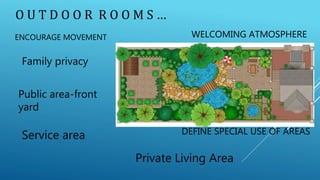
WELCOMING ATMOSPHERE
DEFINE SPECIAL USE OF AREAS
O U T D O O R R O O M S …
ENCOURAGE MOVEMENT
Family privacy
Public area-front
yard
Service area
Private Living Area
PRINCIPLES
OF
LANDSCAPING
• FOCALIZATION/COLOR
• PROPORTION AND SCALE
• BALANCE
• ORDER AND UNITY
• REPETITION
• RHYTHM AND SEQUENCE-CONTRAST AND HARMONY
• INTERCONNECTION
• TRANSITION
1. Living elements, such as flora or fauna; or
what is commonly called gardening, the art and
craft of growing plants with a goal of creating a
beauty with in the landscape.
2. Natural elements such as landforms,
terrain shape and elevation or bodies of
water.
3. Abstract element such as the weather and lightning
conditions.
Landscaping – refers to any activity that modifies the
visible features of an area of land, including:
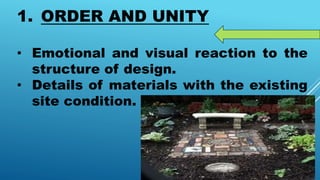
1. ORDER AND UNITY
• Emotional and visual reaction to the
structure of design.
• Details of materials with the existing
site condition.
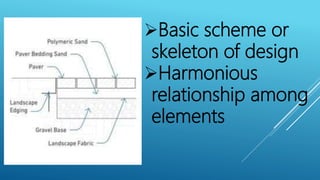
Basic scheme or
skeleton of design
Harmonious
relationship among
elements
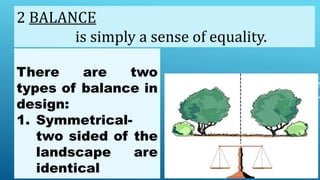
There are two
types of balance in
design:
1. Symmetrical-
two sided of the
landscape are
identical
2 BALANCE
is simply a sense of equality.
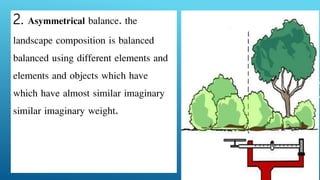
2. Asymmetrical balance. the
landscape composition is balanced
balanced using different elements and
elements and objects which have
which have almost similar imaginary
similar imaginary weight.
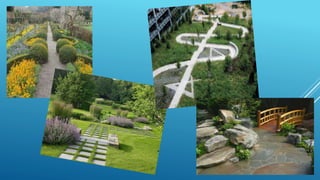
3. CONTRAST AND HARMONY-
RHYTHM AND SEQUENCE
Contrast helps highlight certain elements
in your design, while harmony helps
elements in a landscape composition look
unified. Contrasting elements draw the
viewer’s attention when they’re placed
next to each other. They are apparent flow
of lines, texture and colors that express a
feeling of motion
4. COLOR/FOCALIZATION
• Color gives your landscape design
the dimension of real life.
• Capture attention, create visual
break and create accent or focal
points.
Do not incorporate
too many focal
points into the
landscape
5. TRANSITION
 Transition is simply a gradual
change.
 Illustrated by gradually varying the
plant size or the color intensity.
 Transition can also be applied to
texture, foliage shape and size of
different elements.
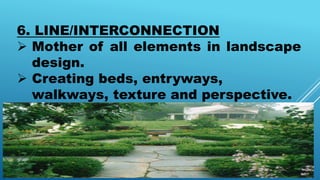
6. LINE/INTERCONNECTION
 Mother of all elements in landscape
design.
 Creating beds, entryways,
walkways, texture and perspective.
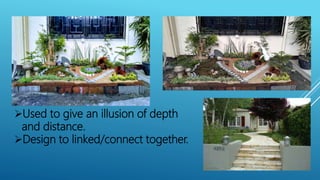
Used to give an illusion of depth
and distance.
Design to linked/connect together.
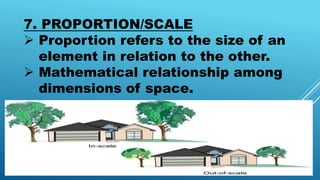
7. PROPORTION/SCALE
 Proportion refers to the size of an
element in relation to the other.
 Mathematical relationship among
dimensions of space.
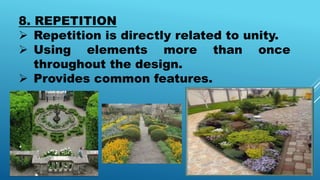
8. REPETITION
 Repetition is directly related to unity.
 Using elements more than once
throughout the design.
 Provides common features.
CONCLUSION
 With these basic principles of landscape
design designing a landscape can be a
nice way of unleashing your creativity.
 Utilizing, colors, contrast, and lines all
can help influence the design of your
landscape.
 Every design creates unique and
aesthetic essence.
https://www.mnn.com/your-home/organic-
farming-gardening/blogs/32-inspirational-
gardening
Principle of landscape design by gall hansen
(university of Florida)
Pictures/sketches from Wikipedia and google
images
Picture from City Division Technolympics
(Landscaping and Installation)
REFERENCES:
SALAMAT

Principles of landscaping

  • 1.
  • 2.
  • 3.
    OVERVIEW: Principles and Design Importanceof Landscape Elements of Landscaping Principles of Landscaping Summary and Conclusion
  • 4.
    PRINCIPLES OF DESIGN Theprinciples of design serve as guidelines that govern the organization of the design elements and materials in accordance with the laws of nature. The design elements are the tools a designer uses to the design principles Definition and understanding differ from one person
  • 5.
  • 6.
    WELCOMING ATMOSPHERE DEFINE SPECIALUSE OF AREAS O U T D O O R R O O M S … ENCOURAGE MOVEMENT Family privacy Public area-front yard Service area Private Living Area
  • 7.
    PRINCIPLES OF LANDSCAPING • FOCALIZATION/COLOR • PROPORTIONAND SCALE • BALANCE • ORDER AND UNITY • REPETITION • RHYTHM AND SEQUENCE-CONTRAST AND HARMONY • INTERCONNECTION • TRANSITION
  • 8.
    1. Living elements,such as flora or fauna; or what is commonly called gardening, the art and craft of growing plants with a goal of creating a beauty with in the landscape. 2. Natural elements such as landforms, terrain shape and elevation or bodies of water. 3. Abstract element such as the weather and lightning conditions. Landscaping – refers to any activity that modifies the visible features of an area of land, including:
  • 9.
    1. ORDER ANDUNITY • Emotional and visual reaction to the structure of design. • Details of materials with the existing site condition.
  • 10.
    Basic scheme or skeletonof design Harmonious relationship among elements
  • 11.
    There are two typesof balance in design: 1. Symmetrical- two sided of the landscape are identical 2 BALANCE is simply a sense of equality.
  • 12.
    2. Asymmetrical balance.the landscape composition is balanced balanced using different elements and elements and objects which have which have almost similar imaginary similar imaginary weight.
  • 13.
    3. CONTRAST ANDHARMONY- RHYTHM AND SEQUENCE Contrast helps highlight certain elements in your design, while harmony helps elements in a landscape composition look unified. Contrasting elements draw the viewer’s attention when they’re placed next to each other. They are apparent flow of lines, texture and colors that express a feeling of motion
  • 15.
    4. COLOR/FOCALIZATION • Colorgives your landscape design the dimension of real life. • Capture attention, create visual break and create accent or focal points. Do not incorporate too many focal points into the landscape
  • 17.
    5. TRANSITION  Transitionis simply a gradual change.  Illustrated by gradually varying the plant size or the color intensity.  Transition can also be applied to texture, foliage shape and size of different elements.
  • 19.
    6. LINE/INTERCONNECTION  Motherof all elements in landscape design.  Creating beds, entryways, walkways, texture and perspective.
  • 20.
    Used to givean illusion of depth and distance. Design to linked/connect together.
  • 21.
    7. PROPORTION/SCALE  Proportionrefers to the size of an element in relation to the other.  Mathematical relationship among dimensions of space.
  • 22.
    8. REPETITION  Repetitionis directly related to unity.  Using elements more than once throughout the design.  Provides common features.
  • 23.
    CONCLUSION  With thesebasic principles of landscape design designing a landscape can be a nice way of unleashing your creativity.  Utilizing, colors, contrast, and lines all can help influence the design of your landscape.  Every design creates unique and aesthetic essence.
  • 25.
    https://www.mnn.com/your-home/organic- farming-gardening/blogs/32-inspirational- gardening Principle of landscapedesign by gall hansen (university of Florida) Pictures/sketches from Wikipedia and google images Picture from City Division Technolympics (Landscaping and Installation) REFERENCES:
  • 26.