Sustainable Design  for Small Landscapes Julie Weisenhorn University of Minnesota Extension Department of Horticultural Science
“…  A small plot of ground well ordered, turns to greater advantage than a large one neglected …” - Leonard Meager The New Art of Gardening , 1697
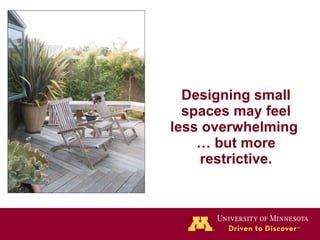
Designing small spaces may feel less overwhelming  … but more restrictive.
Sustainable Design Designing for plant health and longevity; Creating “outdoor rooms”; Important in design regardless of size or cost.
Five Considerations of  Sustainable Design
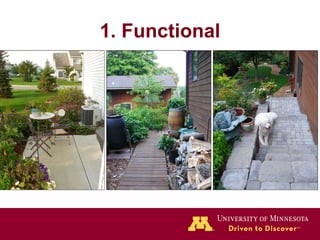
1. Functional
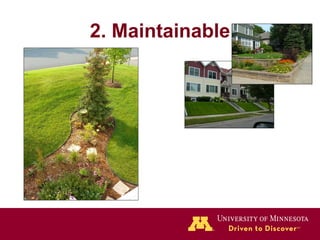
2. Maintainable
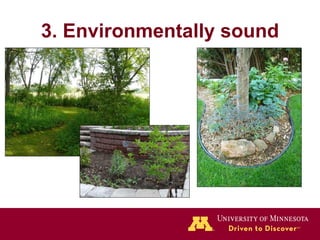
3. Environmentally sound
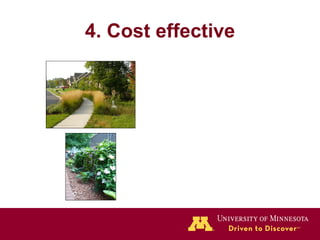
4. Cost effective
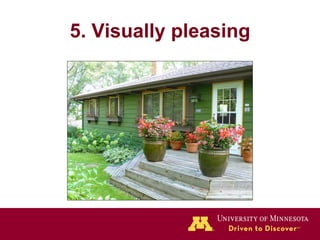
5. Visually pleasing
 
Site analysis Client Interview & Survey Client interview Activities in the landscape Timeline for installation Budget – install and maintenance Site survey Site inventory Specific, honest evaluation of site features; measurements Landscape Design Questionnaire, Site Evaluation Form
Design Principles
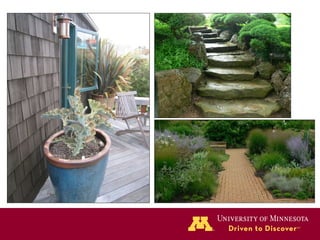
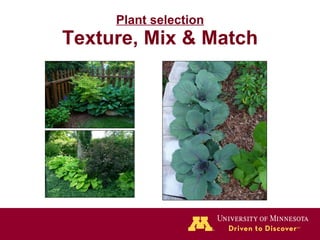
Design Principle   1.  Unity A feeling of “oneness”  Mix & match plants based on texture, form Repetition of hardscapes and plants All aspects should complement one another, not compete for attention; The entire design comes together to form one landscape.
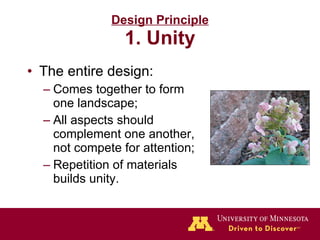
Design Principle 1. Unity The entire design: Comes together to form one landscape; All aspects should complement one another, not compete for attention; Repetition of materials builds unity.
 
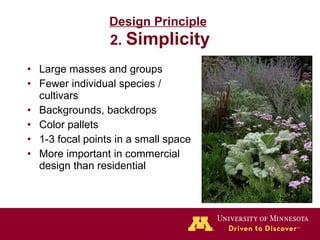
Design Principle   2.  Simplicity Large masses and groups Fewer individual species / cultivars Backgrounds, backdrops Color pallets 1-3 focal points in a small space More important in commercial design than residential
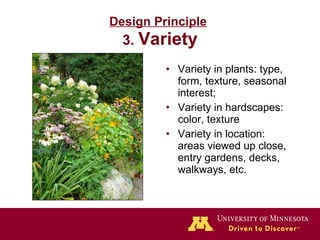
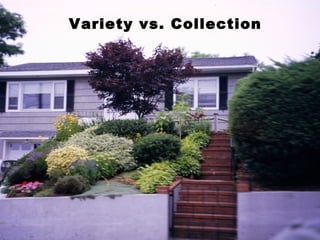
Design Principle   3.  Variety Variety in plants: type, form, texture, seasonal interest; Variety in hardscapes: color, texture  Variety in location: areas viewed up close, entry gardens, decks, walkways, etc.
Variety vs. Collection
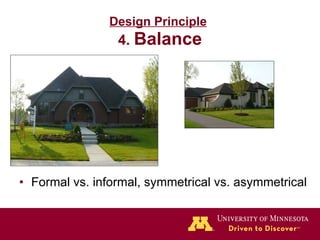
Design Principle   4.  Balance Formal vs. informal, symmetrical vs. asymmetrical
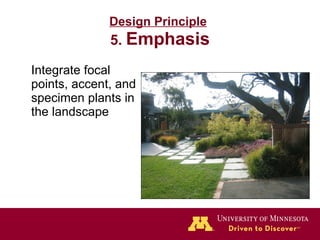
Design Principle   5.  Emphasis Integrate focal points, accent, and specimen plants in the landscape
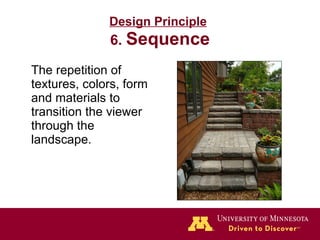
Design Principle   6.  Sequence The repetition of textures, colors, form and materials to transition the viewer through the landscape.
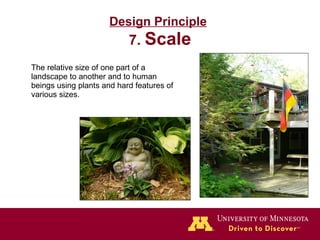
Design Principle   7.  Scale The relative size of one part of a landscape to another and to human beings using plants and hard features of various sizes.
Plant Selection
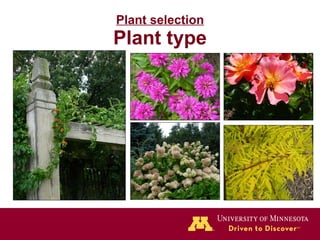
Select plants for sustainability Right plant, right place, right purpose Select plants based on their elements of design (characteristics) plant type Size Form Texture Seasonal interest
Plant selection Plant type
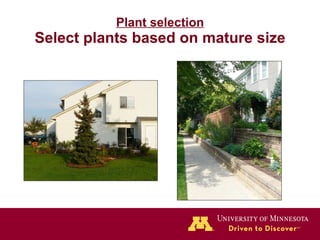
Plant selection Select plants based on mature size
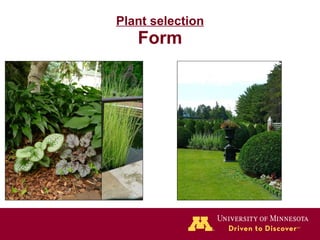
Plant selection Form
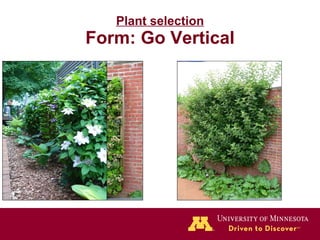
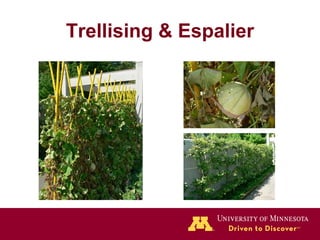
Plant selection Form: Go Vertical
Trellising & Espalier
Plant selection Texture, Mix & Match
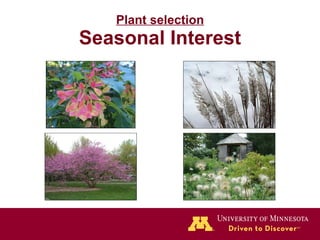
Plant selection Seasonal Interest
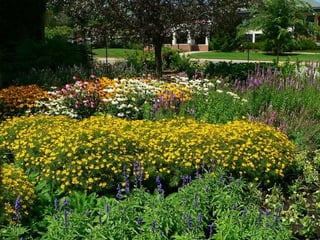
Color
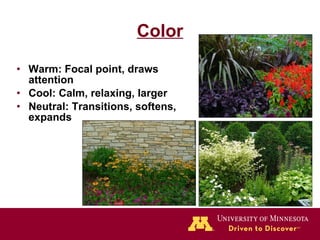
Color Warm: Focal point, draws attention  Cool: Calm, relaxing, larger Neutral: Transitions, softens, expands
Design tips for small landscapes
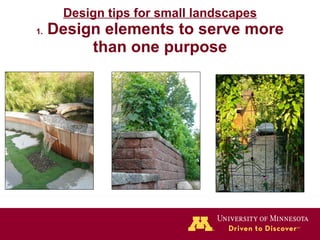
Design tips for small landscapes 1.  Design elements to serve more than one purpose
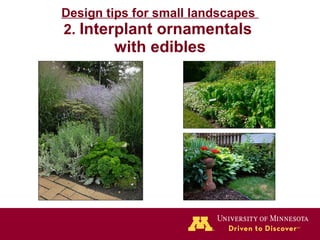
Design tips for small landscapes  2.  Interplant ornamentals  with edibles
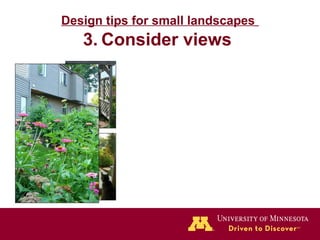
Design tips for small landscapes   3.   Consider views
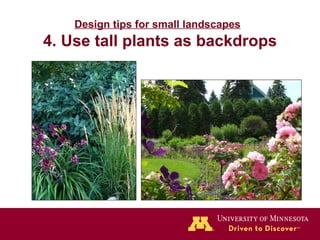
Design tips for small landscapes   4. Use tall plants as backdrops
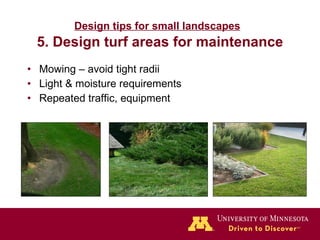
Design tips for small landscapes   5. Design turf areas for maintenance Mowing – avoid tight radii Light & moisture requirements Repeated traffic, equipment
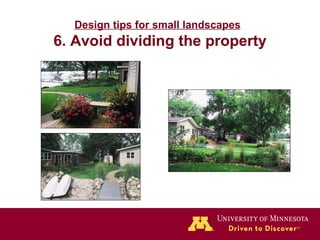
Design tips for small landscapes   6. Avoid dividing the property
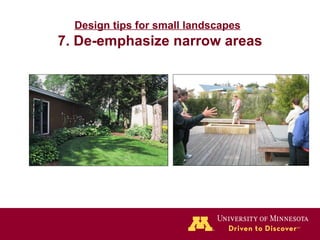
Design tips for small landscapes   7. De-emphasize narrow areas
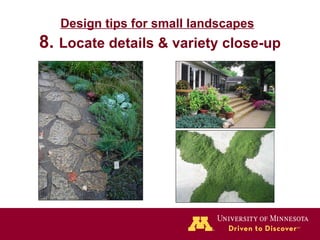
Design tips for small landscapes   8.  Locate details & variety close-up
Resources Sustainable Urban Landscape Information Series (SULIS):  http://www.sustalnd.umn.edu Gardening Information  http://www.extension.umn.edu/gardeninfo Rice, Graham,  The Ultimate Book of Small Gardens Messervy, Julie Moir and Susanka, Susan,  Outside the Not So Big House Beaulieu, David, “Color Theory in Landscape Design”,  http://landscaping.about.com/od/flowersherbsgroundcover1/a/flower_photos.htm Luss, Gunda, “Color Techniques for Landscape Design” http://www.sustland.umn.edu/design/colortechniques.html Boulden, Steve, “Big Help for Small Gardens”, http://www.the-landscape-design-site.com/smallgardens.html
Sustainable Design  for Small Landscapes Julie Weisenhorn University of Minnesota Extension Department of Horticultural Science Email:  [email_address]

Small Space Landscaping 2009

  • 1.
    Sustainable Design for Small Landscapes Julie Weisenhorn University of Minnesota Extension Department of Horticultural Science
  • 2.
    “… Asmall plot of ground well ordered, turns to greater advantage than a large one neglected …” - Leonard Meager The New Art of Gardening , 1697
  • 3.
    Designing small spacesmay feel less overwhelming … but more restrictive.
  • 4.
    Sustainable Design Designingfor plant health and longevity; Creating “outdoor rooms”; Important in design regardless of size or cost.
  • 5.
    Five Considerations of Sustainable Design
  • 6.
  • 7.
  • 8.
  • 9.
  • 10.
  • 11.
  • 12.
    Site analysis ClientInterview & Survey Client interview Activities in the landscape Timeline for installation Budget – install and maintenance Site survey Site inventory Specific, honest evaluation of site features; measurements Landscape Design Questionnaire, Site Evaluation Form
  • 13.
  • 14.
    Design Principle 1. Unity A feeling of “oneness” Mix & match plants based on texture, form Repetition of hardscapes and plants All aspects should complement one another, not compete for attention; The entire design comes together to form one landscape.
  • 15.
    Design Principle 1.Unity The entire design: Comes together to form one landscape; All aspects should complement one another, not compete for attention; Repetition of materials builds unity.
  • 16.
  • 17.
    Design Principle 2. Simplicity Large masses and groups Fewer individual species / cultivars Backgrounds, backdrops Color pallets 1-3 focal points in a small space More important in commercial design than residential
  • 18.
    Design Principle 3. Variety Variety in plants: type, form, texture, seasonal interest; Variety in hardscapes: color, texture Variety in location: areas viewed up close, entry gardens, decks, walkways, etc.
  • 19.
  • 20.
    Design Principle 4. Balance Formal vs. informal, symmetrical vs. asymmetrical
  • 21.
    Design Principle 5. Emphasis Integrate focal points, accent, and specimen plants in the landscape
  • 22.
    Design Principle 6. Sequence The repetition of textures, colors, form and materials to transition the viewer through the landscape.
  • 23.
    Design Principle 7. Scale The relative size of one part of a landscape to another and to human beings using plants and hard features of various sizes.
  • 24.
  • 25.
    Select plants forsustainability Right plant, right place, right purpose Select plants based on their elements of design (characteristics) plant type Size Form Texture Seasonal interest
  • 26.
  • 27.
    Plant selection Selectplants based on mature size
  • 28.
  • 29.
  • 30.
  • 31.
  • 32.
  • 33.
  • 34.
    Color Warm: Focalpoint, draws attention Cool: Calm, relaxing, larger Neutral: Transitions, softens, expands
  • 35.
    Design tips forsmall landscapes
  • 36.
    Design tips forsmall landscapes 1. Design elements to serve more than one purpose
  • 37.
    Design tips forsmall landscapes 2. Interplant ornamentals with edibles
  • 38.
    Design tips forsmall landscapes 3. Consider views
  • 39.
    Design tips forsmall landscapes 4. Use tall plants as backdrops
  • 40.
    Design tips forsmall landscapes 5. Design turf areas for maintenance Mowing – avoid tight radii Light & moisture requirements Repeated traffic, equipment
  • 41.
    Design tips forsmall landscapes 6. Avoid dividing the property
  • 42.
    Design tips forsmall landscapes 7. De-emphasize narrow areas
  • 43.
    Design tips forsmall landscapes 8. Locate details & variety close-up
  • 44.
    Resources Sustainable UrbanLandscape Information Series (SULIS): http://www.sustalnd.umn.edu Gardening Information http://www.extension.umn.edu/gardeninfo Rice, Graham, The Ultimate Book of Small Gardens Messervy, Julie Moir and Susanka, Susan, Outside the Not So Big House Beaulieu, David, “Color Theory in Landscape Design”, http://landscaping.about.com/od/flowersherbsgroundcover1/a/flower_photos.htm Luss, Gunda, “Color Techniques for Landscape Design” http://www.sustland.umn.edu/design/colortechniques.html Boulden, Steve, “Big Help for Small Gardens”, http://www.the-landscape-design-site.com/smallgardens.html
  • 45.
    Sustainable Design for Small Landscapes Julie Weisenhorn University of Minnesota Extension Department of Horticultural Science Email: [email_address]