Intro To Landscape Design
Presenter: Abdullah Moiz
Id: 1272-2021
Instructor: Sir Abrar
Khokhar
Principles Of Landscape Design
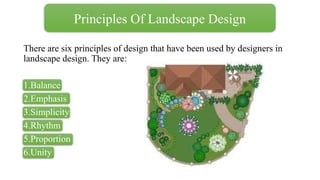
There are six principles of design that have been used by designers in
landscape design. They are:
1.Balance
2.Emphasis
3.Simplicity
4.Rhythm
5.Proportion
6.Unity
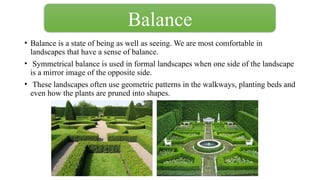
• Balance is a state of being as well as seeing. We are most comfortable in
landscapes that have a sense of balance.
• Symmetrical balance is used in formal landscapes when one side of the landscape
is a mirror image of the opposite side.
• These landscapes often use geometric patterns in the walkways, planting beds and
even how the plants are pruned into shapes.
Balance
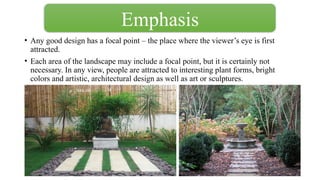
• Any good design has a focal point – the place where the viewer’s eye is first
attracted.
• Each area of the landscape may include a focal point, but it is certainly not
necessary. In any view, people are attracted to interesting plant forms, bright
colors and artistic, architectural design as well as art or sculptures.
Emphasis
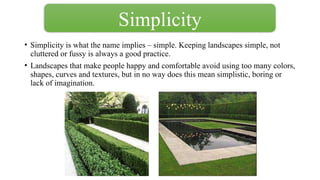
• Simplicity is what the name implies – simple. Keeping landscapes simple, not
cluttered or fussy is always a good practice.
• Landscapes that make people happy and comfortable avoid using too many colors,
shapes, curves and textures, but in no way does this mean simplistic, boring or
lack of imagination.
Simplicity
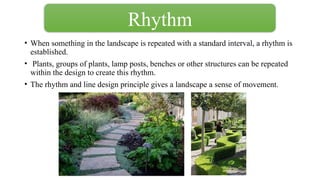
• When something in the landscape is repeated with a standard interval, a rhythm is
established.
• Plants, groups of plants, lamp posts, benches or other structures can be repeated
within the design to create this rhythm.
• The rhythm and line design principle gives a landscape a sense of movement.
Rhythm
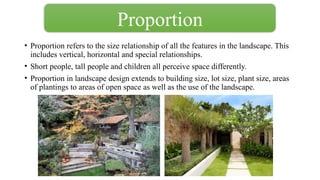
• Proportion refers to the size relationship of all the features in the landscape. This
includes vertical, horizontal and special relationships.
• Short people, tall people and children all perceive space differently.
• Proportion in landscape design extends to building size, lot size, plant size, areas
of plantings to areas of open space as well as the use of the landscape.
Proportion
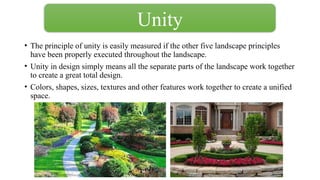
• The principle of unity is easily measured if the other five landscape principles
have been properly executed throughout the landscape.
• Unity in design simply means all the separate parts of the landscape work together
to create a great total design.
• Colors, shapes, sizes, textures and other features work together to create a unified
space.
Unity
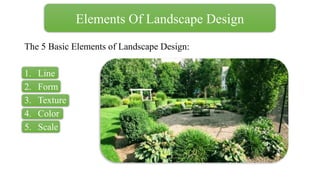
Elements Of Landscape Design
The 5 Basic Elements of Landscape Design:
1. Line
2. Form
3. Texture
4. Color
5. Scale
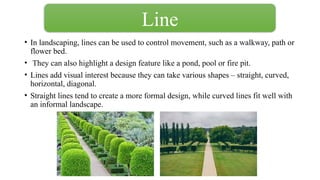
• In landscaping, lines can be used to control movement, such as a walkway, path or
flower bed.
• They can also highlight a design feature like a pond, pool or fire pit.
• Lines add visual interest because they can take various shapes – straight, curved,
horizontal, diagonal.
• Straight lines tend to create a more formal design, while curved lines fit well with
an informal landscape.
Line
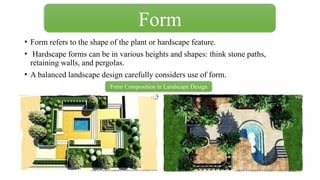
• Form refers to the shape of the plant or hardscape feature.
• Hardscape forms can be in various heights and shapes: think stone paths,
retaining walls, and pergolas.
• A balanced landscape design carefully considers use of form.
Form
Form Composition in Landscape Design
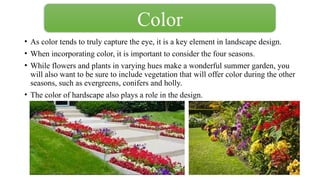
• As color tends to truly capture the eye, it is a key element in landscape design.
• When incorporating color, it is important to consider the four seasons.
• While flowers and plants in varying hues make a wonderful summer garden, you
will also want to be sure to include vegetation that will offer color during the other
seasons, such as evergreens, conifers and holly.
• The color of hardscape also plays a role in the design.
Color
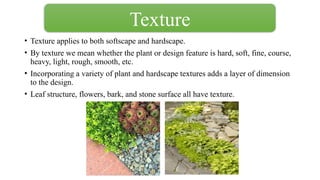
• Texture applies to both softscape and hardscape.
• By texture we mean whether the plant or design feature is hard, soft, fine, course,
heavy, light, rough, smooth, etc.
• Incorporating a variety of plant and hardscape textures adds a layer of dimension
to the design.
• Leaf structure, flowers, bark, and stone surface all have texture.
Texture
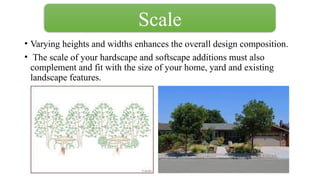
• Varying heights and widths enhances the overall design composition.
• The scale of your hardscape and softscape additions must also
complement and fit with the size of your home, yard and existing
landscape features.
Scale
Thank You!