PRINCIPLES OF
EDUCATION
REPORTED BY: MR. JOHN EMMANUEL R. BATACAN
MA ED SOCIAL STUDIES
ROOSEVELT COLLEGE, INC. – FEU
GRADUATE SCHOOL OF EDUCATION
STARTING PRINCIPLE
• “the child’s original nature is absolutely
antecedent and initial to all educational
activities and results”
STARTING PRINCIPLE
• It is therefore the function of education to
make the best use of these hereditary
tendencies to meet human needs, growth
and development
STARTING PRINCIPLE
• The primary concern of the teacher is NOT
THE SUBJECT but THE CHILD
GUIDING PRINCIPLE
• These refer to the procedure, methods of
instruction, or agglomerations of techniques
by which the pupil and the teacher may work
toward the accomplishment of the goals or
objectives of education
GUIDING PRINCIPLE
• The method of teaching involves the
application of many laws and principles.
GUIDING PRINCIPLE
• Principles serve as guiding philosophy for the
selection and operation of teaching and
learning activities and techniques.
ENDING PRINCIPLE
• Refers to the educational aims, goals,
objectives, outcomes, or results of the
whole educational scheme to which
teaching and learning are directed
PRINCIPLES OF
EFFECTIVE TEACHING
AND LEARNING
REPORTED BY: MR. JOHN EMMANUEL R. BATACAN
MA ED SOCIAL STUDIES
ROOSEVELT COLLEGE, INC. – FEU
GRADUATE SCHOOL OF EDUCATION
PRINCIPLES OF
TEACHING
PRINCIPLES OF TEACHING
• Effective teaching involves acquiring
relevant knowledge about students and
using that knowledge to inform our course
design and classroom teaching
PRINCIPLES OF TEACHING
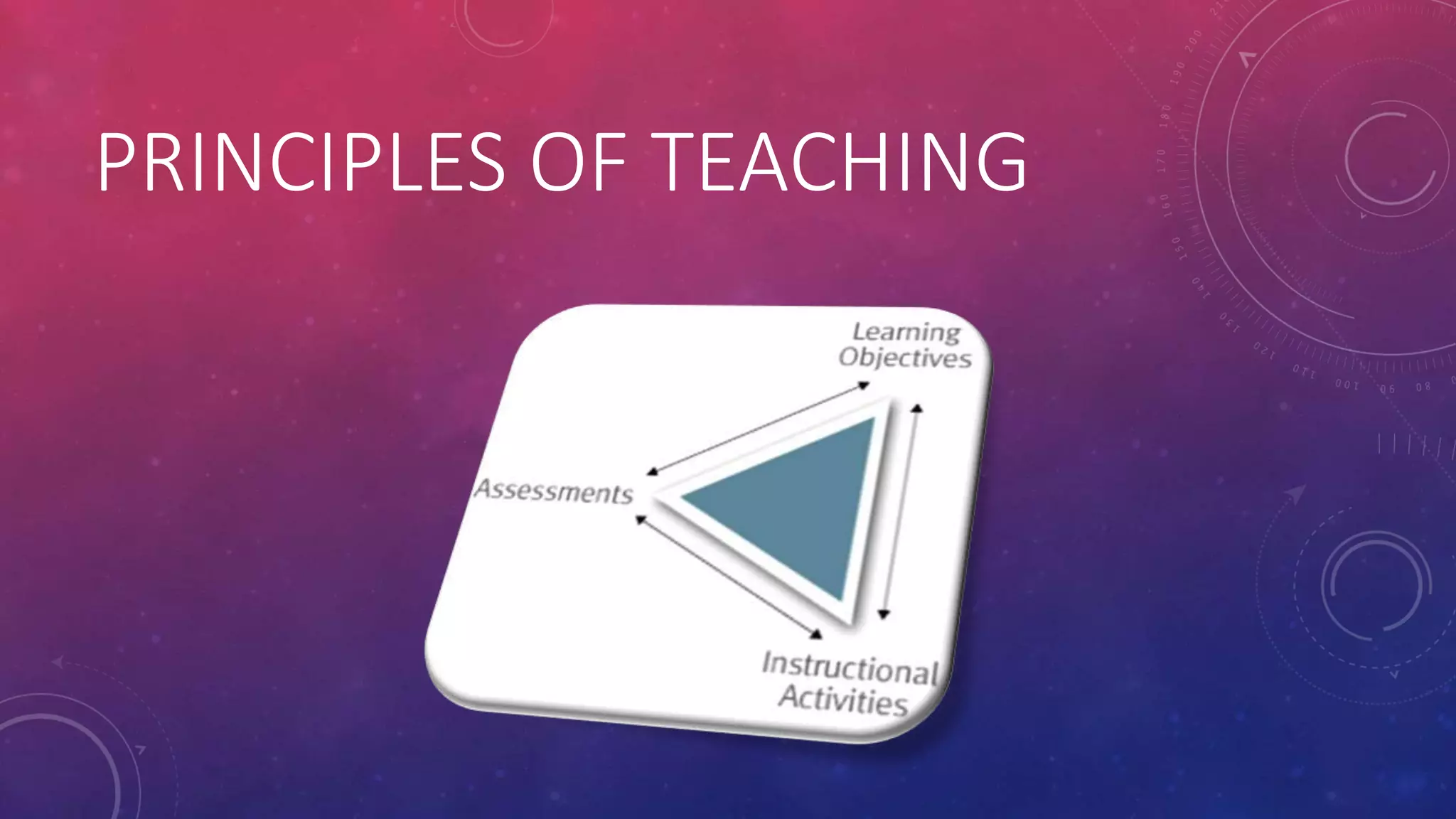
• Effective teaching involves aligning the
three major components of instruction:
Learning Objectives, Assessments, and
Instructional Activities
PRINCIPLES OF TEACHING
• Effective teaching involves articulating
explicit expectations regarding learning
objectives and policies
PRINCIPLES OF TEACHING
• Effective teaching involves prioritizing the
knowledge and skills we choose to focus on
PRINCIPLES OF TEACHING
• Effective teaching involves recognizing and
overcoming our expert blind spots
PRINCIPLES OF TEACHING
• Effective teaching involves adopting
appropriate teaching roles to support our
learning goals
PRINCIPLES OF TEACHING
• Effective teaching involves progressively
refining our courses based on reflection
and feedback
PRINCIPLES OF
LEARNING
PRINCIPLES OF LEARNING
• Students’ prior knowledge can help or
hinder learning
PRINCIPLES OF LEARNING
• How students organize knowledge
influences how they learn and apply what
they know
PRINCIPLES OF LEARNING
• Students’ motivation determines, directs,
and sustains what they do to learn
PRINCIPLES OF LEARNING
• To develop mastery, students must
acquire component skills, practice
integrating them, and know when to apply
what they have learned
PRINCIPLES OF LEARNING
• Goal-directed practice coupled with
targeted feedback enhances the quality of
students’ learning
PRINCIPLES OF LEARNING
• Students’ current level of development
interacts with the social, emotional, and
intellectual climate of the course to
impact learning
PRINCIPLES OF LEARNING
• To become self-directed learners, students
must learn to monitor and adjust their
approaches to learning
REFERENCES
• http://www.yourarticlelibrary.com/teaching/principles-of-teaching-starting-guiding-and-ending/6038
• https://www.cmu.edu/teaching/principles/
• https://www.cmu.edu/teaching/principles/teaching.html
• https://www.cmu.edu/teaching/principles/learning.html
THANK YOU AND GOD BLESS US ALL!!!
JOHN EMMANUEL R. BATACAN

Principles of Education and Principles of Effective Teaching and Learning