Topic: Project Financing
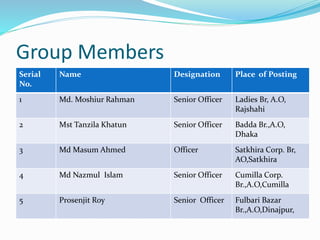
Group Members
Serial
No.
Name Designation Place of Posting
1 Md. Moshiur Rahman Senior Officer Ladies Br, A.O,
Rajshahi
2 Mst Tanzila Khatun Senior Officer Badda Br.,A.O,
Dhaka
3 Md Masum Ahmed Officer Satkhira Corp. Br,
AO,Satkhira
4 Md Nazmul Islam Senior Officer Cumilla Corp.
Br.,A.O,Cumilla
5 Prosenjit Roy Senior Officer Fulbari Bazar
Br.,A.O,Dinajpur,
Concept of Project
 A project is an endeavor undertaken to create a unique
product or service by utilizing prevailing assets.
 A project is a combination of set objectives to be
accomplished within a fixed period. They are an
excellent opportunity to organize your business and
non-business goals efficiently
Characteristics of a Project
 Projects are Bound by Time
 Projects are Purposeful
 Projects Progress Through a Life Cycle to
Accomplish Goals
 Projects are Unique
 A Project is a Single Entity
The project life cycle
Project Financing
 Project finance is the funding (financing) of long-term
infrastructure, industrial projects, and public services
using a non-recourse or limited recourse financial
structure. The debt and equity used to finance the project
are paid back from the cash flow generated by the project.
 Project financing is a loan structure that relies primarily on
the project's cash flow for repayment, with the project's
assets, rights, and interests held as secondary collateral.
Project finance is especially attractive to the private sector
because companies can fund major projects off-balance
sheet (OBS).
Activities for Project Financing
 Pre-sanction Activities
 Assessing the credit,
 Selecting the borrower,
 Preparing the project loan proposal
 Sanctioning
After receiving the approval from the respective
authorities,
 Sanction letter is issued in favour to the client and,
 Client’s consent is taken on the terms and conditions.
 Post-sanction Activities
Activities for Project Financing
 Post-sanction Activities
After receiving client’s consent,
 The necessary documentation
 The disbursement of loan
 Monitoring and recovery
Project Selection
 Project selection is the evaluation of project ideas to
help decide which project has the highest priority. It's
an important part of project portfolio management
(PPM), which is a process used by project management
organizations (PMOs) and project managers to
analyze the potential return on undertaking a project.
Project Selection
Once project managers receive project ideas or proposals, they
often go through a process to assess and select a project that will
move forward. Typically, when project managers select a project,
they may consider the following factors:
 Costs
 Resources
 Benefits or ROI
 Time to complete the project
 Risks associated with the project
Project Appraisal
 Project appraisal means pre-investment analysis of a
proposed project to ascertain whether the project is
technically feasible, commercially viable and
financially profitable.
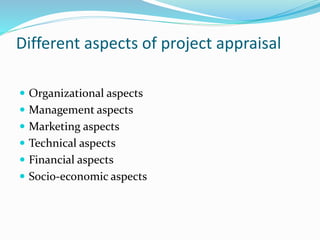
Different aspects of project appraisal
 Organizational aspects
 Management aspects
 Marketing aspects
 Technical aspects
 Financial aspects
 Socio-economic aspects
Organizational aspects
 Consideration:
 Ownership pattern
 Evidence of legality
 Capital structure
 Company current account
 Determination: Organizational strength
Management aspects
 Consideration
 Capacity
 Competence
 Integrity
 Creditworthiness
 Commitment
 Kyc, CIB report etc.
 Reputation & Business Experience
 Determination: Management ability
Marketing aspects
 Consideration
 Demand-Dupply Gap
 Deterining present and future selling prospect of goods
and services
 Determining comptetitive advantages to compete with
others
 Product quality and cost
 Market share estimation
 Determination: Commercial viability
Technical aspects
 Civil Construction
 Land (quantity, position of project, ownership, viability)
 Civil & building construction
 Mechanical and textile
Financial Aspects
 IRR (Internal Rate of Return)
 NPV (Net Present Value)
 PBP (Payback Period)
 BCR (Benefit Cost Ratio)
 BEP (Break Even Point) Analysis
 Margin of Safety
Socio-economic Aspects
 Economic Aspects: Consideration –
 Value addition, employment generation, Savings
 Contribution to GDP
 Economic Rate of Return
 Social Aspects: Consideration –
 Norms and values
 Social responsibility
 Religious and cultural works
Environmental aspects: Consideration –
 Wastage Disposal System
 Effect on Environment and Human body
Disbursement
 Disbursement means paying out money from a fund.
The term disbursement may be used to describe
money paid into a business' operating budget, the
delivery of a loan amount to a borrower.
 An entry for a disbursement includes the date, the
payee name, the amount debited or credited, the
payment method, and the purpose of the payment.
The overall cash balance of the business is then
adjusted to account for the disbursement.
Documentation
After receiving the acceptance of the sanction advice by the borrower, the bank
will take registered mortgage (if any) and collect necessary charge documents.
 D.P. Note
 Letter of Arrangement.
 Letter of lien (in case of loan against any fin. Obligation or
instruments).
 Letter of Guarantee of all Directors (in case of Limited
company).
 Letter of Partnership along with partnership deep in case of
partnership account.
 Board resolution in case of limited company
 Letter of indemnity
 Insurance Policy (covering all risks).
Disbursement Phase by Phase
 As per Approval and Sanction terms and conditions.
 Proportionate Equity Subject to verification of progress
 Other formalities –
 Single time disbursement subject to full equity builds up
 Equity/margin ensured
 Terms of sanction should be complied with
 Charging of securities
 End use verification
 Strictly following the disbursement schedule
Any Questions?
Thank You All.

Group No.pptx

  • 1.
  • 2.
    Group Members Serial No. Name DesignationPlace of Posting 1 Md. Moshiur Rahman Senior Officer Ladies Br, A.O, Rajshahi 2 Mst Tanzila Khatun Senior Officer Badda Br.,A.O, Dhaka 3 Md Masum Ahmed Officer Satkhira Corp. Br, AO,Satkhira 4 Md Nazmul Islam Senior Officer Cumilla Corp. Br.,A.O,Cumilla 5 Prosenjit Roy Senior Officer Fulbari Bazar Br.,A.O,Dinajpur,
  • 3.
    Concept of Project A project is an endeavor undertaken to create a unique product or service by utilizing prevailing assets.  A project is a combination of set objectives to be accomplished within a fixed period. They are an excellent opportunity to organize your business and non-business goals efficiently
  • 4.
    Characteristics of aProject  Projects are Bound by Time  Projects are Purposeful  Projects Progress Through a Life Cycle to Accomplish Goals  Projects are Unique  A Project is a Single Entity
  • 5.
  • 6.
    Project Financing  Projectfinance is the funding (financing) of long-term infrastructure, industrial projects, and public services using a non-recourse or limited recourse financial structure. The debt and equity used to finance the project are paid back from the cash flow generated by the project.  Project financing is a loan structure that relies primarily on the project's cash flow for repayment, with the project's assets, rights, and interests held as secondary collateral. Project finance is especially attractive to the private sector because companies can fund major projects off-balance sheet (OBS).
  • 7.
    Activities for ProjectFinancing  Pre-sanction Activities  Assessing the credit,  Selecting the borrower,  Preparing the project loan proposal  Sanctioning After receiving the approval from the respective authorities,  Sanction letter is issued in favour to the client and,  Client’s consent is taken on the terms and conditions.  Post-sanction Activities
  • 8.
    Activities for ProjectFinancing  Post-sanction Activities After receiving client’s consent,  The necessary documentation  The disbursement of loan  Monitoring and recovery
  • 9.
    Project Selection  Projectselection is the evaluation of project ideas to help decide which project has the highest priority. It's an important part of project portfolio management (PPM), which is a process used by project management organizations (PMOs) and project managers to analyze the potential return on undertaking a project.
  • 10.
    Project Selection Once projectmanagers receive project ideas or proposals, they often go through a process to assess and select a project that will move forward. Typically, when project managers select a project, they may consider the following factors:  Costs  Resources  Benefits or ROI  Time to complete the project  Risks associated with the project
  • 11.
    Project Appraisal  Projectappraisal means pre-investment analysis of a proposed project to ascertain whether the project is technically feasible, commercially viable and financially profitable.
  • 12.
    Different aspects ofproject appraisal  Organizational aspects  Management aspects  Marketing aspects  Technical aspects  Financial aspects  Socio-economic aspects
  • 13.
    Organizational aspects  Consideration: Ownership pattern  Evidence of legality  Capital structure  Company current account  Determination: Organizational strength
  • 14.
    Management aspects  Consideration Capacity  Competence  Integrity  Creditworthiness  Commitment  Kyc, CIB report etc.  Reputation & Business Experience  Determination: Management ability
  • 15.
    Marketing aspects  Consideration Demand-Dupply Gap  Deterining present and future selling prospect of goods and services  Determining comptetitive advantages to compete with others  Product quality and cost  Market share estimation  Determination: Commercial viability
  • 16.
    Technical aspects  CivilConstruction  Land (quantity, position of project, ownership, viability)  Civil & building construction  Mechanical and textile
  • 17.
    Financial Aspects  IRR(Internal Rate of Return)  NPV (Net Present Value)  PBP (Payback Period)  BCR (Benefit Cost Ratio)  BEP (Break Even Point) Analysis  Margin of Safety
  • 18.
    Socio-economic Aspects  EconomicAspects: Consideration –  Value addition, employment generation, Savings  Contribution to GDP  Economic Rate of Return  Social Aspects: Consideration –  Norms and values  Social responsibility  Religious and cultural works Environmental aspects: Consideration –  Wastage Disposal System  Effect on Environment and Human body
  • 19.
    Disbursement  Disbursement meanspaying out money from a fund. The term disbursement may be used to describe money paid into a business' operating budget, the delivery of a loan amount to a borrower.  An entry for a disbursement includes the date, the payee name, the amount debited or credited, the payment method, and the purpose of the payment. The overall cash balance of the business is then adjusted to account for the disbursement.
  • 20.
    Documentation After receiving theacceptance of the sanction advice by the borrower, the bank will take registered mortgage (if any) and collect necessary charge documents.  D.P. Note  Letter of Arrangement.  Letter of lien (in case of loan against any fin. Obligation or instruments).  Letter of Guarantee of all Directors (in case of Limited company).  Letter of Partnership along with partnership deep in case of partnership account.  Board resolution in case of limited company  Letter of indemnity  Insurance Policy (covering all risks).
  • 21.
    Disbursement Phase byPhase  As per Approval and Sanction terms and conditions.  Proportionate Equity Subject to verification of progress  Other formalities –  Single time disbursement subject to full equity builds up  Equity/margin ensured  Terms of sanction should be complied with  Charging of securities  End use verification  Strictly following the disbursement schedule
  • 22.
  • 23.