*Nanotechnology is science,
engineering, and technology
conducted at the Nano scale, which
is about 1 to 100 nanometers.
*Nano science and Nano technology
are the study and application of
extremely small things and can be
used across all the other science
fields, such as chemistry, biology,
physics, materials science, and
engineering.
How big (small) are we talking about?
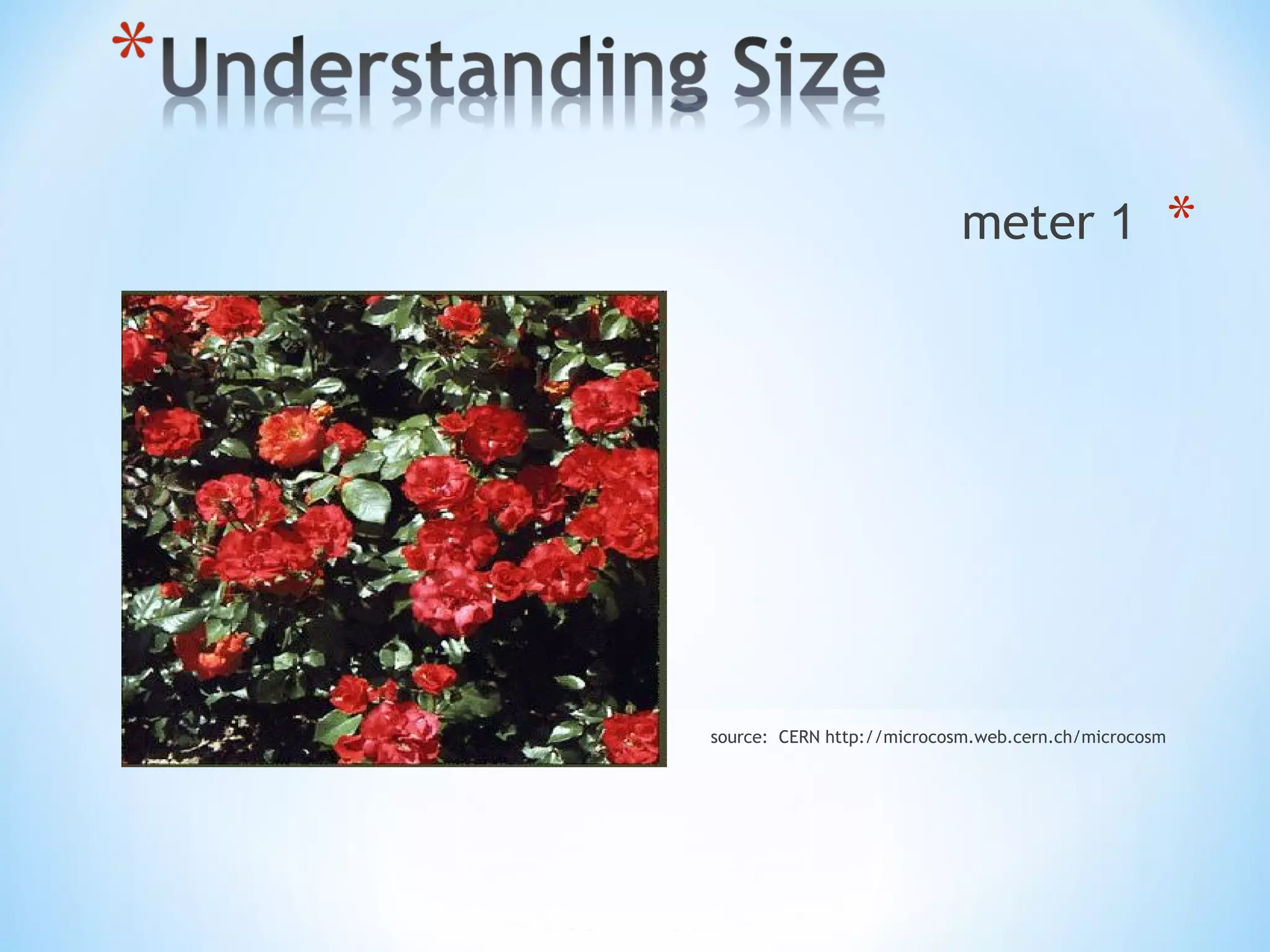
*1meter
source: CERN http://microcosm.web.cern.ch/microcosm
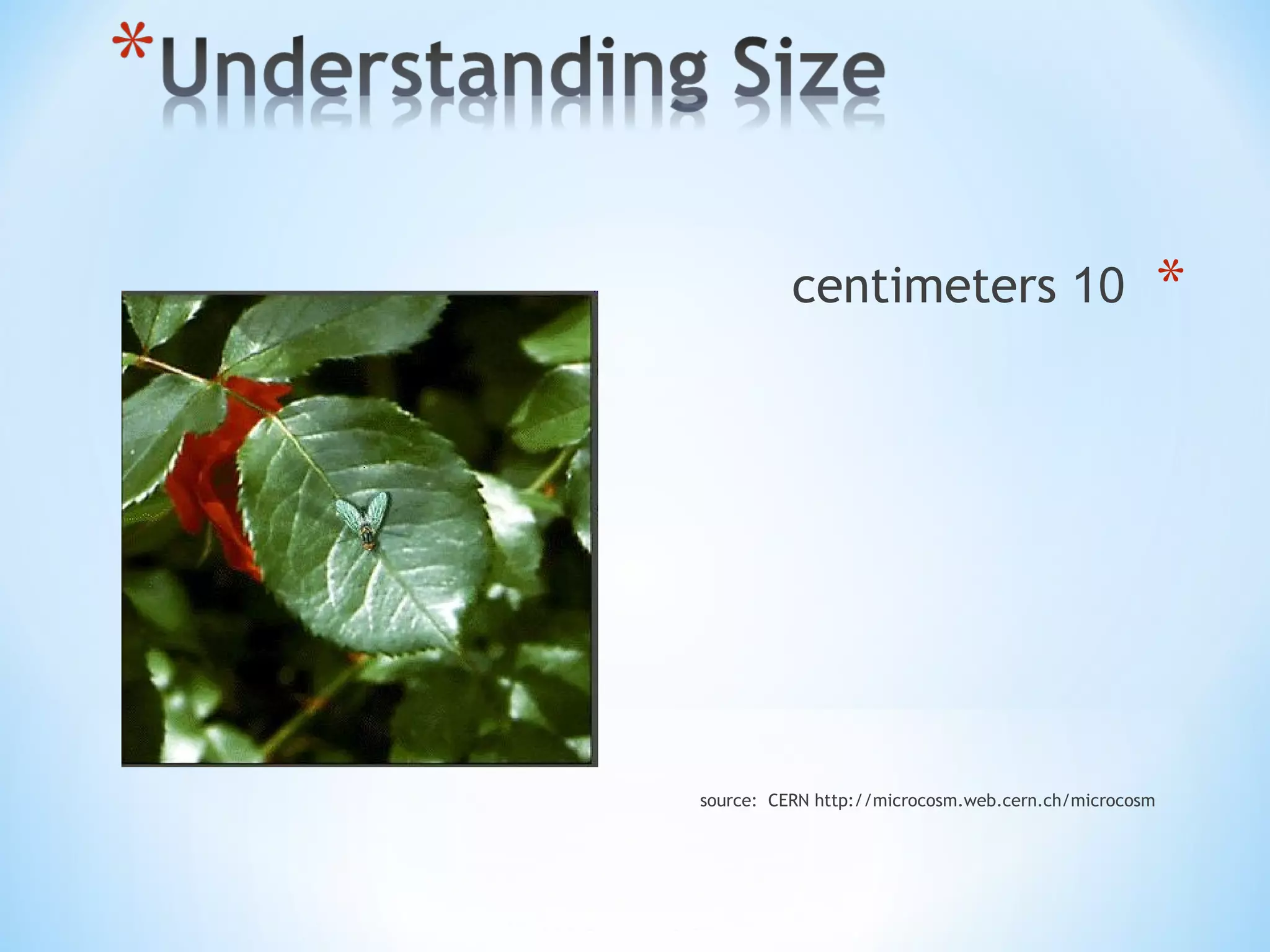
*10centimeters
source: CERN http://microcosm.web.cern.ch/microcosm
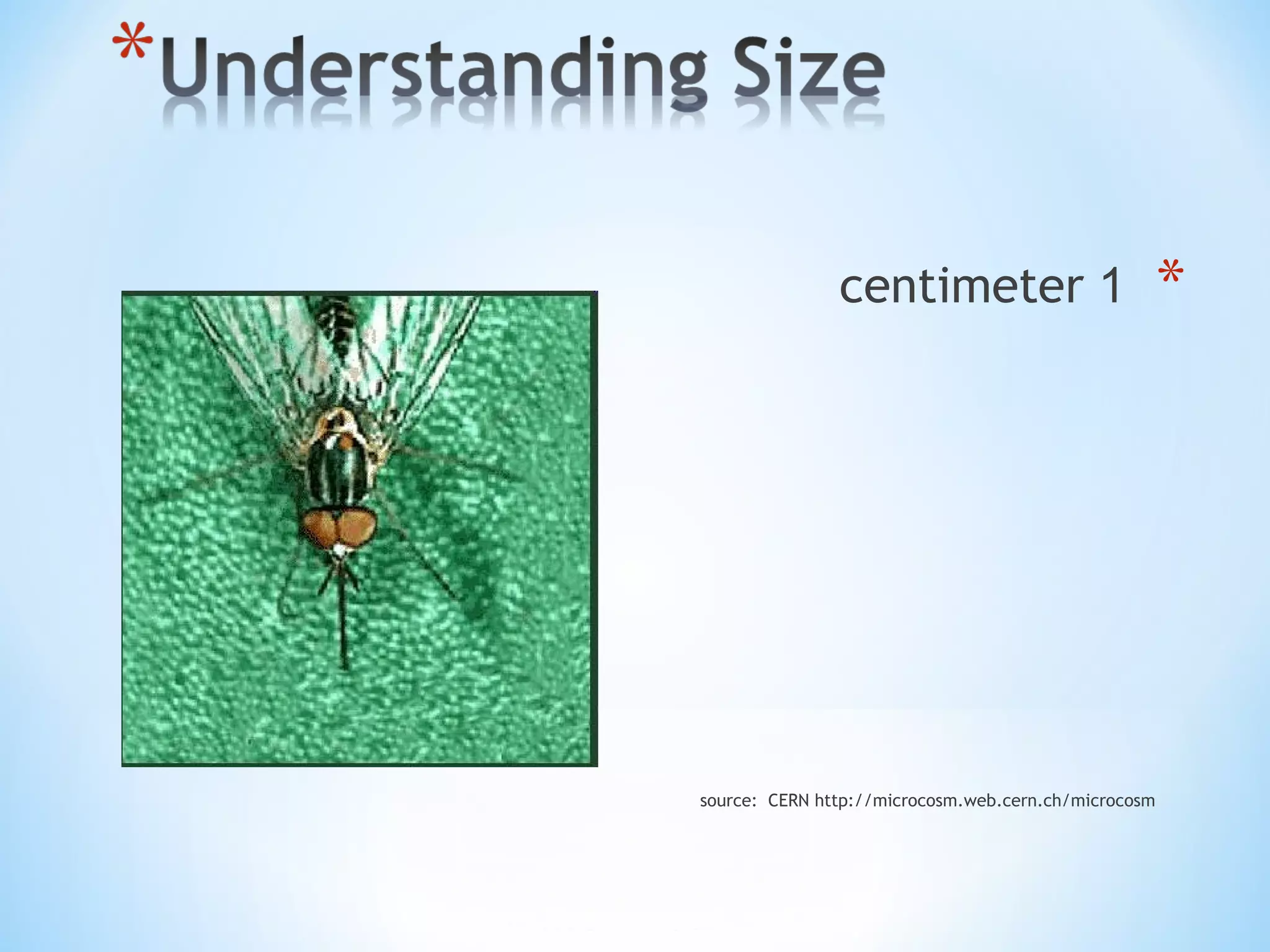
*1centimeter
source: CERN http://microcosm.web.cern.ch/microcosm
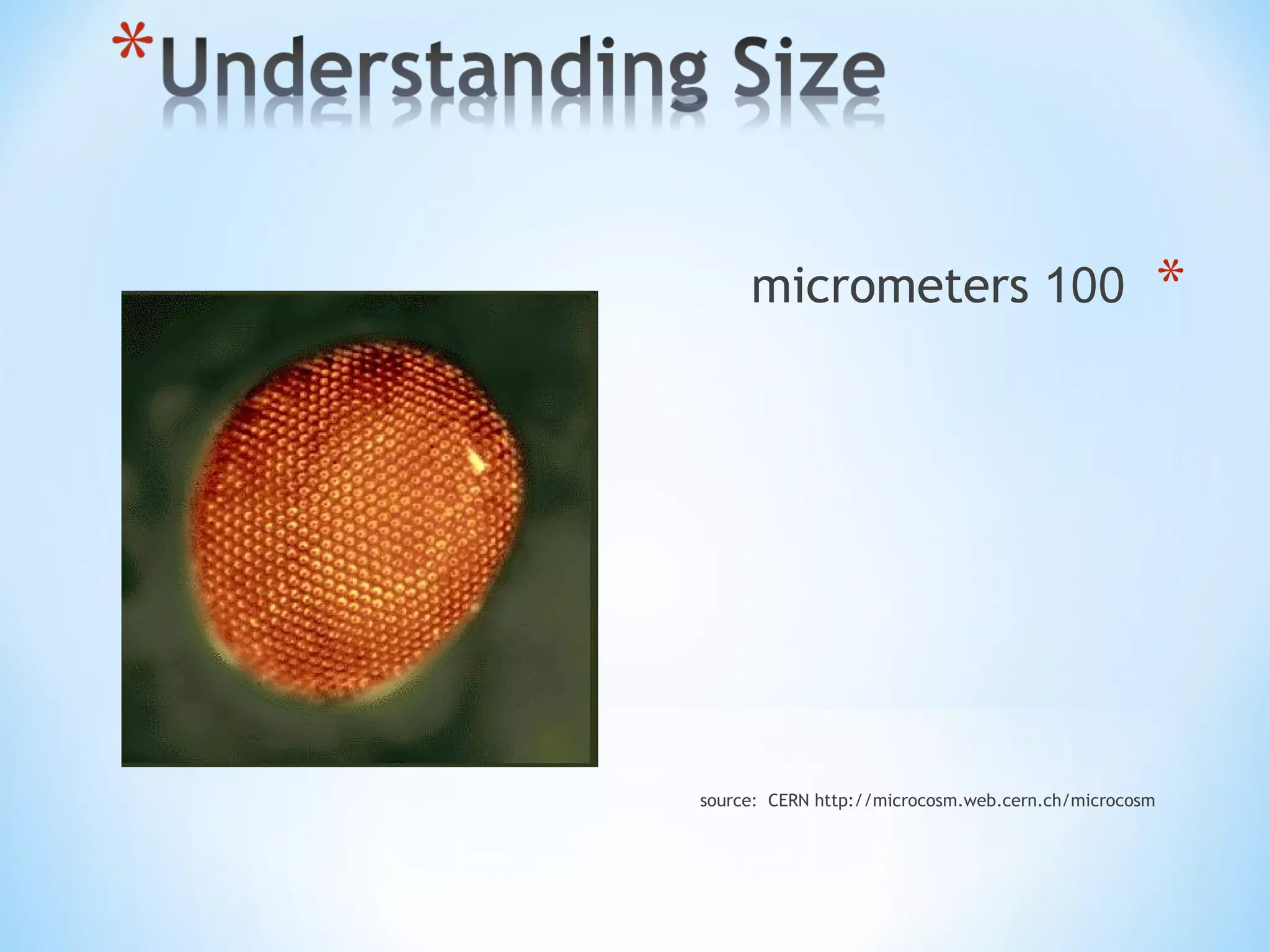
*100micrometers
source: CERN http://microcosm.web.cern.ch/microcosm
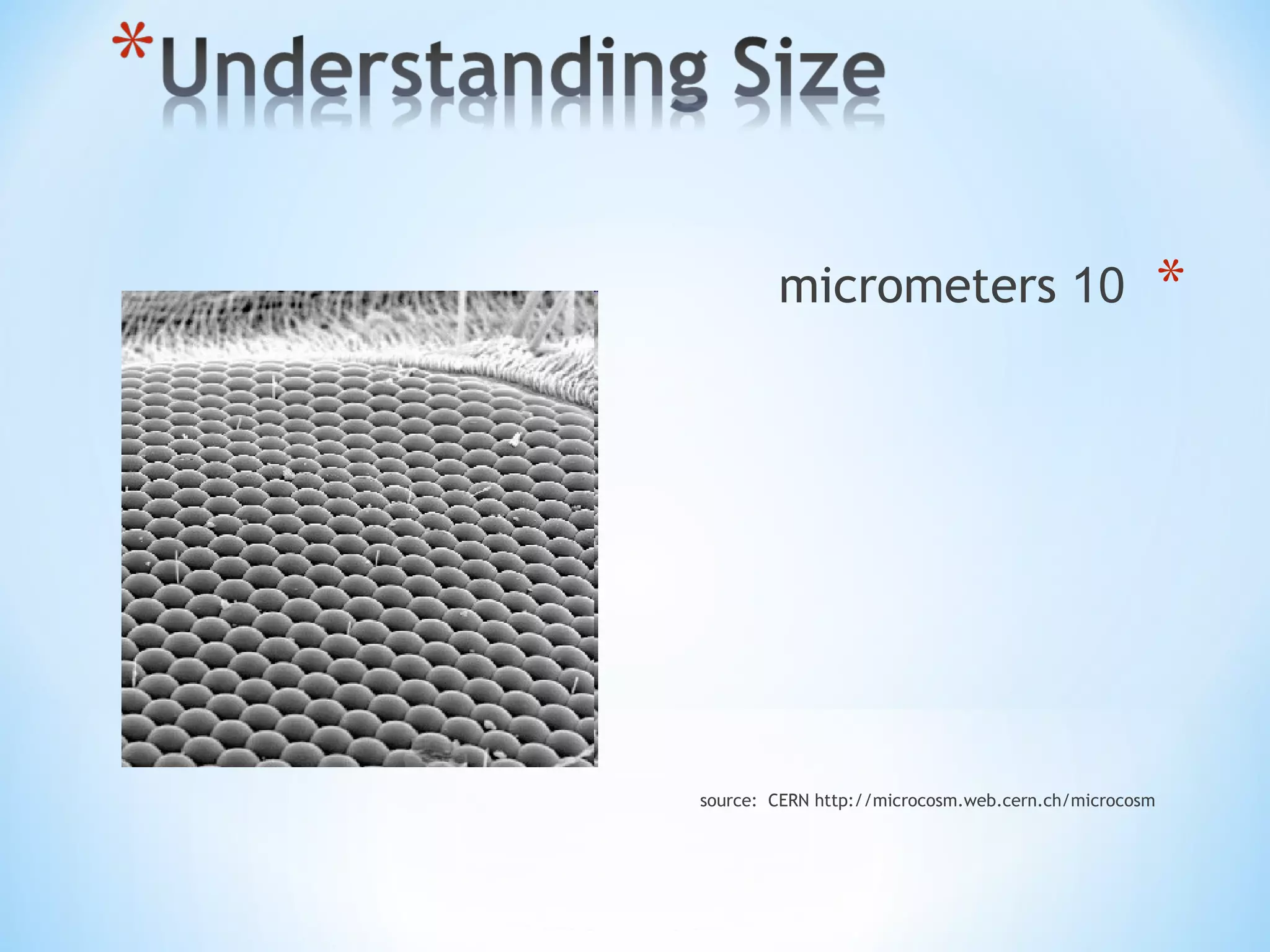
*10micrometers
source: CERN http://microcosm.web.cern.ch/microcosm
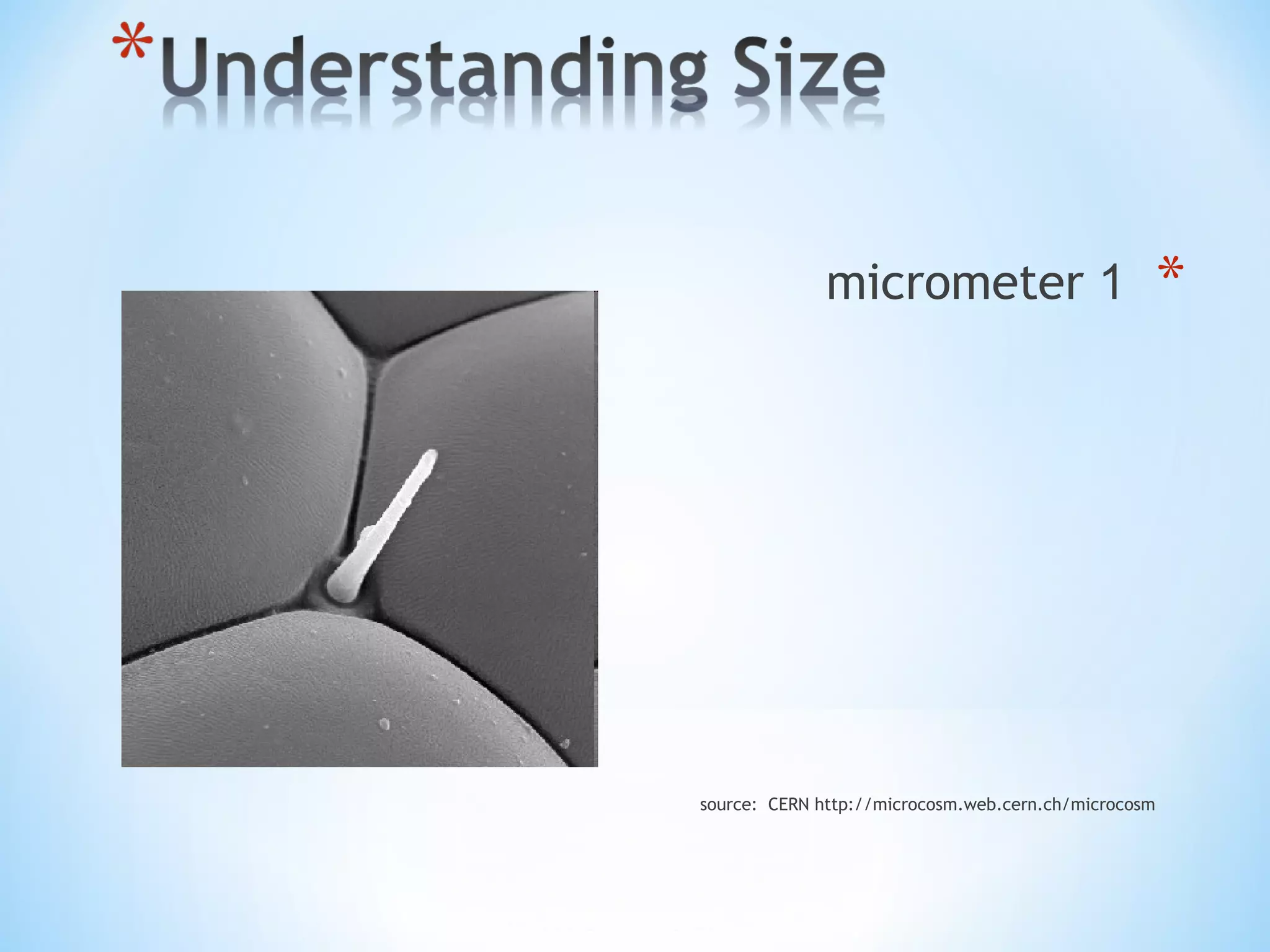
*1micrometer
source: CERN http://microcosm.web.cern.ch/microcosm
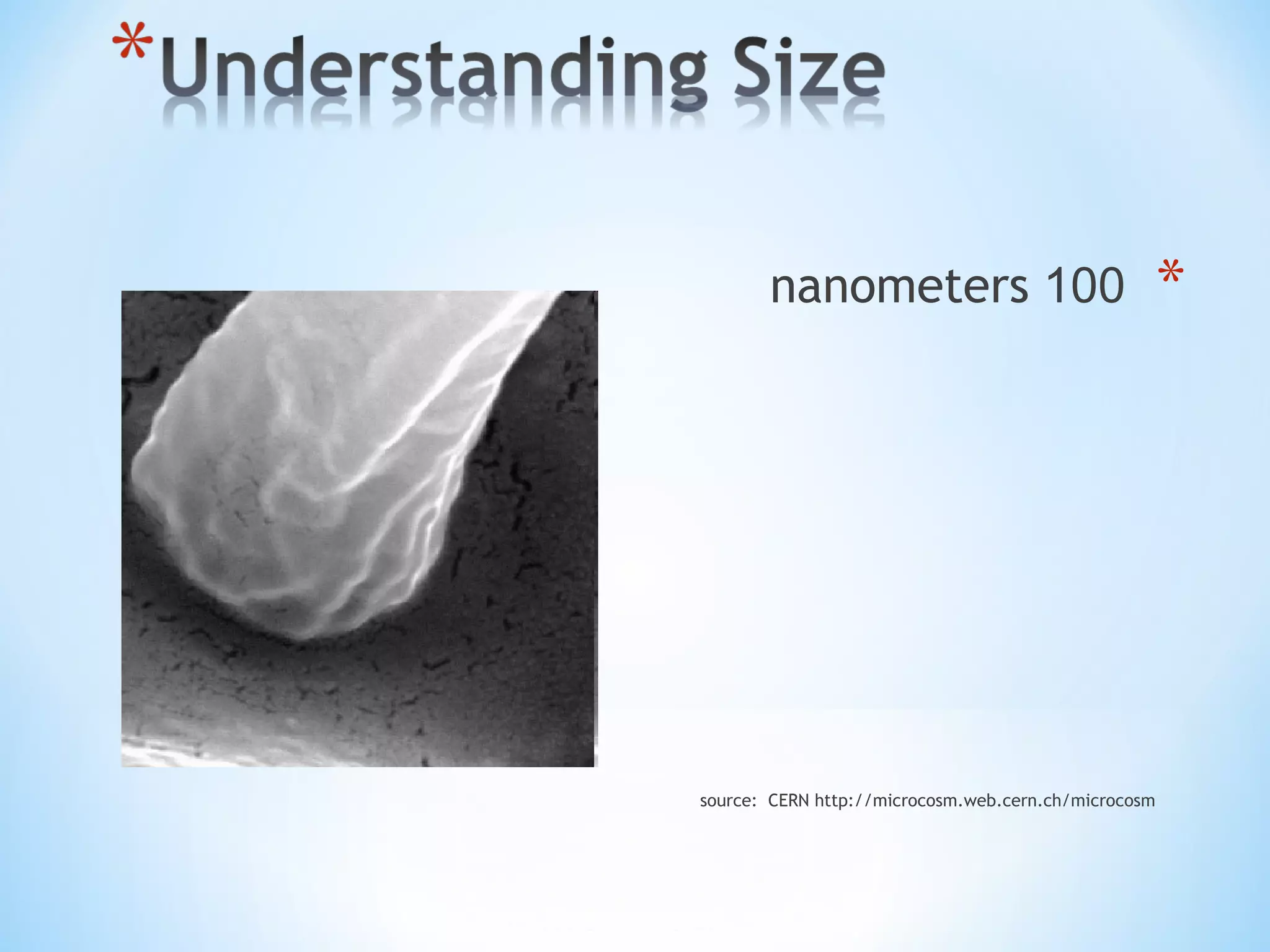
*100nanometers
source: CERN http://microcosm.web.cern.ch/microcosm
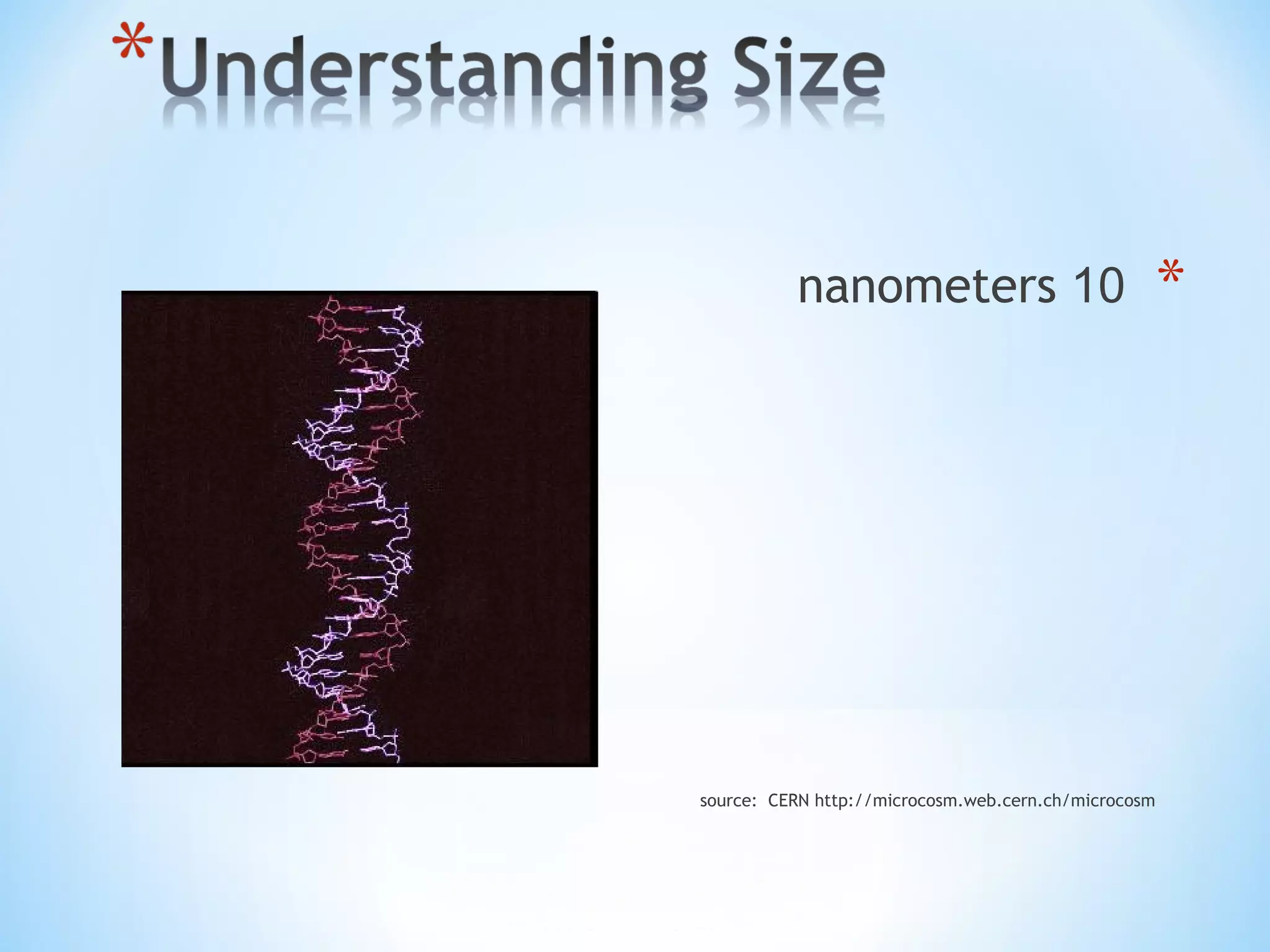
*10nanometers
source: CERN http://microcosm.web.cern.ch/microcosm
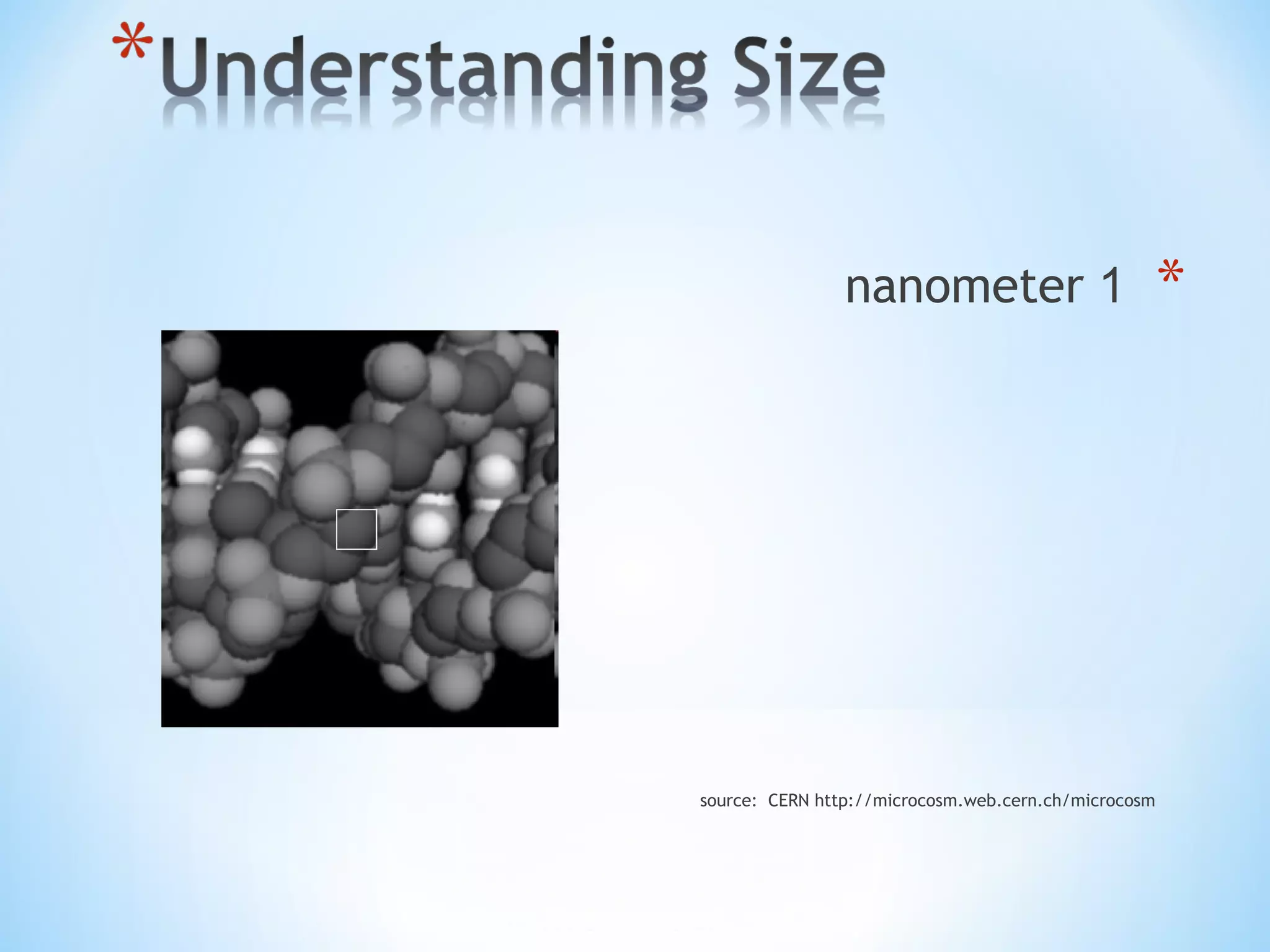
*1nanometer
source: CERN http://microcosm.web.cern.ch/microcosm
*It’s not just how big you are
*It’s what you can do with it
Origins of Nanotechnology
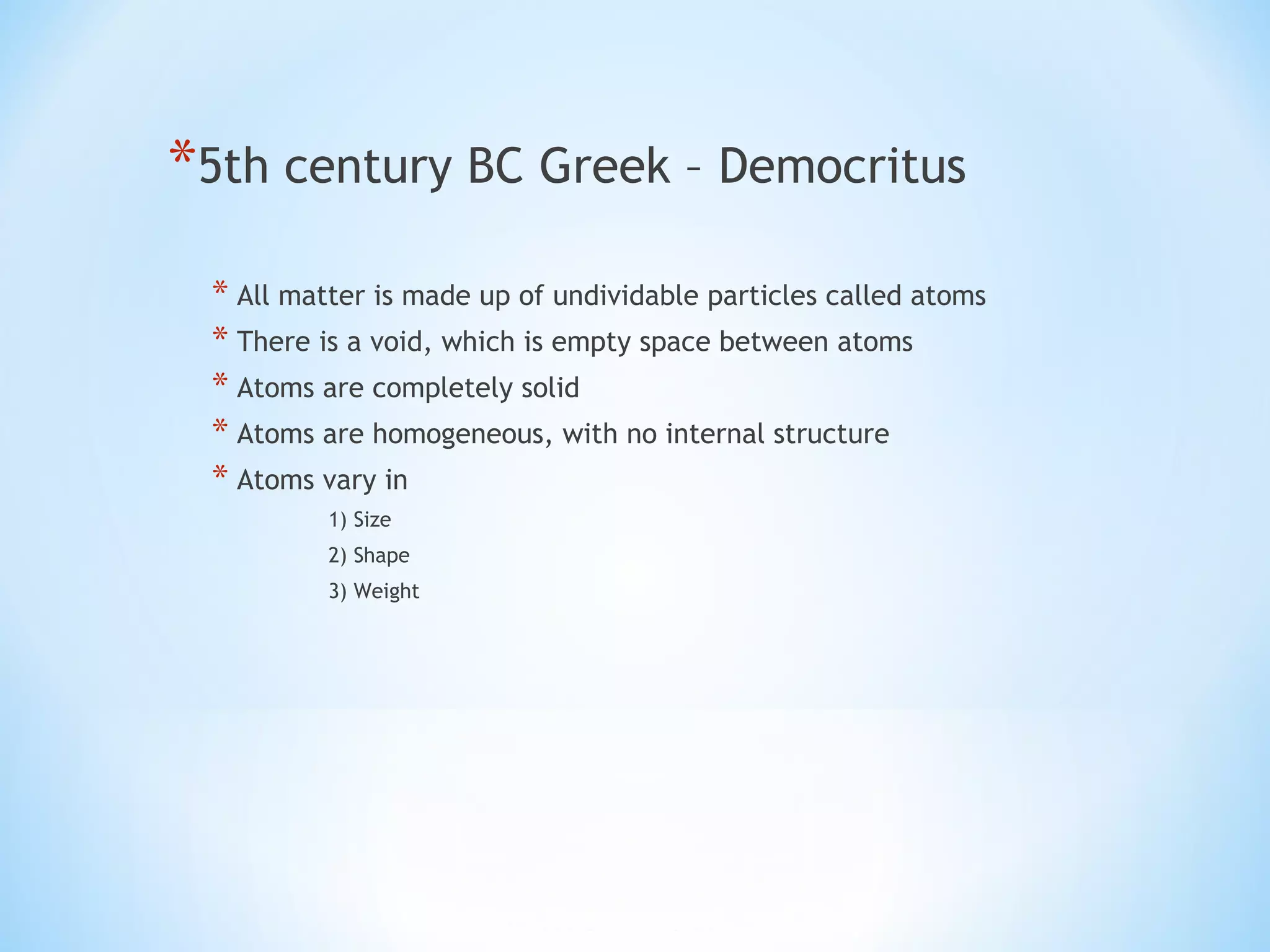
*5th century BC Greek – Democritus
* All matter is made up of undividable particles called atoms
* There is a void, which is empty space between atoms
* Atoms are completely solid
* Atoms are homogeneous, with no internal structure
* Atoms vary in
1) Size
2) Shape
3) Weight
1) chemical elements are made of atoms
2) the atoms of an element are identical in their masses
3) atoms of different elements have different masses
4) atoms only combine in small, whole number ratios such as 1:1, 1:2,
2:3 and so on
5) atoms can be neither created nor destroyed
*Nanoparticles are the end products of a wide
variety of physical, chemical and biological
processes some of which are novel and
radically different, others of which are quite
commonplace.
*Nanoparticles may be defined as submicron
(<1µm) colloidal systems, generally, but not
necessarily, made of polymers (biodegradable
or not).
* Advantages: Nanotechnology lets us make
almost every manufactured product faster,
lighter, stronger, smarter, safer and cleaner,
and even more accurate. We can already see
many of the possibilities as these few examples
illustrate
*. Disadvantages: The biggest
disadvantage is that Nanotechnology is
actually VERY expensive, so not
everyone can buy it or afford it. Its also
very hard to create, and just a single
molecule of powder or dust can damage
the whole thing while it is being
created/ formed.
*Nanoparticles may be created using several
methods. Some of them may occur in nature as
well. The methods of creation include attrition
and pyrolysis. While some methods are bottoms
up, some are called top down. Top down
methods involve braking the larger materials
into nanoparticles.
*Attrition
*Attrition methods include methods by which macro
or micro scale particles are ground in a ball mill, a
planetary ball mill, or other size reducing
mechanism. The resulting particles are air classified
to recover nanoparticles.
*Involves mechanical thermal cycles
*Yields
*broad size distribution (10-1000 nm)
*varied particle shape or geometry
*impurities
*Application
*Nanocomposites
*Nano-grained bulk materials
*Other methods such as,
*Bottoms up methods
*These are further classified according to
phases:
*Gas (Vapor) Phase Fabrication: Pyrolysis, Inert
Gas Condensation
Liquid Phase Fabrication: Solvothermal Reaction,
Sol-gel, Micellar Structured Media
*Pyrolysis
*In pyrolysis, a vaporous precursor (liquid or
gas) is forced through a hole or opening at high
pressure and burned. The resulting solid is air
classified to recover oxide particles from by-
product gases. Pyrolysis often results in
aggregates and agglomerates rather than
singleton primary particles.
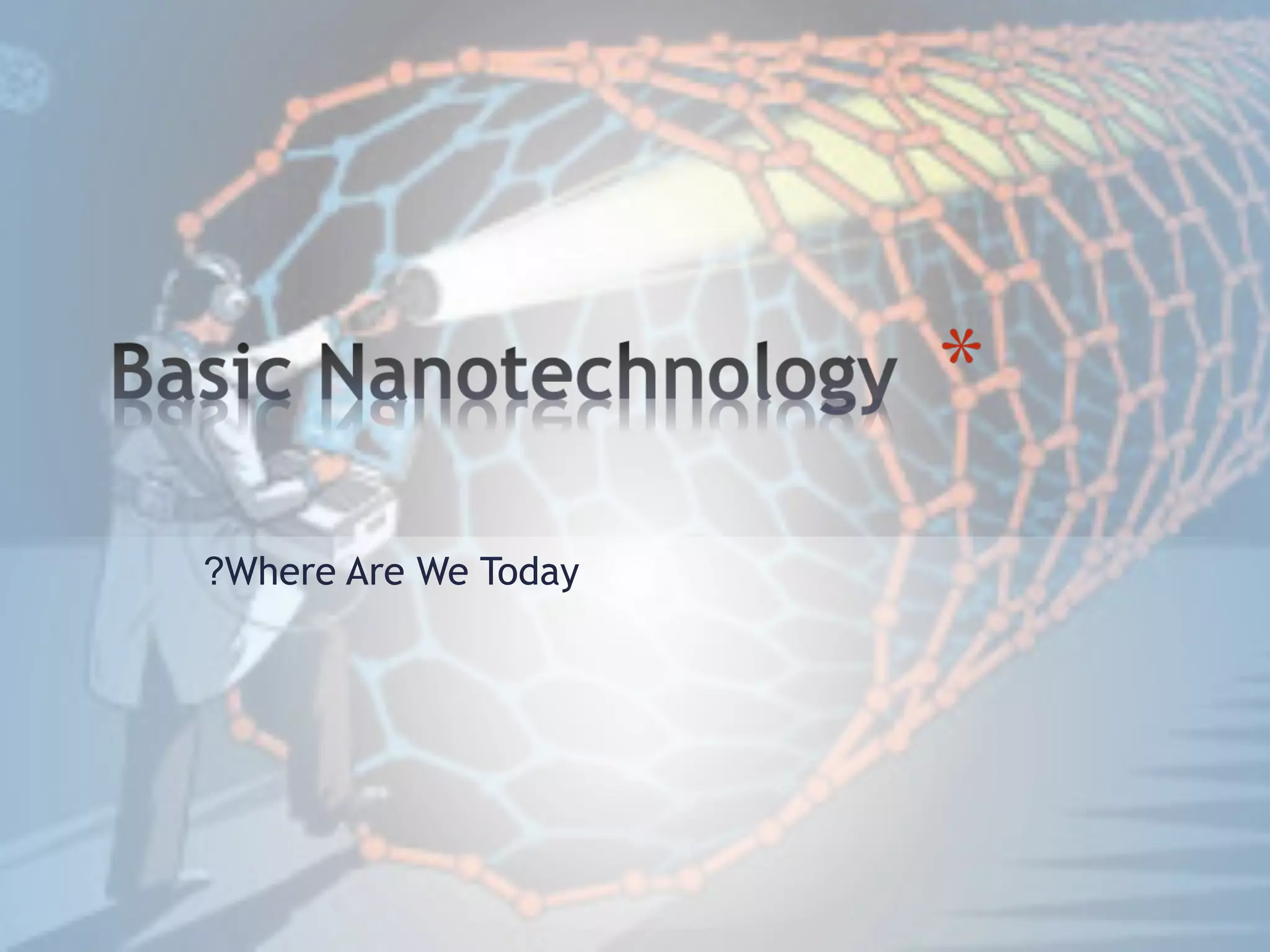
Where Are We Today?
Principle of nanotecnology

Principle of nanotecnology