TYPES OF MANAGERIAL ROLES
TYPES OF MANAGERIAL SKILLS
TYPES OF MANAGERIAL ROLES
 Henry Mintzberg has identified ten common roles of
all managers.
 The roles are divided into three groups:
 Interpersonal
 Informational
 Decisional
INTERPERSONAL ROLE
 Under interpersonal role management involves
managers to act as:
 Figurehead
 Leader
 Liaison manager
CONT…
 Figurehead performs ceremonial & symbolic duties
such as greeting visitors, signing legal documents,
attaining social functions etc. on behalf of the
organization.
 As a Leader managers have to direct & motivate
subordinates, provide training & counselling etc.
 As a Liaison manager maintains information, links
both inside & outside organizations through mail,
phone, meeting etc.
INFORMATIONAL ROLE
 Under informational role managers have to play as:
 Monitor
 Disseminator
 Spokes person
CONT…
 The main role of a Monitor is to seek & receive
information, scan periodic reports & maintain
personal contacts.
 Disseminator has to forward information to other
members of the organization through memos, reports,
phones etc.
 Spokes Person transmits information to outsiders
through speeches, reports etc.
DECISIONAL ROLE
 Under decisional role managers have to act as:
 Entrepreneur
 Disturbance handler
 Resource allocator
 Negotiator
CONT…
 Entrepreneur has to indicate projects, identify new
ideas, focus on creativity, take risk & exploit
opportunities.
 As a Disturbance Handler manager takes corrective
action during disputes or crises. Managers have to
resolve conflicts among subordinates & remain
adaptive to face environmental changes & challenges.
 As a Resource Allocator manager decides allocation
of resources on priority basis & prepares budget.
 A Negotiator represents department during
negotiation of union contracts, sales, purchases etc.
SKILL DISTRIBUTION AT VARIOUS
MANAGEMENT LEVEL
 Robert Katz has suggested three managerial skills that
are essential to the success of management.
 These skills are:
 Technical
 Human
 Conceptual
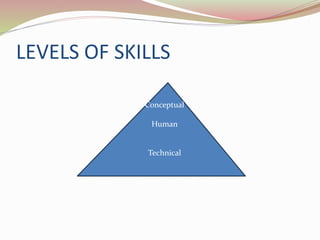
LEVELS OF SKILLS
Conceptual
Human
Technical
TECHNICAL SKILLS
 Technical skill involves process or technical knowledge
& proficiency.
 It belongs to the lower level of the hierarchy.
 Managers use the processes, techniques & tools of a
specific area.
 It is the ability & knowledge needed to accomplish
complex action actions, tasks & processes.
HUMAN SKILL
 Human skill involves the ability to interact effectively
with people.
 Middle level managers should have strong human
skill.
 Managers interact & cooperate with employees.
Human relations skills are directly related to a
manager’s leadership abilities.
 It focuses on the ability to get things done by
understanding & working through others outside of
formally prescribed organizational mechanisms is
crucial for managerial success.
CONCEPTUAL SKILL
 Conceptual skill involves the formulation of ideas.
 It is associated with top level management.
 Managers understand abstract relationships, develop
ideas & solve problems creatively.
 Conceptual skill focuses on the ability to see the
enterprise as a whole & recognise how various
functions of the organization are interrelated & how
changes in one part affect all the others.
 It helps to visualise internal & external relationship.
 Example: Articulating a vision for the organization.

MANAGERIAL ROLES & sKILLS.pptx

  • 1.
    TYPES OF MANAGERIALROLES TYPES OF MANAGERIAL SKILLS
  • 2.
    TYPES OF MANAGERIALROLES  Henry Mintzberg has identified ten common roles of all managers.  The roles are divided into three groups:  Interpersonal  Informational  Decisional
  • 3.
    INTERPERSONAL ROLE  Underinterpersonal role management involves managers to act as:  Figurehead  Leader  Liaison manager
  • 4.
    CONT…  Figurehead performsceremonial & symbolic duties such as greeting visitors, signing legal documents, attaining social functions etc. on behalf of the organization.  As a Leader managers have to direct & motivate subordinates, provide training & counselling etc.  As a Liaison manager maintains information, links both inside & outside organizations through mail, phone, meeting etc.
  • 5.
    INFORMATIONAL ROLE  Underinformational role managers have to play as:  Monitor  Disseminator  Spokes person
  • 6.
    CONT…  The mainrole of a Monitor is to seek & receive information, scan periodic reports & maintain personal contacts.  Disseminator has to forward information to other members of the organization through memos, reports, phones etc.  Spokes Person transmits information to outsiders through speeches, reports etc.
  • 7.
    DECISIONAL ROLE  Underdecisional role managers have to act as:  Entrepreneur  Disturbance handler  Resource allocator  Negotiator
  • 8.
    CONT…  Entrepreneur hasto indicate projects, identify new ideas, focus on creativity, take risk & exploit opportunities.  As a Disturbance Handler manager takes corrective action during disputes or crises. Managers have to resolve conflicts among subordinates & remain adaptive to face environmental changes & challenges.  As a Resource Allocator manager decides allocation of resources on priority basis & prepares budget.  A Negotiator represents department during negotiation of union contracts, sales, purchases etc.
  • 9.
    SKILL DISTRIBUTION ATVARIOUS MANAGEMENT LEVEL  Robert Katz has suggested three managerial skills that are essential to the success of management.  These skills are:  Technical  Human  Conceptual
  • 10.
  • 11.
    TECHNICAL SKILLS  Technicalskill involves process or technical knowledge & proficiency.  It belongs to the lower level of the hierarchy.  Managers use the processes, techniques & tools of a specific area.  It is the ability & knowledge needed to accomplish complex action actions, tasks & processes.
  • 12.
    HUMAN SKILL  Humanskill involves the ability to interact effectively with people.  Middle level managers should have strong human skill.  Managers interact & cooperate with employees. Human relations skills are directly related to a manager’s leadership abilities.  It focuses on the ability to get things done by understanding & working through others outside of formally prescribed organizational mechanisms is crucial for managerial success.
  • 13.
    CONCEPTUAL SKILL  Conceptualskill involves the formulation of ideas.  It is associated with top level management.  Managers understand abstract relationships, develop ideas & solve problems creatively.  Conceptual skill focuses on the ability to see the enterprise as a whole & recognise how various functions of the organization are interrelated & how changes in one part affect all the others.  It helps to visualise internal & external relationship.  Example: Articulating a vision for the organization.

Editor's Notes

  • #2 By: Dr. Debajani Palai, Faculty: IMIT, Cuttack, Odisha