Chapter Ten
Pricing:
Understanding and Capturing
Customer Value
Pricing Concepts
Understanding and
Capturing Customer Value
• What Is a Price?
• Customer Perceptions of Value
• Company and Product Costs
• Other Internal and External Considerations
Affecting Price Decisions
Topic Outline
What Is a Price?
In narrow sense
Price is the amount of money charged for a product or
service.
More Broadly
It is the sum of all the values that consumers give up in
order to gain the benefits of having or using a
product or service.
Price is the only element in the marketing mix that
produces revenue; all other elements represent
costs
Factors to Consider When Setting Prices
• Understanding how much value consumers
put on the benefits they receive from the
product and setting a price that captures
that value
Customer Perceptions of Value
Value Based Pricing Strategies
Value-based pricing uses the buyers’
perceptions of value, not the sellers cost, as
the key to pricing. Price is considered before
the marketing program is set.
• Value-based pricing is customer driven
http://www.babycenter.com/2_freedom-to-
play-their-way-by-pampers-
cruisers_10359097.bc
• Cost-based pricing is product driven
Customer Perceptions of Value
Value Based Pricing Strategies
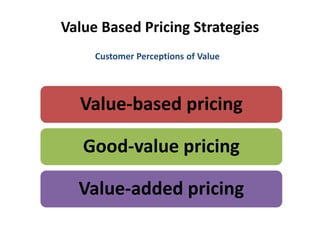
Value-based pricing
Good-value pricing
Value-added pricing
Customer Perceptions of Value
Good-value pricing
Good-value pricing offers the right combination of quality
and good service to fair price
• May involve introducing lesser expensive versions of
established brands
e.g. Armani Exchange, Emirate’s Fly Dubai
• Existing brands are being redesigned to offer more
quality for a given price or the same quality for less
price
• EDLP  Every day low pricing  walmart
Customer Perceptions of Value
Good-value pricing
Everyday low pricing (EDLP) involves charging a
constant everyday low price with few or no
temporary price discounts
High-low pricing involves charging higher prices on an
everyday basis but running frequent promotions to
lower prices temporarily on selected items
Customer Perceptions of Value
Value-added pricing
Value-added pricing attaches value-added features and services to
differentiate offers, support higher prices, and build pricing power
The monsoon season in Mumbai, India, is three months of near-
nonstop rain. For 147 years, most Mumbaikars protected themselves
with a Stag umbrella from venerable Ebrahim Currim & Sons. Like
Ford’s Model T, the basic Stag was sturdy, affordable, and of any color,
as long as it was black. By the end of the twentieth century however,
the Stag was threatened by cheaper imports from China. Stag
responded by dropping prices and scrimping on quality. It was a bad
move: For the first time since the 1940s, the brand began losing
money. Finally, however, Stag came to its senses. It abandoned the
price war and started innovating. It launched designer umbrellas in
funky designs and cool colors. Teenagers and young adults lapped
them up. It then launched umbrellas with a built-in highpower
flashlight for those who walk unlit roads at night and models with
prerecorded tunes for music lovers. For women who walk secluded
streets after dark, there’s Stag’s Bodyguard model, armed with glare
lights, emergency blinkers, and an alarm. Customers willingly pay up to
a 100 percent premium for the new products. Under the new value-
added strategy, the Stag brand has now returned to profitability.
Factors to Consider
When Setting Prices
Cost-based pricing involves setting prices based on the
costs for producing, distributing, and selling the
product plus a fair rate of return for its effort and
risk
Company and Product Costs
Cost-based pricing
Cost-based pricing adds a standard markup to the cost
of the product
Company and Product Costs
Cost-based pricing
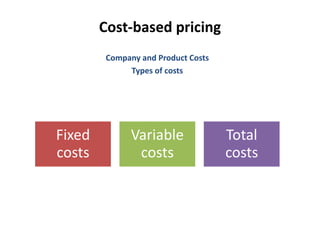
Fixed
costs
Variable
costs
Total
costs
Company and Product Costs
Types of costs
Cost-based pricing
Fixed costs are the costs that do not vary with
production or sales level
• Rent
• Heat
• Interest
• Executive salaries
Company and Product Costs
Cost-based pricing
Variable costs are the costs that vary with the level of
production
• Packaging
• Raw materials
Total costs are the sum of the fixed and variable costs for
any given level of production
Average cost is the cost associated with a given level of
output
Company and Product Costs
Cost Based Pricing
• Experience or learning curve is when
average cost falls as production increases
because fixed costs are spread over more
units
Costs as a Function of Production Experience
Cost Based Pricing Strategies
• Cost-plus pricing adds a standard markup to
the cost of the product
• Benefits
– Sellers are certain about costs
– Prices are similar in industry and price competition is
minimized
– Consumers feel it is fair
• Disadvantages
– Ignores demand and competitor prices
Cost-Plus Pricing
Cost Based Pricing Strategies
Break-even pricing is the price at which total costs are
equal to total revenue and there is no profit
Target profit pricing is the price at which the firm will
break even or make the profit it’s seeking
Break-Even Analysis and Target Profit Pricing
Competition Based Pricing
• Competition-based pricing involves setting
prices based on competitors’ strategies, costs,
prices, and market offerings.
• Consumers will base their judgments of a
product’s value on the prices that competitors
charge for similar products.
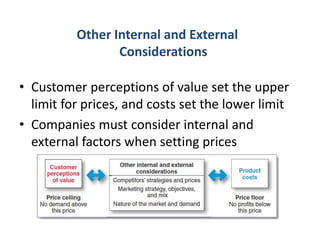
• Customer perceptions of value set the upper
limit for prices, and costs set the lower limit
• Companies must consider internal and
external factors when setting prices
Other Internal and External
Considerations
Factors to Consider When
Setting Prices
Overall Marketing Strategy, Objectives, and Mix
• Price is only one element of the company’s broader
marketing strategy
• If the company has selected its target market and positioning
carefully, then its marketing mix strategy, including price, will
be fairly straightforward.
Other Internal and External Considerations
SESSION END

class 10.ppt

  • 1.
  • 2.
    Pricing Concepts Understanding and CapturingCustomer Value • What Is a Price? • Customer Perceptions of Value • Company and Product Costs • Other Internal and External Considerations Affecting Price Decisions Topic Outline
  • 3.
    What Is aPrice? In narrow sense Price is the amount of money charged for a product or service. More Broadly It is the sum of all the values that consumers give up in order to gain the benefits of having or using a product or service. Price is the only element in the marketing mix that produces revenue; all other elements represent costs
  • 4.
    Factors to ConsiderWhen Setting Prices • Understanding how much value consumers put on the benefits they receive from the product and setting a price that captures that value Customer Perceptions of Value
  • 5.
    Value Based PricingStrategies Value-based pricing uses the buyers’ perceptions of value, not the sellers cost, as the key to pricing. Price is considered before the marketing program is set. • Value-based pricing is customer driven http://www.babycenter.com/2_freedom-to- play-their-way-by-pampers- cruisers_10359097.bc • Cost-based pricing is product driven Customer Perceptions of Value
  • 6.
    Value Based PricingStrategies Value-based pricing Good-value pricing Value-added pricing Customer Perceptions of Value
  • 7.
    Good-value pricing Good-value pricingoffers the right combination of quality and good service to fair price • May involve introducing lesser expensive versions of established brands e.g. Armani Exchange, Emirate’s Fly Dubai • Existing brands are being redesigned to offer more quality for a given price or the same quality for less price • EDLP  Every day low pricing  walmart Customer Perceptions of Value
  • 8.
    Good-value pricing Everyday lowpricing (EDLP) involves charging a constant everyday low price with few or no temporary price discounts High-low pricing involves charging higher prices on an everyday basis but running frequent promotions to lower prices temporarily on selected items Customer Perceptions of Value
  • 9.
    Value-added pricing Value-added pricingattaches value-added features and services to differentiate offers, support higher prices, and build pricing power The monsoon season in Mumbai, India, is three months of near- nonstop rain. For 147 years, most Mumbaikars protected themselves with a Stag umbrella from venerable Ebrahim Currim & Sons. Like Ford’s Model T, the basic Stag was sturdy, affordable, and of any color, as long as it was black. By the end of the twentieth century however, the Stag was threatened by cheaper imports from China. Stag responded by dropping prices and scrimping on quality. It was a bad move: For the first time since the 1940s, the brand began losing money. Finally, however, Stag came to its senses. It abandoned the price war and started innovating. It launched designer umbrellas in funky designs and cool colors. Teenagers and young adults lapped them up. It then launched umbrellas with a built-in highpower flashlight for those who walk unlit roads at night and models with prerecorded tunes for music lovers. For women who walk secluded streets after dark, there’s Stag’s Bodyguard model, armed with glare lights, emergency blinkers, and an alarm. Customers willingly pay up to a 100 percent premium for the new products. Under the new value- added strategy, the Stag brand has now returned to profitability.
  • 10.
    Factors to Consider WhenSetting Prices Cost-based pricing involves setting prices based on the costs for producing, distributing, and selling the product plus a fair rate of return for its effort and risk Company and Product Costs
  • 11.
    Cost-based pricing Cost-based pricingadds a standard markup to the cost of the product Company and Product Costs
  • 12.
  • 13.
    Cost-based pricing Fixed costsare the costs that do not vary with production or sales level • Rent • Heat • Interest • Executive salaries Company and Product Costs
  • 14.
    Cost-based pricing Variable costsare the costs that vary with the level of production • Packaging • Raw materials Total costs are the sum of the fixed and variable costs for any given level of production Average cost is the cost associated with a given level of output Company and Product Costs
  • 15.
    Cost Based Pricing •Experience or learning curve is when average cost falls as production increases because fixed costs are spread over more units Costs as a Function of Production Experience
  • 16.
    Cost Based PricingStrategies • Cost-plus pricing adds a standard markup to the cost of the product • Benefits – Sellers are certain about costs – Prices are similar in industry and price competition is minimized – Consumers feel it is fair • Disadvantages – Ignores demand and competitor prices Cost-Plus Pricing
  • 17.
    Cost Based PricingStrategies Break-even pricing is the price at which total costs are equal to total revenue and there is no profit Target profit pricing is the price at which the firm will break even or make the profit it’s seeking Break-Even Analysis and Target Profit Pricing
  • 18.
    Competition Based Pricing •Competition-based pricing involves setting prices based on competitors’ strategies, costs, prices, and market offerings. • Consumers will base their judgments of a product’s value on the prices that competitors charge for similar products.
  • 19.
    • Customer perceptionsof value set the upper limit for prices, and costs set the lower limit • Companies must consider internal and external factors when setting prices Other Internal and External Considerations
  • 20.
    Factors to ConsiderWhen Setting Prices Overall Marketing Strategy, Objectives, and Mix • Price is only one element of the company’s broader marketing strategy • If the company has selected its target market and positioning carefully, then its marketing mix strategy, including price, will be fairly straightforward. Other Internal and External Considerations
  • 21.

Editor's Notes