Marketing
Pricing
What is Price?
Major Pricing Strategies
Internal & External Consideration
Affecting Price Decisions
Outline
Price!!!
The amount of money charged for a
product or service; the sum of the values
that customers exchange for the benefits
of having or using the product or service.
Major Pricing Strategies
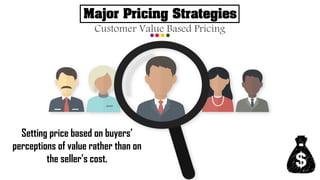
Customer Value Based Pricing
Setting price based on buyers’
perceptions of value rather than on
the seller’s cost.
Price Ceiling
No demand above this Price
Competitors’ strategies and prices
Marketing strategy, objectives, and mix
Nature of the market and demand
Price Floor
No profit below this Price
If customers perceive that a product’s price is greater than its value,
they won’t buy it. If the company prices a product below its costs, profits
will suffer. Between the two extremes, the “right“ pricing strategy is one
that delivers both value to the customer and profits to the company.
Other Internal and External
Considerations
Customer Perceptions
Value
Product Costs
Major Pricing Strategies
Customer Value Based Pricing
Major Pricing Strategies
Design product
to deliver desired
value at target
price
Customer Value Based Pricing
Cost Based Pricing
Design a
good product
Determine
product costs
Set price based
on cost
Convince buyers
of product’s
value
Assess customer
needs and value
perceptions
Set target price to
match customer
perceived value
Determine costs
that can be
incurred
Value Based Pricing
Major Pricing Strategies
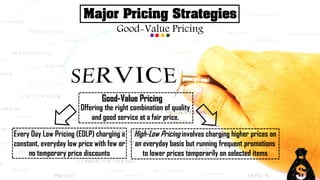
Good-Value Pricing
Offering the right combination of quality
and good service at a fair price.
Good-Value Pricing
Every Day Low Pricing (EDLP) charging a
constant, everyday low price with few or
no temporary price discounts
High-Low Pricing involves charging higher prices on
an everyday basis but running frequent promotions
to lower prices temporarily on selected items
Major Pricing Strategies
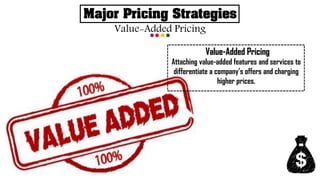
Value-Added Pricing
Attaching value-added features and services to
differentiate a company’s offers and charging
higher prices.
Value-Added Pricing
Setting prices based on the costs for
producing, distributing, and selling the product
plus a fair rate of return for effort and risk.
Major Pricing Strategies
Cost Based Pricing
Major Pricing Strategies
Cost Based Pricing
Types of Costs:
Costs that do not
vary with production
or sales level.
Fixed Costs
Costs that vary
directly with the
level of production.
Variable Costs
The sum of the fixed
and variable costs
for any given level
of production.
Total Costs
Major Pricing Strategies
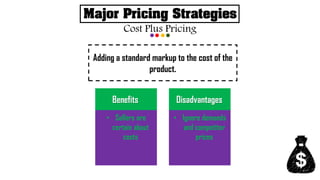
Cost Plus Pricing
Adding a standard markup to the cost of the
product.
• Sellers are
certain about
costs
Benefits
• Ignore demands
and competitor
prices
Disadvantages
Major Pricing Strategies
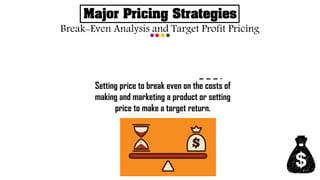
Break-Even Analysis and Target Profit Pricing
Setting price to break even on the costs of
making and marketing a product or setting
price to make a target return.
Setting prices based on competitors’
strategies, prices, costs, and market
offerings.
Major Pricing Strategies
Competition Based Pricing
Pricing Strategies
Pricing Strategies
New Product Pricing Strategy
Market-Skimming Pricing
Setting a high price for a new product to skim
maximum revenues layer by layer from the
segments willing to pay the high price; the
company makes fewer but more profitable sales.
Market-Penetration Pricing
Setting a low price for a new product to
attract a large number of buyers and a
large market share.
Pricing Strategies
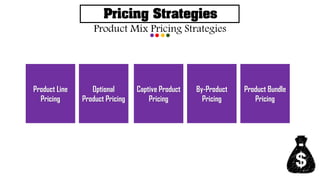
Product Mix Pricing Strategies
Product Line
Pricing
Optional
Product Pricing
Captive Product
Pricing
By-Product
Pricing
Product Bundle
Pricing
Pricing Strategies
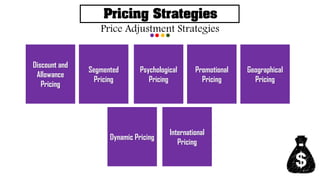
Price Adjustment Strategies
Discount and
Allowance
Pricing
Segmented
Pricing
Psychological
Pricing
Promotional
Pricing
Geographical
Pricing
Dynamic Pricing
International
Pricing
Other Internal and External Considerations
Affecting Price Decisions
Customers Perception of value set the upper
limit for prices, and costs set the lower limit.
Companies must consider all internal and
external factors during setting prices.
Other Internal and External Considerations
Affecting Price Decisions
Target Costing starts with an ideal selling
price based on consumer value considerations
and then targets costs that will ensure that
the price is met.
Other Internal and External Considerations
Affecting Price Decisions

Pricing understanding and capturing customer value.pdf

  • 1.
  • 2.
    What is Price? MajorPricing Strategies Internal & External Consideration Affecting Price Decisions Outline
  • 3.
    Price!!! The amount ofmoney charged for a product or service; the sum of the values that customers exchange for the benefits of having or using the product or service.
  • 4.
    Major Pricing Strategies CustomerValue Based Pricing Setting price based on buyers’ perceptions of value rather than on the seller’s cost.
  • 5.
    Price Ceiling No demandabove this Price Competitors’ strategies and prices Marketing strategy, objectives, and mix Nature of the market and demand Price Floor No profit below this Price If customers perceive that a product’s price is greater than its value, they won’t buy it. If the company prices a product below its costs, profits will suffer. Between the two extremes, the “right“ pricing strategy is one that delivers both value to the customer and profits to the company. Other Internal and External Considerations Customer Perceptions Value Product Costs Major Pricing Strategies Customer Value Based Pricing
  • 6.
    Major Pricing Strategies Designproduct to deliver desired value at target price Customer Value Based Pricing Cost Based Pricing Design a good product Determine product costs Set price based on cost Convince buyers of product’s value Assess customer needs and value perceptions Set target price to match customer perceived value Determine costs that can be incurred Value Based Pricing
  • 7.
    Major Pricing Strategies Good-ValuePricing Offering the right combination of quality and good service at a fair price. Good-Value Pricing Every Day Low Pricing (EDLP) charging a constant, everyday low price with few or no temporary price discounts High-Low Pricing involves charging higher prices on an everyday basis but running frequent promotions to lower prices temporarily on selected items
  • 8.
    Major Pricing Strategies Value-AddedPricing Attaching value-added features and services to differentiate a company’s offers and charging higher prices. Value-Added Pricing
  • 9.
    Setting prices basedon the costs for producing, distributing, and selling the product plus a fair rate of return for effort and risk. Major Pricing Strategies Cost Based Pricing
  • 10.
    Major Pricing Strategies CostBased Pricing Types of Costs: Costs that do not vary with production or sales level. Fixed Costs Costs that vary directly with the level of production. Variable Costs The sum of the fixed and variable costs for any given level of production. Total Costs
  • 11.
    Major Pricing Strategies CostPlus Pricing Adding a standard markup to the cost of the product. • Sellers are certain about costs Benefits • Ignore demands and competitor prices Disadvantages
  • 12.
    Major Pricing Strategies Break-EvenAnalysis and Target Profit Pricing Setting price to break even on the costs of making and marketing a product or setting price to make a target return.
  • 13.
    Setting prices basedon competitors’ strategies, prices, costs, and market offerings. Major Pricing Strategies Competition Based Pricing
  • 14.
  • 15.
    Pricing Strategies New ProductPricing Strategy Market-Skimming Pricing Setting a high price for a new product to skim maximum revenues layer by layer from the segments willing to pay the high price; the company makes fewer but more profitable sales. Market-Penetration Pricing Setting a low price for a new product to attract a large number of buyers and a large market share.
  • 16.
    Pricing Strategies Product MixPricing Strategies Product Line Pricing Optional Product Pricing Captive Product Pricing By-Product Pricing Product Bundle Pricing
  • 17.
    Pricing Strategies Price AdjustmentStrategies Discount and Allowance Pricing Segmented Pricing Psychological Pricing Promotional Pricing Geographical Pricing Dynamic Pricing International Pricing
  • 18.
    Other Internal andExternal Considerations Affecting Price Decisions Customers Perception of value set the upper limit for prices, and costs set the lower limit. Companies must consider all internal and external factors during setting prices.
  • 19.
    Other Internal andExternal Considerations Affecting Price Decisions Target Costing starts with an ideal selling price based on consumer value considerations and then targets costs that will ensure that the price is met.
  • 20.
    Other Internal andExternal Considerations Affecting Price Decisions