LSC @ LDAPCON . 2011


   Sébastien Bahloul
About me
   Developer and software architect
   10 years experience in IAM
   Recently hired as product manager by a French
    security editor, Dictao, providing :
    – personal and server signature,
    – certificate and signing validation,
    – electronic vault
    – multi-factor authentication

11/10/11                                        Page 2
Agenda


   Solving one issue : directory synchronization


   The LSC project


   Demonstration


   Open question : how to get updates notification ?
11/10/11                                            Page 3
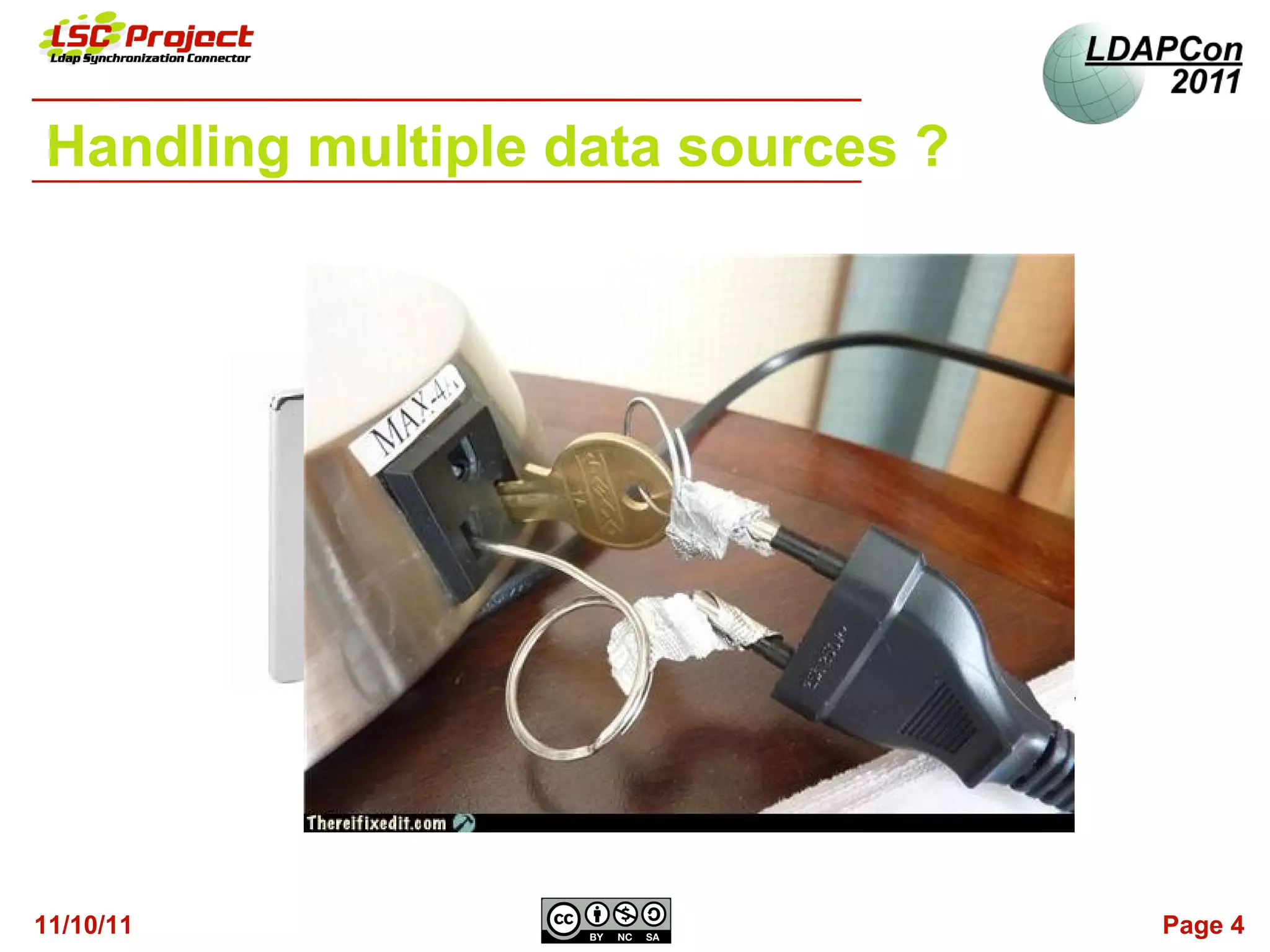
Handling multiple data sources ?


11/10/11                           Page 4
Why ?

   Most of us have already done a directory migration


   Who has already written a synchronization script ?
    that has been used once ?


   Most of LDAP servers are not providing either a
    way to synchronize either heteregeneous data or
    homogeneous data with other implementations

11/10/11                                           Page 5
Introduction
     Automatic synchronization tools
  −       If they already exist, they are quite expensive
          Directory / database-specific replication
          Application-specific connectors (AD, SAP, etc)


  −       What about the rest?
          Between different databases, directories, files?
          Different data models?
          Using standards: LDAP, SQL, etc...?


11/10/11                                                      Page 6
Goals – functionality
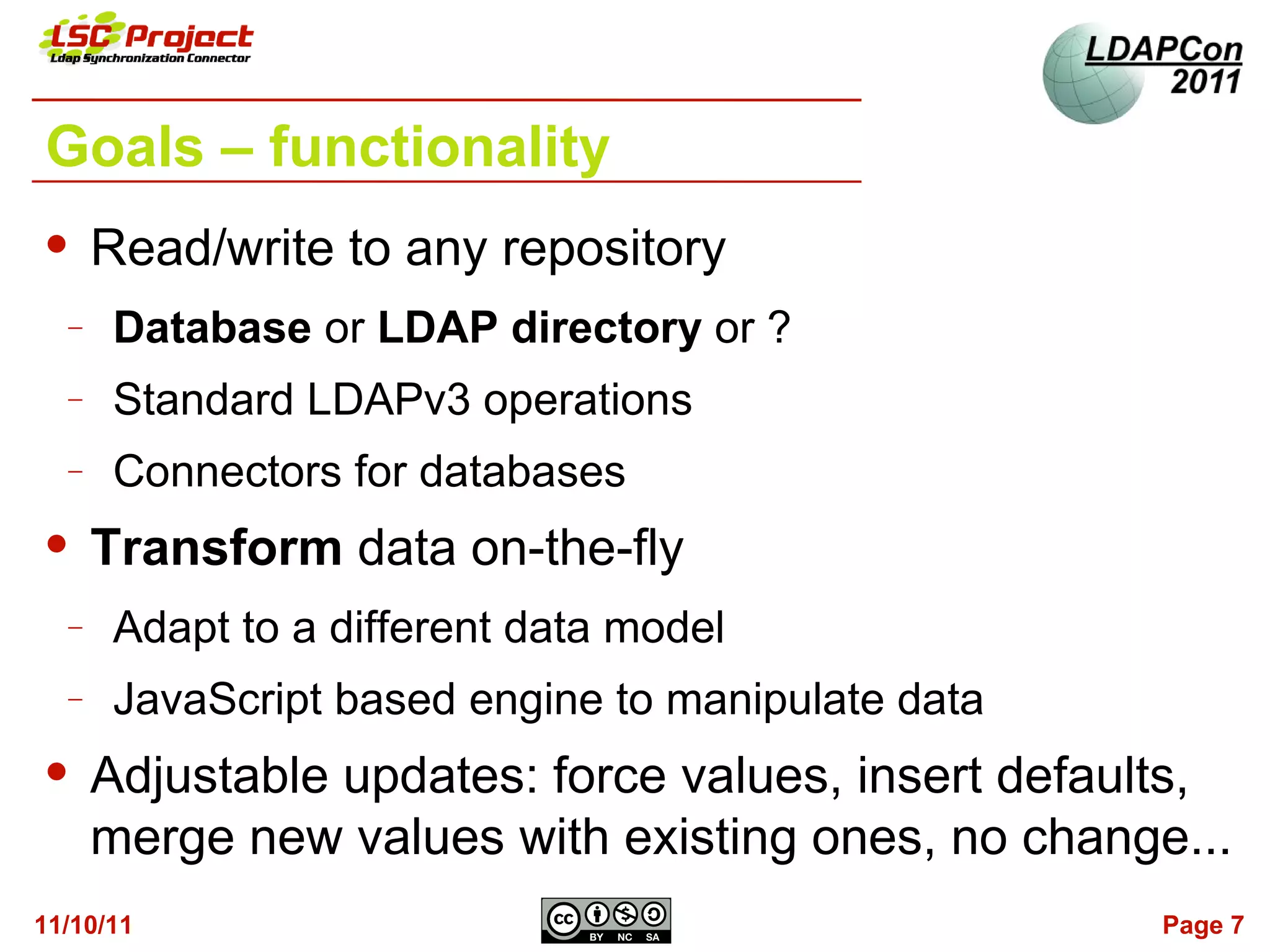
     Read/write to any repository
  −   Database or LDAP directory or ?
  −   Standard LDAPv3 operations
  −   Connectors for databases
     Transform data on-the-fly
  −   Adapt to a different data model
  −   JavaScript based engine to manipulate data
     Adjustable updates: force values, insert defaults,
      merge new values with existing ones, no change...
11/10/11                                            Page 7
Goals – usability
     Quickly implement a new synchronization
     Highly configurable
  −   What exactly do we read?
  −   Powerful transformations (correctness is important)
  −   What exactly do we write?
     Run fast (performance is important)
     Easy to setup
=> Fill the gap between the Perl script and the
Enterprise ETL
11/10/11                                                    Page 8
About LSC Project
       What is LSC?
    −    LDAP Synchronization Connector
    −    Open Source project
    −    BSD licence
    −    Written in Java
    −    6 years in the making
    −    4 years ago LSC-project.org created
    −    ~10 regular contributors

       Website: http://lsc-project.org

11/10/11                                       Page 9
LSC : read and write « everywhere »
   Original and best supported connector to LDAP
    directories
   Additional sources: NIS, database, LDIF/CSV files,
    Web Services
   Additional destinations: Scripting, database
   Extensible API for custom referential support


11/10/11                                            Page 10
Standards based – Wide support
     Any LDAP server should be supported, tested on:
  −   OpenLDAP
  −   OpenDS/J
  −   Sun DSEE
  −   Microsoft Active Directory
  −   Novell Directory Services
  −   IBM Tivoli Directory Server
     Any database with a JDBC connector, tested on:
  −   MySQL, PostgreSQL, Oracle, MSSQL, HSQLDB, ...
11/10/11                                              Page 11
Features
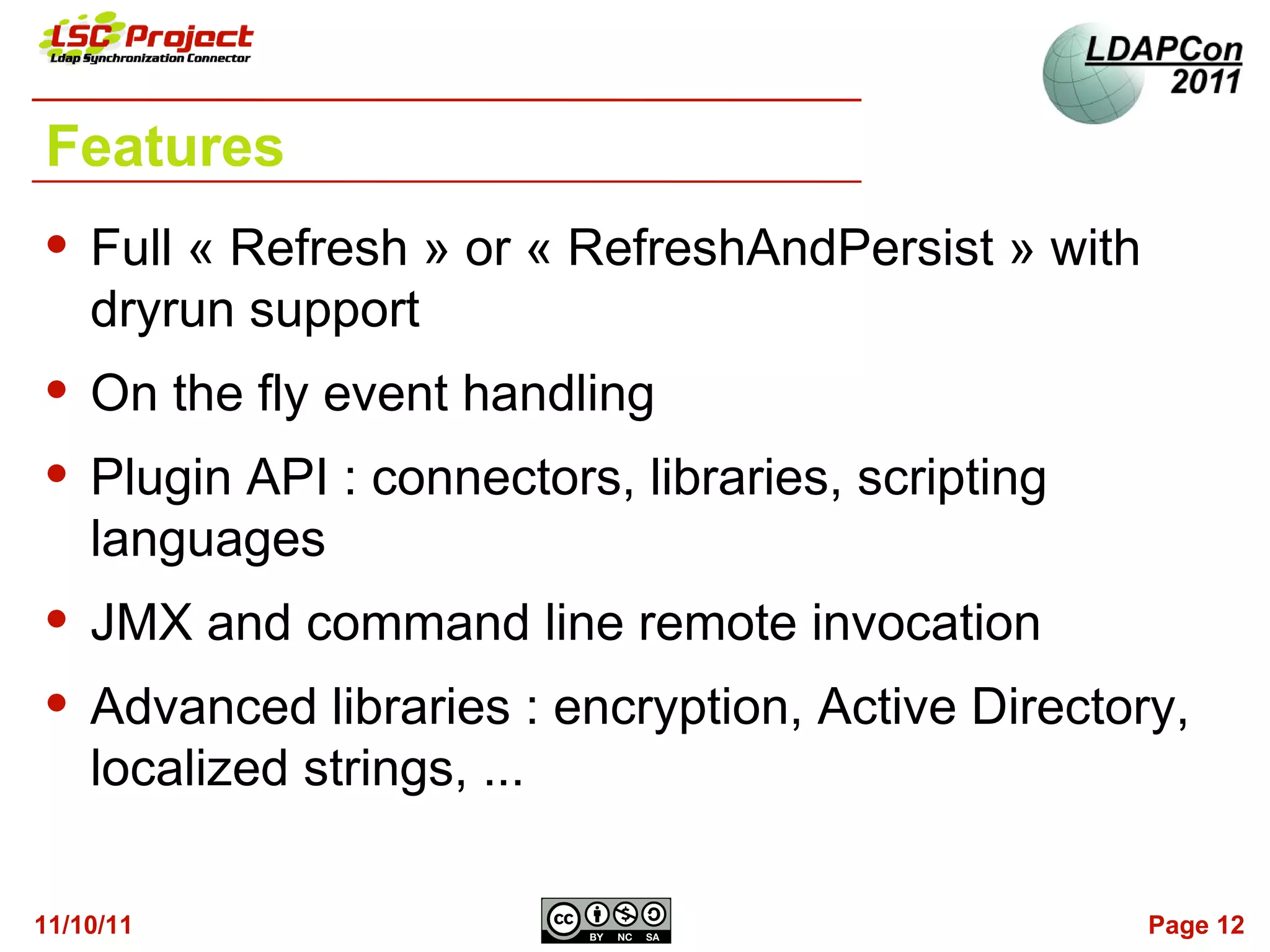
   Full « Refresh » or « RefreshAndPersist » with
    dryrun support
   On the fly event handling
   Plugin API : connectors, libraries, scripting
    languages
   JMX and command line remote invocation
   Advanced libraries : encryption, Active Directory,
    localized strings, ...

11/10/11                                             Page 12
Synchronization rules
   Use your preferred language to write LSC rules!
   LSC built-in and historical support for JavaScript
   Extensible to any JSR 223 compliant language :
    – Php
    – Groovy
    – Unix tools (awk, TCL),
    – Python, Ruby, Scheme (Lisp)
    – ...


11/10/11                                            Page 13
LSC synchronization principles
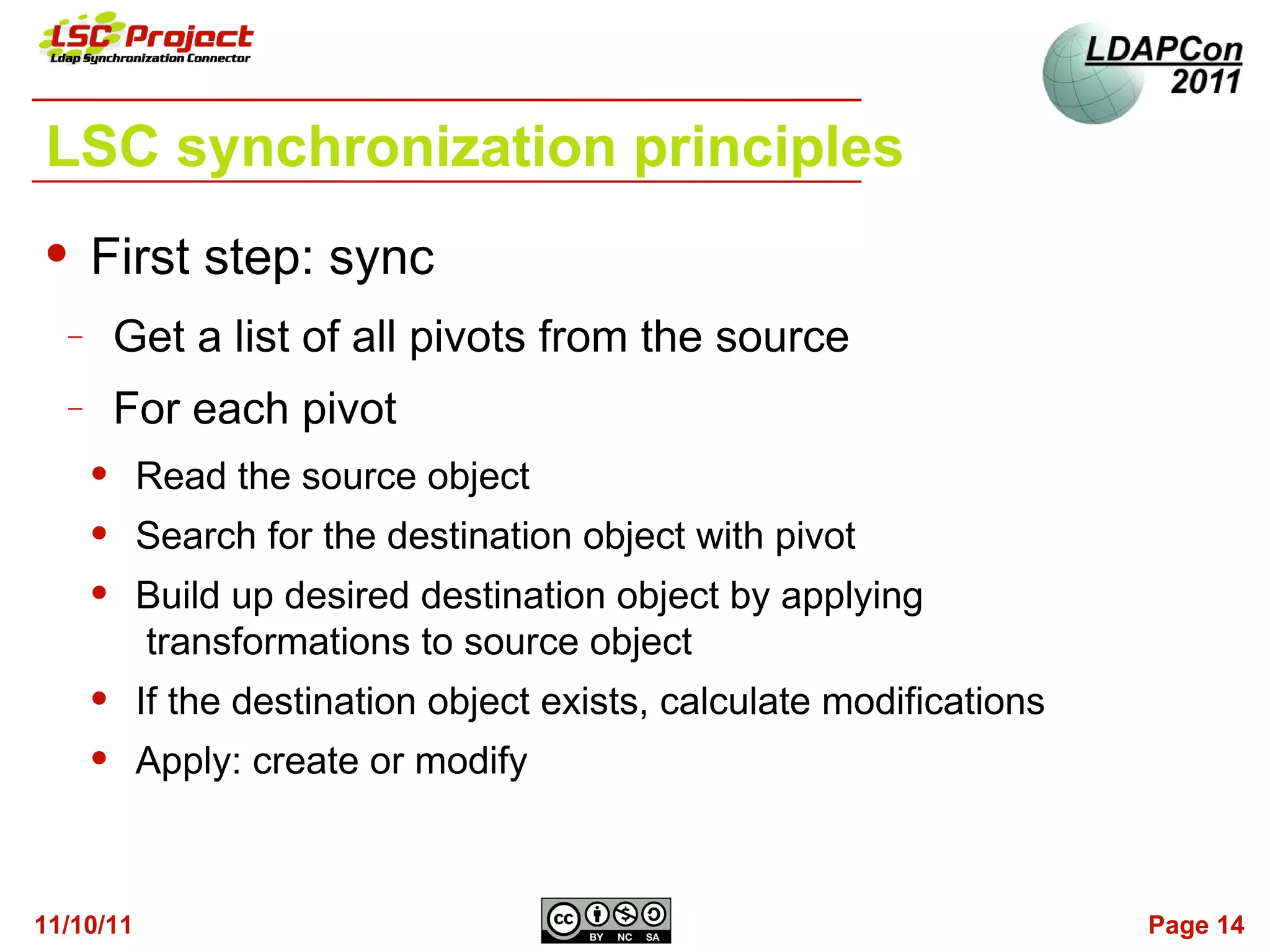
     First step: sync
  −       Get a list of all pivots from the source
  −       For each pivot
          Read the source object
          Search for the destination object with pivot
          Build up desired destination object by applying
           transformations to source object
          If the destination object exists, calculate modifications
          Apply: create or modify


11/10/11                                                               Page 14
LSC synchronization principles
     Second step: clean (optional)
  −       Get a list of all pivots from the destination
  −       For each pivot
          Search for the source object with pivot
          If the source object doesn't exists, delete from destination
          Apply: delete


     Alternative step: asynchronous mode
  −       Get the next source object to synchronize

11/10/11                                                                  Page 15
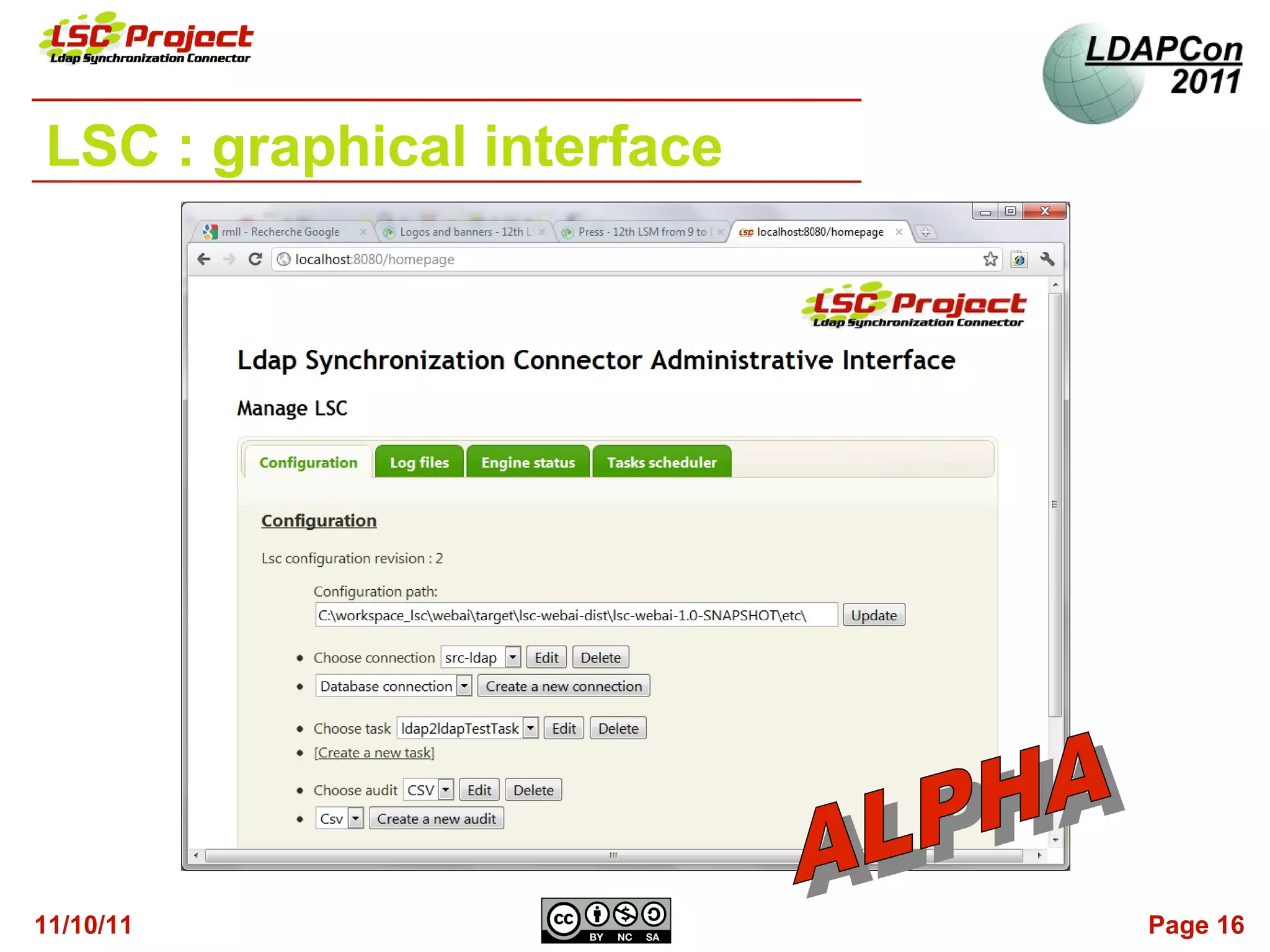
LSC : graphical interface


11/10/11                    Page 16
Demonstration
   Simple use case: synchronize identities
   Involved referential:
    – A source OpenLDAP directory
    – Provisioning to:
           • OpenDJ
           • PostgreSQL


11/10/11                                      Page 17
Roadmap
       Current 2.0 version
    ✔
         Event handling
    ✔
         Write to database
    ✔
         Plugin API
       Next minor version 2.1 (Q1 2012)
    ✗
         Move to a real LDAP API (Apache / OpenDJ LDAP API)
    ✗
         Two-phase commit for file, directory (RFC5805) and database (one-to-many)
    ✗
         Administrative GUI including scheduler
       Next major version 3.0 (later)
    ✗
         Data reconciliation (embedded database)
    ✗
         Many-to-many design

11/10/11                                                                      Page 18
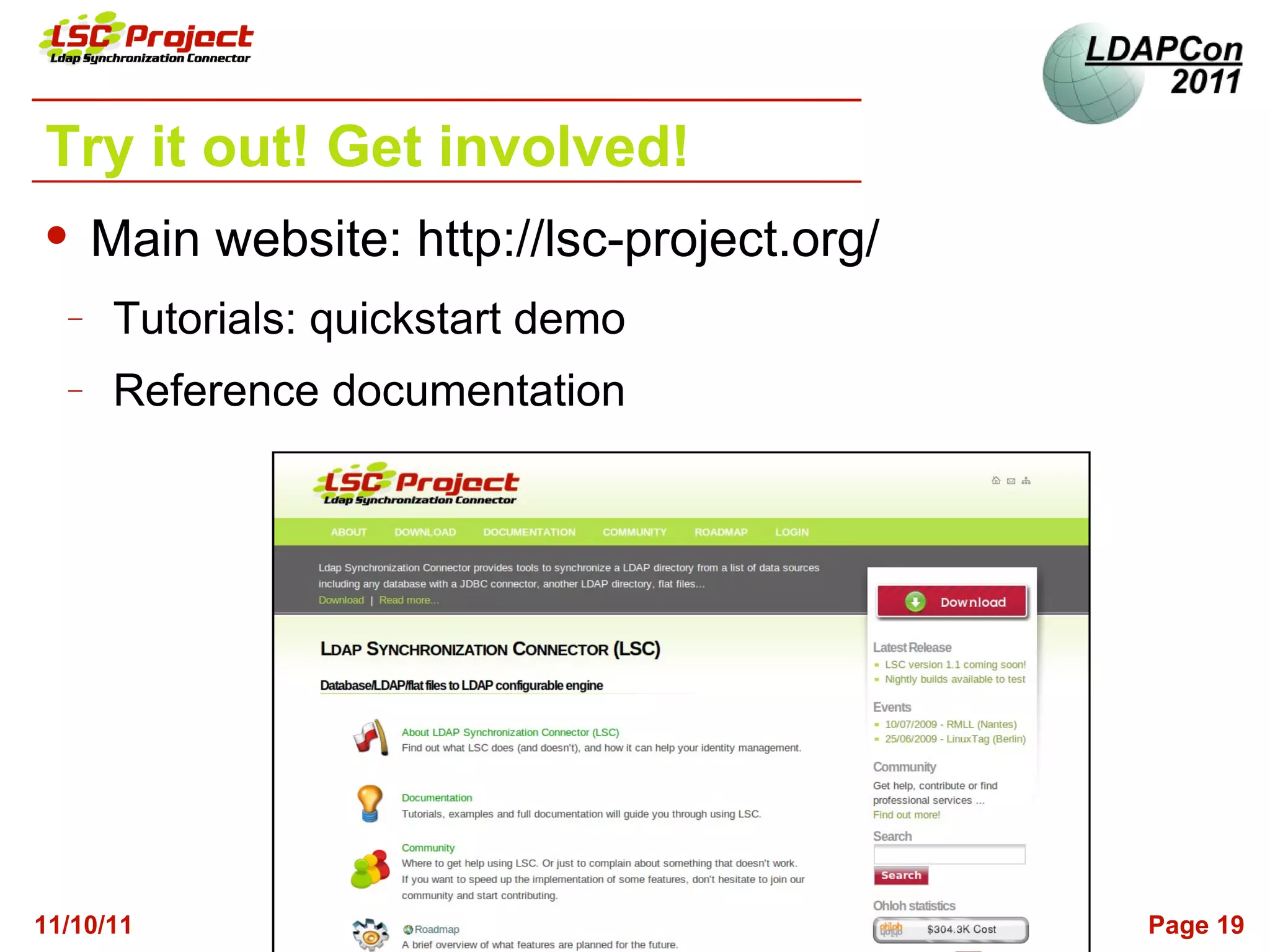
Try it out! Get involved!
     Main website: http://lsc-project.org/
  −    Tutorials: quickstart demo
  −    Reference documentation


11/10/11                                      Page 19
How to get notification updates ?
   The current way of handling:
    – OpenDJ / OpenDS / Oracle / Sun / Netscape :
      persistent search (draft psearch)
    – Apache DS / OpenLDAP: LDAP Content
      Synchronization (RFC4533)
   What would be the best way?
    – Ldap Client Update Protocol
    – Per product logs (retro/external/access/...)
    – Application-side database
11/10/11                                             Page 20
Thanks for your attention!
    Any questions?

LSC@LDAPCon 2011

  • 1.
    LSC @ LDAPCON. 2011 Sébastien Bahloul
  • 2.
    About me  Developer and software architect  10 years experience in IAM  Recently hired as product manager by a French security editor, Dictao, providing : – personal and server signature, – certificate and signing validation, – electronic vault – multi-factor authentication 11/10/11 Page 2
  • 3.
    Agenda  Solving one issue : directory synchronization  The LSC project  Demonstration  Open question : how to get updates notification ? 11/10/11 Page 3
  • 4.
    Handling multiple datasources ? 11/10/11 Page 4
  • 5.
    Why ?  Most of us have already done a directory migration  Who has already written a synchronization script ? that has been used once ?  Most of LDAP servers are not providing either a way to synchronize either heteregeneous data or homogeneous data with other implementations 11/10/11 Page 5
  • 6.
    Introduction  Automatic synchronization tools − If they already exist, they are quite expensive  Directory / database-specific replication  Application-specific connectors (AD, SAP, etc) − What about the rest?  Between different databases, directories, files?  Different data models?  Using standards: LDAP, SQL, etc...? 11/10/11 Page 6
  • 7.
    Goals – functionality  Read/write to any repository − Database or LDAP directory or ? − Standard LDAPv3 operations − Connectors for databases  Transform data on-the-fly − Adapt to a different data model − JavaScript based engine to manipulate data  Adjustable updates: force values, insert defaults, merge new values with existing ones, no change... 11/10/11 Page 7
  • 8.
    Goals – usability  Quickly implement a new synchronization  Highly configurable − What exactly do we read? − Powerful transformations (correctness is important) − What exactly do we write?  Run fast (performance is important)  Easy to setup => Fill the gap between the Perl script and the Enterprise ETL 11/10/11 Page 8
  • 9.
    About LSC Project  What is LSC? − LDAP Synchronization Connector − Open Source project − BSD licence − Written in Java − 6 years in the making − 4 years ago LSC-project.org created − ~10 regular contributors  Website: http://lsc-project.org 11/10/11 Page 9
  • 10.
    LSC : read andwrite « everywhere »  Original and best supported connector to LDAP directories  Additional sources: NIS, database, LDIF/CSV files, Web Services  Additional destinations: Scripting, database  Extensible API for custom referential support 11/10/11 Page 10
  • 11.
    Standards based –Wide support  Any LDAP server should be supported, tested on: − OpenLDAP − OpenDS/J − Sun DSEE − Microsoft Active Directory − Novell Directory Services − IBM Tivoli Directory Server  Any database with a JDBC connector, tested on: − MySQL, PostgreSQL, Oracle, MSSQL, HSQLDB, ... 11/10/11 Page 11
  • 12.
    Features  Full « Refresh » or « RefreshAndPersist » with dryrun support  On the fly event handling  Plugin API : connectors, libraries, scripting languages  JMX and command line remote invocation  Advanced libraries : encryption, Active Directory, localized strings, ... 11/10/11 Page 12
  • 13.
    Synchronization rules  Use your preferred language to write LSC rules!  LSC built-in and historical support for JavaScript  Extensible to any JSR 223 compliant language : – Php – Groovy – Unix tools (awk, TCL), – Python, Ruby, Scheme (Lisp) – ... 11/10/11 Page 13
  • 14.
    LSC synchronization principles  First step: sync − Get a list of all pivots from the source − For each pivot  Read the source object  Search for the destination object with pivot  Build up desired destination object by applying transformations to source object  If the destination object exists, calculate modifications  Apply: create or modify 11/10/11 Page 14
  • 15.
    LSC synchronization principles  Second step: clean (optional) − Get a list of all pivots from the destination − For each pivot  Search for the source object with pivot  If the source object doesn't exists, delete from destination  Apply: delete  Alternative step: asynchronous mode − Get the next source object to synchronize 11/10/11 Page 15
  • 16.
  • 17.
    Demonstration  Simple use case: synchronize identities  Involved referential: – A source OpenLDAP directory – Provisioning to: • OpenDJ • PostgreSQL 11/10/11 Page 17
  • 18.
    Roadmap  Current 2.0 version ✔ Event handling ✔ Write to database ✔ Plugin API  Next minor version 2.1 (Q1 2012) ✗ Move to a real LDAP API (Apache / OpenDJ LDAP API) ✗ Two-phase commit for file, directory (RFC5805) and database (one-to-many) ✗ Administrative GUI including scheduler  Next major version 3.0 (later) ✗ Data reconciliation (embedded database) ✗ Many-to-many design 11/10/11 Page 18
  • 19.
    Try it out!Get involved!  Main website: http://lsc-project.org/ − Tutorials: quickstart demo − Reference documentation 11/10/11 Page 19
  • 20.
    How to getnotification updates ?  The current way of handling: – OpenDJ / OpenDS / Oracle / Sun / Netscape : persistent search (draft psearch) – Apache DS / OpenLDAP: LDAP Content Synchronization (RFC4533)  What would be the best way? – Ldap Client Update Protocol – Per product logs (retro/external/access/...) – Application-side database 11/10/11 Page 20
  • 21.
    Thanks for yourattention! Any questions?