
DBIx::Class                 Département
                                    Office


       vs.
DBIx::DataModel

   FPW 2012, Strasbourg

 laurent.dami@justice.ge.ch
                                             Département
                                                   Office


                                                29.06.12 - Page 1
Agenda

• Introduction
• Schema definition
• Data retrieval
• Joins
• Classes and methods
• Resultset/Statement objects
• Customization
• Conclusion
Introduction
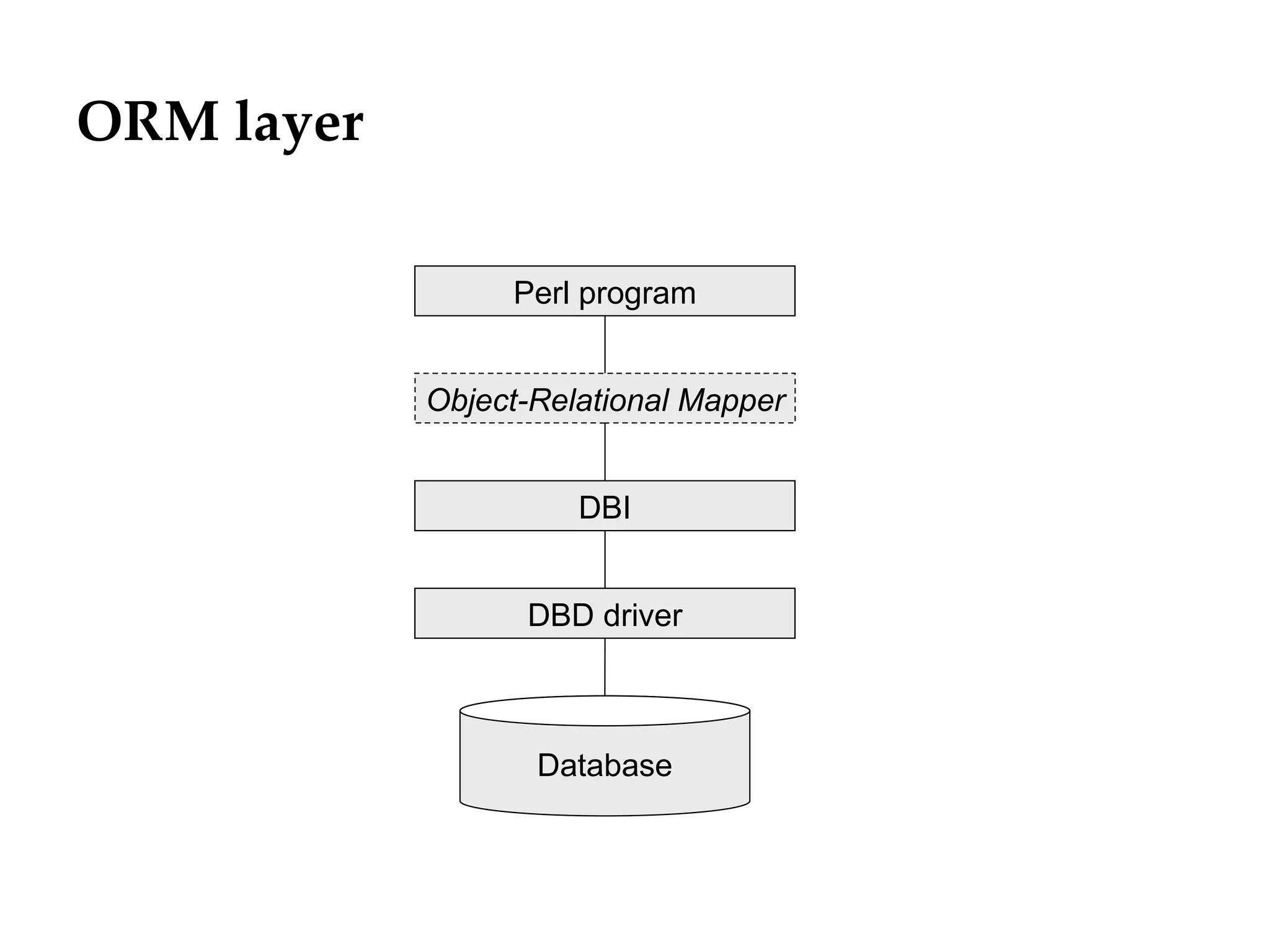
ORM layer

                 Perl program


            Object-Relational Mapper


                      DBI


                  DBD driver


                   Database
ORM useful for …

• dynamic SQL generation
    – navigation between tables
    – generate complex SQL queries from Perl datastructures
    – better than phrasebook or string concatenation
• automatic data conversions (inflation / deflation)
• transaction encapsulation
• data validation
• computed fields
• caching
• expansion of tree data structures coded in the relational model
• …
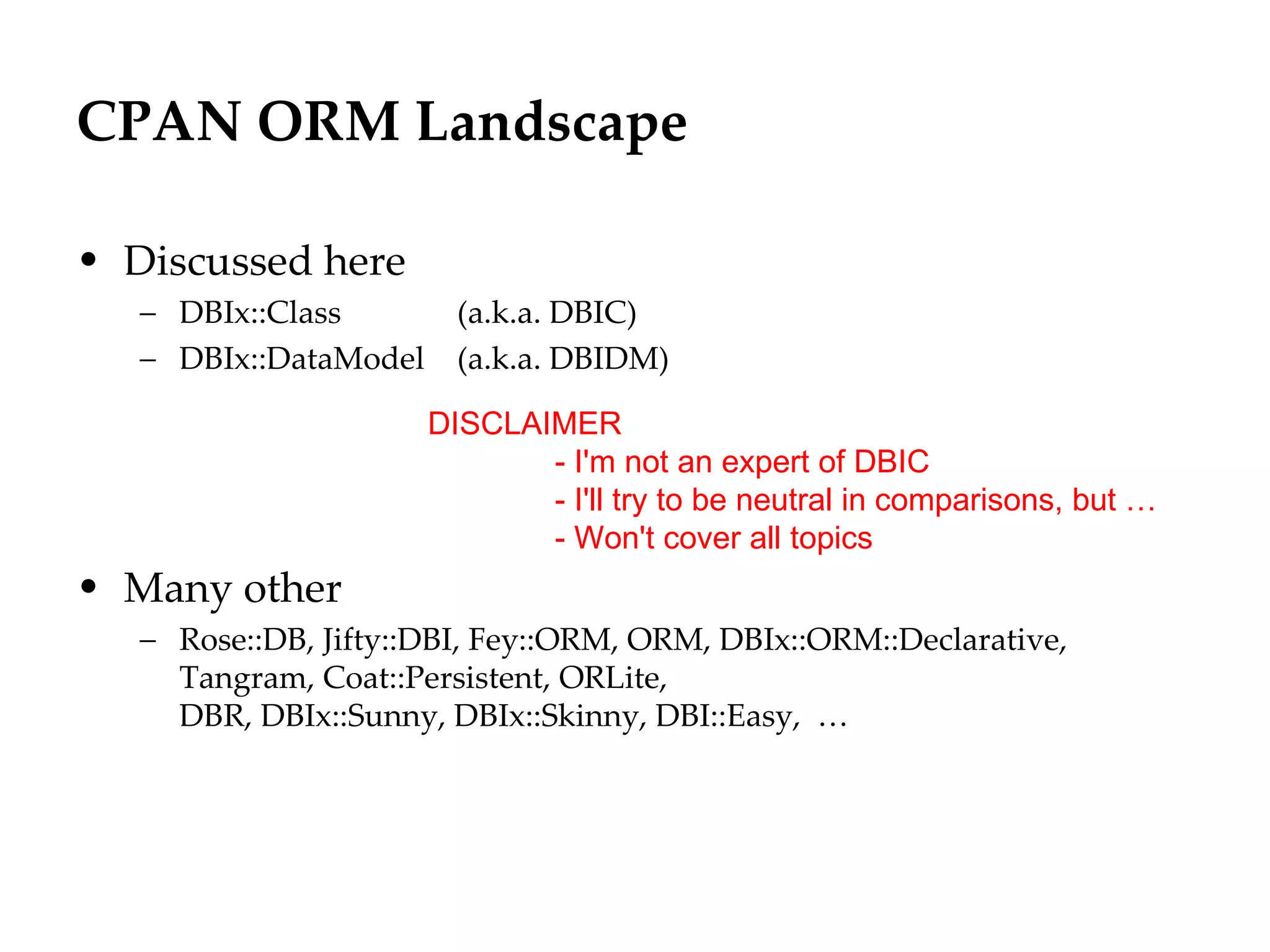
CPAN ORM Landscape

• Discussed here
   – DBIx::Class         (a.k.a. DBIC)
   – DBIx::DataModel     (a.k.a. DBIDM)

                       DISCLAIMER
                              - I'm not an expert of DBIC
                              - I'll try to be neutral in comparisons, but …
                              - Won't cover all topics
• Many other
   – Rose::DB, Jifty::DBI, Fey::ORM, ORM, DBIx::ORM::Declarative,
     Tangram, Coat::Persistent, ORLite,
     DBR, DBIx::Sunny, DBIx::Skinny, DBI::Easy, …
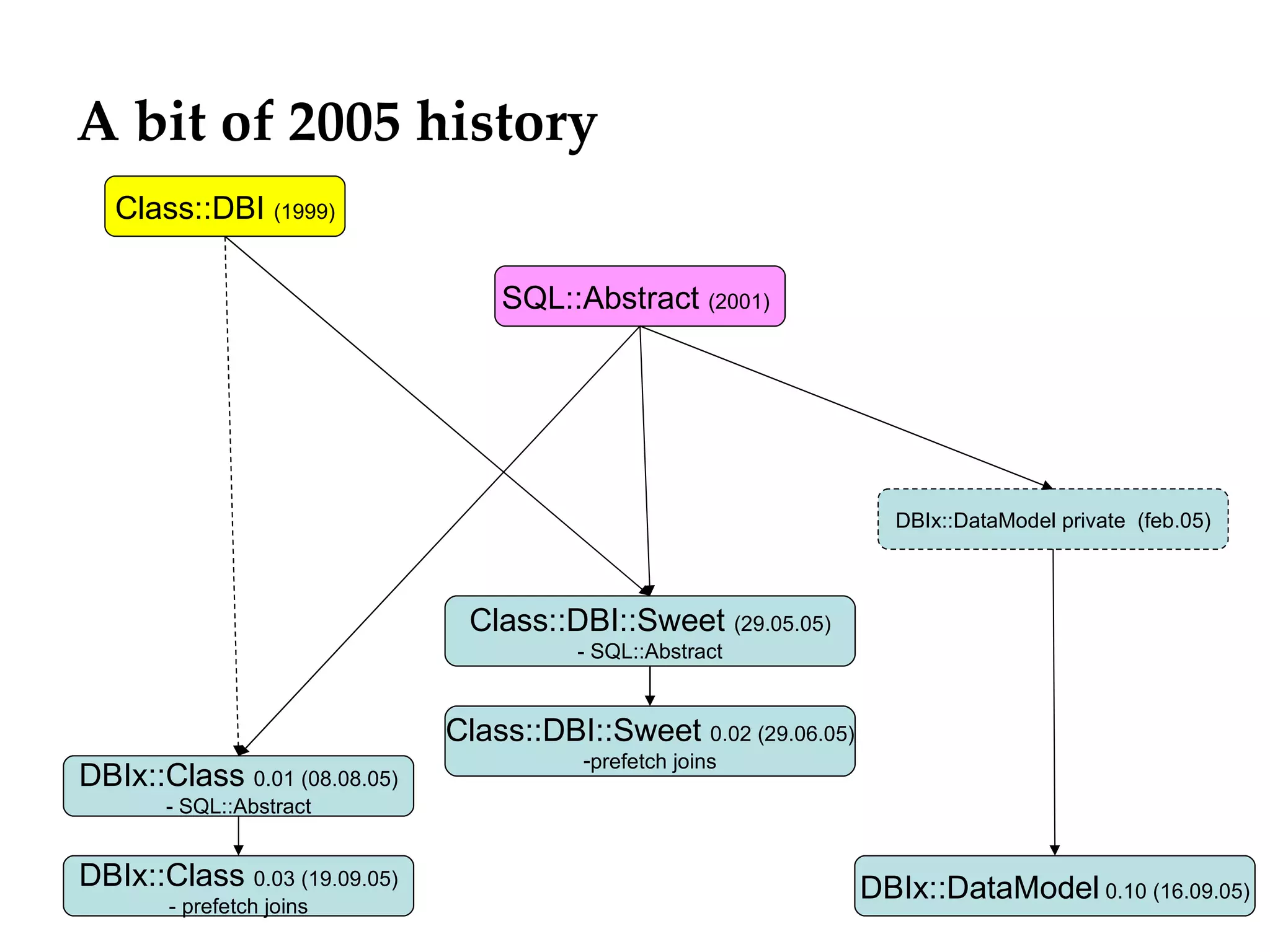
A bit of 2005 history
   Class::DBI (1999)

                                  SQL::Abstract (2001)


                                                                    DBIx::DataModel private (feb.05)


                               Class::DBI::Sweet (29.05.05)
                                        - SQL::Abstract


                              Class::DBI::Sweet 0.02 (29.06.05)
                                         -prefetch joins
DBIx::Class 0.01 (08.08.05)
       - SQL::Abstract


DBIx::Class 0.03 (19.09.05)                                       DBIx::DataModel 0.10 (16.09.05)
       - prefetch joins
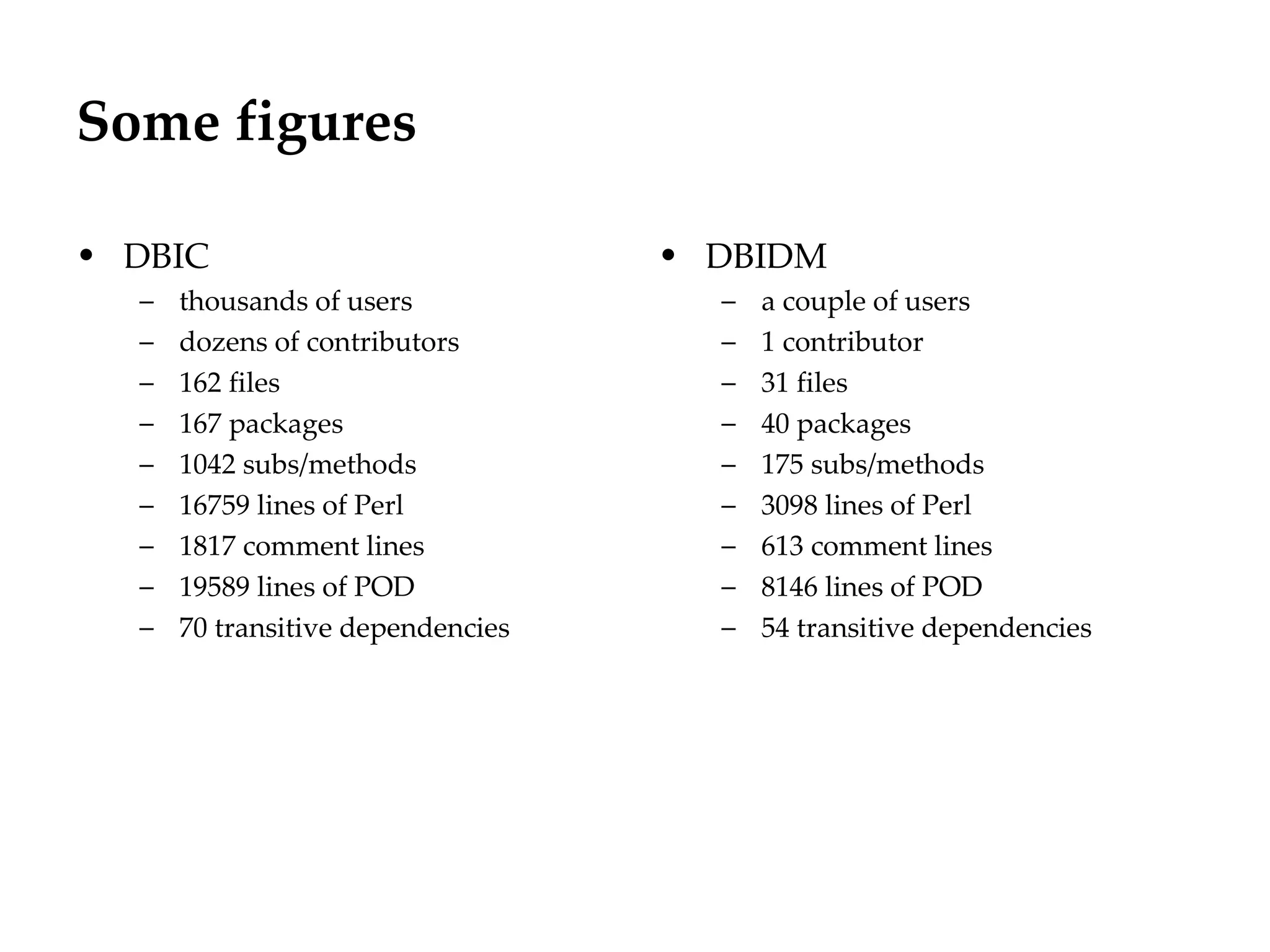
Some figures

• DBIC                             • DBIDM
  –   thousands of users             –   a couple of users
  –   dozens of contributors         –   1 contributor
  –   162 files                      –   31 files
  –   167 packages                   –   40 packages
  –   1042 subs/methods              –   175 subs/methods
  –   16759 lines of Perl            –   3098 lines of Perl
  –   1817 comment lines             –   613 comment lines
  –   19589 lines of POD             –   8146 lines of POD
  –   70 transitive dependencies     –   54 transitive dependencies
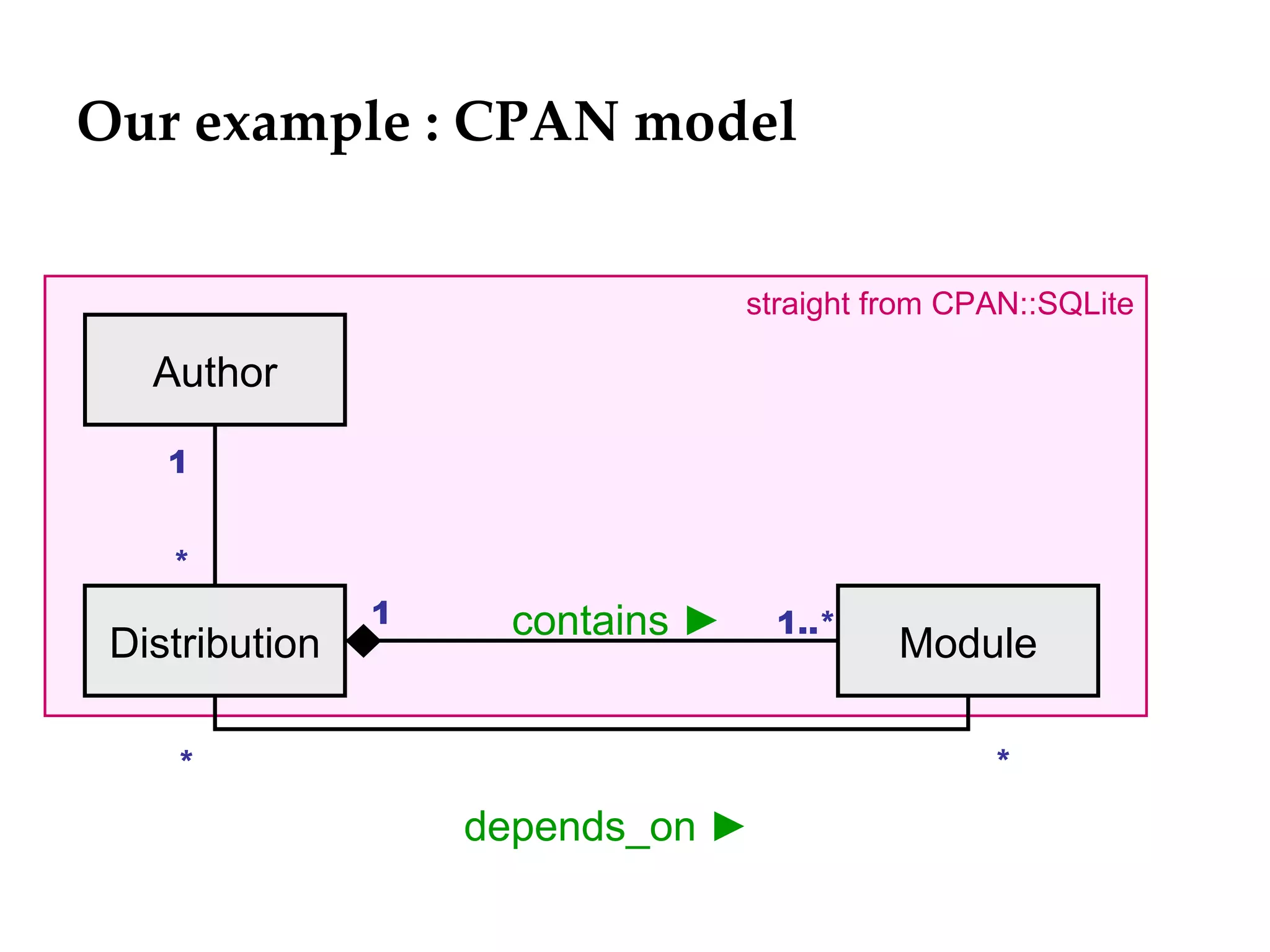
Our example : CPAN model


                                   straight from CPAN::SQLite

   Author

    1


    *
                1     contains ►     1..*
 Distribution                                Module

    *                                              *

                    depends_on ►
Département
                          Office


Schema definition


                                   29.06.12 - Page 1
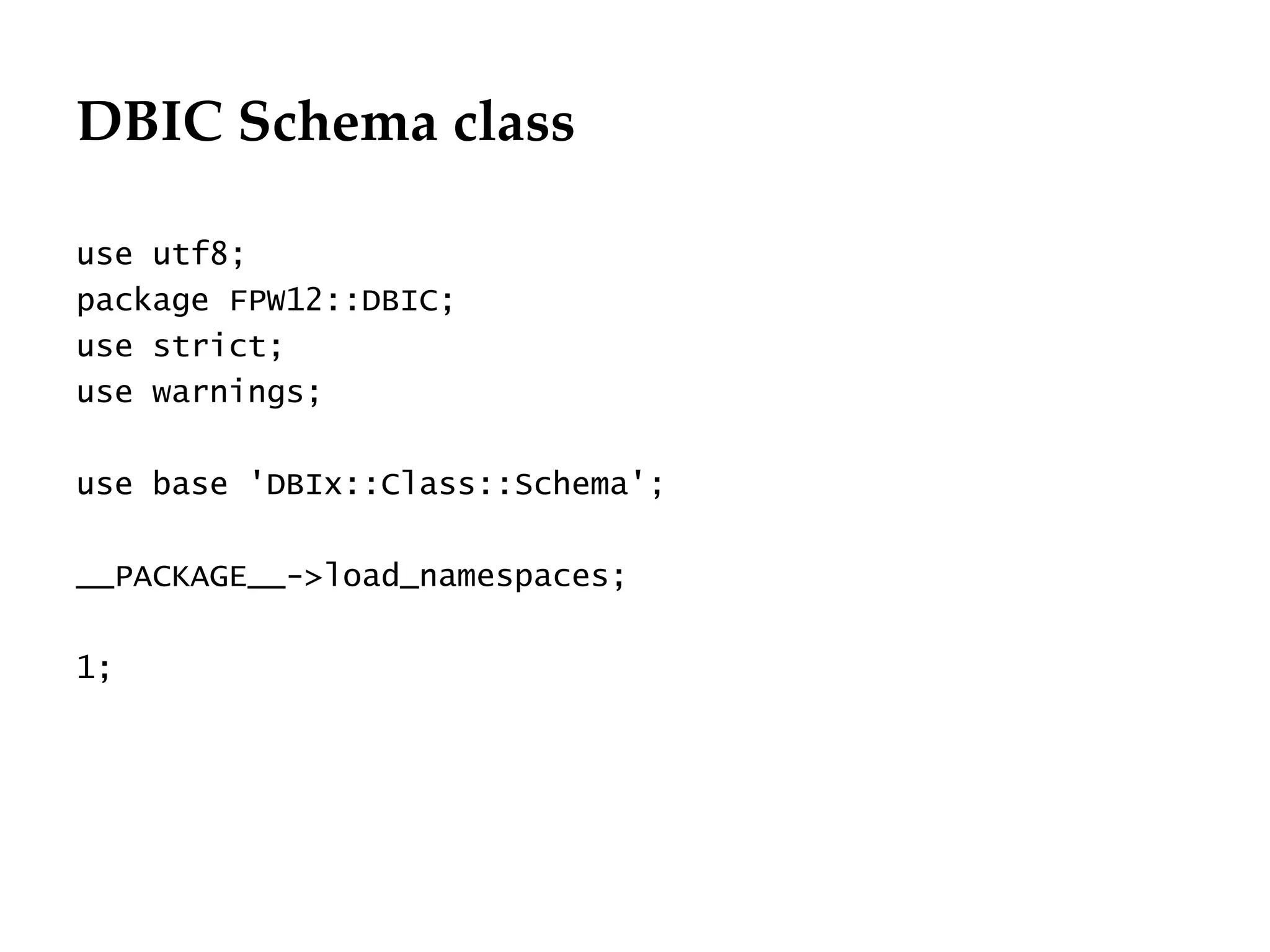
DBIC Schema class
                                  Département
                                        Office


use utf8;
package FPW12::DBIC;
use strict;
use warnings;

use base 'DBIx::Class::Schema';

__PACKAGE__->load_namespaces;

1;


                                                 29.06.12 - Page 1
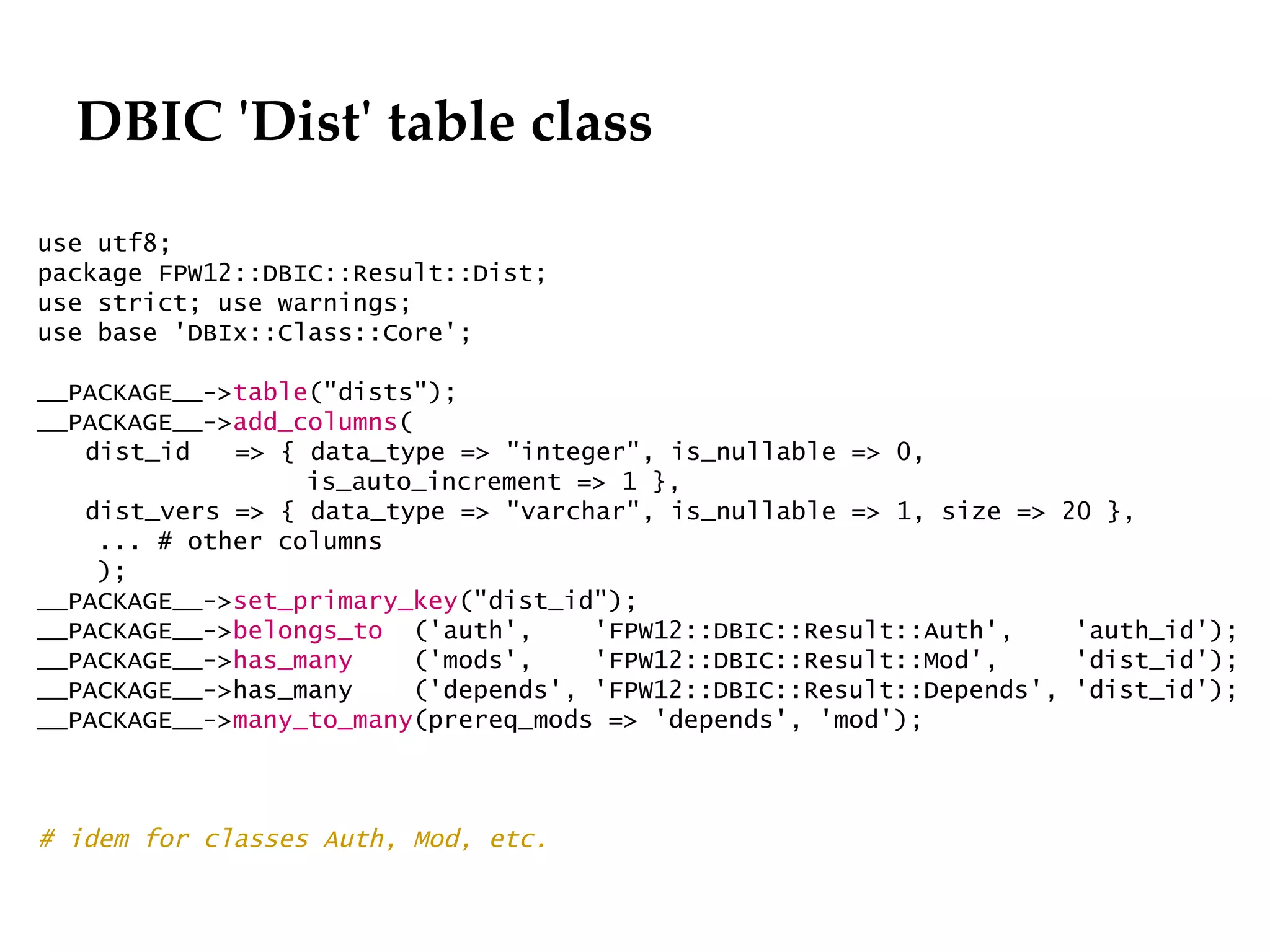
DBIC 'Dist' table class
                                                              Département
                                                                    Office

use utf8;
package FPW12::DBIC::Result::Dist;
use strict; use warnings;
use base 'DBIx::Class::Core';

__PACKAGE__->table("dists");
__PACKAGE__->add_columns(
   dist_id   => { data_type => "integer", is_nullable => 0,
                  is_auto_increment => 1 },
   dist_vers => { data_type => "varchar", is_nullable => 1, size => 20 },
    ... # other columns
    );
__PACKAGE__->set_primary_key("dist_id");
__PACKAGE__->belongs_to ('auth',      'FPW12::DBIC::Result::Auth',    'auth_id');
__PACKAGE__->has_many     ('mods',    'FPW12::DBIC::Result::Mod',     'dist_id');
__PACKAGE__->has_many     ('depends', 'FPW12::DBIC::Result::Depends', 'dist_id');
__PACKAGE__->many_to_many(prereq_mods => 'depends', 'mod');


# idem for classes Auth, Mod, etc.


                                                                             29.06.12 - Page 1
DBIDM centralized declarations
use DBIx::DataModel;
DBIx::DataModel->Schema("FPW12::DBIDM")
#          class          table    primary key
#          =====          =====    ===========
->Table(qw/Auth           auths    auth_id         /)
->Table(qw/Dist           dists    dist_id         /)
->Table(qw/Mod            mods     mod_id          /)
->Table(qw/Depends        depends dist_id mod_id/)
#                 class     role    multipl. (optional join keys)
#                 =====     ====    =======    ====================
->Association([qw/Auth      auth          1  auth_id          /],
               [qw/Dist     dists         *  auth_id          /])
->Composition([qw/Dist      dist          1                   /],
               [qw/Mod      mods          *                   /])
->Association([qw/Dist      dist          1                   /],
               [qw/Depends depends        *                   /])
->Association([qw/Mod       mod           1                   /],
               [qw/Depends depends        *                   /])
->Association([qw/Dist      used_in_dist *   depends distrib /],
               [qw/Mod      prereq_mods *    depends mod      /])
;
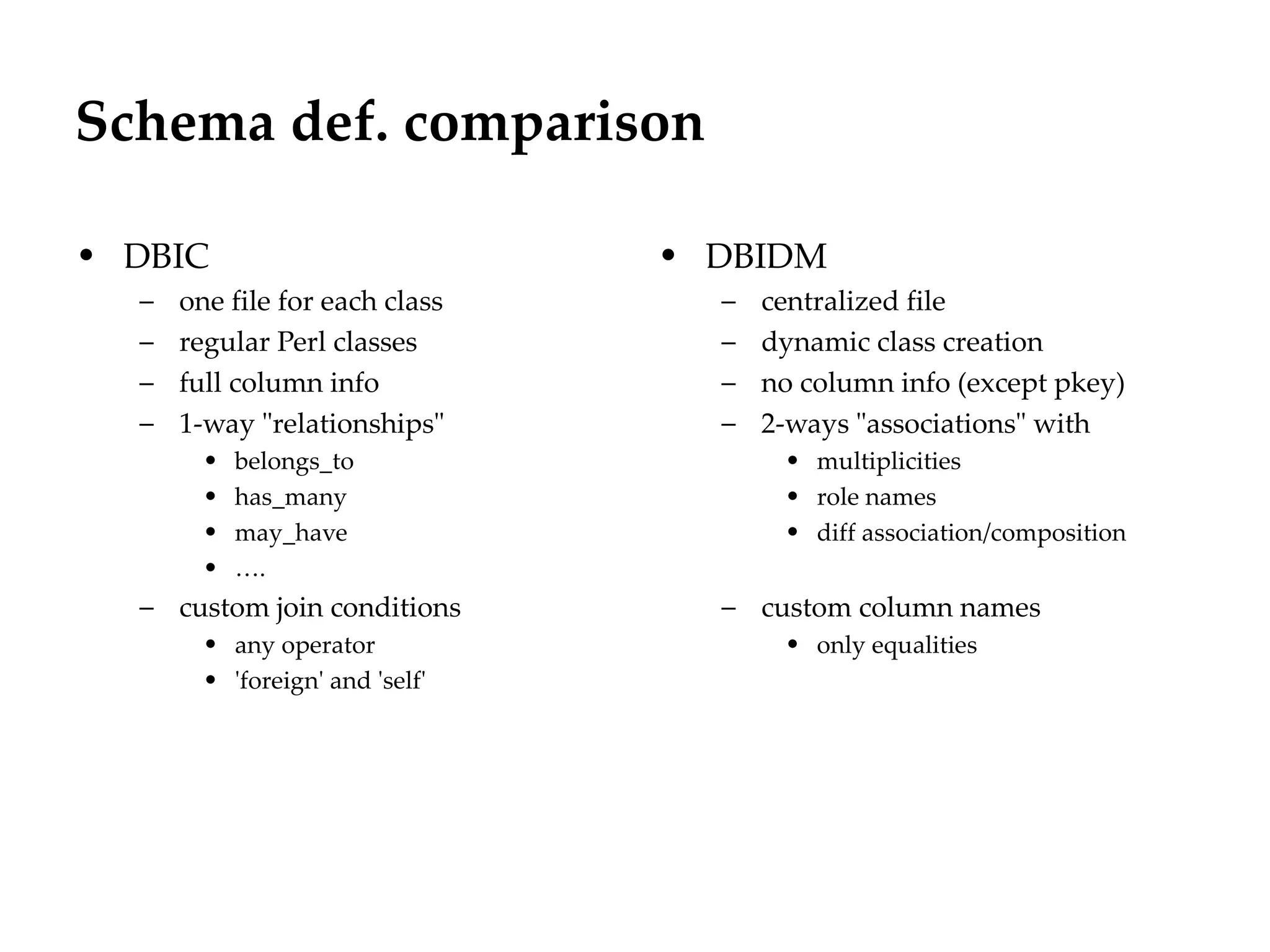
Schema def. comparison
                                                       Département
                                                             Office


• DBIC                           • DBIDM
  –   one file for each class      –   centralized file
  –   regular Perl classes         –   dynamic class creation
  –   full column info             –   no column info (except pkey)
  –   1-way "relationships"        –   2-ways "associations" with
        •   belongs_to                  • multiplicities
        •   has_many                    • role names
        •   may_have                    • diff association/composition
        •   ….
  – custom join conditions         – custom column names
        • any operator                  • only equalities
        • 'foreign' and 'self'


                                                                         29.06.12 - Page 1
Département
                       Office


Data retrieval


                                29.06.12 - Page 1
DBIC: Search
                                              Département
                                                    Office


use FPW12::DBIC;

my $schema = FPW12::DBIC->connect($data_source);

my @dists = $schema->resultset('Dist')->search(
  {dist_name => {-like => 'DBIx%'}},
  {columns   => [qw/dist_name dist_vers/]},
);

foreach my $dist (@dists) {
  printf "%s (%s)n", $dist->dist_name, $dist->dist_vers;
}


                                                             29.06.12 - Page 1
DBIDM: Search
                                                       Département
                                                             Office

use FPW12::DBIDM;
use DBI;

my $datasource = "dbi:SQLite:dbname=../cpandb.sql";
my $dbh = DBI->connect($datasource, "", "",
                       {RaiseError => 1, AutoCommit => 1});
FPW12::DBIDM->dbh($dbh);

my $dists = FPW12::DBIDM::Dist->select(
  -columns => [qw/dist_name dist_vers/],
  -where   => {dist_name => {-like => 'DBIx%'}},
);

foreach my $dist (@$dists) {
  print "$dist->{dist_name} ($dist->{dist_vers})n";
}


                                                                      29.06.12 - Page 1
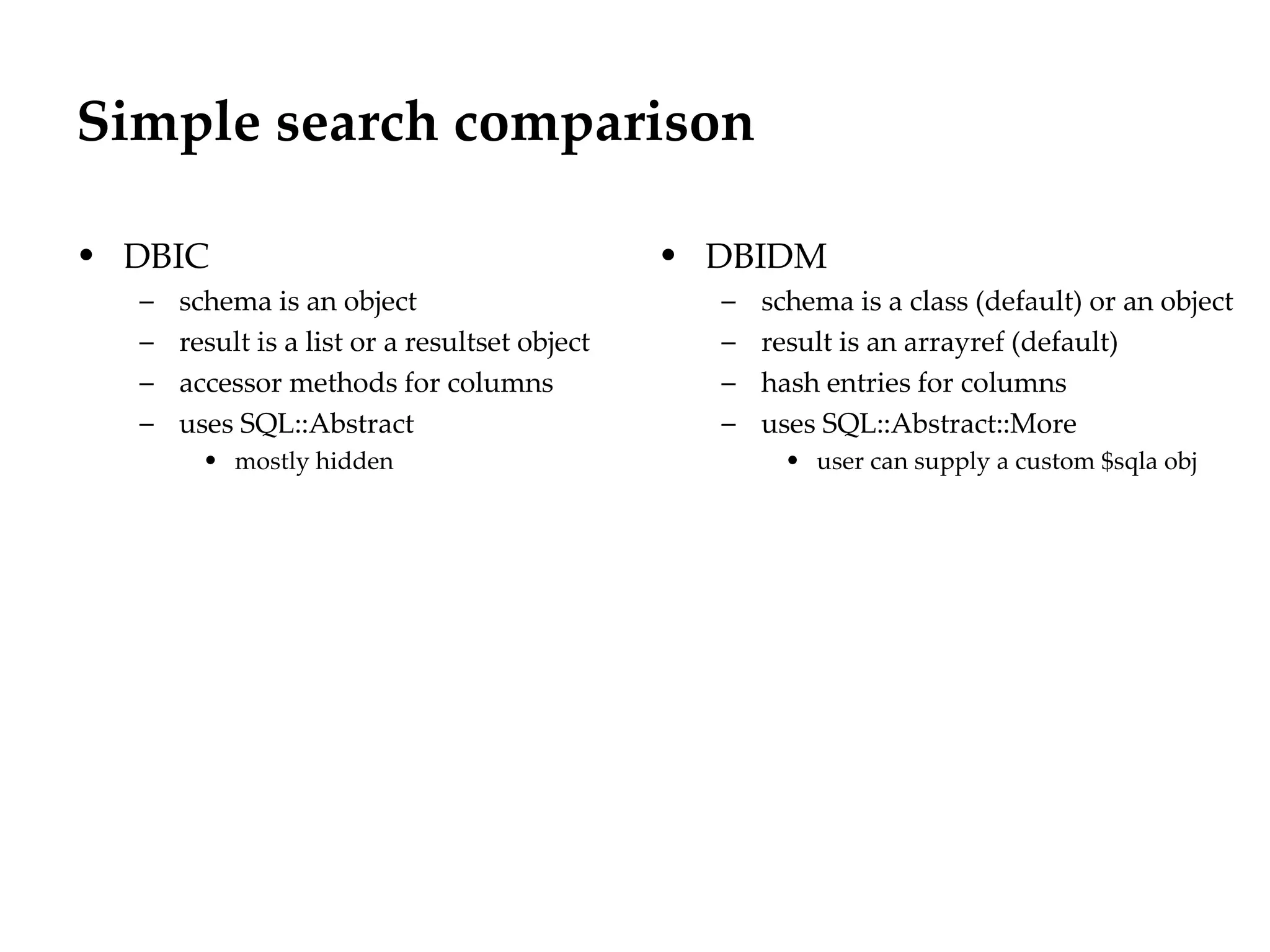
Simple search comparison
                                                                      Département
                                                                            Office


• DBIC                                         • DBIDM
  –   schema is an object                        –   schema is a class (default) or an object
  –   result is a list or a resultset object     –   result is an arrayref (default)
  –   accessor methods for columns               –   hash entries for columns
  –   uses SQL::Abstract                         –   uses SQL::Abstract::More
        • mostly hidden                                • user can supply a custom $sqla obj


                                                                                     29.06.12 - Page 1
SQL::Abstract new()
                                                                    Département
                                                                          Office

• special operators
   – ex: DBMS-independent fulltext search

           # where {field => {-contains => [qw/foo bar/]}

           my $sqla = SQL::Abstract->new(special_ops => [
             {regex => qr/^contains(:?_all|_any)?$/i,
              handler => sub {
                 my ($self, $field, $op, $arg) = @_;
                 my $connector = ($op =~ /any$/) ? ' | ' : ' & ';
                 my @vals = ref $arg ? @$arg : ($arg);
                 @vals = map { split /s+/ } grep {$_} @vals;
                 my $sql = sprintf "CONTAINS($field, '%s') > 0",
                                     join $connector, @vals;
                return ($sql); # no @bind
              }
           ]);


                                                                                   29.06.12 - Page 1
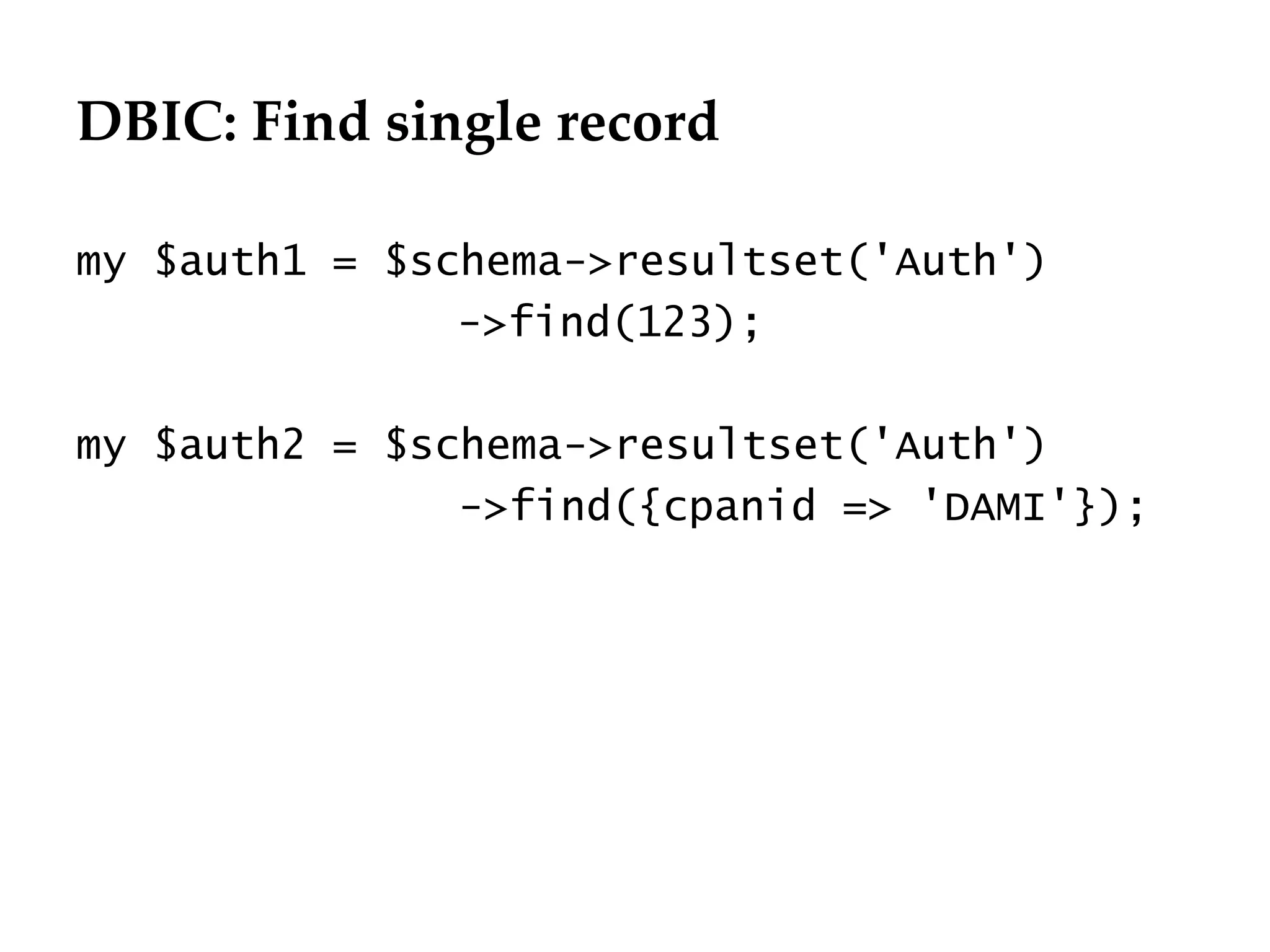
DBIC: Find single record
                                  Département
                                        Office


my $auth1 = $schema->resultset('Auth')
               ->find(123);

my $auth2 = $schema->resultset('Auth')
               ->find({cpanid => 'DAMI'});


                                                 29.06.12 - Page 1
DBIDM: Find single record
                                  Département
                                        Office


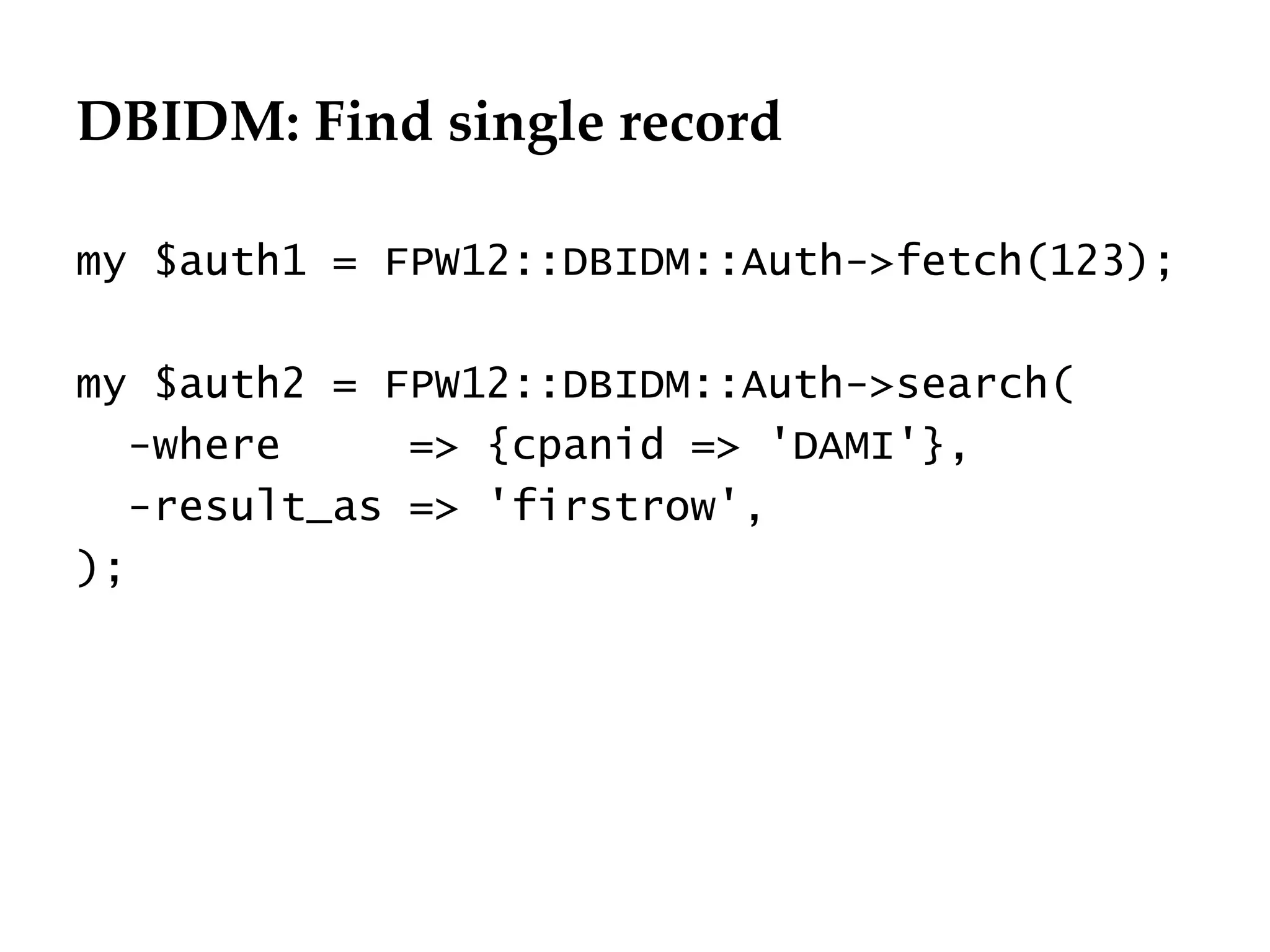
my $auth1 = FPW12::DBIDM::Auth->fetch(123);

my $auth2 = FPW12::DBIDM::Auth->search(
   -where     => {cpanid => 'DAMI'},
   -result_as => 'firstrow',
);


                                                 29.06.12 - Page 1
DBIC: Search args
                                                                 Département
                                                                       Office


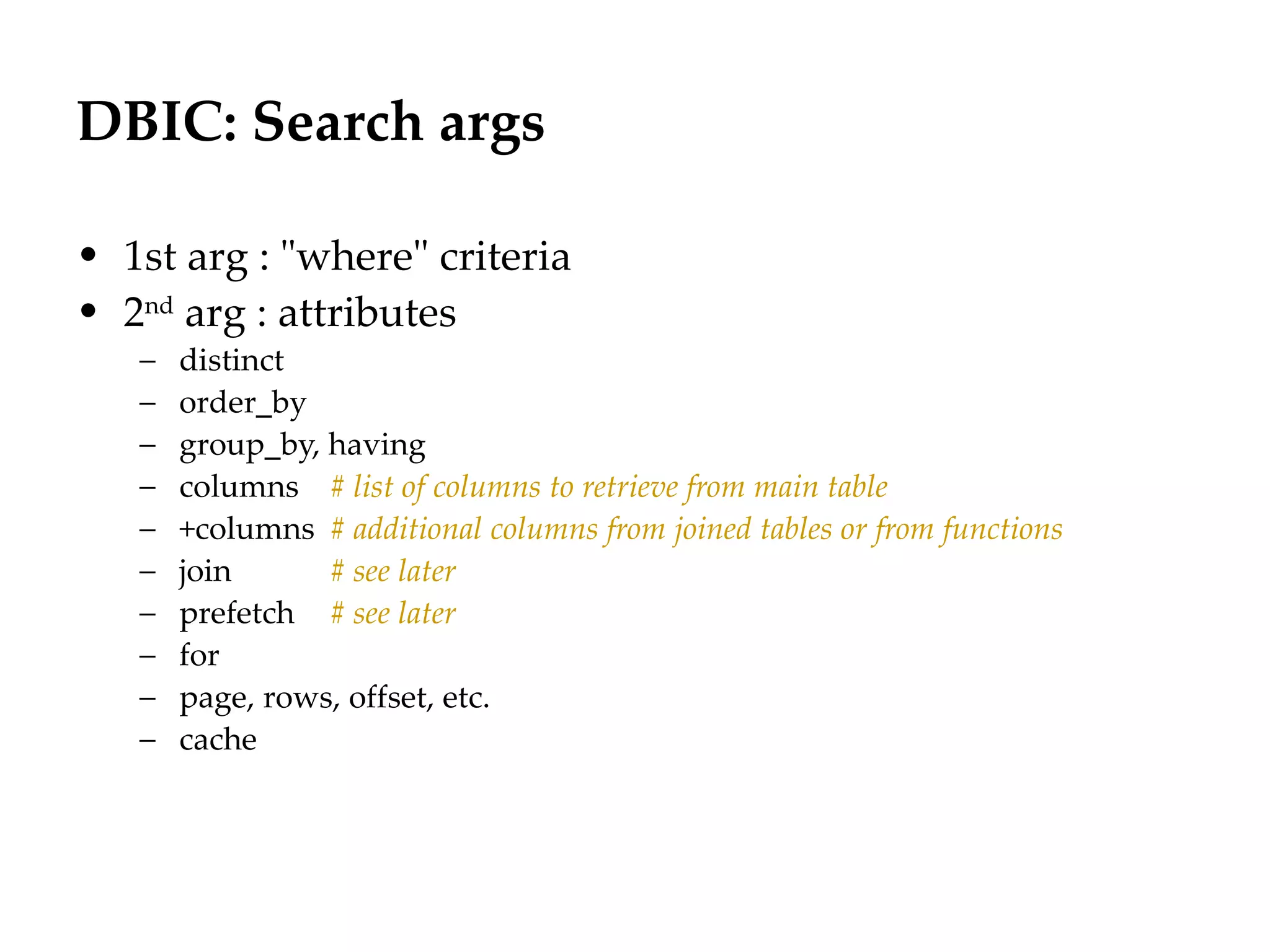
• 1st arg : "where" criteria
• 2nd arg : attributes
   –   distinct
   –   order_by
   –   group_by, having
   –   columns # list of columns to retrieve from main table
   –   +columns # additional columns from joined tables or from functions
   –   join      # see later
   –   prefetch # see later
   –   for
   –   page, rows, offset, etc.
   –   cache


                                                                                29.06.12 - Page 1
DBIDM: Select args
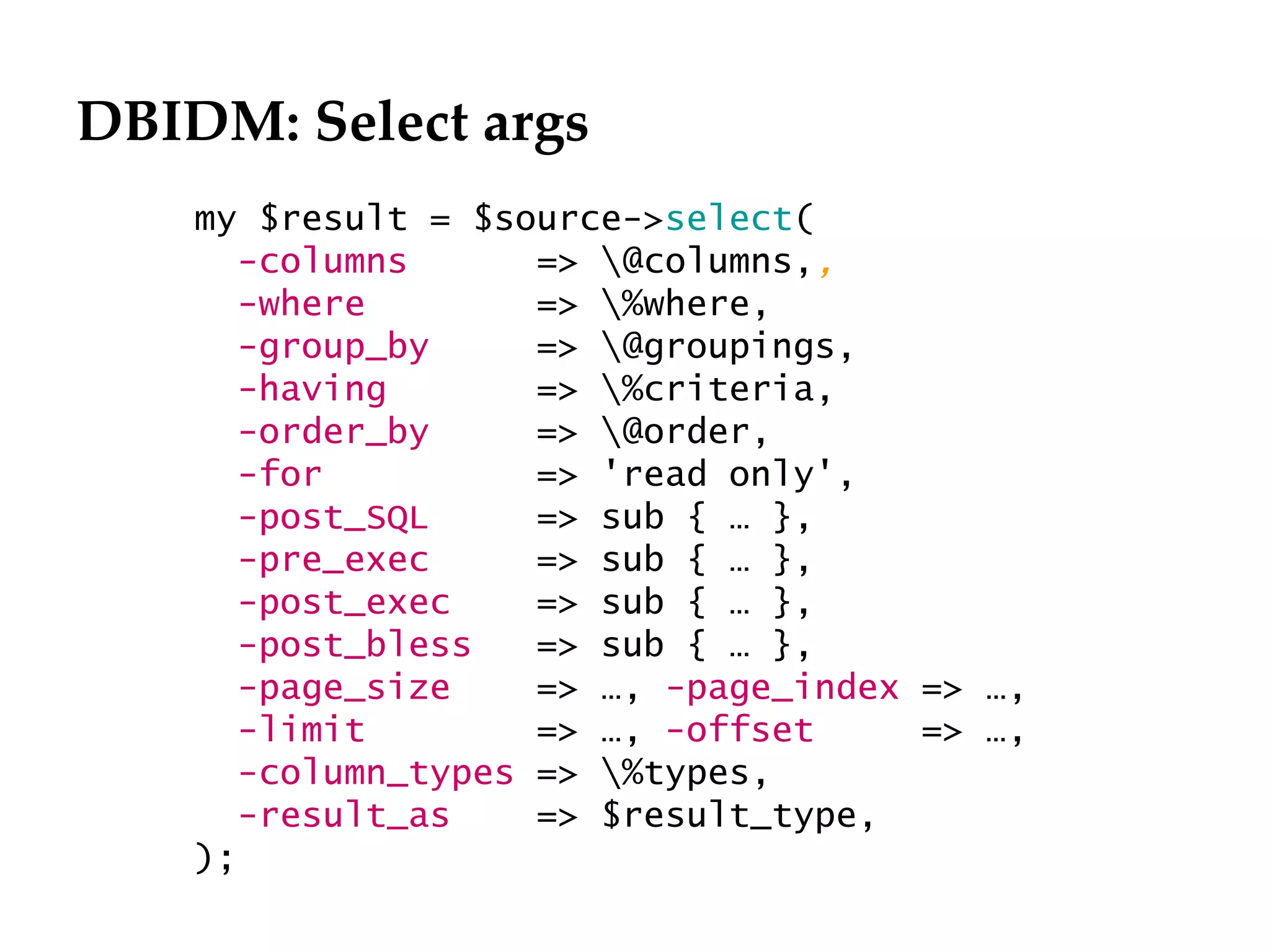
    my $result = $source->select(
       -columns      => @columns,,
       -where        => %where,
       -group_by     => @groupings,
       -having       => %criteria,
       -order_by     => @order,
       -for          => 'read only',
       -post_SQL     => sub { … },
       -pre_exec     => sub { … },
       -post_exec    => sub { … },
       -post_bless   => sub { … },
       -page_size    => …, -page_index => …,
       -limit        => …, -offset     => …,
       -column_types => %types,
       -result_as    => $result_type,
    );
DBIDM: Polymorphic result

-result_as =>
     –   'rows' (default)           :   arrayref of row objects
     –   'firstrow'                 :   a single row object (or undef)
     –   'hashref'                  :   hashref keyed by primary keys
     –   [hashref => @cols]         :   cascaded hashref
     –   'flat_arrayref'            :   flattened values from each row
     –   'statement'                :   a statement object (iterator)
     –   'fast_statement'           :   statement reusing same memory
     –   'sth'                      :   DBI statement handle
     –   'sql'                      :   ($sql, @bind_values)
     –   'subquery'                 :   ["($sql)", @bind]


  don't need method variants : select_hashref(), select_arrayref(), etc.
DBIDM: Fast statement

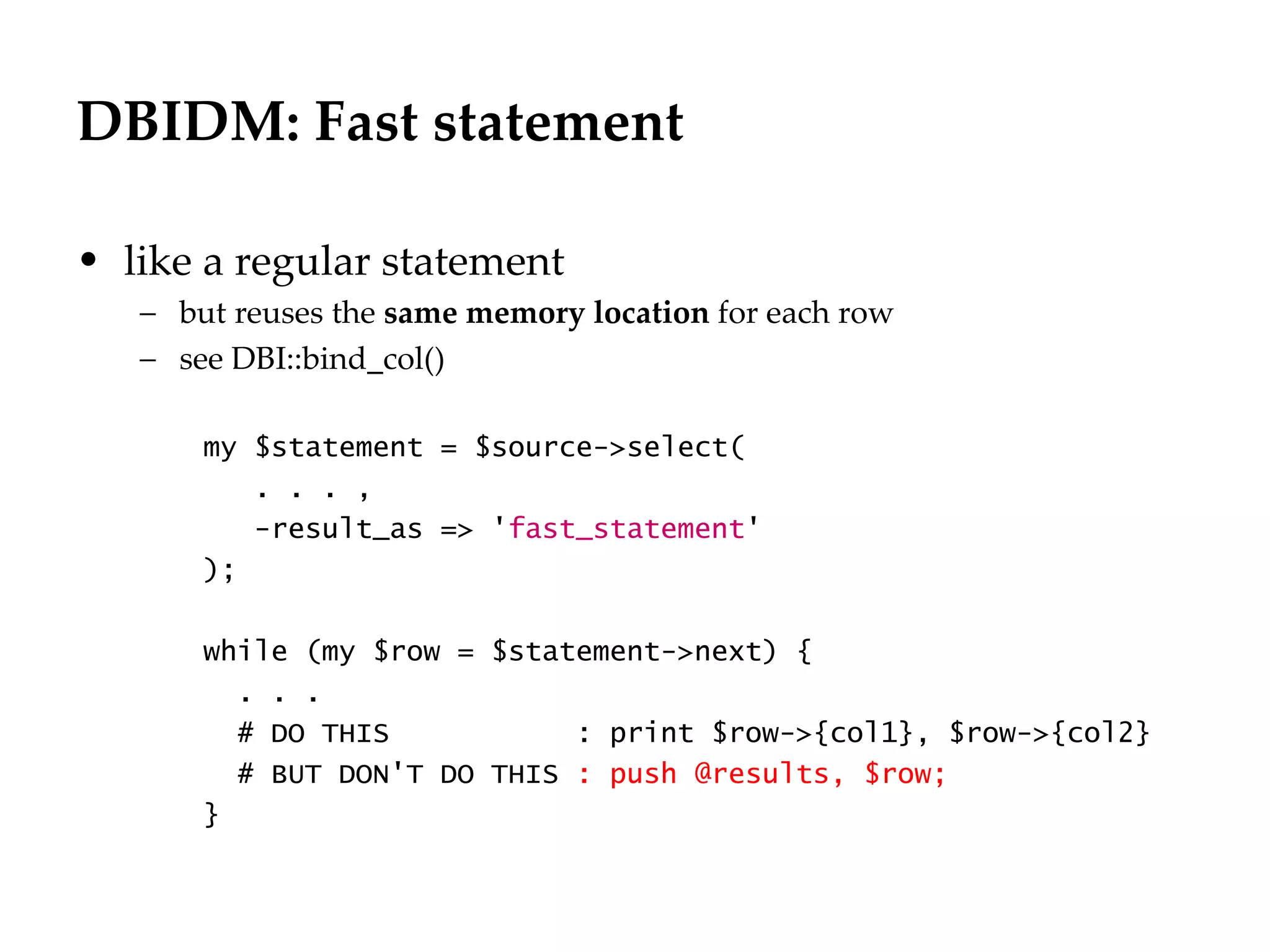
• like a regular statement
   – but reuses the same memory location for each row
   – see DBI::bind_col()

       my $statement = $source->select(
          . . . ,
          -result_as => 'fast_statement'
       );

       while (my $row = $statement->next) {
         . . .
         # DO THIS           : print $row->{col1}, $row->{col2}
         # BUT DON'T DO THIS : push @results, $row;
       }
Advanced search comparison

• DBIC                                  • DBIDM
  –   'find' by any unique constraint     –   'fetch' by primary key only
  –   "inner" vs "outer" columns          –   all columns equal citizens
  –   result is context-dependent         –   polymorphic result
  –   optional caching                    –   no caching
                                          –   statement-specific inflators
                                          –   callbacks
Joins
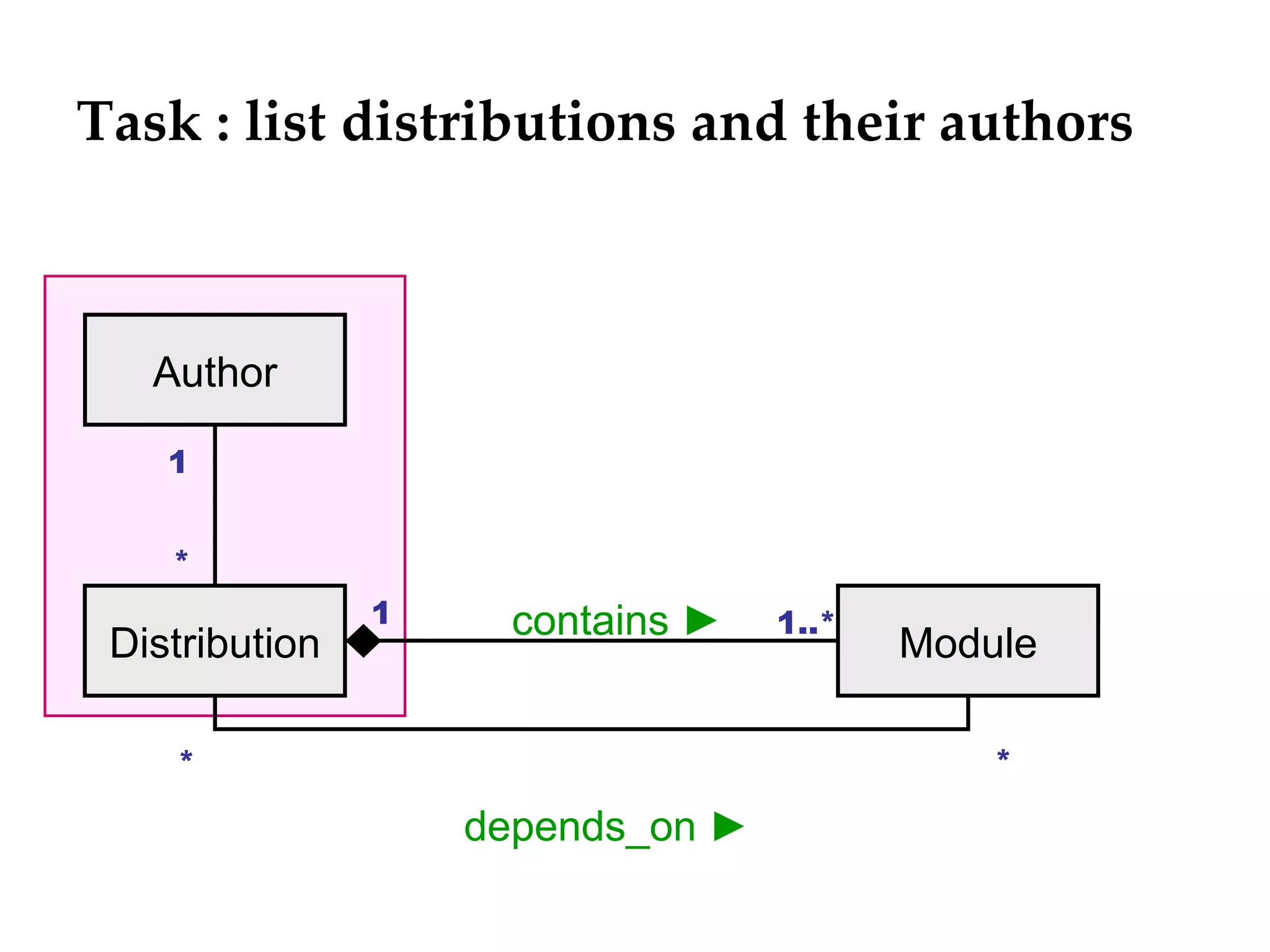
Task : list distributions and their authors


   Author

    1


    *
                1     contains ►   1..*
 Distribution                             Module

    *                                         *

                    depends_on ►
DBIC: Join

my @dists = $schema->resultset('Dist')->search(
  {dist_name => {-like => 'DBIx%'}},
  {columns => [qw/dist_name dist_vers/],
    join    => 'auth',
   '+columns' => [{'fullname' => 'auth.fullname'}],
    },
);

foreach my $dist (@dists) {
  printf "%s (%s) by %sn",
       $dist->dist_name, $dist->dist_vers,
       $dist->get_column('fullname'); # no accessor meth
}
DBIC: Join with prefetch

my @dists = $schema->resultset('Dist')->search(
   {dist_name => {-like => 'DBIx%'}},
   {columns   => [qw/dist_name dist_vers/],
    prefetch => 'auth',
    },
);

foreach my $dist (@dists) {
  printf "%s (%s) by %sn",
    $dist->dist_name, $dist->dist_vers,
    $dist->auth->fullname; # already in memory
}
DBIDM: Join

my $rows = FPW12::DBIDM->join(qw/Dist auth/)->select(
  -columns => [qw/dist_name dist_vers fullname/],
  -where   => {dist_name => {-like => 'DBIx%'}},
);

foreach my $row (@$rows) {
  print "$row->{dist_name} ($row->{dist_vers}) "
      . "by $row->{fullname}n";
}
                                           Dist     Auth

      DBIDM::Source::Join

   new class created on the fly       ..::AutoJoin::…
Multiple joins

• DBIC

join => [ { abc => { def => 'ghi' } },
           { jkl => 'mno' },
          'pqr' ]


• DBIDM

->join(qw/Root abc def ghi jkl mno pqr/)
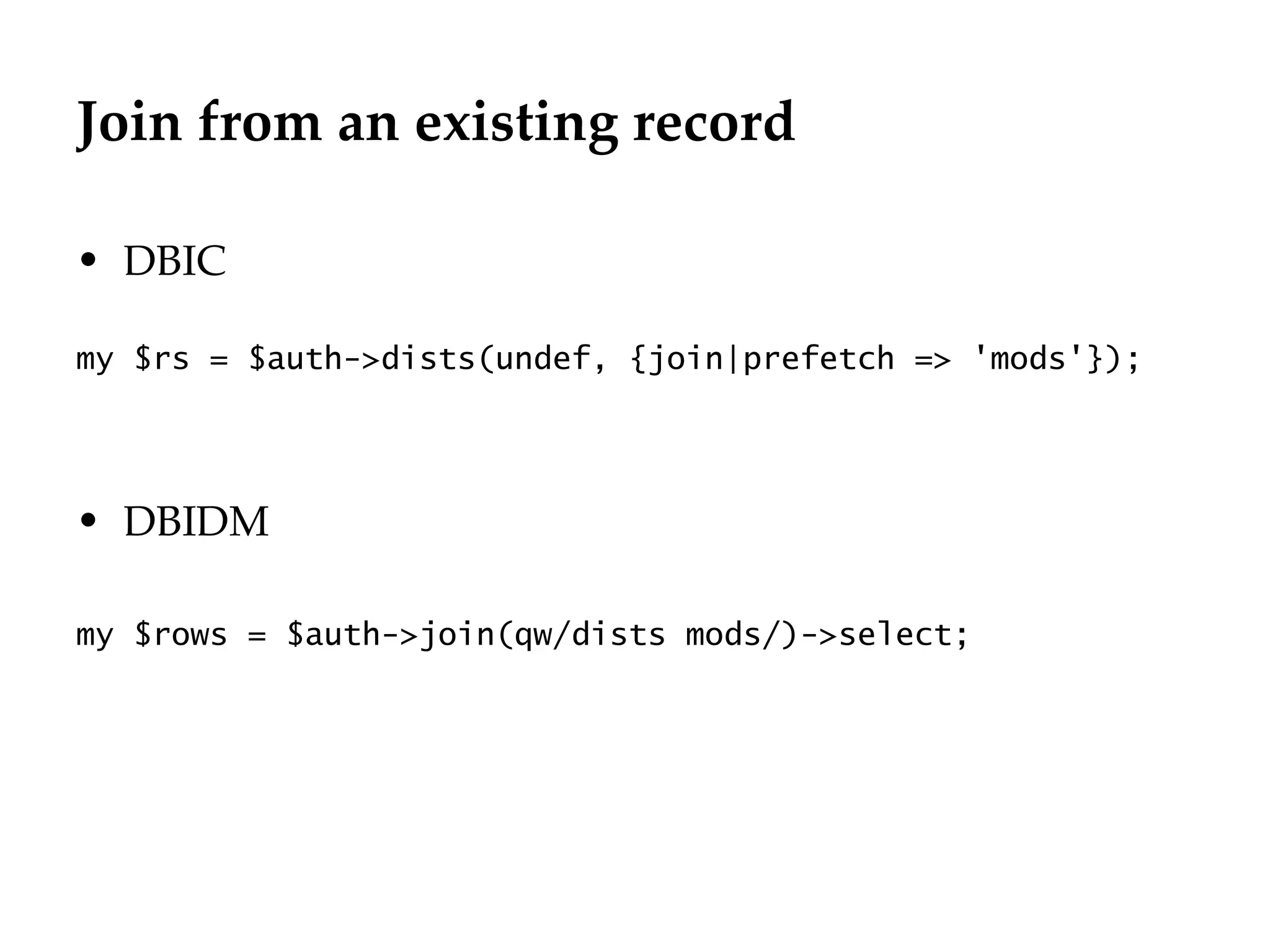
Join from an existing record

• DBIC

my $rs = $auth->dists(undef, {join|prefetch => 'mods'});


• DBIDM

my $rows = $auth->join(qw/dists mods/)->select;
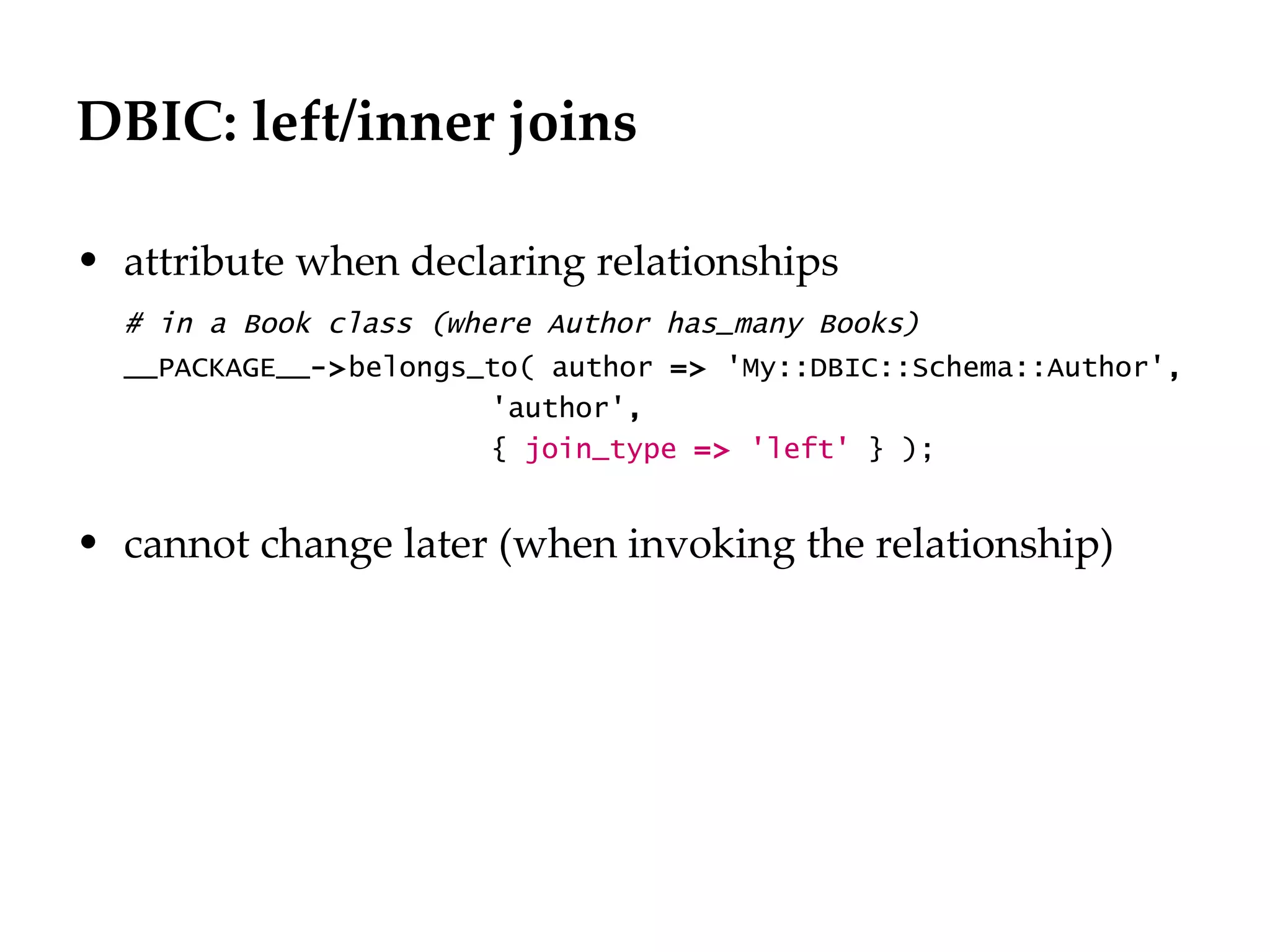
DBIC: left/inner joins

• attribute when declaring relationships
  # in a Book class (where Author has_many Books)
  __PACKAGE__->belongs_to( author => 'My::DBIC::Schema::Author',
                        'author',
                        { join_type => 'left' } );


• cannot change later (when invoking the relationship)
DBIDM: Left / inner joins

->Association([qw/Author         author     1    /],
              [qw/Distribution   distribs   0..* /])
                   # default : LEFT OUTER JOIN

->Composition([qw/Distribution   distrib    1    /],
              [qw/Module         modules    1..* /]);
                   # default : INNER JOIN

# but defaults can be overridden
My::DB->join([qw/Author       <=> distribs/)-> . . .
My::DB->join([qw/Distribution => modules /)-> . . .
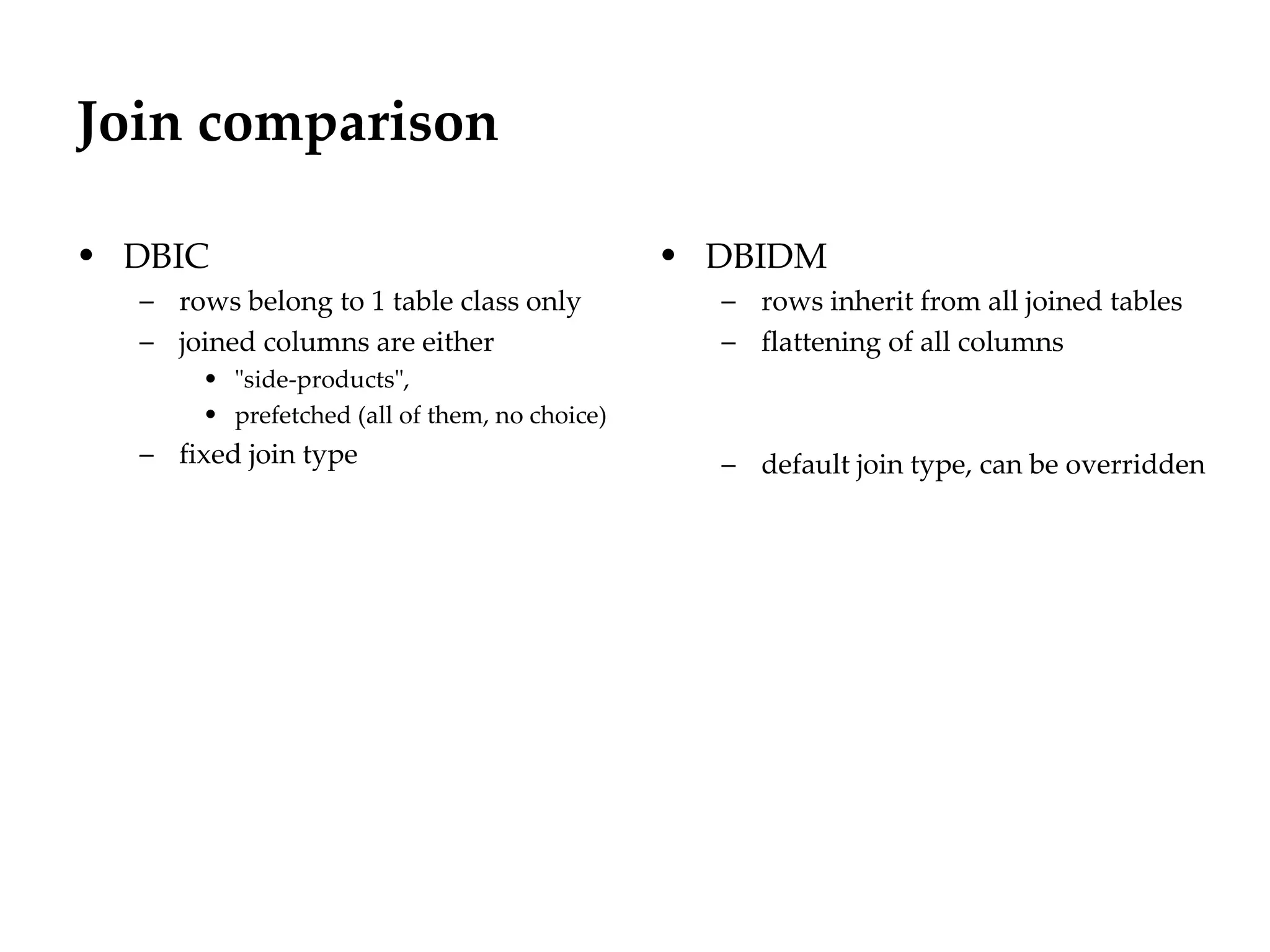
Join comparison

• DBIC                                         • DBIDM
  – rows belong to 1 table class only            – rows inherit from all joined tables
  – joined columns are either                    – flattening of all columns
       • "side-products",
       • prefetched (all of them, no choice)
  – fixed join type                              – default join type, can be overridden
Speed
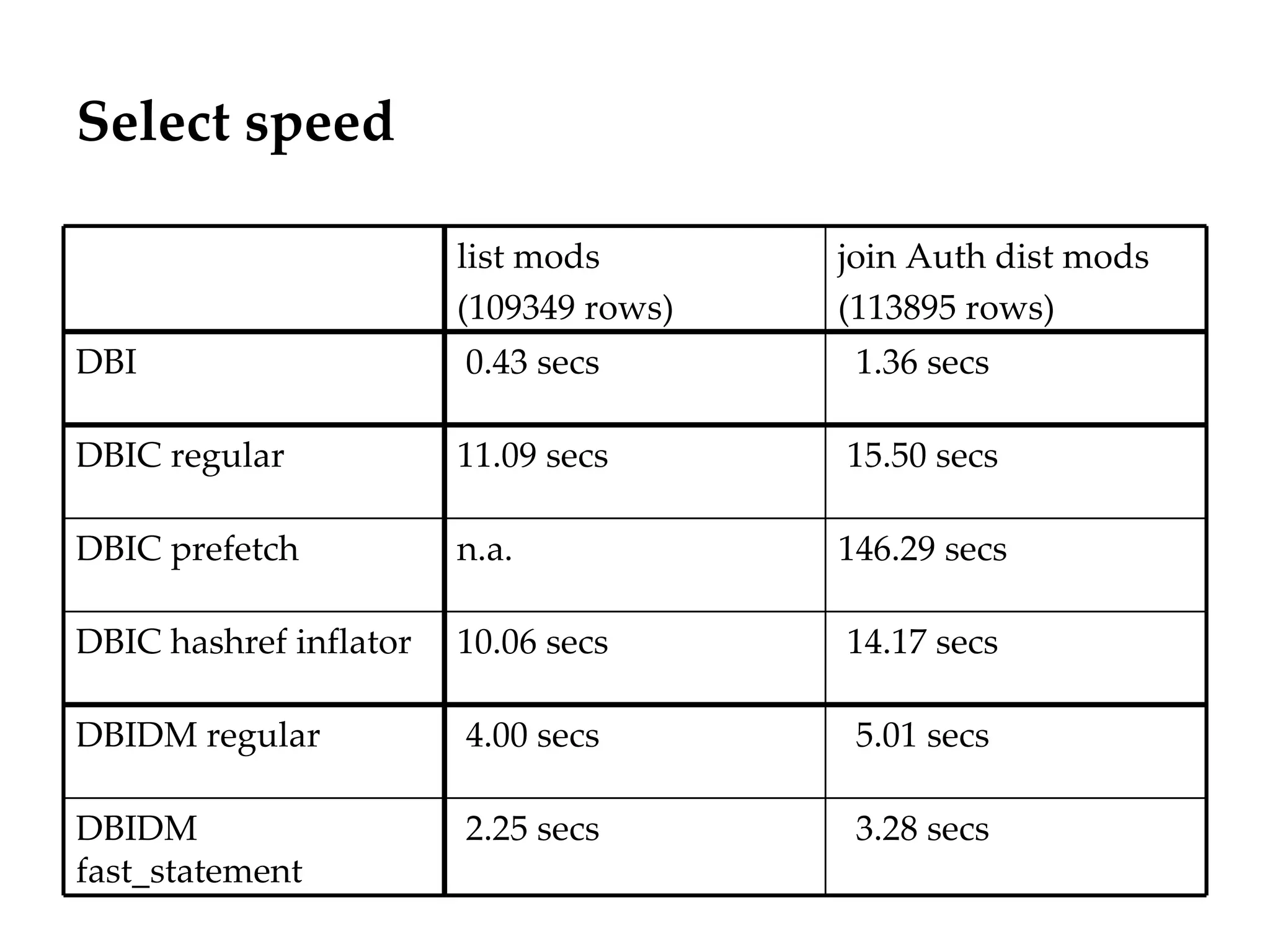
Select speed
                                                Département
                                                      Office


                        list mods       join Auth dist mods
                        (109349 rows)   (113895 rows)
DBI                     0.43 secs        1.36 secs

DBIC regular            11.09 secs      15.50 secs

DBIC prefetch           n.a.            146.29 secs

DBIC hashref inflator   10.06 secs      14.17 secs

DBIDM regular           4.00 secs        5.01 secs

DBIDM                   2.25 secs        3.28 secs
fast_statement
                                                               29.06.12 - Page 1
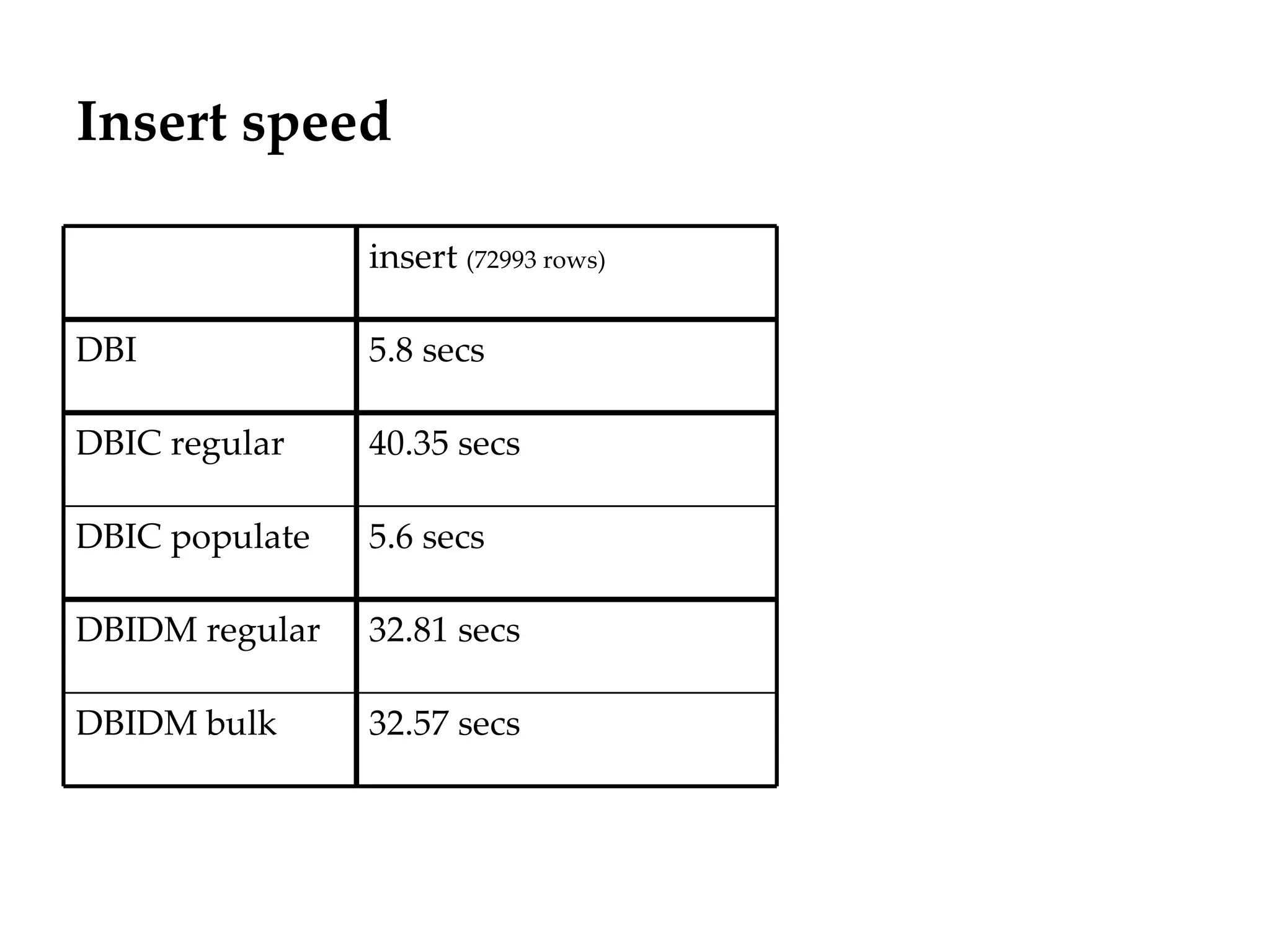
Insert speed
                                      Département
                                            Office


                insert (72993 rows)

DBI             5.8 secs

DBIC regular    40.35 secs

DBIC populate   5.6 secs

DBIDM regular   32.81 secs

DBIDM bulk      32.57 secs


                                                     29.06.12 - Page 1
Département
                            Office


Classes and methods


                                     29.06.12 - Page 1
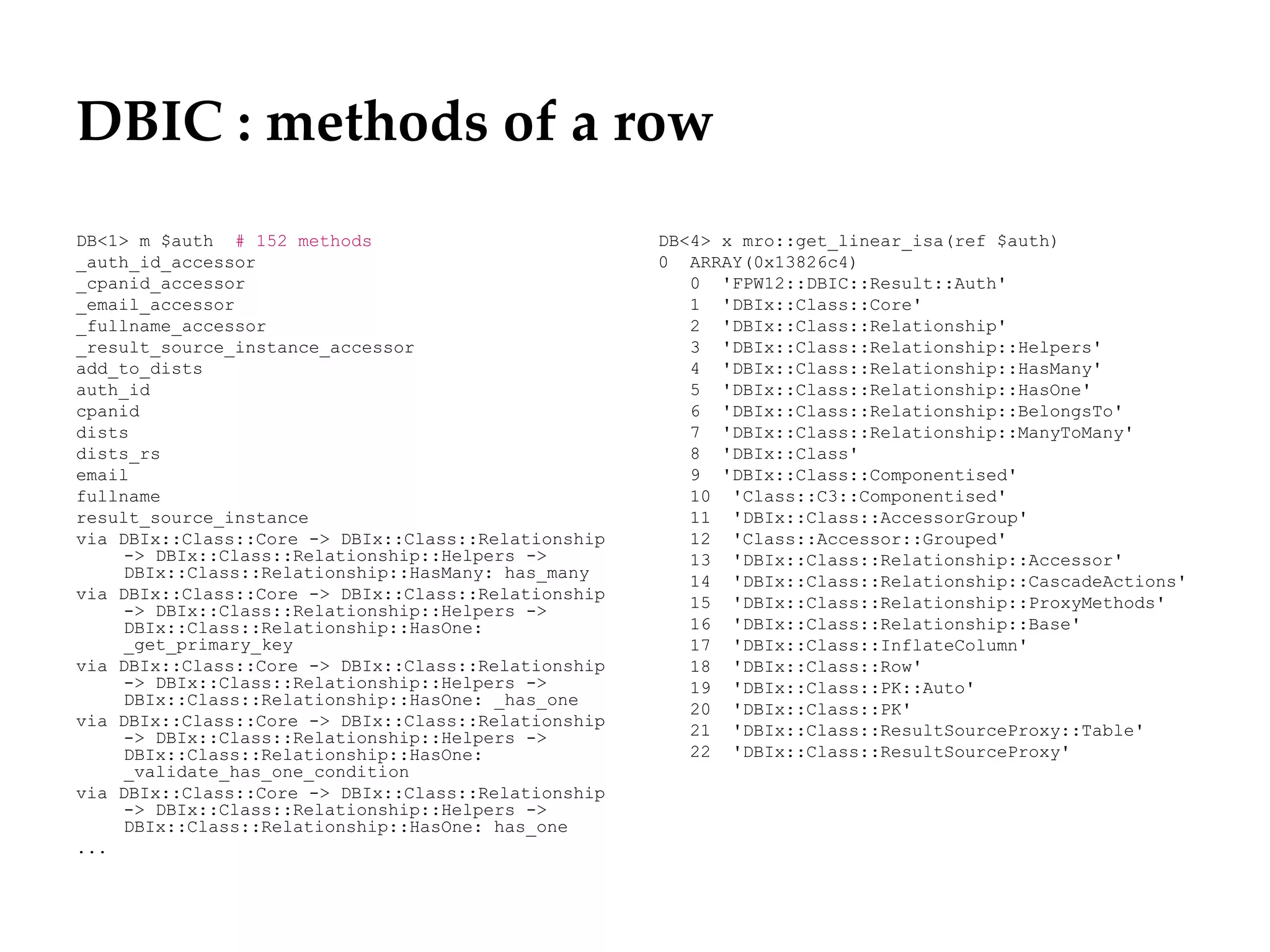
DBIC : methods of a row
DB<1> m $auth # 152 methods                          DB<4> x mro::get_linear_isa(ref $auth)
_auth_id_accessor                                    0 ARRAY(0x13826c4)
_cpanid_accessor                                        0 'FPW12::DBIC::Result::Auth'
_email_accessor                                         1 'DBIx::Class::Core'
_fullname_accessor                                      2 'DBIx::Class::Relationship'
_result_source_instance_accessor                        3 'DBIx::Class::Relationship::Helpers'
add_to_dists                                            4 'DBIx::Class::Relationship::HasMany'
auth_id                                                 5 'DBIx::Class::Relationship::HasOne'
cpanid                                                  6 'DBIx::Class::Relationship::BelongsTo'
dists                                                   7 'DBIx::Class::Relationship::ManyToMany'
dists_rs                                                8 'DBIx::Class'
email                                                   9 'DBIx::Class::Componentised'
fullname                                                10 'Class::C3::Componentised'
result_source_instance                                  11 'DBIx::Class::AccessorGroup'
via DBIx::Class::Core -> DBIx::Class::Relationship      12 'Class::Accessor::Grouped'
     -> DBIx::Class::Relationship::Helpers ->           13 'DBIx::Class::Relationship::Accessor'
     DBIx::Class::Relationship::HasMany: has_many       14 'DBIx::Class::Relationship::CascadeActions'
via DBIx::Class::Core -> DBIx::Class::Relationship
     -> DBIx::Class::Relationship::Helpers ->           15 'DBIx::Class::Relationship::ProxyMethods'
     DBIx::Class::Relationship::HasOne:                 16 'DBIx::Class::Relationship::Base'
     _get_primary_key                                   17 'DBIx::Class::InflateColumn'
via DBIx::Class::Core -> DBIx::Class::Relationship      18 'DBIx::Class::Row'
     -> DBIx::Class::Relationship::Helpers ->           19 'DBIx::Class::PK::Auto'
     DBIx::Class::Relationship::HasOne: _has_one
                                                        20 'DBIx::Class::PK'
via DBIx::Class::Core -> DBIx::Class::Relationship
     -> DBIx::Class::Relationship::Helpers ->           21 'DBIx::Class::ResultSourceProxy::Table'
     DBIx::Class::Relationship::HasOne:                 22 'DBIx::Class::ResultSourceProxy'
     _validate_has_one_condition
via DBIx::Class::Core -> DBIx::Class::Relationship
     -> DBIx::Class::Relationship::Helpers ->
     DBIx::Class::Relationship::HasOne: has_one
...
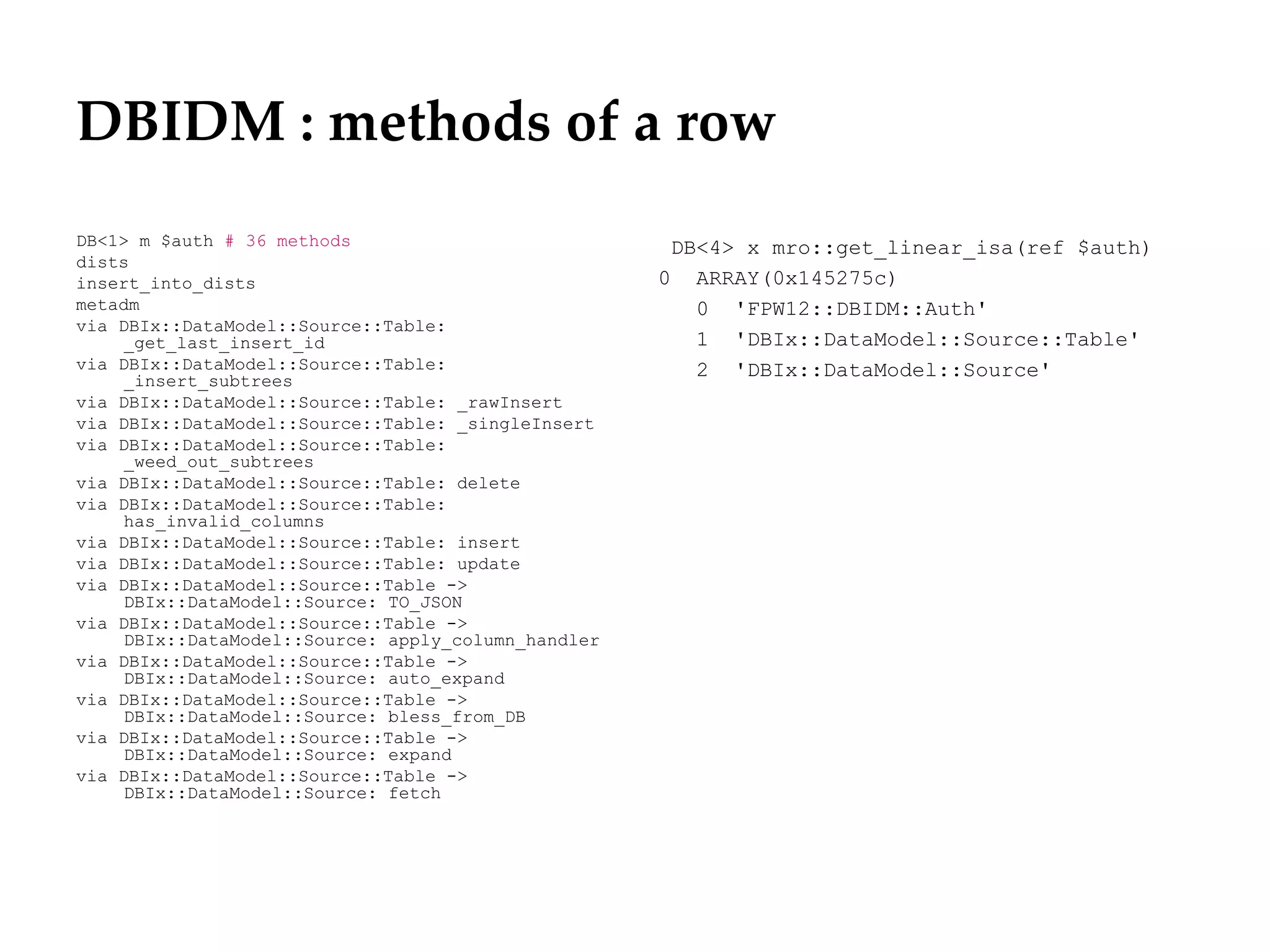
DBIDM : methods of a row
DB<1> m $auth # 36 methods                            DB<4> x mro::get_linear_isa(ref $auth)
dists
insert_into_dists                                    0 ARRAY(0x145275c)
metadm                                                  0 'FPW12::DBIDM::Auth'
via DBIx::DataModel::Source::Table:
     _get_last_insert_id                                1 'DBIx::DataModel::Source::Table'
via DBIx::DataModel::Source::Table:                     2 'DBIx::DataModel::Source'
     _insert_subtrees
via DBIx::DataModel::Source::Table: _rawInsert
via DBIx::DataModel::Source::Table: _singleInsert
via DBIx::DataModel::Source::Table:
     _weed_out_subtrees
via DBIx::DataModel::Source::Table: delete
via DBIx::DataModel::Source::Table:
     has_invalid_columns
via DBIx::DataModel::Source::Table: insert
via DBIx::DataModel::Source::Table: update
via DBIx::DataModel::Source::Table ->
     DBIx::DataModel::Source: TO_JSON
via DBIx::DataModel::Source::Table ->
     DBIx::DataModel::Source: apply_column_handler
via DBIx::DataModel::Source::Table ->
     DBIx::DataModel::Source: auto_expand
via DBIx::DataModel::Source::Table ->
     DBIx::DataModel::Source: bless_from_DB
via DBIx::DataModel::Source::Table ->
     DBIx::DataModel::Source: expand
via DBIx::DataModel::Source::Table ->
     DBIx::DataModel::Source: fetch
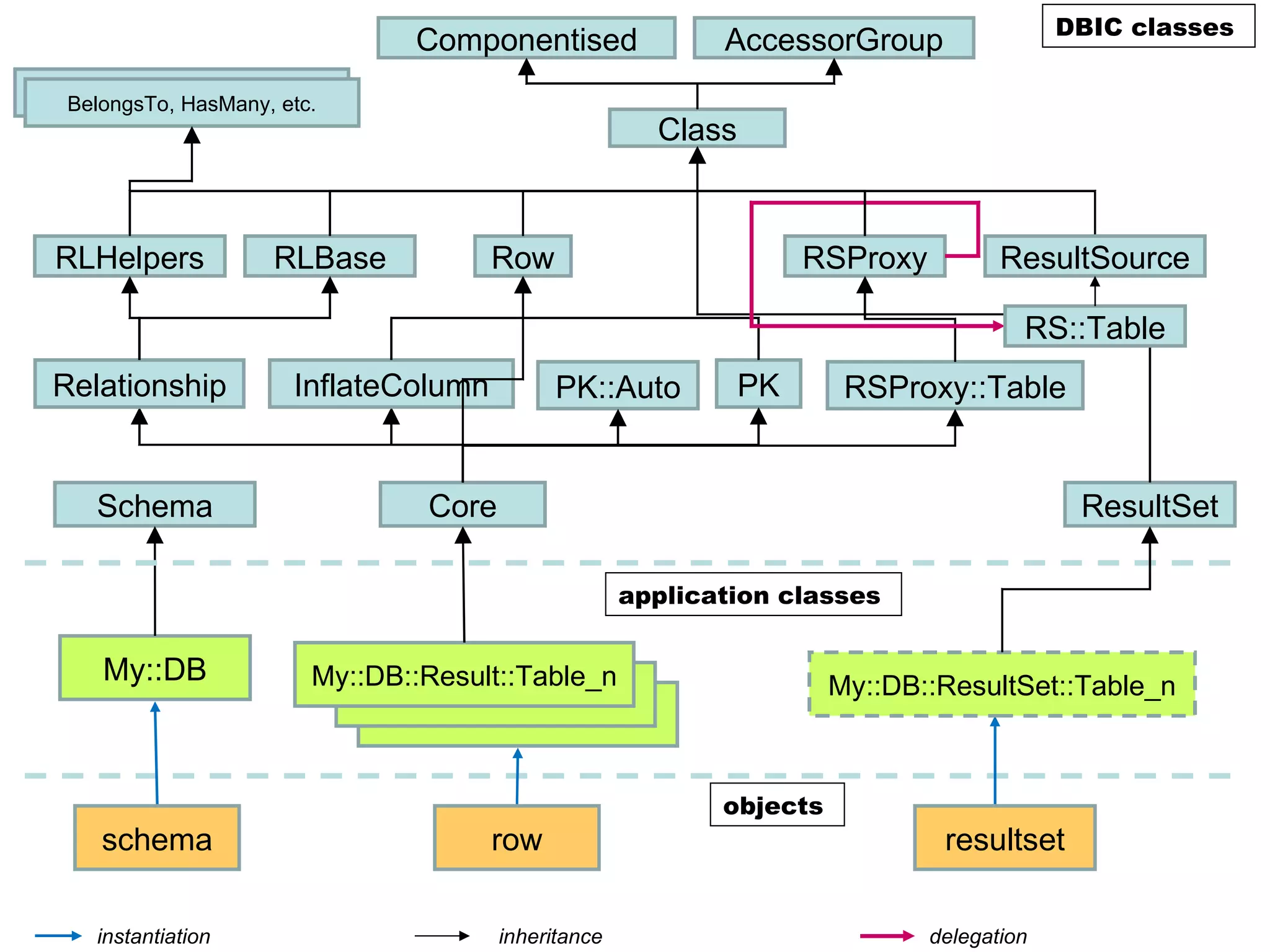
DBIC classes
                               Componentised                AccessorGroup
BelongsTo, HasMany, etc.
 BelongsTo, HasMany, etc.
                                                       Class


RLHelpers           RLBase            Row                           RSProxy          ResultSource

                                                                                       RS::Table
Relationship          InflateColumn          PK::Auto          PK      RSProxy::Table


   Schema                       Core                                                        ResultSet

                                                     application classes


    My::DB              My::DB::Result::Table_n                       My::DB::ResultSet::Table_n


                                                            objects
    schema                            row                                      resultset

   instantiation                       inheritance                            delegation
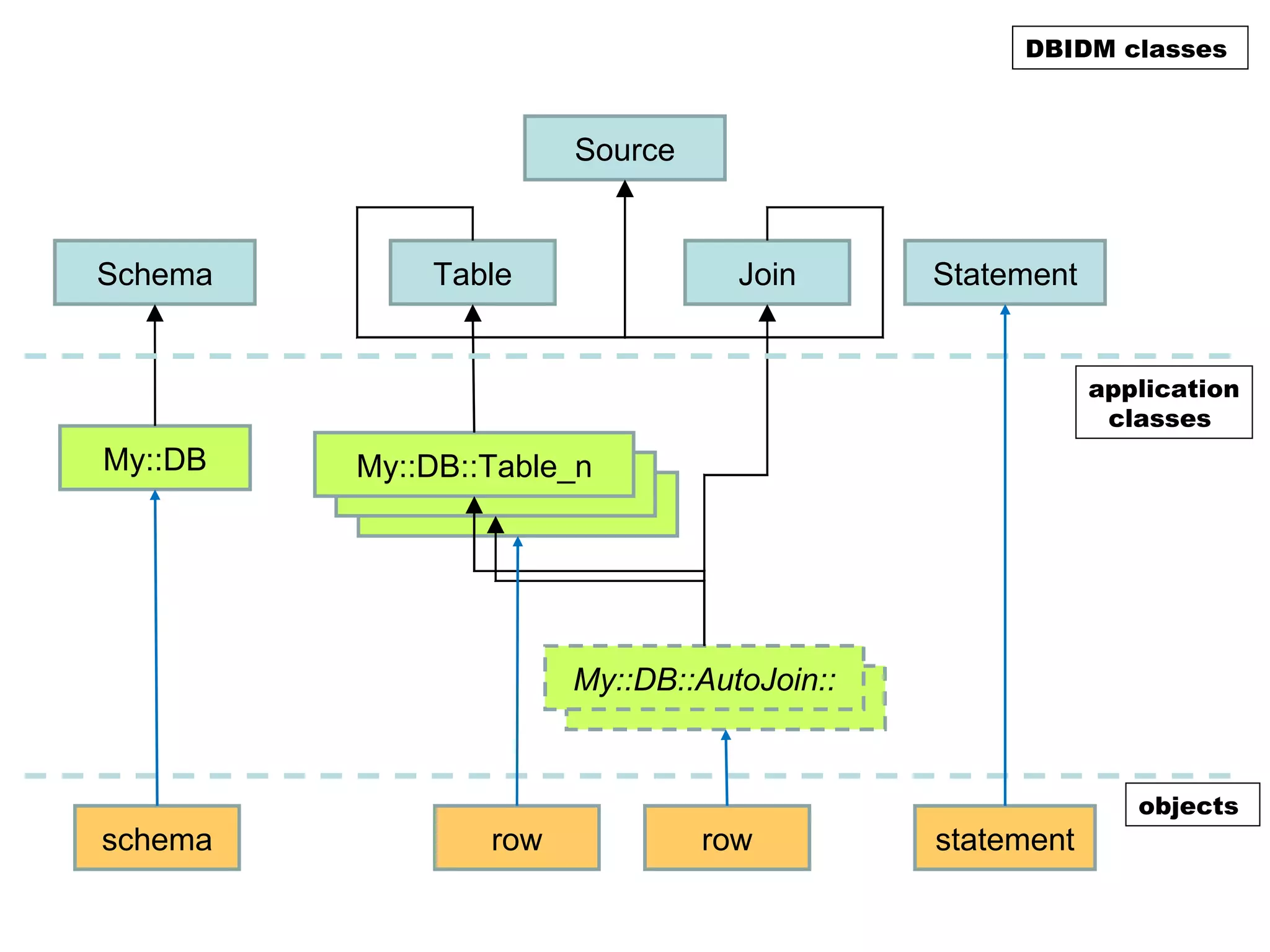
DBIDM classes


                       Source


Schema       Table                Join      Statement


                                                        application
                                                         classes
My::DB   My::DB::Table_n


                       My::DB::AutoJoin::


                                                           objects
schema           row            row         statement
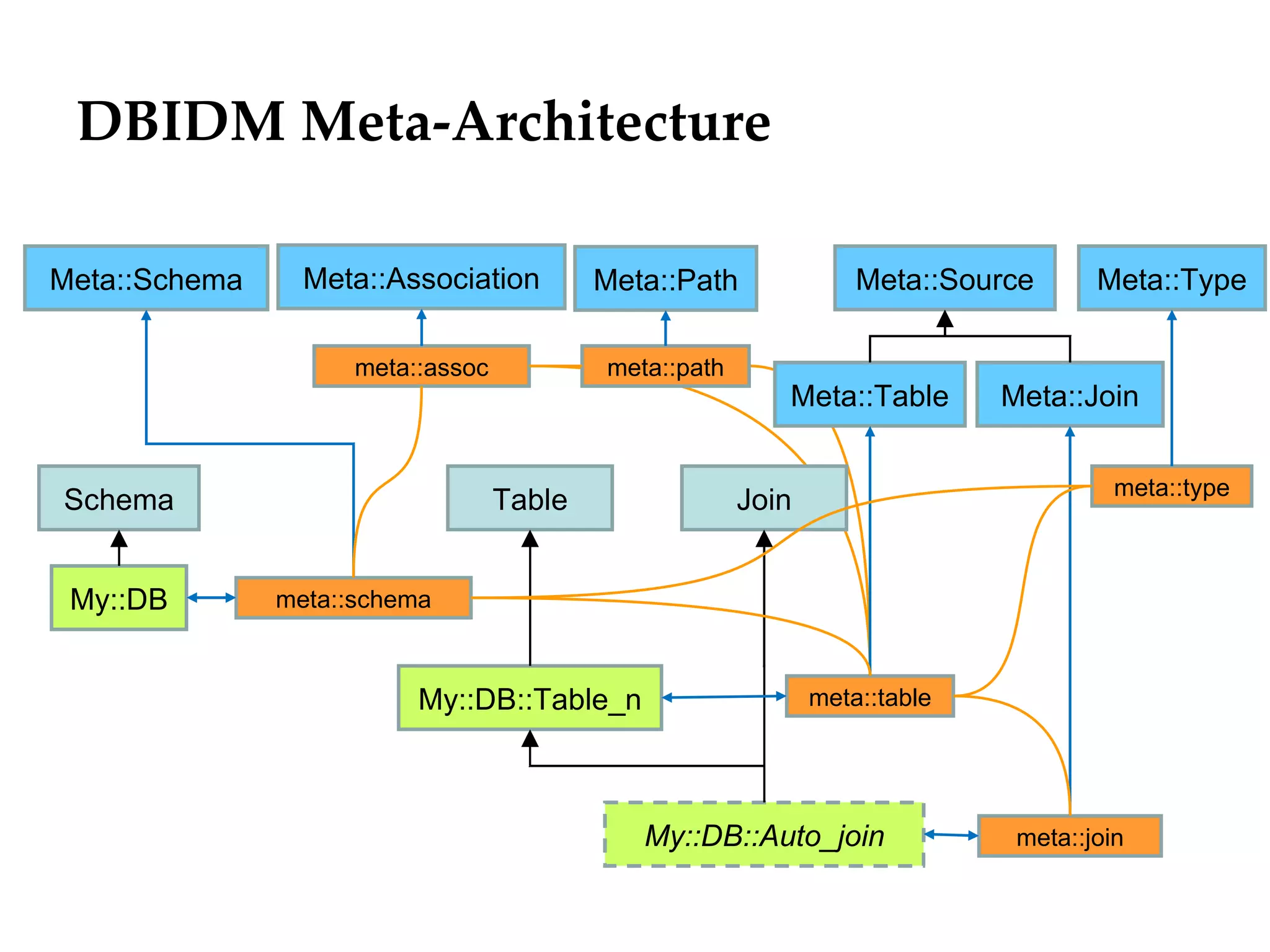
DBIDM Meta-Architecture

Meta::Schema     Meta::Association         Meta::Path              Meta::Source      Meta::Type

                     meta::assoc           meta::path
                                                           Meta::Table       Meta::Join

                                                                                       meta::type
Schema                             Table                Join


 My::DB        meta::schema


                          My::DB::Table_n                      meta::table


                                              My::DB::Auto_join               meta::join
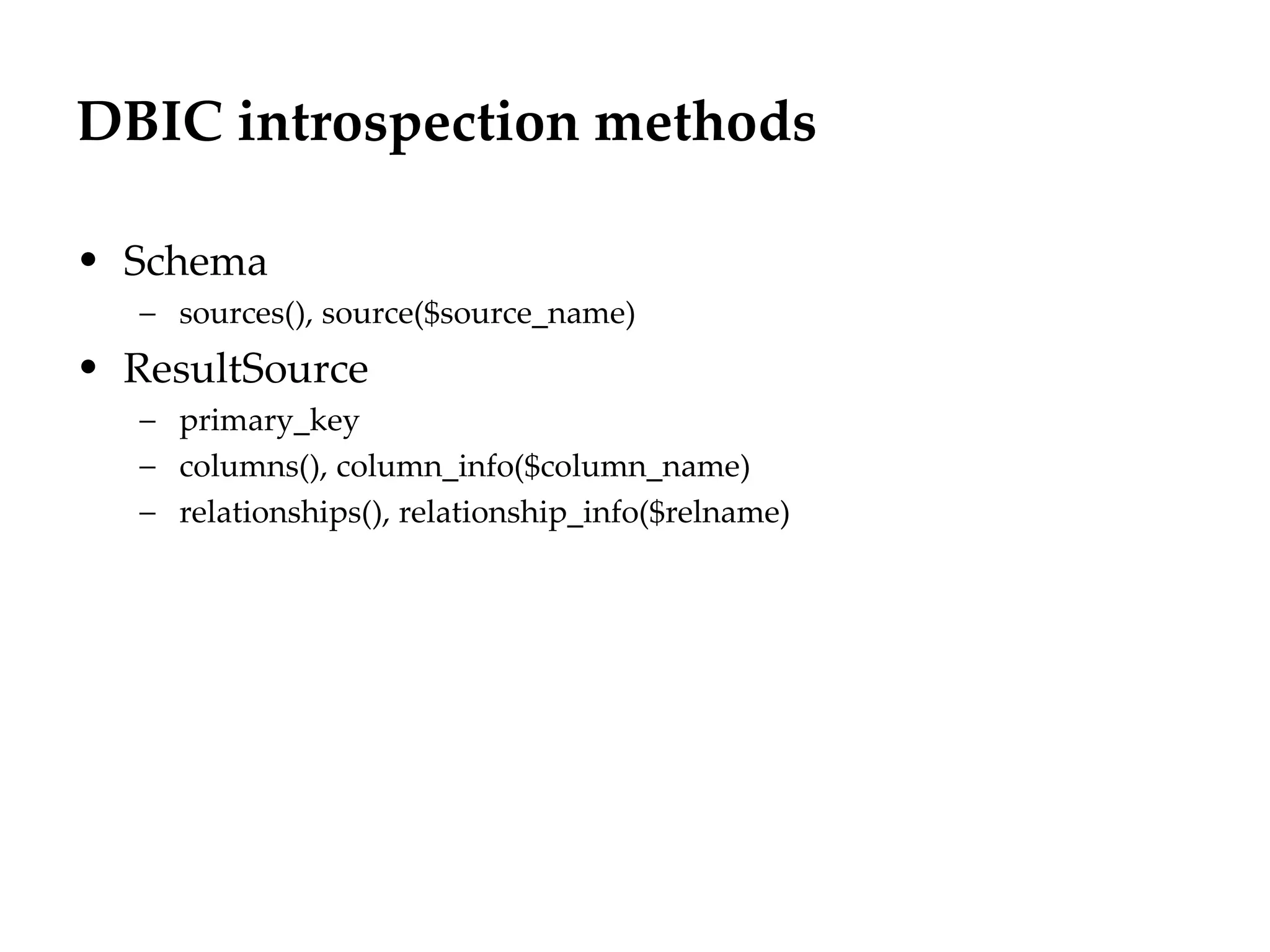
DBIC introspection methods

• Schema
   – sources(), source($source_name)
• ResultSource
   – primary_key
   – columns(), column_info($column_name)
   – relationships(), relationship_info($relname)
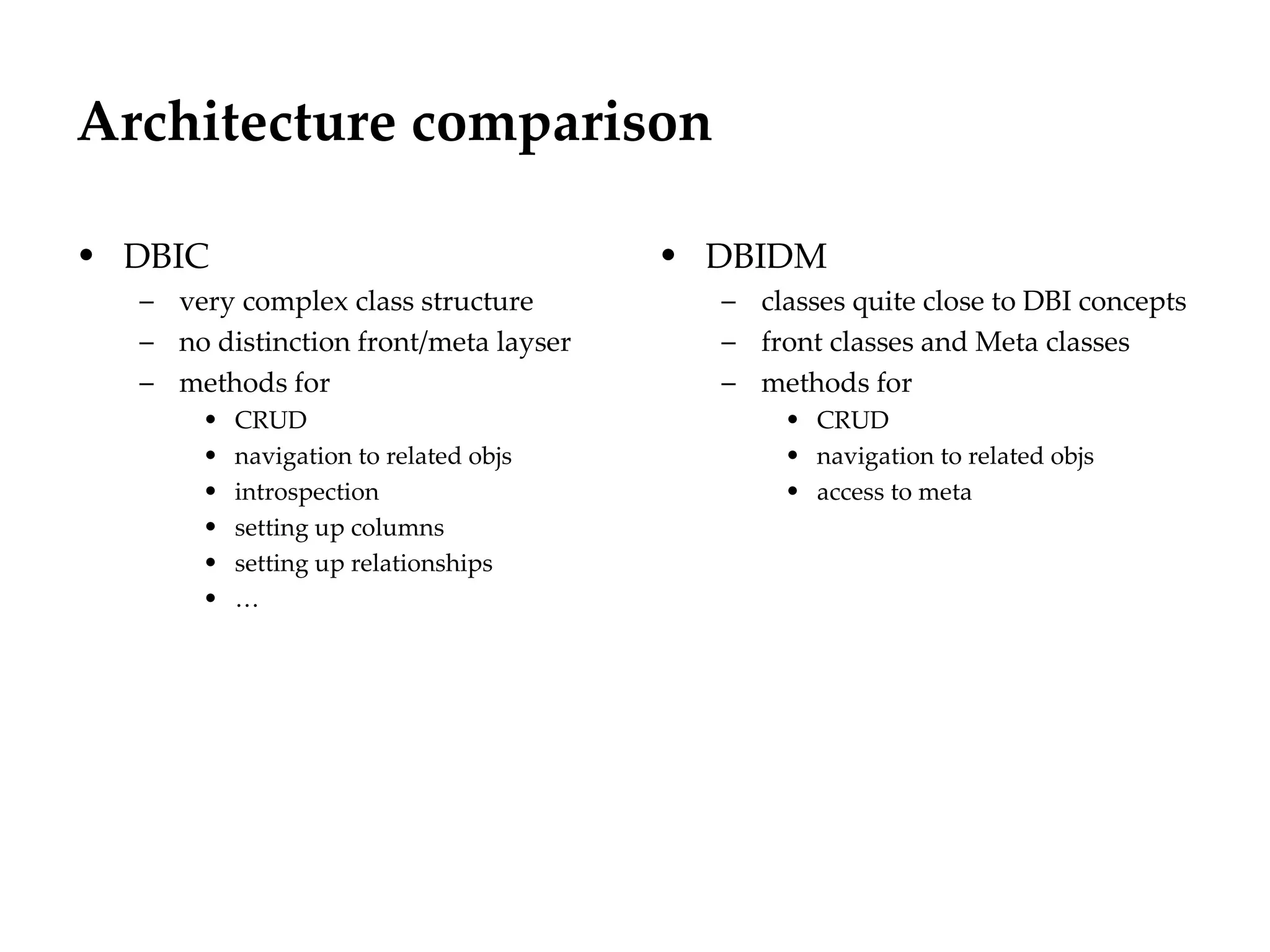
Architecture comparison

• DBIC                                  • DBIDM
  – very complex class structure          – classes quite close to DBI concepts
  – no distinction front/meta layser      – front classes and Meta classes
  – methods for                           – methods for
       •   CRUD                                • CRUD
       •   navigation to related objs          • navigation to related objs
       •   introspection                       • access to meta
       •   setting up columns
       •   setting up relationships
       •   …
Département
                                    Office


Resultset/Statement objects


                                             29.06.12 - Page 1
Example task
                                        Département
                                              Office


• list names of authors
   – of distribs starting with 'DBIx'
   – and version number > 2


                                                       29.06.12 - Page 1
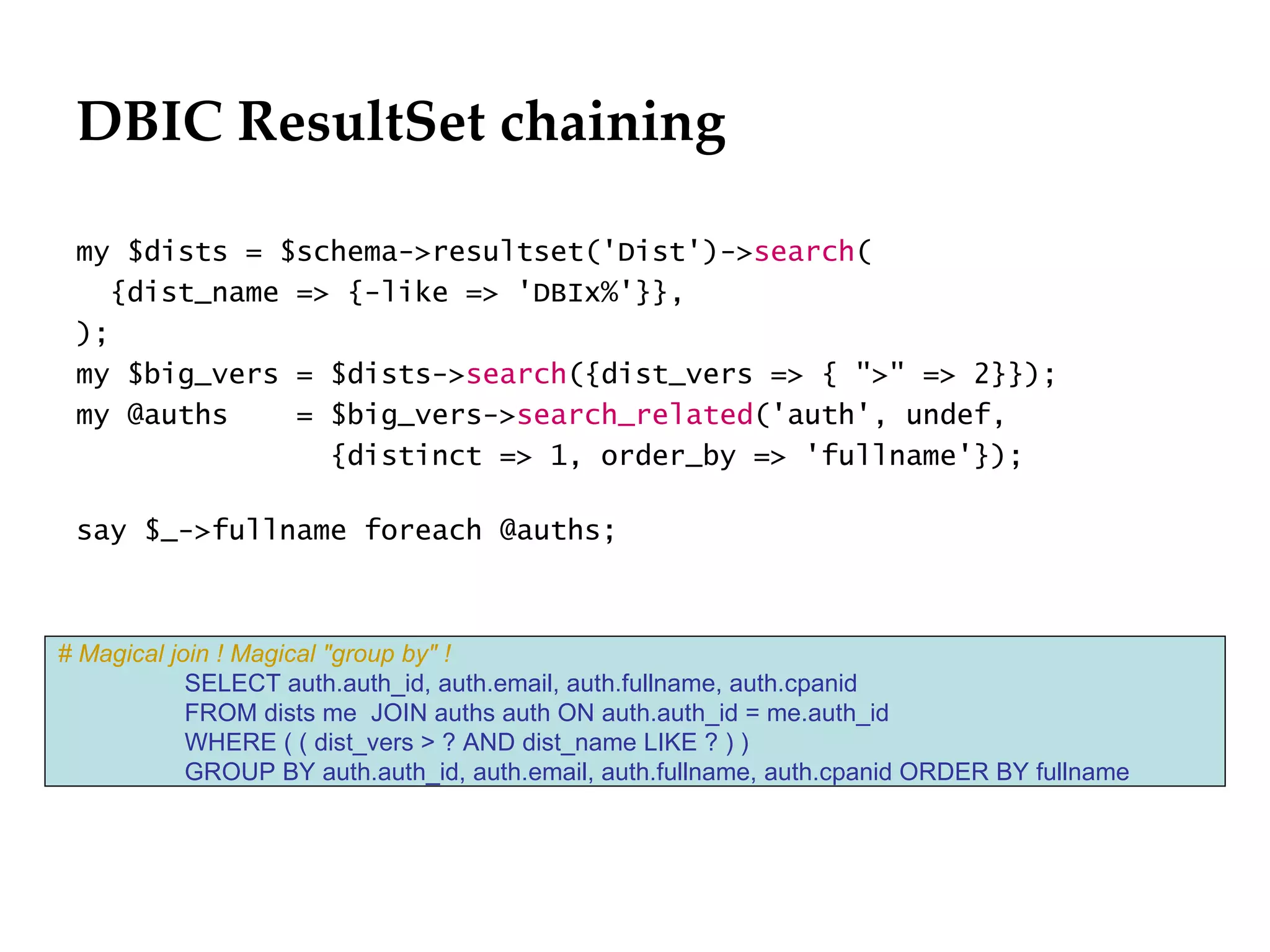
DBIC ResultSet chaining
                                                                             Département
                                                                                   Office

 my $dists = $schema->resultset('Dist')->search(
   {dist_name => {-like => 'DBIx%'}},
 );
 my $big_vers = $dists->search({dist_vers => { ">" => 2}});
 my @auths    = $big_vers->search_related('auth', undef,
                {distinct => 1, order_by => 'fullname'});

 say $_->fullname foreach @auths;


# Magical join ! Magical "group by" !
            SELECT auth.auth_id, auth.email, auth.fullname, auth.cpanid
            FROM dists me JOIN auths auth ON auth.auth_id = me.auth_id
            WHERE ( ( dist_vers > ? AND dist_name LIKE ? ) )
            GROUP BY auth.auth_id, auth.email, auth.fullname, auth.cpanid ORDER BY fullname


                                                                                              29.06.12 - Page 1
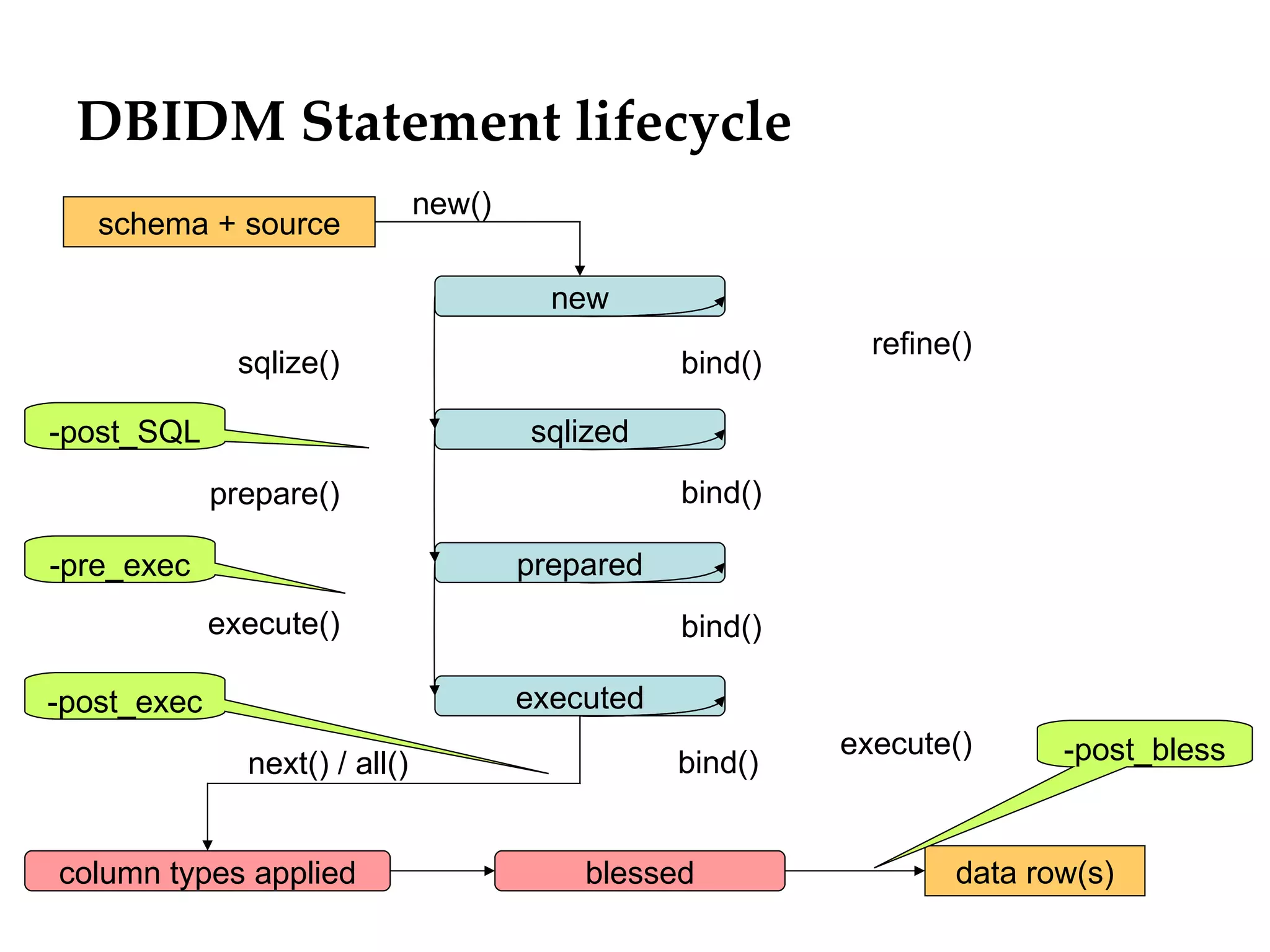
DBIDM Statement lifecycle
                                new()
   schema + source

                                          new
                                                              refine()
               sqlize()                            bind()

-post_SQL                               sqlized
             prepare()                             bind()

-pre_exec                               prepared
             execute()                             bind()

-post_exec                              executed
                                                            execute()      -post_bless
               next() / all()                      bind()


column types applied                        blessed                 data row(s)
DBIDM Statement::refine()

my $stmt = FPW12::DBIDM->join(qw/Dist auth/)->select(
  -where     => {dist_name => {-like => 'DBIx%'}},
  -result_as => 'statement',
);

$stmt->refine(
  -columns   => [-DISTINCT => 'fullname'],
  -where     => {dist_vers => { ">" => 0}},
  -order_by => 'fullname',
);

say $_->{fullname} while $_ = $stmt->next;
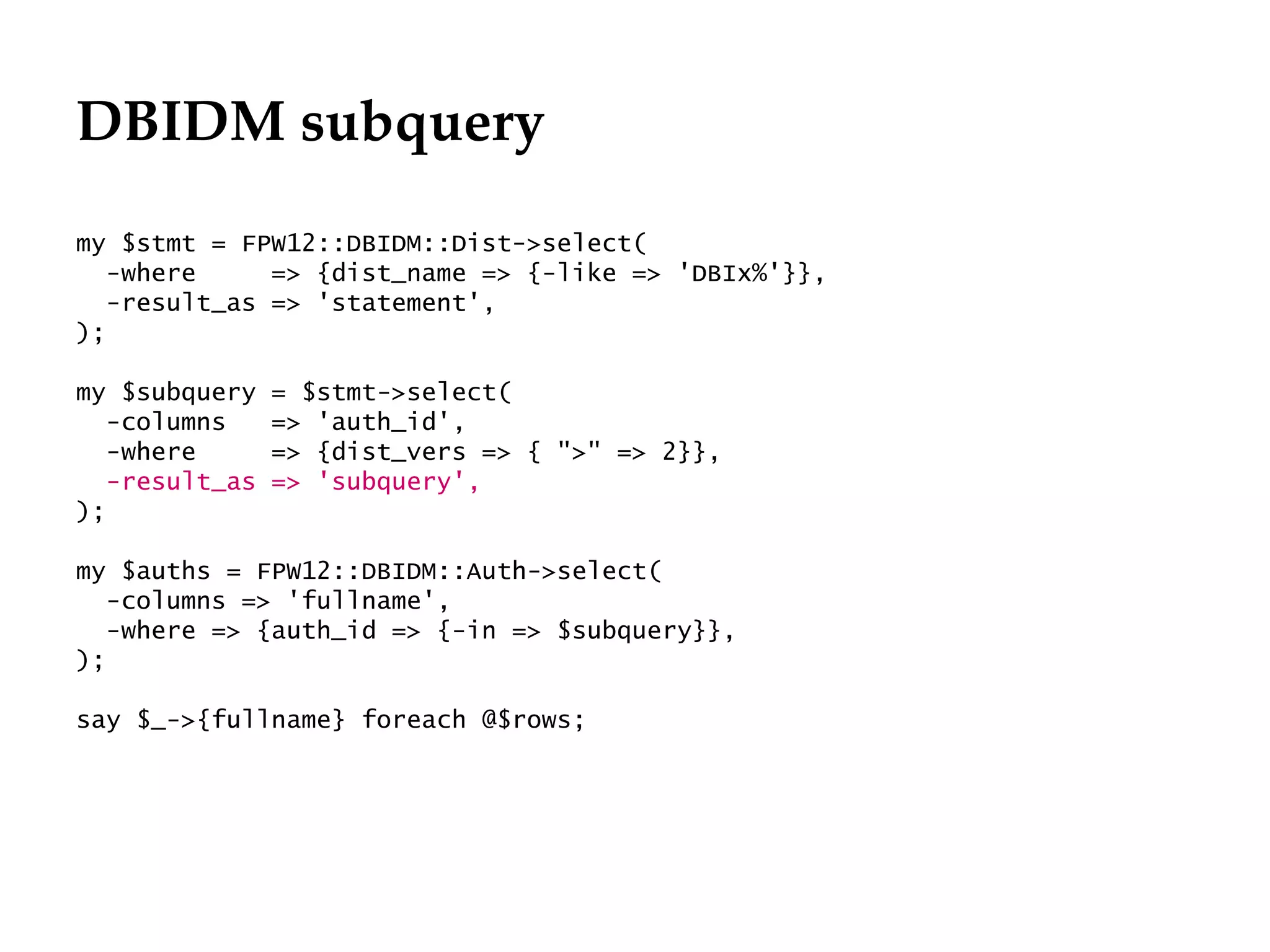
DBIDM subquery
my $stmt = FPW12::DBIDM::Dist->select(
   -where     => {dist_name => {-like => 'DBIx%'}},
   -result_as => 'statement',
);

my $subquery    = $stmt->select(
   -columns     => 'auth_id',
   -where       => {dist_vers => { ">" => 2}},
   -result_as   => 'subquery',
);

my $auths = FPW12::DBIDM::Auth->select(
   -columns => 'fullname',
   -where => {auth_id => {-in => $subquery}},
);

say $_->{fullname} foreach @$rows;
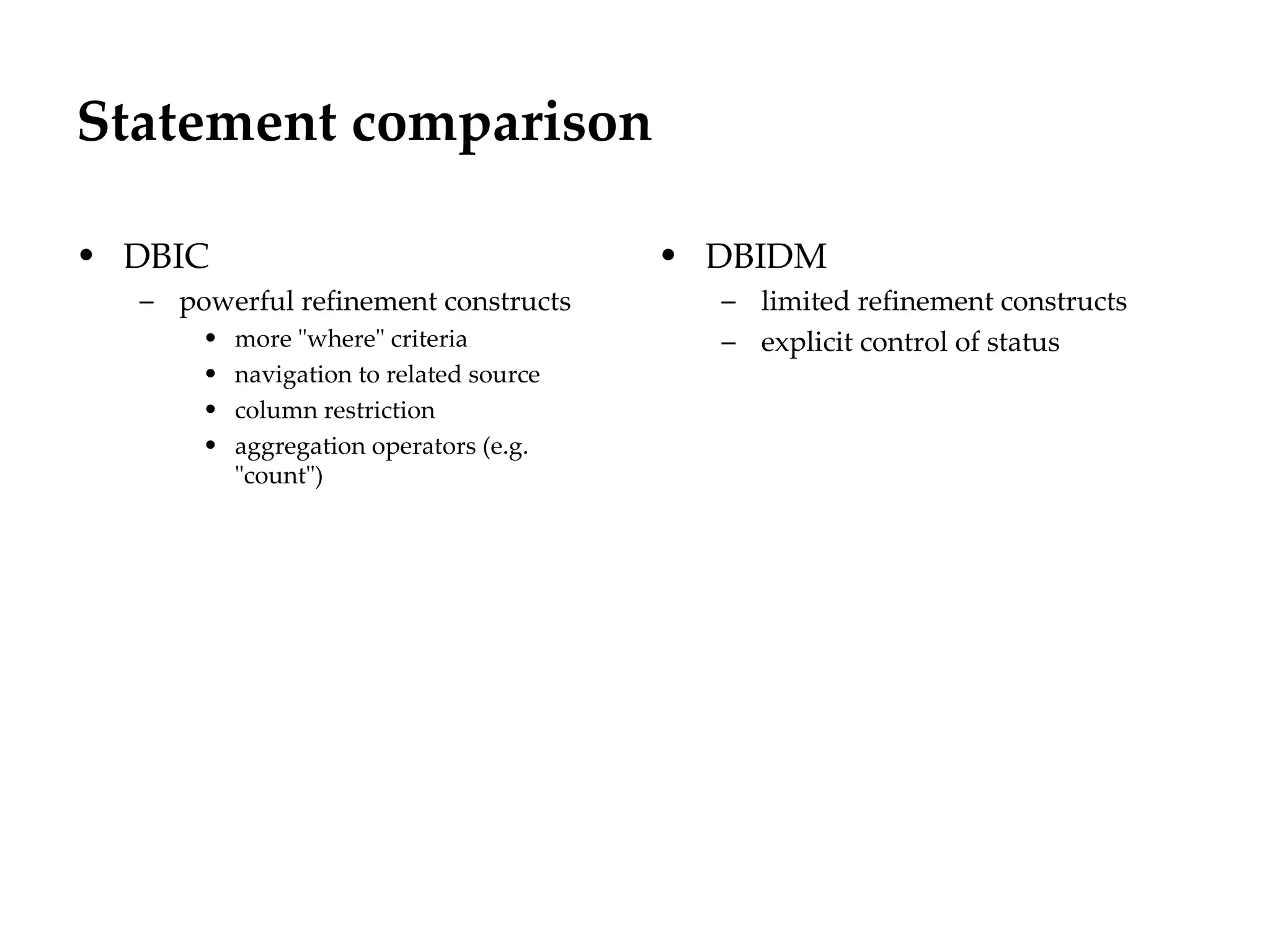
Statement comparison

• DBIC                                   • DBIDM
  – powerful refinement constructs         – limited refinement constructs
      •   more "where" criteria            – explicit control of status
      •   navigation to related source
      •   column restriction
      •   aggregation operators (e.g.
          "count")
Département
                       Office


Other features


                                29.06.12 - Page 1
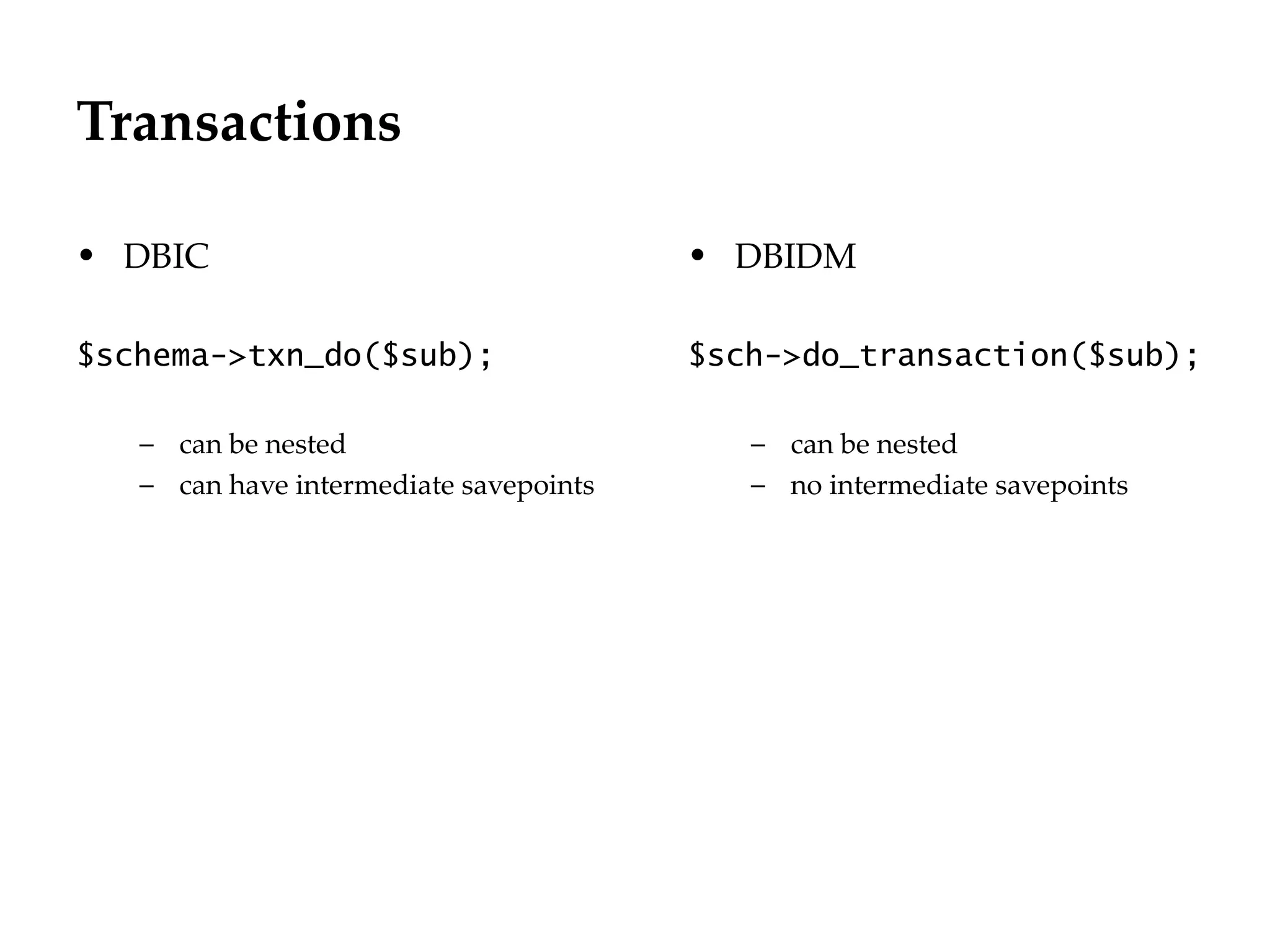
Transactions
                                                          Département
                                                                Office


• DBIC                                  • DBIDM

$schema->txn_do($sub);                  $sch->do_transaction($sub);

   – can be nested                         – can be nested
   – can have intermediate savepoints      – no intermediate savepoints


                                                                          29.06.12 - Page 1
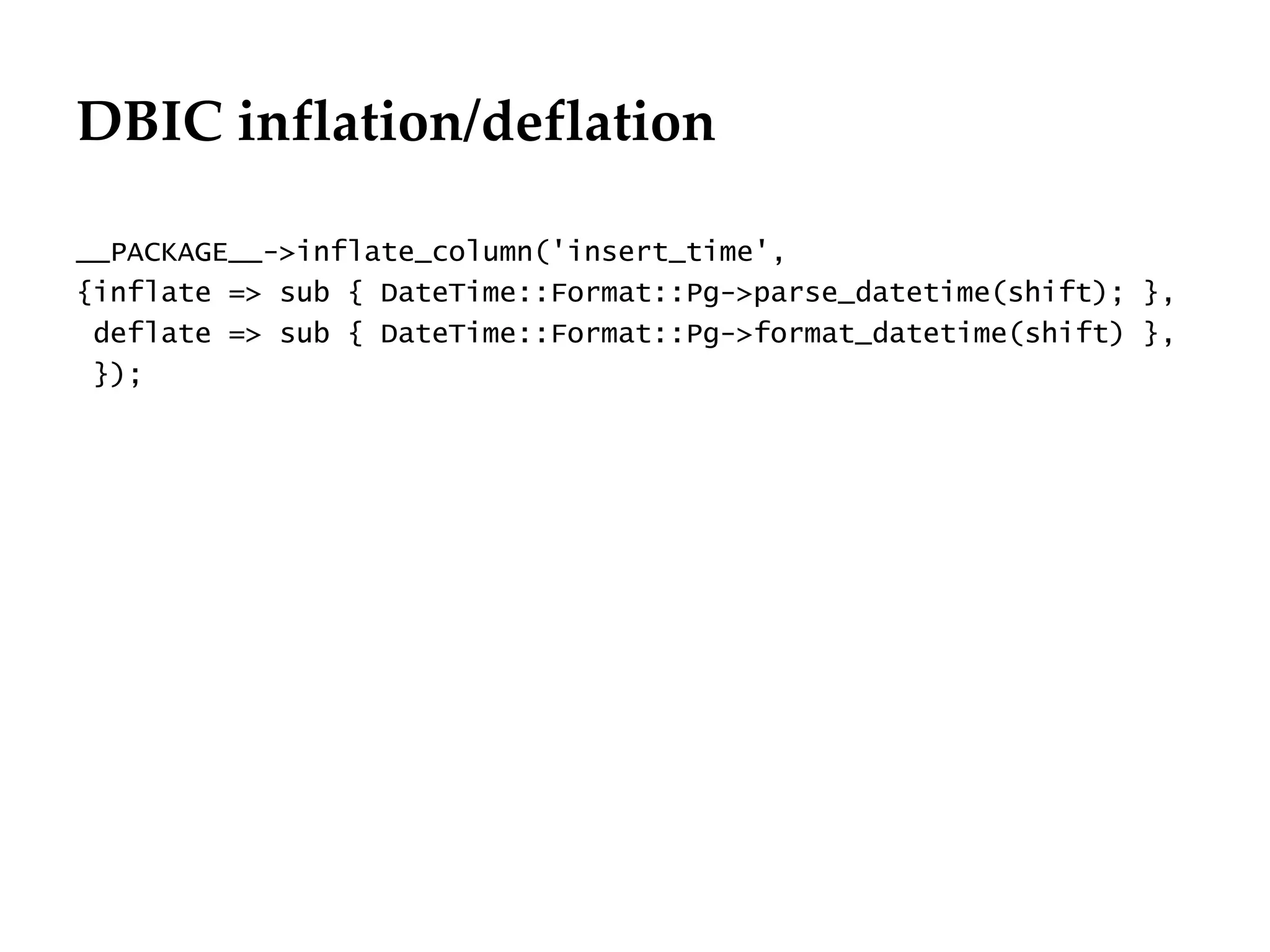
DBIC inflation/deflation

__PACKAGE__->inflate_column('insert_time',
{inflate => sub { DateTime::Format::Pg->parse_datetime(shift); },
 deflate => sub { DateTime::Format::Pg->format_datetime(shift) },
 });
DBIDM Types (inflate/deflate)

# declare a Type
My::DB->Type(Multivalue =>
   from_DB => sub {$_[0] = [split /;/, $_[0]] },
   to_DB   => sub {$_[0] = join ";", @$_[0]   },
);

# apply it to some columns in a table
My::DB::Author->metadm->define_column_type(
   Multivalue => qw/hobbies languages/,
);
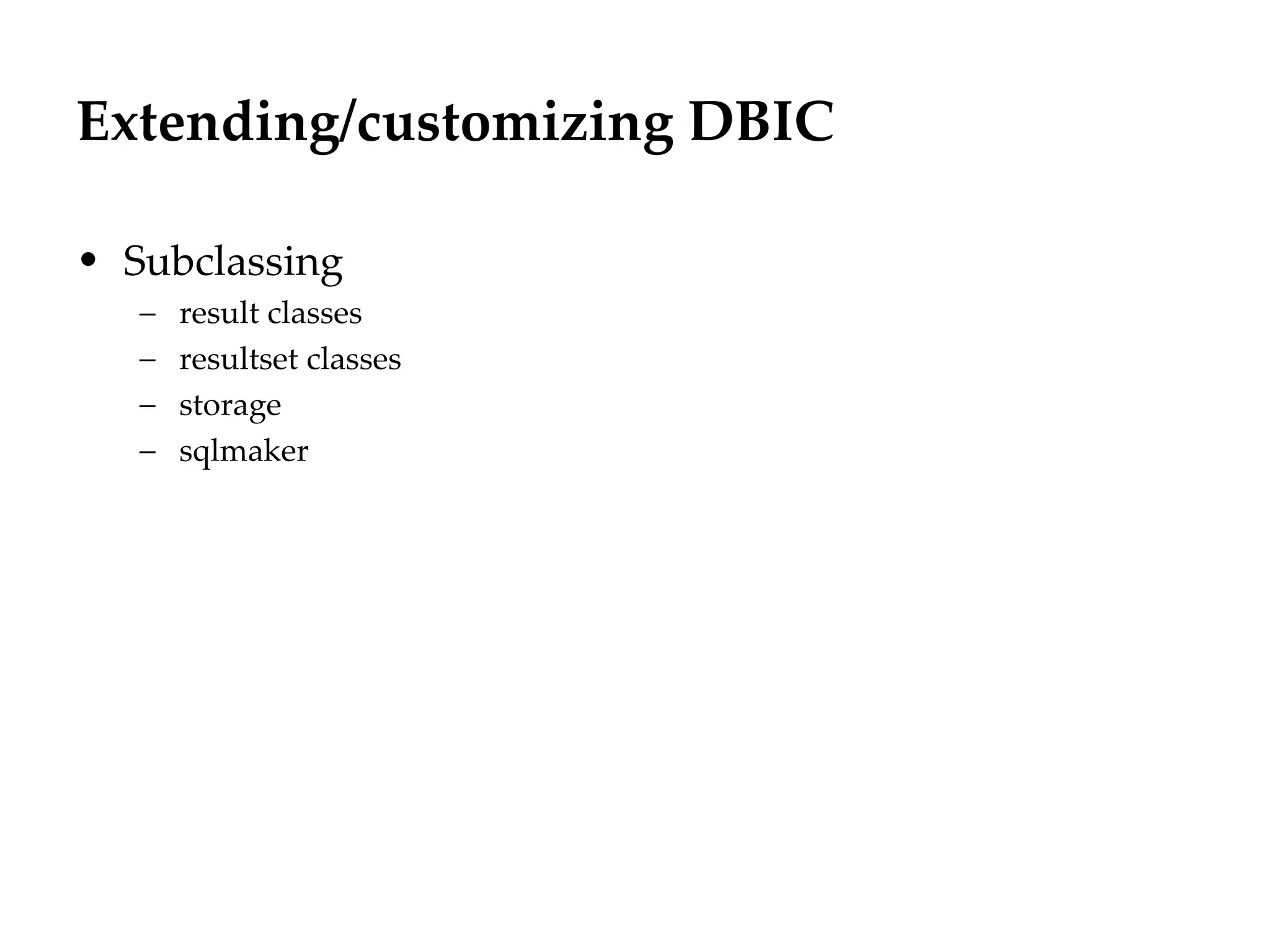
Extending/customizing DBIC

• Subclassing
   –   result classes
   –   resultset classes
   –   storage
   –   sqlmaker
Extending / customizing DBIDM

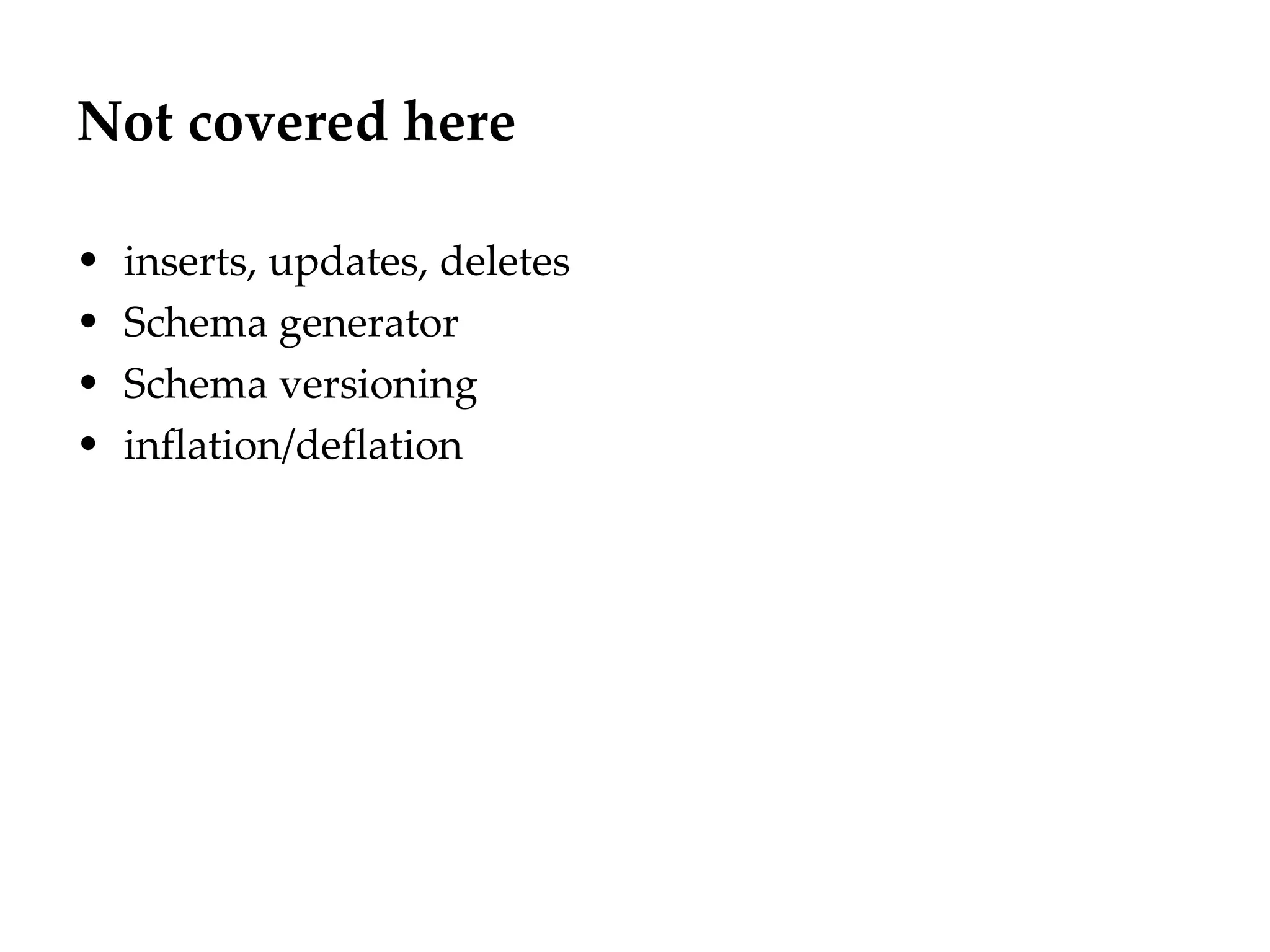
• Schema hooks for
   – SQL dialects (join syntax, alias syntax, limit / offset, etc.)
   – last_insert_id
• Ad hoc subclasses for
   –   SQL::Abstract
   –   Table
   –   Join
   –   Statements
• Statement callbacks
• Extending table classes
   – additional methods
   – redefining _singleInsert method
Not covered here

• inserts, updates, deletes
• Schema generator
• Schema versioning
• inflation/deflation
Département
                             Office


THANK YOU FOR YOUR ATTENTION


                                      29.06.12 - Page 1
Département
                     Office


Bonus slides


                              29.06.12 - Page 1
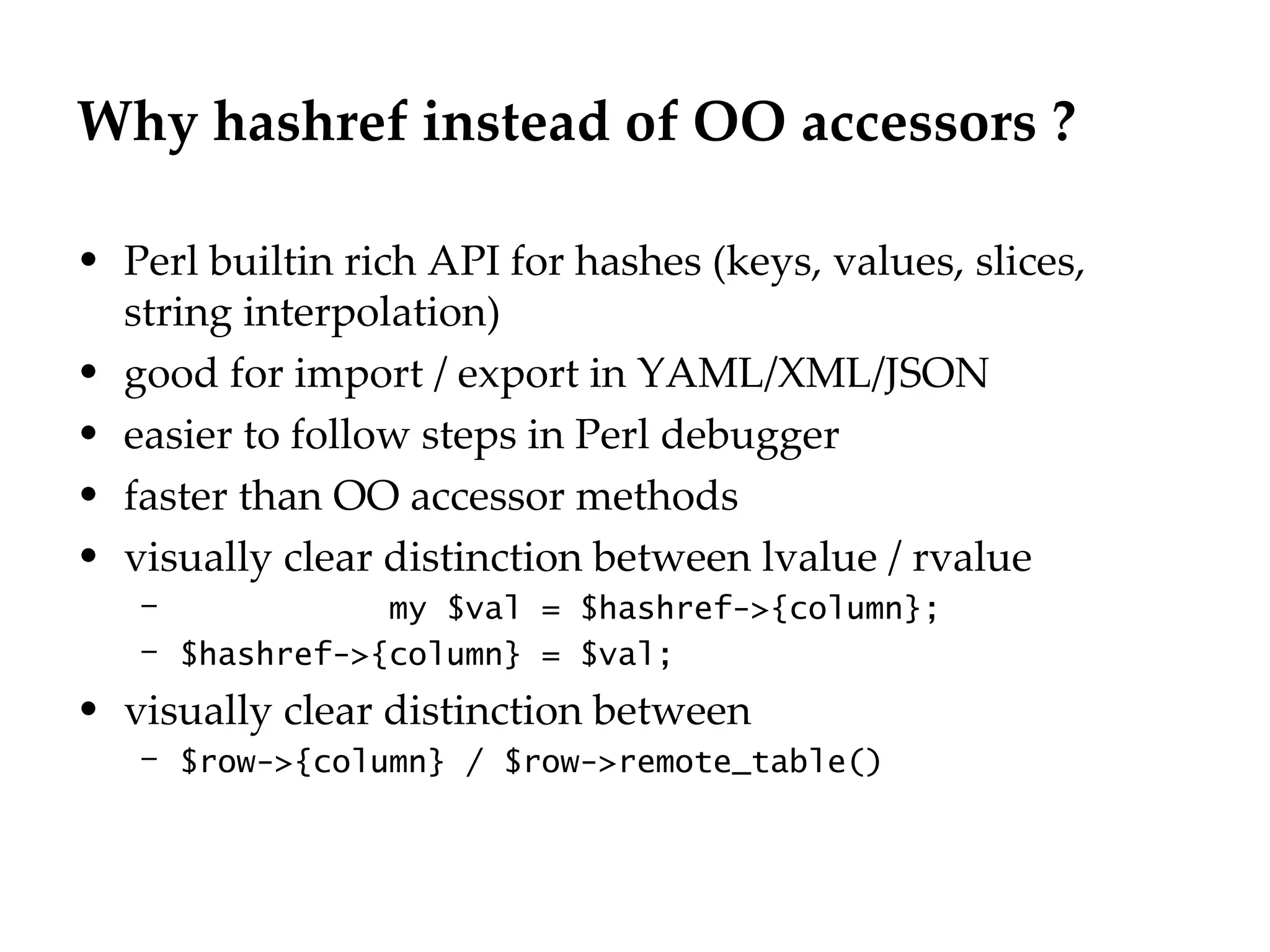
Why hashref instead of OO accessors ?

• Perl builtin rich API for hashes (keys, values, slices,
    string interpolation)
•   good for import / export in YAML/XML/JSON
•   easier to follow steps in Perl debugger
•   faster than OO accessor methods
•   visually clear distinction between lvalue / rvalue
    –            my $val = $hashref->{column};
    – $hashref->{column} = $val;
• visually clear distinction between
    – $row->{column} / $row->remote_table()
SQL::Abstract::More : extensions

• -columns      => [qw/col1|alias1 max(col2)|alias2/]
  –   SELECT col1 AS alias1, max(col2) AS alias2

• -columns      => [-DISTINCT => qw/col1 col2 col3/]
  –   SELECT DISTINCT col1, col2, col3

• -order_by => [qw/col1 +col2 –col3/]
  – SELECT … ORDER BY col1, col2 ASC, col3 DESC

• -for => "update" || "read only"
  – SELECT … FOR UPDATE

DBIx::Class vs. DBix::DataModel

  • 1.
    DBIx::Class Département Office vs. DBIx::DataModel FPW 2012, Strasbourg laurent.dami@justice.ge.ch Département Office 29.06.12 - Page 1
  • 2.
    Agenda • Introduction • Schemadefinition • Data retrieval • Joins • Classes and methods • Resultset/Statement objects • Customization • Conclusion
  • 3.
  • 4.
    ORM layer Perl program Object-Relational Mapper DBI DBD driver Database
  • 5.
    ORM useful for… • dynamic SQL generation – navigation between tables – generate complex SQL queries from Perl datastructures – better than phrasebook or string concatenation • automatic data conversions (inflation / deflation) • transaction encapsulation • data validation • computed fields • caching • expansion of tree data structures coded in the relational model • …
  • 6.
    CPAN ORM Landscape •Discussed here – DBIx::Class (a.k.a. DBIC) – DBIx::DataModel (a.k.a. DBIDM) DISCLAIMER - I'm not an expert of DBIC - I'll try to be neutral in comparisons, but … - Won't cover all topics • Many other – Rose::DB, Jifty::DBI, Fey::ORM, ORM, DBIx::ORM::Declarative, Tangram, Coat::Persistent, ORLite, DBR, DBIx::Sunny, DBIx::Skinny, DBI::Easy, …
  • 7.
    A bit of2005 history Class::DBI (1999) SQL::Abstract (2001) DBIx::DataModel private (feb.05) Class::DBI::Sweet (29.05.05) - SQL::Abstract Class::DBI::Sweet 0.02 (29.06.05) -prefetch joins DBIx::Class 0.01 (08.08.05) - SQL::Abstract DBIx::Class 0.03 (19.09.05) DBIx::DataModel 0.10 (16.09.05) - prefetch joins
  • 8.
    Some figures • DBIC • DBIDM – thousands of users – a couple of users – dozens of contributors – 1 contributor – 162 files – 31 files – 167 packages – 40 packages – 1042 subs/methods – 175 subs/methods – 16759 lines of Perl – 3098 lines of Perl – 1817 comment lines – 613 comment lines – 19589 lines of POD – 8146 lines of POD – 70 transitive dependencies – 54 transitive dependencies
  • 9.
    Our example :CPAN model straight from CPAN::SQLite Author 1 * 1 contains ► 1..* Distribution Module * * depends_on ►
  • 10.
    Département Office Schema definition 29.06.12 - Page 1
  • 11.
    DBIC Schema class Département Office use utf8; package FPW12::DBIC; use strict; use warnings; use base 'DBIx::Class::Schema'; __PACKAGE__->load_namespaces; 1; 29.06.12 - Page 1
  • 12.
    DBIC 'Dist' tableclass Département Office use utf8; package FPW12::DBIC::Result::Dist; use strict; use warnings; use base 'DBIx::Class::Core'; __PACKAGE__->table("dists"); __PACKAGE__->add_columns( dist_id => { data_type => "integer", is_nullable => 0, is_auto_increment => 1 }, dist_vers => { data_type => "varchar", is_nullable => 1, size => 20 }, ... # other columns ); __PACKAGE__->set_primary_key("dist_id"); __PACKAGE__->belongs_to ('auth', 'FPW12::DBIC::Result::Auth', 'auth_id'); __PACKAGE__->has_many ('mods', 'FPW12::DBIC::Result::Mod', 'dist_id'); __PACKAGE__->has_many ('depends', 'FPW12::DBIC::Result::Depends', 'dist_id'); __PACKAGE__->many_to_many(prereq_mods => 'depends', 'mod'); # idem for classes Auth, Mod, etc. 29.06.12 - Page 1
  • 13.
    DBIDM centralized declarations useDBIx::DataModel; DBIx::DataModel->Schema("FPW12::DBIDM") # class table primary key # ===== ===== =========== ->Table(qw/Auth auths auth_id /) ->Table(qw/Dist dists dist_id /) ->Table(qw/Mod mods mod_id /) ->Table(qw/Depends depends dist_id mod_id/) # class role multipl. (optional join keys) # ===== ==== ======= ==================== ->Association([qw/Auth auth 1 auth_id /], [qw/Dist dists * auth_id /]) ->Composition([qw/Dist dist 1 /], [qw/Mod mods * /]) ->Association([qw/Dist dist 1 /], [qw/Depends depends * /]) ->Association([qw/Mod mod 1 /], [qw/Depends depends * /]) ->Association([qw/Dist used_in_dist * depends distrib /], [qw/Mod prereq_mods * depends mod /]) ;
  • 14.
    Schema def. comparison Département Office • DBIC • DBIDM – one file for each class – centralized file – regular Perl classes – dynamic class creation – full column info – no column info (except pkey) – 1-way "relationships" – 2-ways "associations" with • belongs_to • multiplicities • has_many • role names • may_have • diff association/composition • …. – custom join conditions – custom column names • any operator • only equalities • 'foreign' and 'self' 29.06.12 - Page 1
  • 15.
    Département Office Data retrieval 29.06.12 - Page 1
  • 16.
    DBIC: Search Département Office use FPW12::DBIC; my $schema = FPW12::DBIC->connect($data_source); my @dists = $schema->resultset('Dist')->search( {dist_name => {-like => 'DBIx%'}}, {columns => [qw/dist_name dist_vers/]}, ); foreach my $dist (@dists) { printf "%s (%s)n", $dist->dist_name, $dist->dist_vers; } 29.06.12 - Page 1
  • 17.
    DBIDM: Search Département Office use FPW12::DBIDM; use DBI; my $datasource = "dbi:SQLite:dbname=../cpandb.sql"; my $dbh = DBI->connect($datasource, "", "", {RaiseError => 1, AutoCommit => 1}); FPW12::DBIDM->dbh($dbh); my $dists = FPW12::DBIDM::Dist->select( -columns => [qw/dist_name dist_vers/], -where => {dist_name => {-like => 'DBIx%'}}, ); foreach my $dist (@$dists) { print "$dist->{dist_name} ($dist->{dist_vers})n"; } 29.06.12 - Page 1
  • 18.
    Simple search comparison Département Office • DBIC • DBIDM – schema is an object – schema is a class (default) or an object – result is a list or a resultset object – result is an arrayref (default) – accessor methods for columns – hash entries for columns – uses SQL::Abstract – uses SQL::Abstract::More • mostly hidden • user can supply a custom $sqla obj 29.06.12 - Page 1
  • 19.
    SQL::Abstract new() Département Office • special operators – ex: DBMS-independent fulltext search # where {field => {-contains => [qw/foo bar/]} my $sqla = SQL::Abstract->new(special_ops => [ {regex => qr/^contains(:?_all|_any)?$/i, handler => sub { my ($self, $field, $op, $arg) = @_; my $connector = ($op =~ /any$/) ? ' | ' : ' & '; my @vals = ref $arg ? @$arg : ($arg); @vals = map { split /s+/ } grep {$_} @vals; my $sql = sprintf "CONTAINS($field, '%s') > 0", join $connector, @vals; return ($sql); # no @bind } ]); 29.06.12 - Page 1
  • 20.
    DBIC: Find singlerecord Département Office my $auth1 = $schema->resultset('Auth') ->find(123); my $auth2 = $schema->resultset('Auth') ->find({cpanid => 'DAMI'}); 29.06.12 - Page 1
  • 21.
    DBIDM: Find singlerecord Département Office my $auth1 = FPW12::DBIDM::Auth->fetch(123); my $auth2 = FPW12::DBIDM::Auth->search( -where => {cpanid => 'DAMI'}, -result_as => 'firstrow', ); 29.06.12 - Page 1
  • 22.
    DBIC: Search args Département Office • 1st arg : "where" criteria • 2nd arg : attributes – distinct – order_by – group_by, having – columns # list of columns to retrieve from main table – +columns # additional columns from joined tables or from functions – join # see later – prefetch # see later – for – page, rows, offset, etc. – cache 29.06.12 - Page 1
  • 23.
    DBIDM: Select args my $result = $source->select( -columns => @columns,, -where => %where, -group_by => @groupings, -having => %criteria, -order_by => @order, -for => 'read only', -post_SQL => sub { … }, -pre_exec => sub { … }, -post_exec => sub { … }, -post_bless => sub { … }, -page_size => …, -page_index => …, -limit => …, -offset => …, -column_types => %types, -result_as => $result_type, );
  • 24.
    DBIDM: Polymorphic result -result_as=> – 'rows' (default) : arrayref of row objects – 'firstrow' : a single row object (or undef) – 'hashref' : hashref keyed by primary keys – [hashref => @cols] : cascaded hashref – 'flat_arrayref' : flattened values from each row – 'statement' : a statement object (iterator) – 'fast_statement' : statement reusing same memory – 'sth' : DBI statement handle – 'sql' : ($sql, @bind_values) – 'subquery' : ["($sql)", @bind]   don't need method variants : select_hashref(), select_arrayref(), etc.
  • 25.
    DBIDM: Fast statement •like a regular statement – but reuses the same memory location for each row – see DBI::bind_col() my $statement = $source->select( . . . , -result_as => 'fast_statement' ); while (my $row = $statement->next) { . . . # DO THIS : print $row->{col1}, $row->{col2} # BUT DON'T DO THIS : push @results, $row; }
  • 26.
    Advanced search comparison •DBIC • DBIDM – 'find' by any unique constraint – 'fetch' by primary key only – "inner" vs "outer" columns – all columns equal citizens – result is context-dependent – polymorphic result – optional caching – no caching – statement-specific inflators – callbacks
  • 27.
  • 28.
    Task : listdistributions and their authors Author 1 * 1 contains ► 1..* Distribution Module * * depends_on ►
  • 29.
    DBIC: Join my @dists= $schema->resultset('Dist')->search( {dist_name => {-like => 'DBIx%'}}, {columns => [qw/dist_name dist_vers/], join => 'auth', '+columns' => [{'fullname' => 'auth.fullname'}], }, ); foreach my $dist (@dists) { printf "%s (%s) by %sn", $dist->dist_name, $dist->dist_vers, $dist->get_column('fullname'); # no accessor meth }
  • 30.
    DBIC: Join withprefetch my @dists = $schema->resultset('Dist')->search( {dist_name => {-like => 'DBIx%'}}, {columns => [qw/dist_name dist_vers/], prefetch => 'auth', }, ); foreach my $dist (@dists) { printf "%s (%s) by %sn", $dist->dist_name, $dist->dist_vers, $dist->auth->fullname; # already in memory }
  • 31.
    DBIDM: Join my $rows= FPW12::DBIDM->join(qw/Dist auth/)->select( -columns => [qw/dist_name dist_vers fullname/], -where => {dist_name => {-like => 'DBIx%'}}, ); foreach my $row (@$rows) { print "$row->{dist_name} ($row->{dist_vers}) " . "by $row->{fullname}n"; } Dist Auth DBIDM::Source::Join new class created on the fly ..::AutoJoin::…
  • 32.
    Multiple joins • DBIC join=> [ { abc => { def => 'ghi' } }, { jkl => 'mno' }, 'pqr' ] • DBIDM ->join(qw/Root abc def ghi jkl mno pqr/)
  • 33.
    Join from anexisting record • DBIC my $rs = $auth->dists(undef, {join|prefetch => 'mods'}); • DBIDM my $rows = $auth->join(qw/dists mods/)->select;
  • 34.
    DBIC: left/inner joins •attribute when declaring relationships # in a Book class (where Author has_many Books) __PACKAGE__->belongs_to( author => 'My::DBIC::Schema::Author', 'author', { join_type => 'left' } ); • cannot change later (when invoking the relationship)
  • 35.
    DBIDM: Left /inner joins ->Association([qw/Author author 1 /], [qw/Distribution distribs 0..* /]) # default : LEFT OUTER JOIN ->Composition([qw/Distribution distrib 1 /], [qw/Module modules 1..* /]); # default : INNER JOIN # but defaults can be overridden My::DB->join([qw/Author <=> distribs/)-> . . . My::DB->join([qw/Distribution => modules /)-> . . .
  • 36.
    Join comparison • DBIC • DBIDM – rows belong to 1 table class only – rows inherit from all joined tables – joined columns are either – flattening of all columns • "side-products", • prefetched (all of them, no choice) – fixed join type – default join type, can be overridden
  • 37.
  • 38.
    Select speed Département Office list mods join Auth dist mods (109349 rows) (113895 rows) DBI 0.43 secs 1.36 secs DBIC regular 11.09 secs 15.50 secs DBIC prefetch n.a. 146.29 secs DBIC hashref inflator 10.06 secs 14.17 secs DBIDM regular 4.00 secs 5.01 secs DBIDM 2.25 secs 3.28 secs fast_statement 29.06.12 - Page 1
  • 39.
    Insert speed Département Office insert (72993 rows) DBI 5.8 secs DBIC regular 40.35 secs DBIC populate 5.6 secs DBIDM regular 32.81 secs DBIDM bulk 32.57 secs 29.06.12 - Page 1
  • 40.
    Département Office Classes and methods 29.06.12 - Page 1
  • 41.
    DBIC : methodsof a row DB<1> m $auth # 152 methods DB<4> x mro::get_linear_isa(ref $auth) _auth_id_accessor 0 ARRAY(0x13826c4) _cpanid_accessor 0 'FPW12::DBIC::Result::Auth' _email_accessor 1 'DBIx::Class::Core' _fullname_accessor 2 'DBIx::Class::Relationship' _result_source_instance_accessor 3 'DBIx::Class::Relationship::Helpers' add_to_dists 4 'DBIx::Class::Relationship::HasMany' auth_id 5 'DBIx::Class::Relationship::HasOne' cpanid 6 'DBIx::Class::Relationship::BelongsTo' dists 7 'DBIx::Class::Relationship::ManyToMany' dists_rs 8 'DBIx::Class' email 9 'DBIx::Class::Componentised' fullname 10 'Class::C3::Componentised' result_source_instance 11 'DBIx::Class::AccessorGroup' via DBIx::Class::Core -> DBIx::Class::Relationship 12 'Class::Accessor::Grouped' -> DBIx::Class::Relationship::Helpers -> 13 'DBIx::Class::Relationship::Accessor' DBIx::Class::Relationship::HasMany: has_many 14 'DBIx::Class::Relationship::CascadeActions' via DBIx::Class::Core -> DBIx::Class::Relationship -> DBIx::Class::Relationship::Helpers -> 15 'DBIx::Class::Relationship::ProxyMethods' DBIx::Class::Relationship::HasOne: 16 'DBIx::Class::Relationship::Base' _get_primary_key 17 'DBIx::Class::InflateColumn' via DBIx::Class::Core -> DBIx::Class::Relationship 18 'DBIx::Class::Row' -> DBIx::Class::Relationship::Helpers -> 19 'DBIx::Class::PK::Auto' DBIx::Class::Relationship::HasOne: _has_one 20 'DBIx::Class::PK' via DBIx::Class::Core -> DBIx::Class::Relationship -> DBIx::Class::Relationship::Helpers -> 21 'DBIx::Class::ResultSourceProxy::Table' DBIx::Class::Relationship::HasOne: 22 'DBIx::Class::ResultSourceProxy' _validate_has_one_condition via DBIx::Class::Core -> DBIx::Class::Relationship -> DBIx::Class::Relationship::Helpers -> DBIx::Class::Relationship::HasOne: has_one ...
  • 42.
    DBIDM : methodsof a row DB<1> m $auth # 36 methods DB<4> x mro::get_linear_isa(ref $auth) dists insert_into_dists 0 ARRAY(0x145275c) metadm 0 'FPW12::DBIDM::Auth' via DBIx::DataModel::Source::Table: _get_last_insert_id 1 'DBIx::DataModel::Source::Table' via DBIx::DataModel::Source::Table: 2 'DBIx::DataModel::Source' _insert_subtrees via DBIx::DataModel::Source::Table: _rawInsert via DBIx::DataModel::Source::Table: _singleInsert via DBIx::DataModel::Source::Table: _weed_out_subtrees via DBIx::DataModel::Source::Table: delete via DBIx::DataModel::Source::Table: has_invalid_columns via DBIx::DataModel::Source::Table: insert via DBIx::DataModel::Source::Table: update via DBIx::DataModel::Source::Table -> DBIx::DataModel::Source: TO_JSON via DBIx::DataModel::Source::Table -> DBIx::DataModel::Source: apply_column_handler via DBIx::DataModel::Source::Table -> DBIx::DataModel::Source: auto_expand via DBIx::DataModel::Source::Table -> DBIx::DataModel::Source: bless_from_DB via DBIx::DataModel::Source::Table -> DBIx::DataModel::Source: expand via DBIx::DataModel::Source::Table -> DBIx::DataModel::Source: fetch
  • 43.
    DBIC classes Componentised AccessorGroup BelongsTo, HasMany, etc. BelongsTo, HasMany, etc. Class RLHelpers RLBase Row RSProxy ResultSource RS::Table Relationship InflateColumn PK::Auto PK RSProxy::Table Schema Core ResultSet application classes My::DB My::DB::Result::Table_n My::DB::ResultSet::Table_n objects schema row resultset instantiation inheritance delegation
  • 44.
    DBIDM classes Source Schema Table Join Statement application classes My::DB My::DB::Table_n My::DB::AutoJoin:: objects schema row row statement
  • 45.
    DBIDM Meta-Architecture Meta::Schema Meta::Association Meta::Path Meta::Source Meta::Type meta::assoc meta::path Meta::Table Meta::Join meta::type Schema Table Join My::DB meta::schema My::DB::Table_n meta::table My::DB::Auto_join meta::join
  • 46.
    DBIC introspection methods •Schema – sources(), source($source_name) • ResultSource – primary_key – columns(), column_info($column_name) – relationships(), relationship_info($relname)
  • 47.
    Architecture comparison • DBIC • DBIDM – very complex class structure – classes quite close to DBI concepts – no distinction front/meta layser – front classes and Meta classes – methods for – methods for • CRUD • CRUD • navigation to related objs • navigation to related objs • introspection • access to meta • setting up columns • setting up relationships • …
  • 48.
    Département Office Resultset/Statement objects 29.06.12 - Page 1
  • 49.
    Example task Département Office • list names of authors – of distribs starting with 'DBIx' – and version number > 2 29.06.12 - Page 1
  • 50.
    DBIC ResultSet chaining Département Office my $dists = $schema->resultset('Dist')->search( {dist_name => {-like => 'DBIx%'}}, ); my $big_vers = $dists->search({dist_vers => { ">" => 2}}); my @auths = $big_vers->search_related('auth', undef, {distinct => 1, order_by => 'fullname'}); say $_->fullname foreach @auths; # Magical join ! Magical "group by" ! SELECT auth.auth_id, auth.email, auth.fullname, auth.cpanid FROM dists me JOIN auths auth ON auth.auth_id = me.auth_id WHERE ( ( dist_vers > ? AND dist_name LIKE ? ) ) GROUP BY auth.auth_id, auth.email, auth.fullname, auth.cpanid ORDER BY fullname 29.06.12 - Page 1
  • 51.
    DBIDM Statement lifecycle new() schema + source new refine() sqlize() bind() -post_SQL sqlized prepare() bind() -pre_exec prepared execute() bind() -post_exec executed execute() -post_bless next() / all() bind() column types applied blessed data row(s)
  • 52.
    DBIDM Statement::refine() my $stmt= FPW12::DBIDM->join(qw/Dist auth/)->select( -where => {dist_name => {-like => 'DBIx%'}}, -result_as => 'statement', ); $stmt->refine( -columns => [-DISTINCT => 'fullname'], -where => {dist_vers => { ">" => 0}}, -order_by => 'fullname', ); say $_->{fullname} while $_ = $stmt->next;
  • 53.
    DBIDM subquery my $stmt= FPW12::DBIDM::Dist->select( -where => {dist_name => {-like => 'DBIx%'}}, -result_as => 'statement', ); my $subquery = $stmt->select( -columns => 'auth_id', -where => {dist_vers => { ">" => 2}}, -result_as => 'subquery', ); my $auths = FPW12::DBIDM::Auth->select( -columns => 'fullname', -where => {auth_id => {-in => $subquery}}, ); say $_->{fullname} foreach @$rows;
  • 54.
    Statement comparison • DBIC • DBIDM – powerful refinement constructs – limited refinement constructs • more "where" criteria – explicit control of status • navigation to related source • column restriction • aggregation operators (e.g. "count")
  • 55.
    Département Office Other features 29.06.12 - Page 1
  • 56.
    Transactions Département Office • DBIC • DBIDM $schema->txn_do($sub); $sch->do_transaction($sub); – can be nested – can be nested – can have intermediate savepoints – no intermediate savepoints 29.06.12 - Page 1
  • 57.
    DBIC inflation/deflation __PACKAGE__->inflate_column('insert_time', {inflate =>sub { DateTime::Format::Pg->parse_datetime(shift); }, deflate => sub { DateTime::Format::Pg->format_datetime(shift) }, });
  • 58.
    DBIDM Types (inflate/deflate) #declare a Type My::DB->Type(Multivalue => from_DB => sub {$_[0] = [split /;/, $_[0]] }, to_DB => sub {$_[0] = join ";", @$_[0] }, ); # apply it to some columns in a table My::DB::Author->metadm->define_column_type( Multivalue => qw/hobbies languages/, );
  • 59.
    Extending/customizing DBIC • Subclassing – result classes – resultset classes – storage – sqlmaker
  • 60.
    Extending / customizingDBIDM • Schema hooks for – SQL dialects (join syntax, alias syntax, limit / offset, etc.) – last_insert_id • Ad hoc subclasses for – SQL::Abstract – Table – Join – Statements • Statement callbacks • Extending table classes – additional methods – redefining _singleInsert method
  • 61.
    Not covered here •inserts, updates, deletes • Schema generator • Schema versioning • inflation/deflation
  • 62.
    Département Office THANK YOU FOR YOUR ATTENTION 29.06.12 - Page 1
  • 63.
    Département Office Bonus slides 29.06.12 - Page 1
  • 64.
    Why hashref insteadof OO accessors ? • Perl builtin rich API for hashes (keys, values, slices, string interpolation) • good for import / export in YAML/XML/JSON • easier to follow steps in Perl debugger • faster than OO accessor methods • visually clear distinction between lvalue / rvalue – my $val = $hashref->{column}; – $hashref->{column} = $val; • visually clear distinction between – $row->{column} / $row->remote_table()
  • 65.
    SQL::Abstract::More : extensions •-columns => [qw/col1|alias1 max(col2)|alias2/] – SELECT col1 AS alias1, max(col2) AS alias2 • -columns => [-DISTINCT => qw/col1 col2 col3/] – SELECT DISTINCT col1, col2, col3 • -order_by => [qw/col1 +col2 –col3/] – SELECT … ORDER BY col1, col2 ASC, col3 DESC • -for => "update" || "read only" – SELECT … FOR UPDATE