PREVENTION OF MONEY LAUNDERING
ACT, 2002
What is Money- Laundering?
• Disguise of illegal origin of money
• Smuggling, Drug trafficking, Illegal arms
sales, Computer frauds, Embezzlement
• Regarded as ‘DIRTY- MONEY’
Conversion of the ‘dirty- money’ to a
legitimate money.
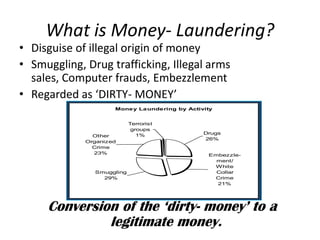
Money Laundering by Activity
Terrorist
groups
1% Drugs
26%
Other
Organized
Crime
23%
Smuggling
29%
Embezzle-
ment/
White
Collar
Crime
21%
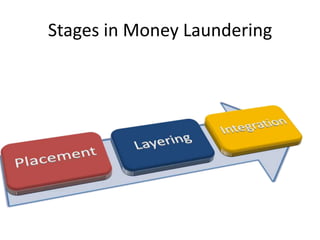
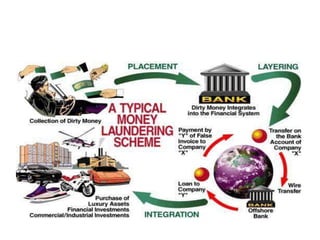
Stages in Money Laundering
Placement: Illegal funds or assets are bought
into the financial system.
Layering: Use of multiple accounts, banks,
intermediaries, corporations, countries etc. to
disguise the origin.
Integration: Funds are made available as
apparently legitimate.
Continuity and Evolution
Early 1990s
Bank-centered
techniques: collection
accounts, loan back
arrangements bank drafts,
money orders and
cashier’s cheques
smurfing
Cash smuggling
Accounts in relatives’
names, shell companies
Hawala, hundi or other
“underground banking”
systems
2010
Wire transfers
New electronic payment
systems
Remittance services and
money exchange services
Assistance from
“Gatekeepers”
Terrorist financing
through non-profit
organizations
Insurance industry,
particularly through
independent insurance
agents
Politically Exposed
Persons (PEPs)
PMLA, 2002
 Came into force with effect from 01st July, 2005
 The Act extend to whole of India except J&K
Object:
To prevent money- laundering, seize the property
with authority, involved in money laundering
Administration:
Directorate of Enforcement of the Department of
Revenue, Ministry of Finance
• Various Rules came into effect from July 2005
– Rules detailing Powers of Director FIU & ED
– Rules detailing the method of attachment of
property, period of retention etc.
– Rules detailing the receipt & management of
confiscated assets
– Rules relating to legal obligations of reporting
entities
According to Section 12
PMLA and the Rules impose obligations on
Banking companies
Financial institutions
Intermediaries of the securities market
To maintain records
furnish information
verify identity of clients
“Banking Company” under PMLA includes:
All nationalized banks, private Indian banks and
private foreign banks
All co-operative banks viz. primary co-operative
banks, state co-operative banks and central (district
level) co-operative banks
State Bank of India and its associates and
subsidiaries
Regional Rural Banks
“Financial Institution” under PMLA includes:
Financial Institutions as defined in Section 45-I
of the RBI Act namely EXIM
Bank, NABARD, NHB, SIDBI, IFCI Ltd., IDFC
Ltd., IIBI Ltd. and TFCI Ltd.
Insurance companies
Hire Purchase companies
Chit fund companies as defined in the Chit
Funds Act.
“Intermediary” under PMLA includes:
Persons registered under Section 12 of the Securities
and Exchange Board of India (SEBI) Act, 1992:
• Stock brokers
• Sub-brokers
• Share transfer agents
• Registrars to issue
• Merchant bankers
• Underwriters
• Portfolio Managers
• Appointment of Principal Officer:
– Every reporting entity shall communicate the
name, designation and address of the Principal
Officer to the Director, FIU-IND
• Furnishing of information by the Principal
Officer:
– furnish the information referred to in the Rules to
the authorities
– retain copy of such information for the purposes
of official record
Obligations of reporting entities
Requirements
Under the Act
Every Broker shall—
(a) maintain a record of all transactions, the nature and
value of which may be prescribed, whether such
transactions comprise of a single transaction or a
series of transactions integrally connected to each
other, and where such series of transactions take
place within a month;
(b) furnish information of transactions referred to in
clause (a) to the Director within such time as may be
prescribed; (i.e. every month)
(c) verify and maintain the records of the identity of all
its clients, in such manner as may be prescribed
(i.e. KYC)
Every broker has to maintain the record of-
• All cash transactions of the value of more than Rs 10
lakh or its equivalent in foreign currency.
• All series of cash transactions integrally connected to
each other which have been valued below Rs 10 lakh
or its equivalent in foreign currency where such
series of transactions take place within one calendar
month.
• All suspicious transactions whether or not made in
cash and including, inter-alia, credits or debits into
from any non monetary account such as DEMAT
account, security account maintained by the
registered intermediary
Suspicion
Transactions
• Funds derived from illegal activities
• Conducted to disguise such funds
• No apparent purpose
• Not the sort of transaction the customer would enter
into
• No reasonable explanation considering the
background and purpose
EXAMPLES:
• Large transactions or patterns
• Clients with links to criminals
• False ID documents or not face to face
• Multiple accounts
• Sudden activity in dormant accounts
• Use of different accounts alternately
Client Identity
• Verify identity of clients:
– Identity of clients
– Current and permanent address
– Nature of business
– Financial status
• Maintain records of the identity of clients for a
period of 10 years from the date of cessation
of the transactions with the client. (Rule 10)
Changes in
Subordinate Legislation
• Reporting entity to maintain records of all
transaction which contain all necessary information
to permit reconstruction of individual transaction …
• Record of receipt by NPOs of value more than Rs 10
lakh to be maintained and reported
• Record of cash transaction to be maintained where
forged or counterfeit currency notes tendered
• No specific mode of maintaining the information
• Period of ten years for retention of records - from
the date of transaction and not from the date of
cessation of the transaction
Legal Obligations &
Guidelines imply
CUSTOMER DUE DILIGENCE
Customer Acceptance -
• Ensure acceptance of only legitimate and bona fide
customers
– Issue of mechanism to verify ID
– Issue of Multiple IDs
– Issue of list of suspects/criminals/unwanted elements
– Awareness and training of staff
Customer Identification-
• Ensure that the customers are properly identified to
understand the risks they may pose.
– Background check of new customer
– Background check of existing clients
– Issue of List of suspects/criminals/unwanted elements
– Awareness and training of staff
Transactions Monitoring-
• Monitor customers accounts and transactions to prevent or
detect illegal activities.
– Issue of Mechanism to verify financial details
– Transactions inconsistent with customers profile (business)
– Unexplained transfers between multiple accounts with no
rationale
– Sudden activity in dormant accounts
Risk Management-
• Implement processes to effectively manage the risks posed by
customers trying to misuse facilities.
– Categorization of customers: high/medium/low risk : a
dynamic concept
– Constant interaction between front desk and the
compliance team required
– Awareness and training of staff
• Set up processes and technology to identify and
report suspicious transactions
– Capture customer details
– Generate alerts
– Collect and analyze additional information
– Decide whether transactions are suspicious
– Ensuring reporting of quality data electronically
• Alignment of people, process and technology
• Confidentiality and Privacy

preventionofmoneylaunderingact2002-131206093709-phpapp01 (1).pdf

  • 1.
    PREVENTION OF MONEYLAUNDERING ACT, 2002
  • 2.
    What is Money-Laundering? • Disguise of illegal origin of money • Smuggling, Drug trafficking, Illegal arms sales, Computer frauds, Embezzlement • Regarded as ‘DIRTY- MONEY’ Conversion of the ‘dirty- money’ to a legitimate money. Money Laundering by Activity Terrorist groups 1% Drugs 26% Other Organized Crime 23% Smuggling 29% Embezzle- ment/ White Collar Crime 21%
  • 3.
    Stages in MoneyLaundering
  • 5.
    Placement: Illegal fundsor assets are bought into the financial system. Layering: Use of multiple accounts, banks, intermediaries, corporations, countries etc. to disguise the origin. Integration: Funds are made available as apparently legitimate.
  • 6.
    Continuity and Evolution Early1990s Bank-centered techniques: collection accounts, loan back arrangements bank drafts, money orders and cashier’s cheques smurfing Cash smuggling Accounts in relatives’ names, shell companies Hawala, hundi or other “underground banking” systems 2010 Wire transfers New electronic payment systems Remittance services and money exchange services Assistance from “Gatekeepers” Terrorist financing through non-profit organizations Insurance industry, particularly through independent insurance agents Politically Exposed Persons (PEPs)
  • 7.
    PMLA, 2002  Cameinto force with effect from 01st July, 2005  The Act extend to whole of India except J&K Object: To prevent money- laundering, seize the property with authority, involved in money laundering Administration: Directorate of Enforcement of the Department of Revenue, Ministry of Finance
  • 8.
    • Various Rulescame into effect from July 2005 – Rules detailing Powers of Director FIU & ED – Rules detailing the method of attachment of property, period of retention etc. – Rules detailing the receipt & management of confiscated assets – Rules relating to legal obligations of reporting entities
  • 9.
    According to Section12 PMLA and the Rules impose obligations on Banking companies Financial institutions Intermediaries of the securities market To maintain records furnish information verify identity of clients
  • 10.
    “Banking Company” underPMLA includes: All nationalized banks, private Indian banks and private foreign banks All co-operative banks viz. primary co-operative banks, state co-operative banks and central (district level) co-operative banks State Bank of India and its associates and subsidiaries Regional Rural Banks
  • 11.
    “Financial Institution” underPMLA includes: Financial Institutions as defined in Section 45-I of the RBI Act namely EXIM Bank, NABARD, NHB, SIDBI, IFCI Ltd., IDFC Ltd., IIBI Ltd. and TFCI Ltd. Insurance companies Hire Purchase companies Chit fund companies as defined in the Chit Funds Act.
  • 12.
    “Intermediary” under PMLAincludes: Persons registered under Section 12 of the Securities and Exchange Board of India (SEBI) Act, 1992: • Stock brokers • Sub-brokers • Share transfer agents • Registrars to issue • Merchant bankers • Underwriters • Portfolio Managers
  • 13.
    • Appointment ofPrincipal Officer: – Every reporting entity shall communicate the name, designation and address of the Principal Officer to the Director, FIU-IND • Furnishing of information by the Principal Officer: – furnish the information referred to in the Rules to the authorities – retain copy of such information for the purposes of official record Obligations of reporting entities
  • 14.
    Requirements Under the Act EveryBroker shall— (a) maintain a record of all transactions, the nature and value of which may be prescribed, whether such transactions comprise of a single transaction or a series of transactions integrally connected to each other, and where such series of transactions take place within a month; (b) furnish information of transactions referred to in clause (a) to the Director within such time as may be prescribed; (i.e. every month) (c) verify and maintain the records of the identity of all its clients, in such manner as may be prescribed (i.e. KYC)
  • 15.
    Every broker hasto maintain the record of- • All cash transactions of the value of more than Rs 10 lakh or its equivalent in foreign currency. • All series of cash transactions integrally connected to each other which have been valued below Rs 10 lakh or its equivalent in foreign currency where such series of transactions take place within one calendar month. • All suspicious transactions whether or not made in cash and including, inter-alia, credits or debits into from any non monetary account such as DEMAT account, security account maintained by the registered intermediary
  • 16.
    Suspicion Transactions • Funds derivedfrom illegal activities • Conducted to disguise such funds • No apparent purpose • Not the sort of transaction the customer would enter into • No reasonable explanation considering the background and purpose
  • 17.
    EXAMPLES: • Large transactionsor patterns • Clients with links to criminals • False ID documents or not face to face • Multiple accounts • Sudden activity in dormant accounts • Use of different accounts alternately
  • 18.
    Client Identity • Verifyidentity of clients: – Identity of clients – Current and permanent address – Nature of business – Financial status • Maintain records of the identity of clients for a period of 10 years from the date of cessation of the transactions with the client. (Rule 10)
  • 19.
    Changes in Subordinate Legislation •Reporting entity to maintain records of all transaction which contain all necessary information to permit reconstruction of individual transaction … • Record of receipt by NPOs of value more than Rs 10 lakh to be maintained and reported • Record of cash transaction to be maintained where forged or counterfeit currency notes tendered • No specific mode of maintaining the information • Period of ten years for retention of records - from the date of transaction and not from the date of cessation of the transaction
  • 20.
    Legal Obligations & Guidelinesimply CUSTOMER DUE DILIGENCE Customer Acceptance - • Ensure acceptance of only legitimate and bona fide customers – Issue of mechanism to verify ID – Issue of Multiple IDs – Issue of list of suspects/criminals/unwanted elements – Awareness and training of staff Customer Identification- • Ensure that the customers are properly identified to understand the risks they may pose. – Background check of new customer – Background check of existing clients – Issue of List of suspects/criminals/unwanted elements – Awareness and training of staff
  • 21.
    Transactions Monitoring- • Monitorcustomers accounts and transactions to prevent or detect illegal activities. – Issue of Mechanism to verify financial details – Transactions inconsistent with customers profile (business) – Unexplained transfers between multiple accounts with no rationale – Sudden activity in dormant accounts Risk Management- • Implement processes to effectively manage the risks posed by customers trying to misuse facilities. – Categorization of customers: high/medium/low risk : a dynamic concept – Constant interaction between front desk and the compliance team required – Awareness and training of staff
  • 22.
    • Set upprocesses and technology to identify and report suspicious transactions – Capture customer details – Generate alerts – Collect and analyze additional information – Decide whether transactions are suspicious – Ensuring reporting of quality data electronically • Alignment of people, process and technology • Confidentiality and Privacy