Presented By:
Mahip Bajracharya
13 June 2021
1
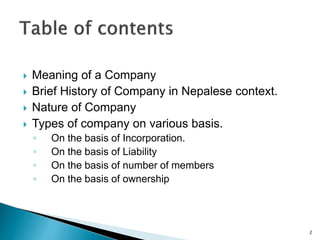
 Meaning of a Company
 Brief History of Company in Nepalese context.
 Nature of Company
 Types of company on various basis.
◦ On the basis of Incorporation.
◦ On the basis of Liability
◦ On the basis of number of members
◦ On the basis of ownership
2
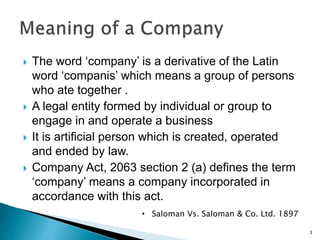
 The word ‘company’ is a derivative of the Latin
word ‘companis’ which means a group of persons
who ate together .
 A legal entity formed by individual or group to
engage in and operate a business
 It is artificial person which is created, operated
and ended by law.
 Company Act, 2063 section 2 (a) defines the term
‘company’ means a company incorporated in
accordance with this act.
3
• Saloman Vs. Saloman & Co. Ltd. 1897
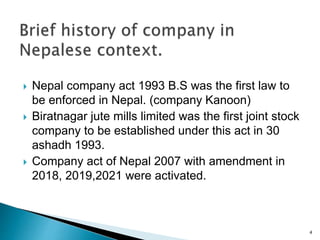
 Nepal company act 1993 B.S was the first law to
be enforced in Nepal. (company Kanoon)
 Biratnagar jute mills limited was the first joint stock
company to be established under this act in 30
ashadh 1993.
 Company act of Nepal 2007 with amendment in
2018, 2019,2021 were activated.
4
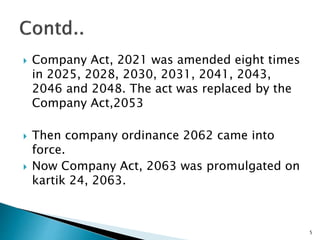
 Company Act, 2021 was amended eight times
in 2025, 2028, 2030, 2031, 2041, 2043,
2046 and 2048. The act was replaced by the
Company Act,2053
 Then company ordinance 2062 came into
force.
 Now Company Act, 2063 was promulgated on
kartik 24, 2063.
5
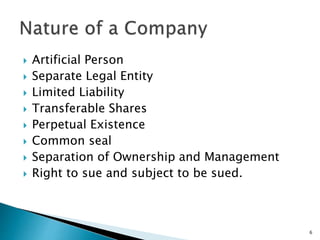
 Artificial Person
 Separate Legal Entity
 Limited Liability
 Transferable Shares
 Perpetual Existence
 Common seal
 Separation of Ownership and Management
 Right to sue and subject to be sued.
6
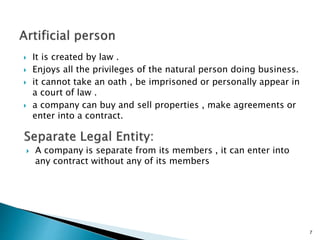
 It is created by law .
 Enjoys all the privileges of the natural person doing business.
 it cannot take an oath , be imprisoned or personally appear in
a court of law .
 a company can buy and sell properties , make agreements or
enter into a contract.
7
 A company is separate from its members , it can enter into
any contract without any of its members
8
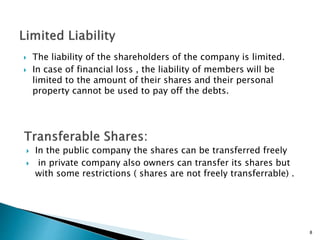
 The liability of the shareholders of the company is limited.
 In case of financial loss , the liability of members will be
limited to the amount of their shares and their personal
property cannot be used to pay off the debts.
 In the public company the shares can be transferred freely
 in private company also owners can transfer its shares but
with some restrictions ( shares are not freely transferrable) .
9
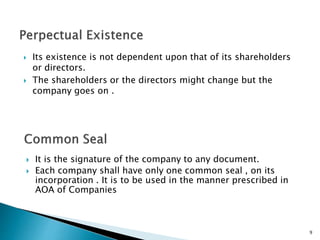
 Its existence is not dependent upon that of its shareholders
or directors.
 The shareholders or the directors might change but the
company goes on .
 It is the signature of the company to any document.
 Each company shall have only one common seal , on its
incorporation . It is to be used in the manner prescribed in
AOA of Companies
10
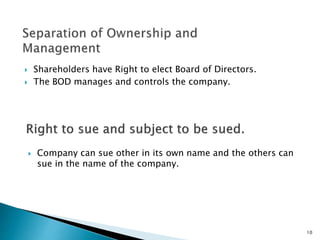
 Shareholders have Right to elect Board of Directors.
 The BOD manages and controls the company.
 Company can sue other in its own name and the others can
sue in the name of the company.
11
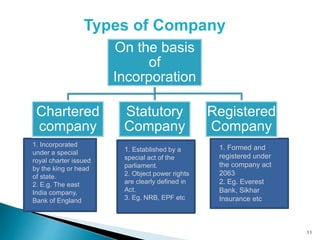
1. Formed and
registered under
the company act
2063
2. Eg. Everest
Bank, Sikhar
Insurance etc
1. Incorporated
under a special
royal charter issued
by the king or head
of state.
2. E.g. The east
India company,
Bank of England
1. Established by a
special act of the
parliament.
2. Object power rights
are clearly defined in
Act.
3. Eg. NRB, EPF etc
On the basis
of
Incorporation
Chartered
company
Statutory
Company
Registered
Company
Types of Company
12
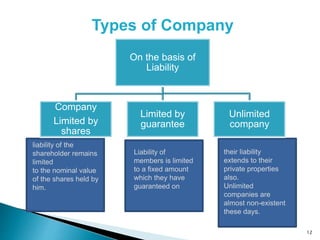
liability of the
shareholder remains
limited
to the nominal value
of the shares held by
him.
their liability
extends to their
private properties
also.
Unlimited
companies are
almost non-existent
these days.
On the basis of
Liability
Company
Limited by
shares
Limited by
guarantee
Unlimited
company
Types of Company
Liability of
members is limited
to a fixed amount
which they have
guaranteed on
13
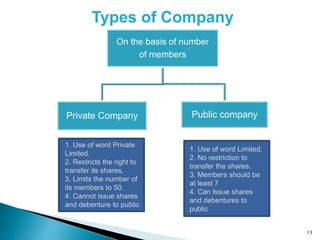
1. Use of word Private
Limited.
2. Restricts the right to
transfer its shares,
3. Limits the number of
its members to 50.
4. Cannot issue shares
and debenture to public
1. Use of word Limited.
2. No restriction to
transfer the shares.
3. Members should be
at least 7
4. Can Issue shares
and debentures to
public
On the basis of number
of members
Private Company Public company
Types of Company
14
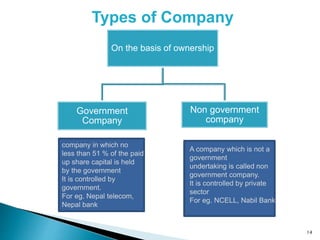
company in which no
less than 51 % of the paid
up share capital is held
by the government
It is controlled by
government.
For eg. Nepal telecom,
Nepal bank
A company which is not a
government
undertaking is called non
government company.
It is controlled by private
sector
For eg. NCELL, Nabil Bank
On the basis of ownership
Government
Company
Non government
company
Types of Company
15
16

company nature and its types

  • 1.
  • 2.
     Meaning ofa Company  Brief History of Company in Nepalese context.  Nature of Company  Types of company on various basis. ◦ On the basis of Incorporation. ◦ On the basis of Liability ◦ On the basis of number of members ◦ On the basis of ownership 2
  • 3.
     The word‘company’ is a derivative of the Latin word ‘companis’ which means a group of persons who ate together .  A legal entity formed by individual or group to engage in and operate a business  It is artificial person which is created, operated and ended by law.  Company Act, 2063 section 2 (a) defines the term ‘company’ means a company incorporated in accordance with this act. 3 • Saloman Vs. Saloman & Co. Ltd. 1897
  • 4.
     Nepal companyact 1993 B.S was the first law to be enforced in Nepal. (company Kanoon)  Biratnagar jute mills limited was the first joint stock company to be established under this act in 30 ashadh 1993.  Company act of Nepal 2007 with amendment in 2018, 2019,2021 were activated. 4
  • 5.
     Company Act,2021 was amended eight times in 2025, 2028, 2030, 2031, 2041, 2043, 2046 and 2048. The act was replaced by the Company Act,2053  Then company ordinance 2062 came into force.  Now Company Act, 2063 was promulgated on kartik 24, 2063. 5
  • 6.
     Artificial Person Separate Legal Entity  Limited Liability  Transferable Shares  Perpetual Existence  Common seal  Separation of Ownership and Management  Right to sue and subject to be sued. 6
  • 7.
     It iscreated by law .  Enjoys all the privileges of the natural person doing business.  it cannot take an oath , be imprisoned or personally appear in a court of law .  a company can buy and sell properties , make agreements or enter into a contract. 7  A company is separate from its members , it can enter into any contract without any of its members
  • 8.
    8  The liabilityof the shareholders of the company is limited.  In case of financial loss , the liability of members will be limited to the amount of their shares and their personal property cannot be used to pay off the debts.  In the public company the shares can be transferred freely  in private company also owners can transfer its shares but with some restrictions ( shares are not freely transferrable) .
  • 9.
    9  Its existenceis not dependent upon that of its shareholders or directors.  The shareholders or the directors might change but the company goes on .  It is the signature of the company to any document.  Each company shall have only one common seal , on its incorporation . It is to be used in the manner prescribed in AOA of Companies
  • 10.
    10  Shareholders haveRight to elect Board of Directors.  The BOD manages and controls the company.  Company can sue other in its own name and the others can sue in the name of the company.
  • 11.
    11 1. Formed and registeredunder the company act 2063 2. Eg. Everest Bank, Sikhar Insurance etc 1. Incorporated under a special royal charter issued by the king or head of state. 2. E.g. The east India company, Bank of England 1. Established by a special act of the parliament. 2. Object power rights are clearly defined in Act. 3. Eg. NRB, EPF etc On the basis of Incorporation Chartered company Statutory Company Registered Company Types of Company
  • 12.
    12 liability of the shareholderremains limited to the nominal value of the shares held by him. their liability extends to their private properties also. Unlimited companies are almost non-existent these days. On the basis of Liability Company Limited by shares Limited by guarantee Unlimited company Types of Company Liability of members is limited to a fixed amount which they have guaranteed on
  • 13.
    13 1. Use ofword Private Limited. 2. Restricts the right to transfer its shares, 3. Limits the number of its members to 50. 4. Cannot issue shares and debenture to public 1. Use of word Limited. 2. No restriction to transfer the shares. 3. Members should be at least 7 4. Can Issue shares and debentures to public On the basis of number of members Private Company Public company Types of Company
  • 14.
    14 company in whichno less than 51 % of the paid up share capital is held by the government It is controlled by government. For eg. Nepal telecom, Nepal bank A company which is not a government undertaking is called non government company. It is controlled by private sector For eg. NCELL, Nabil Bank On the basis of ownership Government Company Non government company Types of Company
  • 15.
  • 16.