
Welcometo
Preventing the Next AvoidableCatastrophe in
Lowand Middle ResourceCountries
The audio for today’s webinar will be coming through
your computer speakers. Please ensure your speakersare
turned on with the volumeup.
Thank you!
Continuing Education Information
ACCREDITATIONSTATEMENTS:
CME: TheCentersfor DiseaseControl and Prevention isaccredited by theAccreditation Council for
Continuing Medical Education (ACCME®)to provide continuing medical education for physicians.
 The Centers for Disease Control and Prevention designates this live activity for a maximum of
(1)AMAPRACategory1Credits™.Physicians should claim only the credit commensurate with the
extent of their participation in the activity.
CNE:The Centers for Disease Control and Prevention is accredited as a provider of Continuing
Nursing Education by the American Nurses Credentialing Center's Commission on Accreditation.
 This activity provides(1) contact hours.
CEU:The Centers for Disease Control and Prevention is authorized by IACETto offer (0.1) CEU's for
this program.
CECH:Sponsored by the Centers for Disease Control and Prevention,a designated provider of continuing
education contact hours (CECH)in health education by the National Commission for Health Education
Credentialing, Inc.This program is designated for Certified Health Education Specialists (CHES)and/or
Master Certified Health Education Specialists (MCHES)to receive up to (1)total Category Icontinuing
education contact hours.Maximum advanced level continuing education contact hours available are 0.
CDCprovider number 98614.
Continuing Education Information
ACCREDITATIONSTATEMENTS:
CPE:TheCentersfor DiseaseControl and Prevention isaccredited by theAccreditation Council
for Pharmacy Education asa provider of continuing pharmacy education.
 This program is a designated event for pharmacists to receive (0.1) Contact Hours in pharmacy
education.The UniversalActivity Number is 0387-0000-16-202-L05-P.
 Category:This activity has been designated as Knowledge-Based.
 Once credit is claimed,an unofficial statement of credit is immediately available on TCEOnline. Official
credit willbe uploaded within 60 days on the NABP/CPEMonitor.
For Certified PublicHealth Professionals(CPH)
 The Centers for Disease Control and Prevention is a pre-approved provider ofCertified in Public Health
(CPH)recertification credits and is authorized to offer (1)CPHrecertification credits for this program.
 CDC is an approved provider of CPH Recertification Credits by the National Board of Public Health
Examiners.Effective October 1,2013,the National Board of Public Health Examiners (NBPHE)accepts
continuing education units (CEU) for CPH recertification credits from CDC. Please select CEUas your
choice for continuing education when registering for a course on TCEOnline. Learners seeking CPH
should use the guidelines provided by the NBPHEfor calculating recertification credits.For assistance
please contact NBPHE at http://www.NBPHE.org.
Continuing Education Disclosure Statement
DISCLOSURE:In compliance with continuing education requirements,all
presenters must disclose any financial or other associations with the
manufacturersof commercial products,suppliersof commercial services,
or commercial supporters as well as any use of unlabeled product(s) or
product(s)under investigational use.
CDC,our planners,presenters,and their spouses/partnerswish to disclose
they have no financial interests or other relationships with the
manufacturersof commercial products,suppliersof commercial services,
or commercial supporters.Planners have reviewed content to ensure
there isno bias.
Content will not include any discussion of the unlabeled useof a product
or a product under investigational use.
CDCdidnot acceptcommercialsupport forthiscontinuing education
activity.
Continuing Education Information
ACTIVITYDESCRIPTION:
Thiswebinar featuresa discussion on healthcare outbreaksfrom a global
perspective.
OBJECTIVES:
 Describe infection control techniques that reduce the risk and spread of
healthcare- associated infections (HAI).
 Identify unsafe practices that place patients at risk for HAIs.
 Describe best practices for infection control and prevention in daily practice in
healthcare settings.
 Apply standards,guidelines,best practices,and established processes related
to safe and effective medication use.
Preventing the Next Avoidable Catastrophe
in Low and Middle ResourceCountries
National Center for Emerging and Zoonotic InfectiousDiseases
Division of Healthcare QualityPromotion
October 18th, 2016
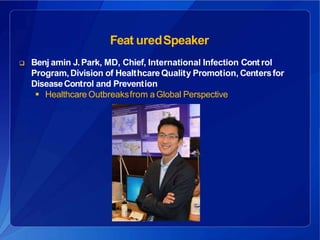
Feat uredSpeaker
 Benj amin J.Park, MD, Chief, International Infection Cont rol
Program,Division of HealthcareQuality Promotion, Centersfor
DiseaseControl and Prevention
 Healthcare Outbreaksfrom a Global Perspective
Before WeGet Started…
 Tosubmit a question:
• Usethe“Chat"window,locatedonthelowerleft-handsideof the
webinarscreen.
• Questionswillbeaddressedat theendof thewebinar,astime
allows.
 Toask for help:
• Pleasepressthe“RaiseHand”button,locatedonthetop left-hand
sideof thescreen.
 Tohear the audio:
• Pleaseensure your speakersare turned on with the volume
up – the audio for today’s conference should be coming
through your computerspeakers.
Thespeakers’slideswill beprovidedto participantsin afollow-up
email.
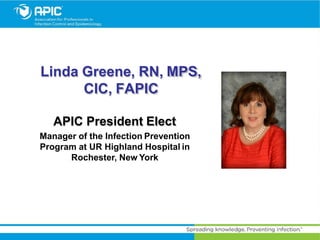
Linda Greene, RN, MPS,
CIC, FAPIC
APIC President Elect
Manager of the Infection Prevention
Program at UR Highland Hospital in
Rochester, New York
International Infection Prevention Week
October 16-22, 2016
• Goal of observance:
– To raises awareness of the role infection prevention plays to
improve patient safety.
– To help healthcare professionals and consumers understand
their role in infection prevention.
www.apic.org/infectionpreventionandyou
2016 Theme: Break the Chain of Infection
Getting involved is easy:
• Download and share the “Break the Chain” infographicfor
healthcare professionals.
• Take the infection prevention pledge.
• Share sample social media posts about infection prevention.
• Send infection prevention eCards.
• Share the infection prevention podcasts.
• Take the polls and quizzes.
Visit www.apic.org/infectionpreventionandyou for more
ways to get involved.
National Center for Emerging and Zoonotic InfectiousDiseases
Preventing the Next Avoidable Catastrophe in Low
and Middle Resource Countries
Benjamin J. Park, MD
Chief, International Infection Control Program
Division of Healthcare QualityPromotion
International Infection Prevention Week
Tuesday, October 18, 2016
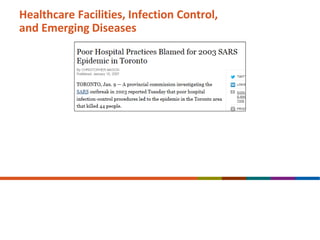
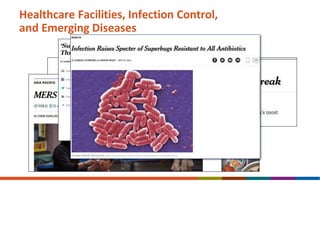
Healthcare Facilities, Infection Control,
and Emerging Diseases
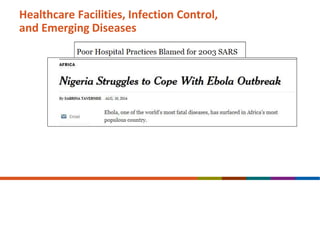
Healthcare Facilities, Infection Control,
and Emerging Diseases
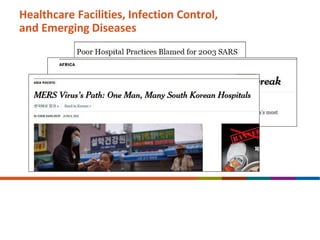
Healthcare Facilities, Infection Control,
and Emerging Diseases
Healthcare Facilities, Infection Control,
and Emerging Diseases
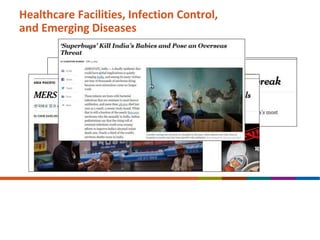
Healthcare Facilities, Infection Control,
and Emerging Diseases
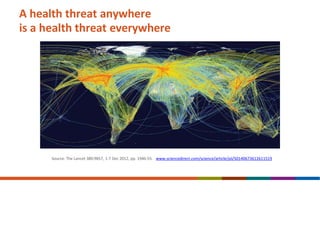
A health threat anywhere
is a health threat everywhere
Source: The Lancet 380:9857, 1-7 Dec 2012, pp. 1946-55. www.sciencedirect.com/science/article/pii/S0140673612611519
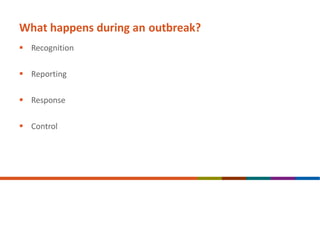
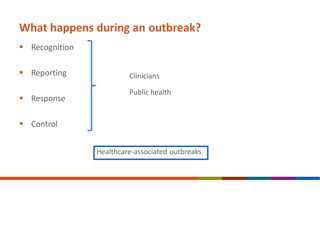
What happens during an outbreak?
 Recognition
 Reporting
 Response
 Control
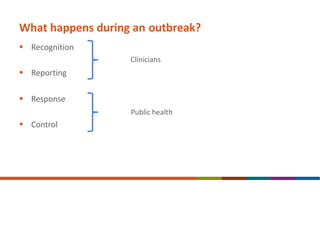
What happens during an outbreak?
 Recognition
Clinicians
 Reporting
 Response
Public health
 Control
What happens during an outbreak?
 Recognition
 Reporting
 Response
 Control
Clinicians
Public health
Healthcare-associated outbreaks
Importance of healthcare facilities in outbreaks
 Key principles of
control of
transmissible
diseases:
– Isolation
– Vaccination
– Medication
prophylaxis
Importance of healthcare facilities in outbreaks
 Key principles of
control of
transmissible
diseases:
– Isolation
– Vaccination
– Medication
prophylaxis
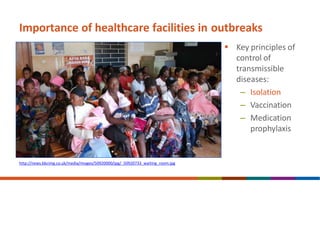
Importance of healthcare facilities in outbreaks
 Key principles of
control of
transmissible
diseases:
– Isolation
– Vaccination
– Medication
prophylaxis
http://news.bbcimg.co.uk/media/images/50920000/jpg/_50920733_waiting_room.jpg
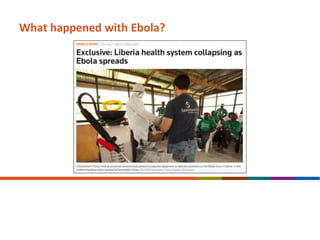
What happened with Ebola?
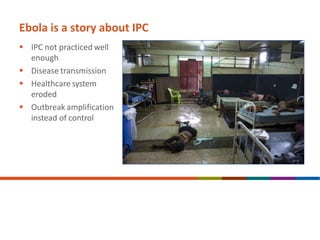
Ebola is a story about IPC
 IPC not practiced well
enough
 Disease transmission
 Healthcare system
eroded
 Outbreak amplification
instead of control
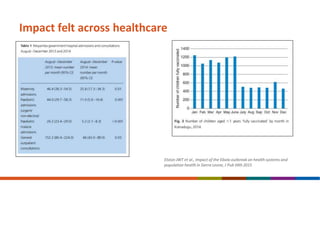
Impact felt across healthcare
Elston JWT et al., Impact of the Ebola outbreak on health systems and
population heatlh in Sierra Leone, J Pub Hlth2015
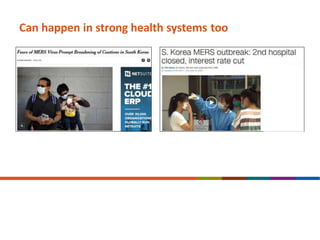
Can happen in strong health systems too
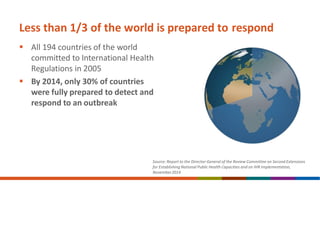
Less than 1/3 of the world is prepared to respond
 All 194 countries of the world
committed to International Health
Regulations in 2005
 By 2014, only 30% of countries
were fully prepared to detect and
respond to an outbreak
Source: Report to the Director-General of the Review Committee on Second Extensions
for Establishing National Public Health Capacities and on IHR Implementation,
November2014
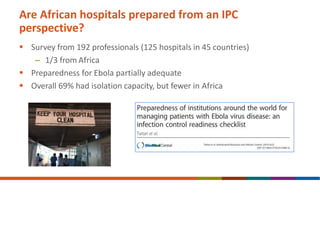
Are African hospitals prepared from an IPC
perspective?
 Survey from 192 professionals (125 hospitals in 45 countries)
– 1/3 from Africa
 Preparedness for Ebola partially adequate
 Overall 69% had isolation capacity, but fewer in Africa
Possible obstacles to healthcare associated outbreak
investigations
 No linkage to public health authorities
 Lack of a dependable laboratory
 Lack of training on outbreak investigation
How do we prepare?
IPC as a priority in low and middle resource countries:
Need for engagement with stakeholders
 Hospitals
 Civil societies
 Professional societies
 Advocacy groups
 Academic groups
 Universities
 Donors
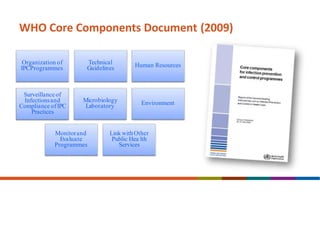
WHO Core Components Document (2009)
Organization of
IPCProgrammes
Technical
Guidelines Human Resources
Surveillance of
Infectionsand
Compliance ofIPC
Practices
Microbiology
Laboratory Environment
Monitorand
Evaluate
Programmes
Link withOther
Public Hea lth
Services
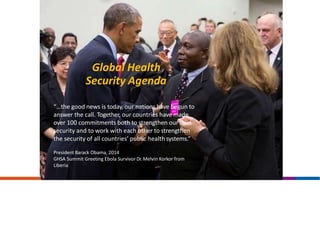
Global Health
Security Agenda
“…the good news is today, our nations have begun to
answer the call. Together, our countries have made
over 100 commitments both to strengthen our own
security and to work with each other to strengthen
the security of all countries’ public health systems.”
President Barack Obama, 2014
GHSA Summit Greeting Ebola Survivor Dr.Melvin Korkor from
Liberia
Global Health Security Agenda
The Global Health Security Agenda (GHSA) was launched in February 2014 to
advance a world safe and secure from infectious disease threats, to bring
together nations from all over the world to make new, concrete commitments,
and to elevate global health security as a national leaders-level priority. The
G7 endorsed the GHSA in June 2014, and Finland and Indonesia hosted
commitment development meetings to spur action in May and August.
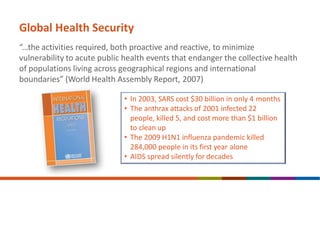
Global Health Security
“...the activities required, both proactive and reactive, to minimize
vulnerability to acute public health events that endanger the collective health
of populations living across geographical regions and international
boundaries” (World Health Assembly Report, 2007)
• In 2003, SARS cost $30 billion in only 4 months
• The anthrax attacks of 2001 infected 22
people, killed 5, and cost more than $1 billion
to clean up
• The 2009 H1N1 influenza pandemic killed
284,000 people in its first year alone
• AIDS spread silently for decades
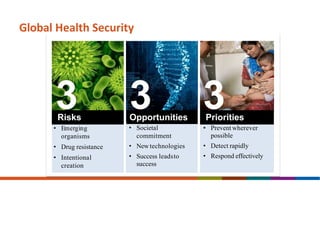
Global Health Security
• Emerging •
organisms
• Drug resistance
• Intentional
creation
Societal
commitment
• Newtechnologies
• Success leadsto
success
• Prevent wherever
possible
• Detect rapidly
• Respond effectively
3 3 3Risks Opportunities Priorities
© David Snyder/CDCFoundation
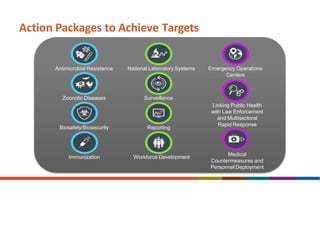
Action Packages to Achieve Targets
Antimicrobial Resistance
Zoonotic Diseases
Biosafety/Biosecurity
Immunization
National Laboratory Systems
Surveillance
Reporting
Workforce Development
Emergency Operations
Centers
Linking Public Health
with Law Enforcement
and Multisectoral
Rapid Response
Medical
Countermeasures and
Personnel Deployment
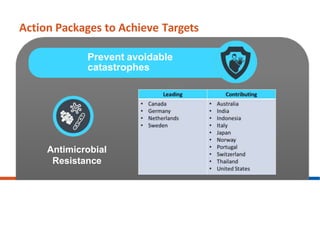
Action Packages to Achieve Targets
Antimicrobial
Resistance
Prevent avoidable
catastrophes
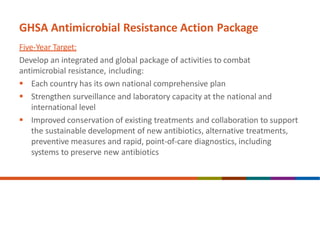
GHSA Antimicrobial Resistance Action Package
Five-Year Target:
Develop an integrated and global package of activities to combat
antimicrobial resistance, including:
 Each country has its own national comprehensive plan
 Strengthen surveillance and laboratory capacity at the national and
international level
 Improved conservation of existing treatments and collaboration to support
the sustainable development of new antibiotics, alternative treatments,
preventive measures and rapid, point-of-care diagnostics, including
systems to preserve new antibiotics
GHSA Antimicrobial Resistance Action Package
As Measured by:
 Number of comprehensive plans to combat antimicrobial resistance
agreed and implemented at a national level, and yearly reporting against
progress towards implementation at the international level
 Number of countries actively participating in a twinning framework, with
countries agreeing to assist other countries in developing and
implementing comprehensive activities to combat antimicrobial
resistance, including use of support provided by international bodies to
improve the monitoring of antimicrobial usage and resistance in humans
and animals.
GHSA Antimicrobial Resistance Action Package
Desired National Impact:
Decisive and comprehensive action to enhance infection prevention and
control activities to prevent the emergence and spread of AMR, especially
among drug-resistant bacteria. Nations will strengthen surveillance and
laboratory capacity, ensure uninterrupted access to essential antibiotics of
assured quality, regulate and promote the rational use of antibiotics in human
medicine and in animal husbandry and other fields as appropriate, and
support existing initiatives to foster innovations in science and technology for
the development of new antimicrobial agents.
CDC in Action
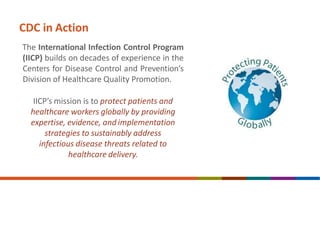
The International Infection Control Program
(IICP) builds on decades of experience in the
Centers for Disease Control and Prevention’s
Division of Healthcare Quality Promotion.
IICP’s mission is to protect patients and
healthcare workers globally by providing
expertise, evidence, and implementation
strategies to sustainably address
infectious disease threats related to
healthcare delivery.
International Infection Control Program:
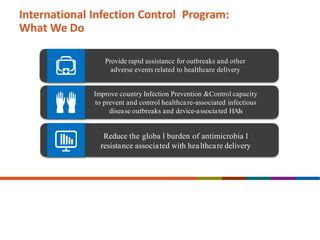
What We Do
Provide rapid assistance for outbreaks and other
adverse events related to healthcare delivery
Improve country Infection Prevention &Control capacity
to prevent and control healthcare-associated infectious
disease outbreaks and device-associated HAIs
Reduce the globa l burden of antimicrobia l
resistance associated with healthcare delivery
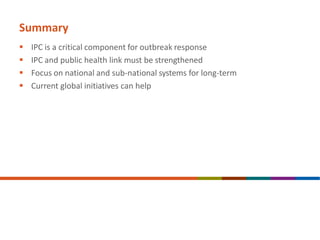
Summary
 IPC is a critical component for outbreak response
 IPC and public health link must be strengthened
 Focus on national and sub-national systems for long-term
 Current global initiatives can help
For more information, contact CDC
1-800-CDC-INFO (232-4636)
TTY: 1-888-232-6348 www.cdc.gov
The findings and conclusions in this report are those of the authors and do not necessarily represent the
official position of the Centers for Disease Control and Prevention.
Thank you!
Before We End Today’sWebinar…
 Quest ion and AnswerSession
 Continuing Education
 Detailed instructions for taking the post-test and evaluation
will appear on your screen assoon astoday’swebinar
concludes.
• www.cdc.gov/tceonline;AccessCode: WC1018
 If you exit out of the webinar prior to taking the post-test and
evaluation,you can accessthe continuing education
information in an email that will be sent to you following
today’swebinar.
THANKYOU

Preventing the Next Avoidable Catastrophe

  • 1.
    Welcometo Preventing the NextAvoidableCatastrophe in Lowand Middle ResourceCountries The audio for today’s webinar will be coming through your computer speakers. Please ensure your speakersare turned on with the volumeup. Thank you!
  • 2.
    Continuing Education Information ACCREDITATIONSTATEMENTS: CME:TheCentersfor DiseaseControl and Prevention isaccredited by theAccreditation Council for Continuing Medical Education (ACCME®)to provide continuing medical education for physicians.  The Centers for Disease Control and Prevention designates this live activity for a maximum of (1)AMAPRACategory1Credits™.Physicians should claim only the credit commensurate with the extent of their participation in the activity. CNE:The Centers for Disease Control and Prevention is accredited as a provider of Continuing Nursing Education by the American Nurses Credentialing Center's Commission on Accreditation.  This activity provides(1) contact hours. CEU:The Centers for Disease Control and Prevention is authorized by IACETto offer (0.1) CEU's for this program. CECH:Sponsored by the Centers for Disease Control and Prevention,a designated provider of continuing education contact hours (CECH)in health education by the National Commission for Health Education Credentialing, Inc.This program is designated for Certified Health Education Specialists (CHES)and/or Master Certified Health Education Specialists (MCHES)to receive up to (1)total Category Icontinuing education contact hours.Maximum advanced level continuing education contact hours available are 0. CDCprovider number 98614.
  • 3.
    Continuing Education Information ACCREDITATIONSTATEMENTS: CPE:TheCentersforDiseaseControl and Prevention isaccredited by theAccreditation Council for Pharmacy Education asa provider of continuing pharmacy education.  This program is a designated event for pharmacists to receive (0.1) Contact Hours in pharmacy education.The UniversalActivity Number is 0387-0000-16-202-L05-P.  Category:This activity has been designated as Knowledge-Based.  Once credit is claimed,an unofficial statement of credit is immediately available on TCEOnline. Official credit willbe uploaded within 60 days on the NABP/CPEMonitor. For Certified PublicHealth Professionals(CPH)  The Centers for Disease Control and Prevention is a pre-approved provider ofCertified in Public Health (CPH)recertification credits and is authorized to offer (1)CPHrecertification credits for this program.  CDC is an approved provider of CPH Recertification Credits by the National Board of Public Health Examiners.Effective October 1,2013,the National Board of Public Health Examiners (NBPHE)accepts continuing education units (CEU) for CPH recertification credits from CDC. Please select CEUas your choice for continuing education when registering for a course on TCEOnline. Learners seeking CPH should use the guidelines provided by the NBPHEfor calculating recertification credits.For assistance please contact NBPHE at http://www.NBPHE.org.
  • 4.
    Continuing Education DisclosureStatement DISCLOSURE:In compliance with continuing education requirements,all presenters must disclose any financial or other associations with the manufacturersof commercial products,suppliersof commercial services, or commercial supporters as well as any use of unlabeled product(s) or product(s)under investigational use. CDC,our planners,presenters,and their spouses/partnerswish to disclose they have no financial interests or other relationships with the manufacturersof commercial products,suppliersof commercial services, or commercial supporters.Planners have reviewed content to ensure there isno bias. Content will not include any discussion of the unlabeled useof a product or a product under investigational use. CDCdidnot acceptcommercialsupport forthiscontinuing education activity.
  • 5.
    Continuing Education Information ACTIVITYDESCRIPTION: Thiswebinarfeaturesa discussion on healthcare outbreaksfrom a global perspective. OBJECTIVES:  Describe infection control techniques that reduce the risk and spread of healthcare- associated infections (HAI).  Identify unsafe practices that place patients at risk for HAIs.  Describe best practices for infection control and prevention in daily practice in healthcare settings.  Apply standards,guidelines,best practices,and established processes related to safe and effective medication use.
  • 6.
    Preventing the NextAvoidable Catastrophe in Low and Middle ResourceCountries National Center for Emerging and Zoonotic InfectiousDiseases Division of Healthcare QualityPromotion October 18th, 2016
  • 7.
    Feat uredSpeaker  Benjamin J.Park, MD, Chief, International Infection Cont rol Program,Division of HealthcareQuality Promotion, Centersfor DiseaseControl and Prevention  Healthcare Outbreaksfrom a Global Perspective
  • 8.
    Before WeGet Started… Tosubmit a question: • Usethe“Chat"window,locatedonthelowerleft-handsideof the webinarscreen. • Questionswillbeaddressedat theendof thewebinar,astime allows.  Toask for help: • Pleasepressthe“RaiseHand”button,locatedonthetop left-hand sideof thescreen.  Tohear the audio: • Pleaseensure your speakersare turned on with the volume up – the audio for today’s conference should be coming through your computerspeakers. Thespeakers’slideswill beprovidedto participantsin afollow-up email.
  • 9.
    Linda Greene, RN,MPS, CIC, FAPIC APIC President Elect Manager of the Infection Prevention Program at UR Highland Hospital in Rochester, New York
  • 10.
    International Infection PreventionWeek October 16-22, 2016 • Goal of observance: – To raises awareness of the role infection prevention plays to improve patient safety. – To help healthcare professionals and consumers understand their role in infection prevention. www.apic.org/infectionpreventionandyou
  • 11.
    2016 Theme: Breakthe Chain of Infection Getting involved is easy: • Download and share the “Break the Chain” infographicfor healthcare professionals. • Take the infection prevention pledge. • Share sample social media posts about infection prevention. • Send infection prevention eCards. • Share the infection prevention podcasts. • Take the polls and quizzes. Visit www.apic.org/infectionpreventionandyou for more ways to get involved.
  • 12.
    National Center forEmerging and Zoonotic InfectiousDiseases Preventing the Next Avoidable Catastrophe in Low and Middle Resource Countries Benjamin J. Park, MD Chief, International Infection Control Program Division of Healthcare QualityPromotion International Infection Prevention Week Tuesday, October 18, 2016
  • 13.
    Healthcare Facilities, InfectionControl, and Emerging Diseases
  • 14.
    Healthcare Facilities, InfectionControl, and Emerging Diseases
  • 15.
    Healthcare Facilities, InfectionControl, and Emerging Diseases
  • 16.
    Healthcare Facilities, InfectionControl, and Emerging Diseases
  • 17.
    Healthcare Facilities, InfectionControl, and Emerging Diseases
  • 18.
    A health threatanywhere is a health threat everywhere Source: The Lancet 380:9857, 1-7 Dec 2012, pp. 1946-55. www.sciencedirect.com/science/article/pii/S0140673612611519
  • 19.
    What happens duringan outbreak?  Recognition  Reporting  Response  Control
  • 20.
    What happens duringan outbreak?  Recognition Clinicians  Reporting  Response Public health  Control
  • 21.
    What happens duringan outbreak?  Recognition  Reporting  Response  Control Clinicians Public health Healthcare-associated outbreaks
  • 22.
    Importance of healthcarefacilities in outbreaks  Key principles of control of transmissible diseases: – Isolation – Vaccination – Medication prophylaxis
  • 23.
    Importance of healthcarefacilities in outbreaks  Key principles of control of transmissible diseases: – Isolation – Vaccination – Medication prophylaxis
  • 24.
    Importance of healthcarefacilities in outbreaks  Key principles of control of transmissible diseases: – Isolation – Vaccination – Medication prophylaxis http://news.bbcimg.co.uk/media/images/50920000/jpg/_50920733_waiting_room.jpg
  • 25.
  • 26.
    Ebola is astory about IPC  IPC not practiced well enough  Disease transmission  Healthcare system eroded  Outbreak amplification instead of control
  • 27.
    Impact felt acrosshealthcare Elston JWT et al., Impact of the Ebola outbreak on health systems and population heatlh in Sierra Leone, J Pub Hlth2015
  • 28.
    Can happen instrong health systems too
  • 29.
    Less than 1/3of the world is prepared to respond  All 194 countries of the world committed to International Health Regulations in 2005  By 2014, only 30% of countries were fully prepared to detect and respond to an outbreak Source: Report to the Director-General of the Review Committee on Second Extensions for Establishing National Public Health Capacities and on IHR Implementation, November2014
  • 30.
    Are African hospitalsprepared from an IPC perspective?  Survey from 192 professionals (125 hospitals in 45 countries) – 1/3 from Africa  Preparedness for Ebola partially adequate  Overall 69% had isolation capacity, but fewer in Africa
  • 31.
    Possible obstacles tohealthcare associated outbreak investigations  No linkage to public health authorities  Lack of a dependable laboratory  Lack of training on outbreak investigation
  • 32.
    How do weprepare?
  • 33.
    IPC as apriority in low and middle resource countries: Need for engagement with stakeholders  Hospitals  Civil societies  Professional societies  Advocacy groups  Academic groups  Universities  Donors
  • 34.
    WHO Core ComponentsDocument (2009) Organization of IPCProgrammes Technical Guidelines Human Resources Surveillance of Infectionsand Compliance ofIPC Practices Microbiology Laboratory Environment Monitorand Evaluate Programmes Link withOther Public Hea lth Services
  • 35.
    Global Health Security Agenda “…thegood news is today, our nations have begun to answer the call. Together, our countries have made over 100 commitments both to strengthen our own security and to work with each other to strengthen the security of all countries’ public health systems.” President Barack Obama, 2014 GHSA Summit Greeting Ebola Survivor Dr.Melvin Korkor from Liberia
  • 36.
    Global Health SecurityAgenda The Global Health Security Agenda (GHSA) was launched in February 2014 to advance a world safe and secure from infectious disease threats, to bring together nations from all over the world to make new, concrete commitments, and to elevate global health security as a national leaders-level priority. The G7 endorsed the GHSA in June 2014, and Finland and Indonesia hosted commitment development meetings to spur action in May and August.
  • 37.
    Global Health Security “...theactivities required, both proactive and reactive, to minimize vulnerability to acute public health events that endanger the collective health of populations living across geographical regions and international boundaries” (World Health Assembly Report, 2007) • In 2003, SARS cost $30 billion in only 4 months • The anthrax attacks of 2001 infected 22 people, killed 5, and cost more than $1 billion to clean up • The 2009 H1N1 influenza pandemic killed 284,000 people in its first year alone • AIDS spread silently for decades
  • 38.
    Global Health Security •Emerging • organisms • Drug resistance • Intentional creation Societal commitment • Newtechnologies • Success leadsto success • Prevent wherever possible • Detect rapidly • Respond effectively 3 3 3Risks Opportunities Priorities © David Snyder/CDCFoundation
  • 39.
    Action Packages toAchieve Targets Antimicrobial Resistance Zoonotic Diseases Biosafety/Biosecurity Immunization National Laboratory Systems Surveillance Reporting Workforce Development Emergency Operations Centers Linking Public Health with Law Enforcement and Multisectoral Rapid Response Medical Countermeasures and Personnel Deployment
  • 40.
    Action Packages toAchieve Targets Antimicrobial Resistance Prevent avoidable catastrophes
  • 41.
    GHSA Antimicrobial ResistanceAction Package Five-Year Target: Develop an integrated and global package of activities to combat antimicrobial resistance, including:  Each country has its own national comprehensive plan  Strengthen surveillance and laboratory capacity at the national and international level  Improved conservation of existing treatments and collaboration to support the sustainable development of new antibiotics, alternative treatments, preventive measures and rapid, point-of-care diagnostics, including systems to preserve new antibiotics
  • 42.
    GHSA Antimicrobial ResistanceAction Package As Measured by:  Number of comprehensive plans to combat antimicrobial resistance agreed and implemented at a national level, and yearly reporting against progress towards implementation at the international level  Number of countries actively participating in a twinning framework, with countries agreeing to assist other countries in developing and implementing comprehensive activities to combat antimicrobial resistance, including use of support provided by international bodies to improve the monitoring of antimicrobial usage and resistance in humans and animals.
  • 43.
    GHSA Antimicrobial ResistanceAction Package Desired National Impact: Decisive and comprehensive action to enhance infection prevention and control activities to prevent the emergence and spread of AMR, especially among drug-resistant bacteria. Nations will strengthen surveillance and laboratory capacity, ensure uninterrupted access to essential antibiotics of assured quality, regulate and promote the rational use of antibiotics in human medicine and in animal husbandry and other fields as appropriate, and support existing initiatives to foster innovations in science and technology for the development of new antimicrobial agents.
  • 44.
    CDC in Action TheInternational Infection Control Program (IICP) builds on decades of experience in the Centers for Disease Control and Prevention’s Division of Healthcare Quality Promotion. IICP’s mission is to protect patients and healthcare workers globally by providing expertise, evidence, and implementation strategies to sustainably address infectious disease threats related to healthcare delivery.
  • 45.
    International Infection ControlProgram: What We Do Provide rapid assistance for outbreaks and other adverse events related to healthcare delivery Improve country Infection Prevention &Control capacity to prevent and control healthcare-associated infectious disease outbreaks and device-associated HAIs Reduce the globa l burden of antimicrobia l resistance associated with healthcare delivery
  • 46.
    Summary  IPC isa critical component for outbreak response  IPC and public health link must be strengthened  Focus on national and sub-national systems for long-term  Current global initiatives can help
  • 47.
    For more information,contact CDC 1-800-CDC-INFO (232-4636) TTY: 1-888-232-6348 www.cdc.gov The findings and conclusions in this report are those of the authors and do not necessarily represent the official position of the Centers for Disease Control and Prevention. Thank you!
  • 48.
    Before We EndToday’sWebinar…  Quest ion and AnswerSession  Continuing Education  Detailed instructions for taking the post-test and evaluation will appear on your screen assoon astoday’swebinar concludes. • www.cdc.gov/tceonline;AccessCode: WC1018  If you exit out of the webinar prior to taking the post-test and evaluation,you can accessthe continuing education information in an email that will be sent to you following today’swebinar. THANKYOU