Global Health Security Agenda
GHSA
http://stm.fi/en/international-cooperation/ghsa
The vision of the GHSA
To attain a world safe and secure from global
health threats posed by infectious diseases
• Infectious disease epidemics pose not only a local health
threat but also an international health security threat
• National multisector cooperation and preparedness are at
the core of effectively combating infectious diseases through
strengthened health systems and preparedness
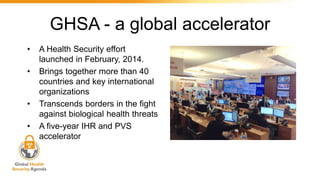
GHSA - a global accelerator
• A Health Security effort
launched in February, 2014.
• Brings together more than 40
countries and key international
organizations
• Transcends borders in the fight
against biological health threats
• A five-year IHR and PVS
accelerator
GHSA - a global accelerator
• Country commitments
• Working through 11 Action
packages
• 10 country Steering Group (SG)
• Finland chairs SG in 2015, in troika
with USA + Indonesia
• Emphasis on cross-sectoral
cooperation
• Working with Non-Governmental
Stakeholders
Country Partners
• Australia, Azerbaijan, Canada, Chile, China,
Denmark,
• Ethiopia, Finland, France, Georgia, Germany,
Guinea,
• India, Indonesia, Israel, Italy, Japan, Jordania,
Kenya, Liberia,
• Malesia, Mexico, The Netherlands, Norway,
Pakistan, Peru,
• Portugal, the Republic of Korea, the Kingdom
of Saudi Arabia, Sierra Leone,
• Singapore, South Africa, Spain, Sweden,
Switzerland,
• Thailand, Turkey, Uganda, Ukraine, UAE, UK,
USA, Vietnam and Yemen
Advisory partners
• WHO, FAO, OIE, Interpol, World Bank and the
European Commission
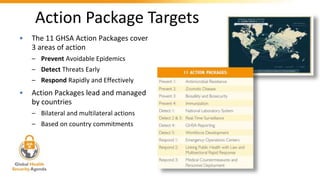
Action Package Targets
• The 11 GHSA Action Packages cover
3 areas of action
– Prevent Avoidable Epidemics
– Detect Threats Early
– Respond Rapidly and Effectively
• Action Packages lead and managed
by countries
– Bilateral and multilateral actions
– Based on country commitments
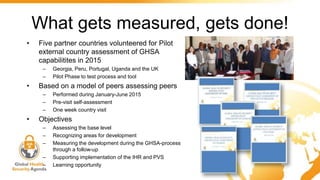
What gets measured, gets done!
• Five partner countries volunteered for Pilot
external country assessment of GHSA
capabilitites in 2015
– Georgia, Peru, Portugal, Uganda and the UK
– Pilot Phase to test process and tool
• Based on a model of peers assessing peers
– Performed during January-June 2015
– Pre-visit self-assessment
– One week country visit
• Objectives
– Assessing the base level
– Recognizing areas for development
– Measuring the development during the GHSA-process
through a follow-up
– Supporting implementation of the IHR and PVS
– Learning opportunity
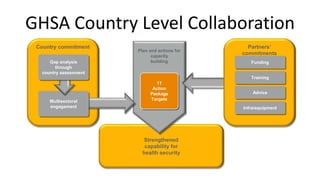
GHSA Country Level Collaboration
Country commitment
Strengthened
capability for
health security
Plan and actions for
capacity
building
11
Action
Package
TargetsMultisectoral
engagement
Partners’
commitments
Funding
Training
Advice
Infra/equipment
Gap analysis
through
country assessment
GHSA effecting change
• Promote political awareness of global
health security as a shared responsibility
• Support International Organizations’ work
on health security
• Support for strengthening health
systems, preparedness capacity building
and enhanced biosafety & biosecurity
• Improved multisectoral collaboration on
health security at all levels
• Redirecting existing resources to better
match country specific and global needs
• Countries committed to taking action
• Develop and share methods of external
peer assessments of national capacity
• Learning opportunities
• Gap analysis > Country Plans
• Reallocation of resources, changing
working methods
• Regional collaboration models
• Collaboration with different Non-
Governmental Stakeholders

GHSA Global Health Security Agenda general presentation

  • 1.
    Global Health SecurityAgenda GHSA http://stm.fi/en/international-cooperation/ghsa
  • 2.
    The vision ofthe GHSA To attain a world safe and secure from global health threats posed by infectious diseases • Infectious disease epidemics pose not only a local health threat but also an international health security threat • National multisector cooperation and preparedness are at the core of effectively combating infectious diseases through strengthened health systems and preparedness
  • 3.
    GHSA - aglobal accelerator • A Health Security effort launched in February, 2014. • Brings together more than 40 countries and key international organizations • Transcends borders in the fight against biological health threats • A five-year IHR and PVS accelerator
  • 4.
    GHSA - aglobal accelerator • Country commitments • Working through 11 Action packages • 10 country Steering Group (SG) • Finland chairs SG in 2015, in troika with USA + Indonesia • Emphasis on cross-sectoral cooperation • Working with Non-Governmental Stakeholders Country Partners • Australia, Azerbaijan, Canada, Chile, China, Denmark, • Ethiopia, Finland, France, Georgia, Germany, Guinea, • India, Indonesia, Israel, Italy, Japan, Jordania, Kenya, Liberia, • Malesia, Mexico, The Netherlands, Norway, Pakistan, Peru, • Portugal, the Republic of Korea, the Kingdom of Saudi Arabia, Sierra Leone, • Singapore, South Africa, Spain, Sweden, Switzerland, • Thailand, Turkey, Uganda, Ukraine, UAE, UK, USA, Vietnam and Yemen Advisory partners • WHO, FAO, OIE, Interpol, World Bank and the European Commission
  • 5.
    Action Package Targets •The 11 GHSA Action Packages cover 3 areas of action – Prevent Avoidable Epidemics – Detect Threats Early – Respond Rapidly and Effectively • Action Packages lead and managed by countries – Bilateral and multilateral actions – Based on country commitments
  • 6.
    What gets measured,gets done! • Five partner countries volunteered for Pilot external country assessment of GHSA capabilitites in 2015 – Georgia, Peru, Portugal, Uganda and the UK – Pilot Phase to test process and tool • Based on a model of peers assessing peers – Performed during January-June 2015 – Pre-visit self-assessment – One week country visit • Objectives – Assessing the base level – Recognizing areas for development – Measuring the development during the GHSA-process through a follow-up – Supporting implementation of the IHR and PVS – Learning opportunity
  • 7.
    GHSA Country LevelCollaboration Country commitment Strengthened capability for health security Plan and actions for capacity building 11 Action Package TargetsMultisectoral engagement Partners’ commitments Funding Training Advice Infra/equipment Gap analysis through country assessment
  • 8.
    GHSA effecting change •Promote political awareness of global health security as a shared responsibility • Support International Organizations’ work on health security • Support for strengthening health systems, preparedness capacity building and enhanced biosafety & biosecurity • Improved multisectoral collaboration on health security at all levels • Redirecting existing resources to better match country specific and global needs • Countries committed to taking action • Develop and share methods of external peer assessments of national capacity • Learning opportunities • Gap analysis > Country Plans • Reallocation of resources, changing working methods • Regional collaboration models • Collaboration with different Non- Governmental Stakeholders