PHYSICAL ACTIVITY PREVALENCE  AND BARRIERS TO PHYSICAL ACTIVITY AMONG YEREVAN ADULT POPULATION (2007) Liana Hakobyan, MD, MPH CRRC Publication Research Fellowship  June, 3 2008
OUTLINE  Introduction Objectives of the study Methodology Results & Discussion  Recommendations Comments, questions
INTRODUCTION Meanwhile, regular  physical activity  provides people of both genders, of all ages and conditions with a wide range of physical, social and mental health  benefits
Physical Activity   Definition Physical activity  -  any bodily movement produced by skeletal muscles that  increases  energy expenditure  Physical fitness  -   set of attributes a person has in regards to  his/her  ability to perform physical activities Exercise  -  repetitive bodily movement done to improve or maintain the components of physical fitness  -  muscular strength,   endurance, flexibility,  as well as  body composition * *Surgeon General
Regular physical activity: Benefits Reduces the risk of:   Cardiovascular Disease Obesity Type II Diabetes mellitus Colon and Breast cancer Fracture / Osteoporosis Mental health disorders (Alzheimer’s disease) Additional benefits  Weight reduction, reduced feelings of stress, improved psychological well-being and physical function, enhanced self-esteem…  The European Health Report  2002 WHO Regional Publications, European Series No. 97
Physical inactivity: Danger 2 million deaths  worldwide annually  Significant contributor to the global burden of  chronic disease   Less healthy pattern of  eating behavior Economic cost:  ◊  higher health care  costs  ( 30%  more  hospital days   &  41%  more  likely annual claims over $5,000 ) ◊  more  absenteeism ◊  value of  future earnings  lost by  premature death Keeler, et al. (1989)  The external cost of a sedentary lifestyle  Am J of PH, 79, 975-981
NEW !!! Health-related benefits could accrue from a minimum of  30 minutes  of  moderate-intensity   activity, such as carrying light loads, brisk walk, bicycling at a regular pace or washing windows, on  most, preferably all, days of the week  American  J  of Sports and Medicine  & General Surgeon Recommendation
Situation in  Armenia Cardiovascular Disease:  morbidity in 2000 - 20.1, while in 2004 - 25.7 (per 1,000) and 58% of all deaths in 2003 Hypertension:   ¼ of adults  (DHS Armenia 2005, WHO 2006) Breast cancer:   the  incidence increased up to 73%, and mortality increased up to 143%  from 1980 to 2000  ( H .  M. G alstyan et al., Short report ;  Archive of Oncology 2003;11(1):31-3 ) Diabetes:   mortality rate increased nearly four-fold from 1981-1998  ( Hovhannisyan, S.G., Tragakes, et al.  Armenia: Health Care Systems in Transition 2001)
Data   on   Armenia H. Armenian et al.  Leninakan-43.3% of cases and 70% of controls active (1988) Hakobyan et al.  – 73% of sedentary lifestyle in Yerevan in 2005 World Vision Armenia & American University of Armenia:  Tashir (Lori marz) and Vardenis (Geghharkunik marz) – 50% of women is sedentary (2004)
Study Aim Prevention of severe diseases directly related to physical inactivity, such as coronary heart disease, diabetes, obesity, colon and breast cancer   Study Objectives Estimation of prevalence of PA among Yerevan 18-65 yr- old adults Identification of groups with escalated health risks due to sedentary life-style  Understanding major barriers to PA Secondary Objectives To reveal the knowledge of target population on benefits of PA and concept of “enough” level  To reveal subjective perception (satisfaction) of people by their level of activity  To identify the current and desired source of information about PA
Dependent Variable: physical activity level   Mode of Measurement Scale 1=Health Enhancing Physical activity level Any of the following two criteria:  -  Vigorous-intensity activity on at least 3 days and accumulating at least 1500 MET-minutes/ week  OR - 7 or more days of any combination of walking, moderate-intensity or vigorous-intensity activities achieving a minimum of at least 3000 MET-minutes/week.  0= Inactive/Minimally active   - No activity is reported  OR - Some activity is reported but not enough to meet category 1  Dichotomous  1=Health Enhancing Physical activity level 0=Inactive/ Minimally active
Independent Variables   Variable Mode of Measurement  Scale 1.  Gender  Dichotomous 1=Female, 0=Male   2.  Age  What was your age on your last birthday?  Continuous  3.  Educational  level  What is your level of education? Ordinal  1= Incomplete / complete secondary  2= College  3=  U niversity/ Postgraduate
Independent Variables (cont.) Variable Mode of Measurement  Scale 4. Income level ( proxy - monthly household expenditures) On average how much money does your household spend monthly? Ordinal  1= Below 35, 000 AMD 2= 35,000 to   70,000  3= 70, 001 to 130 ,   000  4=130 ,  001 to 200 , 000  5 =   More than 200 001 5.  Occupation Are you occupied?  Dichotomous 1=Yes, 0=No 6.  Marital status What is your marital status?  Nominal   1 =  Single 2= Married 3= Divorced  4=Widowed
Methods: 1.  Study Design Cross-sectional  analytical  Population-based telephone survey   Reason: Objectives to achieve  Efficiency in time Efficiency in resources  Limitations:   Inability to provide causal relationship: only test association between variables
Methods: 2. Sampling Probability sampling by  RDD  technique  Sampling unit - telephone number The first two digits are correspond to the area codes (54,56- Kentron ), and the remaining four digits are randomly generated: Ms Excel (Function: =RANDBETWEEN (999, 9999))  Phone numbers are proportionately divided according to the number of 18-65 yr-old people living in each  Hamaynk  (2001 census data)  The method is unrestricted by the problem of missing people with unlisted or new numbers and the sample represents the households from different areas of Yerevan
# Quarter Community  (Hamaynk) # of people aged 18-65 year-old living in  Hamanynk # of people aged 18-65 year-old according to sample size  1 Malatia-Sebastia 93,041 61 2 Nor-Nork 90,848 61 3 Shengavit 87,646 56 4 Arabkir  84,330 51 5 Kentron 82,651 51 6 Erebuni 75,326 46 7 Achapnyak  67,517 41 8 Kanaker-Zeytun 49,567 31 9 Avan 31,403 26 10 Davidashen 26,026 20 11 Nork-Marash 7,078 10 12 Nubarashen 5,783 6 Total  701,216 460
Methods: 3. Study Population Target population -  general population of Yerevan Survey population -  Yerevan adult population Inclusion criteria : residency in Yerevan, age between 18-65 years old at the start of the survey, willingness to participate, and ability to speak Armenian Sample frame  - all telephone households in Yerevan Sample units  were selected by Random Digit Dialing Random selection was used to enroll only one participant per household:  Kish technique  ( “next birthday”  ) to ensure randomization at all stages
Methods: 4. Sample Size Calculation Formula: n=z2*pq/d2 , where p -  proportion of individuals who have the desired characteristic (enough activity level for a healthy lifestyle) q  (1-p)- proportion of those who do not have the desired characteristic  d  - desired level of precision  For 95% CI type I error is α =0.05; Zα= 1.96 (two-sided) Maximum % difference we are willing to accept between true population rate and sample rate is 5%: d = 0.05 To get the maximal sample size, the ratio of active and inactive people is assumed to be 50:50 n = 1.96²*0.5*0.5/0.05²= 384 20% non-response from the previous RDD surveys (1999,2005) the sample size is increased to (384*0.2+384)  460
Methods 5. Data Collection  Phone interviews (September - November 2007) (time period has been selected to control for seasonal variations) Time: during the week-end days and/or in usual working days after 7PM to avoid sampling bias toward non-working people Language: Armenian since 96% of the population speaks the language  Interviewer Training Manual was developed which includes general information about the survey, information about the procedures for gaining cooperation and establishing rapport with respondents Two interviewers previously trained using the Manual
Methods: 6. Study Instrument  International Physical Activity Questionnaire   (short –form) Rationale : ~   Comparable data across countries (designed for  International Prevalence Study ) ~   Reasonable  reliability &  v alidity   ( Spearman’s  Rho : 0.8; criterion validity: median  rho  of  0.3 against the accelerometer) Domains :  1.  screening questions, 2. oral consent form, 3. PA questions (behavior, knowledge, attitude, barriers, motivators), 4. behavioral, health status, demographics Translation, adaptation, pilot testing
Methods 7. Data Coding  Metabolic equivalents  (METs)  were assigned to each activity for categorization  according to three degrees of physical activity – inactive, minimally active and Health Enhancing physical activity level ( www.ipaq.ki.se ) MET is the amount of oxygen used by body as person sits quietly, f.e. talking on the phone, reading a book, i.e. METs represent the ratio of energy expended during a physical activity to the metabolic rate of sitting quietly  For statistical analysis data were recoded to two degrees of physical activity –  1. inactive/minimally   active  and  2. HEPA active   Although minimally active category is more than the minimum level recommended, it is not enough for “total physical activity” when all domains are considered. IPAQ measures total physical activity, but recommendations are based on activity over and above usual daily activities
Calculation of Metabolic Equivalents   TYPE OF ACTIVITY MET AMOUNT Walking 3.3 Moderate intensity activity 4.0 Vigorous intensity activity  8.0 Total MET-min/week = (Walk METs x min x days) + ( Mod METs x min x days) + (Vig METs x min x days) * To calculate the weekly physical activity (MET-hours), we multiplied the number of hours, dedicated to each activity by the specific MET score of each activity.   Ainnsworth et al.  (1993)
Methods: 8. Statistical Analysis  SPSS 11,0 Software Descriptive statistical   analysis -  categorical variables : absolute & relative frequencies  -  continuous variables : mean values ± standard deviation   Stepwise  logistic regression  to assess the association between  physical activity level and sociodemographic indicators &  Chi square   test  to test the association between PA and satisfaction P- values based on two-sided tests and compared to 5% significance level
Methods: 8. Statistical Analysis  (cont.) Three types of logistic regression models:  Model with single variable Model with all variables Model with all variables excluding income The final model is the model with all variables excluding income, since only 64% percent of respondents reported their income, i.e. 36% of data is missing
Ethical Considerations No risk for participants, not sensitive topic  Each interview lasted on average 12 minutes Consent form in Armenian: objectives of the study, its importance, risk/benefit and voluntary nature  Participants were aware that responses were coded and the anonymity of all provided information was insured. Names of the participants were not registered: identifiers were phone numbers, which were not written on the questionnaires.  ID numbers were given to each phone number and were registered in a separate form: Interviewer Report Form  The results of the survey are displayed in an aggregate form.
Results:   1.  Response to the survey Number  Percent  Persons Interviewed (Completed interviews) 369 80% Persons Interviewed (Partial interviews) 0 0 Persons Refused  61 13 Non-reached*  *  people of unknown eligibility who theoretically could be reached during the period of the survey  30 7 Total  460 100
Results: 2. Distribution of Sample Characteristics Characteristics  Category  % of sample representatives Age  Mean ± standard  deviation  39 yrs-old  ± 14 Gender  Male : female  24  : 76 Education  Secondary  19  College  32  University / postgrad  48  Occupation  Unoccupied : occupied 62  : 38  Expenditures  per month (as a  proxy  for income), AMD  < 70,000 8  70,001-130,000 17  130,001-200,000 22 >200,001 17  Marital status  Single 24  Married 69  Divorced 3  Widowed 3
Results: 2. Distribution of Sample Characteristics (cont.) Characteristics  Category  % of sample representatives Health status  Excellent 6  Very good 5  Good 36  Moderate 48  Poor 4  Weight  Too skinny 4  Normal 68  Slightly overweight 23  Overweight 4  Smoking status  Smoking : not smoking 20 : 79  # of cigarettes   Mean ± st. deviation  (range) 20 ± 16  (2-99) # of people in the household  Mean ± st. deviation  (range) 4 ± 2  (1-13)
Results:  3.  Physical Activity Level   Category  of  physical activity Sample  population Inactive /  Minim ally active 53% HEPA active   (Health Enhancing Physical Activity level)  47%
Results: 4. ORs for  Logistic Regression  of association between PA & socio-demographic indicators Single factor model Independent  Variable OR 95% CI p  value 1 Age  0.997 0.983-1.012 0.734 2 Gender  1.082 0.671-1.746 0.747 3 Education 1.403 0.880-2.238 0.155 4 Income level  1.719 0.885-3.338 0.110 5 Occupation*  3.047 1.951-4.758 0.000 6 Marital status*  0.425 0.255-0.710 0.001
Results: 4. ORs for  Logistic Regression  of association between PA & socio-demographic indicators B. Model with all demographic variables Independent  Variable OR 95% CI p  value 1 Age  0.982 0.959-1.006 0.142 2 Gender  0.683 0.341-1.368 0.282 3 Education 0.941 0.484-1.828 0.857 4 Income level  1.719 0.819-3.608 0.152 5 Occupation*  4.078 2.140-7.769 0.000 6 Marital status  2.278 0.967-5.364 0.06
Results: 4. ORs for  Logistic Regression  of association between PA & socio-demographic indicators C. Model with all variables excluding income  Independent  Variable OR 95% CI p  value 1 Age*  0.979 0.960-0.997 0.026 2 Gender  0.716 0.415-1.234 0.229 3 Education 0.995 0.565-1.614 0.864 4 Occupation*  3.324 2.007-5.505 0.000 5 Marital status* 3.369 1.781-6.372 0.000
Results: 5. Knowledge on benefits of physical activity  “Physical activity is beneficial for health” Strongly agree 87% Agree  10% Uncertain 2%  Disagree 1%
Results:  6.   1.  Knowledge  on  the  d iseases  to be prevented  by  PA Disease (Nosology) Spontaneous answer Answer after interviewer clarification YES YES Don’t know NO #   (%) #  (%) #  (%) #  (%) Cardiovascular diseases 90  (24%) 265  (72%) 60  (16%) 24  (7%) Hypertension 46  (13%) 219  (59%) 90  (24%) 39  (11%) Diabetes 8  (2%) 133  (36%) 143  (39%) 73  (20%) Obesity 37  (10%) 294  (80%) 44  (12%) 10  (3%) Colon cancer 2  (1%) 95  (26%) 198  (54%) 55  (15%) Breast cancer 2  (1%) 77  (21%) 204  (55%) 68  (18%)
Results:  6.   2.  Knowledge  on  the  d iseases  to be prevented  by  PA Disease (Nosology) Spontaneous answer Answer after interviewer clarification YES YES Don’t know NO #   (%) #  (%) #  (%) #  (%) Stress 27  (7%) 220  (60%) 87  (24%) 42  (11%) Pneumonia 3  (1%) 80  (22%) 156  (42%) 113  (31%) Tuberculosis 0 37  (10%) 177  (48%) 134  (36%) HIV/AIDS 0 17  (5%) 140  (38%) 192  (52%)
Results:  6. 3.  Knowledge  on  the  d iseases  to be prevented  by  PA Disease (Nosology) Spontaneous answer Answer after interviewer clarification YES YES Don’t know NO #  (%) #  (%) #  (%) #  (%) Osteoporosis 2  (1%) 2  (1%) Arthritis 2  (1%) 29  (8%) Vertebral diseases  6  (2%) Influenza  4  (1%) Metabolic syndrome 2  (1%) Thymus diseases 2  (1%) Muscles diseases 2  (1%) Rheumatic diseases  2  (1%) Bronchitis  1
Results: 7. Knowledge on the concept of “enough” physical activity Only  14%  of participants reported correct amount of physical activity for a healthy lifestyle  Median days reported:  7   Median minutes reported:  60 Correct answer:  30  minutes of moderate activity for  5-7  days per week
Results: 8. Desire to have additional information about physical activity 45%  of participants definitely want to have more information about physical activity 16%  probably want 30%  probably do not want 5%  definitely do not want to have more information about physical activity
Results: 9.  Source of  I nformation about  P hysical  A ctivity: current and desirable  SOURSE Heard about physical activity Want to know about physical activity  #   (%) #  (%) 1 TV  257 70 200 54 2 Radio  76 21 108 29 3 Medical literature 56 15 34 9 4 Physician, medical office  22 6 27 7 5 Newspapers, magazines  57 15 48 13 6 Internet 15 4 25 7 7 Relatives, friends, neighbors 37 10 40 11 8 Workplace 8 2 13 4 9 Brochures 5 1 4 1 10 School, college 4 1 - -
Results 10. Subjective Perception  vs. Objective Level of PA: cross-tabulation Category of activity Inactive/min  active HEPA active Total Satisfaction status No 101 57 158 Yes 93  (48%) 118 (33%) 211  (57%) Total 194 175 369 Pearson Chi-square 15.4   P value  . 000
Results: 11. Desire to be more active 64% of participants reported that they want to practice more activity
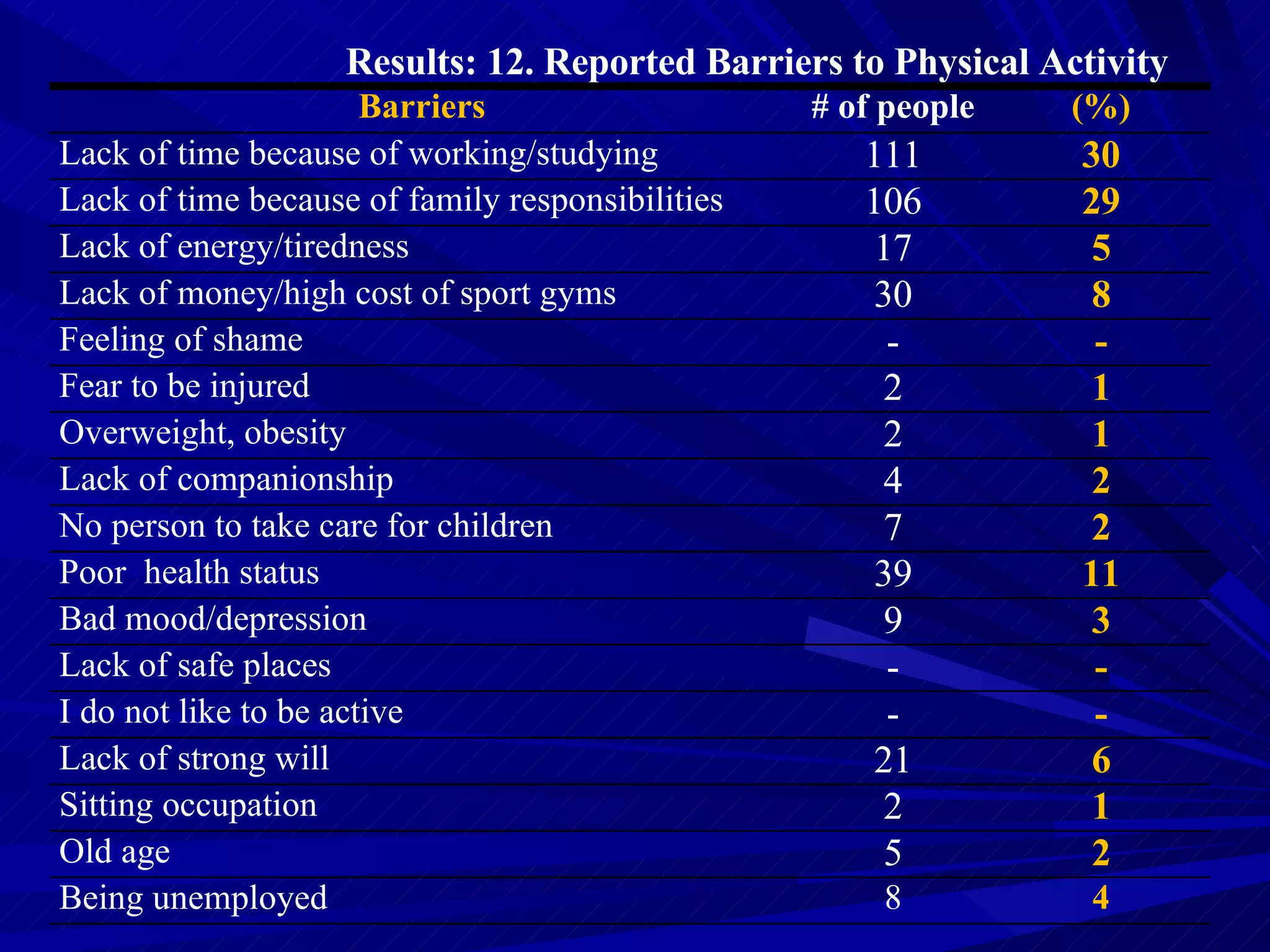
Results: 12. Reported Barriers to Physical Activity Barriers # of people (%) Lack of time because of working/studying 111 30 Lack of time because of family responsibilities 106 29 Lack of energy/tiredness  17 5 Lack of money/high cost of sport gyms 30 8 Feeling of shame - - Fear to be injured 2 1 Overweight, obesity  2 1 Lack of companionship 4 2 No person to take care for children 7 2 Poor  health status 39 11 Bad mood/depression 9 3 Lack of safe places - - I do not like to be active - - Lack of strong will 21 6 Sitting occupation 2 1 Old age  5 2 Being unemployed  8 4
Results: 13.  Motivating  F actors to  P hysical  A ctivity  # FACTOR  Spontaneous  Answer  Answer after Interviewer Clarification #  (%) #  (%) 1 Family member/wife, husband exercising with me 17 5 89 24 2 Friend exercising with me 10 3 86 23 3 Family member/wife, husband encouraging me 9 2 80 22 4 Friend encouraging me 8 2 76 21 5 Employer paying for sport club/gym 11 3 75 20 6 Gym in the workplace 5 2 42 11
Results: 13.  Motivating  F actors to  P hysical  A ctivity  # FACTOR Spontaneous  Answer  Answer after Interviewer Clarification #  (%) #  (%) 7 Flexible working hours 5 1 49 13 8 Advice from a doctor 17 5 123 33 9 Sport club/gym close to home 2 1 37 10 10 Sport club membership 2 1 29 8 11 Person to take care of children 5 1 28 8 12 Availability of inexpensive sport facilities  12 4 13 Availability of green places  2 1
Results: 14. Suggestions:  “ what should be done in your area to motivate people to practice more activity ” Suggestions # of persons answered Create good places (parks) 3 Educate people 4 Establish non-expensive sport facilities 2 Organize meetings with famous sportsmen and sport events 2
Discussion: 1. PA Prevalence  Yerevan, Armenia: 5 3 % sedentary Finland:  8.1%   sedentary Brazil:  41%  sedentary (IPAQ) Greece:  48-53%  sedentary Baltic countries:  43-60%  sedentary USA:  60%  sedentary (leisure-time) Portugal:  60%   France:  50-70%  sedentary (leisure-time) Russia :  73-81%  are sedentary (IPAQ) Conclusion: Yerevan population is more active than US, Portugal, Lithuanian, French, Israel & Russian population & less active than most European countries population, Estonian, Australian, Brazilian and Greek female population
Discussion: 1. PA Prevalence However ! The majority of the mentioned studies assessed not all life domains, but only leisure-time physical activity. We assessed all life domains. From those 47% HEPA active people, 38 (22%) reported jobs requiring heavy physical endeavor: builders, laborers, technicians, etc. Therefore, these people are active as part of their job.  CDC’s recommendations based on the recreational (leisure-time) activity above usual daily activity Conclusion:  the prevalence of sedentary life-style in Armenia is even higher, if only leisure-time activity is taking into consideration.
Discussion: 2. Association between variables & PA:  AGE In  France  meeting the recommended physical activity levels was   more likely in subjects aged 60 years and older A  direc t relationship between PA and age was found also in  Israel In the  US  and  Brazil  the association between physical activity and age was  negative This study  also found  negative  association between age and PA
Discussion: 2. Association between variables & PA:  GENDER Women tend to be  less act i ve  than men in some  European countries, Greece, Australia. In  France  females tend to be  more  active than males.  No  significant association was found between gender and physical activity in  Russia .  This study  also did not found any statistically significant association between physical activity level and gender.
Discussion: 2. Association between variables & PA:  EDUCATION   Physical activity was  inversely  related to educational level in the  US, Israel, Baltic  countries.  Positive  relationship was found between physical activity and education in the pooled  European  data and in  Australia . This stud y did not found any statistically significant association between physical activity level and education.
Discussion: 2. Association between variables & PA:  INCOME Physical activity was  inversely  related to income level in the  US, Israel, & Brazil Positiv e relationship was found between physical activity and income in  Baltic countries, Australia This study  failed to obtain data on association between physical activity level and income, since only 64% of respondents reported their income
Discussion: 2. Association between variables & PA:  MARITAL STATUS Greek  study showed that physically active people were more likely to be unmarried. In  US  the change from a married to a single state did not affect PA relative to remaining married, while the transition from a single to a married state resulted in significant positive changes in PA relative to remaining single. In this study , married individuals are more likely to be active.
Discussion: 2. Association between variables & PA:  OCCUPATION Greek  study showed that physically active people had higher occupation skills In this study  occupied individuals are  more   likely to be active  This finding is probably due to the assessment of all domains physical activity, including work-related
Discussion: 3. Benefits The overwhelming majority of the participants agree that physical activity is beneficial for their health.  The same percentage of American people knows that exercise is beneficial for their health. Although  87%  of surveyed population aware that PA is beneficial for health, only  47%  are HEPA active.
Discussion:  4.Knowledge on the diseases  A very low % of people answered spontaneously that PA is beneficial for CVD (24%), even lower- for hypertension (13%), and for obesity (10%) When the options were read, much more respondents gave right answers  24% of the respondents believe that PA is not beneficial for hypertension, 17%- for CVD, 39%- for diabetes, 54%-for colon cancer, 55% -for breast cancer 22% said that PA is beneficial for the pneumonia, 10%- for the tuberculosis, and 5% - for the HIV/AIDS  Conclusion: there is a lack of concrete knowledge on benefits of physical activity among Yerevan adult population
Discussion: 5. Knowledge on the concept of “enough” activity Only  14%  of the participants reported correct amount of physical activity for a healthy lifestyle  Some respondents reported more extreme amount of daily PA  minutes-120 minutes (22%)  or even  180 minutes (7%) Conclusion: For the majority physical activity sounds as a very intimidating conception
Discussion:  6. Source of information  The majority of the participants heard about PA from  TV and radio .  The disappointing finding of this survey is that only  6%  of people heard about the PA from  physician or medical office More than a half of the participants want to have more information on PA and mostly from the same source  - TV and radio
Discussion: 7. Satisfaction Almost  half  of inactive people are satisfied by the activity they practice  Our findings are consistent with US data, where 52% of the respondents were generally satisfied with the amount of exercise they get, while 58% of them were classified as sedentary In Israel only 17.5% of the sample population considered themselves physically active while in reality being sedentary according to sport intensity calculations Two possible explanations for this unexpected result:  such a question may have sounded unclear to the participants this can be due to the limited knowledge on the concept of “enough” PA level
Discussion: 7. Willingness  The majority of survey sample are willing to expand their level of activity (64%) This is important, since pro-physical activity campaigns should not be tailored to population subgroups apparently unwilling to be active
Discussion: 8. Barriers The main reported barriers: lack of time because of working/studying (30%) & lack of time because of family responsibilities (29%) In Israel: lack of time and/or energy; smoking habits In Baltic countries - lack of time (54%) and laziness (46.7%)  These are types of psychological and behavioral barriers It is not clear, to what extent mentioned barrier “lack of time” is dictated by person’s life circumstances, or by his/her lack of time-management skills While only 4% of the participants reported poor health, 11% mentioned poor health as a barrier to PA
Discussion: 9. Motivators A very low % answered spontaneously to this question, but when the options were read, people became more actively to answer  33% of the respondents would practice more physical activity, if doctor advice them to do it Family member (wife, husband) exercising with, would motivate 24% of respondents; family member/wife, husband encouraging would motivate 22% of respondents Friend, exercising with, would motivate 23%; and friend encouraging would motivate 21% of people 20% of the respondents would practice more exercise if employer pay for the sport club. 13% of the respondents mentioned flexible working hours and 11%-availability of the gym at the workplace. The most important agents are physicians, family and friends, as well as employers
Study Strengths High generalizability: high coverage of Yerevan households by phones – 95%  ( www.armentel.am ) Randomized design: RDD and Kish technique to ensure randomization at all stages High response rate: 80%  Internationally valid and reliable instrument designed for phone interviews
Study Limitations Cross-sectional design Self-reported data  Recall bias Failure to obtain data on Income  Seasonal variations (last 7 days recall) Impossibility to generalize to the whole population of Armenia, especially rural Assessment of all life domains: those who were physically active as part of their job, may bias the study findings
Recommendations: 1. Research  Further research is recommended to assess all life-domains separately, focusing especially on leisure-time activity  Use long-form IPAQ instrument  Exclude those reporting energy expenditure of 10,000 METs or more to avoid measurement error due to over-reporting
Recommendations:   2. Awareness raising Educational programs in different settings  Mass Media programs  Involve politicians, stars Pauses by TV like adds of healthy behavior  Promo actions, campaigns at national level (health walks, health runs), day of activity  “Get active” Brochures with the information on benefits of PA, concept of “enough&quot; activity, ways of overcoming barriers Special calendars and diaries for daily planning
Recommendations:   3. Establishment of environments  Establish attractive and low-cost health clubs  Encourage sport clubs to provide child care facilities, to offer activities for adults and children at the same place and time, to provide special family packages with discount for families and companionships of two or more people Have several attractive sport facilities in each Hamaynk  Promote the use of existing sport facilities: give free advertisement possibilities or provide a discount on advertisement of sport- and fitness-centers, dance clubs, swimming pools, etc.  Create safe and pleasant informal places for people to be active and to increase access to walking and bicycling Construct walking roads with sidewalks and bike lanes, comfortable parks, etc.
Recommendations:   4. P romotion of the activity by employers Encourage employers to give special packages for employees, pay for the sport club Establish ongoing health education program at the workplace  Motivate employers by giving special tax benefits to those organizations which encourage healthy life-style Inform employers  with the report of Surgeon General, according to which workplace physical activity programs can reduce short-term sick leave by 6 to 32%, health care costs by 20-55%, and increase productivity by 2-52%
Recommendations:    5. I mprovement of physicians’ counseling skills Objectively assess physicians’ counseling skills on healthy lifestyle, including physical activity Improve physicians’ counseling practices: - provide GPs, cardiologists and nurses with the additional trainings on healthy-lifestyle counseling, with the evidence based information on the amount, type and duration of physical activity required for maintaining and improving health, with the knowledge, skills and resources to assess current PA level and prescribe appropriate amounts and types of physical activity, based on age, skills, fitness level and health status to prevent injury
Recommendations:   5. I mprovement of physicians’ counseling skills Improve counseling protocols and supervise the compliance with protocols and policy guidelines  Give additional incentives for lifestyle counseling Provide physicians with educational materials to disseminate them among patients Present the results of this study to doctors
Recommendations  Establishment of the network of organizations Monthly newsletters with up-to-date information dedicated to PA Establishment of regular surveillance system to monitor lifestyle factors, collect data on the whole Armenia to have nationally representative data, not limited to the capital city
Programs’ requirements population-based involve multiple sectors and various stakeholders - ministries of health, sport, education, transport and culture; public and private sector groups and NGOs; urban planners and local governments, municipalities  culturally relevant  promote PA in all life settings making use of major sport, health and cultural events be supported at the governmental level.
Conclusion  Improving physical activity practice will bring with it compliance to more healthy dietary patterns as well as to recommended annual health screening; will discourage the use of tobacco, alcohol and drugs, will help to reduce violence, and will promote social interaction and integration Establishing good relationships between environment, behavior, and health, investment of time, energy and money to this will contribute to better health of population and decreased health care costs in the long-term
Acknowledgments Eurasia Partnership Foundation and CRRC CRRC–Armenia staff  Ms. Inessa Asmangulyan and Dr. Levon Dallakyan Ms. Lilit Grigoryan  Dr. Maria Sevoyan
Results:   1.  Response to the survey Two types of RR: based on known eligible respondents and based on known and unknown (estimated) eligible respondents.  1)  RR based on known eligible  respondents RR= # of completed interviews / eligible= # of completed interviews / completed interviews + partial interviews + unavailable for duration + refused to participate = 369/369+0+30+61= 369/460 =  80% 2)  RR based on known and unknown (estimated) eligible respondents Proportion of eligible respondents  = eligible / all screened = completed interviews + partial interviews + unavailable for duration + refused interview + other screened / completed interviews + partial interviews + unavailable for duration + refused interview + other screened + ineligible + business number + refused screening =369+0+30+61+0/369+0+30+61+0+37+46+15=460/558= 0.82 RR= # of completed interviews / eligible = # of completed interviews / completed interviews + partial interviews + unavailable for duration + refused to participate + other screened + refused to screen (estimate) + busy number (estimate) + no answer (estimate)= 369/369+0+30+61+0+15*0.82+26*0.82 +98*0.82 = =369/369+0+30+61+12.3+21.3+80.36 = 369/ 574=  64%

Prevalence of Physical Activity and Barriers to Physical Activity Among Yerevan Adult Population

  • 1.
    PHYSICAL ACTIVITY PREVALENCE AND BARRIERS TO PHYSICAL ACTIVITY AMONG YEREVAN ADULT POPULATION (2007) Liana Hakobyan, MD, MPH CRRC Publication Research Fellowship June, 3 2008
  • 2.
    OUTLINE IntroductionObjectives of the study Methodology Results & Discussion Recommendations Comments, questions
  • 3.
    INTRODUCTION Meanwhile, regular physical activity provides people of both genders, of all ages and conditions with a wide range of physical, social and mental health benefits
  • 4.
    Physical Activity Definition Physical activity - any bodily movement produced by skeletal muscles that increases energy expenditure Physical fitness - set of attributes a person has in regards to his/her ability to perform physical activities Exercise - repetitive bodily movement done to improve or maintain the components of physical fitness - muscular strength, endurance, flexibility, as well as body composition * *Surgeon General
  • 5.
    Regular physical activity:Benefits Reduces the risk of: Cardiovascular Disease Obesity Type II Diabetes mellitus Colon and Breast cancer Fracture / Osteoporosis Mental health disorders (Alzheimer’s disease) Additional benefits Weight reduction, reduced feelings of stress, improved psychological well-being and physical function, enhanced self-esteem… The European Health Report 2002 WHO Regional Publications, European Series No. 97
  • 6.
    Physical inactivity: Danger2 million deaths worldwide annually Significant contributor to the global burden of chronic disease Less healthy pattern of eating behavior Economic cost: ◊ higher health care costs ( 30% more hospital days & 41% more likely annual claims over $5,000 ) ◊ more absenteeism ◊ value of future earnings lost by premature death Keeler, et al. (1989) The external cost of a sedentary lifestyle Am J of PH, 79, 975-981
  • 7.
    NEW !!! Health-relatedbenefits could accrue from a minimum of 30 minutes of moderate-intensity activity, such as carrying light loads, brisk walk, bicycling at a regular pace or washing windows, on most, preferably all, days of the week American J of Sports and Medicine & General Surgeon Recommendation
  • 8.
    Situation in Armenia Cardiovascular Disease: morbidity in 2000 - 20.1, while in 2004 - 25.7 (per 1,000) and 58% of all deaths in 2003 Hypertension: ¼ of adults (DHS Armenia 2005, WHO 2006) Breast cancer: the incidence increased up to 73%, and mortality increased up to 143% from 1980 to 2000 ( H . M. G alstyan et al., Short report ; Archive of Oncology 2003;11(1):31-3 ) Diabetes: mortality rate increased nearly four-fold from 1981-1998 ( Hovhannisyan, S.G., Tragakes, et al. Armenia: Health Care Systems in Transition 2001)
  • 9.
    Data on Armenia H. Armenian et al. Leninakan-43.3% of cases and 70% of controls active (1988) Hakobyan et al. – 73% of sedentary lifestyle in Yerevan in 2005 World Vision Armenia & American University of Armenia: Tashir (Lori marz) and Vardenis (Geghharkunik marz) – 50% of women is sedentary (2004)
  • 10.
    Study Aim Preventionof severe diseases directly related to physical inactivity, such as coronary heart disease, diabetes, obesity, colon and breast cancer Study Objectives Estimation of prevalence of PA among Yerevan 18-65 yr- old adults Identification of groups with escalated health risks due to sedentary life-style Understanding major barriers to PA Secondary Objectives To reveal the knowledge of target population on benefits of PA and concept of “enough” level To reveal subjective perception (satisfaction) of people by their level of activity To identify the current and desired source of information about PA
  • 11.
    Dependent Variable: physicalactivity level Mode of Measurement Scale 1=Health Enhancing Physical activity level Any of the following two criteria: - Vigorous-intensity activity on at least 3 days and accumulating at least 1500 MET-minutes/ week OR - 7 or more days of any combination of walking, moderate-intensity or vigorous-intensity activities achieving a minimum of at least 3000 MET-minutes/week. 0= Inactive/Minimally active - No activity is reported OR - Some activity is reported but not enough to meet category 1 Dichotomous 1=Health Enhancing Physical activity level 0=Inactive/ Minimally active
  • 12.
    Independent Variables Variable Mode of Measurement Scale 1. Gender Dichotomous 1=Female, 0=Male 2. Age What was your age on your last birthday? Continuous 3. Educational level What is your level of education? Ordinal 1= Incomplete / complete secondary 2= College 3= U niversity/ Postgraduate
  • 13.
    Independent Variables (cont.)Variable Mode of Measurement Scale 4. Income level ( proxy - monthly household expenditures) On average how much money does your household spend monthly? Ordinal 1= Below 35, 000 AMD 2= 35,000 to 70,000 3= 70, 001 to 130 ,   000 4=130 , 001 to 200 , 000 5 = More than 200 001 5. Occupation Are you occupied? Dichotomous 1=Yes, 0=No 6. Marital status What is your marital status? Nominal 1 = Single 2= Married 3= Divorced 4=Widowed
  • 14.
    Methods: 1. Study Design Cross-sectional analytical Population-based telephone survey Reason: Objectives to achieve Efficiency in time Efficiency in resources Limitations: Inability to provide causal relationship: only test association between variables
  • 15.
    Methods: 2. SamplingProbability sampling by RDD technique Sampling unit - telephone number The first two digits are correspond to the area codes (54,56- Kentron ), and the remaining four digits are randomly generated: Ms Excel (Function: =RANDBETWEEN (999, 9999)) Phone numbers are proportionately divided according to the number of 18-65 yr-old people living in each Hamaynk (2001 census data) The method is unrestricted by the problem of missing people with unlisted or new numbers and the sample represents the households from different areas of Yerevan
  • 16.
    # Quarter Community (Hamaynk) # of people aged 18-65 year-old living in Hamanynk # of people aged 18-65 year-old according to sample size 1 Malatia-Sebastia 93,041 61 2 Nor-Nork 90,848 61 3 Shengavit 87,646 56 4 Arabkir 84,330 51 5 Kentron 82,651 51 6 Erebuni 75,326 46 7 Achapnyak 67,517 41 8 Kanaker-Zeytun 49,567 31 9 Avan 31,403 26 10 Davidashen 26,026 20 11 Nork-Marash 7,078 10 12 Nubarashen 5,783 6 Total 701,216 460
  • 17.
    Methods: 3. StudyPopulation Target population - general population of Yerevan Survey population - Yerevan adult population Inclusion criteria : residency in Yerevan, age between 18-65 years old at the start of the survey, willingness to participate, and ability to speak Armenian Sample frame - all telephone households in Yerevan Sample units were selected by Random Digit Dialing Random selection was used to enroll only one participant per household: Kish technique ( “next birthday” ) to ensure randomization at all stages
  • 18.
    Methods: 4. SampleSize Calculation Formula: n=z2*pq/d2 , where p - proportion of individuals who have the desired characteristic (enough activity level for a healthy lifestyle) q (1-p)- proportion of those who do not have the desired characteristic d - desired level of precision For 95% CI type I error is α =0.05; Zα= 1.96 (two-sided) Maximum % difference we are willing to accept between true population rate and sample rate is 5%: d = 0.05 To get the maximal sample size, the ratio of active and inactive people is assumed to be 50:50 n = 1.96²*0.5*0.5/0.05²= 384 20% non-response from the previous RDD surveys (1999,2005) the sample size is increased to (384*0.2+384) 460
  • 19.
    Methods 5. DataCollection Phone interviews (September - November 2007) (time period has been selected to control for seasonal variations) Time: during the week-end days and/or in usual working days after 7PM to avoid sampling bias toward non-working people Language: Armenian since 96% of the population speaks the language Interviewer Training Manual was developed which includes general information about the survey, information about the procedures for gaining cooperation and establishing rapport with respondents Two interviewers previously trained using the Manual
  • 20.
    Methods: 6. StudyInstrument International Physical Activity Questionnaire (short –form) Rationale : ~ Comparable data across countries (designed for International Prevalence Study ) ~ Reasonable reliability & v alidity ( Spearman’s Rho : 0.8; criterion validity: median rho of 0.3 against the accelerometer) Domains : 1. screening questions, 2. oral consent form, 3. PA questions (behavior, knowledge, attitude, barriers, motivators), 4. behavioral, health status, demographics Translation, adaptation, pilot testing
  • 21.
    Methods 7. DataCoding Metabolic equivalents (METs) were assigned to each activity for categorization according to three degrees of physical activity – inactive, minimally active and Health Enhancing physical activity level ( www.ipaq.ki.se ) MET is the amount of oxygen used by body as person sits quietly, f.e. talking on the phone, reading a book, i.e. METs represent the ratio of energy expended during a physical activity to the metabolic rate of sitting quietly For statistical analysis data were recoded to two degrees of physical activity – 1. inactive/minimally active and 2. HEPA active Although minimally active category is more than the minimum level recommended, it is not enough for “total physical activity” when all domains are considered. IPAQ measures total physical activity, but recommendations are based on activity over and above usual daily activities
  • 22.
    Calculation of MetabolicEquivalents TYPE OF ACTIVITY MET AMOUNT Walking 3.3 Moderate intensity activity 4.0 Vigorous intensity activity 8.0 Total MET-min/week = (Walk METs x min x days) + ( Mod METs x min x days) + (Vig METs x min x days) * To calculate the weekly physical activity (MET-hours), we multiplied the number of hours, dedicated to each activity by the specific MET score of each activity. Ainnsworth et al. (1993)
  • 23.
    Methods: 8. StatisticalAnalysis SPSS 11,0 Software Descriptive statistical analysis - categorical variables : absolute & relative frequencies - continuous variables : mean values ± standard deviation Stepwise logistic regression to assess the association between physical activity level and sociodemographic indicators & Chi square test to test the association between PA and satisfaction P- values based on two-sided tests and compared to 5% significance level
  • 24.
    Methods: 8. StatisticalAnalysis (cont.) Three types of logistic regression models: Model with single variable Model with all variables Model with all variables excluding income The final model is the model with all variables excluding income, since only 64% percent of respondents reported their income, i.e. 36% of data is missing
  • 25.
    Ethical Considerations Norisk for participants, not sensitive topic Each interview lasted on average 12 minutes Consent form in Armenian: objectives of the study, its importance, risk/benefit and voluntary nature Participants were aware that responses were coded and the anonymity of all provided information was insured. Names of the participants were not registered: identifiers were phone numbers, which were not written on the questionnaires. ID numbers were given to each phone number and were registered in a separate form: Interviewer Report Form The results of the survey are displayed in an aggregate form.
  • 26.
    Results: 1. Response to the survey Number Percent Persons Interviewed (Completed interviews) 369 80% Persons Interviewed (Partial interviews) 0 0 Persons Refused 61 13 Non-reached* * people of unknown eligibility who theoretically could be reached during the period of the survey 30 7 Total 460 100
  • 27.
    Results: 2. Distributionof Sample Characteristics Characteristics Category % of sample representatives Age Mean ± standard deviation 39 yrs-old ± 14 Gender Male : female 24 : 76 Education Secondary 19 College 32 University / postgrad 48 Occupation Unoccupied : occupied 62 : 38 Expenditures per month (as a proxy for income), AMD < 70,000 8 70,001-130,000 17 130,001-200,000 22 >200,001 17 Marital status Single 24 Married 69 Divorced 3 Widowed 3
  • 28.
    Results: 2. Distributionof Sample Characteristics (cont.) Characteristics Category % of sample representatives Health status Excellent 6 Very good 5 Good 36 Moderate 48 Poor 4 Weight Too skinny 4 Normal 68 Slightly overweight 23 Overweight 4 Smoking status Smoking : not smoking 20 : 79 # of cigarettes Mean ± st. deviation (range) 20 ± 16 (2-99) # of people in the household Mean ± st. deviation (range) 4 ± 2 (1-13)
  • 29.
    Results: 3. Physical Activity Level Category of physical activity Sample population Inactive / Minim ally active 53% HEPA active (Health Enhancing Physical Activity level) 47%
  • 30.
    Results: 4. ORsfor Logistic Regression of association between PA & socio-demographic indicators Single factor model Independent Variable OR 95% CI p value 1 Age 0.997 0.983-1.012 0.734 2 Gender 1.082 0.671-1.746 0.747 3 Education 1.403 0.880-2.238 0.155 4 Income level 1.719 0.885-3.338 0.110 5 Occupation* 3.047 1.951-4.758 0.000 6 Marital status* 0.425 0.255-0.710 0.001
  • 31.
    Results: 4. ORsfor Logistic Regression of association between PA & socio-demographic indicators B. Model with all demographic variables Independent Variable OR 95% CI p value 1 Age 0.982 0.959-1.006 0.142 2 Gender 0.683 0.341-1.368 0.282 3 Education 0.941 0.484-1.828 0.857 4 Income level 1.719 0.819-3.608 0.152 5 Occupation* 4.078 2.140-7.769 0.000 6 Marital status 2.278 0.967-5.364 0.06
  • 32.
    Results: 4. ORsfor Logistic Regression of association between PA & socio-demographic indicators C. Model with all variables excluding income Independent Variable OR 95% CI p value 1 Age* 0.979 0.960-0.997 0.026 2 Gender 0.716 0.415-1.234 0.229 3 Education 0.995 0.565-1.614 0.864 4 Occupation* 3.324 2.007-5.505 0.000 5 Marital status* 3.369 1.781-6.372 0.000
  • 33.
    Results: 5. Knowledgeon benefits of physical activity “Physical activity is beneficial for health” Strongly agree 87% Agree 10% Uncertain 2% Disagree 1%
  • 34.
    Results: 6. 1. Knowledge on the d iseases to be prevented by PA Disease (Nosology) Spontaneous answer Answer after interviewer clarification YES YES Don’t know NO # (%) # (%) # (%) # (%) Cardiovascular diseases 90 (24%) 265 (72%) 60 (16%) 24 (7%) Hypertension 46 (13%) 219 (59%) 90 (24%) 39 (11%) Diabetes 8 (2%) 133 (36%) 143 (39%) 73 (20%) Obesity 37 (10%) 294 (80%) 44 (12%) 10 (3%) Colon cancer 2 (1%) 95 (26%) 198 (54%) 55 (15%) Breast cancer 2 (1%) 77 (21%) 204 (55%) 68 (18%)
  • 35.
    Results: 6. 2. Knowledge on the d iseases to be prevented by PA Disease (Nosology) Spontaneous answer Answer after interviewer clarification YES YES Don’t know NO # (%) # (%) # (%) # (%) Stress 27 (7%) 220 (60%) 87 (24%) 42 (11%) Pneumonia 3 (1%) 80 (22%) 156 (42%) 113 (31%) Tuberculosis 0 37 (10%) 177 (48%) 134 (36%) HIV/AIDS 0 17 (5%) 140 (38%) 192 (52%)
  • 36.
    Results: 6.3. Knowledge on the d iseases to be prevented by PA Disease (Nosology) Spontaneous answer Answer after interviewer clarification YES YES Don’t know NO # (%) # (%) # (%) # (%) Osteoporosis 2 (1%) 2 (1%) Arthritis 2 (1%) 29 (8%) Vertebral diseases 6 (2%) Influenza 4 (1%) Metabolic syndrome 2 (1%) Thymus diseases 2 (1%) Muscles diseases 2 (1%) Rheumatic diseases 2 (1%) Bronchitis 1
  • 37.
    Results: 7. Knowledgeon the concept of “enough” physical activity Only 14% of participants reported correct amount of physical activity for a healthy lifestyle Median days reported: 7 Median minutes reported: 60 Correct answer: 30 minutes of moderate activity for 5-7 days per week
  • 38.
    Results: 8. Desireto have additional information about physical activity 45% of participants definitely want to have more information about physical activity 16% probably want 30% probably do not want 5% definitely do not want to have more information about physical activity
  • 39.
    Results: 9. Source of I nformation about P hysical A ctivity: current and desirable SOURSE Heard about physical activity Want to know about physical activity # (%) # (%) 1 TV 257 70 200 54 2 Radio 76 21 108 29 3 Medical literature 56 15 34 9 4 Physician, medical office 22 6 27 7 5 Newspapers, magazines 57 15 48 13 6 Internet 15 4 25 7 7 Relatives, friends, neighbors 37 10 40 11 8 Workplace 8 2 13 4 9 Brochures 5 1 4 1 10 School, college 4 1 - -
  • 40.
    Results 10. SubjectivePerception vs. Objective Level of PA: cross-tabulation Category of activity Inactive/min active HEPA active Total Satisfaction status No 101 57 158 Yes 93 (48%) 118 (33%) 211 (57%) Total 194 175 369 Pearson Chi-square 15.4 P value . 000
  • 41.
    Results: 11. Desireto be more active 64% of participants reported that they want to practice more activity
  • 42.
    Results: 12. ReportedBarriers to Physical Activity Barriers # of people (%) Lack of time because of working/studying 111 30 Lack of time because of family responsibilities 106 29 Lack of energy/tiredness 17 5 Lack of money/high cost of sport gyms 30 8 Feeling of shame - - Fear to be injured 2 1 Overweight, obesity 2 1 Lack of companionship 4 2 No person to take care for children 7 2 Poor health status 39 11 Bad mood/depression 9 3 Lack of safe places - - I do not like to be active - - Lack of strong will 21 6 Sitting occupation 2 1 Old age 5 2 Being unemployed 8 4
  • 43.
    Results: 13. Motivating F actors to P hysical A ctivity # FACTOR Spontaneous Answer Answer after Interviewer Clarification # (%) # (%) 1 Family member/wife, husband exercising with me 17 5 89 24 2 Friend exercising with me 10 3 86 23 3 Family member/wife, husband encouraging me 9 2 80 22 4 Friend encouraging me 8 2 76 21 5 Employer paying for sport club/gym 11 3 75 20 6 Gym in the workplace 5 2 42 11
  • 44.
    Results: 13. Motivating F actors to P hysical A ctivity # FACTOR Spontaneous Answer Answer after Interviewer Clarification # (%) # (%) 7 Flexible working hours 5 1 49 13 8 Advice from a doctor 17 5 123 33 9 Sport club/gym close to home 2 1 37 10 10 Sport club membership 2 1 29 8 11 Person to take care of children 5 1 28 8 12 Availability of inexpensive sport facilities 12 4 13 Availability of green places 2 1
  • 45.
    Results: 14. Suggestions: “ what should be done in your area to motivate people to practice more activity ” Suggestions # of persons answered Create good places (parks) 3 Educate people 4 Establish non-expensive sport facilities 2 Organize meetings with famous sportsmen and sport events 2
  • 46.
    Discussion: 1. PAPrevalence Yerevan, Armenia: 5 3 % sedentary Finland: 8.1% sedentary Brazil: 41% sedentary (IPAQ) Greece: 48-53% sedentary Baltic countries: 43-60% sedentary USA: 60% sedentary (leisure-time) Portugal: 60% France: 50-70% sedentary (leisure-time) Russia : 73-81% are sedentary (IPAQ) Conclusion: Yerevan population is more active than US, Portugal, Lithuanian, French, Israel & Russian population & less active than most European countries population, Estonian, Australian, Brazilian and Greek female population
  • 47.
    Discussion: 1. PAPrevalence However ! The majority of the mentioned studies assessed not all life domains, but only leisure-time physical activity. We assessed all life domains. From those 47% HEPA active people, 38 (22%) reported jobs requiring heavy physical endeavor: builders, laborers, technicians, etc. Therefore, these people are active as part of their job. CDC’s recommendations based on the recreational (leisure-time) activity above usual daily activity Conclusion: the prevalence of sedentary life-style in Armenia is even higher, if only leisure-time activity is taking into consideration.
  • 48.
    Discussion: 2. Associationbetween variables & PA: AGE In France meeting the recommended physical activity levels was more likely in subjects aged 60 years and older A direc t relationship between PA and age was found also in Israel In the US and Brazil the association between physical activity and age was negative This study also found negative association between age and PA
  • 49.
    Discussion: 2. Associationbetween variables & PA: GENDER Women tend to be less act i ve than men in some European countries, Greece, Australia. In France females tend to be more active than males. No significant association was found between gender and physical activity in Russia . This study also did not found any statistically significant association between physical activity level and gender.
  • 50.
    Discussion: 2. Associationbetween variables & PA: EDUCATION Physical activity was inversely related to educational level in the US, Israel, Baltic countries. Positive relationship was found between physical activity and education in the pooled European data and in Australia . This stud y did not found any statistically significant association between physical activity level and education.
  • 51.
    Discussion: 2. Associationbetween variables & PA: INCOME Physical activity was inversely related to income level in the US, Israel, & Brazil Positiv e relationship was found between physical activity and income in Baltic countries, Australia This study failed to obtain data on association between physical activity level and income, since only 64% of respondents reported their income
  • 52.
    Discussion: 2. Associationbetween variables & PA: MARITAL STATUS Greek study showed that physically active people were more likely to be unmarried. In US the change from a married to a single state did not affect PA relative to remaining married, while the transition from a single to a married state resulted in significant positive changes in PA relative to remaining single. In this study , married individuals are more likely to be active.
  • 53.
    Discussion: 2. Associationbetween variables & PA: OCCUPATION Greek study showed that physically active people had higher occupation skills In this study occupied individuals are more likely to be active This finding is probably due to the assessment of all domains physical activity, including work-related
  • 54.
    Discussion: 3. BenefitsThe overwhelming majority of the participants agree that physical activity is beneficial for their health. The same percentage of American people knows that exercise is beneficial for their health. Although 87% of surveyed population aware that PA is beneficial for health, only 47% are HEPA active.
  • 55.
    Discussion: 4.Knowledgeon the diseases A very low % of people answered spontaneously that PA is beneficial for CVD (24%), even lower- for hypertension (13%), and for obesity (10%) When the options were read, much more respondents gave right answers 24% of the respondents believe that PA is not beneficial for hypertension, 17%- for CVD, 39%- for diabetes, 54%-for colon cancer, 55% -for breast cancer 22% said that PA is beneficial for the pneumonia, 10%- for the tuberculosis, and 5% - for the HIV/AIDS Conclusion: there is a lack of concrete knowledge on benefits of physical activity among Yerevan adult population
  • 56.
    Discussion: 5. Knowledgeon the concept of “enough” activity Only 14% of the participants reported correct amount of physical activity for a healthy lifestyle Some respondents reported more extreme amount of daily PA minutes-120 minutes (22%) or even 180 minutes (7%) Conclusion: For the majority physical activity sounds as a very intimidating conception
  • 57.
    Discussion: 6.Source of information The majority of the participants heard about PA from TV and radio . The disappointing finding of this survey is that only 6% of people heard about the PA from physician or medical office More than a half of the participants want to have more information on PA and mostly from the same source - TV and radio
  • 58.
    Discussion: 7. SatisfactionAlmost half of inactive people are satisfied by the activity they practice Our findings are consistent with US data, where 52% of the respondents were generally satisfied with the amount of exercise they get, while 58% of them were classified as sedentary In Israel only 17.5% of the sample population considered themselves physically active while in reality being sedentary according to sport intensity calculations Two possible explanations for this unexpected result: such a question may have sounded unclear to the participants this can be due to the limited knowledge on the concept of “enough” PA level
  • 59.
    Discussion: 7. Willingness The majority of survey sample are willing to expand their level of activity (64%) This is important, since pro-physical activity campaigns should not be tailored to population subgroups apparently unwilling to be active
  • 60.
    Discussion: 8. BarriersThe main reported barriers: lack of time because of working/studying (30%) & lack of time because of family responsibilities (29%) In Israel: lack of time and/or energy; smoking habits In Baltic countries - lack of time (54%) and laziness (46.7%) These are types of psychological and behavioral barriers It is not clear, to what extent mentioned barrier “lack of time” is dictated by person’s life circumstances, or by his/her lack of time-management skills While only 4% of the participants reported poor health, 11% mentioned poor health as a barrier to PA
  • 61.
    Discussion: 9. MotivatorsA very low % answered spontaneously to this question, but when the options were read, people became more actively to answer 33% of the respondents would practice more physical activity, if doctor advice them to do it Family member (wife, husband) exercising with, would motivate 24% of respondents; family member/wife, husband encouraging would motivate 22% of respondents Friend, exercising with, would motivate 23%; and friend encouraging would motivate 21% of people 20% of the respondents would practice more exercise if employer pay for the sport club. 13% of the respondents mentioned flexible working hours and 11%-availability of the gym at the workplace. The most important agents are physicians, family and friends, as well as employers
  • 62.
    Study Strengths Highgeneralizability: high coverage of Yerevan households by phones – 95% ( www.armentel.am ) Randomized design: RDD and Kish technique to ensure randomization at all stages High response rate: 80% Internationally valid and reliable instrument designed for phone interviews
  • 63.
    Study Limitations Cross-sectionaldesign Self-reported data Recall bias Failure to obtain data on Income Seasonal variations (last 7 days recall) Impossibility to generalize to the whole population of Armenia, especially rural Assessment of all life domains: those who were physically active as part of their job, may bias the study findings
  • 64.
    Recommendations: 1. Research Further research is recommended to assess all life-domains separately, focusing especially on leisure-time activity Use long-form IPAQ instrument Exclude those reporting energy expenditure of 10,000 METs or more to avoid measurement error due to over-reporting
  • 65.
    Recommendations: 2. Awareness raising Educational programs in different settings Mass Media programs Involve politicians, stars Pauses by TV like adds of healthy behavior Promo actions, campaigns at national level (health walks, health runs), day of activity “Get active” Brochures with the information on benefits of PA, concept of “enough&quot; activity, ways of overcoming barriers Special calendars and diaries for daily planning
  • 66.
    Recommendations: 3. Establishment of environments Establish attractive and low-cost health clubs Encourage sport clubs to provide child care facilities, to offer activities for adults and children at the same place and time, to provide special family packages with discount for families and companionships of two or more people Have several attractive sport facilities in each Hamaynk Promote the use of existing sport facilities: give free advertisement possibilities or provide a discount on advertisement of sport- and fitness-centers, dance clubs, swimming pools, etc. Create safe and pleasant informal places for people to be active and to increase access to walking and bicycling Construct walking roads with sidewalks and bike lanes, comfortable parks, etc.
  • 67.
    Recommendations: 4. P romotion of the activity by employers Encourage employers to give special packages for employees, pay for the sport club Establish ongoing health education program at the workplace Motivate employers by giving special tax benefits to those organizations which encourage healthy life-style Inform employers with the report of Surgeon General, according to which workplace physical activity programs can reduce short-term sick leave by 6 to 32%, health care costs by 20-55%, and increase productivity by 2-52%
  • 68.
    Recommendations: 5. I mprovement of physicians’ counseling skills Objectively assess physicians’ counseling skills on healthy lifestyle, including physical activity Improve physicians’ counseling practices: - provide GPs, cardiologists and nurses with the additional trainings on healthy-lifestyle counseling, with the evidence based information on the amount, type and duration of physical activity required for maintaining and improving health, with the knowledge, skills and resources to assess current PA level and prescribe appropriate amounts and types of physical activity, based on age, skills, fitness level and health status to prevent injury
  • 69.
    Recommendations: 5. I mprovement of physicians’ counseling skills Improve counseling protocols and supervise the compliance with protocols and policy guidelines Give additional incentives for lifestyle counseling Provide physicians with educational materials to disseminate them among patients Present the results of this study to doctors
  • 70.
    Recommendations Establishmentof the network of organizations Monthly newsletters with up-to-date information dedicated to PA Establishment of regular surveillance system to monitor lifestyle factors, collect data on the whole Armenia to have nationally representative data, not limited to the capital city
  • 71.
    Programs’ requirements population-basedinvolve multiple sectors and various stakeholders - ministries of health, sport, education, transport and culture; public and private sector groups and NGOs; urban planners and local governments, municipalities culturally relevant promote PA in all life settings making use of major sport, health and cultural events be supported at the governmental level.
  • 72.
    Conclusion Improvingphysical activity practice will bring with it compliance to more healthy dietary patterns as well as to recommended annual health screening; will discourage the use of tobacco, alcohol and drugs, will help to reduce violence, and will promote social interaction and integration Establishing good relationships between environment, behavior, and health, investment of time, energy and money to this will contribute to better health of population and decreased health care costs in the long-term
  • 73.
    Acknowledgments Eurasia PartnershipFoundation and CRRC CRRC–Armenia staff Ms. Inessa Asmangulyan and Dr. Levon Dallakyan Ms. Lilit Grigoryan Dr. Maria Sevoyan
  • 74.
    Results: 1. Response to the survey Two types of RR: based on known eligible respondents and based on known and unknown (estimated) eligible respondents. 1) RR based on known eligible respondents RR= # of completed interviews / eligible= # of completed interviews / completed interviews + partial interviews + unavailable for duration + refused to participate = 369/369+0+30+61= 369/460 = 80% 2) RR based on known and unknown (estimated) eligible respondents Proportion of eligible respondents = eligible / all screened = completed interviews + partial interviews + unavailable for duration + refused interview + other screened / completed interviews + partial interviews + unavailable for duration + refused interview + other screened + ineligible + business number + refused screening =369+0+30+61+0/369+0+30+61+0+37+46+15=460/558= 0.82 RR= # of completed interviews / eligible = # of completed interviews / completed interviews + partial interviews + unavailable for duration + refused to participate + other screened + refused to screen (estimate) + busy number (estimate) + no answer (estimate)= 369/369+0+30+61+0+15*0.82+26*0.82 +98*0.82 = =369/369+0+30+61+12.3+21.3+80.36 = 369/ 574= 64%