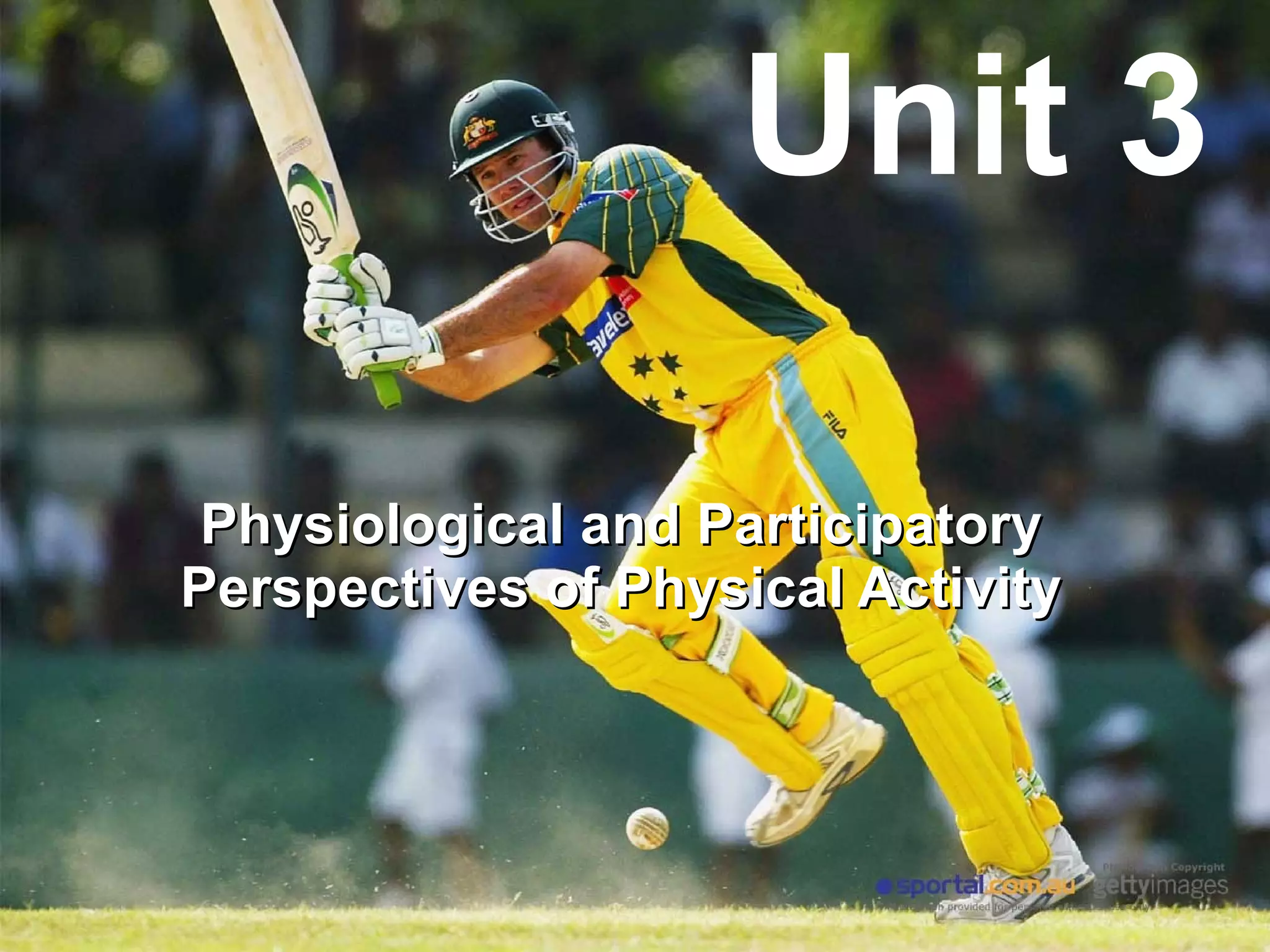
Unit 3 Physiological and Participatory Perspectives of Physical Activity
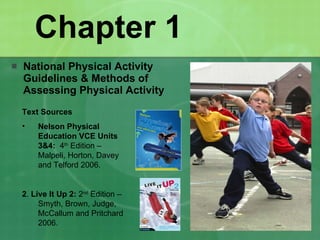
Chapter 1 National Physical Activity Guidelines & Methods of Assessing Physical Activity Text Sources Nelson Physical Education VCE Units 3&4:  4 th  Edition – Malpeli, Horton, Davey and Telford 2006. 2 .  Live It Up 2:  2 nd  Edition – Smyth, Brown, Judge, McCallum and Pritchard 2006.
National Physical Activity Guidelines National Physical Activity Guidelines & Methods of Assessing Physical Activity
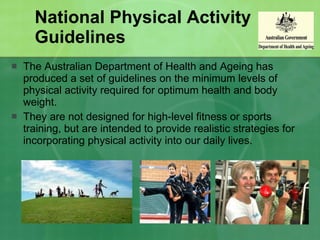
National Physical Activity Guidelines The Australian Department of Health and Ageing has produced a set of guidelines on the minimum levels of physical activity required for optimum health and body weight.  They are not designed for high-level fitness or sports training, but are intended to provide realistic strategies for incorporating physical activity into our daily lives.
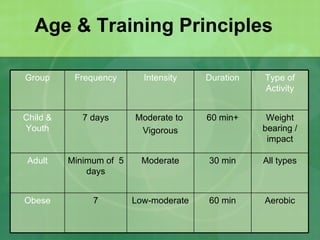
Age & Training Principles Group Frequency Intensity Duration Type of Activity Child & Youth 7 days Moderate to  Vigorous 60 min+ Weight bearing / impact Adult Minimum of  5 days Moderate 30 min All types Obese 7 Low-moderate 60 min Aerobic
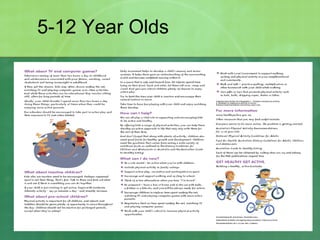
5-12 Year Olds
5-12 Year Olds
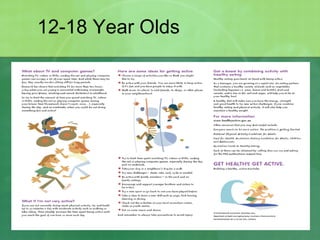
12-18 Year Olds
12-18 Year Olds
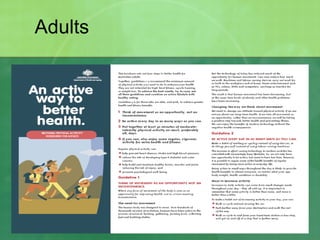
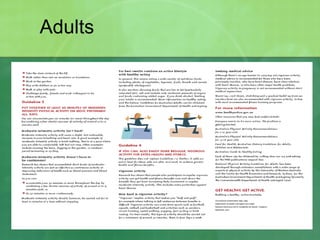
Adults
Adults
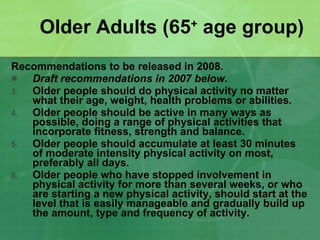
Older Adults (65 +  age group) Recommendations to be released in 2008. Draft recommendations in 2007 below. Older people should do physical activity no matter what their age, weight, health problems or abilities. Older people should be active in many ways as possible, doing a range of physical activities that incorporate fitness, strength and balance. Older people should accumulate at least 30 minutes of moderate intensity physical activity on most, preferably all days. Older people who have stopped involvement in physical activity for more than several weeks, or who are starting a new physical activity, should start at the level that is easily manageable and gradually build up the amount, type and frequency of activity.
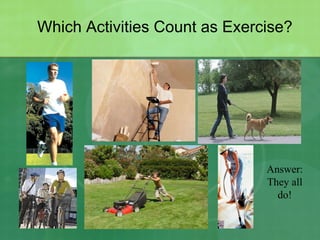
Which Activities Count as Exercise? Answer: They all do!
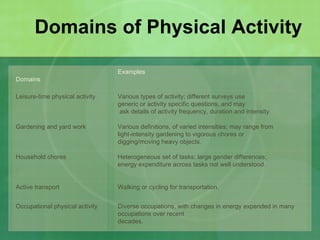
Domains of Physical Activity   Domains Examples Leisure-time physical activity Various types of activity; different surveys use  generic or activity specific questions, and may ask details of activity frequency, duration and intensity. Gardening and yard work Various definitions, of varied intensities; may range from  light-intensity gardening to vigorous chores or  digging/moving heavy objects. Household chores Heterogeneous set of tasks; large gender differences;  energy expenditure across tasks not well understood. Active transport Walking or cycling for transportation. Occupational physical activity Diverse occupations, with changes in energy expended in many occupations over recent  decades.
Need for and Benefits of Physical Activity   National Physical Activity Guidelines & Methods of Assessing Physical Activity
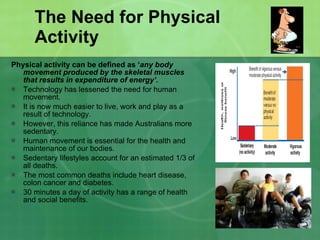
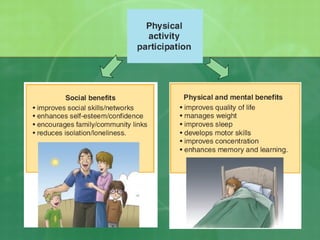
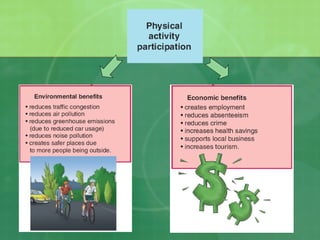
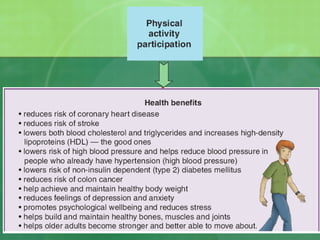
The Need for Physical Activity Physical activity can be defined as ‘ any body movement produced by the skeletal muscles that results in expenditure of energy’. Technology has lessened the need for human movement. It is now much easier to live, work and play as a result of technology. However, this reliance has made Australians more sedentary. Human movement is essential for the health and maintenance of our bodies. Sedentary lifestyles account for an estimated 1/3 of all deaths. The most common deaths include heart disease, colon cancer and diabetes. 30 minutes a day of activity has a range of health and social benefits.


Physical Activity Pyramid National Physical Activity Guidelines & Methods of Assessing Physical Activity
 
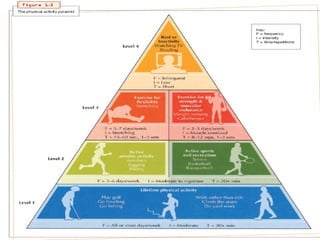
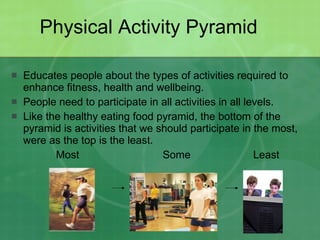
Physical Activity Pyramid Educates people about the types of activities required to enhance fitness, health and wellbeing. People need to participate in all activities in all levels. Like the healthy eating food pyramid, the bottom of the pyramid is activities that we should participate in the most, were as the top is the least. Most  Some  Least
How Active are Australians? National Physical Activity Guidelines & Methods of Assessing Physical Activity
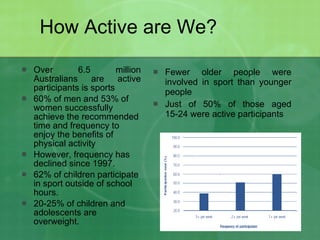
How Active are We? Over 6.5 million Australians are active participants is sports 60% of men and 53% of women successfully achieve the recommended time and frequency to enjoy the benefits of physical activity  However, frequency has declined since 1997. 62% of children participate in sport outside of school hours. 20-25% of children and adolescents are overweight. Fewer older people were involved in sport than younger people Just of 50% of those aged 15-24 were active participants
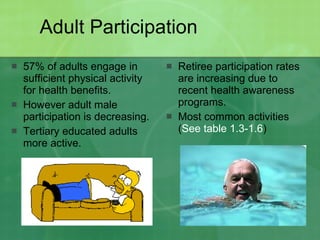
Adult Participation 57% of adults engage in sufficient physical activity for health benefits. However adult male participation is decreasing. Tertiary educated adults more active.  Retiree participation rates are increasing due to recent health awareness programs. Most common activities ( See table 1.3-1.6 )
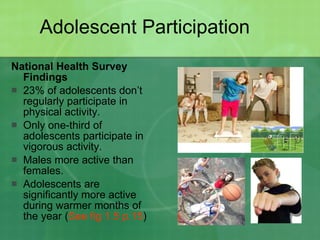
Adolescent Participation National Health Survey Findings 23% of adolescents don’t regularly participate in physical activity. Only one-third of adolescents participate in vigorous activity. Males more active than females. Adolescents are significantly more active during warmer months of the year ( See fig 1.5 p.15 )
Children’s Participation ABS findings 62% of children participate in organised sport. Boys had a higher participation than girls. Peak participation between 10-12 years of age. Soccer is the most popular boys sport and netball for girls. Accelerometer findings 5-6 year old children average four hours of physical activity per day.  10-12 year olds only average 10 minutes.
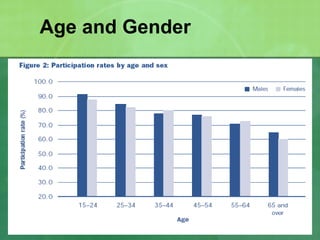
Age and Gender
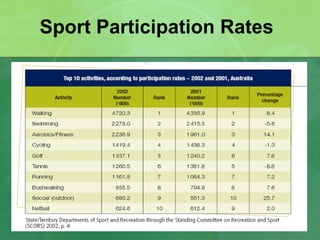
Sport Participation Rates
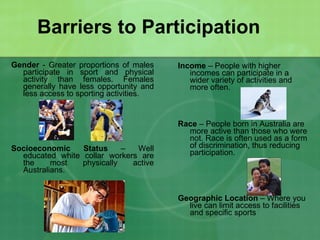
Barriers to Participation Gender  - Greater proportions of males participate in sport and physical activity than females. Females generally have less opportunity and less access to sporting activities.  Socioeconomic Status  – Well educated white collar workers are the most physically active Australians. Income  – People with higher incomes can participate in a wider variety of activities and more often. Race  – People born in Australia are more active than those who were not. Race is often used as a form of discrimination, thus reducing participation.  Geographic Location  – Where you live can limit access to facilities and specific sports
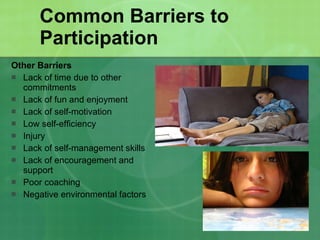
Common Barriers to Participation Other Barriers Lack of time due to other commitments Lack of fun and enjoyment Lack of self-motivation Low self-efficiency Injury Lack of self-management skills Lack of encouragement and support Poor coaching Negative environmental factors
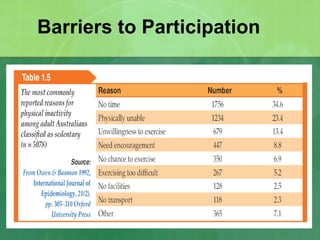
Barriers to Participation
Measuring levels of Physical Activity National Physical Activity Guidelines & Methods of Assessing Physical Activity
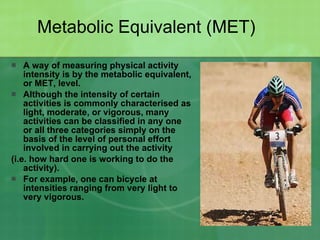
Metabolic Equivalent (MET) A way of measuring physical activity intensity is by the metabolic equivalent, or MET, level.  Although the intensity of certain activities is commonly characterised as light, moderate, or vigorous, many activities can be classified in any one or all three categories simply on the basis of the level of personal effort involved in carrying out the activity  (i.e. how hard one is working to do the activity).  For example, one can bicycle at intensities ranging from very light to very vigorous.
METs Physical activities at different levels of effort can be compared using the metabolic equivalent (MET).  This unit is used to estimate the amount of oxygen used by the body during physical activity (Ainsworth et al., 1993).  1 MET  = the energy (oxygen) used by the body as you sit quietly, perhaps while talking on the phone or reading a book  3.5ml/kg/min of O 2 The harder your body works during the activity, the higher the MET.  Any activity that burns 3 to 6 METs is considered moderate-intensity physical activity.  Any activity that burns > 6 METs is considered vigorous-intensity physical activity.
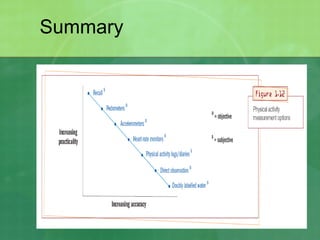
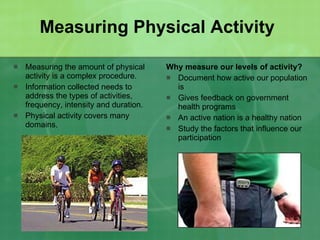
Measuring Physical Activity Measuring the amount of physical activity is a complex procedure. Information collected needs to address the types of activities, frequency, intensity and duration. Physical activity covers many domains. Why measure our levels of activity? Document how active our population is Gives feedback on government health programs An active nation is a healthy nation Study the factors that influence our participation
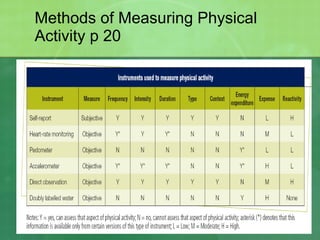
Methods of Measuring Physical Activity p 20
 
Dimensions of Physical Activity Frequency  – Number of times a person engages in an activity Duration  – Length of time engaged in an activity Intensity  – How hard an activity is Type  – Domains Context  – Where you are, when, who with etc. Energy  – Measured in METs Expense  – Cost in dollars Reactivity  – How much the measure biases towards the result.
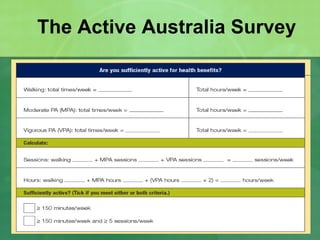
Subjective Measures Examples of subjective (remembering physical activity done) are self-reported recall measures, diaries and logs. Eg. Active Australia Survey and IPAQ.  Strengths Weaknesses Assess multiple domains Can be quickly administered to large groups Low reliability and validity Social biases in answers given Poor recall skills in children
The Active Australia Survey
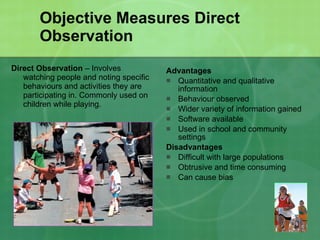
Objective Measures Direct Observation Direct Observation  – Involves watching people and noting specific behaviours and activities they are participating in. Commonly used on children while playing. Advantages Quantitative and qualitative information Behaviour observed Wider variety of information gained Software available Used in school and community settings Disadvantages Difficult with large populations Obtrusive and time consuming Can cause bias
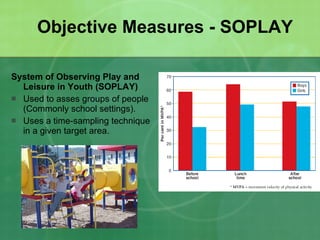
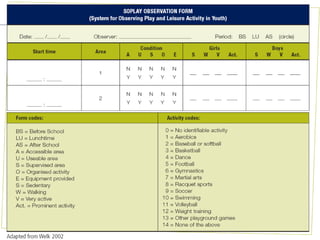
Objective Measures - SOPLAY System of Observing Play and Leisure in Youth (SOPLAY) Used to asses groups of people (Commonly school settings). Uses a time-sampling technique in a given target area.
 
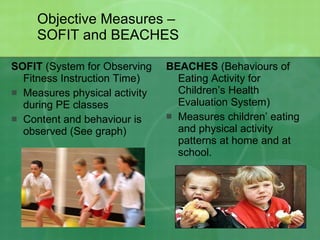
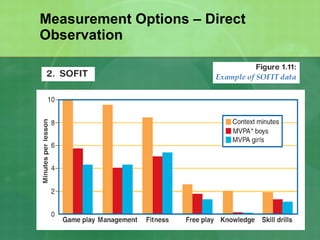
Objective Measures –  SOFIT and BEACHES SOFIT  (System for Observing Fitness Instruction Time) Measures physical activity during PE classes Content and behaviour is observed (See graph) BEACHES  (Behaviours of Eating Activity for Children’s Health Evaluation System) Measures children’ eating and physical activity patterns at home and at school.
Measurement Options – Direct Observation
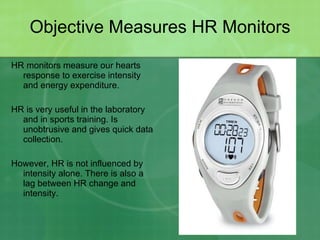
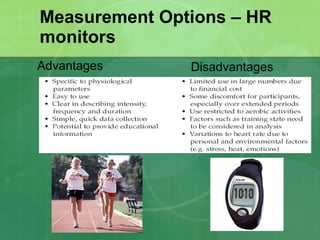
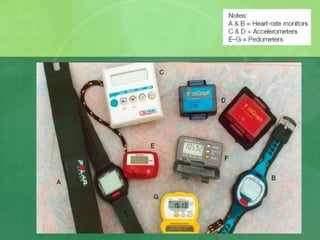
Objective Measures HR Monitors HR monitors measure our hearts response to exercise intensity and energy expenditure. HR is very useful in the laboratory and in sports training. Is unobtrusive and gives quick data collection. However, HR is not influenced by intensity alone. There is also a lag between HR change and intensity.
Measurement Options – HR monitors Advantages Disadvantages
Measurement Options -  Pedometers Advantages Disadvantages
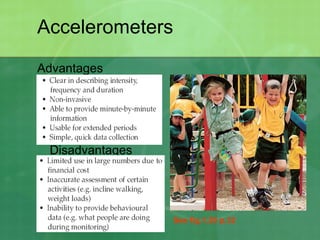
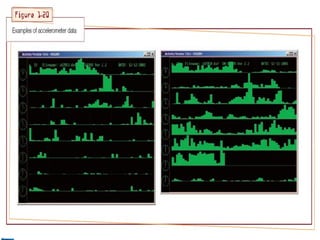
Accelerometers Advantages Disadvantages See fig.1.20 p.32
 
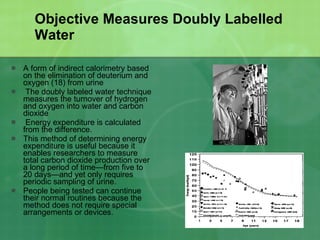
Objective Measures Doubly Labelled Water A form of indirect calorimetry based on the elimination of deuterium and oxygen (18) from urine The doubly labeled water technique measures the turnover of hydrogen and oxygen into water and carbon dioxide Energy expenditure is calculated from the difference.  This method of determining energy expenditure is useful because it enables researchers to measure total carbon dioxide production over a long period of time—from five to 20 days—and yet only requires periodic sampling of urine.  People being tested can continue their normal routines because the method does not require special arrangements or devices.
Doubly labelled Water Advantages Unobtrusive and non invasive. Accurately measures total energy expenditure related to physical activity over a one or two week period. Allows for the calculation of VO 2   Can be used with any age group.  Disadvantages Extremely expensive, around $2000 per person per test. Doesn’t provide any information relating to activity type, frequency, intensity or duration.  Doesn’t provide any contextual information (settings where someone is being active) about the physical activity behaviour of an individual.
Summary
Complete the chapter questions on page 2-8 of Nelson  Peak Performance  Physical Education VCE Units 3 & 4. Peak Performance
Read the summarised information of pages 1-10 of PHYS ED Notes and complete the revision questions. PHYS ED Notes
Web Links – Chapter 1 Australian government physical activity recommendations for children and young people:  http://www.health.gov.au/internet/wcms/publishing.nsf/Content/health-pubhlth-strateg-active-recommend.htm   Children’s leisure activities report (Centre for Physical Activity and Nutrition Research – Deakin University):  http://www.deakin.edu.au/hbs/cpan/be.php   Australian Sports Commission:  http://www.ausport.gov.au   VicHealth (The Victorian Health Promotion Foundation):  http://www.vichealth.vic.gov.au   Physical Activity Resources for Health Professionals – Introduction (Centre for disease control and prevention (USA):  http://www.cdc.gov/nccdphp/dnpa/physical/health_professionals/index.htm   Strategic Inter-Governmental Forum on Physical Activity and Health (SIGPAH):  http://www.nphp.gov.au/workprog/sigpah/   Sport and Recreation Australia:  http://www.sport.vic.gov.au   Australian Sports Commission:  http://www.ausport.gov.au   Find 30 promotion (Government of WA Department of Health):  http://www.find30.com.au   Walking School Bus promotion (UK):  http://www.walkingbus.com   Ministry of Health (New Zealand) toolkits:  http://www.newhealth.govt.nz   The 10,000 Steps Rockhampton project:  http://www.10000steps.org.au/rockhampton/   Travelsmart Australia:  http://www.travelsmart.gov.au   World Health Organisation:  http://www.who.int   Heart Foundation Australia:  http://www.heartfoundation.com.au   VicHealth (The Victorian Health Promotion Foundation):  http://www.vichealth.vic.gov.au   Be Active promotion (Government of South Australia):  http://www.beactive.com.au   Go For Your Life:  http://www.goforyourlife.vic.gov.au   Physical Activity Resources for Health Professionals  –  Introduction (Centre for disease control and prevention  –  USA):  http://www.cdc.gov/nccdphp/dnpa/physical/health_professionals/index.htm   Health Promotion (Public Health Agency of Canada):  http://www.phac-aspc.gc.ca/hp-ps/index.html   Strategic Inter-Governmental Forum on Physical Activity and Health (SIGPAH):  http://www.nphp.gov.au/workprog/sigpah/   Healthy youth (Centre for disease control and prevention (USA):  http://www.cdc.gov/HealthyYouth/   America On The Move promotion:  http://www.americaonthemove.org   Papers from the International Journal of Behavioural Nutrition and Physical Activity:  http://www.ijbnpa.org/home   Department of health and aging (Australian government):  http://www.health.gov.au/internet/wcms/publishing.nsf/content/home   Building a healthy, active Australia (Australian government):  http://www.healthyactive.gov.au   National Public Health Partnership:  http://www.nphp.gov.au   Be Active promotion (Government of South Australia):  http://www.beactive.com.au   Sport and Recreation Australia:  http://www.sport.vic.gov.au

Chapt 1

  • 1.
    Unit 3 Physiologicaland Participatory Perspectives of Physical Activity
  • 2.
    Chapter 1 NationalPhysical Activity Guidelines & Methods of Assessing Physical Activity Text Sources Nelson Physical Education VCE Units 3&4: 4 th Edition – Malpeli, Horton, Davey and Telford 2006. 2 . Live It Up 2: 2 nd Edition – Smyth, Brown, Judge, McCallum and Pritchard 2006.
  • 3.
    National Physical ActivityGuidelines National Physical Activity Guidelines & Methods of Assessing Physical Activity
  • 4.
    National Physical ActivityGuidelines The Australian Department of Health and Ageing has produced a set of guidelines on the minimum levels of physical activity required for optimum health and body weight. They are not designed for high-level fitness or sports training, but are intended to provide realistic strategies for incorporating physical activity into our daily lives.
  • 5.
    Age & TrainingPrinciples Group Frequency Intensity Duration Type of Activity Child & Youth 7 days Moderate to Vigorous 60 min+ Weight bearing / impact Adult Minimum of 5 days Moderate 30 min All types Obese 7 Low-moderate 60 min Aerobic
  • 6.
  • 7.
  • 8.
  • 9.
  • 10.
  • 11.
  • 12.
    Older Adults (65+ age group) Recommendations to be released in 2008. Draft recommendations in 2007 below. Older people should do physical activity no matter what their age, weight, health problems or abilities. Older people should be active in many ways as possible, doing a range of physical activities that incorporate fitness, strength and balance. Older people should accumulate at least 30 minutes of moderate intensity physical activity on most, preferably all days. Older people who have stopped involvement in physical activity for more than several weeks, or who are starting a new physical activity, should start at the level that is easily manageable and gradually build up the amount, type and frequency of activity.
  • 13.
    Which Activities Countas Exercise? Answer: They all do!
  • 14.
    Domains of PhysicalActivity   Domains Examples Leisure-time physical activity Various types of activity; different surveys use generic or activity specific questions, and may ask details of activity frequency, duration and intensity. Gardening and yard work Various definitions, of varied intensities; may range from light-intensity gardening to vigorous chores or digging/moving heavy objects. Household chores Heterogeneous set of tasks; large gender differences; energy expenditure across tasks not well understood. Active transport Walking or cycling for transportation. Occupational physical activity Diverse occupations, with changes in energy expended in many occupations over recent decades.
  • 15.
    Need for andBenefits of Physical Activity National Physical Activity Guidelines & Methods of Assessing Physical Activity
  • 16.
    The Need forPhysical Activity Physical activity can be defined as ‘ any body movement produced by the skeletal muscles that results in expenditure of energy’. Technology has lessened the need for human movement. It is now much easier to live, work and play as a result of technology. However, this reliance has made Australians more sedentary. Human movement is essential for the health and maintenance of our bodies. Sedentary lifestyles account for an estimated 1/3 of all deaths. The most common deaths include heart disease, colon cancer and diabetes. 30 minutes a day of activity has a range of health and social benefits.
  • 17.
  • 18.
  • 19.
  • 20.
    Physical Activity PyramidNational Physical Activity Guidelines & Methods of Assessing Physical Activity
  • 21.
  • 22.
    Physical Activity PyramidEducates people about the types of activities required to enhance fitness, health and wellbeing. People need to participate in all activities in all levels. Like the healthy eating food pyramid, the bottom of the pyramid is activities that we should participate in the most, were as the top is the least. Most Some Least
  • 23.
    How Active areAustralians? National Physical Activity Guidelines & Methods of Assessing Physical Activity
  • 24.
    How Active areWe? Over 6.5 million Australians are active participants is sports 60% of men and 53% of women successfully achieve the recommended time and frequency to enjoy the benefits of physical activity However, frequency has declined since 1997. 62% of children participate in sport outside of school hours. 20-25% of children and adolescents are overweight. Fewer older people were involved in sport than younger people Just of 50% of those aged 15-24 were active participants
  • 25.
    Adult Participation 57%of adults engage in sufficient physical activity for health benefits. However adult male participation is decreasing. Tertiary educated adults more active. Retiree participation rates are increasing due to recent health awareness programs. Most common activities ( See table 1.3-1.6 )
  • 26.
    Adolescent Participation NationalHealth Survey Findings 23% of adolescents don’t regularly participate in physical activity. Only one-third of adolescents participate in vigorous activity. Males more active than females. Adolescents are significantly more active during warmer months of the year ( See fig 1.5 p.15 )
  • 27.
    Children’s Participation ABSfindings 62% of children participate in organised sport. Boys had a higher participation than girls. Peak participation between 10-12 years of age. Soccer is the most popular boys sport and netball for girls. Accelerometer findings 5-6 year old children average four hours of physical activity per day. 10-12 year olds only average 10 minutes.
  • 28.
  • 29.
  • 30.
    Barriers to ParticipationGender - Greater proportions of males participate in sport and physical activity than females. Females generally have less opportunity and less access to sporting activities. Socioeconomic Status – Well educated white collar workers are the most physically active Australians. Income – People with higher incomes can participate in a wider variety of activities and more often. Race – People born in Australia are more active than those who were not. Race is often used as a form of discrimination, thus reducing participation. Geographic Location – Where you live can limit access to facilities and specific sports
  • 31.
    Common Barriers toParticipation Other Barriers Lack of time due to other commitments Lack of fun and enjoyment Lack of self-motivation Low self-efficiency Injury Lack of self-management skills Lack of encouragement and support Poor coaching Negative environmental factors
  • 32.
  • 33.
    Measuring levels ofPhysical Activity National Physical Activity Guidelines & Methods of Assessing Physical Activity
  • 34.
    Metabolic Equivalent (MET)A way of measuring physical activity intensity is by the metabolic equivalent, or MET, level. Although the intensity of certain activities is commonly characterised as light, moderate, or vigorous, many activities can be classified in any one or all three categories simply on the basis of the level of personal effort involved in carrying out the activity (i.e. how hard one is working to do the activity). For example, one can bicycle at intensities ranging from very light to very vigorous.
  • 35.
    METs Physical activitiesat different levels of effort can be compared using the metabolic equivalent (MET). This unit is used to estimate the amount of oxygen used by the body during physical activity (Ainsworth et al., 1993).  1 MET = the energy (oxygen) used by the body as you sit quietly, perhaps while talking on the phone or reading a book 3.5ml/kg/min of O 2 The harder your body works during the activity, the higher the MET.  Any activity that burns 3 to 6 METs is considered moderate-intensity physical activity. Any activity that burns > 6 METs is considered vigorous-intensity physical activity.
  • 36.
    Measuring Physical ActivityMeasuring the amount of physical activity is a complex procedure. Information collected needs to address the types of activities, frequency, intensity and duration. Physical activity covers many domains. Why measure our levels of activity? Document how active our population is Gives feedback on government health programs An active nation is a healthy nation Study the factors that influence our participation
  • 37.
    Methods of MeasuringPhysical Activity p 20
  • 38.
  • 39.
    Dimensions of PhysicalActivity Frequency – Number of times a person engages in an activity Duration – Length of time engaged in an activity Intensity – How hard an activity is Type – Domains Context – Where you are, when, who with etc. Energy – Measured in METs Expense – Cost in dollars Reactivity – How much the measure biases towards the result.
  • 40.
    Subjective Measures Examplesof subjective (remembering physical activity done) are self-reported recall measures, diaries and logs. Eg. Active Australia Survey and IPAQ. Strengths Weaknesses Assess multiple domains Can be quickly administered to large groups Low reliability and validity Social biases in answers given Poor recall skills in children
  • 41.
  • 42.
    Objective Measures DirectObservation Direct Observation – Involves watching people and noting specific behaviours and activities they are participating in. Commonly used on children while playing. Advantages Quantitative and qualitative information Behaviour observed Wider variety of information gained Software available Used in school and community settings Disadvantages Difficult with large populations Obtrusive and time consuming Can cause bias
  • 43.
    Objective Measures -SOPLAY System of Observing Play and Leisure in Youth (SOPLAY) Used to asses groups of people (Commonly school settings). Uses a time-sampling technique in a given target area.
  • 44.
  • 45.
    Objective Measures – SOFIT and BEACHES SOFIT (System for Observing Fitness Instruction Time) Measures physical activity during PE classes Content and behaviour is observed (See graph) BEACHES (Behaviours of Eating Activity for Children’s Health Evaluation System) Measures children’ eating and physical activity patterns at home and at school.
  • 46.
    Measurement Options –Direct Observation
  • 47.
    Objective Measures HRMonitors HR monitors measure our hearts response to exercise intensity and energy expenditure. HR is very useful in the laboratory and in sports training. Is unobtrusive and gives quick data collection. However, HR is not influenced by intensity alone. There is also a lag between HR change and intensity.
  • 48.
    Measurement Options –HR monitors Advantages Disadvantages
  • 49.
    Measurement Options - Pedometers Advantages Disadvantages
  • 50.
  • 51.
  • 52.
    Objective Measures DoublyLabelled Water A form of indirect calorimetry based on the elimination of deuterium and oxygen (18) from urine The doubly labeled water technique measures the turnover of hydrogen and oxygen into water and carbon dioxide Energy expenditure is calculated from the difference. This method of determining energy expenditure is useful because it enables researchers to measure total carbon dioxide production over a long period of time—from five to 20 days—and yet only requires periodic sampling of urine. People being tested can continue their normal routines because the method does not require special arrangements or devices.
  • 53.
    Doubly labelled WaterAdvantages Unobtrusive and non invasive. Accurately measures total energy expenditure related to physical activity over a one or two week period. Allows for the calculation of VO 2 Can be used with any age group. Disadvantages Extremely expensive, around $2000 per person per test. Doesn’t provide any information relating to activity type, frequency, intensity or duration. Doesn’t provide any contextual information (settings where someone is being active) about the physical activity behaviour of an individual.
  • 54.
  • 55.
    Complete the chapterquestions on page 2-8 of Nelson Peak Performance Physical Education VCE Units 3 & 4. Peak Performance
  • 56.
    Read the summarisedinformation of pages 1-10 of PHYS ED Notes and complete the revision questions. PHYS ED Notes
  • 57.
    Web Links –Chapter 1 Australian government physical activity recommendations for children and young people: http://www.health.gov.au/internet/wcms/publishing.nsf/Content/health-pubhlth-strateg-active-recommend.htm Children’s leisure activities report (Centre for Physical Activity and Nutrition Research – Deakin University): http://www.deakin.edu.au/hbs/cpan/be.php Australian Sports Commission: http://www.ausport.gov.au VicHealth (The Victorian Health Promotion Foundation): http://www.vichealth.vic.gov.au Physical Activity Resources for Health Professionals – Introduction (Centre for disease control and prevention (USA): http://www.cdc.gov/nccdphp/dnpa/physical/health_professionals/index.htm Strategic Inter-Governmental Forum on Physical Activity and Health (SIGPAH): http://www.nphp.gov.au/workprog/sigpah/ Sport and Recreation Australia: http://www.sport.vic.gov.au Australian Sports Commission: http://www.ausport.gov.au Find 30 promotion (Government of WA Department of Health): http://www.find30.com.au Walking School Bus promotion (UK): http://www.walkingbus.com Ministry of Health (New Zealand) toolkits: http://www.newhealth.govt.nz The 10,000 Steps Rockhampton project: http://www.10000steps.org.au/rockhampton/ Travelsmart Australia: http://www.travelsmart.gov.au World Health Organisation: http://www.who.int Heart Foundation Australia: http://www.heartfoundation.com.au VicHealth (The Victorian Health Promotion Foundation): http://www.vichealth.vic.gov.au Be Active promotion (Government of South Australia): http://www.beactive.com.au Go For Your Life: http://www.goforyourlife.vic.gov.au Physical Activity Resources for Health Professionals – Introduction (Centre for disease control and prevention – USA): http://www.cdc.gov/nccdphp/dnpa/physical/health_professionals/index.htm Health Promotion (Public Health Agency of Canada): http://www.phac-aspc.gc.ca/hp-ps/index.html Strategic Inter-Governmental Forum on Physical Activity and Health (SIGPAH): http://www.nphp.gov.au/workprog/sigpah/ Healthy youth (Centre for disease control and prevention (USA): http://www.cdc.gov/HealthyYouth/ America On The Move promotion: http://www.americaonthemove.org Papers from the International Journal of Behavioural Nutrition and Physical Activity: http://www.ijbnpa.org/home Department of health and aging (Australian government): http://www.health.gov.au/internet/wcms/publishing.nsf/content/home Building a healthy, active Australia (Australian government): http://www.healthyactive.gov.au National Public Health Partnership: http://www.nphp.gov.au Be Active promotion (Government of South Australia): http://www.beactive.com.au Sport and Recreation Australia: http://www.sport.vic.gov.au