Preterm Birth
Zehdi Eydou
Intern House Officer
Obstetrics and Gynecology
Dubai Academic Health Corporation
Agenda
1. Definition
2. Classification
3. Risk Factors
4. Pathophysiology
5. Triaging Patients with Preterm
Contractions
6. Management
Preterm Labor 2
Definition
Preterm birth (PTB) is defined as a birth (ie, live born
or stillborn ≥20+0 weeks of gestation) that occurs at
<37+0 weeks of gestation
Preterm Labor 3
Definition
Preterm Labor 4
Gestational
Age Criteria
Birth Weight
Criteria
Preterm Labor 5
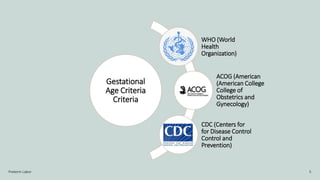
Gestational
Age Criteria
Criteria
WHO (World
Health
Organization)
ACOG (American
(American College
College of
Obstetrics and
Gynecology)
CDC (Centers for
for Disease Control
Control and
Prevention)
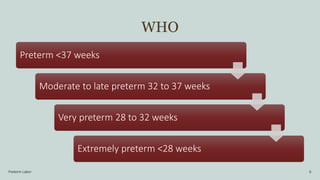
WHO
Preterm Labor 6
Preterm <37 weeks
Moderate to late preterm 32 to 37 weeks
Very preterm 28 to 32 weeks
Extremely preterm <28 weeks
ACOG and CDC
Preterm Labor 7
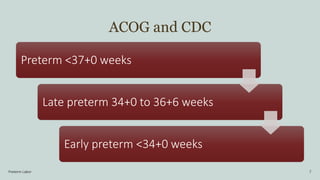
Preterm <37+0 weeks
Late preterm 34+0 to 36+6 weeks
Early preterm <34+0 weeks
Birth Weight Criteria
Preterm Labor 8
Low birth weight (LBW) <2500 grams
grams
Very low birth weight (VLBW) <1500
<1500 grams
Extremely low birth weight (ELBW)
(ELBW) <1000 grams
Classification
Preterm Labor 10
Preterm
Birth
Spontaneous
(70–80%)
Preterm labor
(40–50%)
PPROM (20–
30%)
Cervical
insufficiency or
placental
abruption (rare)
Indicated (20–
30%)
Maternal
conditions
Fetal conditions
Risk Factors
Preterm Labor 12
Prior OB/GYN History
History
Maternal
Demographics and
Genetic Factors
Nutritional
Status/Physical
Activity
Current
Maternal/Pregnancy
Characteristics
Preterm Labor 13
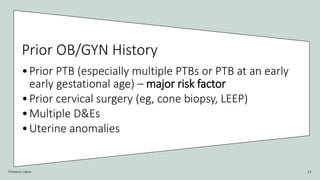
Prior OB/GYN History
•Prior PTB (especially multiple PTBs or PTB at an early
early gestational age) – major risk factor
•Prior cervical surgery (eg, cone biopsy, LEEP)
•Multiple D&Es
•Uterine anomalies
Preterm Labor 14
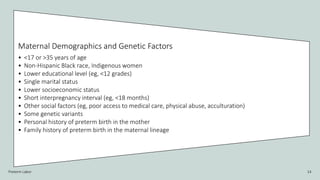
Maternal Demographics and Genetic Factors
• <17 or >35 years of age
• Non-Hispanic Black race, Indigenous women
• Lower educational level (eg, <12 grades)
• Single marital status
• Lower socioeconomic status
• Short interpregnancy interval (eg, <18 months)
• Other social factors (eg, poor access to medical care, physical abuse, acculturation)
• Some genetic variants
• Personal history of preterm birth in the mother
• Family history of preterm birth in the maternal lineage
Preterm Labor 15
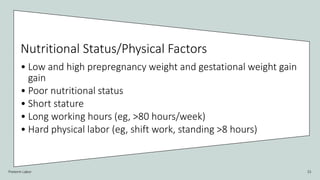
Nutritional Status/Physical Factors
• Low and high prepregnancy weight and gestational weight gain
gain
• Poor nutritional status
• Short stature
• Long working hours (eg, >80 hours/week)
• Hard physical labor (eg, shift work, standing >8 hours)
Preterm Labor 16
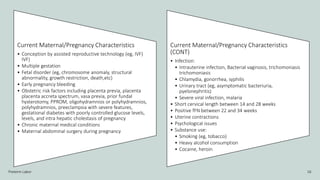
Current Maternal/Pregnancy Characteristics
• Conception by assisted reproductive technology (eg, IVF)
IVF)
• Multiple gestation
• Fetal disorder (eg, chromosome anomaly, structural
abnormality, growth restriction, death,etc)
• Early pregnancy bleeding
• Obstetric risk factors including placenta previa, placenta
placenta accreta spectrum, vasa previa, prior fundal
hysterotomy, PPROM, oligohydramnios or polyhydramnios,
polyhydramnios, preeclampsia with severe features,
gestational diabetes with poorly controlled glucose levels,
levels, and intra hepatic cholestasis of pregnancy
• Chronic maternal medical conditions
• Maternal abdominal surgery during pregnancy
Current Maternal/Pregnancy Characteristics
(CONT)
• Infection:
• Intrauterine infection, Bacterial vaginosis, trichomoniasis
trichomoniasis
• Chlamydia, gonorrhea, syphilis
• Urinary tract (eg, asymptomatic bacteriuria,
pyelonephritis)
• Severe viral infection, malaria
• Short cervical length between 14 and 28 weeks
• Positive fFN between 22 and 34 weeks
• Uterine contractions
• Psychological issues
• Substance use:
• Smoking (eg, tobacco)
• Heavy alcohol consumption
• Cocaine, heroin
Pathophysiology
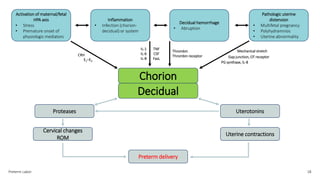
Preterm Labor 18
Activation of maternal/fetal
HPA axis
• Stress
• Premature onset of
physiologic mediators
Inflammation
• Infection (chorion-
decidual) or system
Decidual hemorrhage
• Abruption
Pathologic uterine
distension
• Multifetal pregnancy
• Polyhydramnios
• Uterine abnormality
Chorion
Decidual
CRH
E1–E3
IL-1
IL-6
IL-8
TNF
CSF
FasL
Thrombin
Thrombin receptor
Mechanical stretch
Gap junction, OT receptor
PG synthase, IL-8
Uterotonins
Proteases
Cervical changes
ROM
Uterine contractions
Preterm delivery
Diagnostic Evaluation
20
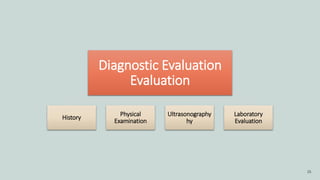
Diagnostic Evaluation
Evaluation
History
Physical
Examination
Ultrasonography
hy
Laboratory
Evaluation
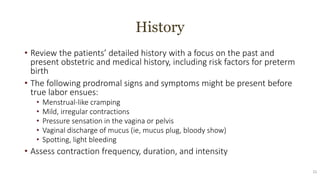
History
• Review the patients’ detailed history with a focus on the past and
present obstetric and medical history, including risk factors for preterm
birth
• The following prodromal signs and symptoms might be present before
true labor ensues:
• Menstrual-like cramping
• Mild, irregular contractions
• Pressure sensation in the vagina or pelvis
• Vaginal discharge of mucus (ie, mucus plug, bloody show)
• Spotting, light bleeding
• Assess contraction frequency, duration, and intensity
21
Physical Examination
• Evaluate for the signs of preterm labor
• Examine the uterus to assess firmness, tenderness,
fetal size, fetal position, and contractions
• Review the fetal heart rate tracing
22
Speculum Examination
23
A speculum examination is performed using a sterile, wet non-lubricated
speculum
Estimate cervical dilation: dilation ≥3 cm supports the diagnosis of
preterm labor
Assess the presence and amount of uterine bleeding: bleeding from
placental abruption or placenta previa can trigger preterm labor
Assess fetal membrane status (intact or ruptured) by standard
methods
Use a swab to obtain a cervicovaginal fluid specimen in case fetal
fibronectin (fFN) testing is subsequently desired
Digital Cervical Examination
• Cervical dilation and effacement are assessed after placenta
previa and rupture of membranes have been excluded by
history and physical, laboratory, and ultrasound examinations,
as appropriate.
• It is important to distinguish between patients whose
membranes have hour-glassed (prolapsed) through a mildly
dilated and effaced cervix (which is suggestive of cervical
insufficiency) and those who are in active labor with
advanced cervical dilation and effacement.
Preterm Labor 24
25
Diagnostic Evaluation
Evaluation
History
Physical
Examination
Ultrasonography
hy
Laboratory
Evaluation
Transvaginal Ultrasound Examination
Preterm Labor 26
• Measurement of cervical length is useful for supporting or
excluding the diagnosis of preterm labor when the diagnosis is
unclear:
• A short cervix (<30 mm) before 34 weeks of gestation is
predictive of an increased risk for preterm birth in all
populations
• A long cervix (≥30 mm) has a high negative predictive value
for preterm birth
Obstetric Ultrasound Examination
Preterm Labor 27
• Obstetric ultrasound examination provides useful
information besides cervical length, including
• Presence/absence of fetal, placental, and maternal
anatomic abnormalities
• Confirmation of fetal presentation
• Assessment of amniotic fluid volume
• Estimated fetal weight
28
Diagnostic Evaluation
Evaluation
History
Physical
Examination
Ultrasonography
hy
Laboratory
Evaluation
Laboratory Evaluation
• Rectovaginal group B streptococcal culture, if not done within the
previous five weeks; antibiotic prophylaxis depends on the results
• Urine culture since asymptomatic bacteriuria and pyelonephritis is
associated with an increased risk of preterm labor and birth
• fFN in pregnancies <34 weeks of gestation with intact membranes,
cervical dilation <3cm, and cervical length 20 to 30 mm on TVUS
• Testing for sexually transmitted infections depending on the patient's
risk factors and whether antepartum testing for the infections was
recently performed
29
Fetal Fibronectin
for Selected
Patients
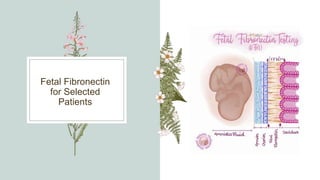
• fFN is an extracellular
matrix protein present at
the decidual-chorionic
interface.
• Disruption of this interface
releases fFN into
cervicovaginal secretions,
which is the basis for its
use as a marker for
predicting spontaneous
preterm.
• Measurement of fFN is
performed to distinguish
true preterm labor from
false labor.
Fetal Fibronectin
for Selected
Patients
Diagnostic Criteria
Preterm Labor 32
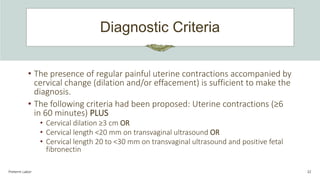
• The presence of regular painful uterine contractions accompanied by
cervical change (dilation and/or effacement) is sufficient to make the
diagnosis.
• The following criteria had been proposed: Uterine contractions (≥6
in 60 minutes) PLUS
• Cervical dilation ≥3 cm OR
• Cervical length <20 mm on transvaginal ultrasound OR
• Cervical length 20 to <30 mm on transvaginal ultrasound and positive fetal
fibronectin
Triaging Patients with Preterm
Contractions
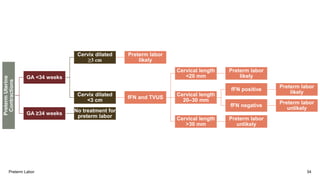
Preterm
Uterine
Contractions
GA <34 weeks
Cervix dilated
≥3 cm
Preterm labor
likely
Cervix dilated
<3 cm
fFN and TVUS
Cervical length
<20 mm
Preterm labor
likely
Cervical length
20–30 mm
fFN positive
Preterm labor
likely
fFN negative
Preterm labor
unlikely
Cervical length
>30 mm
Preterm labor
unlikely
GA ≥34 weeks
No treatment for
preterm labor
Preterm Labor 34
Initial Management of Preterm Labor
Preterm Labor 35
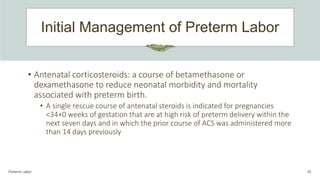
• Antenatal corticosteroids: a course of betamethasone or
dexamethasone to reduce neonatal morbidity and mortality
associated with preterm birth.

• A single rescue course of antenatal steroids is indicated for pregnancies
<34+0 weeks of gestation that are at high risk of preterm delivery within the
next seven days and in which the prior course of ACS was administered more
than 14 days previously
Initial Management of Preterm Labor (CONT)
Preterm Labor 36
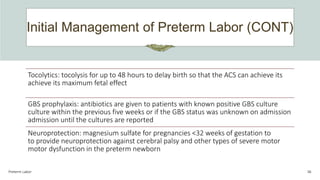
Tocolytics: tocolysis for up to 48 hours to delay birth so that the ACS can achieve its
achieve its maximum fetal effect
GBS prophylaxis: antibiotics are given to patients with known positive GBS culture
culture within the previous five weeks or if the GBS status was unknown on admission
admission until the cultures are reported
Neuroprotection: magnesium sulfate for pregnancies <32 weeks of gestation to
to provide neuroprotection against cerebral palsy and other types of severe motor
motor dysfunction in the preterm newborn
Question
Preterm Labor 37
Question
• A 29-year-old, G2P1+1 with a twin gestation at 25 weeks presents to OB
triage complaining of irregular uterine contractions and back pain. She also reports an
increase in the amount of her vaginal discharge, but denies any "gush of fluid." She
reports that in the morning she had some very light vaginal bleeding, but it has since
resolved. She says that the babies have been active and moving as much as usual. She
thinks that she may have overdone it with too much lifting as she has been rearranging
the nursery to get it ready for the babies. She has no GI or urinary symptoms. She has had
adequate PNC and denies any problems or complications with the pregnancy. On arrival to
triage, she is placed on an external fetal monitor, which indicates uterine contractions
every 2 to 4 min. She is afebrile and her vital signs are all normal. Her gravid uterus
is nontender. The nurses call you to evaluate the patient. You decide to implement all of
the following assessments EXCEPT which one?
A. Sterile digital exam
B. Intravenous hydration
C. Bedside ultrasound
D. Urinalysis and urine culture
E. Rectovaginal swab for Group B Strep
Preterm Labor 38
Reference
s
• Lockwood CJ. Preterm labor: Clinical findings,
diagnostic evaluation, and initial treatment. In; Barss
VA (ed.). UpToDate; 2023. Available from:
https://www.uptodate.com/contents/preterm-labor-
clinical-findings-diagnostic-evaluation-and-initial-
treatment. Accessed on 30 May 2023.
• Robinson JN. Norwitz ER. Spontaneous preterm birth:
Overview of risk factors and prognosis. In: Barss VA.
(ed.). UpToDate; 2023.
https://www.uptodate.com/contents/spontaneous-
preterm-birth-overview-of-risk-factors-and-prognosis.
Accessed 30 May 2023. Accessed on 30 May 2023.
• Casanova R, Chuang A, Goepfert AR, Hueppchen NA,
Weiss PM. Preterm Labor. In: Beckmann and Ling’s
Obstetrics and Gynecology. 8th edn. Philadelphia:
Wolters Kluwer. 2019, p. 366.
Thank You

Preterm Birth.pptx

  • 1.
    Preterm Birth Zehdi Eydou InternHouse Officer Obstetrics and Gynecology Dubai Academic Health Corporation
  • 2.
    Agenda 1. Definition 2. Classification 3.Risk Factors 4. Pathophysiology 5. Triaging Patients with Preterm Contractions 6. Management Preterm Labor 2
  • 3.
    Definition Preterm birth (PTB)is defined as a birth (ie, live born or stillborn ≥20+0 weeks of gestation) that occurs at <37+0 weeks of gestation Preterm Labor 3
  • 4.
    Definition Preterm Labor 4 Gestational AgeCriteria Birth Weight Criteria
  • 5.
    Preterm Labor 5 Gestational AgeCriteria Criteria WHO (World Health Organization) ACOG (American (American College College of Obstetrics and Gynecology) CDC (Centers for for Disease Control Control and Prevention)
  • 6.
    WHO Preterm Labor 6 Preterm<37 weeks Moderate to late preterm 32 to 37 weeks Very preterm 28 to 32 weeks Extremely preterm <28 weeks
  • 7.
    ACOG and CDC PretermLabor 7 Preterm <37+0 weeks Late preterm 34+0 to 36+6 weeks Early preterm <34+0 weeks
  • 8.
    Birth Weight Criteria PretermLabor 8 Low birth weight (LBW) <2500 grams grams Very low birth weight (VLBW) <1500 <1500 grams Extremely low birth weight (ELBW) (ELBW) <1000 grams
  • 9.
  • 10.
    Preterm Labor 10 Preterm Birth Spontaneous (70–80%) Pretermlabor (40–50%) PPROM (20– 30%) Cervical insufficiency or placental abruption (rare) Indicated (20– 30%) Maternal conditions Fetal conditions
  • 11.
  • 12.
    Preterm Labor 12 PriorOB/GYN History History Maternal Demographics and Genetic Factors Nutritional Status/Physical Activity Current Maternal/Pregnancy Characteristics
  • 13.
    Preterm Labor 13 PriorOB/GYN History •Prior PTB (especially multiple PTBs or PTB at an early early gestational age) – major risk factor •Prior cervical surgery (eg, cone biopsy, LEEP) •Multiple D&Es •Uterine anomalies
  • 14.
    Preterm Labor 14 MaternalDemographics and Genetic Factors • <17 or >35 years of age • Non-Hispanic Black race, Indigenous women • Lower educational level (eg, <12 grades) • Single marital status • Lower socioeconomic status • Short interpregnancy interval (eg, <18 months) • Other social factors (eg, poor access to medical care, physical abuse, acculturation) • Some genetic variants • Personal history of preterm birth in the mother • Family history of preterm birth in the maternal lineage
  • 15.
    Preterm Labor 15 NutritionalStatus/Physical Factors • Low and high prepregnancy weight and gestational weight gain gain • Poor nutritional status • Short stature • Long working hours (eg, >80 hours/week) • Hard physical labor (eg, shift work, standing >8 hours)
  • 16.
    Preterm Labor 16 CurrentMaternal/Pregnancy Characteristics • Conception by assisted reproductive technology (eg, IVF) IVF) • Multiple gestation • Fetal disorder (eg, chromosome anomaly, structural abnormality, growth restriction, death,etc) • Early pregnancy bleeding • Obstetric risk factors including placenta previa, placenta placenta accreta spectrum, vasa previa, prior fundal hysterotomy, PPROM, oligohydramnios or polyhydramnios, polyhydramnios, preeclampsia with severe features, gestational diabetes with poorly controlled glucose levels, levels, and intra hepatic cholestasis of pregnancy • Chronic maternal medical conditions • Maternal abdominal surgery during pregnancy Current Maternal/Pregnancy Characteristics (CONT) • Infection: • Intrauterine infection, Bacterial vaginosis, trichomoniasis trichomoniasis • Chlamydia, gonorrhea, syphilis • Urinary tract (eg, asymptomatic bacteriuria, pyelonephritis) • Severe viral infection, malaria • Short cervical length between 14 and 28 weeks • Positive fFN between 22 and 34 weeks • Uterine contractions • Psychological issues • Substance use: • Smoking (eg, tobacco) • Heavy alcohol consumption • Cocaine, heroin
  • 17.
  • 18.
    Preterm Labor 18 Activationof maternal/fetal HPA axis • Stress • Premature onset of physiologic mediators Inflammation • Infection (chorion- decidual) or system Decidual hemorrhage • Abruption Pathologic uterine distension • Multifetal pregnancy • Polyhydramnios • Uterine abnormality Chorion Decidual CRH E1–E3 IL-1 IL-6 IL-8 TNF CSF FasL Thrombin Thrombin receptor Mechanical stretch Gap junction, OT receptor PG synthase, IL-8 Uterotonins Proteases Cervical changes ROM Uterine contractions Preterm delivery
  • 19.
  • 20.
  • 21.
    History • Review thepatients’ detailed history with a focus on the past and present obstetric and medical history, including risk factors for preterm birth • The following prodromal signs and symptoms might be present before true labor ensues: • Menstrual-like cramping • Mild, irregular contractions • Pressure sensation in the vagina or pelvis • Vaginal discharge of mucus (ie, mucus plug, bloody show) • Spotting, light bleeding • Assess contraction frequency, duration, and intensity 21
  • 22.
    Physical Examination • Evaluatefor the signs of preterm labor • Examine the uterus to assess firmness, tenderness, fetal size, fetal position, and contractions • Review the fetal heart rate tracing 22
  • 23.
    Speculum Examination 23 A speculumexamination is performed using a sterile, wet non-lubricated speculum Estimate cervical dilation: dilation ≥3 cm supports the diagnosis of preterm labor Assess the presence and amount of uterine bleeding: bleeding from placental abruption or placenta previa can trigger preterm labor Assess fetal membrane status (intact or ruptured) by standard methods Use a swab to obtain a cervicovaginal fluid specimen in case fetal fibronectin (fFN) testing is subsequently desired
  • 24.
    Digital Cervical Examination •Cervical dilation and effacement are assessed after placenta previa and rupture of membranes have been excluded by history and physical, laboratory, and ultrasound examinations, as appropriate. • It is important to distinguish between patients whose membranes have hour-glassed (prolapsed) through a mildly dilated and effaced cervix (which is suggestive of cervical insufficiency) and those who are in active labor with advanced cervical dilation and effacement. Preterm Labor 24
  • 25.
  • 26.
    Transvaginal Ultrasound Examination PretermLabor 26 • Measurement of cervical length is useful for supporting or excluding the diagnosis of preterm labor when the diagnosis is unclear: • A short cervix (<30 mm) before 34 weeks of gestation is predictive of an increased risk for preterm birth in all populations • A long cervix (≥30 mm) has a high negative predictive value for preterm birth
  • 27.
    Obstetric Ultrasound Examination PretermLabor 27 • Obstetric ultrasound examination provides useful information besides cervical length, including • Presence/absence of fetal, placental, and maternal anatomic abnormalities • Confirmation of fetal presentation • Assessment of amniotic fluid volume • Estimated fetal weight
  • 28.
  • 29.
    Laboratory Evaluation • Rectovaginalgroup B streptococcal culture, if not done within the previous five weeks; antibiotic prophylaxis depends on the results • Urine culture since asymptomatic bacteriuria and pyelonephritis is associated with an increased risk of preterm labor and birth • fFN in pregnancies <34 weeks of gestation with intact membranes, cervical dilation <3cm, and cervical length 20 to 30 mm on TVUS • Testing for sexually transmitted infections depending on the patient's risk factors and whether antepartum testing for the infections was recently performed 29
  • 30.
    Fetal Fibronectin for Selected Patients •fFN is an extracellular matrix protein present at the decidual-chorionic interface. • Disruption of this interface releases fFN into cervicovaginal secretions, which is the basis for its use as a marker for predicting spontaneous preterm. • Measurement of fFN is performed to distinguish true preterm labor from false labor.
  • 31.
  • 32.
    Diagnostic Criteria Preterm Labor32 • The presence of regular painful uterine contractions accompanied by cervical change (dilation and/or effacement) is sufficient to make the diagnosis. • The following criteria had been proposed: Uterine contractions (≥6 in 60 minutes) PLUS • Cervical dilation ≥3 cm OR • Cervical length <20 mm on transvaginal ultrasound OR • Cervical length 20 to <30 mm on transvaginal ultrasound and positive fetal fibronectin
  • 33.
    Triaging Patients withPreterm Contractions
  • 34.
    Preterm Uterine Contractions GA <34 weeks Cervixdilated ≥3 cm Preterm labor likely Cervix dilated <3 cm fFN and TVUS Cervical length <20 mm Preterm labor likely Cervical length 20–30 mm fFN positive Preterm labor likely fFN negative Preterm labor unlikely Cervical length >30 mm Preterm labor unlikely GA ≥34 weeks No treatment for preterm labor Preterm Labor 34
  • 35.
    Initial Management ofPreterm Labor Preterm Labor 35 • Antenatal corticosteroids: a course of betamethasone or dexamethasone to reduce neonatal morbidity and mortality associated with preterm birth. • A single rescue course of antenatal steroids is indicated for pregnancies <34+0 weeks of gestation that are at high risk of preterm delivery within the next seven days and in which the prior course of ACS was administered more than 14 days previously
  • 36.
    Initial Management ofPreterm Labor (CONT) Preterm Labor 36 Tocolytics: tocolysis for up to 48 hours to delay birth so that the ACS can achieve its achieve its maximum fetal effect GBS prophylaxis: antibiotics are given to patients with known positive GBS culture culture within the previous five weeks or if the GBS status was unknown on admission admission until the cultures are reported Neuroprotection: magnesium sulfate for pregnancies <32 weeks of gestation to to provide neuroprotection against cerebral palsy and other types of severe motor motor dysfunction in the preterm newborn
  • 37.
  • 38.
    Question • A 29-year-old,G2P1+1 with a twin gestation at 25 weeks presents to OB triage complaining of irregular uterine contractions and back pain. She also reports an increase in the amount of her vaginal discharge, but denies any "gush of fluid." She reports that in the morning she had some very light vaginal bleeding, but it has since resolved. She says that the babies have been active and moving as much as usual. She thinks that she may have overdone it with too much lifting as she has been rearranging the nursery to get it ready for the babies. She has no GI or urinary symptoms. She has had adequate PNC and denies any problems or complications with the pregnancy. On arrival to triage, she is placed on an external fetal monitor, which indicates uterine contractions every 2 to 4 min. She is afebrile and her vital signs are all normal. Her gravid uterus is nontender. The nurses call you to evaluate the patient. You decide to implement all of the following assessments EXCEPT which one? A. Sterile digital exam B. Intravenous hydration C. Bedside ultrasound D. Urinalysis and urine culture E. Rectovaginal swab for Group B Strep Preterm Labor 38
  • 39.
    Reference s • Lockwood CJ.Preterm labor: Clinical findings, diagnostic evaluation, and initial treatment. In; Barss VA (ed.). UpToDate; 2023. Available from: https://www.uptodate.com/contents/preterm-labor- clinical-findings-diagnostic-evaluation-and-initial- treatment. Accessed on 30 May 2023. • Robinson JN. Norwitz ER. Spontaneous preterm birth: Overview of risk factors and prognosis. In: Barss VA. (ed.). UpToDate; 2023. https://www.uptodate.com/contents/spontaneous- preterm-birth-overview-of-risk-factors-and-prognosis. Accessed 30 May 2023. Accessed on 30 May 2023. • Casanova R, Chuang A, Goepfert AR, Hueppchen NA, Weiss PM. Preterm Labor. In: Beckmann and Ling’s Obstetrics and Gynecology. 8th edn. Philadelphia: Wolters Kluwer. 2019, p. 366.
  • 40.