

PROJECT ON
HYDRODESULFURIZATION
REACTOR DESIGN
By In the expert guidance of:
ALOK SHUKLA Er.
T.P.SINGH ANURAG CHANDRA SHEKHAR ASST.
PROFESSOR
DEEPA KUMAR CHEMICAL ENGG. DEPT.
NIVADITA GUPTA
(B. TECH. FINAL YEAR )
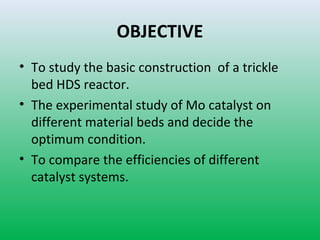
OBJECTIVE
• To study the basic construction of a trickle
bed HDS reactor.
• The experimental study of Mo catalyst on
different material beds and decide the
optimum condition.
• To compare the efficiencies of different
catalyst systems.
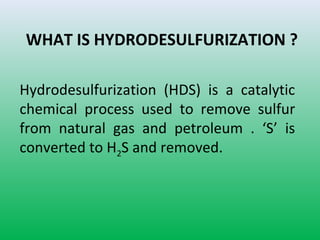
WHAT IS HYDRODESULFURIZATION ?
Hydrodesulfurization (HDS) is a catalytic
chemical process used to remove sulfur
from natural gas and petroleum . ‘S’ is
converted to H2S and removed.
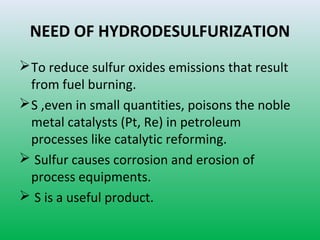
NEED OF HYDRODESULFURIZATION
To reduce sulfur oxides emissions that result
from fuel burning.
S ,even in small quantities, poisons the noble
metal catalysts (Pt, Re) in petroleum
processes like catalytic reforming.
 Sulfur causes corrosion and erosion of
process equipments.
 S is a useful product.
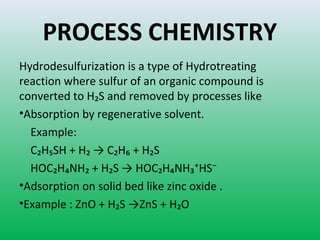
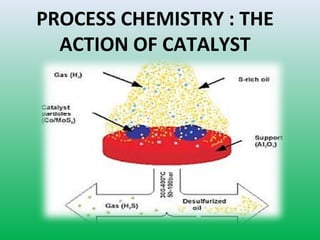
PROCESS CHEMISTRY
Hydrodesulfurization is a type of Hydrotreating
reaction where sulfur of an organic compound is
converted to H₂S and removed by processes like
•Absorption by regenerative solvent.
Example:
C₂H₅SH + H₂ → C₂H₆ + H₂S
HOC₂H₄NH₂ + H₂S → HOC₂H₄NH₃⁺HS⁻
•Adsorption on solid bed like zinc oxide .
•Example : ZnO + H₂S →ZnS + H₂O
PROCESS CHEMISTRY : THE
ACTION OF CATALYST
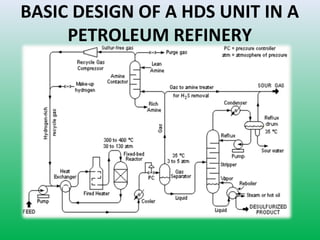
BASIC DESIGN OF A HDS UNIT IN A
PETROLEUM REFINERY
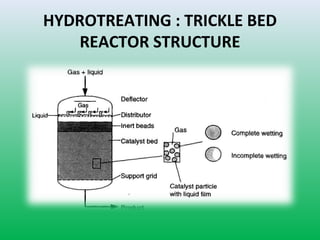
HYDROTREATING : TRICKLE BED
REACTOR STRUCTURE
BASIC DESIGN FEATURES OF A
COMMONLY USED HDS REACTOR
• Generally for liquis crudes a three phase reactor of packed
bed type called trickle bed reactor is used.
• Depth : 3 to 6 m.
• Catalyst prticles spherical with 1/8 to 1/32 in. diameter.
• Temperature 350 to 425°C .
• Pressure 34 to 100 atm.
• Generally cocurrent flow is used.
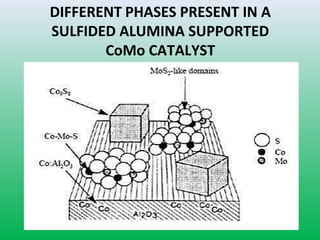
DIFFERENT PHASES PRESENT IN A
SULFIDED ALUMINA SUPPORTED
CoMo CATALYST
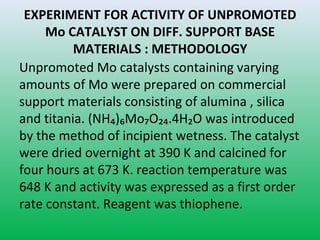
EXPERIMENT FOR ACTIVITY OF UNPROMOTED
Mo CATALYST ON DIFF. SUPPORT BASE
MATERIALS : METHODOLOGY
Unpromoted Mo catalysts containing varying
amounts of Mo were prepared on commercial
support materials consisting of alumina , silica
and titania. (NH₄)₆Mo₇O₂₄.4H₂O was introduced
by the method of incipient wetness. The catalyst
were dried overnight at 390 K and calcined for
four hours at 673 K. reaction temperature was
648 K and activity was expressed as a first order
rate constant. Reagent was thiophene.
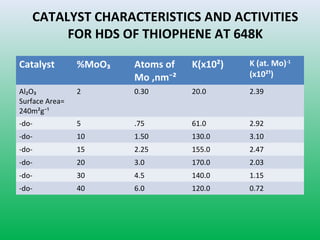
CATALYST CHARACTERISTICS AND ACTIVITIES
FOR HDS OF THIOPHENE AT 648K
Catalyst %MoO₃ Atoms of
Mo ,nm⁻²
K(x10²) K (at. Mo)-1
(x10²¹)
Al₂O₃
Surface Area=
240m²g⁻¹
2 0.30 20.0 2.39
-do- 5 .75 61.0 2.92
-do- 10 1.50 130.0 3.10
-do- 15 2.25 155.0 2.47
-do- 20 3.0 170.0 2.03
-do- 30 4.5 140.0 1.15
-do- 40 6.0 120.0 0.72
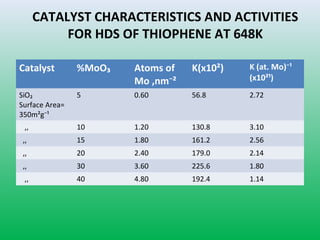
CATALYST CHARACTERISTICS AND ACTIVITIES
FOR HDS OF THIOPHENE AT 648K
Catalyst %MoO₃ Atoms of
Mo ,nm⁻²
K(x10²) K (at. Mo)⁻¹
(x10²¹)
SiO₂
Surface Area=
350m²g⁻¹
5 0.60 56.8 2.72
,, 10 1.20 130.8 3.10
,, 15 1.80 161.2 2.56
,, 20 2.40 179.0 2.14
,, 30 3.60 225.6 1.80
,, 40 4.80 192.4 1.14
CATALYST CHARACTERISTICS AND ACTIVITIES
FOR HDS OF THIOPHENE AT 648K
Catalyst %MoO₃ Atoms of
Mo ,nm⁻²
K(x10²) K (at. Mo)-1
(x10²¹)
TiO₂
Surface Area=
43m²g⁻¹
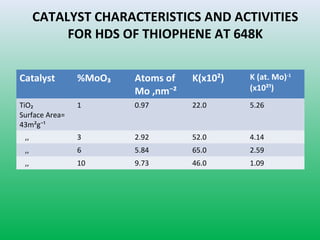
1 0.97 22.0 5.26
,, 3 2.92 52.0 4.14
,, 6 5.84 65.0 2.59
,, 10 9.73 46.0 1.09
CATALYST CHARACTERISTICS AND ACTIVITIES
FOR HDS OF THIOPHENE AT 648K
Catalyst %MoO₃ Atoms of
Mo ,nm⁻²
K(x10²) K (at. Mo)-1
(x10²¹)
ZrO2
Surface Area=
18m²g⁻¹
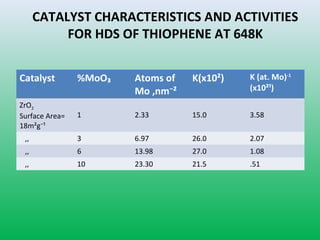
1 2.33 15.0 3.58
,, 3 6.97 26.0 2.07
,, 6 13.98 27.0 1.08
,, 10 23.30 21.5 .51
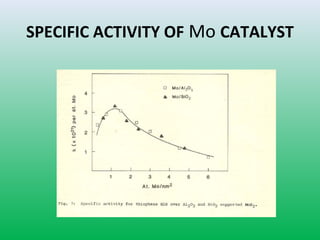
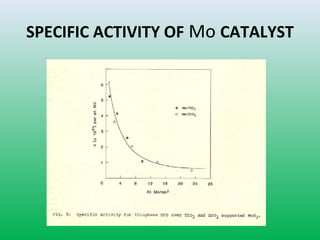
SPECIFIC ACTIVITY OF Mo CATALYST
Application of hydrodesulfuriztion
for natural gas feed at IFFCO, Kalol
• Sulphur compounds are removed from natural
gas 2-3 ppm to less than .1 ppm.
• Desulfurizer operates at a pressure of 39
kg/cm²,temperature 30-35°C.
• Catalyst life is 10 months,catalyst used is
activated carbon.
• Natural gas flow : 20059 kg/hr
• Catalyst volume is 28.3 m³
NEED FOR NEW AND EFFICIENT
CATALYST
Allowable s in environment :
1999 :500 ppm
2001 : 50 ppm
2003 ; 10 ppm
Fossil fuel resources are depleting fast.
Catalyst should have higher mechanical
strength,higher activity,higher tolerance for
contaminants,longer life.
THE NEW CATALYSTS
TiO₂ - Al₂O₃ Composite supports instead of Al₂O₃
Supports, Al₂O₃ - MgO mixed supports.
Au –Pd catalysts
MoC catalysts
Ultrasonically controlled deposition precipitation:
Co–Mo HDS catalysts deposited on wide-pore
ceramic material
Development of mesoporous molecular sieve
materials
The above are indicative examples.
CONCLUSION
In our study of the desulfuriztion of petroleum
crudes we found that same catalyst behaves
differently when placed on different base
supports . So better catalysts can be developed
not only by changing the catalyst material but
also by designing better bed supports.
REFERENCES
1. Perry’s Chemical Engineers Handbook.
2. www.wikipedia.org
3. www.sciencedirect.com
4. Recent Trends in Chemical Reaction Engineering-Vol ii ,
Wiley Eastern Limited.
5. Petroleum Refining Technology : Dr. Ram Prasad : Khanna
Publishers.
6. Data provided by IFFCO , Kalol unit ,Gujarat and ONGC
Dehradun.
7. Elements Of Chemical Reaction Engineering : H.S. Fogler.
THANK YOU!

Presntation hds today

  • 1.
    PROJECT ON HYDRODESULFURIZATION REACTOR DESIGN ByIn the expert guidance of: ALOK SHUKLA Er. T.P.SINGH ANURAG CHANDRA SHEKHAR ASST. PROFESSOR DEEPA KUMAR CHEMICAL ENGG. DEPT. NIVADITA GUPTA (B. TECH. FINAL YEAR )
  • 2.
    OBJECTIVE • To studythe basic construction of a trickle bed HDS reactor. • The experimental study of Mo catalyst on different material beds and decide the optimum condition. • To compare the efficiencies of different catalyst systems.
  • 3.
    WHAT IS HYDRODESULFURIZATION? Hydrodesulfurization (HDS) is a catalytic chemical process used to remove sulfur from natural gas and petroleum . ‘S’ is converted to H2S and removed.
  • 4.
    NEED OF HYDRODESULFURIZATION Toreduce sulfur oxides emissions that result from fuel burning. S ,even in small quantities, poisons the noble metal catalysts (Pt, Re) in petroleum processes like catalytic reforming.  Sulfur causes corrosion and erosion of process equipments.  S is a useful product.
  • 5.
    PROCESS CHEMISTRY Hydrodesulfurization isa type of Hydrotreating reaction where sulfur of an organic compound is converted to H₂S and removed by processes like •Absorption by regenerative solvent. Example: C₂H₅SH + H₂ → C₂H₆ + H₂S HOC₂H₄NH₂ + H₂S → HOC₂H₄NH₃⁺HS⁻ •Adsorption on solid bed like zinc oxide . •Example : ZnO + H₂S →ZnS + H₂O
  • 6.
    PROCESS CHEMISTRY :THE ACTION OF CATALYST
  • 7.
    BASIC DESIGN OFA HDS UNIT IN A PETROLEUM REFINERY
  • 8.
    HYDROTREATING : TRICKLEBED REACTOR STRUCTURE
  • 9.
    BASIC DESIGN FEATURESOF A COMMONLY USED HDS REACTOR • Generally for liquis crudes a three phase reactor of packed bed type called trickle bed reactor is used. • Depth : 3 to 6 m. • Catalyst prticles spherical with 1/8 to 1/32 in. diameter. • Temperature 350 to 425°C . • Pressure 34 to 100 atm. • Generally cocurrent flow is used.
  • 10.
    DIFFERENT PHASES PRESENTIN A SULFIDED ALUMINA SUPPORTED CoMo CATALYST
  • 11.
    EXPERIMENT FOR ACTIVITYOF UNPROMOTED Mo CATALYST ON DIFF. SUPPORT BASE MATERIALS : METHODOLOGY Unpromoted Mo catalysts containing varying amounts of Mo were prepared on commercial support materials consisting of alumina , silica and titania. (NH₄)₆Mo₇O₂₄.4H₂O was introduced by the method of incipient wetness. The catalyst were dried overnight at 390 K and calcined for four hours at 673 K. reaction temperature was 648 K and activity was expressed as a first order rate constant. Reagent was thiophene.
  • 12.
    CATALYST CHARACTERISTICS ANDACTIVITIES FOR HDS OF THIOPHENE AT 648K Catalyst %MoO₃ Atoms of Mo ,nm⁻² K(x10²) K (at. Mo)-1 (x10²¹) Al₂O₃ Surface Area= 240m²g⁻¹ 2 0.30 20.0 2.39 -do- 5 .75 61.0 2.92 -do- 10 1.50 130.0 3.10 -do- 15 2.25 155.0 2.47 -do- 20 3.0 170.0 2.03 -do- 30 4.5 140.0 1.15 -do- 40 6.0 120.0 0.72
  • 13.
    CATALYST CHARACTERISTICS ANDACTIVITIES FOR HDS OF THIOPHENE AT 648K Catalyst %MoO₃ Atoms of Mo ,nm⁻² K(x10²) K (at. Mo)⁻¹ (x10²¹) SiO₂ Surface Area= 350m²g⁻¹ 5 0.60 56.8 2.72 ,, 10 1.20 130.8 3.10 ,, 15 1.80 161.2 2.56 ,, 20 2.40 179.0 2.14 ,, 30 3.60 225.6 1.80 ,, 40 4.80 192.4 1.14
  • 14.
    CATALYST CHARACTERISTICS ANDACTIVITIES FOR HDS OF THIOPHENE AT 648K Catalyst %MoO₃ Atoms of Mo ,nm⁻² K(x10²) K (at. Mo)-1 (x10²¹) TiO₂ Surface Area= 43m²g⁻¹ 1 0.97 22.0 5.26 ,, 3 2.92 52.0 4.14 ,, 6 5.84 65.0 2.59 ,, 10 9.73 46.0 1.09
  • 15.
    CATALYST CHARACTERISTICS ANDACTIVITIES FOR HDS OF THIOPHENE AT 648K Catalyst %MoO₃ Atoms of Mo ,nm⁻² K(x10²) K (at. Mo)-1 (x10²¹) ZrO2 Surface Area= 18m²g⁻¹ 1 2.33 15.0 3.58 ,, 3 6.97 26.0 2.07 ,, 6 13.98 27.0 1.08 ,, 10 23.30 21.5 .51
  • 16.
  • 17.
  • 18.
    Application of hydrodesulfuriztion fornatural gas feed at IFFCO, Kalol • Sulphur compounds are removed from natural gas 2-3 ppm to less than .1 ppm. • Desulfurizer operates at a pressure of 39 kg/cm²,temperature 30-35°C. • Catalyst life is 10 months,catalyst used is activated carbon. • Natural gas flow : 20059 kg/hr • Catalyst volume is 28.3 m³
  • 19.
    NEED FOR NEWAND EFFICIENT CATALYST Allowable s in environment : 1999 :500 ppm 2001 : 50 ppm 2003 ; 10 ppm Fossil fuel resources are depleting fast. Catalyst should have higher mechanical strength,higher activity,higher tolerance for contaminants,longer life.
  • 20.
    THE NEW CATALYSTS TiO₂- Al₂O₃ Composite supports instead of Al₂O₃ Supports, Al₂O₃ - MgO mixed supports. Au –Pd catalysts MoC catalysts Ultrasonically controlled deposition precipitation: Co–Mo HDS catalysts deposited on wide-pore ceramic material Development of mesoporous molecular sieve materials The above are indicative examples.
  • 21.
    CONCLUSION In our studyof the desulfuriztion of petroleum crudes we found that same catalyst behaves differently when placed on different base supports . So better catalysts can be developed not only by changing the catalyst material but also by designing better bed supports.
  • 22.
    REFERENCES 1. Perry’s ChemicalEngineers Handbook. 2. www.wikipedia.org 3. www.sciencedirect.com 4. Recent Trends in Chemical Reaction Engineering-Vol ii , Wiley Eastern Limited. 5. Petroleum Refining Technology : Dr. Ram Prasad : Khanna Publishers. 6. Data provided by IFFCO , Kalol unit ,Gujarat and ONGC Dehradun. 7. Elements Of Chemical Reaction Engineering : H.S. Fogler.
  • 23.