


I MPLEMENTATION OF
V IRTUAL C LASSROOM IN
D ISTANCE L EARNING
P ERSPECTIVE OF
B ANGLADESH
R EPORT I NFO
Chapter 1 Introduction
Chapter 2 Conceptual Background
Chapter 3 Virtual Classroom in
Bangladesh for Distance Learning
Chapter 4 Implementation strategy of
Virtual Classroom for Distance Learning
Chapter 5 Conclusion
V IRTUAL C LASSROOM
V IRTUAL C LASSROOM

 A virtual classroom is a system that
provides the same opportunities for
 the teaching and learning process,
  beyond the physical limits of the
traditional classroom's walls, thanks
        to the use of computer
      communication networks.
C HARACTERISTICS OF V IRTUAL
                 C LASSROOM

Interactivity
Synchrony
Usefulness and Ease of use
Sense of Community
T ECHNOLOGY FOR V IRTUAL
                       C LASSROOM
   Cisco WebEx - http://www.webex.com
   Wimba Collaboration Suite -
    https://wimba.com/products/wimba_collaboration_s
    uite/
   Adobe - http://www.adobe.com
   Moodle VLE - https://vle.wit.ie
   Wiziq -
    http://www.wiziq.com/Virtual_Classroom.aspx
   Visionet - http://www.visionet.in/index.html
A DVANTAGES OF V IRTUAL
      C LASSROOM FOR D ISTANCE
                     L EARNING

   Removal of geographical
    barriers (Anywhere
    learning)
   Quicker to organize
   One to one communication
   Sessions can be recorded
L IMITATIONS OF V IRTUAL
 CLASSROOM OVER T RADITIONAL
                     CLASSROOM
 Familiarity

 Time dependency

 Infrastructure

 Technical Limitations
D ISTANCE E DUCATION /
             L EARNING
D ISTANCE E DUCATION /
                L EARNING

"Distance education is beset with
  a remarkable paradox - it has
   asserted its existence, but it
      cannot define itself.”
F EATURES         OF    D ISTANCE
                                EDUCATION
   Distance education implies that the majority
    of educational communication between
    teacher and student occurs non-contiguously.
   Distance education involves two-way
    communication between teacher and student
    for the purpose of facilitating and supporting
    the educational process.
   Distance education uses technology to
    mediate the necessary two-way
    communication.
VIRTUAL CLASSROOM IN
BANGLADESH FOR DISTANCE
               LEARNING
Bangladesh Virtual Classroom is a project
run by Örebro University (Sweden), Soft-
    Ed Limited and Bangladesh Open
University (BOU), the project is funded by
  SPIDER. Bangladesh Virtual Classroom
project focuses on using electronic means
  to provide education to rural areas in
               Bangladesh.
VIRTUAL CLASSROOM IN
          BANGLADESH FOR
        DISTANCE LEARNING
The project proposed will use mobile
technology’s Short Messaging Service
 along with perceived live telecast to
  create an ‘almost’ ideal classroom
 situation for distance learning using
   the Question based Participation
           (QBP) technique.
IMPLEMENTATION STRATEGY OF
       VIRTUAL CLASSROOM FOR
            DISTANCE LEARNING

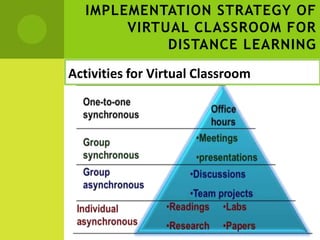
Activities for Virtual Classroom
D IFFERENT STEPS FOR
              IMPLEMENTING VIRTUAL
       CLASSROOM IN B ANGLADESH
   Assess the needs and the necessary
    conditions to satisfy specific target
    group
   Estimate the development cost, effort,
    and implications
   Plan the virtual classroom
   Design the virtual classroom
   Prepare and distribute contents
D IFFERENT STEPS FOR
             IMPLEMENTING VIRTUAL
       CLASSROOM IN B ANGLADESH
   Enable communication
   Implement online student assessment
    methods Teaching
   Implement class management
    procedures
   Set up the system
   Maintain and update the virtual
    classroom
S TEP –O NE
    A SSESS THE NEEDS AND THE
                        NECESSARY
Are there remote students for that
course?
Will they be able to access the course
site and perform all the necessary
interactions?
Is there institutional support and
interest?
Are there administrative policies and
procedures for these cases?
S TEP –T WO
DEVELOPMENT COST, EFFORT, AND
                              IMPLICATIONS
How long is it going to take develops the virtual
classroom?
Which tools will be needed? How much will
they cost? Which equipment will they require?
How many people with which specific will be
needed?
How much will the development impact the
instructor’s workloads?
How much will it impact the teaching methods
used so far?
S TEP –T WO
DEVELOPMENT COST, EFFORT, AND
        IMPLICATIONS ( CONTD .)
What are the institution's Web publishing
and Internet access policies?
How much of the total contents are already
available in electronic format?
What will be the software/hardware
requirements for the client (student)
machine?
What will be the software/hardware
requirements for the server machine?
S TEP –T HREE
P LAN THE VIRTUAL CLASSROOM
What are the educational goals?
How will these goals be
accomplished?
Which goals will possibly not be
accomplished and how can we
compensate for them?
Which approaches could be used to
achieve a given goal? Which of them is
more viable?
S TEP –F OUR
D ESIGN THE VIRTUAL CLASSROOM
 How will the (maybe thousands of) HTML
 pages be structured?
 Can we provide a (preferably consistent)
 "look-and-feel" for the Web pages?
 What should be the layout for a typical
 course page?
 How fancy should the pages be? What is the
 related hardware/software/ technology
 impact?
S TEP –F IVE - P REPARE              AND
         DISTRIBUTE CONTENTS
Which authoring tools should be used?
How to import, create, and edit images?
How to import, create, and edit sounds?
How to import, create, and edit graphics and
animations?
How to import, create, and edit videos?
Where will the Web pages be posted?
S TEP –S IX
    E NABLE   COMMUNICATION


Which form of
communication?
Which tools should be used?
S TEP –S EVEN – I MPLEMENT
  ONLINE STUDENT ASSESSMENT
          METHODS T EACHING
Should the virtual classroom contain quizzes?
What about online assignments?
Should we provide some kind of student
evaluation?
How tests are implemented online?
What about cheating?
How will assignments, tests, etc. be submitted,
graded, and returned to students?
S TEP – E IGHT
I MPLEMENT CLASS MANAGEMENT
                      PROCEDURES

Which type of class management
information is relevant?
Which tools can be used to perform
those tasks?
S TEP – N INE
            S ET UP THE SYSTEM


Which hardware and software
components are necessary?
What is needed to install,
configure, and protect the virtual
classroom contents?
S TEP –T EN
    M AINTAIN AND UPDATE THE
            VIRTUAL CLASSROOM

What are the media, software, and
policies for backup?
Should the site contents and links
also be maintained on a regular
basis?
THANK YOU

Presentaton for cf

  • 1.
    I MPLEMENTATION OF VIRTUAL C LASSROOM IN D ISTANCE L EARNING P ERSPECTIVE OF B ANGLADESH
  • 2.
    R EPORT INFO Chapter 1 Introduction Chapter 2 Conceptual Background Chapter 3 Virtual Classroom in Bangladesh for Distance Learning Chapter 4 Implementation strategy of Virtual Classroom for Distance Learning Chapter 5 Conclusion
  • 3.
    V IRTUAL CLASSROOM
  • 4.
    V IRTUAL CLASSROOM A virtual classroom is a system that provides the same opportunities for the teaching and learning process, beyond the physical limits of the traditional classroom's walls, thanks to the use of computer communication networks.
  • 5.
    C HARACTERISTICS OFV IRTUAL C LASSROOM Interactivity Synchrony Usefulness and Ease of use Sense of Community
  • 6.
    T ECHNOLOGY FORV IRTUAL C LASSROOM  Cisco WebEx - http://www.webex.com  Wimba Collaboration Suite - https://wimba.com/products/wimba_collaboration_s uite/  Adobe - http://www.adobe.com  Moodle VLE - https://vle.wit.ie  Wiziq - http://www.wiziq.com/Virtual_Classroom.aspx  Visionet - http://www.visionet.in/index.html
  • 7.
    A DVANTAGES OFV IRTUAL C LASSROOM FOR D ISTANCE L EARNING  Removal of geographical barriers (Anywhere learning)  Quicker to organize  One to one communication  Sessions can be recorded
  • 8.
    L IMITATIONS OFV IRTUAL CLASSROOM OVER T RADITIONAL CLASSROOM  Familiarity  Time dependency  Infrastructure  Technical Limitations
  • 9.
    D ISTANCE EDUCATION / L EARNING
  • 10.
    D ISTANCE EDUCATION / L EARNING "Distance education is beset with a remarkable paradox - it has asserted its existence, but it cannot define itself.”
  • 11.
    F EATURES OF D ISTANCE EDUCATION  Distance education implies that the majority of educational communication between teacher and student occurs non-contiguously.  Distance education involves two-way communication between teacher and student for the purpose of facilitating and supporting the educational process.  Distance education uses technology to mediate the necessary two-way communication.
  • 12.
    VIRTUAL CLASSROOM IN BANGLADESHFOR DISTANCE LEARNING Bangladesh Virtual Classroom is a project run by Örebro University (Sweden), Soft- Ed Limited and Bangladesh Open University (BOU), the project is funded by SPIDER. Bangladesh Virtual Classroom project focuses on using electronic means to provide education to rural areas in Bangladesh.
  • 13.
    VIRTUAL CLASSROOM IN BANGLADESH FOR DISTANCE LEARNING The project proposed will use mobile technology’s Short Messaging Service along with perceived live telecast to create an ‘almost’ ideal classroom situation for distance learning using the Question based Participation (QBP) technique.
  • 14.
    IMPLEMENTATION STRATEGY OF VIRTUAL CLASSROOM FOR DISTANCE LEARNING Activities for Virtual Classroom
  • 15.
    D IFFERENT STEPSFOR IMPLEMENTING VIRTUAL CLASSROOM IN B ANGLADESH  Assess the needs and the necessary conditions to satisfy specific target group  Estimate the development cost, effort, and implications  Plan the virtual classroom  Design the virtual classroom  Prepare and distribute contents
  • 16.
    D IFFERENT STEPSFOR IMPLEMENTING VIRTUAL CLASSROOM IN B ANGLADESH  Enable communication  Implement online student assessment methods Teaching  Implement class management procedures  Set up the system  Maintain and update the virtual classroom
  • 17.
    S TEP –ONE A SSESS THE NEEDS AND THE NECESSARY Are there remote students for that course? Will they be able to access the course site and perform all the necessary interactions? Is there institutional support and interest? Are there administrative policies and procedures for these cases?
  • 18.
    S TEP –TWO DEVELOPMENT COST, EFFORT, AND IMPLICATIONS How long is it going to take develops the virtual classroom? Which tools will be needed? How much will they cost? Which equipment will they require? How many people with which specific will be needed? How much will the development impact the instructor’s workloads? How much will it impact the teaching methods used so far?
  • 19.
    S TEP –TWO DEVELOPMENT COST, EFFORT, AND IMPLICATIONS ( CONTD .) What are the institution's Web publishing and Internet access policies? How much of the total contents are already available in electronic format? What will be the software/hardware requirements for the client (student) machine? What will be the software/hardware requirements for the server machine?
  • 20.
    S TEP –THREE P LAN THE VIRTUAL CLASSROOM What are the educational goals? How will these goals be accomplished? Which goals will possibly not be accomplished and how can we compensate for them? Which approaches could be used to achieve a given goal? Which of them is more viable?
  • 21.
    S TEP –FOUR D ESIGN THE VIRTUAL CLASSROOM How will the (maybe thousands of) HTML pages be structured? Can we provide a (preferably consistent) "look-and-feel" for the Web pages? What should be the layout for a typical course page? How fancy should the pages be? What is the related hardware/software/ technology impact?
  • 22.
    S TEP –FIVE - P REPARE AND DISTRIBUTE CONTENTS Which authoring tools should be used? How to import, create, and edit images? How to import, create, and edit sounds? How to import, create, and edit graphics and animations? How to import, create, and edit videos? Where will the Web pages be posted?
  • 23.
    S TEP –SIX E NABLE COMMUNICATION Which form of communication? Which tools should be used?
  • 24.
    S TEP –SEVEN – I MPLEMENT ONLINE STUDENT ASSESSMENT METHODS T EACHING Should the virtual classroom contain quizzes? What about online assignments? Should we provide some kind of student evaluation? How tests are implemented online? What about cheating? How will assignments, tests, etc. be submitted, graded, and returned to students?
  • 25.
    S TEP –E IGHT I MPLEMENT CLASS MANAGEMENT PROCEDURES Which type of class management information is relevant? Which tools can be used to perform those tasks?
  • 26.
    S TEP –N INE S ET UP THE SYSTEM Which hardware and software components are necessary? What is needed to install, configure, and protect the virtual classroom contents?
  • 27.
    S TEP –TEN M AINTAIN AND UPDATE THE VIRTUAL CLASSROOM What are the media, software, and policies for backup? Should the site contents and links also be maintained on a regular basis?
  • 30.