International Research Journal of Engineering and Technology (IRJET) e-ISSN: 2395-0056
Volume: 09 Issue: 06 | Jun 2022 www.irjet.net p-ISSN: 2395-0072
© 2022, IRJET | Impact Factor value: 7.529 | ISO 9001:2008 Certified Journal | Page 1389
Analysis of Seismic Behaviors of RC Frame Structure With Bracing
System and Without Bracing System
Shivam Prajapati1, Prof. Siddhartha Deb2, Prof. Satyendra Dubey3
1M-Tech Structural Engg. Studen, Deptt. Of Civil Engg. Gyan Ganga Inst. Of Tech & Science, Jabalpur, M.P. India.
2Assitant Professor Department of Civil Engineering, Gyan Ganga Inst. Of Tech & Science, Jabalpur, M.P. India.
3Associate Professor Department of Civil Engineering, Gyan Ganga Inst. Of Tech & Science, Jabalpur, M.P. India.
---------------------------------------------------------------------***---------------------------------------------------------------------
Abstract – In this research work time history analysis is
carried out for G+23 RC building of square shape 52mX52m
(plan configuration) frame structure without and with
different steel bracing system viz. X, V, inverted V, Eccen
Forward, Eccen Back. The member property of beams 300mm
X 400mm and columns300mmX500mmandISLB250sections
are used to compare for same patterns of beam, column and
bracings. We provide different seismic and other parameters
like Seismic Zone- III, Soil Site factor 2 for Medium Soil,
Damping = 5% (as per table-3 clause 6.4.2), Zone factor for
zone III, Z=0.16), Importance Factor I=1.5 (Important
structure as per Table-6), Response Reduction Factor R=5 for
Special steel moment resisting frame Table-7), Sa/g=Average
acceleration coefficient (depend on Natural fundamental
period)Grade of concrete is considered M25, Grade of Rebar is
considered Fe-415, Grade of Steel –Fe-345,Dead Load forWall
12.88 KN/m, Dead Load for Slab 3 KN/m2. . The property of
the section is used as IS 456:2016 and per IS 800:2007 by
using Etab Software and analyzed as per 1893-2016 by
Response Spectrum Method. The comparative analysis is done
in the term of storey displacement.
Key Words: Retrofit, ,Seismi analysis, braced RC structures,
Seismic Zone, types of Soil, Steel Brace, RC Structure, Etab
Software’s etc.
1. INTRODUCTION
The concrete structure with Steel braced frame is one
amongst the structural system comfortable repel the
earthquake masses within the multistorey buildings,several
existing bolstered cement concrete buildings must be
retrofitting to beat deficiencies to resist seismal masses. the
employment of steel bracing systems for strengthening or
retrofitting seismically light concrete frames could be a
viable answer for enhancing tremor confrontation.
The primary purpose of every kind of structural systems
employed in the building form of structures is to transfer
gravity masses effectively. the foremost common masses
ensuing from the result of gravity ar loading, load and snow
load. Besides these vertical masses, buildings also are
subjected to lateral masses caused by wind, blasting or
earthquake. Lateral masses will develop high stresses, turn
out sway movement or cause vibration. Therefore, it's
important for the structure to own ample strength against
vertical masses along with adequatestiffnesstoresistlateral
forces. Strengthening of structures proves to be a more
robust choice business to the economic issues and
immediate shelterissuesinsteadofreplacementofbuildings.
Hence, we all know this retrofittingandwhilenotretrofitting
structure within which economical as compared to every
different structure. Therefore, seismal retrofitting or
strengthening of building structures is one amongst the
foremost vital aspects for mitigating seismal hazards
particularly in earthquake prone areas.
1.1 BUILDING CONFIGURATIONS
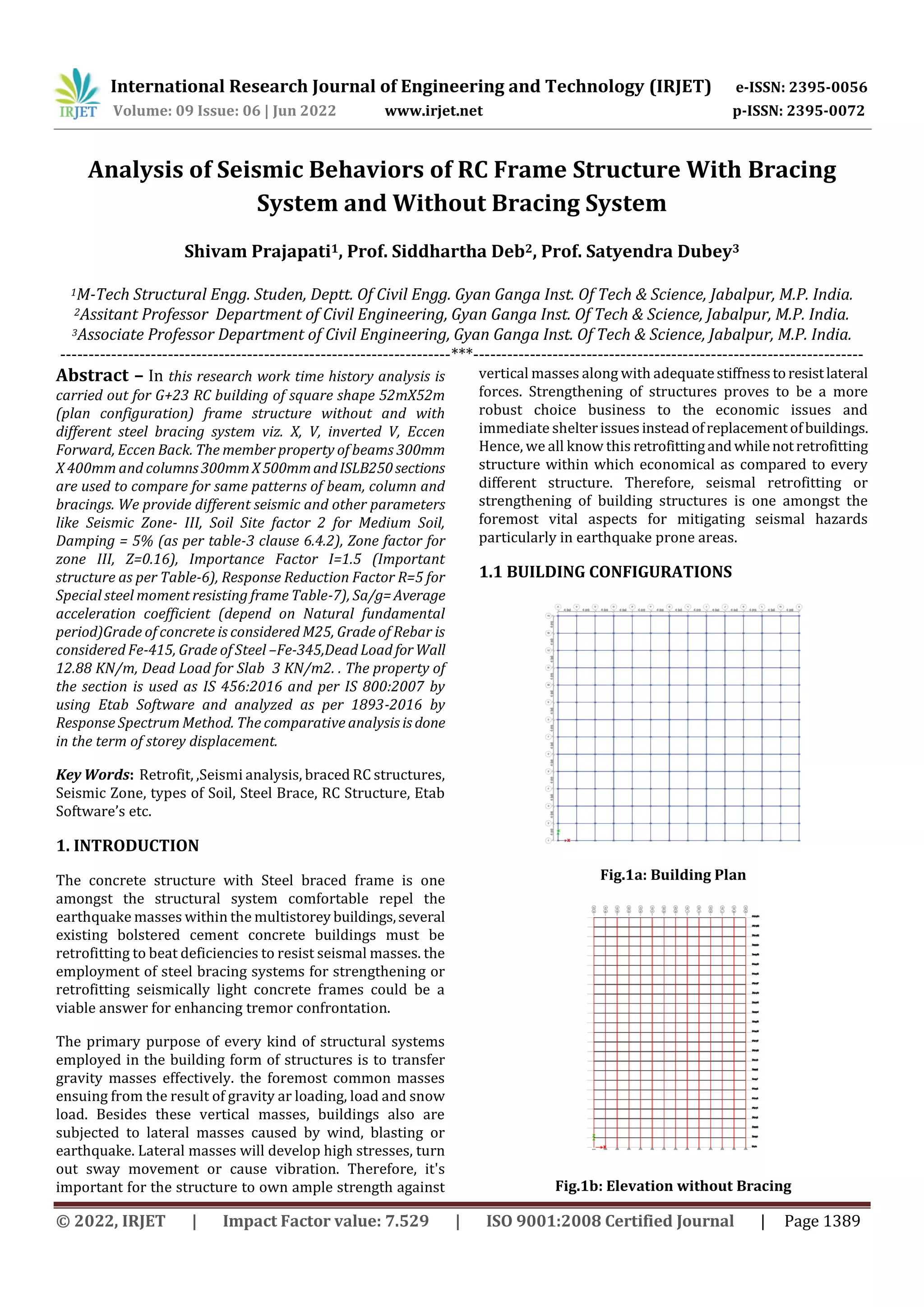
Fig.1a: Building Plan
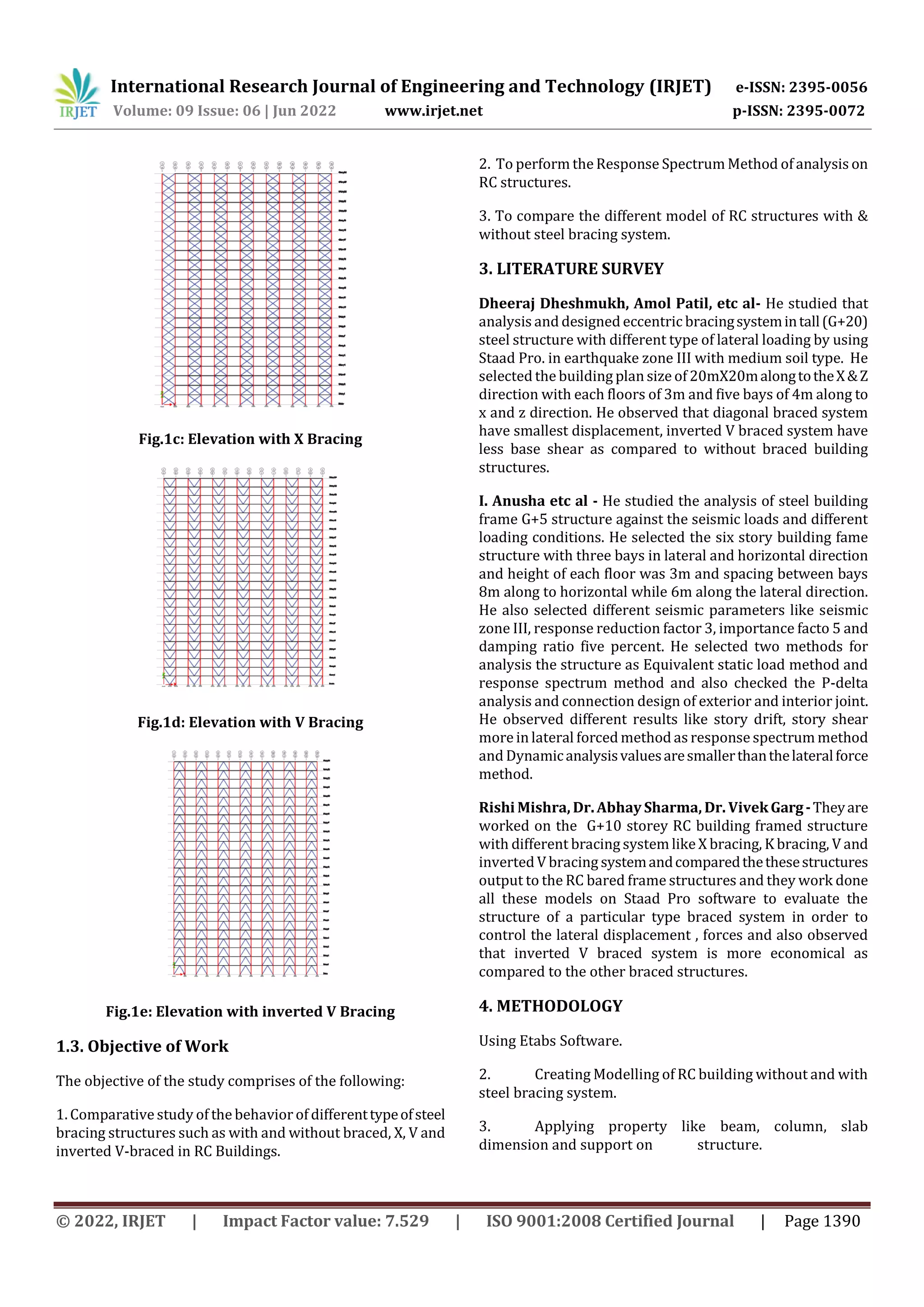
Fig.1b: Elevation without Bracing
International Research Journal of Engineering and Technology (IRJET) e-ISSN: 2395-0056
Volume: 09 Issue: 06 | Jun 2022 www.irjet.net p-ISSN: 2395-0072
© 2022, IRJET | Impact Factor value: 7.529 | ISO 9001:2008 Certified Journal | Page 1390
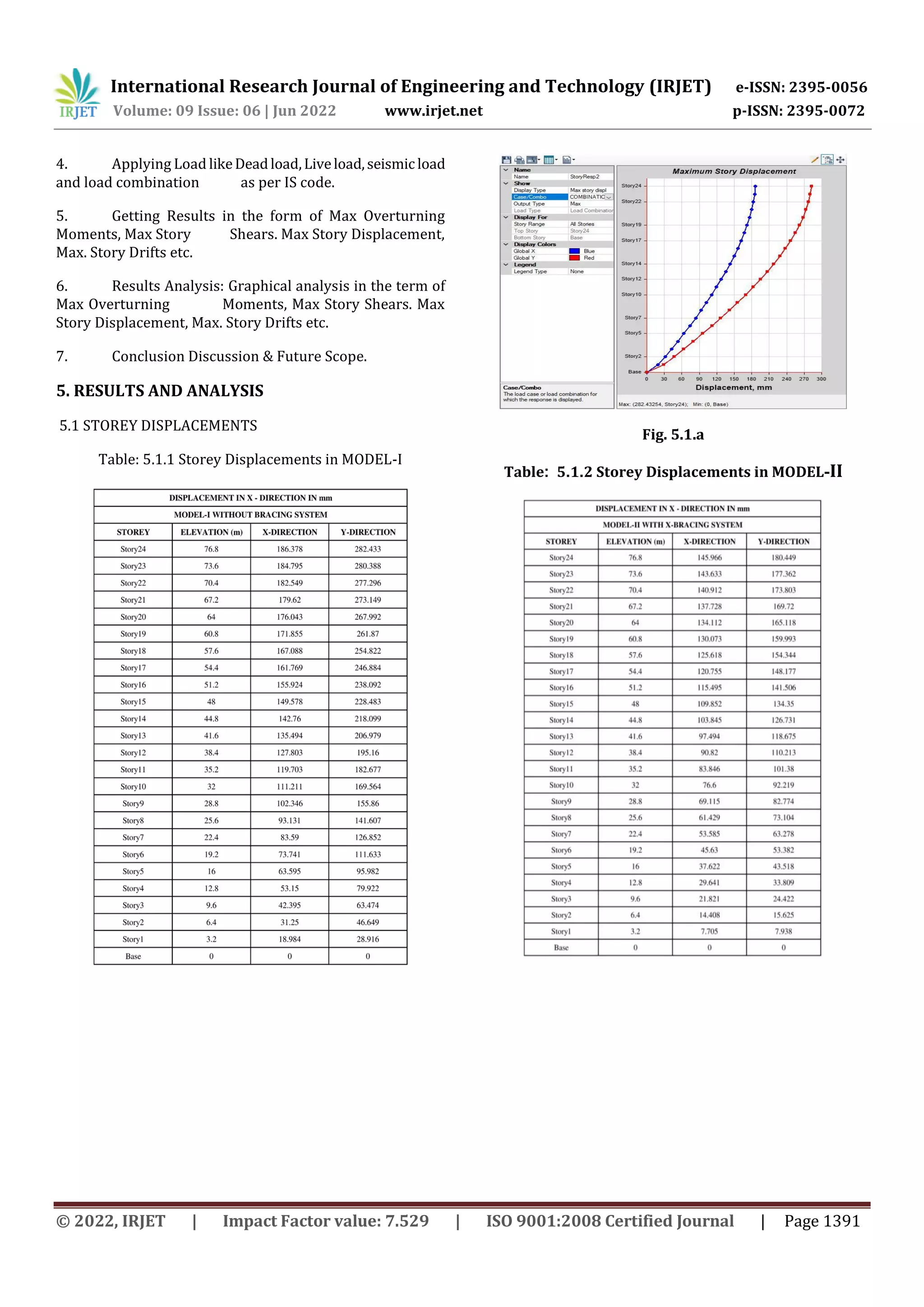
Fig.1c: Elevation with X Bracing
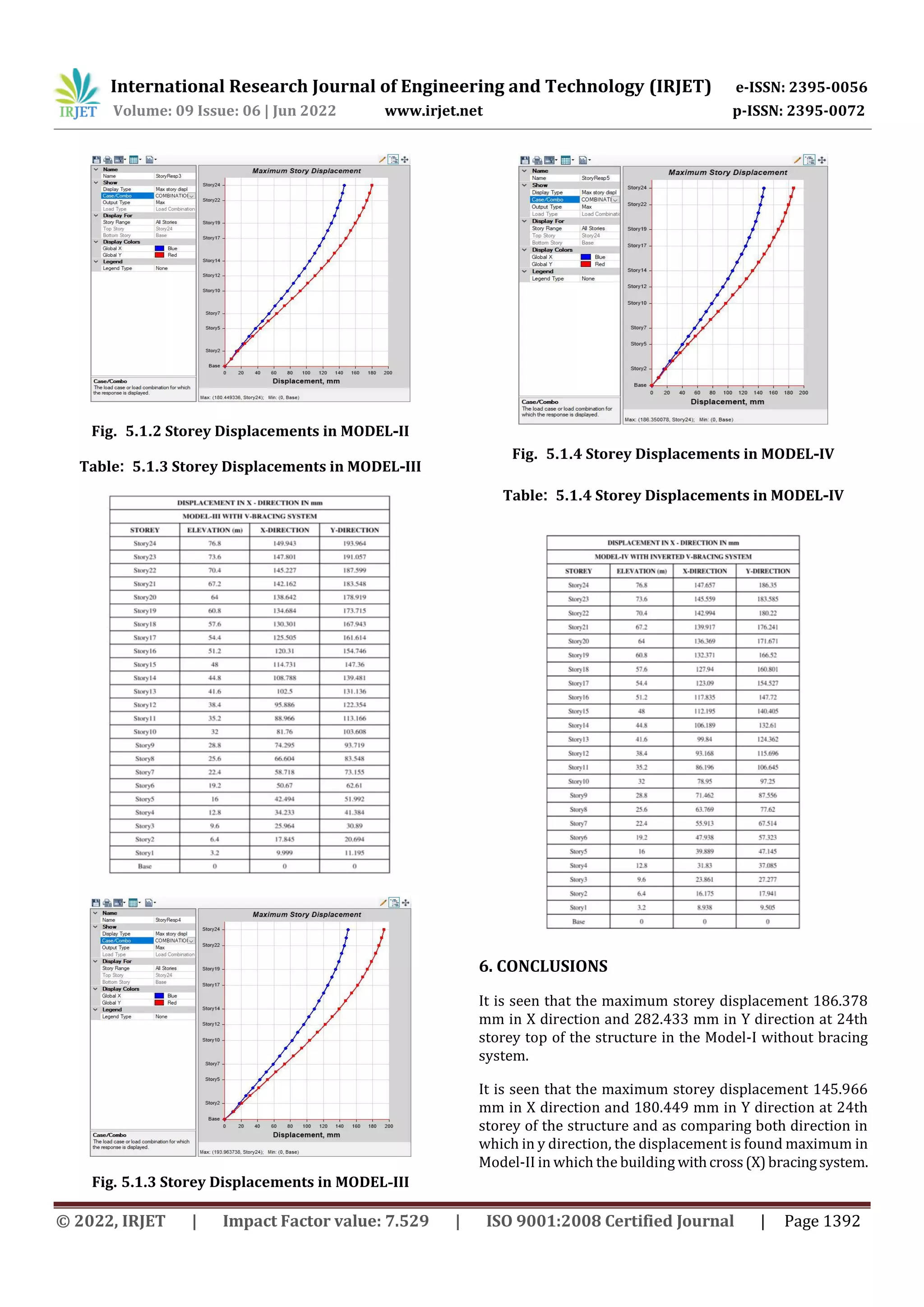
Fig.1d: Elevation with V Bracing
Fig.1e: Elevation with inverted V Bracing
1.3. Objective of Work
The objective of the study comprises of the following:
1. Comparative study of the behavior of differenttypeofsteel
bracing structures such as with and without braced, X, V and
inverted V-braced in RC Buildings.
2. To perform the Response Spectrum Method of analysis on
RC structures.
3. To compare the different model of RC structures with &
without steel bracing system.
3. LITERATURE SURVEY
Dheeraj Dheshmukh, Amol Patil, etc al- He studied that
analysis and designed eccentric bracingsystemintall(G+20)
steel structure with different type of lateral loading by using
Staad Pro. in earthquake zone III with medium soil type. He
selected the building plan size of 20mX20malongtotheX&Z
direction with each floors of 3m and five bays of 4m along to
x and z direction. He observed that diagonal braced system
have smallest displacement, inverted V braced system have
less base shear as compared to without braced building
structures.
I. Anusha etc al - He studied the analysis of steel building
frame G+5 structure against the seismic loads and different
loading conditions. He selected the six story building fame
structure with three bays in lateral and horizontal direction
and height of each floor was 3m and spacing between bays
8m along to horizontal while 6m along the lateral direction.
He also selected different seismic parameters like seismic
zone III, response reduction factor 3, importance facto 5 and
damping ratio five percent. He selected two methods for
analysis the structure as Equivalent static load method and
response spectrum method and also checked the P-delta
analysis and connection design of exterior and interior joint.
He observed different results like story drift, story shear
more in lateral forced method as response spectrum method
and Dynamicanalysisvaluesaresmallerthanthelateralforce
method.
Rishi Mishra, Dr. Abhay Sharma, Dr. VivekGarg-Theyare
worked on the G+10 storey RC building framed structure
with different bracing system like X bracing, K bracing, V and
inverted V bracing systemandcomparedthethesestructures
output to the RC bared frame structures and they work done
all these models on Staad Pro software to evaluate the
structure of a particular type braced system in order to
control the lateral displacement , forces and also observed
that inverted V braced system is more economical as
compared to the other braced structures.
4. METHODOLOGY
Using Etabs Software.
2. Creating Modelling of RC building without and with
steel bracing system.
3. Applying property like beam, column, slab
dimension and support on structure.
International Research Journal of Engineering and Technology (IRJET) e-ISSN: 2395-0056
Volume: 09 Issue: 06 | Jun 2022 www.irjet.net p-ISSN: 2395-0072
© 2022, IRJET | Impact Factor value: 7.529 | ISO 9001:2008 Certified Journal | Page 1391
4. Applying Load likeDeadload,Liveload,seismicload
and load combination as per IS code.
5. Getting Results in the form of Max Overturning
Moments, Max Story Shears. Max Story Displacement,
Max. Story Drifts etc.
6. Results Analysis: Graphical analysis in the term of
Max Overturning Moments, Max Story Shears. Max
Story Displacement, Max. Story Drifts etc.
7. Conclusion Discussion & Future Scope.
5. RESULTS AND ANALYSIS
5.1 STOREY DISPLACEMENTS
Table: 5.1.1 Storey Displacements in MODEL-I
Fig. 5.1.a
Table: 5.1.2 Storey Displacements in MODEL-II
International Research Journal of Engineering and Technology (IRJET) e-ISSN: 2395-0056
Volume: 09 Issue: 06 | Jun 2022 www.irjet.net p-ISSN: 2395-0072
© 2022, IRJET | Impact Factor value: 7.529 | ISO 9001:2008 Certified Journal | Page 1392
Fig. 5.1.2 Storey Displacements in MODEL-II
Table: 5.1.3 Storey Displacements in MODEL-III
Fig. 5.1.3 Storey Displacements in MODEL-III
Fig. 5.1.4 Storey Displacements in MODEL-IV
Table: 5.1.4 Storey Displacements in MODEL-IV
6. CONCLUSIONS
It is seen that the maximum storey displacement 186.378
mm in X direction and 282.433 mm in Y direction at 24th
storey top of the structure in the Model-I without bracing
system.
It is seen that the maximum storey displacement 145.966
mm in X direction and 180.449 mm in Y direction at 24th
storey of the structure and as comparing both direction in
which in y direction, the displacement is found maximum in
Model-II in which the building withcross(X)bracingsystem.
International Research Journal of Engineering and Technology (IRJET) e-ISSN: 2395-0056
Volume: 09 Issue: 06 | Jun 2022 www.irjet.net p-ISSN: 2395-0072
© 2022, IRJET | Impact Factor value: 7.529 | ISO 9001:2008 Certified Journal | Page 1393
It is found that the maximum storey displacement 149.943
mm in X direction and 193.964 mm in Y direction at top of
the structure in Model-III with V bracing system.
It is seen that the maximum storey displacement 147.657
mm in X direction and 186.350 mm in Y direction at top of
the structure in model-IV with inverted V bracing system.
REFERENCES
[1] Viswanath K.G, Prakash K.B., Anant Desai, “Seismic
Analysis of Steel Braced Reinforced Concrete Frames”
International Journal ofCivil andStructural Engineering,
Volume 1, No 1, 2010
[2] Venkatesh S.V., H. Sharada Bai., Divya S.P., “Response of
a 3-Dimensional 2 X 3 Bays Ten Storey RC Frame with
Steel Bracings as Lateral Load Resisting Systems
Subjected To Seismic Load” International Journal of
Scientific & Engineering Research Volume 4, Issue 5,
May-2013.
[3] Yogendra Singh, “Lateral Load Resisting Systems for
MultiStorey Buildings” 4] M.D. Kevadkar, P.B. Kodag,
“Lateral Load Analysis of R.C.C Building”, International
Journal of Modern Engineering Research (IJMER),Vol.3,
Issue.3, May-June. 2013
[4] Dr. Vinod Hosur, “Earthquake-Resistant Design of
Building Structures”, Wiley India Pvt. Ltd, New Delhi,
India.
[5] S.K.Duggal, “Earthquake ResistantDesignofStructures”,
Oxford University Press.
[6] IS 1893 (Part 1): 2002, “Criteria for Earthquake
Resistant Design of Structures”, Bureau of Indian
Standards, New Delhi.

Analysis of Seismic Behaviors of RC Frame Structure With Bracing System and Without Bracing System

  • 1.
    International Research Journalof Engineering and Technology (IRJET) e-ISSN: 2395-0056 Volume: 09 Issue: 06 | Jun 2022 www.irjet.net p-ISSN: 2395-0072 © 2022, IRJET | Impact Factor value: 7.529 | ISO 9001:2008 Certified Journal | Page 1389 Analysis of Seismic Behaviors of RC Frame Structure With Bracing System and Without Bracing System Shivam Prajapati1, Prof. Siddhartha Deb2, Prof. Satyendra Dubey3 1M-Tech Structural Engg. Studen, Deptt. Of Civil Engg. Gyan Ganga Inst. Of Tech & Science, Jabalpur, M.P. India. 2Assitant Professor Department of Civil Engineering, Gyan Ganga Inst. Of Tech & Science, Jabalpur, M.P. India. 3Associate Professor Department of Civil Engineering, Gyan Ganga Inst. Of Tech & Science, Jabalpur, M.P. India. ---------------------------------------------------------------------***--------------------------------------------------------------------- Abstract – In this research work time history analysis is carried out for G+23 RC building of square shape 52mX52m (plan configuration) frame structure without and with different steel bracing system viz. X, V, inverted V, Eccen Forward, Eccen Back. The member property of beams 300mm X 400mm and columns300mmX500mmandISLB250sections are used to compare for same patterns of beam, column and bracings. We provide different seismic and other parameters like Seismic Zone- III, Soil Site factor 2 for Medium Soil, Damping = 5% (as per table-3 clause 6.4.2), Zone factor for zone III, Z=0.16), Importance Factor I=1.5 (Important structure as per Table-6), Response Reduction Factor R=5 for Special steel moment resisting frame Table-7), Sa/g=Average acceleration coefficient (depend on Natural fundamental period)Grade of concrete is considered M25, Grade of Rebar is considered Fe-415, Grade of Steel –Fe-345,Dead Load forWall 12.88 KN/m, Dead Load for Slab 3 KN/m2. . The property of the section is used as IS 456:2016 and per IS 800:2007 by using Etab Software and analyzed as per 1893-2016 by Response Spectrum Method. The comparative analysis is done in the term of storey displacement. Key Words: Retrofit, ,Seismi analysis, braced RC structures, Seismic Zone, types of Soil, Steel Brace, RC Structure, Etab Software’s etc. 1. INTRODUCTION The concrete structure with Steel braced frame is one amongst the structural system comfortable repel the earthquake masses within the multistorey buildings,several existing bolstered cement concrete buildings must be retrofitting to beat deficiencies to resist seismal masses. the employment of steel bracing systems for strengthening or retrofitting seismically light concrete frames could be a viable answer for enhancing tremor confrontation. The primary purpose of every kind of structural systems employed in the building form of structures is to transfer gravity masses effectively. the foremost common masses ensuing from the result of gravity ar loading, load and snow load. Besides these vertical masses, buildings also are subjected to lateral masses caused by wind, blasting or earthquake. Lateral masses will develop high stresses, turn out sway movement or cause vibration. Therefore, it's important for the structure to own ample strength against vertical masses along with adequatestiffnesstoresistlateral forces. Strengthening of structures proves to be a more robust choice business to the economic issues and immediate shelterissuesinsteadofreplacementofbuildings. Hence, we all know this retrofittingandwhilenotretrofitting structure within which economical as compared to every different structure. Therefore, seismal retrofitting or strengthening of building structures is one amongst the foremost vital aspects for mitigating seismal hazards particularly in earthquake prone areas. 1.1 BUILDING CONFIGURATIONS Fig.1a: Building Plan Fig.1b: Elevation without Bracing
  • 2.
    International Research Journalof Engineering and Technology (IRJET) e-ISSN: 2395-0056 Volume: 09 Issue: 06 | Jun 2022 www.irjet.net p-ISSN: 2395-0072 © 2022, IRJET | Impact Factor value: 7.529 | ISO 9001:2008 Certified Journal | Page 1390 Fig.1c: Elevation with X Bracing Fig.1d: Elevation with V Bracing Fig.1e: Elevation with inverted V Bracing 1.3. Objective of Work The objective of the study comprises of the following: 1. Comparative study of the behavior of differenttypeofsteel bracing structures such as with and without braced, X, V and inverted V-braced in RC Buildings. 2. To perform the Response Spectrum Method of analysis on RC structures. 3. To compare the different model of RC structures with & without steel bracing system. 3. LITERATURE SURVEY Dheeraj Dheshmukh, Amol Patil, etc al- He studied that analysis and designed eccentric bracingsystemintall(G+20) steel structure with different type of lateral loading by using Staad Pro. in earthquake zone III with medium soil type. He selected the building plan size of 20mX20malongtotheX&Z direction with each floors of 3m and five bays of 4m along to x and z direction. He observed that diagonal braced system have smallest displacement, inverted V braced system have less base shear as compared to without braced building structures. I. Anusha etc al - He studied the analysis of steel building frame G+5 structure against the seismic loads and different loading conditions. He selected the six story building fame structure with three bays in lateral and horizontal direction and height of each floor was 3m and spacing between bays 8m along to horizontal while 6m along the lateral direction. He also selected different seismic parameters like seismic zone III, response reduction factor 3, importance facto 5 and damping ratio five percent. He selected two methods for analysis the structure as Equivalent static load method and response spectrum method and also checked the P-delta analysis and connection design of exterior and interior joint. He observed different results like story drift, story shear more in lateral forced method as response spectrum method and Dynamicanalysisvaluesaresmallerthanthelateralforce method. Rishi Mishra, Dr. Abhay Sharma, Dr. VivekGarg-Theyare worked on the G+10 storey RC building framed structure with different bracing system like X bracing, K bracing, V and inverted V bracing systemandcomparedthethesestructures output to the RC bared frame structures and they work done all these models on Staad Pro software to evaluate the structure of a particular type braced system in order to control the lateral displacement , forces and also observed that inverted V braced system is more economical as compared to the other braced structures. 4. METHODOLOGY Using Etabs Software. 2. Creating Modelling of RC building without and with steel bracing system. 3. Applying property like beam, column, slab dimension and support on structure.
  • 3.
    International Research Journalof Engineering and Technology (IRJET) e-ISSN: 2395-0056 Volume: 09 Issue: 06 | Jun 2022 www.irjet.net p-ISSN: 2395-0072 © 2022, IRJET | Impact Factor value: 7.529 | ISO 9001:2008 Certified Journal | Page 1391 4. Applying Load likeDeadload,Liveload,seismicload and load combination as per IS code. 5. Getting Results in the form of Max Overturning Moments, Max Story Shears. Max Story Displacement, Max. Story Drifts etc. 6. Results Analysis: Graphical analysis in the term of Max Overturning Moments, Max Story Shears. Max Story Displacement, Max. Story Drifts etc. 7. Conclusion Discussion & Future Scope. 5. RESULTS AND ANALYSIS 5.1 STOREY DISPLACEMENTS Table: 5.1.1 Storey Displacements in MODEL-I Fig. 5.1.a Table: 5.1.2 Storey Displacements in MODEL-II
  • 4.
    International Research Journalof Engineering and Technology (IRJET) e-ISSN: 2395-0056 Volume: 09 Issue: 06 | Jun 2022 www.irjet.net p-ISSN: 2395-0072 © 2022, IRJET | Impact Factor value: 7.529 | ISO 9001:2008 Certified Journal | Page 1392 Fig. 5.1.2 Storey Displacements in MODEL-II Table: 5.1.3 Storey Displacements in MODEL-III Fig. 5.1.3 Storey Displacements in MODEL-III Fig. 5.1.4 Storey Displacements in MODEL-IV Table: 5.1.4 Storey Displacements in MODEL-IV 6. CONCLUSIONS It is seen that the maximum storey displacement 186.378 mm in X direction and 282.433 mm in Y direction at 24th storey top of the structure in the Model-I without bracing system. It is seen that the maximum storey displacement 145.966 mm in X direction and 180.449 mm in Y direction at 24th storey of the structure and as comparing both direction in which in y direction, the displacement is found maximum in Model-II in which the building withcross(X)bracingsystem.
  • 5.
    International Research Journalof Engineering and Technology (IRJET) e-ISSN: 2395-0056 Volume: 09 Issue: 06 | Jun 2022 www.irjet.net p-ISSN: 2395-0072 © 2022, IRJET | Impact Factor value: 7.529 | ISO 9001:2008 Certified Journal | Page 1393 It is found that the maximum storey displacement 149.943 mm in X direction and 193.964 mm in Y direction at top of the structure in Model-III with V bracing system. It is seen that the maximum storey displacement 147.657 mm in X direction and 186.350 mm in Y direction at top of the structure in model-IV with inverted V bracing system. REFERENCES [1] Viswanath K.G, Prakash K.B., Anant Desai, “Seismic Analysis of Steel Braced Reinforced Concrete Frames” International Journal ofCivil andStructural Engineering, Volume 1, No 1, 2010 [2] Venkatesh S.V., H. Sharada Bai., Divya S.P., “Response of a 3-Dimensional 2 X 3 Bays Ten Storey RC Frame with Steel Bracings as Lateral Load Resisting Systems Subjected To Seismic Load” International Journal of Scientific & Engineering Research Volume 4, Issue 5, May-2013. [3] Yogendra Singh, “Lateral Load Resisting Systems for MultiStorey Buildings” 4] M.D. Kevadkar, P.B. Kodag, “Lateral Load Analysis of R.C.C Building”, International Journal of Modern Engineering Research (IJMER),Vol.3, Issue.3, May-June. 2013 [4] Dr. Vinod Hosur, “Earthquake-Resistant Design of Building Structures”, Wiley India Pvt. Ltd, New Delhi, India. [5] S.K.Duggal, “Earthquake ResistantDesignofStructures”, Oxford University Press. [6] IS 1893 (Part 1): 2002, “Criteria for Earthquake Resistant Design of Structures”, Bureau of Indian Standards, New Delhi.