Imaging of Wrist joint
DR RAKIB AHMAD WANI
PG III YEAR
Introduction
• This joint is a complex joint in upper limb
• Consists of articulations of Radius, ulna,
carpus and carpo-metacarpal bones
• To evaluate and interpret wrist images one
should be fully aware of the anatomy
• X ray serves as basic tool while MRI serves to
answer the issues of soft tissues
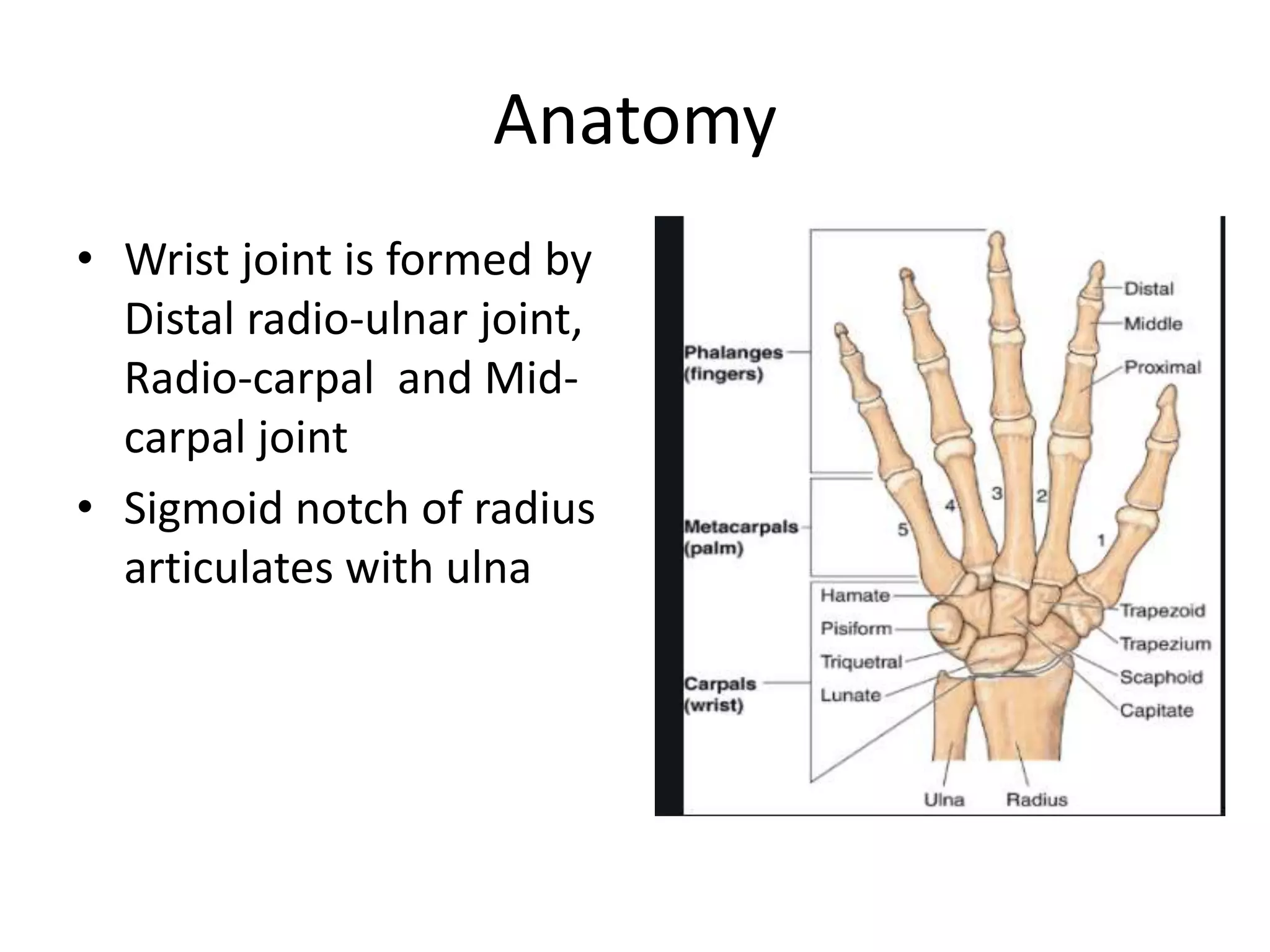
Anatomy
• Wrist joint is formed by
Distal radio-ulnar joint,
Radio-carpal and Mid-
carpal joint
• Sigmoid notch of radius
articulates with ulna
X ray wrist
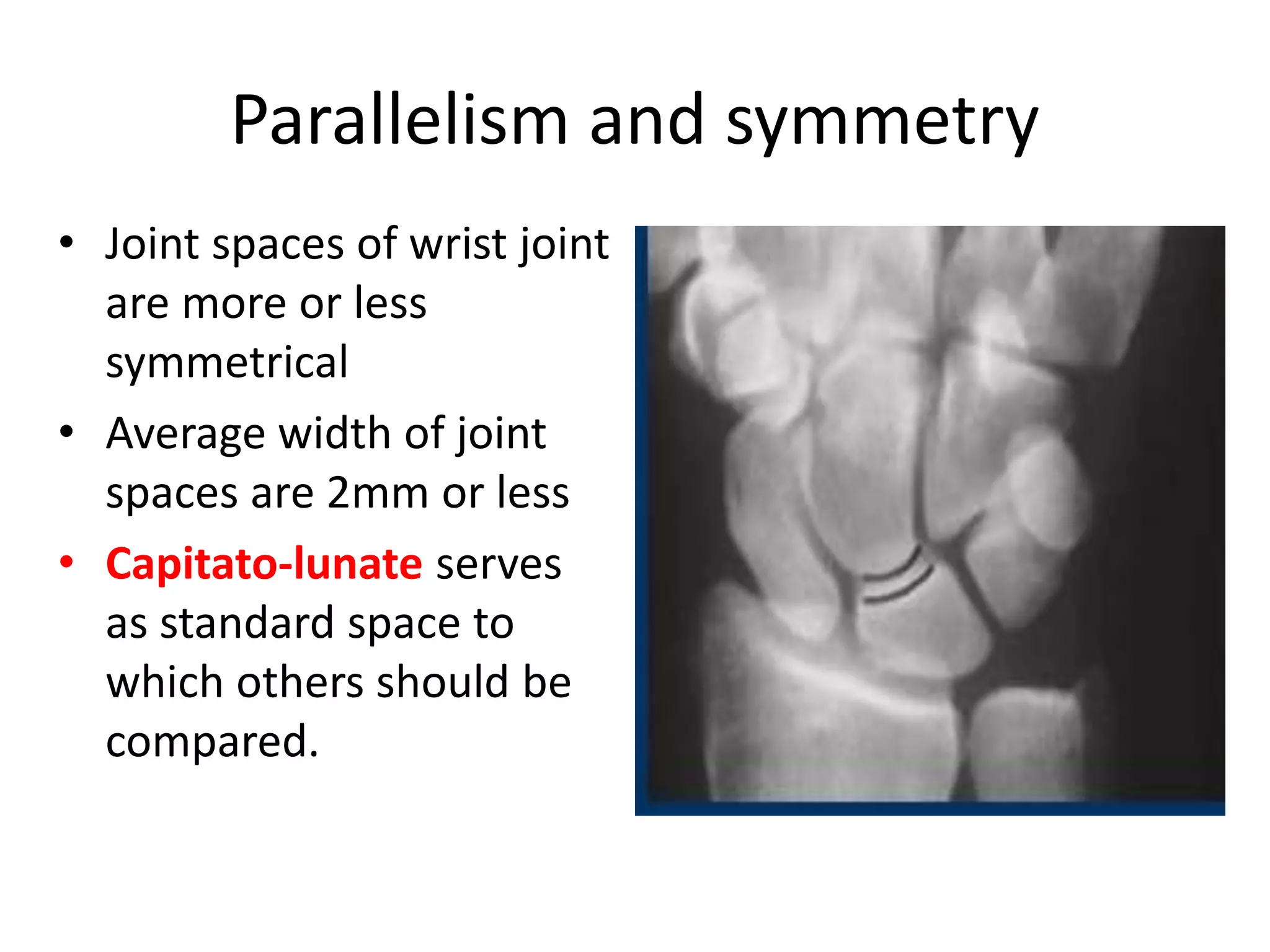
Parallelism and symmetry
• Joint spaces of wrist joint
are more or less
symmetrical
• Average width of joint
spaces are 2mm or less
• Capitato-lunate serves
as standard space to
which others should be
compared.
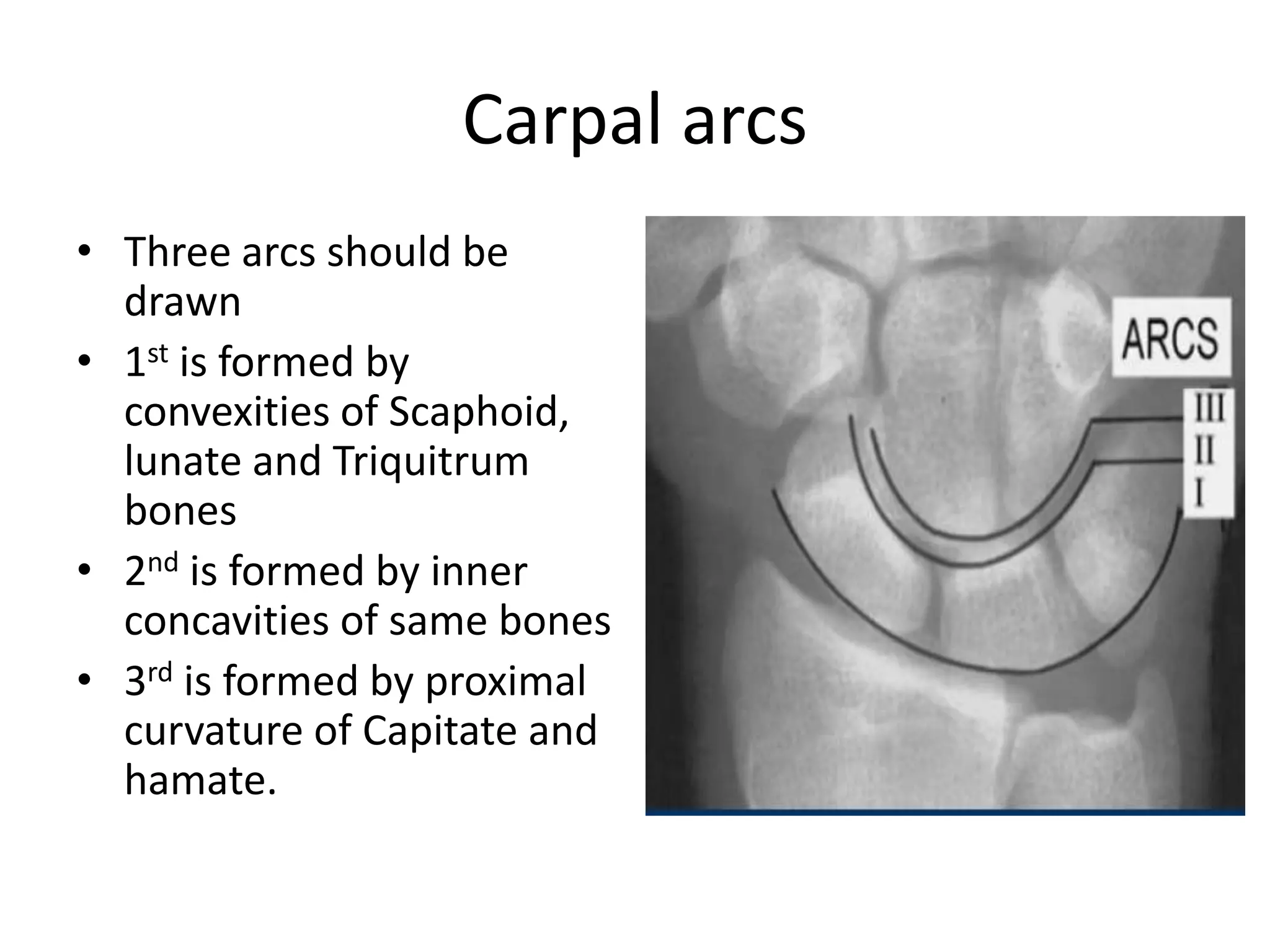
Carpal arcs
• Three arcs should be
drawn
• 1st is formed by
convexities of Scaphoid,
lunate and Triquitrum
bones
• 2nd is formed by inner
concavities of same bones
• 3rd is formed by proximal
curvature of Capitate and
hamate.
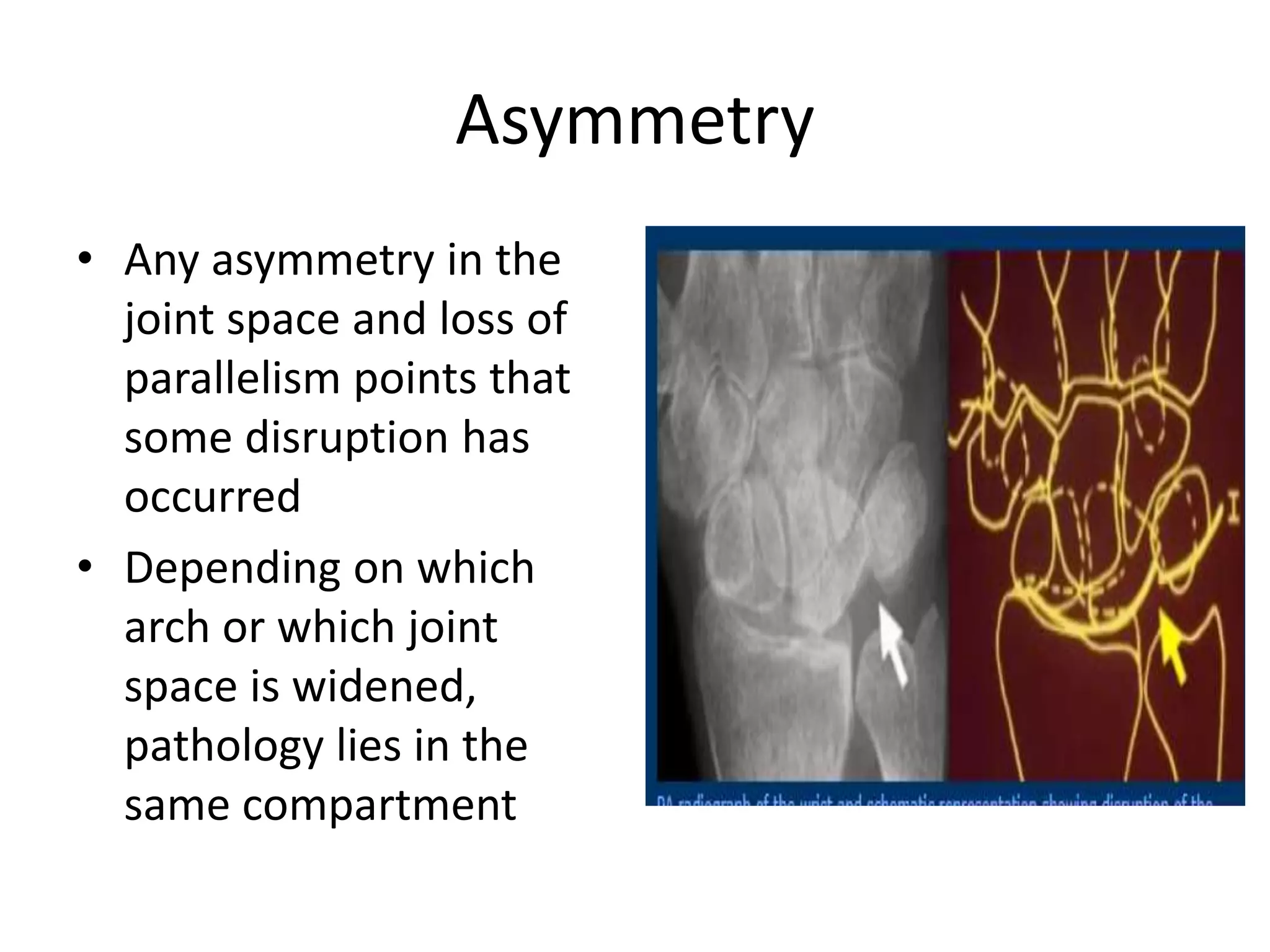
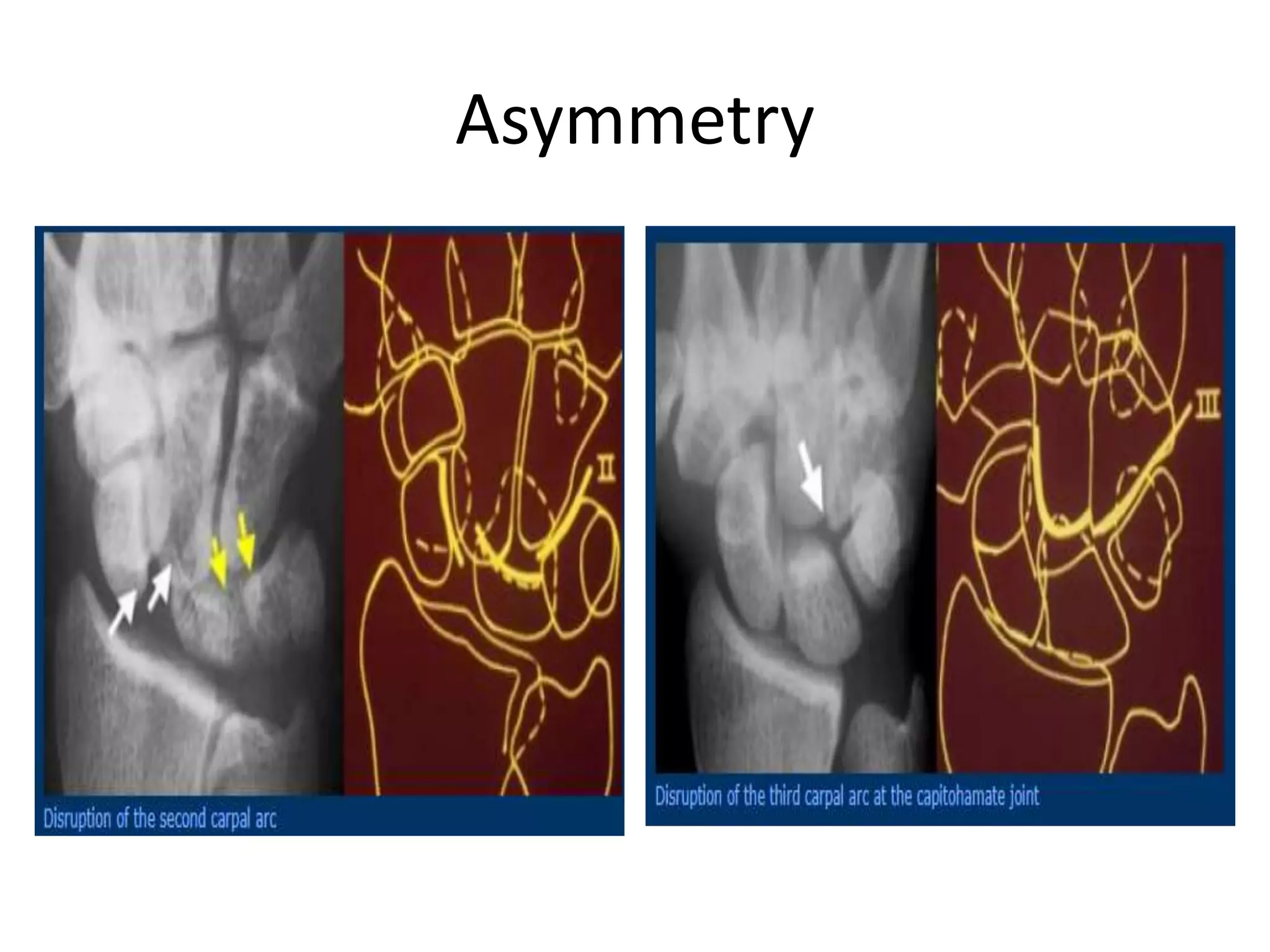
Asymmetry
• Any asymmetry in the
joint space and loss of
parallelism points that
some disruption has
occurred
• Depending on which
arch or which joint
space is widened,
pathology lies in the
same compartment
Asymmetry
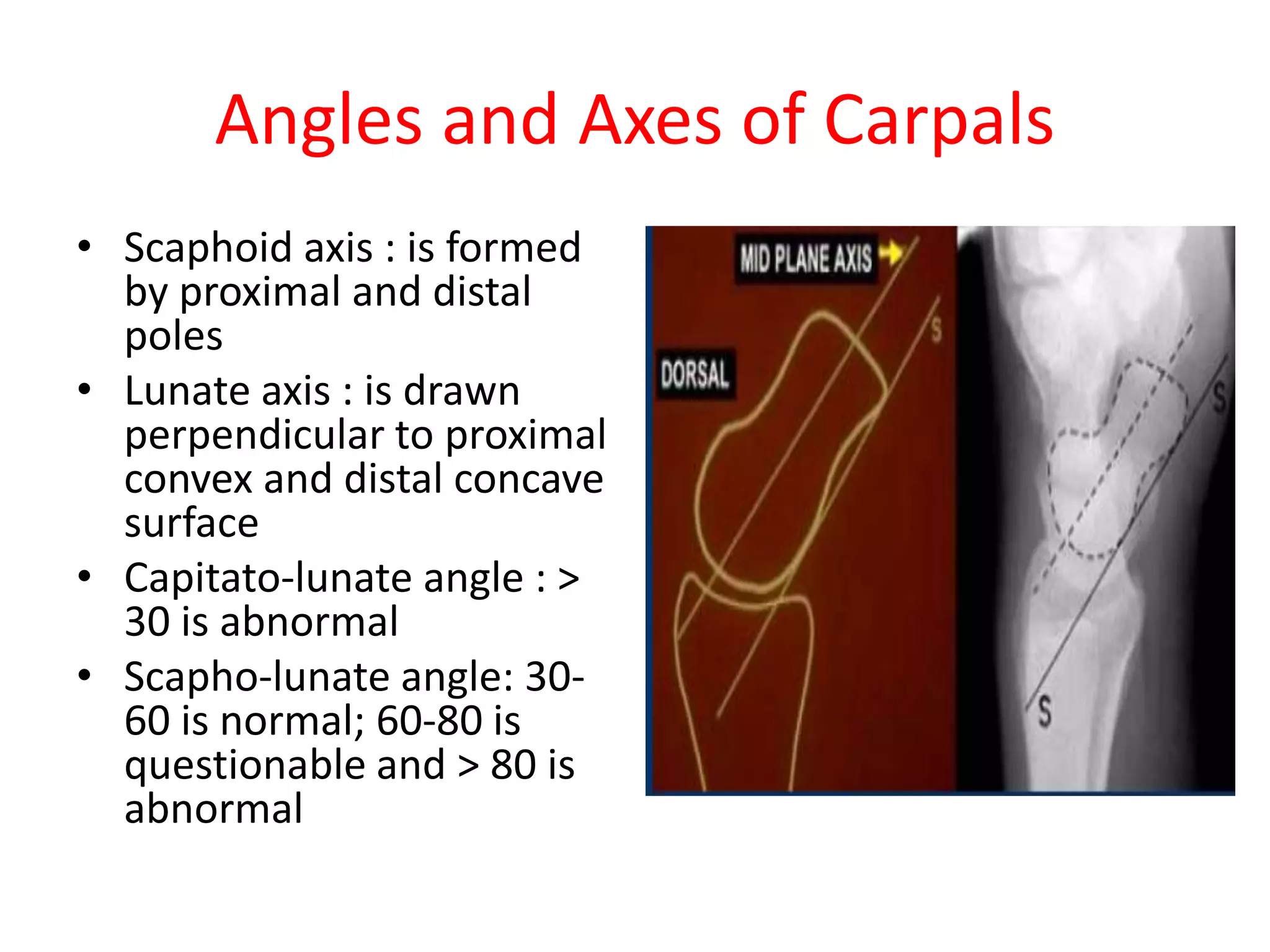
Angles and Axes of Carpals
• Scaphoid axis : is formed
by proximal and distal
poles
• Lunate axis : is drawn
perpendicular to proximal
convex and distal concave
surface
• Capitato-lunate angle : >
30 is abnormal
• Scapho-lunate angle: 30-
60 is normal; 60-80 is
questionable and > 80 is
abnormal
Axes and Angles
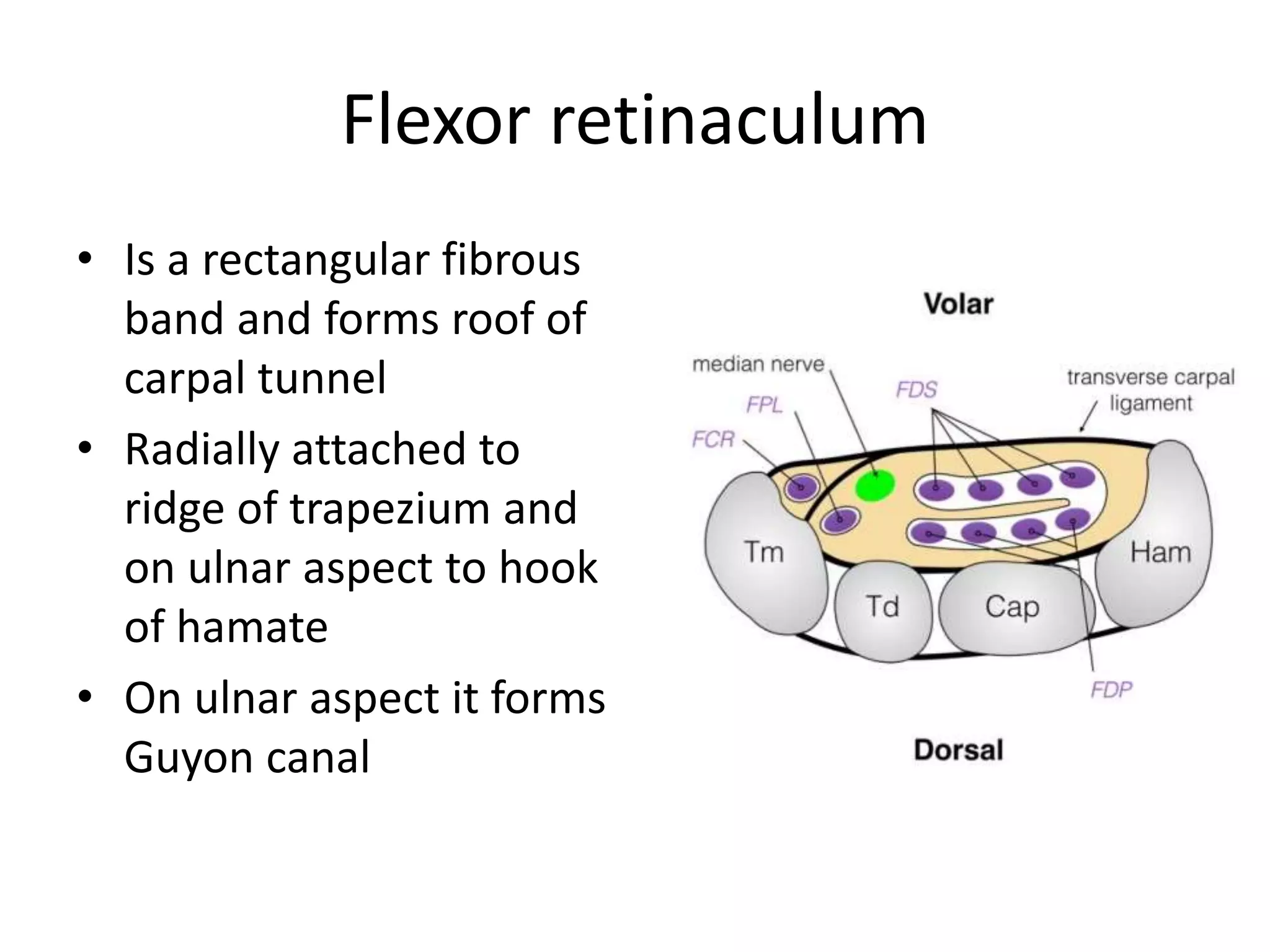
Flexor retinaculum
• Is a rectangular fibrous
band and forms roof of
carpal tunnel
• Radially attached to
ridge of trapezium and
on ulnar aspect to hook
of hamate
• On ulnar aspect it forms
Guyon canal
Flexor retinaculum
Guyon’s canal
• Is a fibro-osseous
tunnel that contains
ulnar neuro-vascular
bundle
• Landmarks are deep to
FCU, Lateral to Pisiform
and at the hook of
hamate
Extensor Tendons
• On dorsal aspect,
tendons are divided
into 6 compartments
• Lister tubercle is
important landmark
that separates II and III
compartment.
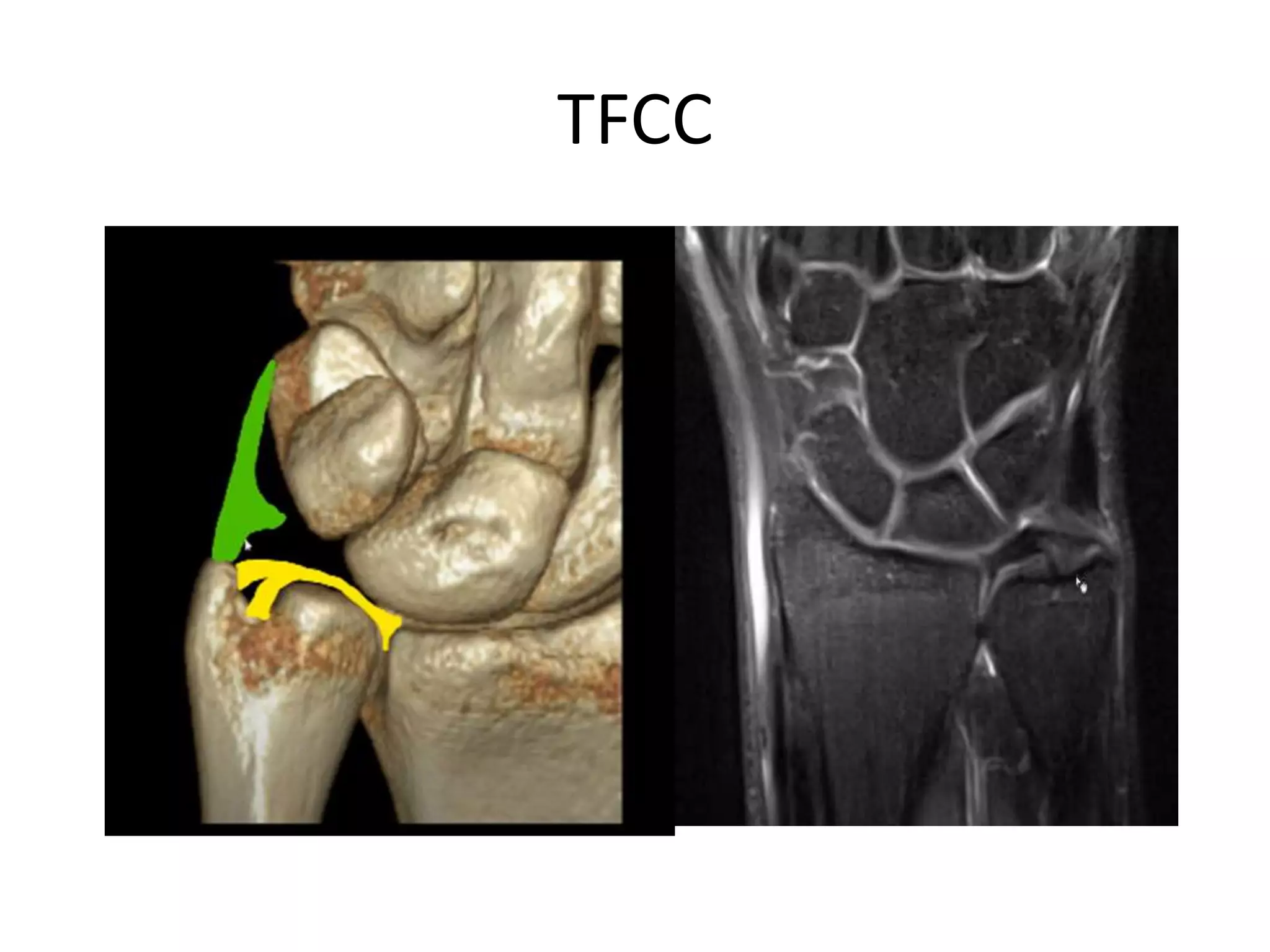
Triangular Fibro-Cartilage complex
• It is a complex structure
has various parts :
Triangular fibro-
cartilage ; Radio-ulnar ;
ulno-carpal; Meniscal
homologue; ECU
tendon and ulnar
collateral ligament.
TFCC
TFCC
RU ligaments
Inter-carpal ligaments
• These are stabilizers of the wrist joint and are
divided into extrinsic and intrinsic parts.
• Intrinsic : Scapho-lunate, Luno-triquetral are
important ones .
TFCC.
• Extrinsic: volar, Dorsal, RCL and UCL
Inter-carpal ligaments
• The two important
ligaments are in the
proximal row : scapho-
lunate and luno-
triquitrum.
• The first one is
pyramidal and latter is
horse shoe in shape
Pathologies
TFCC Tear
• It can be traumatic in
young in radial end and
degenerative in elderly at
ulnar end
• Presents with ulnar side
wrist pain
• Seen as fluid intensity
signal along the ulna
• Discontinuity of complex
is seen on MR
arthrogram.
TFCC Tear
Palmer classification
• class 1
a) central perforation
b) Ulnar avulsion with or
without ulnar fracture
c) Avulsion of Ulno-
triquetral and ulno-
ilunate ligament
d) Radial avulsion of TFCC
• Class 2
a) TFCC wear with thinning
without perforation
b) TFCC wear with
ulnar/lunate/triquetral
chondromalacia
c) TFCC perforation with
chondromalacia
d) Luno-triquetral perf with
2a/2b or 2c
e) Any of above with ulno-
carpal arthritis
Scapho-lunate dissociation
• Is aka rotatory
subluxation of scaphoid.
• Refers to abnormal
orientation of scaphoid
and lunate and is due to
injury to the scapho-
lunate ligament
• Relative flexion of
scaphoid with relative
extension of lunate is
typical pattern
• On x ray widened
Scapho-lunate interval
of >4mm is seen
• Increase in Scapho-
lunate angle >60 degree
• On MRI examination, It
is seen as discontinuity
of the Scapho-lunate
ligament along with
joint effusion.
SL dissociation
Terry Thomas sign MRI imaging
SL Tear Grading
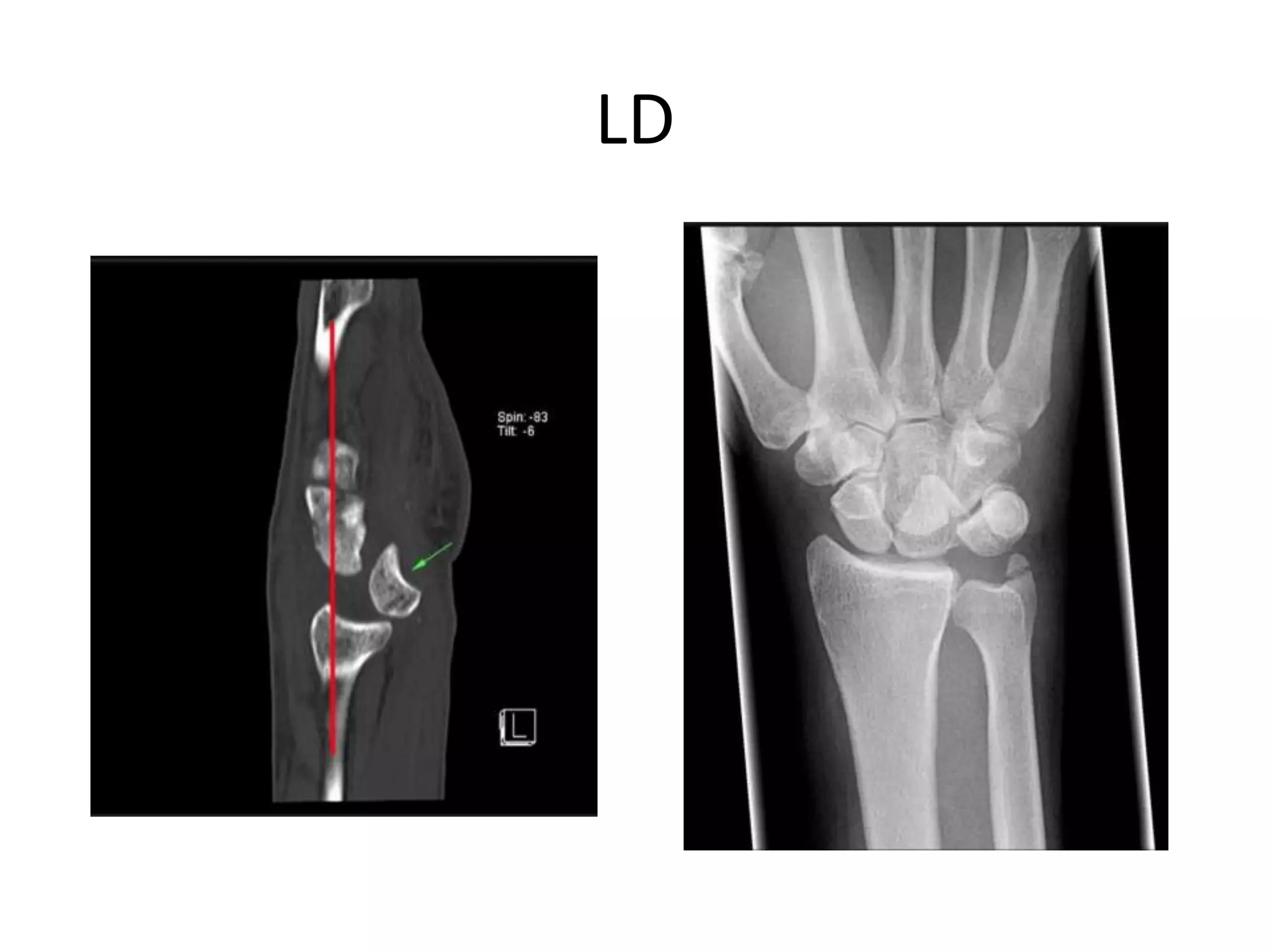
Lunate Dislocations
• These are uncommon traumatic wrist
injuries .
• Lunate is displaced and rotated volarly.
• Occurs due to fall on out-stretched hand.
• Lunate shows “Piece of Pie sign”
• Rest of the bones are well aligned with
maintained symmetry.
LD
Peri-lunate dislocation
• Are potentially closed wrist injuries and
involve the carpus relative to lunate
• involves scapho-lunate and Luno-
triquetral ligaments
• In this pathology, the Capitate (apple)
doesn’t sit in the concavity of Lunate
(Cup)
Dorsal and Volar intercalated
segment instability
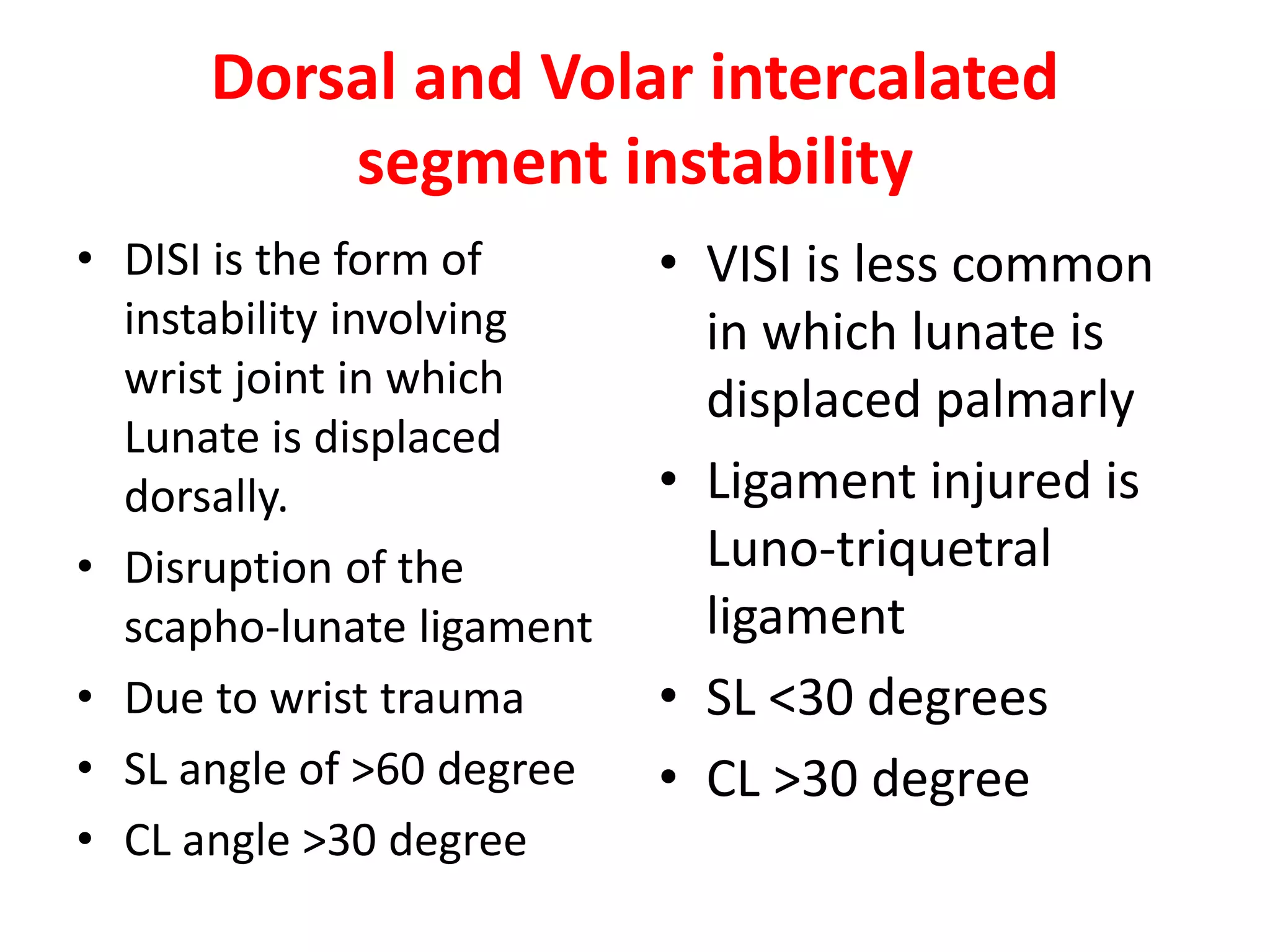
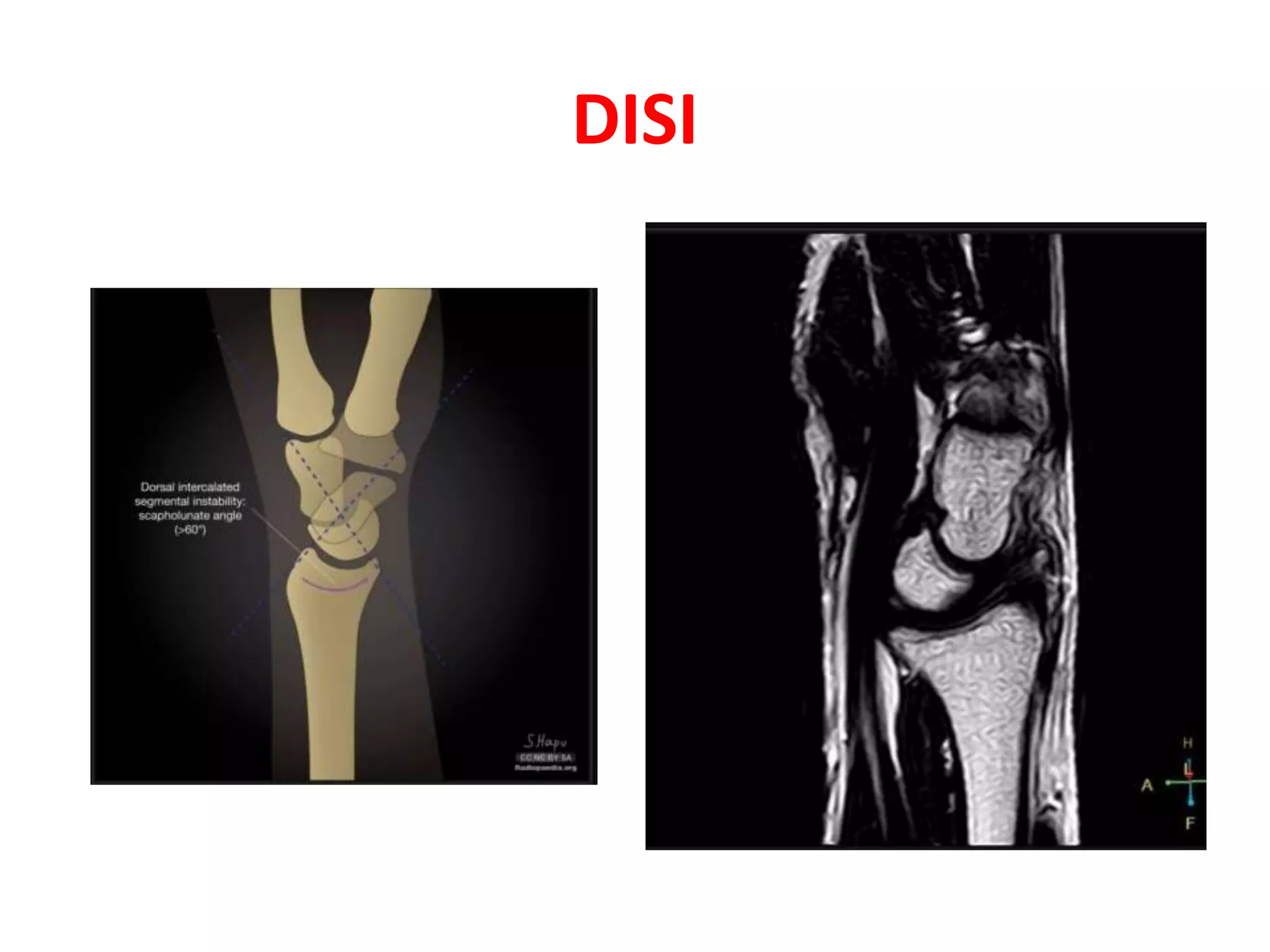
• DISI is the form of
instability involving
wrist joint in which
Lunate is displaced
dorsally.
• Disruption of the
scapho-lunate ligament
• Due to wrist trauma
• SL angle of >60 degree
• CL angle >30 degree
• VISI is less common
in which lunate is
displaced palmarly
• Ligament injured is
Luno-triquetral
ligament
• SL <30 degrees
• CL >30 degree
DISI
VISI
Ulnar variance
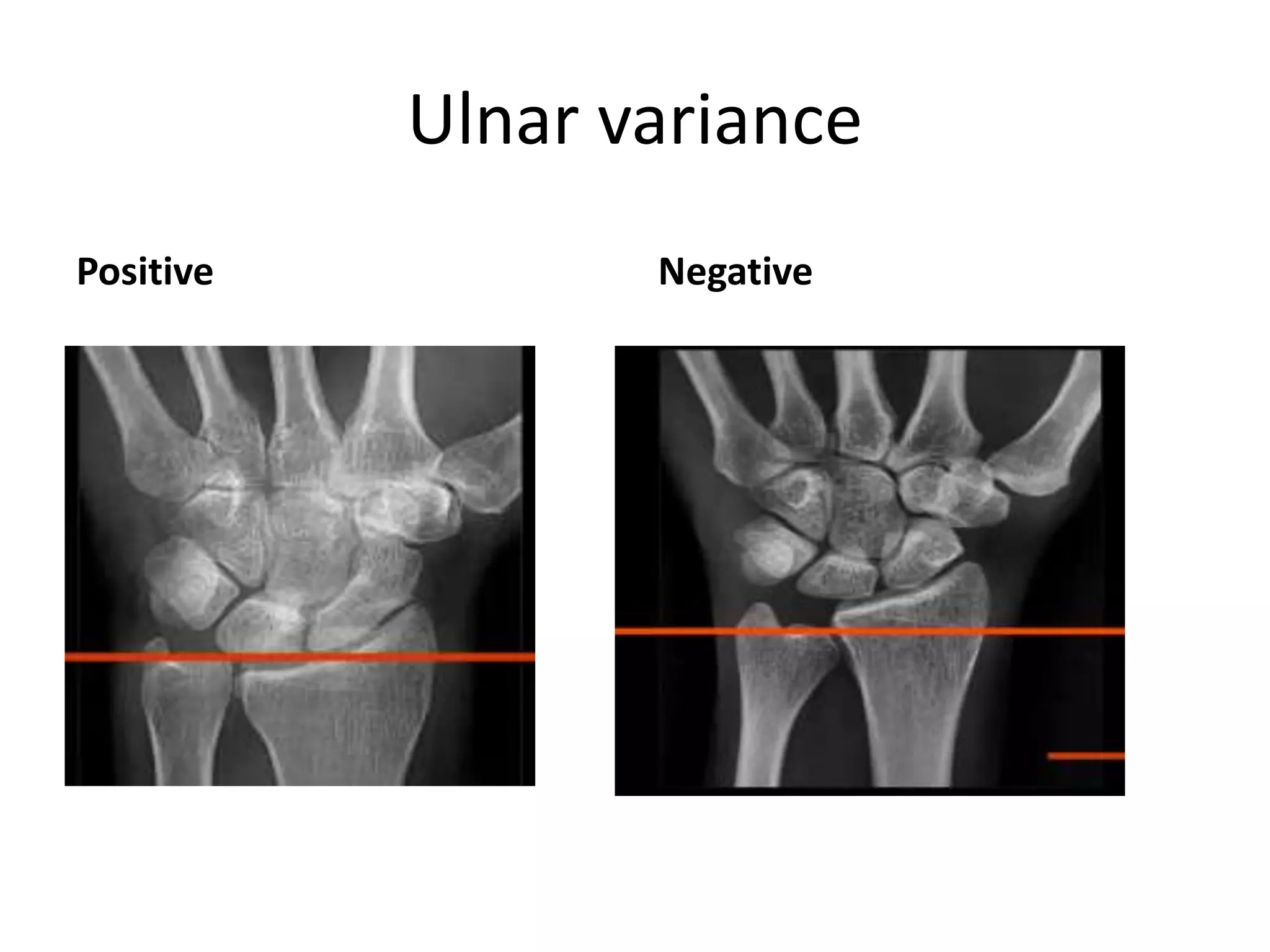
• It is defined as the relative length of distal end of ulna
wrt radius
• If ulna is shorter than radius it is called Negative ulnar
variance
• If ulna is longer than radius it is called positive ulnar
variance
• If both are equal it is called neutral variance
• On radiographs Positive variance is when the level of
the ulna is >2.5 mm beyond the radius margin at the
distal radio-ulnar joint and negative variance is when
the ulna is ≤2.5 mm than the radius at the DRUJ
Ulnar variance
Positive Negative
Ulnar impaction syndrome
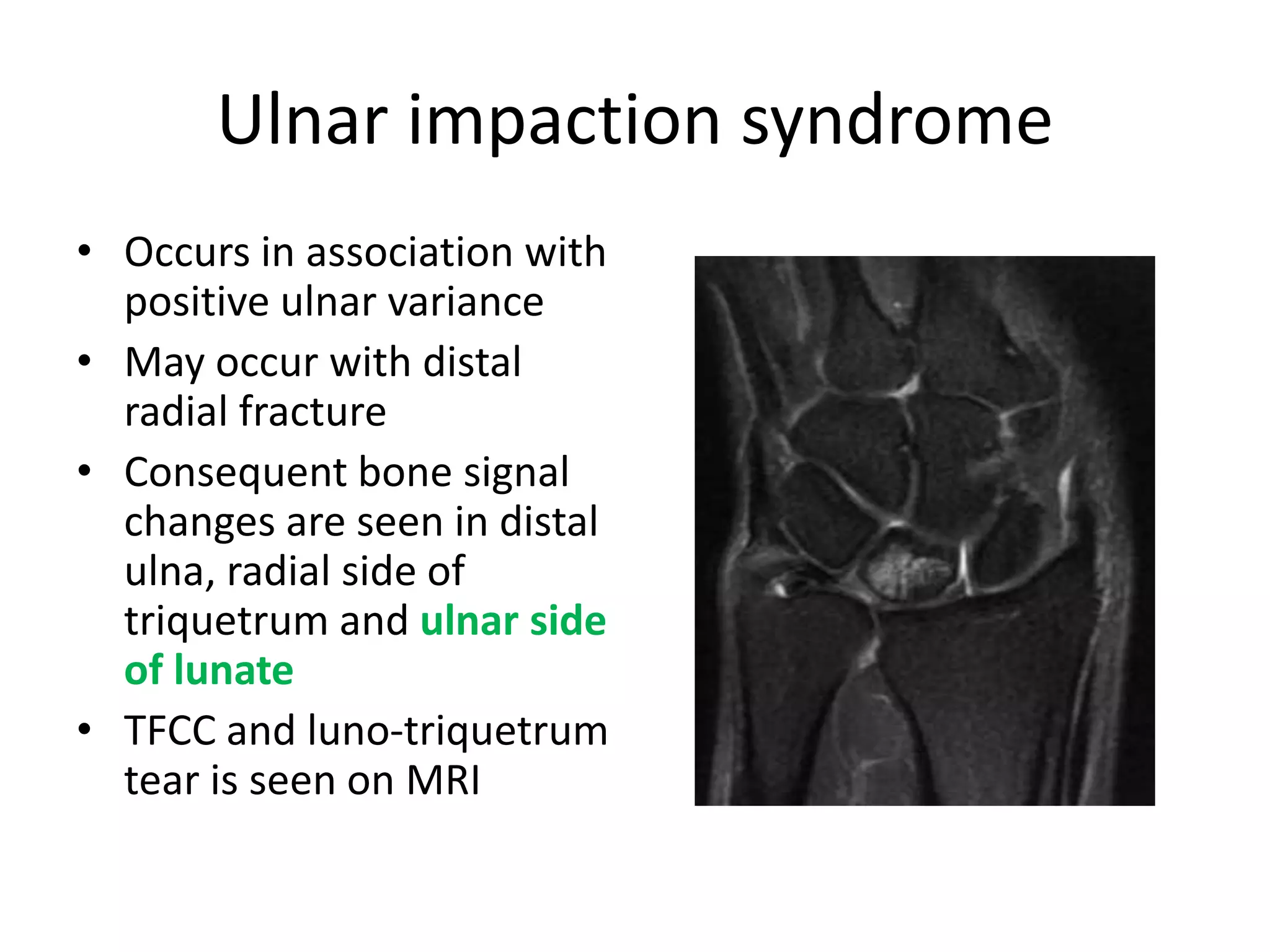
• Occurs in association with
positive ulnar variance
• May occur with distal
radial fracture
• Consequent bone signal
changes are seen in distal
ulna, radial side of
triquetrum and ulnar side
of lunate
• TFCC and luno-triquetrum
tear is seen on MRI
Ulnar impaction syndrome
Ulnar impingement syndrome
• Occurs in association with
Negative ulnar variance
• shortened distal ulna
results in contraction of
the extensor pollicis
brevis, abductor pollicis
longus, and pronator
quadratus muscles which
prevents normal
buttressing of the
radioulnar joint.
• Seen as edema where
ulna converges on radius
Ulnar impingement syndrome
AVN of Scaphoid bone
• Trauma of scaphoid
bone leads to AVN
• It has peculiar blood
supply where in
proximal pole receives
blood supply in
retrograde fashion
• It mnifests as sclerosis
of bone on wrist
radiographs
AVN of scaphoid
Kienbock disease
• Is associated with negative ulnar variance
together with a susceptible blood vessel
• Is defined as osteonecrosis of the lunate
where cortical blood supply is compromised
and results in infarction of the bone with
surrounding hyperemia
• Sclerosis with negative ulnar variance is seen
• Bone signal changes are seen along the central
and radial aspect of lunate
Kienbock disease
Stahl classification of Kienbock disease
• stage I: normal radiograph
• stage II: increased radio density of the lunate
with possible decrease of lunate height on the
radial side only
• stage III
– IIIa: lunate collapse, no scaphoid rotation
– IIIb: lunate collapse, fixed scaphoid rotation
• stage IV: degenerative changes around lunate
Kienbock disease
Stage II AP Stage II Lateral
Carpal coalition
• Refers to failure of separation of two or more
carpal bones
• Lunate and triquetrum are most common
• It may be osseous, cartilaginous or fibrous
• Associated with Holt oram, turner syndrome
etc
Carpal coalition
Carpal Tunnel Syndrome
• Results from the compression of Median Nerve in carpal tunnel
• Nocturnal ascending pain emanating from the wrist, is typical
• sensory symptoms affect the first three digits and, depending on
innervation patterns, the radial aspect of the fourth digit
• Positive Tinel test: paresthesias elicited by tapping the median
nerve at the wrist
• Occurs due to
mechanical overuse (considered the most common association)
osteoarthritis
trauma
acromegaly
• Ganglion cysts, primary nerve sheath tumors
synovial hypertrophy in rheumatoid arthritis
USG CTS
criteria
• Palmar bowing of Flexor
retinaculum of >2mm
• Flattening of nerve distally
with increased thickness
proximally
• Normal Cross section area is
9-11mm sq
• Difference of > 2mm sq at
CT and pronator quadratus
has high sensitivity
Image
Images
USG
MRI for CTS
• In carpal tunnel syndrome, MRI can demonstrate
palmar bowing of the flexor retinaculum,
enlargement of the median nerve at the level of
the pisiform, and flattening of the median nerve
at the level of the hook of hamate.
• Other signs are edema or loss of fat within the
carpal tunnel, and increased size or edema of the
nerve on fluid-sensitive sequences, and, in some
cases, contrast enhancement of the nerve
MRI
Fibrolipomatous hamartoma of MN
• It is a benign neoplasm
of median nerve
• Proliferation of fibro-
adipose tissue of sheath
• Imaging features are co-
axial cable like
appearance on axial and
spaghetti like on
coronal images
Guyon’s canal syndrome
• Results from compression
of ulnar nerve.
• Hook of hamate fracture,
Ganglion cyst are its
causes.
• On x ray hook of hamate
fracture is seen.
• On USG ganglion cyst,
lipoma or ulnar artery
thrombus is seen and on
MRI these findings are
seen with better accuracy
De Quervain TS
• Aka washerwoman’s
sprain
• Occurs due to
inflammation of EPB
and APL tendons
• On USG Thickening of
tendons with fluid in
extensor compartment
and increased flow on
CDI in peri-tendonous
region
MRI
• More sensitive and
specific
• Increased fluid in
tendon sheath
• Thickened edematous
retinaculum with peri
tendenous edema
• Sometimes features of
tendonosis are also
seen
Proximal intersection syndrome
• Is overuse tenosynovitis around the
intersection of 1st and 2nd compartment
extensor tendons
• Seen in weight lifters, skiers etc
• Fluid is seen within the involved tendons with
loss of hyper echoic plane between the
tendon compartments
• On MRI peri tendenous edema is noted 4cm
proximal to lister’s tubercle
Proximal intersection syndrome
USG MRI
Distal intersection syndrome
• Relates to teno-synovitis of EPL tendon where
it crosses the ECRB and ECRL tendon
• Crossover is located just distal to lister’s
tubercle
• Over us, trauma and RA are etiologic factors
• Edema is noted in peri-tendenous region at
intersection point
Images
Ganglion cyst
• is a non malignant
cystic mass and result
from myxoid
degenration of
connective tissue
assoiated with joint
capsule and tendon
sheath
• Seen as anechoic cyst
with PAE on USG and
cystic signal on MRI
Value of axial and coronal images
Axial
• Distal RU joint
• Carpal tunnel and contents
• Flexor and extensor tendons
• Ulnar nerve and median
nerve pathologies
Coronal
• TFCC
• Ulnar Variance
• Scapho-lunate and Luno-
triquetral ligaments
• Fractures
• AVN
• Arthropathies
Summary
History and clinical findings should be available
Assess the congruity of bones on bones, Look for
any asymmetry
Look for ulnar variance
Look for any bone marrow edema/effusion
Asses inter-carpal ligaments and TFCC
Look carefully for any pathology of
carpal/Guyon’s canal
Findings should be noted to reach to a specific
diagnosis
Thank
You

Imaging of wrist joint

  • 1.
    Imaging of Wristjoint DR RAKIB AHMAD WANI PG III YEAR
  • 2.
    Introduction • This jointis a complex joint in upper limb • Consists of articulations of Radius, ulna, carpus and carpo-metacarpal bones • To evaluate and interpret wrist images one should be fully aware of the anatomy • X ray serves as basic tool while MRI serves to answer the issues of soft tissues
  • 3.
    Anatomy • Wrist jointis formed by Distal radio-ulnar joint, Radio-carpal and Mid- carpal joint • Sigmoid notch of radius articulates with ulna
  • 4.
  • 5.
    Parallelism and symmetry •Joint spaces of wrist joint are more or less symmetrical • Average width of joint spaces are 2mm or less • Capitato-lunate serves as standard space to which others should be compared.
  • 6.
    Carpal arcs • Threearcs should be drawn • 1st is formed by convexities of Scaphoid, lunate and Triquitrum bones • 2nd is formed by inner concavities of same bones • 3rd is formed by proximal curvature of Capitate and hamate.
  • 7.
    Asymmetry • Any asymmetryin the joint space and loss of parallelism points that some disruption has occurred • Depending on which arch or which joint space is widened, pathology lies in the same compartment
  • 8.
  • 9.
    Angles and Axesof Carpals • Scaphoid axis : is formed by proximal and distal poles • Lunate axis : is drawn perpendicular to proximal convex and distal concave surface • Capitato-lunate angle : > 30 is abnormal • Scapho-lunate angle: 30- 60 is normal; 60-80 is questionable and > 80 is abnormal
  • 10.
  • 11.
    Flexor retinaculum • Isa rectangular fibrous band and forms roof of carpal tunnel • Radially attached to ridge of trapezium and on ulnar aspect to hook of hamate • On ulnar aspect it forms Guyon canal
  • 12.
  • 13.
    Guyon’s canal • Isa fibro-osseous tunnel that contains ulnar neuro-vascular bundle • Landmarks are deep to FCU, Lateral to Pisiform and at the hook of hamate
  • 14.
    Extensor Tendons • Ondorsal aspect, tendons are divided into 6 compartments • Lister tubercle is important landmark that separates II and III compartment.
  • 16.
    Triangular Fibro-Cartilage complex •It is a complex structure has various parts : Triangular fibro- cartilage ; Radio-ulnar ; ulno-carpal; Meniscal homologue; ECU tendon and ulnar collateral ligament.
  • 18.
  • 19.
  • 20.
  • 21.
    Inter-carpal ligaments • Theseare stabilizers of the wrist joint and are divided into extrinsic and intrinsic parts. • Intrinsic : Scapho-lunate, Luno-triquetral are important ones . TFCC. • Extrinsic: volar, Dorsal, RCL and UCL
  • 22.
    Inter-carpal ligaments • Thetwo important ligaments are in the proximal row : scapho- lunate and luno- triquitrum. • The first one is pyramidal and latter is horse shoe in shape
  • 23.
  • 24.
    TFCC Tear • Itcan be traumatic in young in radial end and degenerative in elderly at ulnar end • Presents with ulnar side wrist pain • Seen as fluid intensity signal along the ulna • Discontinuity of complex is seen on MR arthrogram.
  • 25.
  • 27.
    Palmer classification • class1 a) central perforation b) Ulnar avulsion with or without ulnar fracture c) Avulsion of Ulno- triquetral and ulno- ilunate ligament d) Radial avulsion of TFCC • Class 2 a) TFCC wear with thinning without perforation b) TFCC wear with ulnar/lunate/triquetral chondromalacia c) TFCC perforation with chondromalacia d) Luno-triquetral perf with 2a/2b or 2c e) Any of above with ulno- carpal arthritis
  • 28.
    Scapho-lunate dissociation • Isaka rotatory subluxation of scaphoid. • Refers to abnormal orientation of scaphoid and lunate and is due to injury to the scapho- lunate ligament • Relative flexion of scaphoid with relative extension of lunate is typical pattern • On x ray widened Scapho-lunate interval of >4mm is seen • Increase in Scapho- lunate angle >60 degree • On MRI examination, It is seen as discontinuity of the Scapho-lunate ligament along with joint effusion.
  • 29.
  • 30.
  • 31.
    Lunate Dislocations • Theseare uncommon traumatic wrist injuries . • Lunate is displaced and rotated volarly. • Occurs due to fall on out-stretched hand. • Lunate shows “Piece of Pie sign” • Rest of the bones are well aligned with maintained symmetry.
  • 32.
  • 33.
    Peri-lunate dislocation • Arepotentially closed wrist injuries and involve the carpus relative to lunate • involves scapho-lunate and Luno- triquetral ligaments • In this pathology, the Capitate (apple) doesn’t sit in the concavity of Lunate (Cup)
  • 35.
    Dorsal and Volarintercalated segment instability • DISI is the form of instability involving wrist joint in which Lunate is displaced dorsally. • Disruption of the scapho-lunate ligament • Due to wrist trauma • SL angle of >60 degree • CL angle >30 degree • VISI is less common in which lunate is displaced palmarly • Ligament injured is Luno-triquetral ligament • SL <30 degrees • CL >30 degree
  • 36.
  • 37.
  • 38.
    Ulnar variance • Itis defined as the relative length of distal end of ulna wrt radius • If ulna is shorter than radius it is called Negative ulnar variance • If ulna is longer than radius it is called positive ulnar variance • If both are equal it is called neutral variance • On radiographs Positive variance is when the level of the ulna is >2.5 mm beyond the radius margin at the distal radio-ulnar joint and negative variance is when the ulna is ≤2.5 mm than the radius at the DRUJ
  • 39.
  • 40.
    Ulnar impaction syndrome •Occurs in association with positive ulnar variance • May occur with distal radial fracture • Consequent bone signal changes are seen in distal ulna, radial side of triquetrum and ulnar side of lunate • TFCC and luno-triquetrum tear is seen on MRI
  • 41.
  • 42.
    Ulnar impingement syndrome •Occurs in association with Negative ulnar variance • shortened distal ulna results in contraction of the extensor pollicis brevis, abductor pollicis longus, and pronator quadratus muscles which prevents normal buttressing of the radioulnar joint. • Seen as edema where ulna converges on radius
  • 43.
  • 44.
    AVN of Scaphoidbone • Trauma of scaphoid bone leads to AVN • It has peculiar blood supply where in proximal pole receives blood supply in retrograde fashion • It mnifests as sclerosis of bone on wrist radiographs
  • 45.
  • 46.
    Kienbock disease • Isassociated with negative ulnar variance together with a susceptible blood vessel • Is defined as osteonecrosis of the lunate where cortical blood supply is compromised and results in infarction of the bone with surrounding hyperemia • Sclerosis with negative ulnar variance is seen • Bone signal changes are seen along the central and radial aspect of lunate
  • 47.
  • 48.
    Stahl classification ofKienbock disease • stage I: normal radiograph • stage II: increased radio density of the lunate with possible decrease of lunate height on the radial side only • stage III – IIIa: lunate collapse, no scaphoid rotation – IIIb: lunate collapse, fixed scaphoid rotation • stage IV: degenerative changes around lunate
  • 49.
    Kienbock disease Stage IIAP Stage II Lateral
  • 50.
    Carpal coalition • Refersto failure of separation of two or more carpal bones • Lunate and triquetrum are most common • It may be osseous, cartilaginous or fibrous • Associated with Holt oram, turner syndrome etc
  • 51.
  • 52.
    Carpal Tunnel Syndrome •Results from the compression of Median Nerve in carpal tunnel • Nocturnal ascending pain emanating from the wrist, is typical • sensory symptoms affect the first three digits and, depending on innervation patterns, the radial aspect of the fourth digit • Positive Tinel test: paresthesias elicited by tapping the median nerve at the wrist • Occurs due to mechanical overuse (considered the most common association) osteoarthritis trauma acromegaly • Ganglion cysts, primary nerve sheath tumors synovial hypertrophy in rheumatoid arthritis
  • 53.
    USG CTS criteria • Palmarbowing of Flexor retinaculum of >2mm • Flattening of nerve distally with increased thickness proximally • Normal Cross section area is 9-11mm sq • Difference of > 2mm sq at CT and pronator quadratus has high sensitivity Image
  • 54.
  • 55.
  • 56.
    MRI for CTS •In carpal tunnel syndrome, MRI can demonstrate palmar bowing of the flexor retinaculum, enlargement of the median nerve at the level of the pisiform, and flattening of the median nerve at the level of the hook of hamate. • Other signs are edema or loss of fat within the carpal tunnel, and increased size or edema of the nerve on fluid-sensitive sequences, and, in some cases, contrast enhancement of the nerve
  • 57.
  • 60.
    Fibrolipomatous hamartoma ofMN • It is a benign neoplasm of median nerve • Proliferation of fibro- adipose tissue of sheath • Imaging features are co- axial cable like appearance on axial and spaghetti like on coronal images
  • 62.
    Guyon’s canal syndrome •Results from compression of ulnar nerve. • Hook of hamate fracture, Ganglion cyst are its causes. • On x ray hook of hamate fracture is seen. • On USG ganglion cyst, lipoma or ulnar artery thrombus is seen and on MRI these findings are seen with better accuracy
  • 63.
    De Quervain TS •Aka washerwoman’s sprain • Occurs due to inflammation of EPB and APL tendons • On USG Thickening of tendons with fluid in extensor compartment and increased flow on CDI in peri-tendonous region
  • 65.
    MRI • More sensitiveand specific • Increased fluid in tendon sheath • Thickened edematous retinaculum with peri tendenous edema • Sometimes features of tendonosis are also seen
  • 66.
    Proximal intersection syndrome •Is overuse tenosynovitis around the intersection of 1st and 2nd compartment extensor tendons • Seen in weight lifters, skiers etc • Fluid is seen within the involved tendons with loss of hyper echoic plane between the tendon compartments • On MRI peri tendenous edema is noted 4cm proximal to lister’s tubercle
  • 67.
  • 68.
    Distal intersection syndrome •Relates to teno-synovitis of EPL tendon where it crosses the ECRB and ECRL tendon • Crossover is located just distal to lister’s tubercle • Over us, trauma and RA are etiologic factors • Edema is noted in peri-tendenous region at intersection point
  • 69.
  • 70.
    Ganglion cyst • isa non malignant cystic mass and result from myxoid degenration of connective tissue assoiated with joint capsule and tendon sheath • Seen as anechoic cyst with PAE on USG and cystic signal on MRI
  • 72.
    Value of axialand coronal images Axial • Distal RU joint • Carpal tunnel and contents • Flexor and extensor tendons • Ulnar nerve and median nerve pathologies Coronal • TFCC • Ulnar Variance • Scapho-lunate and Luno- triquetral ligaments • Fractures • AVN • Arthropathies
  • 73.
    Summary History and clinicalfindings should be available Assess the congruity of bones on bones, Look for any asymmetry Look for ulnar variance Look for any bone marrow edema/effusion Asses inter-carpal ligaments and TFCC Look carefully for any pathology of carpal/Guyon’s canal Findings should be noted to reach to a specific diagnosis
  • 74.