TCOM 4170 Spring 2014
Video Production
Amani Channel, MA
Lecture #2
Agenda
 Review
 Production Positions
 Planning to Shoot
 Using your Camera
 Composition
 Photo Essay In Class Assignment
Quiz
1.

Explain the difference between HD and SD

2.

Name 3 video formats (types of cams/acquisition)

3.

Explain what nonlinear editing is

4.

What is workflow?

5.

Explain why composition is important
Remember
• Goal is to create interesting stories
• Tell narratives
• Learn professional video production techniques
• Composition
• Lighting
• Audio
• Editing
Case Study
 Alfred Hitchcock
 Hitchcock’s Rule “The size of an object in a frame should be

directly related to its importance in the story at that very
moment.”
 Hitchcock Techniques

http://www.youtube.com/watch?v=u5cxBHJ9_i4
http://www.youtube.com/watch?v=Eg6velhQxGs
The Filmmakers Eye
 High/low angles

High-camera above eye level = weakness, powerless, passive
Low-below eye level = power, control, confidence
 Focal Points

Center of interest in a composition
Create compositions that will be understood
 180 Rule Maintains spatial continuity

The camera should always be placed on one side of an
imaginary line
http://www.youtube.com/watch?v=27KCpefUMxU
The Filmmakers Eye
 Field of View

How much space along the x and y axis a lens will include in a
frame, wide angle, normal, telephoto. Short focal length =
greater field of view
 Focal length is a measurement (millimeters) from the optical

center to the recording surface.
 Depth of field

Distance along along the z axis that will be in sharp focus
Basic Production Positions
 Above the line: writer, producer, director, talent

Below the line: everyone else (most production positions)
http://en.wikipedia.org/wiki/Below_the_line_(filmmaking)
 Executive Director/Client: Finance

Producer: Budget/Logistics/Keeps project on track
Director: Calling the shots/camera
Audio
DP: Lights/Camera
PA: Assists with equipment
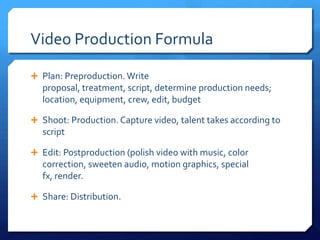
Video Production Formula
 Plan: Preproduction. Write proposal, treatment, script,

determine production needs; location, equipment, crew, edit,
budget
 Shoot: Production. Capture video, talent takes according to

script
 Edit: Postproduction (polish video with music, color

correction, sweeten audio, motion graphics, special fx,
render.
 Share: Distribution.
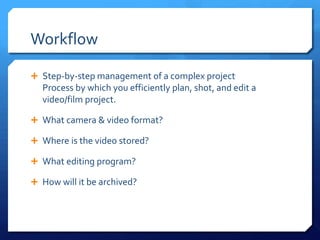
Workflow
 Step-by-step management of a complex project

Process by which you efficiently plan, shot, and edit a
video/film project.
 What camera & video format?

 Where is the video stored?
 What editing program?
 How will it be archived?
Getting to know the camera
 How to turn it on
 Connect to tripod
 Audio
 White balance
 Focus
 Watch zooms
Storytelling Goals
 Tell a story
 Beginning/middle/end
 Good audio
 Good video
 Good pictures
 Emotion is good
The first step
 Writing the proposal. The concept of the story, what is the

plot, goal, or reason why the film/video is being created.
 Who is the talent? Shoot location(s), props?
 What equipment? Camera, mics, special needs?
 Timeline, shoot dates, deadlines
 Final deliverable (format, DVD, media file?)

TCOM 4170, Spring 2013 Lecture 2

  • 1.
    TCOM 4170 Spring2014 Video Production Amani Channel, MA Lecture #2
  • 2.
    Agenda  Review  ProductionPositions  Planning to Shoot  Using your Camera  Composition  Photo Essay In Class Assignment
  • 3.
    Quiz 1. Explain the differencebetween HD and SD 2. Name 3 video formats (types of cams/acquisition) 3. Explain what nonlinear editing is 4. What is workflow? 5. Explain why composition is important
  • 4.
    Remember • Goal isto create interesting stories • Tell narratives • Learn professional video production techniques • Composition • Lighting • Audio • Editing
  • 5.
    Case Study  AlfredHitchcock  Hitchcock’s Rule “The size of an object in a frame should be directly related to its importance in the story at that very moment.”  Hitchcock Techniques http://www.youtube.com/watch?v=u5cxBHJ9_i4 http://www.youtube.com/watch?v=Eg6velhQxGs
  • 6.
    The Filmmakers Eye High/low angles High-camera above eye level = weakness, powerless, passive Low-below eye level = power, control, confidence  Focal Points Center of interest in a composition Create compositions that will be understood  180 Rule Maintains spatial continuity The camera should always be placed on one side of an imaginary line http://www.youtube.com/watch?v=27KCpefUMxU
  • 7.
    The Filmmakers Eye Field of View How much space along the x and y axis a lens will include in a frame, wide angle, normal, telephoto. Short focal length = greater field of view  Focal length is a measurement (millimeters) from the optical center to the recording surface.  Depth of field Distance along along the z axis that will be in sharp focus
  • 8.
    Basic Production Positions Above the line: writer, producer, director, talent Below the line: everyone else (most production positions) http://en.wikipedia.org/wiki/Below_the_line_(filmmaking)  Executive Director/Client: Finance Producer: Budget/Logistics/Keeps project on track Director: Calling the shots/camera Audio DP: Lights/Camera PA: Assists with equipment
  • 9.
    Video Production Formula Plan: Preproduction. Write proposal, treatment, script, determine production needs; location, equipment, crew, edit, budget  Shoot: Production. Capture video, talent takes according to script  Edit: Postproduction (polish video with music, color correction, sweeten audio, motion graphics, special fx, render.  Share: Distribution.
  • 10.
    Workflow  Step-by-step managementof a complex project Process by which you efficiently plan, shot, and edit a video/film project.  What camera & video format?  Where is the video stored?  What editing program?  How will it be archived?
  • 11.
    Getting to knowthe camera  How to turn it on  Connect to tripod  Audio  White balance  Focus  Watch zooms
  • 12.
    Storytelling Goals  Tella story  Beginning/middle/end  Good audio  Good video  Good pictures  Emotion is good
  • 13.
    The first step Writing the proposal. The concept of the story, what is the plot, goal, or reason why the film/video is being created.  Who is the talent? Shoot location(s), props?  What equipment? Camera, mics, special needs?  Timeline, shoot dates, deadlines  Final deliverable (format, DVD, media file?)