3D PRINT
MIGUEL ÁLVAREZ
INTRODUCTION
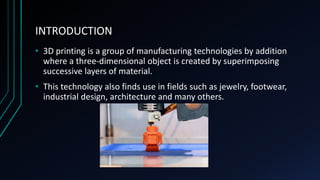
• 3D printing is a group of manufacturing technologies by addition
where a three-dimensional object is created by superimposing
successive layers of material.
• This technology also finds use in fields such as jewelry, footwear,
industrial design, architecture and many others.
HISTORY
• In the year 1976 began to investigate and develop equipment and
materials for this type of manufacturing.
• One of the first developers was Hideo Kodama and later, in 1984,
Chuck Hull perfected them to the point that most current printers
still use their method.
Hideo Kodama Chuck Hull
GENERAL PRINCIPLES
• The manufacturing additive is taken to virtual drawings of
computer-aided design (CAD) for the printer to use as a guide.
• Depending on the machine being used,
the material or a printing material is
deposited in the construction bed or
platform until the object is completed.
METHODS
• A large number of technologies are available for 3D printing; Its
main differences are in the way in which the different layers are
used to create pieces.
• Each method has its own advantages and disadvantages and some
companies offer to choose the material according to the client's
priorities.
MATERIALS
• 3D printers can not use any type of material, but there is a wide
variety for printing.
• The design of our product will give us a step to choose the material
that we should use and the process by which it will be printed.
FINISHES
• 3D printing by injection is optimized for speed, low cost and ease of
use which makes it a very useful technique for the industry.
• Multiple techniques can be used for finishes, they are non-toxic and
the finishes are impressive.
Wood finish. Bronze finish.
EDUCATION
• The applications in education are endless, helping students to
understand and visualize abstract concepts in subjects such as
social, natural sciences, technology ...
FEEDING
• Foodini and ChefJet are some of the best known 3D food printers.
• The technology itself allows to substitute some processes and
customize the ingredients.
ARCHEOLOGY
The use of 3D scanning technologies allows the replication of real
objects without the use of molding processes, which can be
expensive, more difficult or too invasive to be carried out.
ART
• 3D printing has reached such levels that many artists have used
them for different arts.
FASHION
• There are also clothes printed on materials such as Filaflex, used by
designers such as Karl Legarfeld, Melinda Looi, etc. In fact there is a
contest called "3D Fashion Day".
• Adidas was the pioneer since in 2015 she developed 3D printed
shoes.
MEDICINE
• 3D printing applied in medicine is a process that consists in the
creation of artificial organs from a digital model with the help of a
3D printer, as opposed to genetic reproduction methodologies.
• Many teams of scientists work to solve the current limitations of
this technology.
MEDICINE
• Currently, 3D printing methods of body segment models have been
developed using computerized tomography images or other type of
scanning, which allows the replication of body sections. These
generate a simile of the corporal section, real and tangible, that
preserves the proportions, the topographic relationships, the
morphology and the color, without danger of decomposition or
contamination.
DOMESTIC USE
• Every day there are more "desktop" 3D printers since prices are
going down and the software is easy to understand.
• They are a good tool in any job and in the future you will find more
uses.
• What Is 3D Printing and How Does It Work?
• https://www.youtube.com/watch?v=Vx0Z6LplaMU
THE END
Miguel Álvarez

3D Printer

  • 1.
  • 2.
    INTRODUCTION • 3D printingis a group of manufacturing technologies by addition where a three-dimensional object is created by superimposing successive layers of material. • This technology also finds use in fields such as jewelry, footwear, industrial design, architecture and many others.
  • 3.
    HISTORY • In theyear 1976 began to investigate and develop equipment and materials for this type of manufacturing. • One of the first developers was Hideo Kodama and later, in 1984, Chuck Hull perfected them to the point that most current printers still use their method. Hideo Kodama Chuck Hull
  • 4.
    GENERAL PRINCIPLES • Themanufacturing additive is taken to virtual drawings of computer-aided design (CAD) for the printer to use as a guide. • Depending on the machine being used, the material or a printing material is deposited in the construction bed or platform until the object is completed.
  • 5.
    METHODS • A largenumber of technologies are available for 3D printing; Its main differences are in the way in which the different layers are used to create pieces. • Each method has its own advantages and disadvantages and some companies offer to choose the material according to the client's priorities.
  • 6.
    MATERIALS • 3D printerscan not use any type of material, but there is a wide variety for printing. • The design of our product will give us a step to choose the material that we should use and the process by which it will be printed.
  • 7.
    FINISHES • 3D printingby injection is optimized for speed, low cost and ease of use which makes it a very useful technique for the industry. • Multiple techniques can be used for finishes, they are non-toxic and the finishes are impressive. Wood finish. Bronze finish.
  • 8.
    EDUCATION • The applicationsin education are endless, helping students to understand and visualize abstract concepts in subjects such as social, natural sciences, technology ...
  • 9.
    FEEDING • Foodini andChefJet are some of the best known 3D food printers. • The technology itself allows to substitute some processes and customize the ingredients.
  • 10.
    ARCHEOLOGY The use of3D scanning technologies allows the replication of real objects without the use of molding processes, which can be expensive, more difficult or too invasive to be carried out.
  • 11.
    ART • 3D printinghas reached such levels that many artists have used them for different arts.
  • 12.
    FASHION • There arealso clothes printed on materials such as Filaflex, used by designers such as Karl Legarfeld, Melinda Looi, etc. In fact there is a contest called "3D Fashion Day". • Adidas was the pioneer since in 2015 she developed 3D printed shoes.
  • 13.
    MEDICINE • 3D printingapplied in medicine is a process that consists in the creation of artificial organs from a digital model with the help of a 3D printer, as opposed to genetic reproduction methodologies. • Many teams of scientists work to solve the current limitations of this technology.
  • 14.
    MEDICINE • Currently, 3Dprinting methods of body segment models have been developed using computerized tomography images or other type of scanning, which allows the replication of body sections. These generate a simile of the corporal section, real and tangible, that preserves the proportions, the topographic relationships, the morphology and the color, without danger of decomposition or contamination.
  • 16.
    DOMESTIC USE • Everyday there are more "desktop" 3D printers since prices are going down and the software is easy to understand. • They are a good tool in any job and in the future you will find more uses.
  • 17.
    • What Is3D Printing and How Does It Work? • https://www.youtube.com/watch?v=Vx0Z6LplaMU
  • 18.