KRG 
Musings from the Chair
What is research? 
• Accumulation of information? 
• Developing theories? 
• Creating new knowledge? 
• Proving something is true or false? 
• Stuff your grandmother already knows?
Research: The Scientific Method 
• The systematic pursuit of knowledge with a view: 
• To describe 
• Facts, observations, data 
• Validity, reliability, objectivity 
• To explain 
• Laws 
• Stable dependency between variables 
• To predict 
• Theories and models 
• Constructs, hypotheses, postulates
Scientific method 
• Process versus product 
• Cumulative & iterative (new ideas build on the old) 
• Public (ideas are open to discussion and inspection) 
• Parsimonious (describe, explain, predict) 
• Objective (‘unbiased’) 
• Misconceptions about science 
• Science is always correct (informed opinion) 
• Science is always conducted via an idealized method (try and try again) 
• Science is always objective (confirmation bias; beliefs; preconceptions) 
• Power/abuse of numbers (“Misunderstanding of probability may be the greatest 
impediment to scientific literacy.” Stephen Jay Gould) 
• Limits to a shared understanding because of race, culture, gender, 
social history 
• Values and beliefs inextricably linked to what is viewed as legitimate science 
• Informed consumers of knowledge 
• Given a thimble of facts we make a bathtub of generalizations
Misunderstandings arising from 
ignoring the condition 
• Many research studies involving people study a fairly 
restricted group. Thus they result in conditional 
probabilities with a fairly restricted condition. 
Unfortunately, all too often this restriction is not 
emphasized enough. For example, a study of a 
cholesterol-lowering medication might be restricted to 
men between the ages of 45 and 65 who have previously 
had a heart attack. If a physician decides, on the basis of 
this study, to prescribe the medication to a woman who is 
70 years old and has no previous record of heart attacks, 
the physician is extrapolating; the applicability of the study 
to this quite different group of people is questionable.
The ‘Hard’ Sciences 
• In at least one sense the social sciences are truly the “hard” 
sciences. A problem unique to these sciences is that the 
subjects can read. Because of this, developing a theory to 
understand and predict an election outcome or a stock market 
crash is fundamentally more difficult than predicting a chemical 
reaction or an earthquake. In the latter cases, the publication 
of the theory will not effect the prediction. However, for an 
election or stock market crash, if the prediction is made public, 
and the theory is convincing, individuals have incentives to take 
advantage of this information and alter their behaviour. They 
made decide to sell off their stocks if they believe a crash is 
imminent which may precipitate the crash earlier than predicted 
thus making the theory wrong. Any good theory must work 
even when the participants know the theory, that is, the theory 
must survive its own publication.
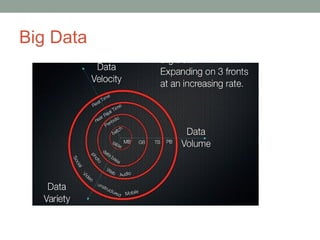
Big Data
Big Data
Big Data
The age of big data 
• D3M or DDDM (data driven decision making) 
• DIDM (data informed decision making) 
• Data includes numbers, images, text, video, data streams 
• Predict will need 1.5 million data literate managers and 
200,000 individuals with ‘deep analytic skills’ 
• Needs from economics to politics to sport 
• No area will be untouched 
• Moneyball 
• Use of data in sports like tennis and soccer 
• Public health policy 
• Mapping sporting events onto crime hot spots 
• Double edged sword 
• Bigger the data the bigger the potential bias errors
Big Data
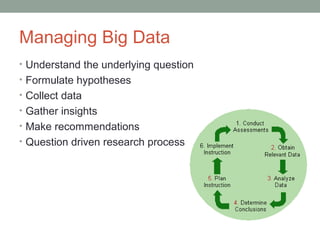
Managing Big Data 
• Understand the underlying question 
• Formulate hypotheses 
• Collect data 
• Gather insights 
• Make recommendations 
• Question driven research process
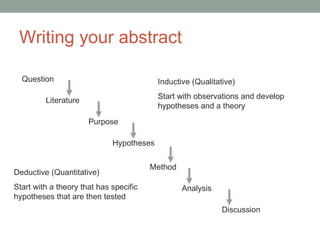
Writing your abstract 
Question 
Literature 
Purpose 
Hypotheses 
Method 
Analysis 
Discussion 
Deductive (Quantitative) 
Start with a theory that has specific 
hypotheses that are then tested 
Inductive (Qualitative) 
Start with observations and develop 
hypotheses and a theory
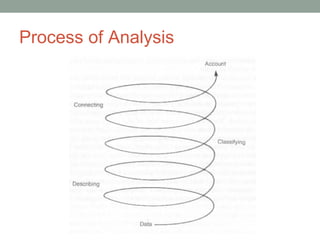
Process of Analysis

Presentation1a paul carpenter

  • 1.
  • 2.
    What is research? • Accumulation of information? • Developing theories? • Creating new knowledge? • Proving something is true or false? • Stuff your grandmother already knows?
  • 3.
    Research: The ScientificMethod • The systematic pursuit of knowledge with a view: • To describe • Facts, observations, data • Validity, reliability, objectivity • To explain • Laws • Stable dependency between variables • To predict • Theories and models • Constructs, hypotheses, postulates
  • 4.
    Scientific method •Process versus product • Cumulative & iterative (new ideas build on the old) • Public (ideas are open to discussion and inspection) • Parsimonious (describe, explain, predict) • Objective (‘unbiased’) • Misconceptions about science • Science is always correct (informed opinion) • Science is always conducted via an idealized method (try and try again) • Science is always objective (confirmation bias; beliefs; preconceptions) • Power/abuse of numbers (“Misunderstanding of probability may be the greatest impediment to scientific literacy.” Stephen Jay Gould) • Limits to a shared understanding because of race, culture, gender, social history • Values and beliefs inextricably linked to what is viewed as legitimate science • Informed consumers of knowledge • Given a thimble of facts we make a bathtub of generalizations
  • 5.
    Misunderstandings arising from ignoring the condition • Many research studies involving people study a fairly restricted group. Thus they result in conditional probabilities with a fairly restricted condition. Unfortunately, all too often this restriction is not emphasized enough. For example, a study of a cholesterol-lowering medication might be restricted to men between the ages of 45 and 65 who have previously had a heart attack. If a physician decides, on the basis of this study, to prescribe the medication to a woman who is 70 years old and has no previous record of heart attacks, the physician is extrapolating; the applicability of the study to this quite different group of people is questionable.
  • 6.
    The ‘Hard’ Sciences • In at least one sense the social sciences are truly the “hard” sciences. A problem unique to these sciences is that the subjects can read. Because of this, developing a theory to understand and predict an election outcome or a stock market crash is fundamentally more difficult than predicting a chemical reaction or an earthquake. In the latter cases, the publication of the theory will not effect the prediction. However, for an election or stock market crash, if the prediction is made public, and the theory is convincing, individuals have incentives to take advantage of this information and alter their behaviour. They made decide to sell off their stocks if they believe a crash is imminent which may precipitate the crash earlier than predicted thus making the theory wrong. Any good theory must work even when the participants know the theory, that is, the theory must survive its own publication.
  • 7.
  • 8.
  • 9.
  • 10.
    The age ofbig data • D3M or DDDM (data driven decision making) • DIDM (data informed decision making) • Data includes numbers, images, text, video, data streams • Predict will need 1.5 million data literate managers and 200,000 individuals with ‘deep analytic skills’ • Needs from economics to politics to sport • No area will be untouched • Moneyball • Use of data in sports like tennis and soccer • Public health policy • Mapping sporting events onto crime hot spots • Double edged sword • Bigger the data the bigger the potential bias errors
  • 11.
  • 12.
    Managing Big Data • Understand the underlying question • Formulate hypotheses • Collect data • Gather insights • Make recommendations • Question driven research process
  • 13.
    Writing your abstract Question Literature Purpose Hypotheses Method Analysis Discussion Deductive (Quantitative) Start with a theory that has specific hypotheses that are then tested Inductive (Qualitative) Start with observations and develop hypotheses and a theory
  • 14.