Network Service in
               OpenStack Cloud
                 p

                         Yaohui Jin
                  email: ji h at sjtu.edu.cn
                     il jinyh t jt d
                  Sina Weibo: @bright_jin


                Network & Information Center

© jinyh@sjtu
Acknowledgement

       Team: Dr. Xuan Luo, Pengfei Zhang, Xiaosheng Zuo,
        Zhixing Xu, Xinyu Xu, Jianwen Wei, Baoqing Huang, etc.
       Prof. Hongfang Yu and team with UESTC
       Prof. Jianping Wang with CityU HK
       Engineers, discussion and slides from Intel, SINA, IBM,
        Cisco, Dell, VMware/EMC, H3C, Huawei, IXIA, …
       OpenStack Community
       China OpenStack User Group (COSUG)
       China OpenStack Cloud League (COSCL)
       Technical blogs such as blog.ioshints.info, ipspace.net, …


© jinyh@sjtu                                                         2
OpenStack in Academia
                            for Research & Operation
       USC, Information Science Institute
       Purdue University
       University of Melbourne
       San Diego Supercomputer Center
       Brookhaven National Lab., DOE
       Argonne National Lab., DOE
       European Organization for Nuclear Research (CERN)
       Shanghai Jiao Tong University
       University of Science & Technology of China
       University of Electrical Science & Technology of China
       ……
© jinyh@sjtu                                                     3
Agenda


       Introduction
       SDN and OpenFlow
       Network Virtualization
        N t   k Vi t li ti
       Network Virtualization in OpenStack
       Our Work


© jinyh@sjtu                                  4
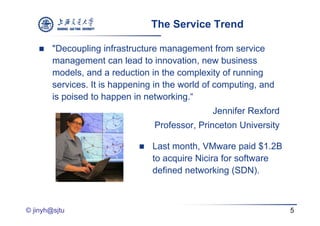
The Service Trend

       "Decoupling infrastructure management from service
        management can lead to innovation new business
                                   innovation,
        models, and a reduction in the complexity of running
        services. It is happening in the world of computing, and
        is poised to happen in networking.“
                                                Jennifer Rexford
                                 Professor, Princeton University

                                Last month, VMware paid $1.2B
                                 to acquire Nicira for software
                                 defined networking (SDN).


© jinyh@sjtu                                                       5
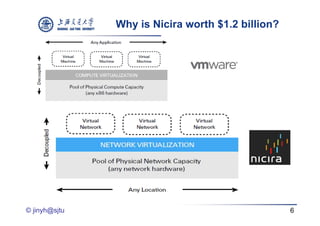
Why is Nicira worth $1.2 billion?


© jinyh@sjtu                                       6
SDN and OpenFlow


© jinyh@sjtu
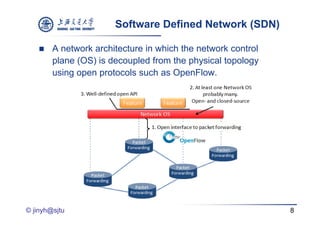
Software Defined Network (SDN)

       A network architecture in which the network control
        plane (OS) is decoupled from the physical topology
        using open protocols such as OpenFlow.


© jinyh@sjtu                                                  8
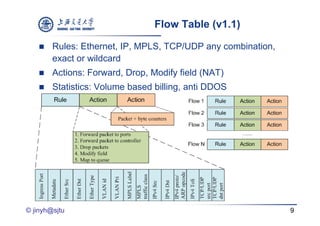
Flow Table (v1.1)

       Rules: Ethernet, IP, MPLS, TCP/UDP any combination,
        exact or wildcard
       Actions: Forward, Drop, Modify field (NAT)
       Statistics: Volume based billing anti DDOS
                                 billing,


© jinyh@sjtu                                                  9
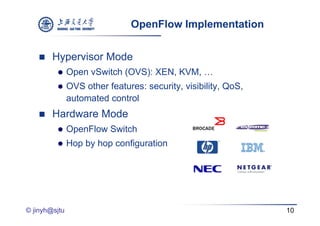
OpenFlow Implementation


       Hypervisor Mode
         yp
              Open vSwitch (OVS): XEN, KVM, …
              OVS other features: security, visibility, QoS
                                   security visibility QoS,
               automated control
       Hardware Mode
              OpenFlow Switch
              Hop by hop configuration


© jinyh@sjtu                                                   10
Reality Check

       “OpenFlow doesn’t let you do anything you couldn’t do on a
        network
        net ork before” –Scott Shenker (Professor UC Berkele
                         Scott         (Professor,    Berkeley,
        OpenFlow co-inventor)
       Frames are still f
        F           till forwarded, packets are d li
                               d d     k t      delivered t h t
                                                        d to hosts.
       OpenFlow 1.3 was recently approved.
       Major vendors are participating - Cisco, Juniper, Brocade,
        Huawei, Ericsson, etc. It’s still early stage technology but
        commercial products are shipping.
       OpenFlow led by large companies Google/Yahoo/Verizon
        and lack of focus on practical applications in the enterprise.


© jinyh@sjtu                                                           11
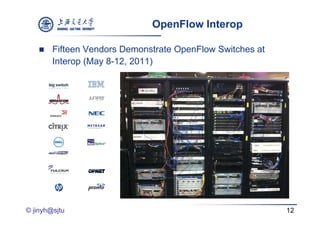
OpenFlow Interop

       Fifteen Vendors Demonstrate OpenFlow Switches at
        Interop (May 8-12 2011)
                     8-12,


© jinyh@sjtu                                               12
Network Virtualization


© jinyh@sjtu
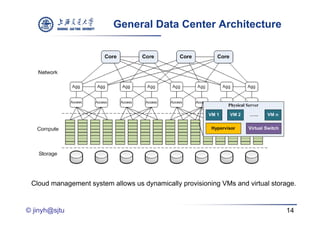
General Data Center Architecture


 Cloud management system allows us dynamically provisioning VMs and virtual storage.


© jinyh@sjtu                                                                    14
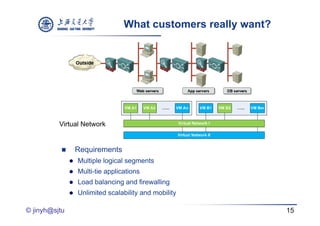
What customers really want?


          Virtual Network


                  Requirements
                  Multiple logical segments
                        p     g       g
                  Multi-tie applications
                  Load balancing and firewalling
                  Unlimited scalability and mobility

© jinyh@sjtu                                                     15
Multi-Tenant Isolation
       Making life easier for the cloud provider
              Customer VMs attached to “random” L3 subnets
              VM IP addresses allocated by the IaaS provider
              Predefined configurations or user-controlled firewalls
       Autonomous tenant address space
        A t        t    t dd
              Both MAC and IP addresses could overlap between two tenants, or
               even within the same tenant
              Each overlapping address space needs a separate segment


© jinyh@sjtu                                                                     16
Scalability

       Datacenter networks have got much bigger (and getting bigger still !!)
              Juniper s
               Juniper’s Qfabric ~6000 ports, Cisco’s FabricPath over 10k ports
                                  6000        Cisco s
       Tenant number dramatically increase as the IaaS experiences rapid
        commoditization
              Forrester Research forecasts that public cloud today globally valued at
               $2.9B, projected to grow to $5.85B by 2015.
       Server virtualization increase demand on switch MAC address tables
              Physical with 2 MACs -> 100 VMs with 2 vNIC need 200+ MACs!


© jinyh@sjtu                                                                             17
Possible Solutions (1)

       VLANs per tenant
              limitations of VLAN-id range (Only 12bits ID = 4K)
              VLAN trunk is manually configured
              Spanning tree limits the size of the network
       L2 over L2
              vCDNI(VMware), Provider Bridging(Q-in-Q)
              Limitations in number of users (limited by VLAN-id range)
              Proliferation of VM MAC addresses in switches in the network
               (requiring larger table sizes in switches)
              Switches must support use of same MAC address in multiple
               VLANs (independent VLAN learning)


© jinyh@sjtu                                                                  18
Possible Solutions (2): L2 over IP

       Virtual eXtensible LAN (VXLAN)
              VMware, Arista, Broadcom, Cisco, Citrix, Red Hat
              VXLAN Network Identifier (VNI): 24 bits = 16M
              UDP encapsulation, new protocol
       Network Virtualization Generic Routing Encapsulation
        (NVGRE)
              Microsoft, Arista, Intel, Dell, HP, Broadcom, Emulex
              Virtual Subnet Identifier (VSID): 24 bits = 16M
              GRE tunneling, relies on existing protocol
       Stateless Transport Tunneling (STT)
        St t l    T       tT     li
              Nicira
              Context ID
               C t t ID: 64 bit TCP lik encapsulation
                            bits, TCP-like     l ti

© jinyh@sjtu                                                          19
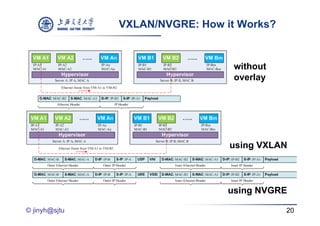
VXLAN/NVGRE: How it Works?


                                  without
                                  overlay


                                 using VXLAN


                                 using NVGRE

© jinyh@sjtu                                20
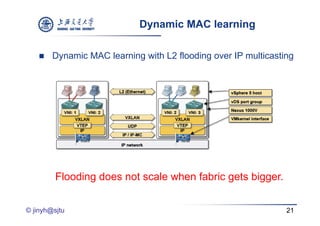
Dynamic MAC learning

       Dynamic MAC learning with L2 flooding over IP multicasting


         Flooding does not scale when fabric gets bigger.


© jinyh@sjtu                                                    21
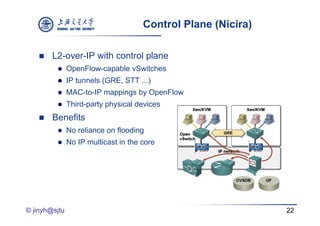
Control Plane (Nicira)

       L2-over-IP with control plane
              OpenFlow-capable vSwitches
              IP tunnels (GRE, STT ...)
              MAC-to-IP mappings by OpenFlow
              Third-party physical devices
       Benefits
              No reliance on flooding
              No IP multicast in the core


© jinyh@sjtu                                                   22
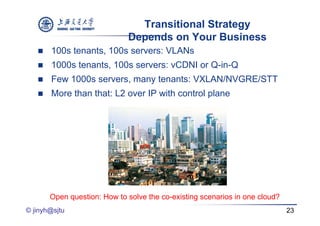
Transitional Strategy
                             Depends on Your Business
      100s tenants, 100s servers: VLANs
      1000s tenants, 100 servers: vCDNI or Q i Q
       1000 t     t 100s            CDNI Q-in-Q
      Few 1000s servers, many tenants: VXLAN/NVGRE/STT
      More than that: L2 over IP with control plane


       Open question: How to solve the co-existing scenarios in one cloud?
© jinyh@sjtu                                                                 23
Network Virtualization in
                 Openstack


© jinyh@sjtu
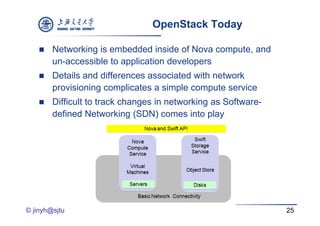
OpenStack Today

       Networking is embedded inside of Nova compute, and
        un-accessible to application developers
       Details and differences associated with network
        provisioning complicates a simple compute service
       Difficult to track changes in networking as Software-
        defined Networking (SDN) comes into play


© jinyh@sjtu                                                    25
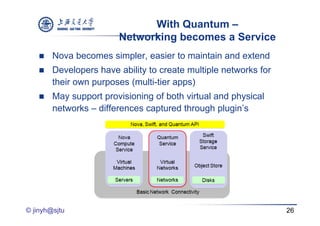
With Quantum –
                        Networking becomes a Service
       Nova becomes simpler, easier to maintain and extend
       Developers have ability to create multiple networks for
        their own purposes (multi-tier apps)
       May support provisioning of both virtual and physical
        networks – differences captured through plugin’s
                                 p            g p g


© jinyh@sjtu                                                      26
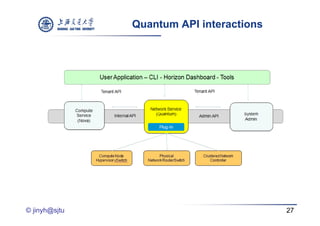
Quantum API interactions


© jinyh@sjtu                              27
Plug-in’s available today


       Open vSwitch
         p
       Linux bridge
       Nicira
        Ni i NVP
       Cisco (Nexus switches and UCS VM-FEX)
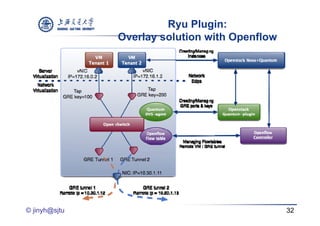
       NTT Labs Ryu OpenFlow controller
       NEC OpenFlow
       Big Switch Floodlight


© jinyh@sjtu                                         28
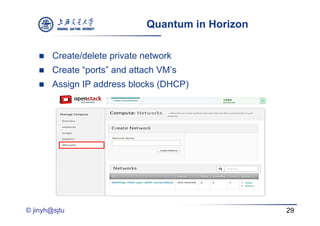
Quantum in Horizon

       Create/delete private network
       Create “ports” and attach VM’s
       Assign IP address blocks (
            g                    (DHCP)
                                      )


© jinyh@sjtu                                       29
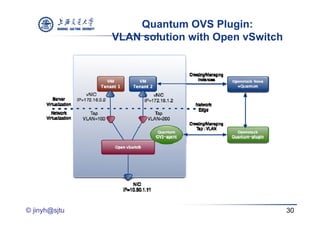
Quantum OVS Plugin:
               VLAN solution with Open vSwitch


© jinyh@sjtu                                     30
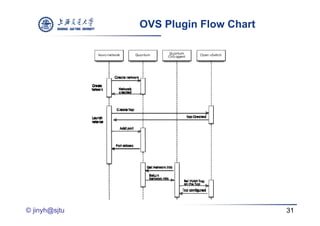
OVS Plugin Flow Chart


© jinyh@sjtu                           31
Ryu Plugin:
               Overlay solution with Openflow


© jinyh@sjtu                                    32
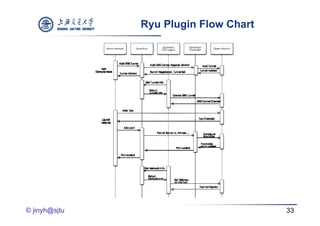
Ryu Plugin Flow Chart


© jinyh@sjtu                           33
vCube: Virtual, Versatile, Visible
   Network Service for OpenStack Cloud


© jinyh@sjtu
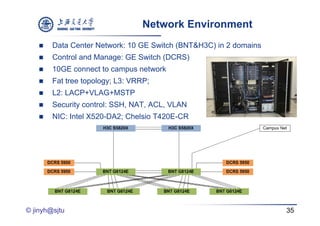
Network Environment
       Data Center Network: 10 GE Switch (BNT&H3C) in 2 domains
       Control and Manage: GE Switch (DCRS)
       10GE connect to campus network
       Fat tree topology; L3: VRRP;
       L2: LACP+VLAG+MSTP
       Security control: SSH, NAT, ACL, VLAN
       NIC: Intel X520-DA2; Chelsio T420E-CR


© jinyh@sjtu                                                       35
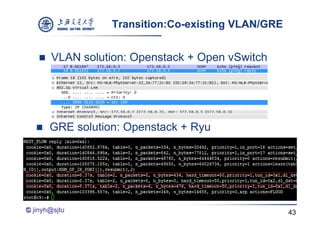
Transition:Co-existing VLAN/GRE


       VLAN solution: Openstack + Open vSwitch
                        p           p


       GRE solution: Openstack + Ryu


© jinyh@sjtu                                         36
                                                      43
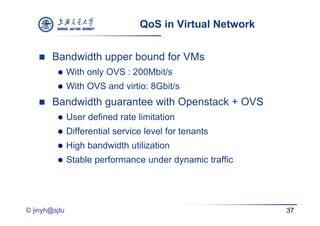
QoS in Virtual Network


       Bandwidth upper bound for VMs
                   pp
              With only OVS : 200Mbit/s
              With OVS and virtio: 8Gbit/s
       Bandwidth guarantee with Openstack + OVS
              User defined rate limitation
              Differential service level for tenants
              High bandwidth utilization
              Stable performance under dynamic traffic
                      p                  y


© jinyh@sjtu                                               37
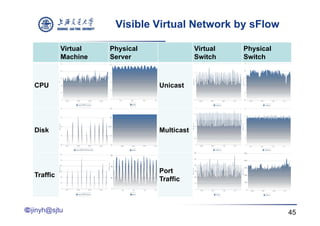
Visible Virtual Network by sFlow

             Virtual   Physical               Virtual   Physical
             Machine   Server                 Switch    Switch


   CPU                            Unicast


   Disk                           Multicast


                                  Port
   Traffic
                                  Traffic


© jinyh@sjtu
© jinyh@sjtu                                                       38
                                                                    45
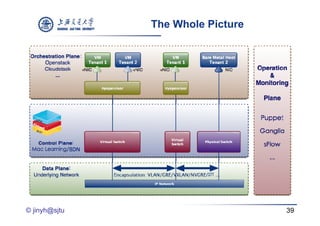
The Whole Picture


© jinyh@sjtu                       39
Thanks for your attention!


                  Weibo: @bright_jin


© jinyh@sjtu                           40

Network service in open stack cloud

  • 1.
    Network Service in OpenStack Cloud p Yaohui Jin email: ji h at sjtu.edu.cn il jinyh t jt d Sina Weibo: @bright_jin Network & Information Center © jinyh@sjtu
  • 2.
    Acknowledgement  Team: Dr. Xuan Luo, Pengfei Zhang, Xiaosheng Zuo, Zhixing Xu, Xinyu Xu, Jianwen Wei, Baoqing Huang, etc.  Prof. Hongfang Yu and team with UESTC  Prof. Jianping Wang with CityU HK  Engineers, discussion and slides from Intel, SINA, IBM, Cisco, Dell, VMware/EMC, H3C, Huawei, IXIA, …  OpenStack Community  China OpenStack User Group (COSUG)  China OpenStack Cloud League (COSCL)  Technical blogs such as blog.ioshints.info, ipspace.net, … © jinyh@sjtu 2
  • 3.
    OpenStack in Academia for Research & Operation  USC, Information Science Institute  Purdue University  University of Melbourne  San Diego Supercomputer Center  Brookhaven National Lab., DOE  Argonne National Lab., DOE  European Organization for Nuclear Research (CERN)  Shanghai Jiao Tong University  University of Science & Technology of China  University of Electrical Science & Technology of China  …… © jinyh@sjtu 3
  • 4.
    Agenda  Introduction  SDN and OpenFlow  Network Virtualization N t k Vi t li ti  Network Virtualization in OpenStack  Our Work © jinyh@sjtu 4
  • 5.
    The Service Trend  "Decoupling infrastructure management from service management can lead to innovation new business innovation, models, and a reduction in the complexity of running services. It is happening in the world of computing, and is poised to happen in networking.“ Jennifer Rexford Professor, Princeton University  Last month, VMware paid $1.2B to acquire Nicira for software defined networking (SDN). © jinyh@sjtu 5
  • 6.
    Why is Niciraworth $1.2 billion? © jinyh@sjtu 6
  • 7.
  • 8.
    Software Defined Network(SDN)  A network architecture in which the network control plane (OS) is decoupled from the physical topology using open protocols such as OpenFlow. © jinyh@sjtu 8
  • 9.
    Flow Table (v1.1)  Rules: Ethernet, IP, MPLS, TCP/UDP any combination, exact or wildcard  Actions: Forward, Drop, Modify field (NAT)  Statistics: Volume based billing anti DDOS billing, © jinyh@sjtu 9
  • 10.
    OpenFlow Implementation  Hypervisor Mode yp  Open vSwitch (OVS): XEN, KVM, …  OVS other features: security, visibility, QoS security visibility QoS, automated control  Hardware Mode  OpenFlow Switch  Hop by hop configuration © jinyh@sjtu 10
  • 11.
    Reality Check  “OpenFlow doesn’t let you do anything you couldn’t do on a network net ork before” –Scott Shenker (Professor UC Berkele Scott (Professor, Berkeley, OpenFlow co-inventor)  Frames are still f F till forwarded, packets are d li d d k t delivered t h t d to hosts.  OpenFlow 1.3 was recently approved.  Major vendors are participating - Cisco, Juniper, Brocade, Huawei, Ericsson, etc. It’s still early stage technology but commercial products are shipping.  OpenFlow led by large companies Google/Yahoo/Verizon and lack of focus on practical applications in the enterprise. © jinyh@sjtu 11
  • 12.
    OpenFlow Interop  Fifteen Vendors Demonstrate OpenFlow Switches at Interop (May 8-12 2011) 8-12, © jinyh@sjtu 12
  • 13.
  • 14.
    General Data CenterArchitecture Cloud management system allows us dynamically provisioning VMs and virtual storage. © jinyh@sjtu 14
  • 15.
    What customers reallywant? Virtual Network  Requirements  Multiple logical segments p g g  Multi-tie applications  Load balancing and firewalling  Unlimited scalability and mobility © jinyh@sjtu 15
  • 16.
    Multi-Tenant Isolation  Making life easier for the cloud provider  Customer VMs attached to “random” L3 subnets  VM IP addresses allocated by the IaaS provider  Predefined configurations or user-controlled firewalls  Autonomous tenant address space A t t t dd  Both MAC and IP addresses could overlap between two tenants, or even within the same tenant  Each overlapping address space needs a separate segment © jinyh@sjtu 16
  • 17.
    Scalability  Datacenter networks have got much bigger (and getting bigger still !!)  Juniper s Juniper’s Qfabric ~6000 ports, Cisco’s FabricPath over 10k ports 6000 Cisco s  Tenant number dramatically increase as the IaaS experiences rapid commoditization  Forrester Research forecasts that public cloud today globally valued at $2.9B, projected to grow to $5.85B by 2015.  Server virtualization increase demand on switch MAC address tables  Physical with 2 MACs -> 100 VMs with 2 vNIC need 200+ MACs! © jinyh@sjtu 17
  • 18.
    Possible Solutions (1)  VLANs per tenant  limitations of VLAN-id range (Only 12bits ID = 4K)  VLAN trunk is manually configured  Spanning tree limits the size of the network  L2 over L2  vCDNI(VMware), Provider Bridging(Q-in-Q)  Limitations in number of users (limited by VLAN-id range)  Proliferation of VM MAC addresses in switches in the network (requiring larger table sizes in switches)  Switches must support use of same MAC address in multiple VLANs (independent VLAN learning) © jinyh@sjtu 18
  • 19.
    Possible Solutions (2):L2 over IP  Virtual eXtensible LAN (VXLAN)  VMware, Arista, Broadcom, Cisco, Citrix, Red Hat  VXLAN Network Identifier (VNI): 24 bits = 16M  UDP encapsulation, new protocol  Network Virtualization Generic Routing Encapsulation (NVGRE)  Microsoft, Arista, Intel, Dell, HP, Broadcom, Emulex  Virtual Subnet Identifier (VSID): 24 bits = 16M  GRE tunneling, relies on existing protocol  Stateless Transport Tunneling (STT) St t l T tT li  Nicira  Context ID C t t ID: 64 bit TCP lik encapsulation bits, TCP-like l ti © jinyh@sjtu 19
  • 20.
    VXLAN/NVGRE: How itWorks? without overlay using VXLAN using NVGRE © jinyh@sjtu 20
  • 21.
    Dynamic MAC learning  Dynamic MAC learning with L2 flooding over IP multicasting Flooding does not scale when fabric gets bigger. © jinyh@sjtu 21
  • 22.
    Control Plane (Nicira)  L2-over-IP with control plane  OpenFlow-capable vSwitches  IP tunnels (GRE, STT ...)  MAC-to-IP mappings by OpenFlow  Third-party physical devices  Benefits  No reliance on flooding  No IP multicast in the core © jinyh@sjtu 22
  • 23.
    Transitional Strategy Depends on Your Business  100s tenants, 100s servers: VLANs  1000s tenants, 100 servers: vCDNI or Q i Q 1000 t t 100s CDNI Q-in-Q  Few 1000s servers, many tenants: VXLAN/NVGRE/STT  More than that: L2 over IP with control plane Open question: How to solve the co-existing scenarios in one cloud? © jinyh@sjtu 23
  • 24.
    Network Virtualization in Openstack © jinyh@sjtu
  • 25.
    OpenStack Today  Networking is embedded inside of Nova compute, and un-accessible to application developers  Details and differences associated with network provisioning complicates a simple compute service  Difficult to track changes in networking as Software- defined Networking (SDN) comes into play © jinyh@sjtu 25
  • 26.
    With Quantum – Networking becomes a Service  Nova becomes simpler, easier to maintain and extend  Developers have ability to create multiple networks for their own purposes (multi-tier apps)  May support provisioning of both virtual and physical networks – differences captured through plugin’s p g p g © jinyh@sjtu 26
  • 27.
  • 28.
    Plug-in’s available today  Open vSwitch p  Linux bridge  Nicira Ni i NVP  Cisco (Nexus switches and UCS VM-FEX)  NTT Labs Ryu OpenFlow controller  NEC OpenFlow  Big Switch Floodlight © jinyh@sjtu 28
  • 29.
    Quantum in Horizon  Create/delete private network  Create “ports” and attach VM’s  Assign IP address blocks ( g (DHCP) ) © jinyh@sjtu 29
  • 30.
    Quantum OVS Plugin: VLAN solution with Open vSwitch © jinyh@sjtu 30
  • 31.
    OVS Plugin FlowChart © jinyh@sjtu 31
  • 32.
    Ryu Plugin: Overlay solution with Openflow © jinyh@sjtu 32
  • 33.
    Ryu Plugin FlowChart © jinyh@sjtu 33
  • 34.
    vCube: Virtual, Versatile,Visible Network Service for OpenStack Cloud © jinyh@sjtu
  • 35.
    Network Environment  Data Center Network: 10 GE Switch (BNT&H3C) in 2 domains  Control and Manage: GE Switch (DCRS)  10GE connect to campus network  Fat tree topology; L3: VRRP;  L2: LACP+VLAG+MSTP  Security control: SSH, NAT, ACL, VLAN  NIC: Intel X520-DA2; Chelsio T420E-CR © jinyh@sjtu 35
  • 36.
    Transition:Co-existing VLAN/GRE  VLAN solution: Openstack + Open vSwitch p p  GRE solution: Openstack + Ryu © jinyh@sjtu 36 43
  • 37.
    QoS in VirtualNetwork  Bandwidth upper bound for VMs pp  With only OVS : 200Mbit/s  With OVS and virtio: 8Gbit/s  Bandwidth guarantee with Openstack + OVS  User defined rate limitation  Differential service level for tenants  High bandwidth utilization  Stable performance under dynamic traffic p y © jinyh@sjtu 37
  • 38.
    Visible Virtual Networkby sFlow Virtual Physical Virtual Physical Machine Server Switch Switch CPU Unicast Disk Multicast Port Traffic Traffic © jinyh@sjtu © jinyh@sjtu 38 45
  • 39.
    The Whole Picture ©jinyh@sjtu 39
  • 40.
    Thanks for yourattention! Weibo: @bright_jin © jinyh@sjtu 40