OPENFLOW
Technical Relevance Analysis for a MBB
service provider
Radhakant Das
02Oct’11
Radhakant
CONCEPT
OPENFLOW approach centralizes the intelligence in a Data transport network
and makes the routing & Switching elements mere Packet forwarders
Currently all routing and switching elements are Intelligent and hence
expensive.
In current situation, intelligence is duplicated in all routing& switching
elements doing the same task while adding complexity as well as reduced
efficiency over redundant links/alternate paths.
OPENFLOW has potential of following the History of
centralizing Intelligence in Wireless Industry
• HLR in early days were collocated to each wireless MSC making it expensive and become
almost impossible once the Operators reached the million barrier even at city level. Finally
the Intelligence of HLR moved out from MSC to Standalone-mode followed by lot of debate
on centralized vs integrated versions w.r.to economy of scale.
• 10-12 years back all the MSCs(Mobile Switching centre) use to do subscriber profiling,
Mobility Management ,call control and routing. With the growth industry on number of
subscribers , call attempts etc all the intelligence moved out from MSC and renamed as
Media Gateway which simply does the call routing and switching
Above explanation does give the evidence that VOICE i.e. TDM industry has seen the
change of trend in architecture from distributed to centralized due to economical and
complexity consideration.
OPENFLOW follows the exact path on Packet domain, what has
been seen in past in VOICE dominant Mobile industry
Packet Forwarder
Feature Feature
Packet Forwarder
Packet Forwarder
Packet Forwardier
Packet Forwarder
Operating
System
Operating
System
Operating
System
Operating
System
Operating
System
Network OS
Feature Feature
Feature Feature
Feature Feature
Feature Feature
Feature Feature
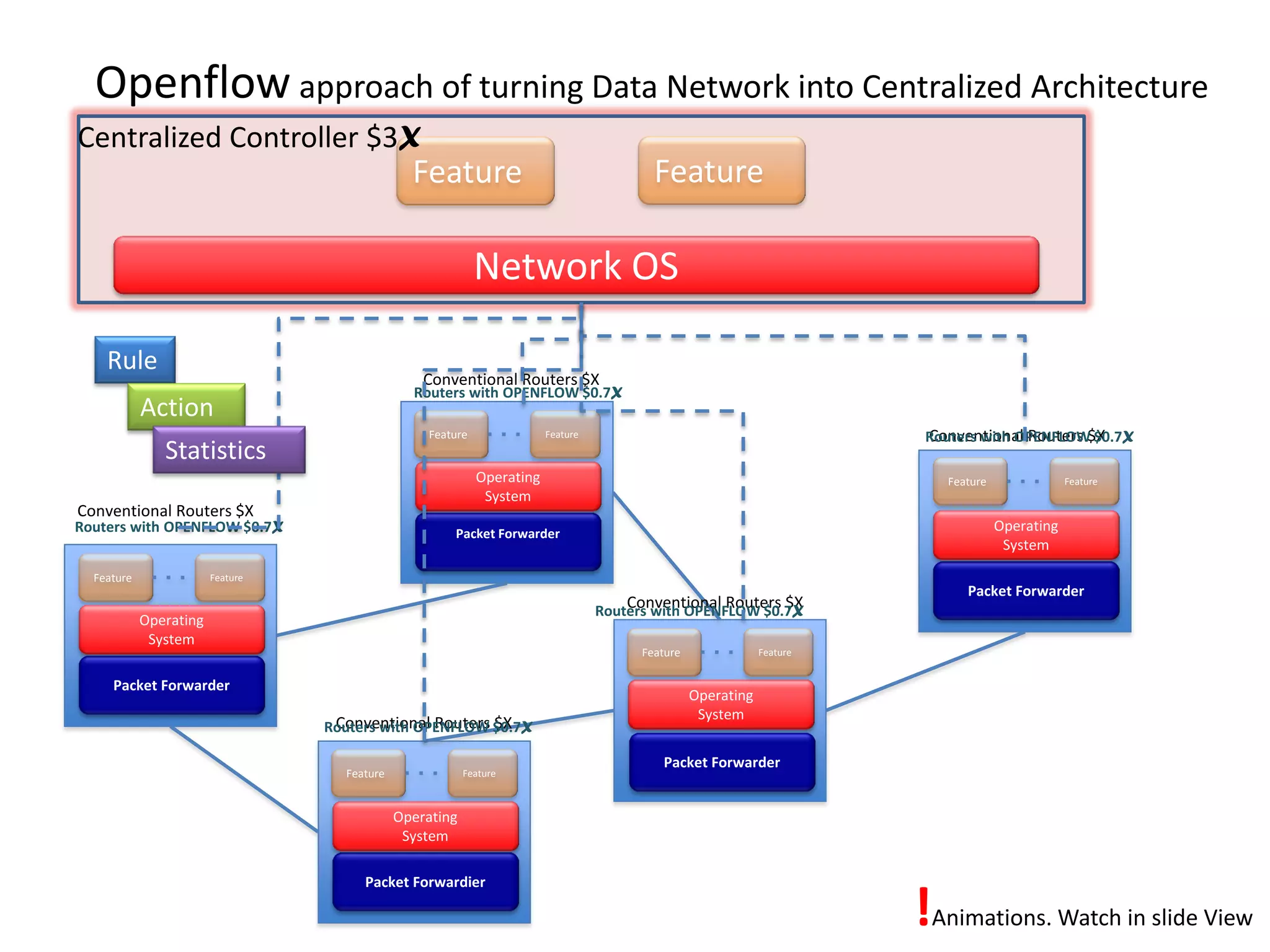
Openflow approach of turning Data Network into Centralized Architecture
Conventional Routers $X
Conventional Routers $XRouters with OPENFLOW $0.7X
Routers with OPENFLOW $0.7X
Centralized Controller $3X
Rule
Action
Statistics
!Animations. Watch in slide View
OpenFlow allows telcos to reduce CAPEX, OPEX and to
add new differentiating features to their networks.
CAPEX Items -
• Given that Routers and Switches expected to be far simpler and use, less
processing ,the cost is expected to be reduced by ~30%. Where as the
central server will be and additional cost eqv to 3times of typical cost of
highest capacity switch in an incumbent network.
• CAPEX on Load Balancers can be eliminated.
OPEX Benefits - The bandwidth utilisation will be more efficient than incumbent multipath
network. The upper and lower peaks across redundant paths will be
normailsed upto 30%.
Operational Skillset levels required across multivendor scenario will be
reduced significantly.
Differentiating Features - Next slide---------------------
Differentiating Features in OPENFLOW
• Simplicity of Single API for Path provisioning , Policy creation etc especially on
multivendor scenario.
• High Scalability - In regular scenario, Economics of architecture is largely influenced
by size of the network. Where as in OPENFLOW the designer doesnot need to
bother about the size of deployment. Investment is protected as same architecture
is applicable along with all benefits for both small and large size networks.
• High Distribution Efficiency – In multipath and redundancy scenario the traffic is
largely unevenly distributed between Source and Destination. Openflow normalises
the traffic distribution in multipath scenario hence resources/ assets are optimally
utilised which can be financially termed as RoA (Return of Assets)
• Decreased Latency -Since number of elements (Majorly Load balancer, Firewall ,
hops) across path is reduced the latency will decrease accordingly.
• Higher Security – The local nodes no more can be configured in isolation to take
decision on their own
• Efficient and better service assurance than legacy MPLS where each
Switch/Routing element puts its intelligence to derive a QOS.
Differentiating Features………contd.
• Significant reduction in lead time of implementing innovative routing and
switching protocols.
• In an ALL-IP mobile network, traffic from Base stations can dynamically select the
most suitable routes based on backhaul utilization .
• WIFI, WIMAX hand off trial has already been carried out in University lab .The
handoff was based on location information within mobile networks, received
signal power level, communication resource utilization and mobile backhaul
congestion.
o Using OPENFLOW protocol, OPEN/Public WIFI can be accessed with external
authentication such as FACEBOOK Connect, GOOGLE OPENID.
• Firewall functionality can be addressed through the OPENFLOW
• It seriously compliments the efficiency of running cloud services and Data Centre
making FACEBOOK,YAHOO and GOOGLE seriously participating ONF forums
Open flow Relevance to Mobile Broadband business –
It will help smooth distribution of Data traffic across
Platform redundancy , backbone multipath and lead to
optimal usage of these . Currently the MBB providers are
trying to achieve this through expensive load balancers
and complication on building the intelligence on each
node.
Caution: The technology is currently on test beds and on its
way to large scale commercial deployments
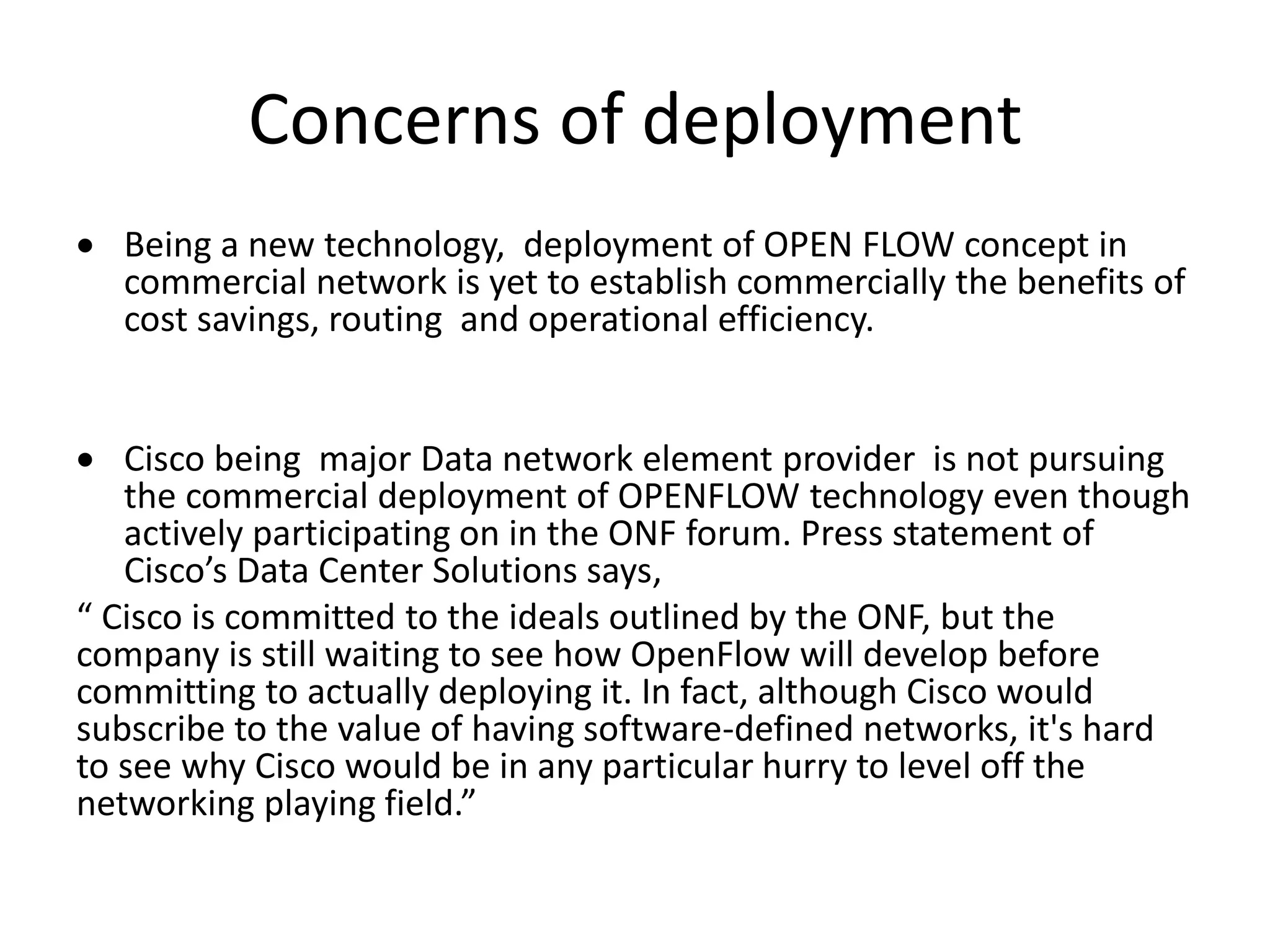
Concerns of deployment
 Being a new technology, deployment of OPEN FLOW concept in
commercial network is yet to establish commercially the benefits of
cost savings, routing and operational efficiency.
 Cisco being major Data network element provider is not pursuing
the commercial deployment of OPENFLOW technology even though
actively participating on in the ONF forum. Press statement of
Cisco’s Data Center Solutions says,
“ Cisco is committed to the ideals outlined by the ONF, but the
company is still waiting to see how OpenFlow will develop before
committing to actually deploying it. In fact, although Cisco would
subscribe to the value of having software-defined networks, it's hard
to see why Cisco would be in any particular hurry to level off the
networking playing field.”
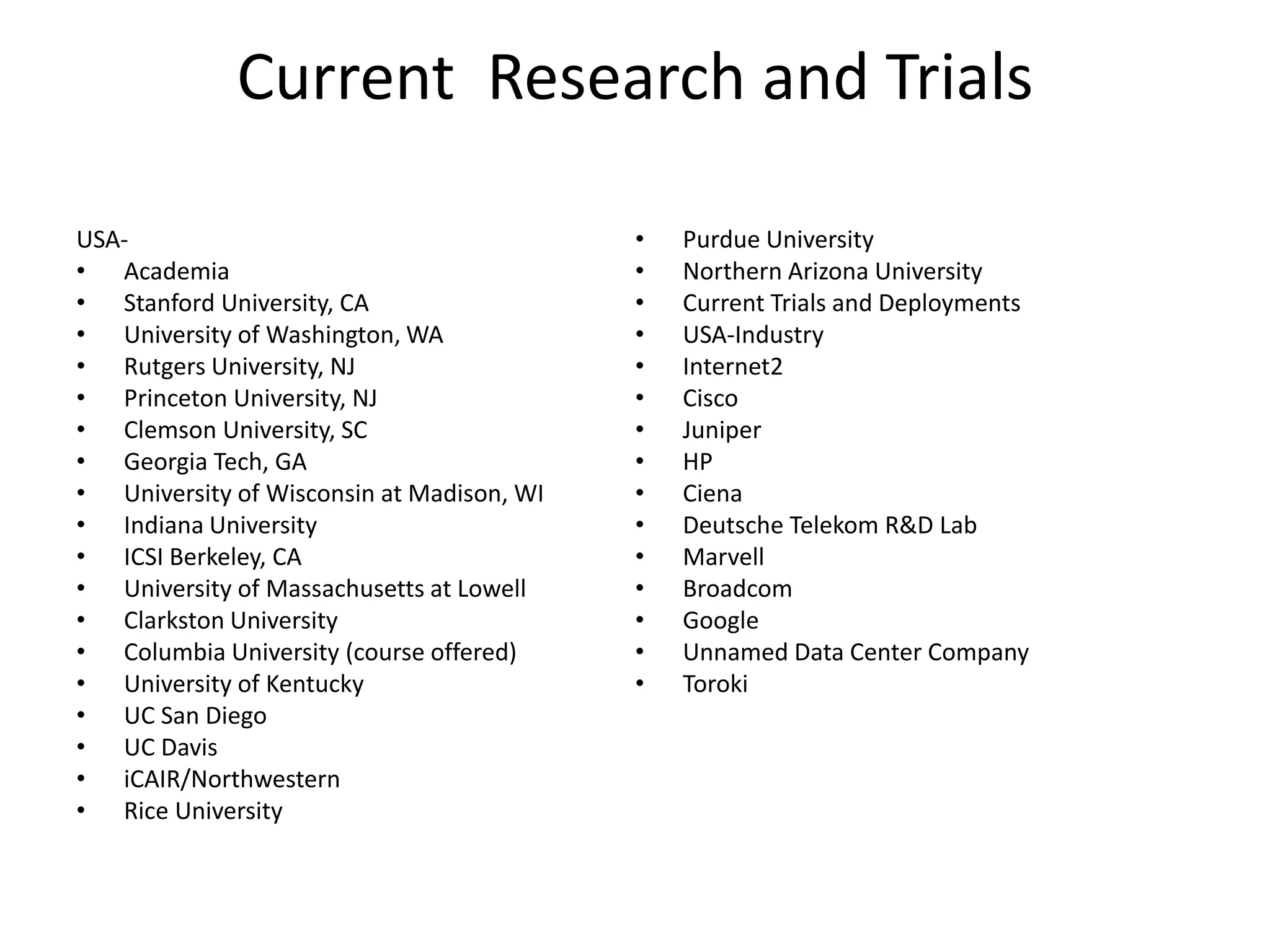
Current Research and Trials
USA-
• Academia
• Stanford University, CA
• University of Washington, WA
• Rutgers University, NJ
• Princeton University, NJ
• Clemson University, SC
• Georgia Tech, GA
• University of Wisconsin at Madison, WI
• Indiana University
• ICSI Berkeley, CA
• University of Massachusetts at Lowell
• Clarkston University
• Columbia University (course offered)
• University of Kentucky
• UC San Diego
• UC Davis
• iCAIR/Northwestern
• Rice University
• Purdue University
• Northern Arizona University
• Current Trials and Deployments
• USA-Industry
• Internet2
• Cisco
• Juniper
• HP
• Ciena
• Deutsche Telekom R&D Lab
• Marvell
• Broadcom
• Google
• Unnamed Data Center Company
• Toroki
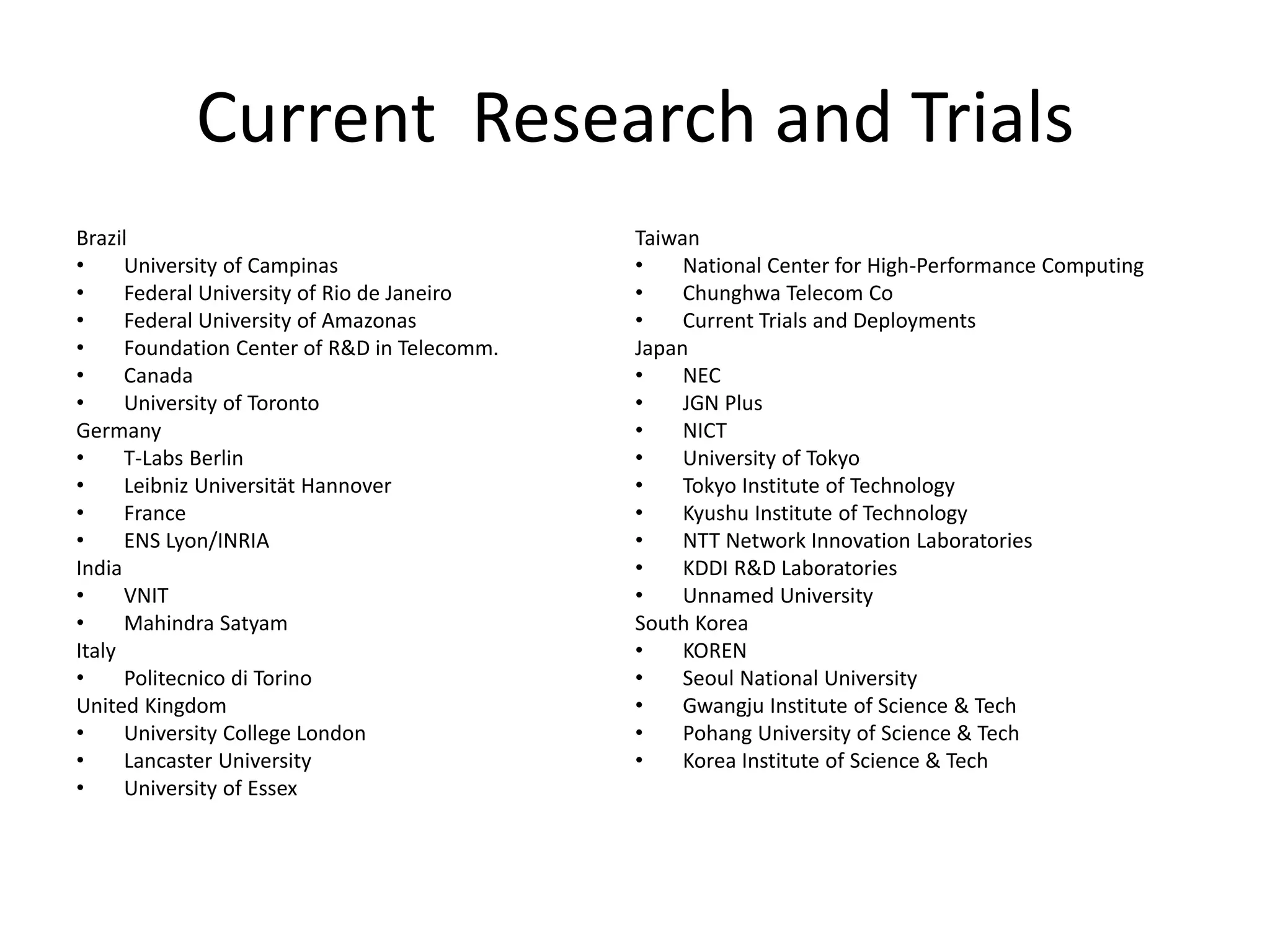
Current Research and Trials
Brazil
• University of Campinas
• Federal University of Rio de Janeiro
• Federal University of Amazonas
• Foundation Center of R&D in Telecomm.
• Canada
• University of Toronto
Germany
• T-Labs Berlin
• Leibniz Universität Hannover
• France
• ENS Lyon/INRIA
India
• VNIT
• Mahindra Satyam
Italy
• Politecnico di Torino
United Kingdom
• University College London
• Lancaster University
• University of Essex
Taiwan
• National Center for High-Performance Computing
• Chunghwa Telecom Co
• Current Trials and Deployments
Japan
• NEC
• JGN Plus
• NICT
• University of Tokyo
• Tokyo Institute of Technology
• Kyushu Institute of Technology
• NTT Network Innovation Laboratories
• KDDI R&D Laboratories
• Unnamed University
South Korea
• KOREN
• Seoul National University
• Gwangju Institute of Science & Tech
• Pohang University of Science & Tech
• Korea Institute of Science & Tech
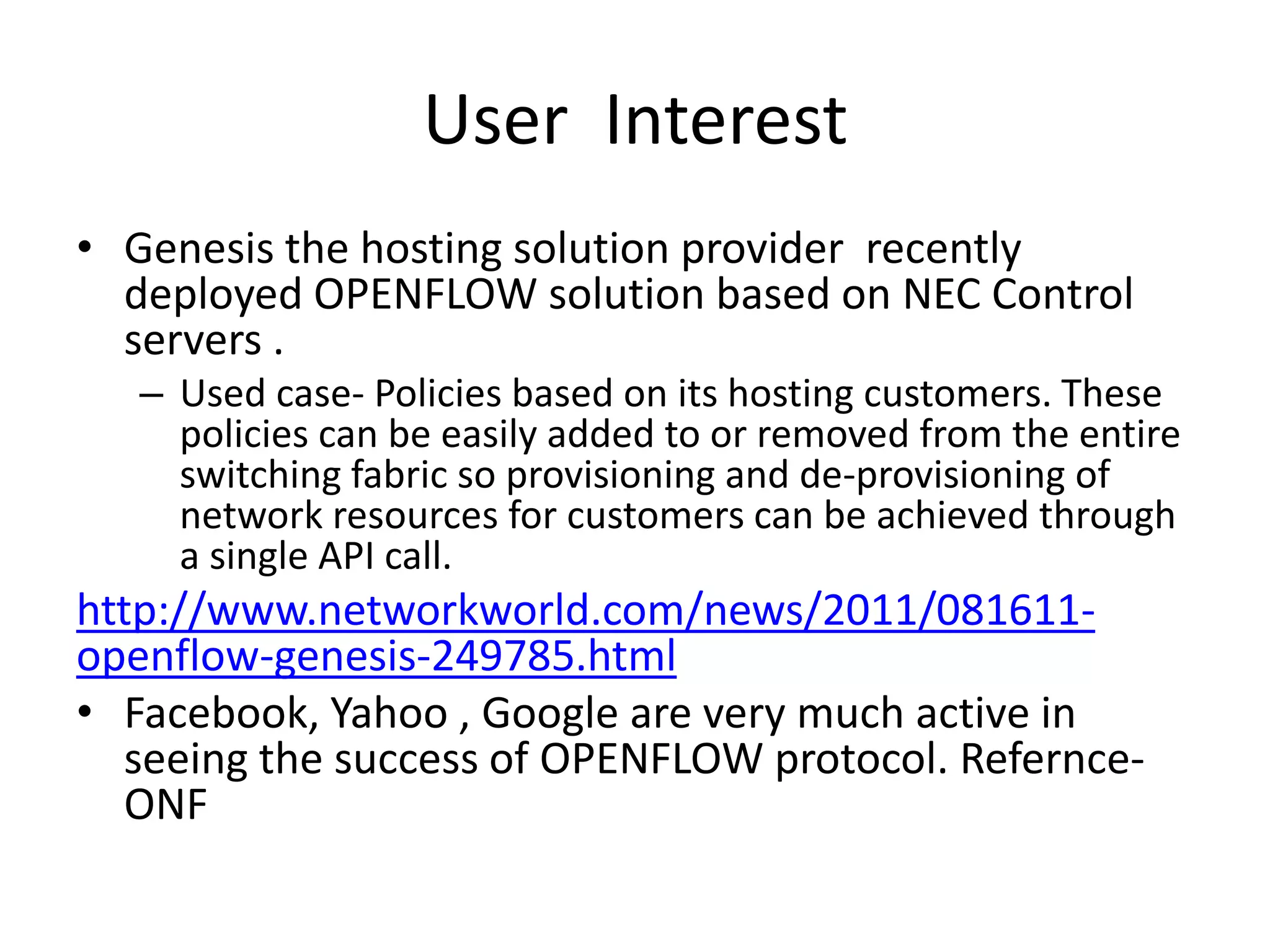
User Interest
• Genesis the hosting solution provider recently
deployed OPENFLOW solution based on NEC Control
servers .
– Used case- Policies based on its hosting customers. These
policies can be easily added to or removed from the entire
switching fabric so provisioning and de-provisioning of
network resources for customers can be achieved through
a single API call.
http://www.networkworld.com/news/2011/081611-
openflow-genesis-249785.html
• Facebook, Yahoo , Google are very much active in
seeing the success of OPENFLOW protocol. Refernce-
ONF
Proposed Steps to embrace OpenFlow
in MBB service provider scenario
• All In-process and future RFPs should Mention OPENFLOW
architecture.
• New load balancer deployments should be evaluated from
OPENFLOW perspective.
• Evaluate roadmaps of currently deployed router and switching
elements and shortlist them on putting OPENFLOW layer.
• Calculate the capacity gain in the shortlisted elements and estimate
if connecting them to a Control server will balance the savings over
a period of time.
• New immediate deployments should have a forward compatibility
towards OPENFLOW
• Once some elements become OPENFLOW capable cluster them and
let them interwork with non-OpenFlow cluster
http://video.necam.com/pflow/ : Simple
animated video explaining why to embrace OPENFLOW
End of presentation

Openflow for Mobile Broadband service providers_Nov'11

  • 1.
    OPENFLOW Technical Relevance Analysisfor a MBB service provider Radhakant Das 02Oct’11 Radhakant
  • 2.
    CONCEPT OPENFLOW approach centralizesthe intelligence in a Data transport network and makes the routing & Switching elements mere Packet forwarders Currently all routing and switching elements are Intelligent and hence expensive. In current situation, intelligence is duplicated in all routing& switching elements doing the same task while adding complexity as well as reduced efficiency over redundant links/alternate paths.
  • 3.
    OPENFLOW has potentialof following the History of centralizing Intelligence in Wireless Industry • HLR in early days were collocated to each wireless MSC making it expensive and become almost impossible once the Operators reached the million barrier even at city level. Finally the Intelligence of HLR moved out from MSC to Standalone-mode followed by lot of debate on centralized vs integrated versions w.r.to economy of scale. • 10-12 years back all the MSCs(Mobile Switching centre) use to do subscriber profiling, Mobility Management ,call control and routing. With the growth industry on number of subscribers , call attempts etc all the intelligence moved out from MSC and renamed as Media Gateway which simply does the call routing and switching Above explanation does give the evidence that VOICE i.e. TDM industry has seen the change of trend in architecture from distributed to centralized due to economical and complexity consideration. OPENFLOW follows the exact path on Packet domain, what has been seen in past in VOICE dominant Mobile industry
  • 4.
    Packet Forwarder Feature Feature PacketForwarder Packet Forwarder Packet Forwardier Packet Forwarder Operating System Operating System Operating System Operating System Operating System Network OS Feature Feature Feature Feature Feature Feature Feature Feature Feature Feature Openflow approach of turning Data Network into Centralized Architecture Conventional Routers $X Conventional Routers $X Conventional Routers $X Conventional Routers $X Conventional Routers $XRouters with OPENFLOW $0.7X Routers with OPENFLOW $0.7X Routers with OPENFLOW $0.7X Routers with OPENFLOW $0.7X Routers with OPENFLOW $0.7X Centralized Controller $3X Rule Action Statistics !Animations. Watch in slide View
  • 5.
    OpenFlow allows telcosto reduce CAPEX, OPEX and to add new differentiating features to their networks. CAPEX Items - • Given that Routers and Switches expected to be far simpler and use, less processing ,the cost is expected to be reduced by ~30%. Where as the central server will be and additional cost eqv to 3times of typical cost of highest capacity switch in an incumbent network. • CAPEX on Load Balancers can be eliminated. OPEX Benefits - The bandwidth utilisation will be more efficient than incumbent multipath network. The upper and lower peaks across redundant paths will be normailsed upto 30%. Operational Skillset levels required across multivendor scenario will be reduced significantly. Differentiating Features - Next slide---------------------
  • 6.
    Differentiating Features inOPENFLOW • Simplicity of Single API for Path provisioning , Policy creation etc especially on multivendor scenario. • High Scalability - In regular scenario, Economics of architecture is largely influenced by size of the network. Where as in OPENFLOW the designer doesnot need to bother about the size of deployment. Investment is protected as same architecture is applicable along with all benefits for both small and large size networks. • High Distribution Efficiency – In multipath and redundancy scenario the traffic is largely unevenly distributed between Source and Destination. Openflow normalises the traffic distribution in multipath scenario hence resources/ assets are optimally utilised which can be financially termed as RoA (Return of Assets) • Decreased Latency -Since number of elements (Majorly Load balancer, Firewall , hops) across path is reduced the latency will decrease accordingly. • Higher Security – The local nodes no more can be configured in isolation to take decision on their own • Efficient and better service assurance than legacy MPLS where each Switch/Routing element puts its intelligence to derive a QOS.
  • 7.
    Differentiating Features………contd. • Significantreduction in lead time of implementing innovative routing and switching protocols. • In an ALL-IP mobile network, traffic from Base stations can dynamically select the most suitable routes based on backhaul utilization . • WIFI, WIMAX hand off trial has already been carried out in University lab .The handoff was based on location information within mobile networks, received signal power level, communication resource utilization and mobile backhaul congestion. o Using OPENFLOW protocol, OPEN/Public WIFI can be accessed with external authentication such as FACEBOOK Connect, GOOGLE OPENID. • Firewall functionality can be addressed through the OPENFLOW • It seriously compliments the efficiency of running cloud services and Data Centre making FACEBOOK,YAHOO and GOOGLE seriously participating ONF forums
  • 8.
    Open flow Relevanceto Mobile Broadband business – It will help smooth distribution of Data traffic across Platform redundancy , backbone multipath and lead to optimal usage of these . Currently the MBB providers are trying to achieve this through expensive load balancers and complication on building the intelligence on each node. Caution: The technology is currently on test beds and on its way to large scale commercial deployments
  • 9.
    Concerns of deployment Being a new technology, deployment of OPEN FLOW concept in commercial network is yet to establish commercially the benefits of cost savings, routing and operational efficiency.  Cisco being major Data network element provider is not pursuing the commercial deployment of OPENFLOW technology even though actively participating on in the ONF forum. Press statement of Cisco’s Data Center Solutions says, “ Cisco is committed to the ideals outlined by the ONF, but the company is still waiting to see how OpenFlow will develop before committing to actually deploying it. In fact, although Cisco would subscribe to the value of having software-defined networks, it's hard to see why Cisco would be in any particular hurry to level off the networking playing field.”
  • 10.
    Current Research andTrials USA- • Academia • Stanford University, CA • University of Washington, WA • Rutgers University, NJ • Princeton University, NJ • Clemson University, SC • Georgia Tech, GA • University of Wisconsin at Madison, WI • Indiana University • ICSI Berkeley, CA • University of Massachusetts at Lowell • Clarkston University • Columbia University (course offered) • University of Kentucky • UC San Diego • UC Davis • iCAIR/Northwestern • Rice University • Purdue University • Northern Arizona University • Current Trials and Deployments • USA-Industry • Internet2 • Cisco • Juniper • HP • Ciena • Deutsche Telekom R&D Lab • Marvell • Broadcom • Google • Unnamed Data Center Company • Toroki
  • 11.
    Current Research andTrials Brazil • University of Campinas • Federal University of Rio de Janeiro • Federal University of Amazonas • Foundation Center of R&D in Telecomm. • Canada • University of Toronto Germany • T-Labs Berlin • Leibniz Universität Hannover • France • ENS Lyon/INRIA India • VNIT • Mahindra Satyam Italy • Politecnico di Torino United Kingdom • University College London • Lancaster University • University of Essex Taiwan • National Center for High-Performance Computing • Chunghwa Telecom Co • Current Trials and Deployments Japan • NEC • JGN Plus • NICT • University of Tokyo • Tokyo Institute of Technology • Kyushu Institute of Technology • NTT Network Innovation Laboratories • KDDI R&D Laboratories • Unnamed University South Korea • KOREN • Seoul National University • Gwangju Institute of Science & Tech • Pohang University of Science & Tech • Korea Institute of Science & Tech
  • 12.
    User Interest • Genesisthe hosting solution provider recently deployed OPENFLOW solution based on NEC Control servers . – Used case- Policies based on its hosting customers. These policies can be easily added to or removed from the entire switching fabric so provisioning and de-provisioning of network resources for customers can be achieved through a single API call. http://www.networkworld.com/news/2011/081611- openflow-genesis-249785.html • Facebook, Yahoo , Google are very much active in seeing the success of OPENFLOW protocol. Refernce- ONF
  • 13.
    Proposed Steps toembrace OpenFlow in MBB service provider scenario • All In-process and future RFPs should Mention OPENFLOW architecture. • New load balancer deployments should be evaluated from OPENFLOW perspective. • Evaluate roadmaps of currently deployed router and switching elements and shortlist them on putting OPENFLOW layer. • Calculate the capacity gain in the shortlisted elements and estimate if connecting them to a Control server will balance the savings over a period of time. • New immediate deployments should have a forward compatibility towards OPENFLOW • Once some elements become OPENFLOW capable cluster them and let them interwork with non-OpenFlow cluster
  • 14.
    http://video.necam.com/pflow/ : Simple animatedvideo explaining why to embrace OPENFLOW End of presentation