REVIEW
VOLCANOES
Learning Objective
At the end of the
lesson you will be able
to:
1.) Describe the
different types of
volcanoes;
2.) Differentiate
between active and
inactive volcanoes
12/8/2020 4
Once upon a time the ancient Romans
believed that Vulcan, god of fire and
metalworking, had a blacksmith shop on a
mountain on an island near Sicily, named
Vulcano. This is where the word "volcano"
came from. The end.
Volcano
•Volcanoes are very different
•Not formed by folding and
crumpling or by uplift and
erosion.
•Formed by accumulation of
their own eruptive products
Volcano
Eruptive products: lava,
bomb, tephra.
Vent/opening- is where the
materials are ejected.
12/8/2020 8
Volcano
•Buoyancy and gas pressure
force molten rocks upward and
break through weak zones of
earth's crust.
•Eruption begins, molten pour
from the vent as non-explosive
lava flows out it may shoot
violently into the air.
12/8/2020 9
Volcano
•Due to force of gravity, larger fragments fall
back around the vent.
•Finer materials carried by the wind only to fall
to the ground many
•miles away.
•Finest ash are ejected to the atmosphere and
carried around the
•world.
12/8/2020 10
Volcano
•Magma- molten rock
below the surface of the
earth
•Lava- ejected to flow on
the surface of the earth
12/8/2020
11
commonly contains
crystals, fragments of
surrounding rocks and
dissolved gases
ten miles
beneath the
ground
Upon cooling liquid
precipitates crystals
until solidification is
complete to form
igneous rocks
12/8/2020 12
Magma
Lava viscosity is
influence by
temperature, mineral
and water content
Red hot when
it pours out of
the vent
Very hot gas rich
lava contains-
silicon, sodium,
potassium and
flows
like hot tar
12/8/2020 13
Lava
Cooler gas poor
lava high in
silicon, sodium
and potassium
and flows
sluggishly
Volcano
•2 factors that determine
the type of eruption:
1. Silica
2. Water Content
a.) Silica type lava, lava flows freely
15
b.) Low-water, high silica type lava
(very viscous) produces pasty lava
which usually results in domes
16
c.) In a high-water, low silica
(not viscous) lava, the eruption
appears as a fountain of runny
lava
d.) In a high-water, high silica
type (very viscous) lava, the
eruption is explosive.
VOLCANO
Products
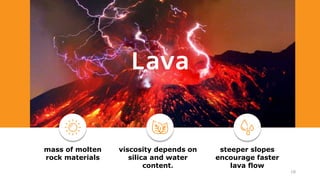
mass of molten
rock materials
viscosity depends on
silica and water
content.
steeper slopes
encourage faster
lava flow
Lava
18
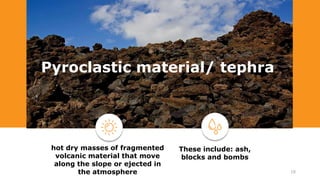
hot dry masses of fragmented
volcanic material that move
along the slope or ejected in
the atmosphere
These include: ash,
blocks and bombs
19
Pyroclastic material/ tephra
basic components
of magma or lava
maybe in the form of water vapor,
hydrogen sulfide, sulfur dioxide,
carbon monoxide or hydrogen
chloride.
The proportion of these
components changes
with changing
temperature.20
Volcanic gas
3 types of
Volcanoes
.
Composite
Volcano
12/8/2020 24
Cinder cone
volcano
12/8/2020 26
Shield
volcano
12/8/2020 28
•Some of Earth's grandest
mountains
•Sometimes called
stratovolcanoes
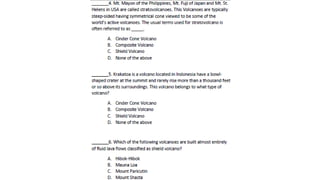
• Typically, steep-sided,
symmetrical cones of large
base built by layers of lava
flows, volcanic ash, cinders,
blocks and bombs.
29
Composite
Volcano
•Rise as much as 8000 ft
above their bases
•Some of the most
conspicuous and beautiful
mountains in the world
are composite volcanoes
30
Composite
Volcano
Mount Mayon in the Philippines
Mount Fuji in Japan
Mount Shasta in California
Mount Hood in Oregon
Mount Rainier in Washington
•They have crater at the
summit which contains a
central vent or a
clustered group of vents.
•Lava either flow through
breaks in the crater wall
or come out from
fissures.
36
Composite
Volcano
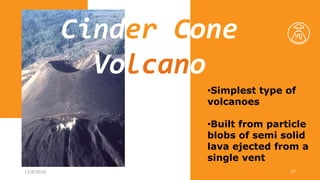
•Simplest type of
volcanoes
•Built from particle
blobs of semi solid
lava ejected from a
single vent
12/8/2020 37
Cinder Cone
Volcano
•Most have a bowl-shaped
crater at the summit and
rarely rise more than a
thousand feet or so above
their surroundings.
•Generally not very tall, only a
few hundred meters because
gravity tends to cause the
loose cinders to slide off the
sides.
12/8/2020 38
Cinder Cone
Volcano
•Third type of
volcanoes
• Built almost
entirely of fluid
lava flows
39
Shield
Volcano
•Pours out in all directions
from a central summit vent, or
group of vents, building a
broad, gently sloping cone of
flat, domical shape.
• Hawaiian volcanoes are
known as shield volcanoes
because they resemble the
wide, rounded shape of an
ancient warrior's shield.
40
Shield
Volcano
•Tend to erupt non-
explosively mainly
pouring out huge volumes
of fluid lava.
•Some of the largest
volcanoes in the world
are shield volcanoes.
41
Shield
Volcano
“Climb To
The Top:
Smoke And
Ladders”
12/8/2020 42
https://www.geniusgames.
org/collections/science-
based-tabletop-games
12/8/2020 43
Why do we
need to study
Volcanoes?
12/8/2020 45
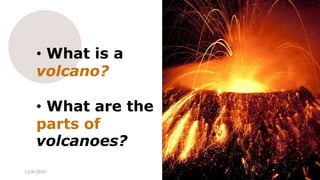
• What is a
volcano?
• What are the
parts of
volcanoes?
12/8/2020 46
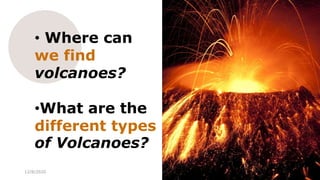
• Where can
we find
volcanoes?
•What are the
different types
of Volcanoes?
12/8/2020 47
Summary/
Generalization
12/8/2020 48
EVALUATING
LEARNING
12/8/2020 49
THANK YOU

Volcano

  • 2.
  • 3.
  • 4.
    Learning Objective At theend of the lesson you will be able to: 1.) Describe the different types of volcanoes; 2.) Differentiate between active and inactive volcanoes 12/8/2020 4
  • 6.
    Once upon atime the ancient Romans believed that Vulcan, god of fire and metalworking, had a blacksmith shop on a mountain on an island near Sicily, named Vulcano. This is where the word "volcano" came from. The end.
  • 7.
    Volcano •Volcanoes are verydifferent •Not formed by folding and crumpling or by uplift and erosion. •Formed by accumulation of their own eruptive products
  • 8.
    Volcano Eruptive products: lava, bomb,tephra. Vent/opening- is where the materials are ejected. 12/8/2020 8
  • 9.
    Volcano •Buoyancy and gaspressure force molten rocks upward and break through weak zones of earth's crust. •Eruption begins, molten pour from the vent as non-explosive lava flows out it may shoot violently into the air. 12/8/2020 9
  • 10.
    Volcano •Due to forceof gravity, larger fragments fall back around the vent. •Finer materials carried by the wind only to fall to the ground many •miles away. •Finest ash are ejected to the atmosphere and carried around the •world. 12/8/2020 10
  • 11.
    Volcano •Magma- molten rock belowthe surface of the earth •Lava- ejected to flow on the surface of the earth 12/8/2020 11
  • 12.
    commonly contains crystals, fragmentsof surrounding rocks and dissolved gases ten miles beneath the ground Upon cooling liquid precipitates crystals until solidification is complete to form igneous rocks 12/8/2020 12 Magma
  • 13.
    Lava viscosity is influenceby temperature, mineral and water content Red hot when it pours out of the vent Very hot gas rich lava contains- silicon, sodium, potassium and flows like hot tar 12/8/2020 13 Lava Cooler gas poor lava high in silicon, sodium and potassium and flows sluggishly
  • 14.
    Volcano •2 factors thatdetermine the type of eruption: 1. Silica 2. Water Content
  • 15.
    a.) Silica typelava, lava flows freely 15 b.) Low-water, high silica type lava (very viscous) produces pasty lava which usually results in domes
  • 16.
    16 c.) In ahigh-water, low silica (not viscous) lava, the eruption appears as a fountain of runny lava d.) In a high-water, high silica type (very viscous) lava, the eruption is explosive.
  • 17.
  • 18.
    mass of molten rockmaterials viscosity depends on silica and water content. steeper slopes encourage faster lava flow Lava 18
  • 19.
    hot dry massesof fragmented volcanic material that move along the slope or ejected in the atmosphere These include: ash, blocks and bombs 19 Pyroclastic material/ tephra
  • 20.
    basic components of magmaor lava maybe in the form of water vapor, hydrogen sulfide, sulfur dioxide, carbon monoxide or hydrogen chloride. The proportion of these components changes with changing temperature.20 Volcanic gas
  • 21.
  • 24.
  • 26.
  • 28.
  • 29.
    •Some of Earth'sgrandest mountains •Sometimes called stratovolcanoes • Typically, steep-sided, symmetrical cones of large base built by layers of lava flows, volcanic ash, cinders, blocks and bombs. 29 Composite Volcano
  • 30.
    •Rise as muchas 8000 ft above their bases •Some of the most conspicuous and beautiful mountains in the world are composite volcanoes 30 Composite Volcano
  • 31.
    Mount Mayon inthe Philippines
  • 32.
  • 33.
    Mount Shasta inCalifornia
  • 34.
  • 35.
    Mount Rainier inWashington
  • 36.
    •They have craterat the summit which contains a central vent or a clustered group of vents. •Lava either flow through breaks in the crater wall or come out from fissures. 36 Composite Volcano
  • 37.
    •Simplest type of volcanoes •Builtfrom particle blobs of semi solid lava ejected from a single vent 12/8/2020 37 Cinder Cone Volcano
  • 38.
    •Most have abowl-shaped crater at the summit and rarely rise more than a thousand feet or so above their surroundings. •Generally not very tall, only a few hundred meters because gravity tends to cause the loose cinders to slide off the sides. 12/8/2020 38 Cinder Cone Volcano
  • 39.
    •Third type of volcanoes •Built almost entirely of fluid lava flows 39 Shield Volcano
  • 40.
    •Pours out inall directions from a central summit vent, or group of vents, building a broad, gently sloping cone of flat, domical shape. • Hawaiian volcanoes are known as shield volcanoes because they resemble the wide, rounded shape of an ancient warrior's shield. 40 Shield Volcano
  • 41.
    •Tend to eruptnon- explosively mainly pouring out huge volumes of fluid lava. •Some of the largest volcanoes in the world are shield volcanoes. 41 Shield Volcano
  • 42.
    “Climb To The Top: SmokeAnd Ladders” 12/8/2020 42
  • 43.
  • 45.
    Why do we needto study Volcanoes? 12/8/2020 45
  • 46.
    • What isa volcano? • What are the parts of volcanoes? 12/8/2020 46
  • 47.
    • Where can wefind volcanoes? •What are the different types of Volcanoes? 12/8/2020 47
  • 48.
  • 49.
  • 56.

Editor's Notes

  • #5 Photo by Marc Szeglat on Unsplash <div>Icons made by <a href="https://www.flaticon.com/authors/freepik" title="Freepik">Freepik</a> from <a href="https://www.flaticon.com/" title="Flaticon">www.flaticon.com</a></div>
  • #7 Photo by Marc Szeglat on Unsplash
  • #8 Photo by Marc Szeglat on Unsplash
  • #9 Photo by Marc Szeglat on Unsplash <div>Icons made by <a href="https://www.flaticon.com/authors/freepik" title="Freepik">Freepik</a> from <a href="https://www.flaticon.com/" title="Flaticon">www.flaticon.com</a></div>
  • #10 Photo by Max Vnck on Unsplash
  • #11 Photo by Jiaying on Unsplash
  • #12 Photo by Max Vnck on Unsplash
  • #13 Photo by Max Vnck on Unsplash
  • #14 Photo by Max Vnck on Unsplash
  • #15 Photo by Marc Szeglat on Unsplash
  • #16 Photo by Caitlin Wynne on Unsplash
  • #17 Photo by Caitlin Wynne on Unsplash
  • #18 Photo by Marc Szeglat on Unsplash
  • #19 Photo by Max Vnck on Unsplash
  • #20 Photo by Max Vnck on Unsplash
  • #21 Photo by Max Vnck on Unsplash
  • #22 Photo by Marc Szeglat on Unsplash
  • #24 Photo by Max Vnck on Unsplash
  • #25 Photo by Marc Szeglat on Unsplash <div>Icons made by <a href="https://www.flaticon.com/authors/freepik" title="Freepik">Freepik</a> from <a href="https://www.flaticon.com/" title="Flaticon">www.flaticon.com</a></div>
  • #26 Photo by Max Vnck on Unsplash
  • #27 Photo by Marc Szeglat on Unsplash <div>Icons made by <a href="https://www.flaticon.com/authors/freepik" title="Freepik">Freepik</a> from <a href="https://www.flaticon.com/" title="Flaticon">www.flaticon.com</a></div>
  • #28 Photo by Max Vnck on Unsplash
  • #29 Photo by Marc Szeglat on Unsplash <div>Icons made by <a href="https://www.flaticon.com/authors/freepik" title="Freepik">Freepik</a> from <a href="https://www.flaticon.com/" title="Flaticon">www.flaticon.com</a></div>
  • #30 Photo by Max Vnck on Unsplash
  • #31 Photo by Max Vnck on Unsplash
  • #32 Photo by Max Vnck on Unsplash
  • #33 Photo by Max Vnck on Unsplash
  • #34 Photo by Max Vnck on Unsplash
  • #35 Photo by Max Vnck on Unsplash
  • #36 Photo by Max Vnck on Unsplash
  • #37 Photo by Max Vnck on Unsplash
  • #38 Photo by Max Vnck on Unsplash
  • #39 Photo by Max Vnck on Unsplash
  • #40 Photo by Max Vnck on Unsplash
  • #41 Photo by Max Vnck on Unsplash
  • #42 Photo by Max Vnck on Unsplash
  • #43 Photo by Marc Szeglat on Unsplash <div>Icons made by <a href="https://www.flaticon.com/authors/freepik" title="Freepik">Freepik</a> from <a href="https://www.flaticon.com/" title="Flaticon">www.flaticon.com</a></div>
  • #44 Photo by Marc Szeglat on Unsplash <div>Icons made by <a href="https://www.flaticon.com/authors/freepik" title="Freepik">Freepik</a> from <a href="https://www.flaticon.com/" title="Flaticon">www.flaticon.com</a></div>
  • #45 Photo by Max Vnck on Unsplash
  • #46 Photo by Jiaying on Unsplash
  • #47 Photo by Jiaying on Unsplash
  • #48 Photo by Jiaying on Unsplash
  • #49 Photo by Marc Szeglat on Unsplash <div>Icons made by <a href="https://www.flaticon.com/authors/freepik" title="Freepik">Freepik</a> from <a href="https://www.flaticon.com/" title="Flaticon">www.flaticon.com</a></div>
  • #50 Photo by Marc Szeglat on Unsplash <div>Icons made by <a href="https://www.flaticon.com/authors/freepik" title="Freepik">Freepik</a> from <a href="https://www.flaticon.com/" title="Flaticon">www.flaticon.com</a></div>
  • #57 Photo by Marc Szeglat on Unsplash