

Orientalism
The last phase
by Edward Said
Ilyas Babar Awan
Lecturer in English
National University of Modern Languages, Islamabad, Pakistan
Orientalism
• "Orientalism” is a way of seeing that imagines, emphasizes,
exaggerates and distorts differences of Arab/Eastern peoples and
cultures as compared to that of Europe and the U.S. It often
involves seeing Arab/Eastern cultures as exotic, backward,
uncivilized, and at times dangerous. Edward W. Said, in his
groundbreaking book, Orientalism, defined it as the acceptance in
the West of “the basic distinction between East and West as the
starting point for elaborate theories, epics, novels, social
descriptions, and political accounts concerning the Orient, its
people, customs, ‘mind,’ destiny and so on.”
WWII
• After WWII France and Britain no longer occupy center stage in world
politics; the American imperium has displaced them.
• Since World War II. and more noticeably after each of the Arab-Israeli
wars, the Arab Muslim has become a figure in American popular culture,
even as in the academic world, in the policy planner's world, and in the
world of business very serious attention is being paid the Arab.
• A vast web of interests now links all parts of the former colonial world to
the United Stales
Representation of the Orient
• A wide variety of hybrid representations of the Orient now roam
the culture. Japan, Indochina, China, India, Pakistan : their
representations have had, and continue to have, wide
repercussions, and they have been discussed in many places for
obvious reasons.
1. Popular images and social science representations.
2. Cultural relations policy.
3. Merely Islam
4. Orientals Orientals Orientals
Arab Israel War – June 1967
The Six-Day War, also known as the June War, 1967 Arab–
Israeli War, or Third Arab–Israeli War, was fought between
June 5 and 10, 1967 by Israel and the neighboring states
of Egypt, Jordan, and Syria.
Result of this war: 1000 Israeli casualties , 20000 Arab
causalities
Israel seized control of the Gaza Strip and the Sinai
Peninsula from Egypt, the West Bank and East Jerusalem
from Jordan, and the Golan Heights from Syria.
1. Popular images and social science
representations
(Mis)-Representations
Here are a few examples of how the Arab is often represented
today. But first knowing about June war is important.
Princeton University New Jersey USA
Princeton's tenth reunion
class in 1967 ( Arab Costume suggested before war)
The costume for Princeton's tenth reunion
class in 1967 had been planned before the June was,
Arab: robes, headgear,
sandals.
Princeton's tenth reunion
class in 1967 ( Arab Costume suggested After war)
Immediately after the war, when it had become clear
that the Arab motif was an embarrassment, a change in
the reunion plans was decreed. Wearing the costume as
had been originally planned, the class was now to walk
in procession, hands above heads in a gesture of abject
defeat.
Reason: Defeat
This was what the Arab had
become. From a faintly outlined stereotype as a
camel-riding nomad( an accepted caricature as the
embodiment of incompetence and easy defeat: that
was an the scope given the Arab.
Arab–Israeli War-1973
Yom Kippur War or Ramadan War or October War
The 1973 Arab–Israeli War, was a war fought by the coalition of Arab states led
by Egypt and Syria against Israel from October 6 to 25, 1973. The fighting mostly
took place in the Sinai and the Golan Heights, territories that had been occupied
by Israel since the Six-Day War of 1967.
The war began when the Arab coalition launched a joint surprise attack on Israeli
positions in the Israeli-occupied territories on Yom Kippur, the holiest day in
Judaism, which also occurred that year during the Muslim holy month of
Ramadan.
Result:
By the end of the war, the Israelis had advanced to positions some 101 kilometres
from Egypt's capital, Cairo, and occupied 1,600 square kilometres west of the
Suez Canal. They had also cut the Cairo-Suez road and encircled the bulk of
Egypt's Third Army.
Arab representation
Cartoons depicting an Arab sheik standing behind a
gasoline pump turned up consistently. These Arabs,
however, were clearly "Semitic": their sharply hooked
noses, the evil mustachioed leer on their faces, were
obvious reminders that "Semites" were at the bottom of
all "our" troubles, which in this case was principally a
gasoline shortage.
Arab’s Oil Resources
Aside from his anti-Zionism, the Arab is
an oil supplier. This is another negative
characteristic. Arabslj don’t have the
moral qualifications for owning such
vast oil
reserves.
Arab (mis)-representation in Films
In the films and television the Arab is associated either
with lechery or bloodthirsty dishonesty. He appears as an
oversexed degenerate, capable, it is true, of cleverly
devious intrigues, but essentially sadistic, treacherous,
low. Slave trader, camel driver, moneychanger, colorful
scoundrel: these are some traditional Arab roles in the
cinema.
Arabs (mis)-representation in
Journalism/Media
In newsreels or news photos, the Arab is
always shown in large numbers. No
individuality, no personal characteristics
or experiences.
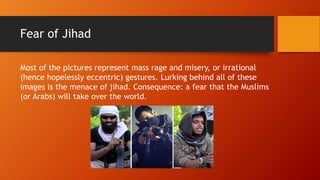
Fear of Jihad
Most of the pictures represent mass rage and misery, or irrational
(hence hopelessly eccentric) gestures. Lurking behind all of these
images is the menace of jihad. Consequence: a fear that the Muslims
(or Arabs) will take over the world.
The Arabs and Islam in American Textbooks
"The Moslem religion, called Islam. began in the seventh century. It was started by a wealthy
businessman of Arabia, called Mohammed. He claimed that he was a prophet. He found
followers among other Arabs. He told '(hem that they were picked to rule the world."
Reason
• “The absence of literature and the relatively weak position of
philology in contemporary American studies of the Near East are
illustrations of a new eccentricity in Orientalism, where indeed
my use of the word itself is anomalous”.
• (Edward Said , Orientalism p.291)
Evidence from history
• In 1973, during the anxious days of the October Arab-Israeli War,
the New York Times Magazine commissioned two articles, one
representing the Israeli and one the Arab side of the conflict. The
Israeli side was presented by an Israeli lawyer; the Arab side, by
an American former ambassador to an Arab country who had no
formal training in Oriental studies. Lest we jump immediately to
the simple conclusion that the Arabs were believed incapable of
representing themselves, we would do well to remember that both
Arabs and Jews in this instance were Semites (in the broad
cultural designation I have been discussing) and that both were
being made to be represented for a Western audience
2. Cultural relations
policy.
American Oriental Society-1842
American Oriental Society in 1842
At its first annual meeting in 1843 its president, John Pickering, made the very clear
point that America proposed for itself the study of the Orient in order to follow the
example of the imperial European powers.
US interest in the Orient
• While it is true to say that the United States did not in fact
become a world empire until the twentieth century, it is also true
that during the nineteenth century the United States was
concerned with the Orient in ways that prepared for its later,
overtly imperial concern.
World Wars and US interest in the Middle East
• WWI:
• During the First World War, what was to become a major United States
policy interest in Zionism and the colonization of Palestine playedan
estimable role in getting the United States into the war.
• WWII:
• During and after the Second World War, the escalation in United States
interest in the Middle East was remarkable. Cairo, Teheran, and North
Africa were important arenas of war, and in that setting, with the
exploitation of its oil, strategic, and human resources pioneered by
Britain and France, the United States prepared for its new postwar
imperial role.
Cultural relations policy
• Defined by Mortimer Graves in 1950
• “every significant publication in every important near eastern language
published since 1900 , our congress ought to recognize as a measure of
our national security”.
• (Communism and Islam are threats)
• Mortimer Graves served as executive Director of ACLS from 1953-1957
• ACLS ( American Council of Learned Societies)
Von Grunebaum writes
• Gustave Edmund von Grunebaum was an Austrian historian and Arabist.
Born in Vienna, Grunebaum received his Ph.D. in Oriental Studies at the
University of Vienna in 1931 with a dissertation on classical Arabic
poetry.
• “It is essential to realize that Muslim civilization is a cultural entity that does not share
our primary aspirations”.
• “[Arab or Islamic nationalism] lacks, in spite of its occasional use as a catchword, the
concept of the divine right of a nation, it lacks a formative ethic, it also lacks, it would
seem, the later nineteenth century belief in mechanistic progress; above all it lacks the
intellectual vigor of a primary phenomenon”.
Cambridge History of Islam (1970)
• The Cambridge History of Islam radically misconceive and
misrepresent Islam as a religion; it also has no corporate idea of
itself as a history.
• For hundreds of pages in volume 1 , Islam is understood to mean
an unrelieved chronology of battles, reigns, and deaths, rises and
heydays, comings and passings, written for the most part in a
ghastly monotone.
Cambridge History of Islam (1970)
• Take the Abbasid period from the eighth to the eleventh century
as an instance. Anyone who has the slightest acquaintance with
Arab or Islamic history will know that it was a high point of
Islamic civilization, as brilliant a period of cultural history as the
High Renaissance in Italy. Yet nowhere in the forty pages of
description does one get an inkling of any richness; what is found
instead
3.Merely Islam
The Protocols of the Elders of Zion (1930)
• “The Arabs, who are superficially clever and quick witted,
worship one thing, and one thing only power and success”.
If Orientalism fails?
• Positively. I do believe-and in my other work have tried to show
that enough is being done today in the human sciences provide the
contemporary scholar with insights, methods, and ideas that could
dispense with racial, ideological, and imperialist stereotypes of
the sort provided during its historical ascendancy by Orientalism. I
consider Orientalism's failure to have been a human as much as an
intellectual one; for in having to take up a position of irreducible
opposition to a region of the world it considered alien to its own,
Orientalism failed to identify. with human experience failed also
to see it as human experience.
QA
Ilyas Babar Awan
Lecturer in English
National University of Modern Languages, Islamabad, Pakistan
ilyasbabar@numl.edu.pk

Orientalism

  • 1.
    Orientalism The last phase byEdward Said Ilyas Babar Awan Lecturer in English National University of Modern Languages, Islamabad, Pakistan
  • 2.
    Orientalism • "Orientalism” isa way of seeing that imagines, emphasizes, exaggerates and distorts differences of Arab/Eastern peoples and cultures as compared to that of Europe and the U.S. It often involves seeing Arab/Eastern cultures as exotic, backward, uncivilized, and at times dangerous. Edward W. Said, in his groundbreaking book, Orientalism, defined it as the acceptance in the West of “the basic distinction between East and West as the starting point for elaborate theories, epics, novels, social descriptions, and political accounts concerning the Orient, its people, customs, ‘mind,’ destiny and so on.”
  • 3.
    WWII • After WWIIFrance and Britain no longer occupy center stage in world politics; the American imperium has displaced them. • Since World War II. and more noticeably after each of the Arab-Israeli wars, the Arab Muslim has become a figure in American popular culture, even as in the academic world, in the policy planner's world, and in the world of business very serious attention is being paid the Arab. • A vast web of interests now links all parts of the former colonial world to the United Stales
  • 4.
    Representation of theOrient • A wide variety of hybrid representations of the Orient now roam the culture. Japan, Indochina, China, India, Pakistan : their representations have had, and continue to have, wide repercussions, and they have been discussed in many places for obvious reasons. 1. Popular images and social science representations. 2. Cultural relations policy. 3. Merely Islam 4. Orientals Orientals Orientals
  • 5.
    Arab Israel War– June 1967 The Six-Day War, also known as the June War, 1967 Arab– Israeli War, or Third Arab–Israeli War, was fought between June 5 and 10, 1967 by Israel and the neighboring states of Egypt, Jordan, and Syria. Result of this war: 1000 Israeli casualties , 20000 Arab causalities Israel seized control of the Gaza Strip and the Sinai Peninsula from Egypt, the West Bank and East Jerusalem from Jordan, and the Golan Heights from Syria.
  • 6.
    1. Popular imagesand social science representations
  • 7.
    (Mis)-Representations Here are afew examples of how the Arab is often represented today. But first knowing about June war is important.
  • 8.
  • 9.
    Princeton's tenth reunion classin 1967 ( Arab Costume suggested before war) The costume for Princeton's tenth reunion class in 1967 had been planned before the June was, Arab: robes, headgear, sandals.
  • 10.
    Princeton's tenth reunion classin 1967 ( Arab Costume suggested After war) Immediately after the war, when it had become clear that the Arab motif was an embarrassment, a change in the reunion plans was decreed. Wearing the costume as had been originally planned, the class was now to walk in procession, hands above heads in a gesture of abject defeat. Reason: Defeat This was what the Arab had become. From a faintly outlined stereotype as a camel-riding nomad( an accepted caricature as the embodiment of incompetence and easy defeat: that was an the scope given the Arab.
  • 11.
    Arab–Israeli War-1973 Yom KippurWar or Ramadan War or October War The 1973 Arab–Israeli War, was a war fought by the coalition of Arab states led by Egypt and Syria against Israel from October 6 to 25, 1973. The fighting mostly took place in the Sinai and the Golan Heights, territories that had been occupied by Israel since the Six-Day War of 1967. The war began when the Arab coalition launched a joint surprise attack on Israeli positions in the Israeli-occupied territories on Yom Kippur, the holiest day in Judaism, which also occurred that year during the Muslim holy month of Ramadan. Result: By the end of the war, the Israelis had advanced to positions some 101 kilometres from Egypt's capital, Cairo, and occupied 1,600 square kilometres west of the Suez Canal. They had also cut the Cairo-Suez road and encircled the bulk of Egypt's Third Army.
  • 12.
    Arab representation Cartoons depictingan Arab sheik standing behind a gasoline pump turned up consistently. These Arabs, however, were clearly "Semitic": their sharply hooked noses, the evil mustachioed leer on their faces, were obvious reminders that "Semites" were at the bottom of all "our" troubles, which in this case was principally a gasoline shortage.
  • 13.
    Arab’s Oil Resources Asidefrom his anti-Zionism, the Arab is an oil supplier. This is another negative characteristic. Arabslj don’t have the moral qualifications for owning such vast oil reserves.
  • 14.
    Arab (mis)-representation inFilms In the films and television the Arab is associated either with lechery or bloodthirsty dishonesty. He appears as an oversexed degenerate, capable, it is true, of cleverly devious intrigues, but essentially sadistic, treacherous, low. Slave trader, camel driver, moneychanger, colorful scoundrel: these are some traditional Arab roles in the cinema.
  • 15.
    Arabs (mis)-representation in Journalism/Media Innewsreels or news photos, the Arab is always shown in large numbers. No individuality, no personal characteristics or experiences.
  • 16.
    Fear of Jihad Mostof the pictures represent mass rage and misery, or irrational (hence hopelessly eccentric) gestures. Lurking behind all of these images is the menace of jihad. Consequence: a fear that the Muslims (or Arabs) will take over the world.
  • 17.
    The Arabs andIslam in American Textbooks "The Moslem religion, called Islam. began in the seventh century. It was started by a wealthy businessman of Arabia, called Mohammed. He claimed that he was a prophet. He found followers among other Arabs. He told '(hem that they were picked to rule the world."
  • 18.
    Reason • “The absenceof literature and the relatively weak position of philology in contemporary American studies of the Near East are illustrations of a new eccentricity in Orientalism, where indeed my use of the word itself is anomalous”. • (Edward Said , Orientalism p.291)
  • 19.
    Evidence from history •In 1973, during the anxious days of the October Arab-Israeli War, the New York Times Magazine commissioned two articles, one representing the Israeli and one the Arab side of the conflict. The Israeli side was presented by an Israeli lawyer; the Arab side, by an American former ambassador to an Arab country who had no formal training in Oriental studies. Lest we jump immediately to the simple conclusion that the Arabs were believed incapable of representing themselves, we would do well to remember that both Arabs and Jews in this instance were Semites (in the broad cultural designation I have been discussing) and that both were being made to be represented for a Western audience
  • 20.
  • 21.
    American Oriental Society-1842 AmericanOriental Society in 1842 At its first annual meeting in 1843 its president, John Pickering, made the very clear point that America proposed for itself the study of the Orient in order to follow the example of the imperial European powers.
  • 22.
    US interest inthe Orient • While it is true to say that the United States did not in fact become a world empire until the twentieth century, it is also true that during the nineteenth century the United States was concerned with the Orient in ways that prepared for its later, overtly imperial concern.
  • 23.
    World Wars andUS interest in the Middle East • WWI: • During the First World War, what was to become a major United States policy interest in Zionism and the colonization of Palestine playedan estimable role in getting the United States into the war. • WWII: • During and after the Second World War, the escalation in United States interest in the Middle East was remarkable. Cairo, Teheran, and North Africa were important arenas of war, and in that setting, with the exploitation of its oil, strategic, and human resources pioneered by Britain and France, the United States prepared for its new postwar imperial role.
  • 24.
    Cultural relations policy •Defined by Mortimer Graves in 1950 • “every significant publication in every important near eastern language published since 1900 , our congress ought to recognize as a measure of our national security”. • (Communism and Islam are threats) • Mortimer Graves served as executive Director of ACLS from 1953-1957 • ACLS ( American Council of Learned Societies)
  • 25.
    Von Grunebaum writes •Gustave Edmund von Grunebaum was an Austrian historian and Arabist. Born in Vienna, Grunebaum received his Ph.D. in Oriental Studies at the University of Vienna in 1931 with a dissertation on classical Arabic poetry. • “It is essential to realize that Muslim civilization is a cultural entity that does not share our primary aspirations”. • “[Arab or Islamic nationalism] lacks, in spite of its occasional use as a catchword, the concept of the divine right of a nation, it lacks a formative ethic, it also lacks, it would seem, the later nineteenth century belief in mechanistic progress; above all it lacks the intellectual vigor of a primary phenomenon”.
  • 26.
    Cambridge History ofIslam (1970) • The Cambridge History of Islam radically misconceive and misrepresent Islam as a religion; it also has no corporate idea of itself as a history. • For hundreds of pages in volume 1 , Islam is understood to mean an unrelieved chronology of battles, reigns, and deaths, rises and heydays, comings and passings, written for the most part in a ghastly monotone.
  • 27.
    Cambridge History ofIslam (1970) • Take the Abbasid period from the eighth to the eleventh century as an instance. Anyone who has the slightest acquaintance with Arab or Islamic history will know that it was a high point of Islamic civilization, as brilliant a period of cultural history as the High Renaissance in Italy. Yet nowhere in the forty pages of description does one get an inkling of any richness; what is found instead
  • 28.
  • 29.
    The Protocols ofthe Elders of Zion (1930) • “The Arabs, who are superficially clever and quick witted, worship one thing, and one thing only power and success”.
  • 30.
    If Orientalism fails? •Positively. I do believe-and in my other work have tried to show that enough is being done today in the human sciences provide the contemporary scholar with insights, methods, and ideas that could dispense with racial, ideological, and imperialist stereotypes of the sort provided during its historical ascendancy by Orientalism. I consider Orientalism's failure to have been a human as much as an intellectual one; for in having to take up a position of irreducible opposition to a region of the world it considered alien to its own, Orientalism failed to identify. with human experience failed also to see it as human experience.
  • 31.
    QA Ilyas Babar Awan Lecturerin English National University of Modern Languages, Islamabad, Pakistan ilyasbabar@numl.edu.pk